
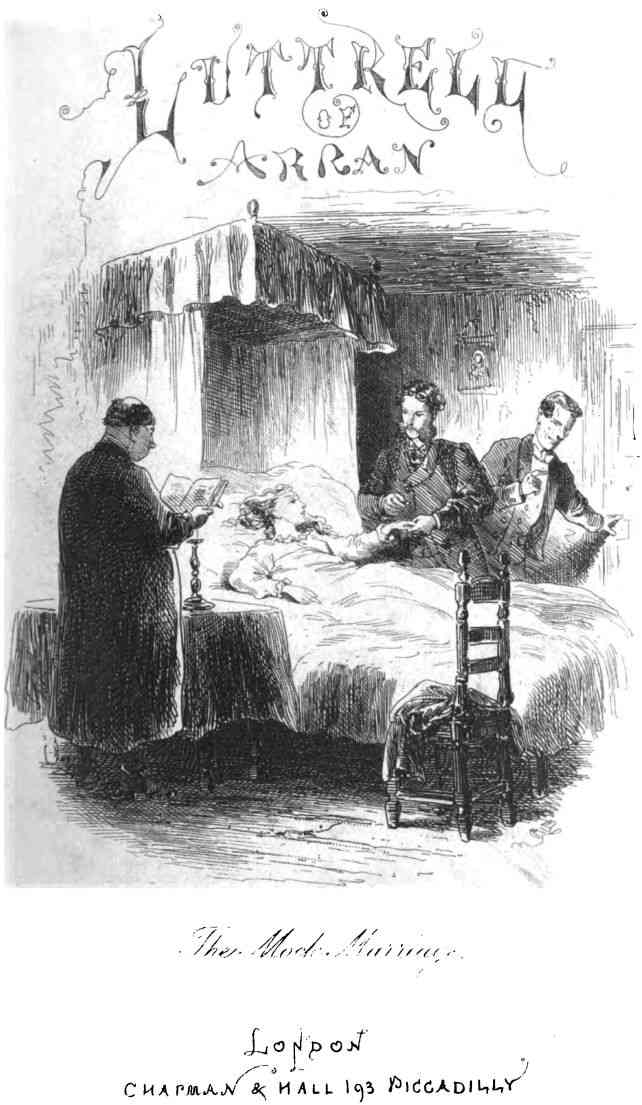
CHAPTER VIII. AN OLD BACHELOR’S HOUSE
It is quite true Georgina forgot all about Mr. M’Kinlay. The gardener had met her on her way, and presented her with a bouquet of Japanese roses—the real purple roses it was supposed never could be reared out of a Tycoon’s garden; and so she hastened up to her sister’s room, as totally oblivious of the man of law as though he had been hundreds of miles away. They talked pleasantly of flowers—flowers for the china vase, and flowers for the hair—they laughed at the incongruous blunders of the people who wore “wrong colours,” and that “drab bonnet” they had seen last Sunday in church. They next discussed dress, and the impossibility of wearing anything “decent” on the dusty roads; and, lastly, they ordered the ponies and the phaeton, and drove out.
How charmingly pleasant are these lives of little cares and of little duties: where conscience has no burden that would be too weighty for the strength of childhood—where no torturing anxieties invade, no tormenting ambitions pursue—where the morning’s stroll through the garden is the very type of existence, a ramble amidst fragrance, and fruit, and flowers, with no other call upon exertion than to enjoy! And what a teachable faculty is that same one of enjoyment. How it develops itself under good training and favourable opportunities.
These sisters had a very pleasant life, and they knew it; that is, they no more overlooked the stones in their path than their neighbours; but they thoroughly understood that Fate had accorded them a very smooth road, and one right easy to travel. They chatted gaily as they drove along the side of a brightly eddying river, through a glen of some miles in extent. The day was one of those mellow ones of August, tempered with a slight breeze, that gently moved the cloud-shadows on the mountains, adding at each change some new effect of light and colour. “Let us go and call on Sir Within,” said Lady Vyner; “it would be a glorious day to see the old castle, and the mountain behind it.” Her sister agreed at once; for though the drive was full eight miles, the road was beautiful all the way, and at its end was a grand old keep, Dalradern Castle, with a charming old bachelor for its owner, than whom none better understood how to do the honours of his house. While the sisters push their smart ponies to a brisk trot, we shall take the opportunity to say a word of Sir Within Wardle. He was the last of a great Welsh family of large fortune and ancient name, but who had lived all his life away from England. He had been in diplomacy since his boyhood; he had joined an embassy in the Low Countries at the age of sixteen, and lived long enough to see the whole map of Europe new coloured.
It had been the dream of his existence to “come home”—to return to the temperate climate and genial air of England—to get back where the trees were really trees, and where grass was veritably green, and where people told the truth, and tradesmen were honest. Well, he did get back, but it was not to find everything as he had pictured it. The temperate climate rained a good deal. The genial air had a marked tendency to give bronchitis. The grass was unquestionably green, but so were they who walked in it, for wet feet were invariable. As to truthfulness in his own class, he had nothing to complain of; but he thought servants were pretty much as elsewhere, and as to his tradespeople, there was little to choose between Fleet-street and the “Graben,” and Piccadilly was not a whit above the Rue de la Paix!
In fact, there were many things as he had hoped, and not a few that disappointed him. People, generally, were what he deemed more narrow-minded; they sat more in judgment over their neighbours than he liked; they were more inquisitive and less charitable. In his world, where he had passed fifty odd years, the charming people were admitted to be charming, though certain delinquencies chargeable to them might have disparaged their claims to character. It was not held to the disadvantage of Beauty that discretion should not have united itself to loveliness, and Wit was just as highly appreciated as though its possessor had not been more than lucky with the dice-box. Sir Within, be it remarked, wanted none of these immunities on his own behalf. He had never been what is called a man of gallantry, never gambled. His great passion was a splendid house and grand receptions. He liked great people, crowned heads, and after them coroneted ones. He revered Grand-Dukes and Serene Highnesses; and it was not by any means improbable that in his homage to the great lay the secret of that tolerance on the score of morals that marked him; for, be it said with respect, Kings and Kaisers have a habit of showing the world that they soar in a sphere above common proprieties, and can afford to do in ethics what they can do with the Bourse—go in for a rise or fall, as the whim seizes them.
To “come back” with tastes like these was a mistake, but to attempt to justify them was infinitely worse. Sir Within began to lecture his country neighbours on their hard-heartedness and ungenerosity. He enumerated scores of people who had taken little scampers into vice, and come back to live more gorgeously on virtue. What anecdotes he had of ministers who had cheated at cards! Great men, excellent men in all other respects, unimpeachable in all their public acts, and pillars of the State they pertained to.. He told of a society whose very laxity saved all friction, and which went on smoothly—for it always went downwards. The consequence may be anticipated. His neighbours—at least their wives—voted him an old monster of vice, corrupted by half a century of foreign iniquities. They refused his invitations, and neglected his advances. His presents of fruit—such fruit too!—were declined, and his society strictly avoided.
The Vyners, who only came to the neighbourhood for a few weeks in the year, scarcely knew anything of local feelings, and only heard that he never went out, and saw little company at home—facts which, when they came to be acquainted with him, struck them as strange, for he was eminently one made for society, and seemed to feel the raciest enjoyment in it. He had all that peculiar go and eagerness in him which pertains to men who talk well, and feel that they have this power.
Perhaps my reader may have met such a character—not that they exist as a class—but if he has done so, he will acknowledge that it is a very charming form of selfishness, and gifted with marvellous powers of pleasing. At all events, Lady Vyner and her sister delighted in him—most ungrateful had they been if they had not—for never was courtesy more polished, never homage more devoted or more respectful. Royalty could not have been received by him with a greater deference, and now, as they drove up to the massive entrance of the castle, and the sharp clatter of the ponies’ feet awoke the echoes of the solemn court-yard, Sir Within was promptly at his post to help them to descend; and as the wind blew his long white hair backwards, he stooped to kiss their hands with all the reverence of a courtier.
“Do you know, dear ladies,” said he, “that I had a vision of this visit? It was revealed to me—I cannot say how—that you would come over here to-day, and I told Bernais to prepare the orangery; for,” said I, “Bernais, I will offer ces dames no luncheon, but will insist on their taking an early dinner.”
“What a tempting proposal!” said Lady Vyner, looking at Georgina, whose fiat was always needed to every project.
“I vote for being tempted,” said Georgina, gaily; “but what do I see there—something new?”
“No, something old, but restored. Don’t you remember the last day you were here saying that the silence of this old court wanted the pleasant plash of a fountain? and so I got these disabled nymphs and hamadryads remounted, and set them to blow their conchs and spout the cataracts as of yore.”
“How beautiful it all is!”
“Curious enough, the figures are really good. Some worthy ancestor of mine had purchased this group at Urbino from some ruined Italian mansion; and, as a work of art, it is almost equal to a Luca della Robb. The mistake is the era. It is not suited to this old dungeon. Here we are in the tenth century, and this group is cinque cento. Let me send it to the cottage. It would be perfect in your garden.”
“Not for worlds. I couldn’t think of it!”
“Don’t think of it, but say ‘Yes.’ Remember, that in villa ornamentation nothing comes amiss; there are no incongruities.”
“It is impossible, Sir Within—quite impossible.”
“Don’t imagine we have come here as brigands,” said Miss Courtenay, smiling.
“When you carry away my heart, what matters what is left me?” said he, sighing.
Miss Courtenay looked down—it was a bashful look, but not a displeased one—and, somehow, more conscious than the compliment of so old a gentleman might seem to warrant.
“And so Sir Gervais likes Ireland?” said he, as he introduced them into the drawing-room.
“So much so, that I fear he has made a purchase of some property there.”
“That is only a mistake when one feels that he must live on the spot he owns. Some witty Frenchman says: ‘I used to fancy that I owned my furniture, but I found that it owned me. I was the bondsman of an old arm-chair, and the actual slave of a chest of drawers!’ You laugh, ladies, but just see whether this old house or I be the master here.”
“Well, it’s not a very severe bondage after all,” said Georgina, smiling.
“How pleasantly one discusses another’s captivity! By the way, when are you all to come and pay me this long-promised visit? Remember, the longer you defer payment, the larger grows the debt; your week is now a month.”
“When Sir Gervais comes home, we shall be delighted.”
“Why not be here when he arrives? How much pleasanter he’d find the house where your presence had imparted that charm that comes of female influence. You cannot guess how this old room, that I thought so dreary a while ago, looks positively beautiful now. Yes, Bernais, bring it in.” This was said to the servant, who, after appearing at the door, made a hasty retreat. “It is the menu of our dinner, ladies, and my cook, M. Piquard, wishes to acquit himself with distinction. See, here is a query. ‘Is the pheasant to be “aux huitres,” or aux pointes d’asperges?’ Decide.”
“I should say with the asparagus,” said Miss Courtenay.
“And your judgment is correct; the other is a mere compromise to a supposed English taste. A summer day’s dinner is to the full banquet of mid-winter what a light ‘aquarelle’ is to an oil picture. You want grace, delicacy; you require elegance, transparency, softness; not depth, nor force, nor strong effect.”
“What Sybarites you must deem us!” said Lady Vyner, laughing.
“I am repeating for you to-day a little dinner I once gave the Duchesse de Sagance. She was much admired at the time by the Archduke Charles of Austria; but forgive me if I am talking of forbidden themes.”
“Oh, go on, Sir Within! We must implicitly bow to your discretion.”
“Ah, if you do that, I am ruined. You silence me at once!”
“You surely wouldn’t have us say, ‘Be indiscreet?’”
“No; but I’d have you say, ‘Talk to us as if we were all at Vienna, at Milan, or at Naples.’”
“Neither my sister nor myself ‘pose’ for prudery, Sir Within; but the world says that you are—what shall I call it?—too—too—do help me to the word.”
“How can I, when it is to my own blame? Who ever called on a prisoner to fill up his own indictment?”
“What the world means is, perhaps,” broke in Georgina, “that Sir Within occasionally forgets his geography, and fancies at the foot of Snowdon that he is close to Vesuvius.”
“I apprehend you,” said he, smiling; “but confess, that dress is not more a question of climate than conversation; both one and the other are lighter in the south of Europe, and what is of more moment, with perfect safety, too; mark that, Mesdames, with perfect safety.”
“It may be all very well for you, who are acclimatised, to say so,” said Lady Vyner; “but bear in mind that we only passed one winter at Rome.”
“And did you not like it? What a furious cataract of all manner of sensations is a first winter at Rome! Grandeur and littleness, Sublimity and absurdity—the splendid St. Peter’s and the slipshod priesthood—and, more ridiculous than all, our cockney population wandering over the Coliseum and Quirinal, not fully certain that they are getting the real article for their money, or whether Nero and Tiberius are not dear at the price paid for them. I often wish it were right for an ex-Envoy to give his note-book, or some extracts from it, to the world. Impressions of the B. S.—the British Subject, I mean—by a late Foreign Minister.”
“Very amusing, doubtless; but very spiteful,” said Miss Courtenay.
“Here comes Bernais to announce dinner, and rescue you from my tartness;” and, giving an arm to each of the ladies, he led them forward.
Valued reader, is it amongst the number of your experiences to have “assisted” at a dinner—usually a Russian one—where, without having found anything pre-eminently good to eat, you are given to understand that all cost fabulous sums—that the fricassee you scarcely tasted was brought from the frontier of China, and the fish, that seemed flavourless, came by estafette from the Caspian? Such, in a certain way, was Sir Within’s conversation; it sparkled with great people—Kings glittered, and Queens bespangled it; it was evidently a dear article to have acquired, but, beyond that, it possessed little value. Yet, “for all that, and all that,” his guests liked it. To be sure, it was admirably aided; his “little dinner,” as he modestly styled it, was a banquet, not in ponderous detail or duration, but in the perfect selection and the exquisite delicacy of all that composed it.
And did he not relish the success he achieved—the double success of his cook and of himself! If there be a time when egotism is less odious than at others, it is when a host expatiates on the pains he has taken to feed you. The little selfish vaingloriousness of the moment is so readily pardoned, while the truffle is on your fork, or the ruby claret half way to your lips.
It was towards the close of the dinner that Sir Within, adroitly turning the topic from the meats to the guests, was discussing, with some knowledge of the subject, the people who made the pleasantest dinner company, and showing how an accomplished host makes the light talkers do duty at the first course, using them as mere skirmishers, who are to fall back and be ignored as the great engagement comes on. “I flatter myself,” said he, “that I can manage most classes of men, though I own there is one that totally defies me—that is to say, he is so obstinately self-willed, and so professionally trained to persistence, that he deems it a triumph. I mean your lawyer!”
“Oh, Laura! what have I done!” exclaimed Georgina, laying her hand on her sister’s arm, and staring half wildly at her.
“What is it? What is the matter?”
“Was there ever such a blunder—how shall we get over it?”
“What is it, then? tell it!” cried Lady Vyner, eagerly.
“I forgot all about him—utterly—completely forgot!”
“About whom?”
“Mr. M’Kinlay, the lawyer. He arrived this morning, came to the cottage very early, saying he was on his way to Ireland to meet Gervais, and only ran over from Crewe to see us; I left him to tell you that he was there. I had it in my head when I quitted the room, but what drove it out again, or what occurred to make me forget it, I cannot now imagine.”
In spite of all the annoyance of the incident, Lady Vyner laughed immoderately, and so did Sir Within, and so, at last, did Miss Courtenay, and the mirth was kept up by all sorts of fanciful conceits as to what the lawyer must have thought, said, or done.
“He has driven away in a towering passion; he’s hot-tempered at times, I know,” said Lady Vyner.
“No, no! you’ll find him very comfortably installed when you get back,” said Sir Within. “He’ll be vexed, he’ll be angry, doubtless; but as a minister plenipotentiary vents his ill-temper in a despatch, your man of law consigns all his indignation, more practically, to his bill of costs. What an avalanche of six-and-eightpences will fall on your forgetfulness.”
“We must hasten to repair the disaster. Sir Within, would you oblige me by ordering our ponies. I know you’ll forgive our abrupt leave-taking.”
“I shall never forgive the cause of it. Why not let me send a messenger over to ask him, saying I had insisted on detaining you?”
“Oh, on no account! Besides, he’s a touchy person, and my husband is most tenacious regarding him. I must hasten back and make my explanations in person.”
“I don’t know how I am to face him at all!” cried Georgina.
“I’d certainly not try,” said Sir Within.
Vague as the mere words were, they were uttered with a significance that plainly said, “You might stay where you are;” and Miss Courtenay evidently so read them, for her cheek reddened as she turned away.
Lady Vyner, however, went on: “I don’t think we shall have any difficulty about it—at least, I hope not—though what I’m to say, and how to say it, I cannot imagine.”
“Throw me into the breach,” said Sir Within; “say that, hearing of his arrival, I begged a visit from you—that I wanted some legal advice—I required a draft of—what shall I say?—I can scarcely be going to be married. Let it be a will, then.”
“Oh no, not a will, Sir Within!” said Georgina, with a very soft smile.
“It shall be whatever you decide for it,” said he, assisting her with her shawl as he spoke.
“Do you ever mean to come over to breakfast with us?” asked Lady Vyner. “The promise has been made and renewed, I think, a dozen times.”
“May I say next Sunday, then?”
“And you’ll promise to come to church with us afterwards?” cried Lady Vyner.
He muttered something with a smile to Miss Courtenay, and she turned away abruptly, but ere she drew down her veil her face betokened the reverse of displeasure.
Though, as they drove homeward, the unpleasant explanation that lay before them engaged much of their thoughts, taxing all their address how to encounter its difficulty, yet, from time to time, Georgina would return to talk of the house they had just quitted, and the host.
“It is easy enough to see why our straitlaced neighbours do not take to him,” said she; “he is too much a man of the world—too tolerant and forgiving for their notions.”
“A little too lax, also, for the proprieties of English life,” added Lady Vyner.
“For its hypocrisies, if you like, Laura. I’m certain people are pretty much the same everywhere, though the way they talk about themselves may be very different.”
“I suspect he has made a conquest, Georgy,” said her sister, laughing; “or rather, that his magnificent old castle, and his Vandykes, and his pineries, and his conservatory have——”
“No! that I protest against. His ‘accessories,’ as the French would call them, are undeniable. It is a house absolutely princely in all its details; but I think he himself is the gem of the collection. He is so courteous and so pleasant, so anecdotic, and so full of all manner of apropos, and then so utterly unlike every one else that one knows.”
“I suppose there lies his chief attraction. We have to measure him with people all whose thoughts and ideas are so essentially homely, and who must of necessity be eternally talking of themselves—that is, of their own turnpike, their own turnips, and their own cock pheasants.”
“Is it not strange that he never married?” said Georgina, after a silence.
“I don’t think so. He’s not a man that would be likely to marry, and very far from being one that a woman would like to take as a husband.”
“Do you think so—do you really think so?”
“I’m certain of it. All those charming little schemes for our entertainment that captivated us a while ago, show a degree of care and attention bestowed on little things which would make life a perfect servitude. Cannot you imagine him spending his mornings giving audience to his cook, and listening to the report of his gardener? I fancy I see him in the midst of a levee of domestics, gravely listening to the narrative of the last twenty-four hours of his household.”
“So far from that,” said Georgina, warmly, “he told me Bernais did everything—engaged and discharged servants, changed furniture, rearranged rooms, and, in fact, managed little daily ‘surprises’ for him, that, as he said, compensated for much of the solitude in which he lived.”
“But why does he live in solitude? Why not go back to the life and the places that habit has endeared to him?”
“He told me to-day that he intended to do so; that he is only waiting for the visit of a certain relative, Mr. Ladarelle; after which he means to set out for Italy.”
“Ladarelle is the great banker, and, if I mistake not, his heir.” “Yes. Sir Within says that they scarcely know each other, and have all that dislike and distrust that usually separate the man in possession and the man in expectancy.”
“One can fancy how distasteful his heir must be to a man like Sir Within Wardle,” said Lady Vyner.
“To any man, sister,” broke in Georgina—“to any man who only knows the person as the inheritor of his fortune. I declare I think Sir Within spoke of the Ladarelles with much forbearance, aware, as he is, that they are coming down here to see in what state of repair the castle is, and whether the oaks are being thinned more actively than a mere regard for their welfare would exact.”
“Did Sir Within say that?” asked Lady Vyner, with a laugh. “No; but I guessed it!” “Well, he supplied the text for your theory?” “In a measure, perhaps. It was when you went with Groves to look at the large cactus he told me this, and mentioned that, by a singular provision, though the estate is strictly entailed, he could charge the property to any extent with jointure if he married; and perhaps, said he, my worthy relatives are anxious to satisfy themselves that this event has not, nor is very likely to occur.”
“Not now, certainly?” said Lady Vyner, with a saucy laugh. “I don’t know. There are many women well to do, and well off, would marry him.”
“That is to say, there are a considerable number of women who would sacrifice much for money.”
Miss Courtenay was silent; when she next spoke, it was about the evening—the air was growing fresh, and the twilight deepening. “I wonder in what mood we are to find Mr. M’Kinlay—if we are to find him at all.”
“I own it would be very awkward; but I am such a coward about meeting him, that I half wish he had gone away, and that we were left to make our lame excuses in a letter.”
“I have to confess that the matter sits very lightly on my conscience,” said Georgina, “though I am the real delinquent. I don’t like him, and I shall not be very unhappy if he knows it.”
“Possibly enough, but such a breach of all politeness——”
“My dear Laura, he has met this incident, or something very like it, a hundred times. Earls and Viscounts have made appointments with him and forgotten him; he has been left standing on that terrace, or pacing moodily up that street, for hours long, and, as Sir Within said very smartly, consoled by the item that would record it in the bill of costs.”
“Yes, I remember the remark; it struck me as the only bit of vulgarity about him.”
“Vulgarity! Sir Within Wardle vulgar!”
“Well, I have no other word for it, Georgy. It was the observation that might readily have come from any ordinary and common-place person, and sounded unsuitably from the lips of a very polished gentleman.”
“Poor Sir Within! if in a gloomy moment you may be wondering to yourself what harsh or envious things your wealth, your splendour, and your taste may have provoked from us, I am certain that you never imagined that the imputation of being vulgar was one of them!”
Fortunately there was no time to continue a theme so threatening to be unpleasant, for already they were at the gate lodge, and a loud summons with the bell had announced their arrival.
CHAPTER IX. MR. M’KINLAY’S TRIALS
Mr. M’Kinlay was awakened from a pleasant nap oyer the “Man of Feeling,” which he had persuaded himself he was reading with all the enjoyment it had once afforded him, by the French clock oyer the mantelpiece performing a lively waltz, and then striking five!
He started, rubbed his eyes, and looked about him, not very certain for some minutes where he was. The hum of the bees, the oppressive perfume of the sweetbriar and the jessamine, and the gentle drip-drip of a little trickling rivulet over some rock-work, seemed still to steep his senses in a pleasant dreamy languor, and a sort of terror seized him that the ladies might possibly have come in, and found him there asleep. He rang the bell and summoned Rickards at once.
“Where are the ladies?” asked he, eagerly.
“Not come back yet, Sir. It’s very seldom they stay out so long. I can make nothing of it.”
“You told her Ladyship I was here, didn’t you?”
“I told Miss Georgina, Sir, and of course she told my Lady.”
“What’s your dinner-hour?”
“Always early, Sir, when Sir Gervais is from home. My Lady likes four, or half-past.”
“And it’s five now!”
“Yes, Sir; a quarter-past five. It’s the strangest thing I ever knew,” said he, going to the window, which commanded a view of the road at several of its windings through the valley. “We have an excellent lake trout for dinner; but by good luck it’s to be grilled, not boiled, or it would be ruined utterly.”
“Capital things, those red trout,” said M’Kinlay, to whom, like most of his craft and way of life, the pleasures of the table offered great temptations. “Is your cook a good one, Rickards?”
“Only a woman, Sir; but by no means bad. Sir Gervais always takes M. Honoré with him on board the yacht; but you’ll see, Sir, that she knows how to roast, and we have a sweet saddle of Welsh mutton to-day, if it’s not over-done.”
“That’s what I’m afraid of, Rickards,” said the lawyer; and if a sigh ever denoted sorrow, his did as he spoke. “Is the mutton small?”
“Very small, Sir. Mountain mutton.”
“And of course it will be done to rags! She serves it with currant-jelly, I snppose?”
“No, Sir, with guava. Sir Gervais prefers it.”
“And what else was there on your bill of fare for to-day?”
“A very simple dinner, Sir. Partridges on toast, a salad of white truffles, and a roast hare.”
“Quite enough, quite enough. Do you bring your wine down with you!”
“Only the Madeira, Sir. Sir Gervais gets some claret oyer from an Irish house called Sneyd’s, which he calls very drinkable.”
“So do I, too; very drinkable, indeed; and your Madeira, you say, you bring with you. I say, Rickards, I think a glass of it and a biscuit wouldn’t be amiss, if I’m to wait much longer.”
“I was just thinking the same, Sir; and if you’ll step into the dining-room and take a morsel of game-pie, I’ll fetch the Madeira out of the sun. It’s fine and mellow by this time.”
“Is this your woman cook’s performance?” said Mr. M’Kinky, as he helped himself for the second time to the pie.
“Yes, Sir; and she’d do better, too, if it wasn’t that the ladies don’t like so much jelly. Here’s a fine whole truffle, Sir!”
“She’s a valuable woman—a very valuable woman. Tell her, Rickards, that I drank her health in a bumper. Yes, up to the brim with it. She shall have all the honours.”
“Something sweet, Sir? A little cherry tart?”
“Well, a little cherry tart I’ ll not object to. No, no, Rickards, don’t open champagne for me.”
“It’s in the ice, Sir, and quite ready.”
“Let it stay there. I’m very simple about both eating and drinking. I’d not have made a bad hermit, if I hadn’t been a lawyer.”
“No, indeed, Sir! I never saw a gentleman so easily pleased. You’re not like Mr. Grenfell, Sir, that has the bill of fare brought up every morning to his dressing-room; ay, and M. Honoré himself, too, summoned, just as if it was before a magistrate, to explain what’s the meaning of this, and why he doesn’t do the other.”
“Your master permits this?”
“He likes it, Sir; he laughs heartily at it.”
“And the ladies, do they like it?”
“Oh, Mr. Grenfell only comes over to Beau Park when the ladies is away, Sir, up in town, or at the sea-side.”
“He’s no favourite of theirs, then?”
“I don’t believe they ever saw him, Sir. At all events, he was never down with us when we were all at home.”
“I suspect I know why,” said M’Kinlay, knowingly.
“Yes, Sir,” replied Rickards, as knowingly, while he took up a jar of pickled onions from the sideboard, and held it ostentatiously forward.
“You’re right, Rickards, you’ve hit it correctly. One glass more of that admirable wine. What’s that great ringing at the gate? Is that your mistress?”
“No, Sir. The lodge people have orders never to keep her waiting; they always have a look-out when she’s coming. There it is again. If you’ll excuse me a moment, Sir, I’d better step out and see what it means!”
The permission was graciously accorded, and Mr. M’Kinlay emptied the last of the Madeira into his glass, discussing with himself whether the world had anything really more enjoyable to offer than a simple cottage life, with a good cook, and a capital cellar! Little heed did he give to the absence of Rickards, nor was he in the least aware that the bland butler had been above a quarter of an hour away, when he entered flushed and excited.
“It’s the same as a burglary, Sir, there’s no difference; and it’s by good luck you are here to declare the law of it!”
“What’s the matter—what has happened, Rickards?”
“They’re in the drawing-room, Sir; they walked in by the open windows; there was no keeping them out.”
“Who are in the drawing-room?”
“The tourists, Sir,” exclaimed Rickards. “The tourists! The people that would force their way into Windsor Castle and go through it, if the King was at his dinner there!”
Strong in a high purpose, and bold with the stout courage of that glorious Madeira, Mr. M’Kinlay arose. “This is an unparalleled outrage,” cried he; “follow me, Rickards;” and he took his way to the drawing-room. Though the noise and tumult bespoke the presence of several people, there were not above half a dozen in the room. One, however, a pale, sickly-looking young man, with long hair, which required everlasting tossing of his head to keep out of his eyes, sat at the piano, playing the most vigorous chords, while over his shoulder leaned a blue-eyed, fair, ringletted lady, whose years—past the forties—rather damaged the evident determination she evinced to be youthful and volatile.
“Do, Manny, do dearest, there’s a love,” said she, with the faintest imaginable lisp, “do compothe something. A Fanthasia, on visiting Dinaslryn. A dhream——”
“Pray be quiet, Celestina!” said he, with a wave of his hand. “You derange me!”
“Have they got a ‘catalog’ of the gimcracks?” exclaimed a nasal voice that there was no mistaking. “I a’n’t posted in brass idols and boxwood saints, but I’d like to have ‘em booked and ticketed.”
“Are you aware, gentlemen and ladies,” said Mr. M’Kinlay, with a voice meant to awaken the very dullest sense of decorum—“are you aware that you are in the house of a private gentleman, without any permission or sanction on his part?”
“Oh, don’t, don’t disturb him, Sir,” broke in the ringletted lady. “You’ll never forgive yourself if you spoil it;” and she pointed to the artist, who had now let all his hair fall forward, after the fashion of a Skye terrier, and sat with his head drooped over the piano, and his hands suspended above the keys.
“Say what for the whole bilen,” cried the Yankee. “It ain’t much of a show; but I’ll take it over to New York, and charge only twenty-five cents for the reserved seats!”
“I repeat, Sir,” exclaimed M’Kinlay, “your presence here, and that of all your companions, is a most unreasonable intrusion—a breach of all propriety—one of those violations of decency, which, however practised, popular, and approved of in a certain country, neither distinguished for the civilisation of its inhabitants, nor for their sense of refinement——”
“Is it Ireland you mane, Sir—is it Ireland?” said a short, carbuncled-nosed little man, with a pair of fiery red eyes. “Say the word if it is.”
“It is not Ireland, Sir. I respect the Irish. I esteem them.”
“Could you get them to be quiet, Celestina?” said the artist, faintly; “could you persuade the creatures to be still?”
“Hush, hush!” said she, motioning with both her hands.
A tremendous crash now resounded through the room. It was Mr. Herodotus M. Dodge, who, in experimenting with his umbrella on a Sèvres jar, to detect if it were cracked, had smashed it to atoms, covering the whole floor with the fragments.
“Send for the police! Tell the porter to lock the gate, and fetch the police!” shouted M’Kinlay. “I trust to show you, Sir, that you’re not in Fifteenth-street, or Forty-sixth Avenue. I hope to prove to you that you’re in a land of law and order.”
Overcome by his rage, he followed Rickards out of the room, declaring that he’d make all England ring with the narrative of this outrage.
The legal mind, overbalanced for an instant, suddenly recovered its equanimity, and he began to reflect how far he was justified in a forcible detention. Would “a claim lie” for false imprisonment? Were he to detain them, too, what should be his charge? Was it a trespass? Had they been warned off? “Wait a moment, Rickards,” said he; “I must think a minute or two. There’s a difficulty here. Where a person, passing in the street, smashes accidentally—it must be accidentally—a pane of plate-glass, of the value of, let us say five-and-twenty or thirty guineas, the law only holds him responsible for the damage of an ordinary window-pane; so that here it will be quite open to the defence to show that this man imagined he was breaking a common jug, a mere earthenware pipkin. It is, then, to the trespass we must look. Call the lodge-keeper; say I wish to have a word with him.”
While Rickards hastened on his errand, Mr. M’Kinlay sat down to ponder carefully over the case. Your men conversant with great causes in equity and weighty trials at bar, are nervously fearful of meddling with the small cases which come before petty tribunals. They really know little about them, and are almost certain to fail in them; and they feel—very naturally—ashamed at the sorry figure they must exhibit in such failures.
“They’re all gone, Sir—they’ve made a regular retreat of it—not one left.”
“Who—who are gone?”
“Them tourists, Sir. They overtook me as I went down the avenue, and made George open the gate; and away they are, the whole of ‘em.”
“I’m not sorry for it, Rickards. I declare I’m not sorry. It would cost more time and more trouble to follow them up than they’re worth; and I am certain, besides, Sir Gervais wouldn’t have the affair in the newspapers for ten times the amount of all the damage they’ve done him. What’s that noise without—who’s coming now?”
“My Lady!” exclaimed Rickards, and hastened out to receive her. Mr. M’Kinlay could notice that a short dialogue took place between the ladies and the butler before they entered the door, and that they both laughed at something he was telling them. Was the story that amused them of him, or of the invasion? He had not time to consider, when they entered.
“How d’ye do, Mr. M’Kinlay?” said Lady Vyner, quietly. “We’ve kept you very long waiting, I fear. You may serve dinner at once, Rickards. Mr. M’Kinlay will excuse our dining in morning dress, Georgina.”
“I should hope so,” said her sister, with a very saucy toss of the head.
“Your Ladyship will excuse my not remaining to dinner,” said he, with a marked coldness. “I only wanted to see you, and ask if you had any commissions for Sir Gervais.”
“No, there’s nothing, I fancy. I wrote yesterday—I think it was yesterday.”
“Tell him not to meddle with Irish property, and come away from that country as soon as he can,” said Georgina.
“Say the garden is looking beautiful since the rain,” said Lady Vyner, rising. “Good-by, and a pleasant journey!”
“Good-by!” said Georgina, giving him the tips of her fingers.
And Mr. M’Kinlay bowed and took his leave, carrying away as he went very different thoughts of cottage life and its enjoyments from those he might have felt had he gone when he had finished the last glass of Madeira.
CHAPTER X. THE SHEBEEN
Just as we see on the confines of some vast savage territory one solitary settlement that seems to say, “Here civilisation ends, beyond this the tracts of cultivated man are unknown,” so there stood on the borders of a solitary lake in Donegal—Lough Anare—a small thatched house, over whose door an inscription announced “Entertainment for Man and Beast,” the more pretentious letters of the latter seeming to indicate that the accommodation for Beast was far more likely to prove a success than that intended for mere humanity.
What imaginable spirit of enterprise could have induced Mr. O’Rorke to have established an inn in such a region is not easy to guess. To the north of Lough Anare lay a vast untravelled, almost roadless district. Great mountains and deep valleys, wild plains of heather, enclosing lakes, with islands, sometimes mere rocks, sometimes covered with an oak scrub—last remnants of primeval forests—succeeded each other apparently without end. A miserable shealing, usually padlocked on the outside, was all that betokened habitation, and a living being was rarely met with. It is true there was scenery which for grandeur and beauty might have vied with the most vaunted spots on the island. Mountain gorges far finer than Dunluce, lakes more varied in shape, and with margins bolder in outline and richer in colour than Killarney, and coast-line with which the boasted Glengariff could not for a moment compete, all destined to remain as unknown as if they lay thousands of miles away in some Indian sea.
A great proportion of this territory was the property of the University of Dublin—endowment made in the time of Queen Elizabeth, when probably all lands without the pale had about the same value; some of it pertained to a wealthy English noble, who, until the accident of a governmental survey, had never so much as cared to ascertain his limits, and who made the first use of his knowledge by announcing for sale the lands of Mac-na-Morroch, Knochlifty, Eilmacooran, and Denyvaragh; in all, nigh fifty thousand acres of mountain, bog, callow, and lake, whose great capabilities, whether for sheep-farming, fishing, for the quarries of marble, or the immense mineral resources, were vouched for by a roll of scientific names, whose very titular letters enforced conviction. If the pen of an imaginative writer might have been employed in depicting the stores of wealth and fortune that lay here entombed, no fancy could have exaggerated the natural loveliness of the landscape. All that was wild and grotesque in outline, with all that was most glowing in colour, were there; and when on the nameless lakes the setting sun added his glory to the golden purple of their reflected lights, the scene became one of such gorgeous splendour as Art would not have dared to imitate.
The little inn we have just mentioned stood on a rocky eminence which projected from the mountain-side, and could be seen for miles off, more conspicuous, besides, by a large green flag, with a harp in the centre, which by the patriotism of Mr. O’Rorke flaunted its folds to the wild mountain breezes, as though enjoying in the solitude an immunity which the Saxon might have resented elsewhere. Tim O’Rorke was indeed one who had “suffered for Ireland.” Four several times had he figured in Crown Prosecutions, and both fine and imprisonment had been his portion. On the last occasion, however, either that national enthusiasm was cooling down, or that suspicions of Tim’s honesty were getting abroad, the subscription for his defence was almost a failure. No imposing names headed the list, and the sums inscribed were mean and contemptible. Unable to fee the great bar, to retain which, perhaps, formed the grandest triumph of his life, O’Rorke decided to defend himself, and in the course of his defence launched forth into a severe and insulting castigation of his party, who, after using up his youth and manhood in their cause, left him, when old and broken and dispirited, to the merciless cruelty of his enemies. He read aloud in open court the names of the powerful and wealthy men who at first stood by him, and then, with a shameless insolence, contrasted them with the ignoble friends who remained to him. He recited the proud sums once contributed, and, amidst the laughter of the court, ridiculed the beggarly half-crowns that now represented Irish patriotism. The verdict was against him, and once more was he sent back to Kilmainham, to serve out a two years’ sentence, this time unalienated by the sympathy of any friends, or the kind wishes of any partisans. His sentence completed, he made two to three efforts to reinstate himself in public esteem; he established an eating-house called “The Rebel’s Home,” he instituted an evening paper entitled the Pike, he invented a coat-button marked ‘98, but somehow friends and enemies had become wearied of him. It was seen that he was one of those who neither have the power of good nor evil, that he could be of no use to his own, no injury to others, and the world dropped him—dropped him as it does its poor and disreputable relatives, taking no heed of his gaunt looks nor his tattered raiment, and by its tacit indifference showed that the mass of mankind can behave on certain occasions pretty much as would an individual man. Tim threatened, stormed, and reviled; he vowed vengeance and menaced disclosures; he swore that his revelations would impeach some of the highest in the land, and he intimated that up to a certain day he was yet appeasable. Threats, however, were not more successful than entreaties, and Tim, gathering together a few pounds, under the plea of departure for Australia, quitted the scene he had so long troubled, and was heard of no more.
For years he had continued to exist in some fashion or other—poaching the chief source—in the wild spot we have just described; and it was on the rock in front of his door, with a short pipe in his mouth, that he now lay stretched, on a fine autumn morning, lazily gazing down the valley, where at a great distance off he could detect a small speck upon the road, intimating that rarest of all events, the approach of a jaunting-car. He threw his glance upwards to see that his flag disported its folds to the air, and to the sign over his door—“The Vinegar Hill, by T. O’Rorke, Entertainment for Man and Beast”—to be sure that all was in order, and he then smoked quietly on and watched the road.
By a landslip which had occurred several years before, and whose effects had never been remedied, the road was blocked up about a mile from the little inn, and travellers desirous of its accommodation were obliged to continue their journey on foot. Whether from the apathy of hope deferred, or calculating on the delay that must thus intervene, Mr. O’Rorke saw two persons descend from the car, and, each taking his carpet-bag, set out to walk, without the slightest movement on his part to provide for their reception; and this, though he was himself cook, waiter, and housemaid—all that the inn possessed of master or attendant.
Mr. O’Rorke’s experience of travellers included but two categories, each of them rare enough in their visitations. They either came to shoot grouse or convert the natives. All who were not sportsmen were missionaries. A certain amount of peril attended both pursuits. The people were a wild, semi-civilised set, who saw with jealousy a stranger amongst them, and certain hints, palpable enough not to be mistaken, intimated to the lovers of sport, as well as the distributers of tracts, that their pursuits were dangerous ones; and thus, in time, the numbers decreased year by year, till at last the advent of a traveller was a rare event.
The two who now ascended the rocky pathway had neither guns nor fishing-tackle—as little had they of missionaries in their aspect—and he watched them with a lazy curiosity as they approached.
“Are you Mr. O’Rorke?” cried the first who came forward, who was our acquaintance Sir Gervais Vyner.
“Yes, my name is O’Rorke.”
“And the owner of this inn, I take it?” asked Grenfell, somewhat haughtily.
“The same.”
“Is this your usual way of receiving strangers, my friend, or is your present manner an especial politeness to ourselves?”
“Can you let us have a dinner, and make up a couple of rooms?” broke in Vyner, hastily. “We should like to stop here a few days.”
“You can see the rooms, whether they’ll do for you or not; such as they are, you can have them, but I can’t make them better.”
“And for eating, what can you give us?”
“Mutton always—fish and game when there’s the season for them—and poteen to wash them down.”
“That is the illicit spirit, isn’t it?” asked Grenfell.
“Just as illicit as anything else a man makes of his own produce for his own use; just as illicit as the bread that is made of his own corn.”
“You’re a politician, I see,” said Grenfell, with a sneering laugh. “I half suspected it when I saw your green flag there.”
“If I hadn’t been one, and an honest one too, I’d not be here today,” said he, with an energy greater than he had shown before. “Have you anything to say against that flag?”
“Of course he has not. Neither he nor I ever saw it before,” said Vyner.
“Maybe you’ll be more familiar with it yet; maybe the time isn’t far off when you’ll see it waving over the towers of Dublin Castle!”
“I’m not aware that there are any towers for it to wave over,” said Grenfell, mockingly.
“I’ll tell you what there are! There are hills and mountains, that our fathers had as their own; there are plains and valleys, that supported a race braver and better than the crafty Saxons that overcame them; there are holy churches, where our faith was taught before we ever heard of Harry the Eighth and his ten wives!”
“You are giving him more than the Church did,” said Grenfell.
“I don’t care whether they were ten or ten thousand. He is your St. Peter, and you can’t deny him!”
“I wish I could deny that I don’t like this conversation,” said Vyner. “My friend and I never came here to discuss questions of politics or polemics. And now about dinner. Could you let us have it at three o’clock; it is just eleven now?”
“Yes, it will be ready by three,” said O’Rorke, gravely.
“The place is clean enough inside,” whispered Grenfell, as he came from within, “but miserably poor. The fellow seems to have expended all his spare cash in rebellious pictures and disloyal engravings.”
“He is an insupportable bore,” muttered Vyner; “but let us avoid discussion with him, and keep him at a distance.”
“I like his rabid Irishism, I own,” said Grenfell, “and I intend to post myself up, as the Yankees say, in rebellious matters before we leave this.”
“Is that Lough Anare, that sheet of water I see yonder?”
“Yes,” said O’Rorke.
“There’s a ruined tower and the remains of seven churches, I think, on an island there?”
“You’d like to draw it, perhaps?” asked O’Rorke, with a cunning curiosity in his eye.
“For the present, I’d rather have a bathe, if I could find a suitable spot.”
“Keep round to the westward there. It is all rock along that side, and deep water close to the edge. You’ll find the water cold, if you mind that.”
“I like it all the better. Of course, George, you’ll not come? You’ll lie down on the sward here, and doze or dream till I come back.”
“Too happy, if I can make sleep do duty for books or newspapers,” yawned out Grenfell.
“Do you want a book?” asked O’Rorke.
“Yes, of all things. What can you give me?”
He returned to the house, and brought out about a dozen books. There were odd volumes of the press, O’Callaghan’s “Celts and Saxons,” and the Milesian Magazine, profusely illustrated with wood-cuts of English cruelty in every imaginable shape that human ingenuity could impart to torture.
“That will show you how we were civilised, and why it takes so long to do it,” said O’Rorke, pointing to an infamous print, where a celebrated drummer named Hempenstall, a man of gigantic stature, was represented in the act of hanging another over his shoulder, the artist having given to the suffering wretch an expression of such agony as no mere words would convey.
“This fellow is intolerable,” muttered Vyner, as he turned away, and descended the rocky path. Grenfell, too, appeared to have had enough of his patriotic host, for he stretched himself out on the green sward, drawing his hat over his eyes, and giving it to be seen that he would not be disturbed.
O’Rorke now retreated to the kitchen to prepare for his guest’s entertainment, but he started with astonishment as he entered. “What, Kitty, is this you?” cried he; “when did you come?”
The question was addressed to a little girl of some ten or eleven years old, who, with her long golden hair loose on her shoulders, and her cheeks flushed with exercise, looked even handsomer than when first we saw her in the ruined Abbey at Arran, for it was the same child who had stood forward to claim the amber necklace as her right.
“My grandfather sent me home,” said she, calmly, as she threw the long locks back from her forehead, “for he had to stay a day at Murranmore, and if he’s not here to-morrow morning I’m to go on by myself.”
“And was that all you got by your grand relation, Kitty?” said he, pointing to the necklace that she still wore.
“And isn’t it enough?” answered she, proudly; “they said at the funeral that it was worth a king’s ransom.”
“Then they told you a lie, child, that’s all; it wouldn’t bring forty shillings—if it would thirty—to-morrow.”
“I don’t believe you, Tim O’Rorke,” said she, boldly; “but it’s just like you to make little of what’s another’s.”
“You have the family tongue if you haven’t their fortune,” said he, with a laugh. “Are you tired, coming so far?”
“Not a bit; I took the short cut by Lisnacare, and came down where the waterfall comes in winter, and it saved more than four miles of the road.”
“Ay, but you might have broken your neck.”
“My neck was safe enough,” said she, saucily.
“Perhaps you could trust your feet if you couldn’t your head,” said he, mockingly.
“I could trust them both, Tim O’Rorke; and maybe they’d both bring me farther and higher than yours ever did you.”
“There it is again; it runs in your blood; and there never was one of your name that hadn’t a saucy answer.”
“Then don’t provoke what you don’t like,” said she, with a quivering lip, for though quick at reply she was not the less sensitive to rebuke.
“Take a knife and scrape those carrots, and, when you’ve done, wash those radishes well.”
The girl obeyed without a word, seeming well pleased to be employed.
“Did she leave any money behind her?” asked he, after a pause.
“No, none.”
“And how did he treat you?—was he civil to you all?”
“We never saw him.”
“Not see him!—how was that? Sure he went to the wake?”
“He did not. He sent us ‘lashins’ of everything. There was pork and potatoes, and roast hens and ducks, and eggs and tea, and sugar and whisky, and cakes of every kind.”
“But why didn’t he come in amongst you to say that you were welcome, to wish you a good health, and the time of the year?”
“I don’t know.”
“And your grandfather bore that?”
She made no answer, but her face became crimson.
“I suppose it was all right; he wanted to show you that it was all over between him and you, and that when she was gone you didn’t belong to him any more.”
Two heavy tears rolled along the hot and burning cheeks of the child, but she never spoke.
“Your old grandfather’s well changed, Kitty, from what I knew him once, or he wouldn’t have borne it so quietly. And what did you get for your journey?”
“We got all her clothes—elegant fine clothes—and linen—two big boxes full, and knives and forks, and spoons and plates, that would fill two dressers as big as that. And this,” and she lifted the amber beads as she spoke, with a flashing eye—“and this besides.”
“He knew you well; he treated you just the way they treat the wild Indians in the Rocky Mountains, where they buy all that they have in the world for an old brass button or a few spangles. In his eyes you were all poor savages, and no more.”
“I wish I never set foot in your house, Tim O’Rorke,” said she, throwing down the knife, and stamping her bare foot with anger. “‘Tis never a good word for man or woman comes out of your mouth, and if it wasn’t so far to go I’d set off now.”
“You’re the making of a nice one,” said he, with a sneering laugh.
“I’m the making of what will be far above you one day,” said she, and her large blue eyes dilated, and her nostrils expanded with passion.
“Go down to the well and fill that pitcher,” said he, calmly. And she took the vessel, and tripped as lightly on the errand as though she had not come seventeen long miles that same morning.