
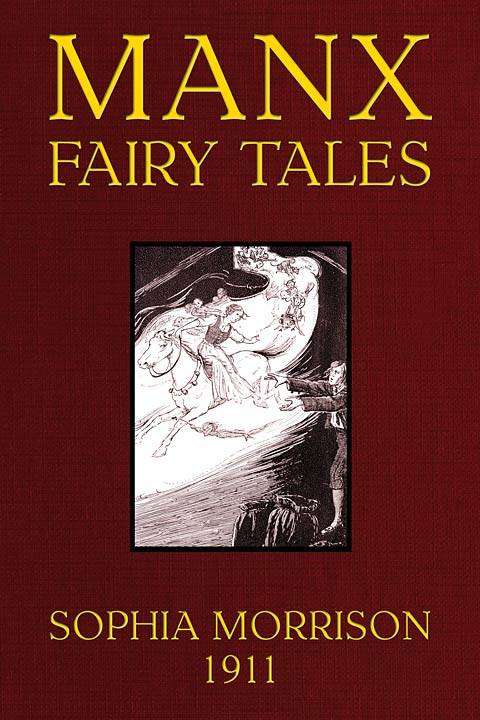
The Project Gutenberg eBook of Manx Fairy Tales
Title: Manx Fairy Tales
Author: Sophia Morrison
Release date: April 15, 2016 [eBook #51762]
Most recently updated: October 23, 2024
Language: English
Credits: Produced by Jeroen Hellingman and the Online Distributed
Proofreading Team at http://www.pgdp.net/ for Project
Gutenberg (This file was produced from images generously
made available by The Internet Archive/American Libraries.)
DAVID NUTT, 57–59 LONG ACRE
1911
PREFACE
There is at least one spot in the world where Fairies are still believed in, and where, if you look in the right places, they may still be found, and that is the little island from which these stories come—Ellan Vannin, the Isle of Mann. But I have used a word which should not be mentioned here—they are never called Fairies by the Manx, but Themselves, or the Little People, or the Little Fellows, or the Little Ones, or sometimes even the Lil’ Boys. These Little People are not the tiny creatures with wings who flutter about in many English Fairy tales, but they are small persons from two to three feet in height, otherwise very like mortals. They wear red caps and green jackets and are very fond of hunting—indeed they are most often seen on horseback followed by packs of little hounds of all the colours of the rainbow. They are rather inclined to be mischievous and spiteful, and that is why they are called by such good names, in case they should be listening!
Besides these red-capped Little Fellows there are other more alarming folk. There is the Fynoderee, who is large, ugly, hairy and enormously strong, but not so bad as he looks, for often he helps on the farm during the night by thrashing corn. He does not like to be seen, so if a farmer wants work done by him, he must take care to keep out of the Fynoderee’s way. Then, far uglier than Fynoderee, are the Bugganes, who are horrible and cruel creatures. They can appear in any shape they please—as ogres with huge heads and great fiery eyes, or without any heads at all; as small dogs who grow larger and larger as you watch them until they are larger than elephants, when perhaps they turn into the shape of men or disappear into nothing; as horned monsters or anything they choose. Each Buggane has his own particular dwelling-place—a dark sea-cave, a lonely hill, or a ruined Keeill, or Church. There are many others too, but these are the chief.
Most of the stories are traditional and have been handed down by word of mouth from father to son. I owe hearty thanks to those from whose lips I have heard them—Messrs. J. R. Moore, William Cashen, Joe Moore, Ned Quayle and others. Of the four stories which have not been told to me personally—Teeval, Kitterland, The Wizard’s Palace, and Smereree—the three first have been printed in various folk-lore books, and the Manx of the last appeared in ‘Yn Lioar Manninagh’ some years ago. Lastly I must thank my friend Miss Alice Williams for her kind help and valuable assistance in many ways.
SOPHIA MORRISON.