
CHAPTER X
Margaret’s first feeling on awaking next morning was relief that her mother now knew all. There had been very little to know or to conceal, but it was a comfort to feel that the reason for her reticence—the apprehension of being talked over at Barton Park—was understood. Mrs. Dashwood was quite ready to seem satisfied by this explanation, though she felt herself at liberty to think what more she chose.
Margaret, by her confidence and by her tears, had ensured herself against any further reproach from Mrs. Dashwood. She was not, however, ensured against discomfort from other causes. No sooner was breakfast over than Sir John’s loud voice, Mrs. Jennings’s cheerful talking, and Mrs. Palmer’s hearty laughter were heard in the hall. Mrs. Jennings could not resist coming to see how Miss Margaret looked after parting with her new beau.
“The Commander is a very fine young man, my dear, though he has such low connections and no fortune to speak of. A good riddance, I say, Mrs. Dashwood! He would not do for Miss Margaret at all, but I will not deny that he is agreeable. Mr. Palmer and he were at it hammer and tongs with their politics and their this and their that. I never heard Mr. Palmer say so much before.”
Margaret’s only reply was a smile, harder to assume than when young Mr. Carey or Mr. Atherton was the beau referred to. She could not conceive how so much was known, but would not make a single inquiry. It could not be long before something intelligible was uttered when so much was being said by three people all at once.
It was Mrs. Palmer who enlightened her.
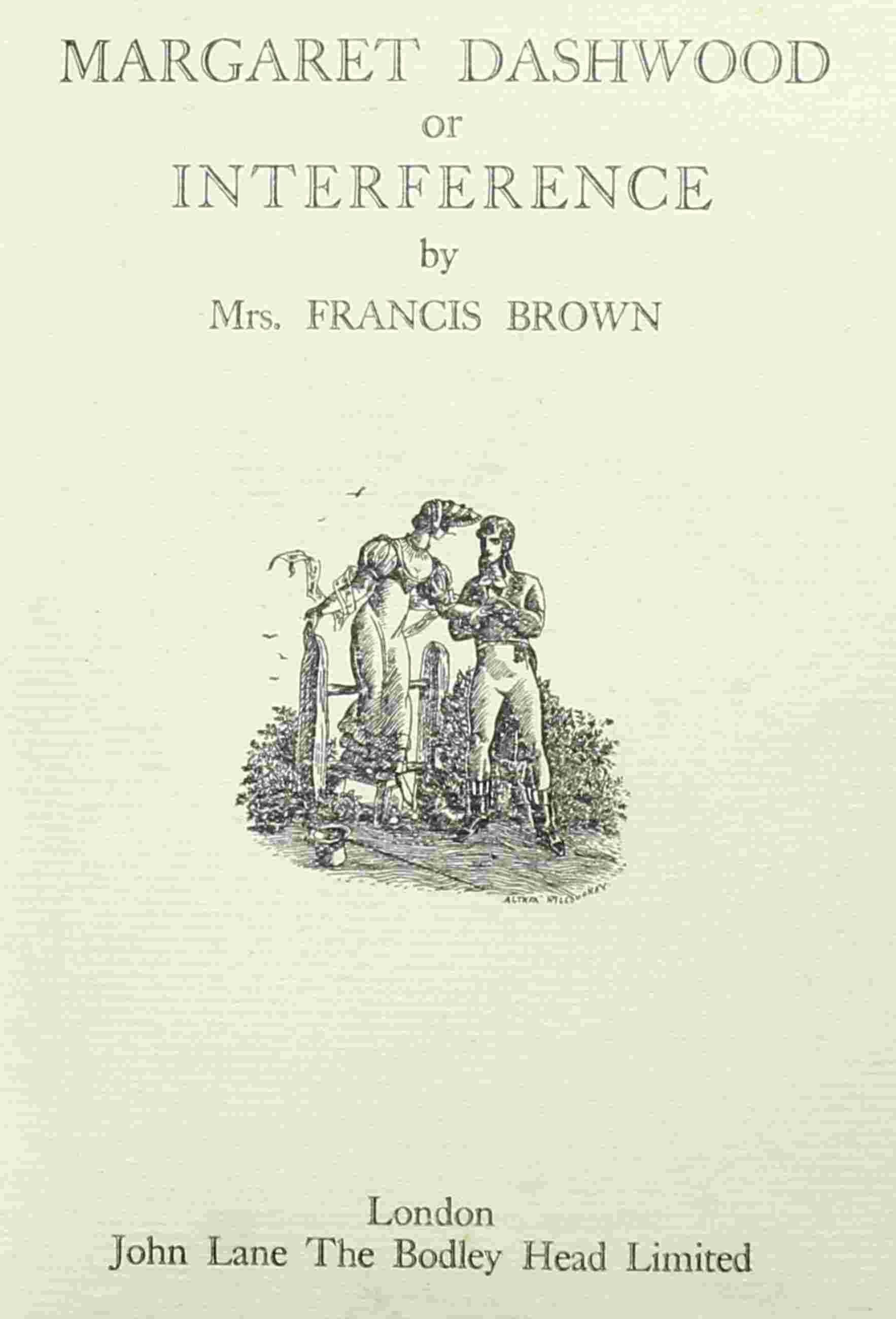
“My mother is always for making a joke, but you know we did think it strange when Commander Pennington described you, and asked where you lived. There was something about a scarf to be returned, I think. I did not understand it all. It seems your scarf blew away and he caught it. I hope you have it safe again.”
“Yes,” replied Margaret, “it was returned to me.”
“Oh,” cried Mrs. Jennings, “but that was only the beginning of your acquaintance. And now he is gone, and that had better be the end, Miss Margaret. We cannot have you taken all over the world, when there are several near at hand who would like to keep you here.”
Mrs. Dashwood endeavoured to lead the conversation away from Margaret by inquiring as to the intimacy between Mr. Palmer and Commander Pennington. Mrs. Palmer was delighted to be the chief talker, and related how they had been at the Royal Naval Academy at Portsmouth together, but that Mr. Palmer had succeeded to the property. So it had ended in his not going into the navy after all, and very glad she was of it, as to have a husband at sea would be a shocking thing. She laughed merrily at the thought, and was still more amused at the idea that with the war still going on there would have been danger of her becoming a widow.
“But of course I should never have married him at all in that case, so I should not have minded it in the least, except that of course I should not have liked to be an old maid.”
Mrs. Palmer, having been thus providentially spared from early widowhood and perpetual spinsterhood by the circumstance of Mr. Palmer not having entered the navy, was naturally against that profession. She had much to say of its evils, and recounted with hearty laughter the hardships that she knew to be the lot of a naval officer’s wife.
She was on her way to London. Mr. Palmer would call for her almost immediately. The House was sitting, and he had his duties as a member. She called specially to know if Mrs. Dashwood had any message for her son and his wife, as she would be very happy to convey it. Mrs. Dashwood was firm that she had no such message to send. She had written to them a day or two ago, and had nothing to add to what she had then written.
Sir John and Mrs. Jennings were warm in giving the usual invitation to dinner. It was urgent in this case, as the loss of Mr. and Mrs. Palmer would leave them disconsolate, a party of five, when only yesterday they had sat down eight to dinner. Mrs. Dashwood could not be so cruel as to refuse.
Mrs. Dashwood was, however, deaf to all calls of humanity, and would have excused her daughter also, but Margaret, seeing clearly that any reluctance on her part to go into society would be construed as “wearing the willow,” accepted with seeming satisfaction, and Sir John and Mrs. Jennings returned to the Park easy in their minds that Mr. Atherton’s chances were as good as ever.
Mrs. Palmer remained to chatter for half an hour till her chaise arrived, to give Margaret repeated invitations to join her in London, all of which were steadily declined, and to recount over and over again the sayings and doings of her son, only four years old, but already famed for his wit and beauty.
Mr. Palmer came. Margaret would have liked to hear something of his friendships at the Royal Naval Academy, but he had very little to say beyond grumbling at the weather and the roads. Mrs. Dashwood congratulated him on having effected a meeting with his friend, and he replied that it had been very agreeable. He further volunteered that he wished there were more like Pennington, but that was all; and the couple soon drove off, Mrs. Palmer laughing and waving till she was out of sight.
Margaret hardened her mind as she dressed for her dinner engagement that afternoon. She would not pay any attention to their jokes, and she would not understand their questions. She was prepared for much discomfort which she would bear with a smiling face. In the event it was not so bad. As before, Miss Nancy Steele had much to say, and had no idea that Commander Pennington was to be interested in anyone but herself. The Commander and the Doctor took up about the same space in her mind and Mr. Atherton had all the rest. Margaret found that she had no need for defence against jocularity, as all the wit was to be expended elsewhere. Mr. Atherton sat next her and was attentive, but his gallantry took the form of praising her music, and this gave her an excuse to pass most of the time after dinner at the instrument. It was a fine one and to play on it gave her real pleasure.
As Lady Middleton, who was fond of cards, was able to get up a rubber, and Sir John had been out all the morning and was glad to get some sleep, the party may be said to have been productive of more enjoyment than is usual at such gatherings. There was no one who had not some degree of happiness, and even Miss Nancy Steele, who had Mrs. Jennings for a partner, and would have preferred Mr. Atherton, was consoled by winning three shillings, which would just pay for the new pink ribbons she wished to purchase in time for her next meeting with the Doctor.