
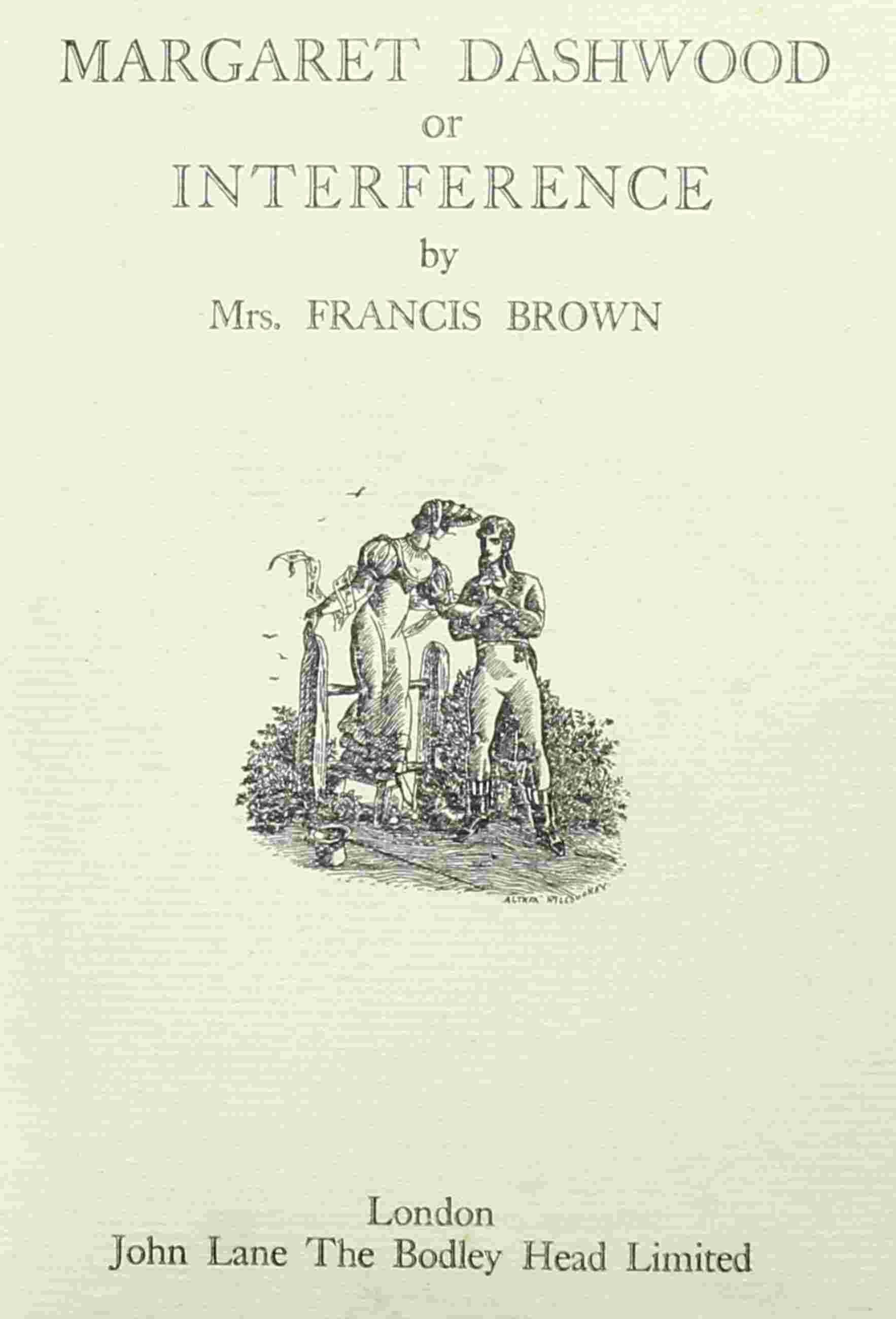
MARGARET DASHWOOD
CHAPTER I
Margaret Dashwood was an observer of life. Her temper was calm, her manner gentle, and she was able to listen to the accounts other people gave of their activities without the appearance of fatigue. The circumstances of her life up to the age of seventeen had combined to increase in her these qualities, so valuable to her acquaintance, so agreeable to herself, and so baffling to those desiring a nearer intimacy. She was the youngest of three daughters, not so accomplished and self-reliant as Elinor, not so handsome and impulsive as Marianne, and less attractive than either, if to be immediately noticed is to be attractive.
Their mother was a widow, whose income, though possibly equal to her expenditure, was consistently below her wishes, and the three Miss Dashwoods were obliged to suit their requirements to their mother’s purse rather than to her heart.
Mr. and Mrs. Dashwood had lived for ten years with his uncle, the owner of a large estate in Sussex to which Mr. Dashwood was the heir. The property was inherited, but enjoyed for only a twelvemonth, and Mrs. Dashwood became a widow with a small income.
The idea of wealth takes root quickly in the mind, and Mrs. Dashwood was not easily convinced that she was now unable to afford indulgences for her daughters. Her own tastes were simple, or became so after her change of situation; and, in order that Elinor and Marianne might be suitably attired and escorted, her own pin-money was severely taxed. Margaret, as the youngest daughter and not yet grown up, had a more personal experience of the family economies than her sisters, and she learned more of the meaning of the word “poor” than either of them was ever to know.
Six months after her husband’s death Mrs. Dashwood removed, with her daughters, from Norland Park, in the county of Sussex, to Barton Cottage, near Exeter. Margaret was only thirteen at the time of this removal and, though deeply mourning the loss of her father, with whom she had been a special favourite, her feelings on leaving her home were tinged quite as much with excitement as with regret. She had found, however, that, if she wished to be left in peace to her own reflections, it was wise to agree with outward fervour with Marianne, whose sensibilities were of such a nature as to brook no opposition, least of all from a younger sister.
In Marianne’s company Margaret expressed undying sorrow at parting from the woods of Norland—but she ran away if her father’s name occurred. With her mother she said little of regrets, but something of the joy of living in a cottage, and possibly keeping pigs and poultry; and with Elinor her subjects of conversation were still more limited for, as a rule, to her eldest sister she said nothing at all. She was quite willing to admire Elinor for her wisdom and elegance, but was not very fond of her society, and did not covet her notice, which usually took the form of gentle reproof or a slightly satirical approval. Margaret did not feel that she merited either. Most of her time was spent with Marianne, who would read aloud to her and rhapsodize with great spirit, if no older listener was to be secured. With her mother she was always happy, for Mrs. Dashwood restrained her grief when with her child, though she was in the habit of indulging it more freely with her elder daughters.
The new owner of Norland, John Dashwood, the son of Mr. Dashwood by a former wife, early took up his residence accompanied by his wife and little son, now the heir to the property. Margaret soon contrived to dismiss her brother and his wife from her thoughts as “very disagreeable.” When obliged to be in company with them she merely thought of something else, and in this way escaped much that tried her mother and sisters almost beyond bearing. Her little nephew, Harry, she loved dearly, and amused him untiringly, and in this way gained approval and some degree of liking from Mrs. John Dashwood. Margaret was as unaware of this honour as she would have been indifferent had she known of it.
In one respect Elinor became the subject of special interest and reflection to Margaret during the months that followed their father’s death and before their removal was decided. Mrs. John Dashwood’s brother, Edward Ferrars, had come to pay a short visit to his sister, and remained to pay a long one. Wherever Margaret went in the garden or shrubbery she found Edward and Elinor there before her, pacing the walks in earnest talk or sitting on a garden-seat while Elinor drew and Edward read aloud to her. It was Margaret’s first experience of the kind, and she found it exceedingly interesting, so much so that on more than one occasion she felt inclined to call her mother’s attention to it, but the habit of silence prevailed and, later, her thoughts were distracted by her mother’s announcement of the pending removal.
The day came for their departure, and Marianne’s tears flowed freely in the carriage as they drove away from Norland. Mrs. Dashwood did not restrain her grief, and even the self-contained Elinor was moved. Margaret, however, held her perfectly dry handkerchief up to her face and peeped over it at the countryside and villages. By and by she was able to put away the appearance of sorrow, and on the second day could enjoy the journey without pretence. Elinor was determinedly full of interest and admiration, Mrs. Dashwood responded quickly to this happier mood, and even Marianne brightened as the beauties of Devonshire came in sight. Barton Cottage itself was pronounced bearable, and its situation was found to be perfection.
Here Margaret was to live and grow up from thirteen to seventeen—when our story opens—and much was she to observe in those four years.
She was to see how lovers advance and retire, set to corners, and set to partners not only in the ballroom. She was to find from Sir John Middleton and his wife, their near neighbours, that kindness could be inconvenient and that children could be troublesome; from Colonel Brandon that a brother-in-law could be old enough to be her father; from Edward Ferrars that a brother-in-law could be sober enough to be her grandfather; from Mrs. Jennings, Lady Middleton’s mother, that sweethearts were a good joke; from Miss Steele that beaux were vastly entertaining; and from her own sisters that lovers caused more grief and pain than she would have supposed possible.