
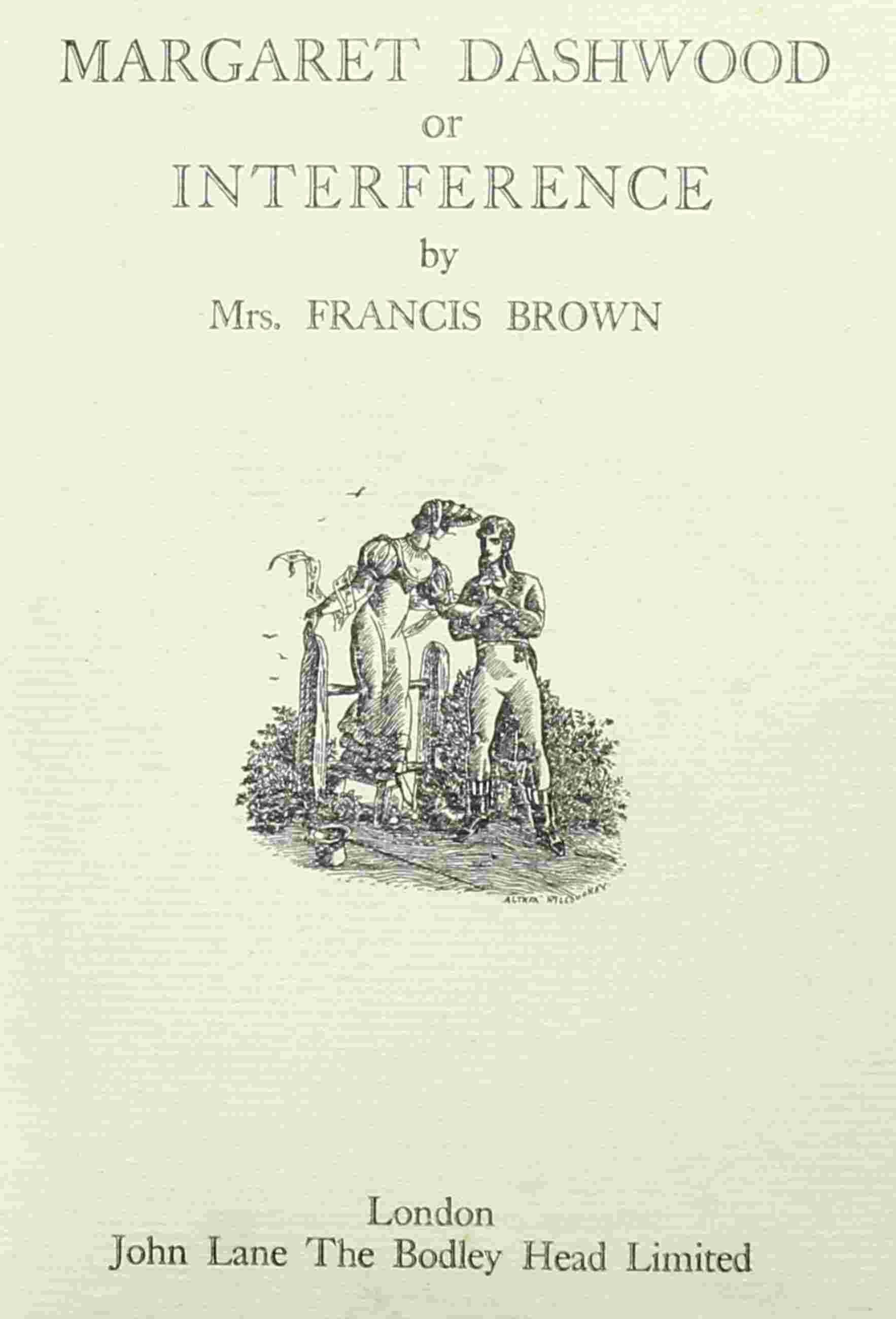
CHAPTER XXVIII
Mrs. Ferrars, as Marianne expected, repeated her request that the sisters should accompany her to Scotland. She was none the less surprised at having her offer accepted.
The contest between the elder and the younger lady was still carried on, but the ground of difference was changed. It was not now whether Marianne should or should not join her husband in Scotland, but whether she was doing so to please herself or out of kindness to Mrs. Ferrars, who always assumed the one reason and Marianne the other.
It was Wednesday morning. Edward had left on Tuesday, was giving his horses two days’ rest, and would return on Friday, bringing Elinor back to take charge of the children and soothe her disturbed household. Mrs. Ferrars, Marianne and Margaret were to start early on Friday, with man and maid in the chaise behind, and intended to reach Bath in time for the Sunday. The journey was to be continued at a similarly leisurely pace and Margaret looked forward with great interest to the coming week.
This morning Marianne found it necessary to go to the village to give some orders, and had added that she proposed to look in on Mrs. Ferrars to give her something vexatious to think about. As soon as she was gone, Margaret took some work and went to sit in an old yew arbour which stood on a mound against the high wall that surrounded the garden. Thence she could see Marianne walking along the lane towards the village, the morning coach passing on the turnpike road, then a cart, and later a gentleman’s carriage.
It was a cheerful place in which to spend an hour or two in the open air without the fatigue of walking or the necessity for change of dress. She had been settled there for about half an hour when she noticed a curricle coming along the road at a rapid pace. It stopped, and a man got out, and spoke to his companion, who then drove forward more slowly. Margaret had nothing very particular to do, and at first she watched this figure with idle interest, but it was not long before she became aware that he had turned into the lane, not long before she knew who it was, and not long before he was standing below her on the other side of the wall, and looking up.
“May I come up there, Margaret?” he asked.
“Yes, if you can,” she replied, “but there is a way round by the great gate.”
The gallant Commander was not the man to go round by any great gate when a more direct way was before him. The wall was of rough stone, and some of the stones projected. He was soon near the top, but then experienced some difficulty.
“Shall I give you a hand?” she asked.
“Yes, if you will,” said he.
He did not, however, give up the hand when he was beside her in the gazebo. They sat down together, and though Margaret might ask questions about the journey it was difficult to keep up a purely formal conversation when he held her hand. So it was not long before she was silent, and he began to speak, and told her of his errand. It was to ask her a simple question, and, when she heard the question, she was in no doubt as to the answer.
When Marianne returned from her latest discussion with Mrs. Ferrars she heard that which put all quarrels out of her head. It was a joyful day for Marianne. She was not the less in love with romance because she was also in love with the Colonel, and by the time she had heard all they would tell her she was, outwardly at least, by far the most enthusiastic of the three. They quitted her soon to indulge in the endless discussions, the long silences, the renewed converse, which are so familiar to all who have been in love. Marianne was left to the enjoyment of her own thoughts and the formation of further plans.
It was not until dinner was over and Marianne had exercised her right as hostess to secure their company in the drawing-room that she produced her scheme.
“Richard,” she asked, “how soon do you wish to be married?”
“As soon as is possible,” he replied promptly.
“I will not ask Margaret. She would only give me some evasive reply, but I will ask her another question. Do you want to have every one at Barton asking you questions and then inventing the answers and saying you said this or that, and noticing when you blush, and teasing you and vexing you in every imaginable way?”
“I do not think I mind very much. I am used to that sort of thing, and now——”
“That is the wrong answer, Margaret,” said Richard. “You should have replied as I did, in the way your sister expected. You should have said simply ‘No.’”
“Her answer was perfectly satisfactory to me, thank you, Richard. She ended it with ‘and now.’ That means, does it not, Margaret, that being to marry Richard makes everything right. Correct me if I am wrong. I do not wish to attribute to you anything you do not willingly admit.”
Margaret willingly admitted as she was asked, and Marianne expressed herself satisfied.
“Richard wishes to get married as soon as possible, and Margaret admits that nothing else matters. Now for my third question, which is for both of you. Do you wish to please me greatly?”
This was immediately agreed to by both.
“Well, then, do, do come to Scotland with us, Richard, and be married there. It is the most entrancing scheme. I have been thinking of it half the morning. Margaret and I will travel with Mrs. Ferrars, and you will follow in a hired chaise. At all the stops there you will be, and I will present you to Mrs. Ferrars as a mere acquaintance. We shall spend Sunday in Bath, and I will take care that she is kept out of the way, but she is bound to see you, and to find out that you are following us, and she will be so delightfully angry at your continued appearances, and abuse you so much, and I shall enjoy myself beyond measure.”
Margaret protested that their marriage was being pressed into service to keep up the contest with Mrs. Ferrars, but Marianne would not have it so. She had other and better reasons to urge.
“Do think how deplorably unromantic our marriages have been. Mamma, to begin with, marrying Papa, years and years older than herself, and a widower of all things. Then Elinor, with dear good Edward, who is the most prosaic creature in the world, and as to myself, though I would not have anything different, no one can possibly think my marriage in the least romantic. Now you two have the most amazing opportunity. Nothing could exceed the delightful romance of your situation. To make it perfect you must elope.”
“Mamma——” began Margaret.
“Mamma will be delighted,” went on Marianne. “She said at my wedding that she hoped she would never have to undergo so much of fuss and ceremony again. She even said she hoped you would elope when your turn came, though I do not suppose she quite meant that. However, there can be no harm in taking her at her word.”
“That is not what I meant,” said Margaret. “I did not think she would particularly desire wedding festivities, but I think she should know what is happening, that her consent——”
“I wrote to her before I came away,” said Richard.
This was unexpected.
“Do you mean she knows?” asked Margaret.
“She knows what I wanted.”
“And she did not object? She consented,” declared Marianne. “There can be no question of it. If she had wished to prevent it she would have done so.”
“She did not have very much time,” said Richard.
“Oh, Mamma always says if she does not wish anything. Besides, she would never oppose us in anything that was of real importance. I am sure Mamma would be on my side. She would love to vex Mrs. Ferrars.”
“There is one thing I do not like,” said Richard. “How about the Colonel? This is his house. I do not want to elope from it without his consent.”
“Oh!” said Marianne. “That is another point. You would never, never guess it to look at him, but my husband was once all ready prepared to elope himself, only all was discovered.”
“With you?” asked Richard, puzzled.
“No, not with me, with another lady, long, long ago. It is a great secret; but it will be impossible for him to make any objection to elopements from his house. Also, I really do not see what else is to be done. You would not wish Margaret to go to Scotland, and leave you here?”
Richard agreed that he would not.
“Of course she could stay on at the parsonage with Elinor.”
Margaret thought not.
“Well, then, there is nothing for it but for you to come to Scotland with us, and when there it would be a pity not to get married. For if you do you can go straight back together to Mamma, and you will see at once if you have vexed her. But I think it will amuse and please her of all things.”
It did really seem to be a plan of some convenience. Marianne assumed it to be settled. Richard found it very much to his liking, and Margaret only stipulated that they should write without delay to her mother.