
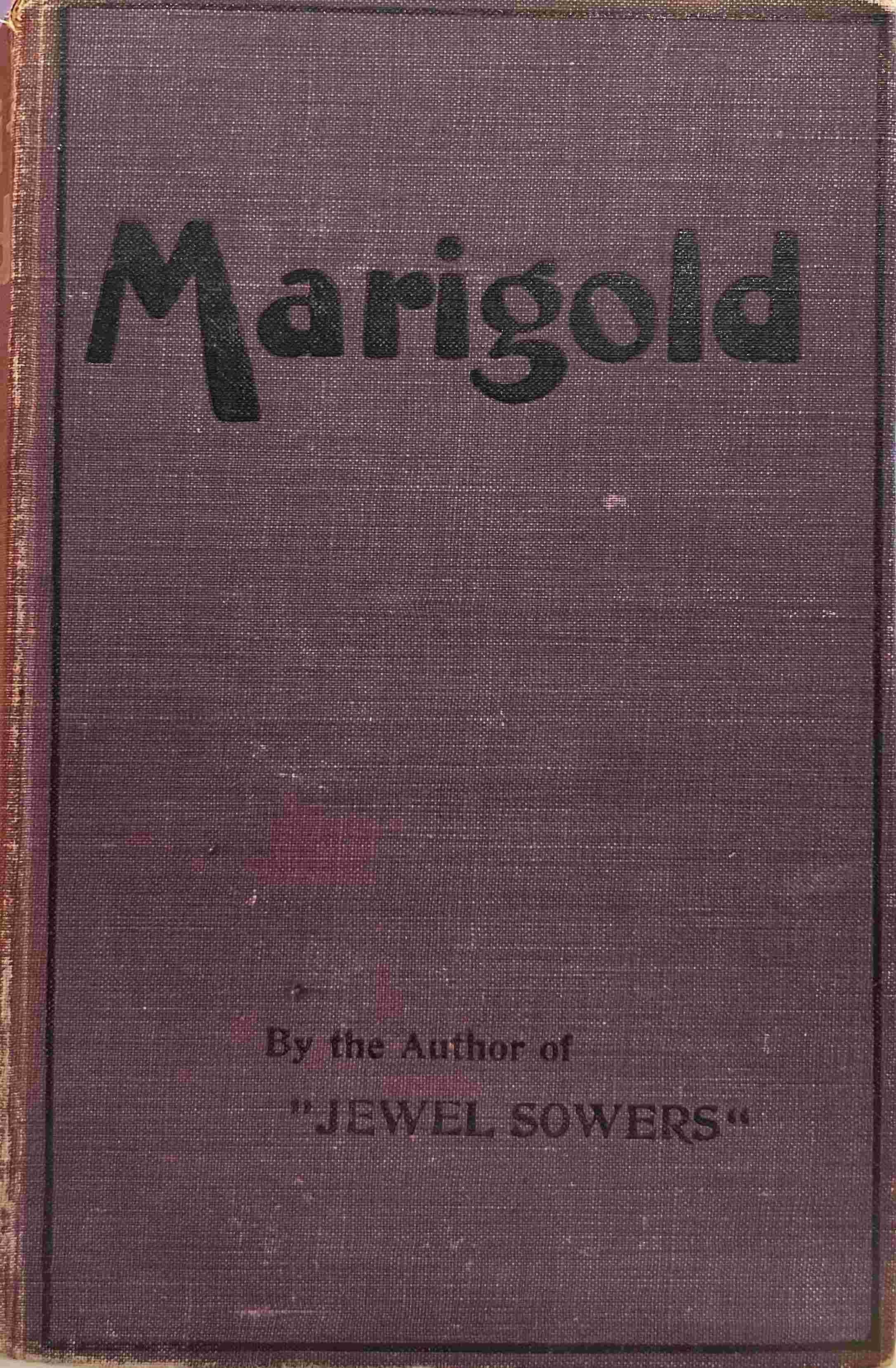
The Project Gutenberg eBook of Marigold
Title: Marigold
A story
Author: Edith Allonby
Release date: June 28, 2025 [eBook #76409]
Language: English
Original publication: London: Greening & Co., Ltd, 1905
Credits: Ed Foster, Mary Glenn Krause, Julie Turner and the Online Distributed Proofreading Team at https://www.pgdp.net
MARIGOLD
BY THE SAME AUTHOR
JEWEL SOWERS
A Story
Weekly Survey.
“An original and intensely interesting novel. We should welcome anything further from the pen of this anonymous writer who has produced a book that any one might be proud to sign.”
Sunday Times.
“It is permeated with the spirit of adventure, so that one is interested in the characters and their doings. Those who like the marvellous and have no objection to considering the impossible, will find a certain fascination about the story, which they will read to the end.”
Glasgow Herald.
“The author of this anonymous book need not have hesitated to own it, for it is thoroughly readable, and its artistic merits are very considerable. It is at once a somewhat ambitious allegory and a satire with a fair measure of point and vigour.”
Morning Post.
“We cannot help noting that the writer has no little power both of description and character drawing, or that the whole book has been most carefully elaborated.”
Onlooker.
“The author hides her—is it her?—identity under anonymity but has no reason to fear criticism. Though called a ‘novel’ it is a clever parable and deals with the evil of selfishness, and the blessings resulting from works for work’s sake.”
T.P.’s Weekly.
“There is good writing in this story, which undoubtedly shows imaginative power.”
Manchester Guardian.
“‘The Jewel Sowers’ is wholly fantastic in its incidents, but its characters are those of our society; and with all the machinery of a fairy tale, the book still belongs to the realms of daily fiction. Appropriately enough the scene is laid in another world, one in which everything is said to be the opposite of the life of this planet. But this is a mere warning that the tale is fantastic; men and women in Lucifram, as the new world is called, are even too much like those on this, and if their powers are strangely superior, their motives are entirely familiar. The book, in fact, is an experiment in fantasy, and none the less pleasant on that account. It is neither an allegory, as are other tales similarly constructed, nor yet a satire, though there are elements of both interwoven with the adventures and the incidents. The anonymous authoress has demanded a wider sphere for the evolution of her characters, and no one who feels the charms of her pleasantly depicted heroine will grudge the novel atmosphere in which she is forced to suffer and to act. The book is lightly written, bright, and entertaining, and almost every character introduced is neatly characterised. Perhaps the best of them is the fairy frog, whose cheerful temper is the result of martyrdom, and who should earn a place among the favourite heroes of the fairy world.”