
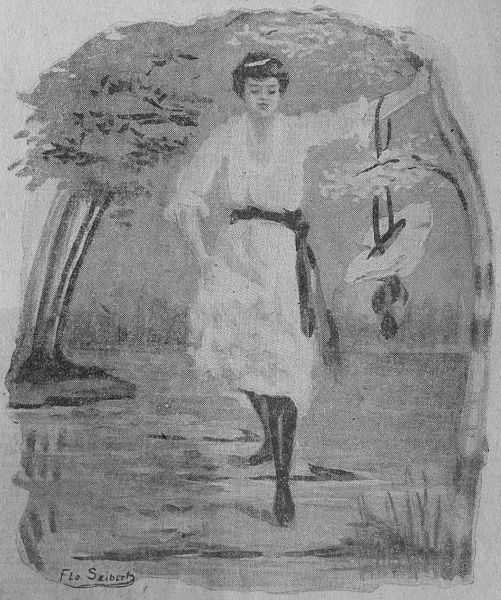
CHAPTER VIII.
A change came at last—one for which none of the three had been prepared: Lord Ridsdale married.
The first thing the new Lady Ridsdale did was to insist on the removal of Miss Arleigh from school.
"Nearly eighteen," she said, "and still at school! My dear William, the only wonder is that the poor girl has not fallen into some dreadful mischief. She ought to have been presented last year. We must have her home at once."
Lady Ridsdale was a woman of the world; she knew exactly how much eclat and importance would accrue to her from the fact of being chaperone to a wealthy heiress like Miss Arleigh.
"Is the girl pretty?" she asked her husband; and to do him justice, he looked much confused.
"I hardly know what to answer you, Laura. I must confess the truth; I have not seen her for two years and more. When my wife died I was quite at a loss what to do with her, so I sent her to school. Miss Carleton promised to take complete charge of her, and I have not seen her, as I say, for more than two years."
"Was she a pretty girl then?" persisted Lady Ridsdale.
"I think so. Miss Carleton said she was beautiful. She had been crying when I saw her, so that I could hardly judge."
"A beauty, and a wealthy heiress! We must have her at home at once, William. We will fetch her without any delay."
Lord Ridsdale thought some of the servants might go, that it was hardly necessary for him to make the journey. His wife laughed at him.
"You do not know the social importance of your ward," she said. "Before long Miss Arleigh will be one of the queens of society, heiress of Hanton, and of the large fortune left by her father; we shall have some of the first men in England wooing her. She may be a duchess if she likes." At which intelligence Lord Ridsdale opened his eyes.
He had thought of his ward as of a tiresome responsibility, a child of whom the charge would be very troublesome. He had taken good care of her money, because he was an honorable man, but he had not thought much of what his wife called her social position. As a probable duchess he felt a great amount of respect for her.
So Lord and Lady Ridsdale went together to bring their beautiful young ward home. Miss Carleton was grieved to lose her.
"She has been a docile pupil, and she is a beautiful, lovable girl. Though I am sorry indeed to part with her, for her own sake I am glad she is going; it is high time she saw something of the world."
"You have had no trouble with her, I hope?" said Lord Ridsdale. "At seventeen most young girls have begun to think of love and lovers."
Miss Carleton prided herself on the fact that in her establishment such matters were entirely avoided.
"There is nothing of the kind," she replied, earnestly. "I do not believe that Miss Arleigh has even begun to think of such things."
"So much the worse when she does begin," thought Lady Ridsdale.
When the preliminaries had all been discussed, and Miss Arleigh was requested to meet her guardian, Lady Ridsdale could not control her surprise at the sight of the girl's beauty.
"You could not tell whether she was pretty or not?" she said afterwards to her husband. "William you must be blind."
She welcomed the young girl warmly. She kissed the fresh blooming face that had all a woman's beauty with the innocence of a child. She clasped her arms round the slender, girlish figure.
"You must learn to love me," she said, "to look on me in the place of the mother you have lost."
And Marion Arleigh for the first time in her life imagined to herself what a mother's love would be like.
"What a strange idea to keep you so long at school!" said Lady Ridsdale. "We must do our best to atone for it."
"I should imagine that my guardian did not know what to do with me," she replied, with a smile so bright and sweet that Lord Ridsdale at once fell in love with her, as his wife had done before him.
"Where am I going to live?" asked Marion, after they had been talking for some time.
"We are going to Thorpe Castle," replied Lady Ridsdale, "and I thought you would enjoy being there with us."
"I shall enjoy anything and everything" said Marion. "I have all my life before me, and it will be full of glorious possibilities."
Suddenly she paused, remembering that her life was settled and arranged; it held no more possibilities; they were all at an end. For the first time she felt the weight of the chain that bound her. Lady Ridsdale wondered why the beautiful face suddenly grew pale and grave.
Half an hour afterwards Marion came timidly to her side.
"Lady Ridsdale," she began, in a half-hesitating manner, "of course I never thought such happiness as the marriage of my guardian was in store for me."
"I suppose not," was the smiling reply.
"I used to think that I should go away from here and be so lonely, so sad. I have made a promise and I do not see how I can keep it."
Lady Ridsdale was touched and flattered by the girl's confidence.
"Tell me all about it, Marion; you shall keep the promise, if it be possible."
"There is a governess here, one of the assistants; her name is Lyster—Adelaide Lyster. She has always been very kind to me; indeed I should have been most lonely but for her, and I—I am very much attached to her."
"Quite natural and quite right," said Lady Ridsdale. "You wish, of course, to make her a very handsome present?"
"No, not quite that," said Marion, looking very uncomfortable; "it is much worse than that. I thought I should be all alone, and I promised that when I left Miss Carleton's she should go with me as my companion, and should live with me."
Lady Ridsdale looked very grave.
"I do not think it possible, my dear," she replied. "Lord Ridsdale has the greatest objection to that kind of thing. Will you not try if you shall like me as a companion?"
"I am quite sure to do that," she said; "but I made the promise. What shall I do?"
"You made it under a certain set of circumstances," said Lady Ridsdale "and they no longer exist. You may, I think, in all honor, defer the keeping of it, until you have a house of your own."
But Marion still looked as she felt—uncomfortable. Lord Ridsdale had gone to superintend some arrangements for their departure, leaving the two ladies alone.
"You think the young person will be disappointed?" said Lady Ridsdale, kindly.
"I am sure she will," replied Marion wincing at the words "young person."
"Let me see her; ask her to come here, and I will speak to her. After all, my dear, you are not in the least to blame if you cannot keep your promise—you must remember that."
A few more minutes and Miss Lyster, dressed in her most becoming costume, stood before Lady Ridsdale.
A few words passed, and then Lady Ridsdale began;
"My ward is in some distress, Miss Lyster. I find that she has promised you that you shall live with her as companion."
"She certainly did so, and I have made all arrangements for that purpose."
"We will hope you have not made many arrangements," said Lady Ridsdale, suavely, "as Miss Arleigh's movements have been so very uncertain. Of course, when Miss Arleigh is of age, and makes her own arrangements—forms her own household—she will do as she likes. It will be utterly impossible for her to carry out her promise in Lord Ridsdale's house, as I am sure you will have the good sense to perceive."
Now, Miss Lyster was not wanting in good sense. She was taken by surprise, as was every one else, by this sudden movement. She had had no time to think what was best under the circumstances; the only idea that occurred to her was how more than useless it would be to offend Lady Ridsdale. Unless she managed to secure her good opinions there would be no invitations to Ridsdale house. These ideas flashed through her mind with the rapidity of lightning; then Miss Lyster, with an expression on her face that was a most perfect mixture of reverence and humility, said:
"I hope Miss Arleigh will study herself and your ladyship, not me."
"You must not look at it in that light. Miss Arleigh studies every one most kindly, I am sure. It is simply this: that there would never be the least objection to Miss Arleigh following out any wish or any idea that should occur to her, but that in this case it would be impossible to carry out her wish. Miss Arleigh will soon be surrounded by friends and companions of her own age, and then she will not feel lonely."
Miss Lyster's reply was a deep, silent bow. To herself she said:
"If she thinks to take Marion from me, she is mistaken. I will never lose my hold on her."
Lady Ridsdale was touched by the companion's resignation to circumstances.
"We shall be very pleased to see you at Thorpe Castle during the vacation, Miss Lyster," said Lady Ridsdale, "and we owe you a deep debt of gratitude for your unfailing kindness to Miss Arleigh."
Then the interview ended.
Miss Lyster, after a few more words, quitted the room.
"My dear Marion," said Lady Ridsdale, "I am almost glad that circumstances do prevent you from carrying out this arrangement."
"Why?" she asked simply.
"Because I have lived in the world long enough to be a judge of character, and your friend's face does not please me. Do not trust her too far."
CHAPTER IX.
Life at Miss Carleton's and life at Thorpe Castle were very different. Marion had not been there very long before she began to feel most perfectly happy, and to wonder how she endured the monotonous routine of school.
The parting from Allan had really been terrible to her, his love had for so long been her chief comfort and her only pleasure. She said to herself that she should miss him most terribly; yet, if she had looked into her own heart, she would have seen it was not so much him she should miss as it was the novelty of his letters, his plotting, his poetry, the stolen interviews, the hidden romance that she thought so beautiful.
"You will not forget me, darling?" he said, pleadingly. "You will write to me, and you will let me sometimes see you?" She promised faithfully. She wept over leaving him, yet in some unaccountable way her spirits rose when she came away; she felt more free, more at ease than she had done for a long time.
"You must make the best use of the sunny days," said Lady Ridsdale. "There is one advantage in having been so long at school—you will be perfectly fresh to the world, and that is always a charm in itself. You must give yourself up entirely to my guidance for a time."
Marion did so most willingly. Lady Ridsdale engaged a pretty, quick Parisian as lady's maid; she invited young ladies of her own rank and position to stay at the castle; she obtained every possible enjoyment and pleasure for the girl.
This was something like. The hours seemed to fly like golden moments, the very atmosphere was different. Here all was refinement, grace, courtesy and kindness. Lady Ridsdale knew some delightful people, and nothing pleased her so much as filling Thorpe Castle with visitors.
One and all were delighted with the young heiress. Her beauty, her brilliant accomplishments, her simplicity, her frankness of character and sweetness of temper made her a general favorite. She soon made up for lost time. She learned to drive, to ride, to row, to do all the hundred and one pretty things that mark the young lady of the world.
The gentlemen admired her exceedingly, she was so lovely, so candid. She was never left alone. If she entered the drawing-room she was instantly surrounded with a little court of admirers. When she wished to ride or walk there was always some little contention as to who should accompany her. It was very pleasant. Before she had been at Thorpe Castle long Marion Arleigh was queen of the new world. In the midst of all her happiness the first letter from Allan Lyster came like a thunderbolt. She was naturally so frank, so candid, that the keeping of a secret was most difficult to her. Her first impulse was to go to Lady Ridsdale and tell her everything. Then she remembered that she had given a solemn pledge of secrecy, and that she must not say one word.
It made her very unhappy. She did not like the sense of concealment. She did not like having a secret of so much importance that she could share with no one. Then it struck her, too, that the tone of the letter was not quite what she liked; it was in some vague way different from the tone of the people she was living with. She did not like that reiterated petition, for secrecy was weighing heavily on her heart and soul. She waited two days before answering that letter. She said to herself that she ought to be very pleased to receive it, and that she was pleased; yet something weighed on her mind and shadowed the perfect happiness she had expected to feel.
Then she answered him, and again, for the first time in her life, she sat with her pen in her hand, hardly knowing what to say. She had been accustomed to writing page after page and never pausing. Since then something seemed to have arisen in her life and to stand between them. She did not care to tell him of the luxury of Thorpe Castle, the number of visitors, the splendor of the entertainments.
"That will not interest him," she said; "his life is so different." A strange sensation of uneasiness came over her as she remembered how different it was. So she wrote a letter full of commonplaces, and when Allan Lyster read it he bit his lips in fierce, hot anger.
"She is learning not to care for me already," he said. "She has never written so coldly to me before."
Adelaide bade him to be of good cheer.
"I shall go to the castle at Christmas," she said, "and, rely upon it, Allan, I will find an opportunity of sending for you. You need not be anxious; there is no possible plea on which she can escape you now. If you will take my advice you will not draw the chain too tightly; let her feel that she is free."
Allan took her advice. He did not persecute her with letters; he wrote, and filled his pages with love and flattery so sweet it could not tease her.
And then when Christmas came around Adelaide filled the grand purpose of her life—she went to Thorpe Castle. Her behavior there might have been taken as a model. She was quite sure of Marion's affection, so she devoted herself entirely to Lady Ridsdale; she waited upon her, she solicited her advice, she administered to her the most delicate doses of flattery. In short, she set herself to work to win Lady Ridsdale's heart; but she did not succeed.
The mistress of Thorpe Castle did not like Miss Lyster; she merely tolerated her, and that was for Marion's sake. With Lord Ridsdale she succeeded better. Her subtle flattery and constant attentions made some impression on him. He told his wife that Miss Lyster was a very amiable girl, and he hoped she would often pass her vacation at Thorpe Castle. My lady smiled suavely, and made no reply.
Adelaide wrote to her brother that he had no cause for fear.
"The first morning of my arrival," she said, "Marion took me to her room, and we had a long talk about you. Have no fear; she is quite true to you, and I have a scheme in my mind for getting you invited to the castle."
One morning when Lady Ridsdale and Miss Arleigh were engaged with visitors Adelaide asked if she might go through the picture-gallery. Lord Ridsdale, flattered by the request, offered to go with her and show her some of his especial favorites.
Miss Lyster was all enthusiasm, and she was tolerably well acquainted with the first principles of art. She made some remarks that pleased and interested his lordship. Then she was quite silent for some minutes, and afterward sighed deeply. Lord Ridsdale looked at her. The sigh had been such a profound one that he could not help taking some notice of it.
"Are you tired?" he asked.
"No," she replied. "You are so kind, Lord Ridsdale, that I may tell you of what I was thinking. I was wishing that this great privilege I now enjoy could be given to my brother instead of me."
Lord Ridsdale looked benevolently interested, and she continued:
"I have but one relative in the world, an only brother, and he is an artist. He lives on his art, and I was thinking what a privilege he would consider it of what benefit it would be to him, if he could see those pictures."
"Your brother is an artist! I see no reason why he should not profit by this really beautiful collection of pictures. Would he like to visit Thorpe Castle, do you think?"
"You are too kind, Lord Ridsdale. I should say it would be a glimpse of paradise to him."
"Then by all means. Miss Lyster, write and ask him. I cannot extend the invitation for any lengthened period, as we have so many visitors, but if he will come for a week I shall be delighted to see him."
She thanked him until his lordship was in a perfect glow of benevolence to think what a kind and generous action he had performed. His wife did not look quite so pleased when he told her; but then, my Lord Ridsdale was not a man of great observation.
CHAPTER X.
As a result of the conversation in the picture-gallery the young artist, in compliance with an invitation of Lord Ridsdale, came over to Thorpe Castle. Long before he came Marion had grown sick of the deception and weary of the chains that bound her.
She was naturally so frank, so open, that the need for concealment troubled her greatly. She had the warmest affection for Lady Ridsdale. She would have liked above all things to have trusted and confided in her. It was torture to the girl to think that she was helping others to keep secret from her that which she ought to know. She shrank from Miss Lyster. She no longer cared to be beguiled by long walks in the shrubbery, to hear nothing but praises of "my brother," and the oft-told tale of his love for her. Association with refined, honorable, high-minded people was doing its work with her; anything approaching deceit, falsehood or meanness revolted her.
Those were not the best possible dispositions in which Allan could find her. He had not reckoned upon these better influences; he had not thought that when she came to contrast his behavior with that of others she would see how deficient in all honor and manliness it had been; he trusted to the glamor of love, and behold! there had been no love on her part; nothing but gratified vanity.
He was very pleased to go to Thorpe Castle—he thought nothing would advance his cause more than for her to meet him among her own class, meet him as her equal in some respects, if not in all.
"I am so happy," said Adelaide Lyster to her on the morning of the day on which he was expected. "I am so very happy, Marion, and you"—
But no answering enthusiasm shone in Miss Arleigh's face, and Adelaide noticed it.
"Allan will enjoy himself so much here," she continued. "Ah! Marion, the sight of you will be like sunshine to flowers to him."
But Miss Arleigh did not look delighted; she was thinking more of how she could keep such a secret from her good, kind guardians than of any pleasure in meeting her lover.
He came; she lingered by Lady Ridsdale's side during his reception. The thought did certainly pass through Lord Ridsdale's mind that Allan Lyster was very young and very handsome to be drawing-master of a young ladies' school; but not for the world would he have breathed such a thought to any one living, lest it should injure him. Lord Ridsdale was courtesy itself to his young guest. He pointed out to him the finest pictures; he took him over the woods to show him where the most picturesque scenery lay; he took him to the library and introduced to his notice some of the finest works of art.
When they came to compare notes Lord and Lady Ridsdale quite disagreed over Allan. The gentleman liked him, he thought him clever, gifted and intellectual; Lady Ridsdale, with the keener sense belonging to women, read his character more clearly.
"He is not true," she said. "His eyes have never once met mine with a frank, clear look; either he has something to conceal, or his natural disposition is anything but candid."
Lady Ridsdale did not like him, but with some of the visitors at Thorpe Castle he was very popular. His talents were appreciated and admired. One gentleman, Sir Thomas Ashburnham, ordered a picture from him; another purchased a series of sketches; and a third invited him to a grand old castle in the North where he could make himself familiar with some of the finest rugged scenery in Scotland.
So that in one sense his visit was a complete success. He increased his social importance; he made friends who would be of great value to him; but, so far as Marion was concerned, it was a complete, dead failure. He had expected long interviews with her; he had thought of long and pleasant hours in the grounds; he had pictured to himself how she would renew her vows of fidelity to him; how she would listen, as she had done before, to his love-making, and perhaps even seem fonder to him than she had ever done before.
Instead of which she certainly shrank from him. Never once during the whole of his stay at Thorpe Castle did he contrive to get one tete-a-tete with her. If he wrote a little note asking her to meet him in the shrubbery or the grounds, or to give him five minutes in the conservatory, her answer was always that she was engaged. If he rose earlier than usual, hoping to meet her in the breakfast-room, she invariably remained later than usual upstairs. He could not, contrive as he would, obtain five minutes with her. In vain he asked his sister to manage an interview for him; Marion seemed instinctively aware of what she wanted. When Miss Lyster suggested a walk in the garden, Marion, knowing that her brother would be sure to appear, declined it. Her only safeguard lay in continually seeking Lady Ridsdale's society.
"The dear child is so warmly attached to me!" said the mistress of Thorpe Castle to her husband. "It is really wonderful."
While Allan and his sister began to feel, with something of baffled rage, that their power over her was growing less.
"Why do you never consent to see my brother?" asked Adelaide one day, when Allan had complained most bitterly to her.
"Because I have such great respect for my guardians," she answered. "I cannot bear anything clandestine or underhand beneath their roof."
A reply that, strange to say, silenced Miss Lyster. Brother and sister held a council of war, and it was decided that all deference must be paid to her humor.
"Content yourself, brother, with reminding her of her promise to marry you when she comes of age, but do no more. Do not seek an interview with her; let her imagine herself quite free."
But the finishing stroke was given one day during lunch, when the conversation turned upon the elopement of a young lady in the neighborhood. Lady Ridsdale expressed great fears for her future.
"He is not a gentleman," she said. "No true gentleman would ever try to persuade any girl to a clandestine engagement."
She saw Marion open her eyes and look at her in amazement.
"I am quite right, my dear," she said. "You may depend upon it, a man who would persuade any girl to engage herself to him unknown to her friends is not only no gentleman, but he is not even an honest man."
Marion Arleigh's beautiful face flushed, then grew deadly pale; almost involuntarily she looked at Allan, but he did not raise his eyes to meet hers.
Those words were the death-blow to her love, or what she called her love—"Not even an honest man." This hero of her romance, this artist whom she was to ennoble by her love, was not even an honest man. She shuddered and grew faint at the thought.
Again she was present when Lady Ridsdale was talking of the Lysters to her husband. She praised Allan's artistic qualities, she admired his talents, but she owned frankly that she did not like him, that she did not think him true.
Marion Arleigh was very much struck with this remark. Then she began to think over all she knew of the Lysters. She saw all in the clear light of reason, not in the glamor of love, and her judgment condemned them both. The sister had been false to her trust; she had betrayed the youth and innocence of the pupil entrusted to her, and he—she summed up the evil he had done her in these few words—he was not true.
She decided upon what to do. She would never be false to them; all her life long she would do her best to advance Allan's interest; but she must release herself from the tie that became unbearable to her.
He, at this difficult juncture of affairs, behaved with great tact. He took his sister's advice, and would not intrude upon her. He sought no more interviews; he wrote no more notes.
"He sees," thought Marion, "that my eyes are open, and he wisely intends to let me go free. He sees that I understand he has acted dishonorably in taking advantage of my youth, and he is, perhaps, sorry for it."
So, in proportion as he ceased to importune her, she grew kinder to him. She talked to him about his pictures, and the progress he was making. He showed her sketches of pictures that he intended to paint, but the word love was never mentioned.
The time came now for Miss Lyster to return to her school duties. She was not affected, but she felt the deepest sorrow. It was not pleasant to leave such a home as Thorpe Castle for the drudgery of a school. But she could see plainly if that visit was to be renewed she must go, and make no sign.
Brother and sister were profuse in their thanks; they expressed the deepest gratitude to Lord and Lady Ridsdale; they professed themselves overcome with benefits. Lord Ridsdale received all these thanks with great complacency, feeling that he deserved them. Lady Ridsdale's impression was:
"I am glad they are gone, though I do not like to interfere in Marion's affairs. I shall certainly advise her to drop that acquaintance as soon as she can."
Allan bade Marion "good-bye." His last words to her were:
"I shall not seek to correspond with you clandestinely—nothing but the fervor of my love can possibly excuse my having met you as I did. I loved you, so I forgot prudence, ceremony, etiquette, and all. But, Marion, you will remember that you are my promised wife."
She shrank back at the words. It was the greatest relief to her when they went; it was as though some dark, brooding presence was removed from the castle.
CHAPTER XI.
More than once was Marion Arleigh tempted to break that solemn promise, and tell all to Lady Ridsdale. She longed to do so—the fact of being blamed would not prevent her, she felt that she deserved it—but she was one of those who are most scrupulous in keeping a promise once given. Of one thing she was quite resolved—she would write to Allan and tell him this clandestine engagement must come to an end. She could not bear the burden of the secret any longer, neither could she possibly fulfil the contract. She found on examining her own heart that she did not love him, and a marriage without love was absurd.
She told him she would always be his friend, that she should look upon his advancement in life as her especial care; she should always remember him, with the most grateful affection; but as for love, all notion of it must be considered at an end. And, she wrote still further, she could not blame herself for this, because she felt that her youth and inexperience excused her. She should always remember the claim that Adelaide and himself had upon her, and she was always his sincerely affectionate friend, Marion Arleigh.
Allan Lyster was not altogether surprised at the receipt of this letter; he had anticipated some such blow. He went with it at once to his friend and counsellor, his sister.
"It seems to me," he said, "that there is an end of the whole business—a dead failure."
"Nothing of the kind," she replied. "Now you see the value of my advice over documentary evidence; these letters of yours are a fortune in themselves."
"I do not see it," he replied, gloomily.
"Men are not gifted with much foresight," said Adelaide Lyster. "Let us consider. She has pledged her word, over and over again in those letters, to marry you."
"She has done so," he replied.
"Then you hold a position from which nothing can dislodge you. If you were to go over and insist on her promise being carried out, it would be useless; not only would she refuse, but Lord and Lady Ridsdale would take her part against you, and all would be lost. Evidently that plan would be quite useless."
"Yes, there could result nothing save evil from such an attempt," he replied.
"Take my advice, Allan. Now answer me honestly, what is it that you hope to make out of this? Do you care very much for the girl herself?"
"I like her," was the hesitating answer; "but I must confess I care more for money than anything else."
"Then I will teach you how to make money of this affair. Write tomorrow, tell her you have received her letter, but that you must always love her, and that you shall hold her to her promise of being your wife. The chances are that she will not answer that letter, and that for a time there will be silence between you. Then," she continued, "my advice to you is this: wait until she marries. You cannot marry her now, she will never be willing, but you can make a very decent fortune out of her when she is married."
"In what way?" he asked.
"Hold those letters as a rod over her, threaten to bring an action against her—she will never know that such an action cannot stand; or if that does not do, threaten to show them to her husband. Rather than let him know, rather than let Lord and Lady Ridsdale know, she will give you thousands of pounds."
Allan Lyster for one-half moment shrank from his sister.
"It seems so very bad," he said.
"Not at all. She will have more money than she can count; you have a right to some of it. Of course, you will never really tell, but why not make what you can out of it? She would not even miss a thousand a year and see what one thousand alone would do for you."
So it was settled—the fiendish plan that was to torture an innocent woman until she was driven to shame and almost death. He wrote the letter. Marion received it with silent disdain; she had told him that it must all be at an end, and it should be so.
Then, as Adelaide had wisely forseen, there fell silence between them. Adelaide wrote at intervals; in one letter she said:
"Allan has told me what passed between you." She made no further comment; after a time she ceased even to mention his name in her letters, and then Marion believed herself, in all honesty, free. She did not forget her promise; she interested herself greatly in procuring commissions for Allan Lyster; she persuaded Lord Ridsdale to order several pictures from him; she sent very handsome presents to Adelaide, and thanked Heaven that never again while she lived would she have a secret.
How relieved, how happy she felt! Life was not the same to her, now that this terrible burden was removed. She asked herself how she ever could have been so blind and mad as to believe the feeling she entertained for Allan Lyster was love.
A year passed, and, except for the favors she conferred upon him, the orders that she had obtained for him, no news came to Marion of the man who had been her lover. How was she to know that the web was weaving slowly around her? It was silence like that of a tiger falling back for a spring.
Then the great event of her life came to Marion Arleigh. She fell in love, and this time it was real, genuine and true. Lady Ridsdale insisted on her going to London for the season.
It was high time, she said, that Miss Arleigh, the heiress of Hanton, was presented at court, and made her debut in the great world.
So they went to London, and Marion, by her wonderful beauty and grace, created a great sensation there; Heiress of Hanton, one of the prettiest estates in England, she had plenty of lovers; her appearance was the most decided success, just as Lady Ridsdale had foreseen that it would be.
Then came my Lord Atherton, one of the proudest and handsomest men in England, the owner of an immense property and most noble name. He had been abroad for some years, but returned to London, and was considered one of the most eligible and accomplished men of the day. Many were the speculations as to whom he would marry—as to who would win the great matrimonial prize.
The wonder and speculations were soon at an end. Lord Atherton saw Miss Arleigh and fell in love with her at once. Not for her money—he was rich enough to dispense with wealth in a wife; not for money, but for her wonderful beauty and simple, unaffected grace.
He was charmed with her; the candor, the purity, the brightness of her disposition enchanted him.
"Her lips seemed to be doubly lovely," he said one day to Lady Ridsdale, "because they have not, in my opinion, ever uttered one false word."
Marion was equally enchanted; there was no one so great or so good as Lord Atherton. The heroes she had read of faded into insignificance before him. He was so generous, so noble, so loyal, so truthful in every way, such a perfect gentleman, and no mean scholar. It was something to win the love of such a man, it was something to love him.
Now she understood this was true love, the very remembrance of her infatuation over Allan Lyster dyed her beautiful faca crimson. Ah, how she thanked Heaven that she was free, how utterly wretched she would have been for her whole life long had she been beguiled into marrying him!
She loved Lord Atherton with her whole heart, her womanly nature did him full homage. She appreciated his noble qualities, she was happy in his love as it was possible for a woman to be.
Yet, after he had asked her to be his wife, there came over her a great longing to tell him the story of her engagement to Allan Lyster.
"He ought to know it," she said, "though all is at end now; he ought to know it, there should be no secrets between us."
But she dare not tell him. One thing that restrained her was the promise she had given never to mention it, but the reason above all others was she knew his fastidious sense of honor so well that she was afraid he would not love her when he knew how lightly she had once before given her love.
So she committed that greatest of all errors, she engaged herself to marry Lord Atherton without telling him of her acquaintance with the young artist. Then she was so happy for a time that she forgot the whole matter; she was so happy that she ceased to remember there had ever been anything deserving blame in her life.
The season over, they returned to Thorpe Castle, and Lord Atherton soon followed to pay them a long visit. He told them quite frankly that it was perfectly useless to delay the wedding, that he could not live out of Marion's presence, therefore the sooner the arrangements were made the better.
That was perhaps the happiest time in Marion's life. Lady Ridsdale, delighted at the excellent match she was about to make, was in the highest spirits. Preparations were begun for the trousseau. Lord Atherton ordered that his mansion, Leigh Hall, should be entirely refurnished. Every luxury, every splendor, every magnificence, was prepared for the bride; presents were lavished upon her from all sides; congratulations and good wishes were showered on her.
She was perhaps at that time the happiest girl in the world. She had almost forgotten that buried romance of her school days. When she remembered Allan, it was only with an earnest desire to help him. To Adelaide Lyster she sent some very superb presents, telling her frankly of her approaching marriage, and telling her she would always be most welcome at Leigh Hall.
If she had been more worldly-wise, poor child, she would have known that Adelaide's silence meant mischief; but she was not married with any presentiment of the sorrow that was to fall so heavily upon her and when she was married she declared herself to be happier than any one had ever been in this world yet.
CHAPTER XII.
An agreement had been made between them that some little time should elapse before Allan put his long-cherished scheme into execution. Nothing, Adelaide assured him, could have answered his purpose better than Marion's marriage with the wealthy Lord Atherton.
"You will be able to get what you like from her, Allan. I am told she worships her husband. Those letters will be worth a fortune, after all. Now see what it is to have a clever sister."
They allowed her, poor child, some short dream of happiness; she was lulled into perfect security when the blow fell. As Lady Atherton of Leigh her position was second to none. Her husband owned half the county; she was queen of the whole of it. She was beloved, popular and admired; her husband worshiped her; her friends held her in highest honor and esteem. To Lord and Lady Ridsdale she had grown dear as a child of their own. She was at the height of human felicity; there was nothing on earth left for her to desire. Sometimes, when she heard of the misery resulting from very unequal or loveless marriages, she would raise her beautiful face to heaven and thank God that she had been preserved from the snares of her youth. She heard quite accidentally from some one, who had been purchasing a picture, that Allan Lyster was abroad, and she decided, in her own most generous mind, that when he returned he should have an order that would please him. But he did not return, and from her old friend, Adelaide, she had heard no single word since her marriage.
There were great rejoicings when her little son and heir was born; the only fear was lest the child should be absolutely killed by the great amount of affection and caresses heaped upon it. Lord Atherton's happiness was complete, Lord and Lady Ridsdale were delighted with the beautiful princely boy, and his mother absolutely worshiped him.
It was when the little heir of Leigh was about a year old that the blow fell on his beautiful mother. She was seated one morning in her luxurious dressing-room, a scene of splendid confusion and brilliant coloring that would have enchanted an artist, herself more lovely than ever, for the promise of her girlhood had developed into magnificent womanhood. Jewels of great value lay on the toilet-table, costly dresses were lying about. The nurse had just been in with baby, and nothing would please baby but playing with his mamma's beautiful golden-brown hair. Of course his wish must be gratified. The diamond arrow that fastened the heavy coils was withdrawn, and the glorious wealth of hair, in all its shining abundance, fell in picturesque disorder. Then Lord Atherton entered to ask his wife some question about the day's proceedings, and he told her she looked so lovely he would not let the beautiful hair be touched. My lord withdrew, leaving his wife's face flushed with pleasure at his praises. Then came the maid, and she brought in her hands some letters that had just arrived. Lady Atherton laid them down carelessly; there was nothing, she thought, that could possibly interest her.
Presently she took up the letters, and then all her indifference vanished, the love light died from her eyes, the smile from her lips. She knew the handwriting. One of those notes was from Allan Lyster.
She hastily opened it, and, as she read, all the color faded from her sweet face. The folly and sin of her ignorant girlhood were finding her out.
"I have but just returned from abroad," he wrote, "where I have been for more than two years, and I am completely overwhelmed by the intelligence that awaited me. You are married, Marion! You, who promised so faithfully to be my wife. You, whose letters to me contain that promise given over and over again. It is too late to ask what this treachery means. I have by me the letter you wrote, asking for your freedom, and I have the copy of mine absolutely refusing it. I told you then that I should hold you to your promise, and you have disregarded my words.
"Marion, I must have compensation. It is useless talking to one like you of love. You throw aside the poor artist for the rich lord. You must pay me in your own coin, in what you value most—money. You have wronged me as your promised husband. I had some right to your fortune, as your duped and deserted lover. That right still remains. I claim some portion of what ought to have been all mine.
"I am in immediate and urgent want of a thousand pounds. That is very little for one who ought, as your husband, to be at this moment the master of Hanton Hall and its rich domain. However, for a time, that will content me; when I want another I will come to you for it. I will not call at your house; you can send me a check, bank note, or what you will.
"I do not wish to seem harsh, but it is better to tell you at once that if you refuse any money request of mine at any time I shall immediately commence proceedings against you. I shall bring an action for breach of promise of marriage, and all England will cry shame on the false, mercenary woman who abandoned a poor lover, to whom her troth was plighted, in order to marry a rich lord. All England shall despise you. For your child's sake, I counsel you to avoid an exposure."
She read those terrible words over and over again. Suddenly the whole plot grew clear to her. It was for this they had schemed and plotted. Not for love of her, but to make money out of her, to trade upon her weakness and folly, stain her character, her fair name, her happiness, the love of her husband and child, the esteem of her friends. All lay in their hands. They could, if they would, make her name, that noble name which her husband bore so proudly, a subject of jest all over the world.
She could fancy the papers, their paragraphs, their remarks, their comments. She could almost see the heading:
"Action for Breach of Promise against Lady Atherton." How the Radicals, who hated her husband for his politics, would rejoice! Even in the years to come, when her child grew to man's estate, it would be as a black mark against him that his mother had been the subject of such vulgar jest. Her husband would never bear it. He would leave her, she was sure. Ah! better pay a thousand pounds over and over again than go through all this.
Yet it seemed a large sum; not that she cared for it, but how could she get it without her husband's knowledge? By her own wish, all money affairs had been left in his hands; he would wonder when he looked at her check book why she had drawn so large a sum; better write out checks of a hundred pounds each.
She did so, and sent them. Just as she was folding the paper that enclosed them a grand inspiration came to her—an impulse to go to her husband and tell him all.
He would find some means of saving her, she was quite sure of that. Then the more cowardly, the weaker part of her nature, rose in rebellion. She dared not, for, if she did, he would never love her again. So she sent the thousand pounds, and then there was an interval of peace. Yet not peace for her; the sword was suspended over her head, and any moment it might fall. She grew thin, restless and nervous; her husband and all her friends wondered what ailed her; her manner changed, even her beautiful face seemed to grow restless and pale.
Then came the demand for a second thousand. Having tasted the luxury of spending what he liked and living without work, Allan Lyster was entranced with his triumph. He had taken rooms in a very expensive and fashionable locality, he bought a horse, and set up a private cab, with a smart little tiger. He entered one of the fashionable clubs, and people began to say that he had had money left him. If any one of the gentlemen who met him and touched his hand, had but known that he was trading on a woman's secret, they would have thrashed him with less remorse of conscience than if they were punishing a mad dog.
Then the third thousand was asked for, and Lady Atherton was at a loss where or how to get it; her husband had already rallied her about the large sums of money she spent, and she was obliged to have recourse to means she disliked for procuring it.
CHAPTER XIII.
There came a day when Lady Atherton could no longer meet the demands made upon her; the estate near Hanton was to be sold, and her husband wished to purchase it.
"A little economy for one year," he said to his wife, "and we shall do it easily. You will not mind being careful for one year, Marion?"
She told him, what was perfectly true, that she would deprive herself of anything on earth for his sake. He laughed.
"There will not be much privation needed, for one who has spent three thousand pounds in six months. I shall have to give my little wife some lessons in economy."
It was hard, for on her own self she had not spent one shilling. Another time she was greatly distressed what to say—her husband complained of her dress.
"Marion," he said, "it seems absurd to say, but, my darling, you are positively shabby—that is, for one in your position. How is it?"
She did not tell him that she could not purchase more dresses, or, rather, would not until Madame Elise was paid. Her face flushed, and Lord Atherton smiled.
"You need not carry economy too far," he said; "it is very good of you to take so great an interest in me, Marion, but you must not go to these extremes. You had five hundred pounds yesterday; go and get some pretty, elegant dresses suitable for Lady Atherton."
She could not tell him that she had sent that all away, and had not a shilling left. There were times when Marion, Lady Atherton, heiress of Hanton, mistress of one of the finest fortunes in England, wife of one of the richest men—when she hardly knew where to turn for money; the poorest beggar in the street was more at ease.
In the meantime, Allan Lyster, by his successful trading on a woman's secret, was leading a life of complete and perfect luxury. He spared no expense; he gambled, betted, played at every game of chance; he was well known at Tattersall's in all the green rooms; he played to perfection the part of a fast man about town, while the woman he had pretended to love was wearing her life away in mortification and suspense.
At last, what she had long foreseen came to pass. Allan wrote to her for money when she was utterly unable to get it. She was compelled to borrow it from Lord Ridsdale. He lent it to her with a smile, telling her at the same time, with real gravity in his voice, that he hoped she was keeping no secret from her husband.
So the time came when she could no longer keep pace with his extravagance, when she was compelled to refuse his request. He had lost some money in a bet over some horses. He told her that he must have it, and she assured him that it was impossible. Then the blow fell. He wrote to say that if the money were not sent him by Thursday he should at once commence an action against her.
"The damages that I shall win," he wrote, "will be so large that I shall not want to ask you for more."
She was terrified almost out of her senses. To many women it would have occurred to sell or pledge their jewels, to change diamonds for paste. She thought of none of these things. Lord Ridsdale had gone to Paris, she could not ask him, and Lady Atherton was at her wits' end.
She learned, however, that she was too fearful, that he was trading on her alarm, that he could not bring an action against her, because at the time that promise had been given she was a ward and not of age. She wrote and told him that his threat was in vain.
It was the answer to that question that drove her from home a fugitive, that exiled her from all she loved, that drove her mad with terror.
He wrote to her and admitted that her argument was perfectly just, that perhaps in strict legal bounds he could not maintain such an action; but the shame and exposure for her, he told her, would be none the less.
"If you persist in your refusal," he wrote, "I shall go at once to Lord Atherton. I will show him those letters, and ask him in justice to give me some share of the fortune he has deprived me of. I shall read every word to him, and tell him all that took place; he may judge between us."
The letter fell from her nerveless hands, and Marion, Lady Atherton, fell on her knees with a cry of despair. She was powerless to help herself, she could do nothing, she could get no more money; and even if she could of what avail? If she sent this, in a few weeks or months at the farthest, he would renew his demand, and she could not do more. The sword must fall, as well now as in a year's time; besides, the suspense was killing her. The long strain upon her nerves began to tell at last. She was fast, losing her health and strength; she could not eat nor sleep; she was as one beside herself; frightful dreams, dread that knew no words, fear that could not be destroyed, pursued her. She grew so pale, so thin, so nervous, that Lord Atherton was alarmed about her.
If she had loved her husband less her despair would not have been so great. Sooner than he should read those ill-considered words—those protestations of love that made her face flush with flame—sooner than he should read those she would die any death. For it had come to that; she looked for death to save her. She felt powerless in the hands of a villain who would never cease to persecute her.
She sent no answer to the letter. What could she say? She made one or two despairing efforts to get the money, found it impossible, then gave herself up for lost.
She did not write, but there came another note from him saying that unless he heard from her that the money was coming he would wait upon her husband on Friday morning and tell him all.
There was no further respite for her—the sword had fallen—she could not live and face it; she could not live knowing that her husband was to read those words of her folly, that he was to know all the deceit, the clandestine correspondence that weighed now so bear it.
"I shall never look in his face again," she said to herself. "I could never bear that he should see me after he knows that."
She weighed it well in her mind. She looked at it in every way, but the more she thought of it the more impossible it seemed. She could not bring disgrace on her husband and live. She could not doom her only child to sorrow and shame, yet live. She could not bear the ignominy of the exposure. She, who had been so proud of her fair fame, of her spotless name, her high reputation. It was not possible. She could not bear it. Her hands trembled. All the strength seemed to leave her. She fell half-fainting—moaning with white lips that she could not bear it and live.
Must she die? Must she part with the sweet, warm life that filled her veins? Must she seek death because she could no longer live?
No, she dare not.
"I cannot live and I dare not die," she moaned. "I am utterly wretched, utterly hopeless and miserable. Life and death alike are full of terrors for me."
What should she do? Through the long, burning hours, through the long, dreary nights, she asked herself that question—What should she do?
Her husband, alarmed at her white face and altered manner, talked of summoning a physician to her. Her friends advised change of air, but there was no human help for her.
Then, when mind and brain alike were overdone, when the strained nerves gave way, when the fever of fear and suspense rose to its height, she thought of flight. That was the only recourse left to her—flight! Then she would escape the terrors of death and the horror of life. Flight was the only resource left to her. The poor, bewildered mind, groping so darkly, fixed on this one idea. She would not kill herself. That would deprive her of all hope in another world. She dare not live her present life, but flight would save her.
People would only think she was mad for running away, and surely when Allan Lyster saw what he had done he would relent and persecute her no more.
She was not herself when she stole so quietly from home and went disguised to the station. She was half delirious with fear and dread; her brain whirled, her heart beat, every moment she dreaded to see Allan Lyster pursuing her. Her only idea was to get away from him, safe in some refuge where he could not find her.
She little dreamed that in the hurry of her flight she had dropped Allan Lyster's letter—the letter in which he threatened to tell her husband—the letter which drove her mad, and sent her from home. She had intended to destroy it; she believed she had done so; but the fact was, it had fallen from her hands on the floor, and she never thought of it again. Her maid, thinking it might be of consequence, picked it up and laid it on the mantelshelf. Only God knows what would have become of Lady Atherton but for this oversight.
Her absence was not discovered until evening, when it was time to dress for dinner; then the maid could not find her. No notice was taken of her absence at first; they thought she had gone out and had been detained; but when midnight arrived, and there was still no news of her, Lord Atherton became alarmed. He went into her dressing-room, and there his eyes fell upon the letter. He opened and read it, bewildered by its contents. At first he did not understand it, then he began to see what it meant.
Gradually the meaning grew clear to him. This villain was trading upon some secret of poor Marion, and she in fear and trembling had fled. He felt sure of it, and from that conviction he took his precautions.
He said nothing to the servants, except that Lady Atherton had gone away for a few days and would not return just yet. "I shall find her," he thought, "before the scandal gets known." Seeing their lord perfectly cool and unconcerned, the servants made sure all was right. No one in the wide world knew the true story of Lady Atherton's flight except her husband.
"I will find her," he said to himself; "but before I even begin to look for her I will settle my account with the sneaking villain known as Allan Lyster."
CHAPTER XIV.
In his luxurious drawing-room Allan Lyster sat alone. He was engaged to dine with a party of guardsmen at Richmond, but he hardly felt in spirits to go. This was Thursday; never dreaming that Lady Atherton would fail him, he had faithfully promised to pay his bet on Friday. It was now Thursday evening, and he had heard nothing from her. He had not the least intention of really betraying her to her husband—he knew the character of an English gentleman too well for that. He knew that if Lord Atherton had but the least suspicion of the vilely treacherous way in which he had preyed upon his innocent wife, he would, in all probability, thrash him within an inch of his life.
He was far from being comfortable, and wished that he had taken Adelaide's advice and had gone less rashly to work—had been content with less. After all, he felt compelled to own that he had been rather hard upon her.
"Let her send this time," he said to himself, "and I will not trouble her again just yet."
He was seated in a luxurious lounging chair, on the table by his side was a bottle of finest Cognac, and he was enjoying the flavor of a very fine cigar. Notwithstanding all these comforts, Allan Lyster was not happy.
"I cannot think," he said to himself, "why she does not send."
At that moment he heard a sharp ring at the door bell.
"That is the messenger," he said to himself, triumphantly, "and it is quite time, too."
But it was a man's heavy footstep that mounted the stairs, and when Allan Lyster looked anxiously at the door, he was astonished to see Lord Atherton enter, carrying a thick riding whip in his hand.
He sprang obsequiously from his chair.
"I am delighted to see you, my lord," he began, but one look at that white, stern face froze the words on his lips. Lord Atherton waved his hand.
"I want those letters, sir!" he cried, in a voice of thunder—"those letters that you have, holding as a sword over the head of my wife!"
"What if I refuse to give them?" replied Allan.
"Then I shall take them from you. I have read this precious epistle, in which you threaten to show them to me. Now bring them here."
"I am not accustomed, my lord, to this treatment."
Lord Atherton's face flushed, his eyes seemed to flame fire.
"Not a word; bring them to me! You have traded for the last time upon a woman's weakness and fears. I will read the letters, then I will tell you what I think of you."
"Better tell your wife," sneered the other, "what you think of her."
"My wife is a lady," was the quiet reply—"a lady for whom I have the greatest honor, respect and esteem. Your lips simply sully her name, and I refuse to hear it from you."
"She did not always think so," was the sullen reply. "If you had not stepped in and robbed me, she would have been my wife now."
The white anger of that face, and the convulsive movement of the hand that held the heavy whip, might have warned him.
"I want those letters," repeated Lord Atherton; "bring them to me at once. Remember, they are useless to you; you will never force one mere farthing from Lady Atherton—your keeping them will be useless."
"It will be more to my interest to keep them," sneered Allan Lyster; "they are interesting documents, and I can show them to those who will not judge the matter in so onesided a manner as your lordship."
"You may publish them, if you please," said Lord Atherton, "but I will take care that every line in them brands you with red hot shame. You shall publish them, and I will make all England ring with the story of your infamy. I will make every honest man loathe you."
"You cannot," said Allan Lyster.
"I can. Englishmen like fair play. I will tell all England how you took advantage of a girl's youth and inexperience, above all, of the fact of her being an orphan, to beguile her into making you a promise of marriage, and how since you have traded, you coward, on her weakness, on her love for her husband, on the best part of her nature; and I will tell my story so honestly, so well, that every honest man shall hate you. You may have frightened my poor wife with shadows, you cannot so frighten me. I tell you, and I am speaking truthfully, that I do not care if you print her letters and every man, woman and child read them; they shall read my vindication of her and my denunciation of you."
"You see, Lord Atherton, she did promise to marry me, and I did reckon upon her fortune. What will you give me for the letters?"
"Nothing. If, after reading them, I find you really received, from the pure and noble lady who is now my wife, a promise of marriage, I will give you some compensation. I will give you two thousand pounds, although I know that promise to have been drawn from her by fraud, treachery and cunning."
Allan Lyster began to see, in his own phrase, that the game was up. He unlocked the door of a little cabinet, and took from it a bundle of papers. He gave them to Lord Atherton, who, still standing, read them word for word.
"It is as I thought," he said, when he came to the last. "It is the worst case of fraud, deception and cowardice I have ever met. Nothing could be more mean, more dishonorable, more revolting. Still, as the promise is true, I will give you a check for two thousand pounds when you have destroyed them."
Very slowly and deliberately Allan Lyster tore the letters into the smallest shreds, until they all were destroyed, then Lord Atherton, taking a check book from his pocket, wrote him out a check for two thousand pounds.
Allan took it sullenly enough.
"If I had my rights," he said, "I should have more than that every quarter."
"That is as it may be," said Lord Atherton, quietly. "You may have deceived a very young and inexperienced girl; but you would not, perhaps, have been so successful when that same girl was able to compare you with others. Now I have paid you; remember, I do not seek to purchase your silence. I leave it entirely to your own option whether you tell your story or not. I know that you cannot brand yourself with deeper disgrace and shame than by making public your share in this transaction."
Allan Lyster murmured some insolent words which his lordship did not choose to hear. He straightened the lash of his whip.
"Now," he continued, blandly, "I am going to give you a lesson. I am going to teach you several things. The first is to respect the trusts that parents and governesses place in you when they confide young girls to you for lessons; the second, is to respect women, and not, like a vile, mean coward, to trade upon their secrets; and the third lesson I wish to give you is to make you an honest man, to teach you to live on your own earnings, and not on the price of a woman's tears. This is how I would enforce my lesson."
He raised that strong right arm of his and rained down heavy blows on the cowardly traitor who had taken a woman's money as the price of his honor and manhood. His face never for one moment lost its calm; but the strong arm did its work, until the coward whined for pity. Then Lord Atherton broke his whip in two and flung it on the floor.
"I should not like to touch even a dog with it," he said, "after it has touched you."
He stood still for some moments to see if the coward would make any effort to rise and revenge himself; but the man who had been content to live on a woman's misery thought the safest plan was to lie still on the floor.
"I shall be happy to repeat my lesson," said his lordship, calmly, "if you require it again."
Allan Lyster made no reply, and Lord Atherton walked away. When he was quite gone, and the last sound of his footsteps died away, he rose—he shook his fist in impotent wrath:
"Curse him!" he cried. "It shall go hard with me but I will be equal with him yet!"
He had played his last card and lost; henceforward there was nothing for him but hard work and dishonor. He knew that what Lord Atherton had said was true; if any one knew what he had done, nothing but hatred and disgust would be his portion.
Lord Atherton went at once to Scotland Yard and asked for a detective. He showed him the portrait of his wife, told him she had left home under a false impression, and that he would give him fifty pounds if he could trace her.
For a week all effort was in vain, they could hear nothing of her; then one morning Lord Atherton saw an advertisement in the "Times," and he said to himself that the lost was found.
CHAPTER XV.
ADVERTISEMENT.—On Thursday evening last a lady arrived at the little village of Redcliffe, and took lodgings there. The same evening she fell ill of brain fever, and now is in danger of death. She is a stranger to all in the village, and no clue as to her name or friends can be found. Any one who has a missing relative or friend is requested to attend to this advertisement.
Then followed a description of the lady and of the dress she wore. Lord Atherton felt sure that it was his lost wife.
Without saying one word, he went at once to Redcliffe; he went to the address given and was referred to Mrs. Hirste's.
He went there, and said he had every reason to believe the lady mentioned in the advertisement was his wife. "She left home," he said, "unknown to us, delirious, without doubt, at the time, and quite unable to account for her own action."
They took him into the room where she lay; he looked at the flushed face and shining eyes.
"It is my wife," he said, quietly. "Thank God, I have found her."
But Marion did not know him; her hot lips murmured continually of Allan, who was persecuting her, and of her husband whom she loved so dearly, but who would never be willing to see her again.
"How she must have suffered!" he said to himself. Then he telegraphed to London for a physician and a nurse. They were not long in coming; by that time the whole village was in a state of excitement and consternation.
"She will recover, I have every reason to believe," said the doctor, "but she has evidently suffered long and terribly. Some domestic trouble, my lord, I suppose, that has preyed upon her?"
"Yes," replied Lord Atherton, "a domestic trouble that she has been foolish enough to keep to herself and which had preyed on her mind."
She had the best of care, the kindest and most constant attention, yet it was some time before she opened her eyes to the ordinary affairs of this life.
Lord Atherton never forgot the hour—he was sitting by her bedside. He had barely left her since her illness began, and suddenly he heard the sound of a low, faint sigh.
He looked eagerly into the worn, sweet face—once more the light of reason shone in those lovely eyes.
"Marion," he said, gently.
She gave one half-frightened glance at him, then buried her face in her hands with a moan.
"My sweet wife," he said, "do not be afraid. I know all about it, darling. I have made that villain destroy those letters. You need fear no more."
"And you are not cross?" she whispered.
"Not with you, my poor child; always trust me, Marion. I love you better than any one else in the world could love you. I am afraid even that I love your faults."
"Do you know that I promised to marry him?" she asked.
"Yes, I know all about it. Thank God you were not deluded into carrying out the promise. It was all a plot, my darling, between that wretched man and his sister. They knew you had money and they wanted it. I must not reproach you, but I wish you had told me before we were married—you should not have suffered so terribly."
"Shall you love me just as much as you did before?" she asked, after a short pause.
"I may safely say that I shall love you a thousand times better, Marion. You see, I have found out in this short space of time that I could not live without you."
She was not long in recovering after that. As soon as it was possible to move her, Lord Atherton took her to Hanton, and there she speedily regained health and strength.
When she was quite well, Lord Atherton had one more conversation with her on this matter.
"You were so very young," he said, "and the brother and sister seem both to have been specious, cunning and clever; they evidently played upon your weakness and childish love of romance. Therefore, my darling, I look very indulgently upon that girlish error, if I may call it by so grave a name. Shall I tell you frankly, Marion, where you did wrong?"
"Yes," she replied, looking up at him with eyes that shone brightly through her tears.
"You did wrong in concealing anything from me," he continued. "Rely upon it, my darling, the surest foundation for happiness in marriage is perfect trust. A secret between husband and wife is like a worm in a bud, or a canker in fairest fruit; no matter if the telling of a secret should even provoke anger, it should always be told. That shall be the last between us, Marion."
She clung to him with caressing hands, thanking him, blessing him, and promising him that while she lived there should never more be any secrets between them.
Lord Atherton was quite right. Allan Lyster was only too glad to keep his secret, but he never did any more good. Years passed on; fair, blooming children made the old walls of Hanton re-echo with music; Lady Atherton had almost forgotten this, the peril of her youth, when once more there came a letter from Allan Lyster. He was dying, in the greatest poverty and distress, and implored their help. Lord Atherton generously went to his aid. He provided him with all needful comforts, and, after his death, buried him.
Of Adelaide Lyster, after the failure of her brother's schemes, they never heard again. Lady Atherton is very careful in the training of her daughters, teaching them to distinguish between true and false romance—teaching them that the most beautiful poetry of life is truth.