
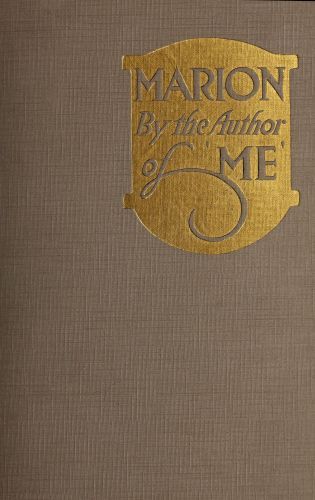
The Project Gutenberg eBook of Marion: The Story of an Artist's Model
Title: Marion: The Story of an Artist's Model
Author: Onoto Watanna
Illustrator: Henry Hutt
Release date: September 17, 2018 [eBook #57920]
Most recently updated: January 24, 2021
Language: English
Credits: Produced by Mary Glenn Krause, Chuck Greif, amsibert and
the Online Distributed Proofreading Team at
http://www.pgdp.net (This file was produced from images
generously made available by The Internet Archive/American
Libraries.)
MARION
|
CONTENTS: (In certain versions of this etext [in certain browsers]
clicking on the image will bring up a larger version.) |
MARION
THE STORY OF AN ARTIST’S MODEL
BY
Herself and the Author of “Me”
Illustrations by
HENRY HUTT
New York
W. J. Watt & Company
PUBLISHERS
Copyright, 1916, by
W. J. WATT & COMPANY
PRESS OF
BRAUNWORTH & CO.
PRINTERS AND BOOKBINDERS
BROOKLYN, N. Y.
MARION
THE STORY OF AN ARTIST’S MODEL
I
“IN dat familee dere are eleven cheeldren, and more—they come! See dat leetle one? She is très jolie! Oui, très jolie, n’est-ce pas? De father he come from Eengland about ten year ago. He was joost young man, mebbe twenty-seven or twenty-eight year ol’, and he have one leetle foreign wife and six leetle cheeldren. They were all so cold. They were not use to dis climate of Canada. My wife and I, we keep de leetle ’otel at Hochelaga, and my wife she take all dose leetle ones and she warm dem before the beeg hall stove, and she make for dem the good French pea-soup.”
Mama had sent me to the corner grocer to buy some things. Monsieur Thebeau, the grocer, was talking, and to a stranger. I felt ashamed and humiliated to hear our family thus discussed. Why should we always be pointed out in this way and made to feel conspicuous and freaky? It was horrid that the size of our family and my mother’s nationality should be told to everyone by that corner grocer. I glared haughtily at Monsieur Thebeau, but he went garrulously on, regardless of my discomfiture.
“De eldest—a boy, monsieur—he was joost nine year old, and my wife she call him, ‘Le petit père.’ His mother she send him out to walk wiz all hees leetle sisters, and she say to him: ‘Charles, you are one beeg boy, almost one man, and you must take care you leetle sisters; so, when de wind she blow too hard, you will walk you on de side of dat wind, and put yourself between it and your sisters.’ ‘Yes, mama,’ il dit. And we, my wife and I, we look out de window, and me? I am laugh, and my wife, she cry—she have lost her only bebby, monsieur—to see dat leetle boy walk him in front of his leetle sisters, open hees coat, comme ça, monsieur, and spread it wiz hees hands, to make one shield to keep de wind from his sisters.”
The man to whom Monsieur Thebeau had been speaking, had turned around, and was regarding me curiously. I felt abashed and angry under his compelling glance. Then he smiled, and nodding his head, he said:
“You are right. She is pretty—quite remarkably pretty!”
I forgot everything else. With my little light head and heart awhirl, I picked up my packages and ran out of the store. It was the first time I had been called pretty, and I was just twelve years old. I felt exhilarated and utterly charmed.
When I reached home, I deposited the groceries on a table in the kitchen and ran up to my room. Standing on a chair, I was able to see my face in the oval mirror that topped a very high and scratched old chiffonier. I gazed long and eagerly at the face I had often heard Monsieur Thebeau say was “très jolie,” which French words I now learned must mean: “Pretty—quite remarkably pretty!” as had said that Englishman in the store.
Was I really pretty then? Surely the face reflected there was too fat and too red. My! my cheeks were as red as apples. I pushed back the offending fat with my two hands, and I opened my eyes wide and blinked them at myself in the glass. Oh! if only my hair were gold! I twisted and turned about, and then I made grimaces at my own face.
Suddenly I was thrilled with a great idea—one that for the moment routed my previous ambition to some day be an artist, as was my father. I would be an actress! If I were pretty, and both that Frenchman and Englishman had said so, why should I not be famous?
I slipped into mama’s room, found a long skirt, and put it on me; also a feather which I stuck in my hair. Then, fearing detection, I ran out on tiptoe to the barn. There, marching up and down, I recited poems. I was pausing, to bow elaborately to the admiring audience, which, in my imagination, was cheering me with wild applause, when I heard mama’s voice calling to me shrilly:
“Marion! Marion! Where in the world is that girl?”
“Coming, mama.”
I divested myself hastily of skirt and feather, and left the barn on a run for the house. Here mama thrust our latest baby upon me, with instructions to keep him quiet while she got dinner. I took that baby in my arms, but I was still in that charmed world of dreams, and in my hand I clasped a French novel, which I had filched from my brother Charles’ room. Charles at this time was twenty years of age, and engaged to be married to a girl we did not like.
I tried to read, but that baby would not keep still a minute. He wriggled about in my lap and reached a grimy hand after my book. Irritated and impatient, I shook him, jumped him up and down, and then, as he still persisted, I pinched him upon the leg. He simply yelled. Mama’s voice screamed at me above the baby’s:
“If you can’t take better care of that baby, and keep him quiet, you shall not be allowed to paint with your father this afternoon, but shall sit right here and sew,” a punishment that made me put down the book, and amuse the baby by letting him pull my hair, which seemed to make him supremely happy, to judge from his chuckles and shouts of delight.
After dinner, which we had at noon, I received the cherished permission, and ran along to papa’s room. Dear papa, whose gentle, sensitive hands are now at rest! I can see him sitting at his easel, with his blue eyes fixed absently upon the canvas before him. Papa, with the heart and soul of a great artist, “painting, painting,” as he would say, with a grim smile, “pot-boilers to feed my hungry children.”
I pulled out my paints and table, and began to work. From time to time I spoke to papa.
“Say, papa, what do I use for these pink roses?”
“Try rose madder, white and emerald green—a little naples yellow,” answered papa patiently.
“Papa, what shall I use for the leaves?”
“Oh, try making your greens with blues and yellows.”
From time to time I bothered him. By and by, I tired of the work, and getting up with a clatter, I went over and watched him. He was painting cool green waves dashing over jagged rocks, from a little sketch he had taken down at Lachine last summer.
“Tell me, papa,” I said after a moment, “if I keep on learning, do you think I will ever be able to earn my living as an artist?”
“Who? What—you? Oh!” Absently papa blew the smoke about his head, gazed at me, but did not seem to see me. He seemed to be talking rather to himself, not bitterly, but just sadly:
“Better be a dressmaker or a plumber or a butcher or a policeman. There is no money in art!”
II
NEXT to our garden, separated only by a wooden fence, through which we children used to peep, was the opulent and well-kept garden of Monsieur Prefontaine, who was a very important man, once Mayor of Hochelaga, the French quarter of Montreal, in which we lived. Madame Prefontaine, moreover, was an object of unfailing interest and absorbing wonder to us children. She was an enormously fat woman, and had once taken a trip to New York City, to look for a wayward sister. There she had been offered a job as a fat woman for a big circus. Madame Prefontaine used to say to the neighbors, who always listened to her with great respect:
“Mon dieu! That New York—it is one beeg hell! Never do I feel so hot as in dat terrible city! I feel de grease it run all out of me! Mebbe, eef I stay at dat New York, I may be one beeg meelionaire—oui! But, non! Me? I prefer my leetle home, so cool and quiet in Hochelaga than be meelionaire in dat New York, dat is like purgatory.”
We had an old straggly garden. Everything about it looked “seedy” and uncared for and wild, for we could not afford a gardener. My sisters and I found small consolation in papa’s stout assertion that it looked picturesque, with its gnarled old apple trees and shrubs in their natural wild state. I was sensitive about that garden. It was awfully poor-looking in comparison with our neighbors’ nicely kept places. It was just like our family, I sometimes treacherously thought—unkempt and wild and “heathenish.” A neighbor once called us that. I stuck out my tongue at her when she said it. Being just next to the fine garden of Monsieur Prefontaine, it appeared the more ragged and beggarly, that garden of ours.
Mama would send us children to pick the maggots off the currant bushes and the bugs off the potato plants and, to encourage us, she would give us one cent for every pint of bugs or maggots we showed her. I hated the bugs and maggots, but it was fascinating to dig up the potatoes. To see the vegetables actually under the earth seemed almost like a miracle, and I would pretend the gnomes and fairies put them there, and hid inside the potatoes. I once told this to my little brothers and sisters, and Nora, who was just a little tot, wouldn’t eat a potato again for weeks, for fear she might bite on a fairy. Most of all, I loved to pick strawberries, and it was a matter of real grief and humiliation to me that our own strawberries were so dried-up looking and small, as compared with the big, luscious berries I knew were in the garden of Monsieur Prefontaine.
On that day, I had been picking strawberries for some time, and the sun was hot and my basket only half full. I kept thinking of the berries in the garden adjoining, and the more I thought of them, the more I wished I had some of them.
It was very quiet in our garden. Not a sound was anywhere, except the breezes, making all kinds of mysterious whispers among the leaves. For some time, my eye had become fixed, fascinated, upon a loose board, with a hole in it near the ground. I looked and looked at that hole, and I thought to myself: “It is just about big enough for me to crawl through.” Hardly had that thought occurred to me, when down on hands and knees I dropped, and into the garden of the great Monsieur Prefontaine I crawled.
The strawberry beds were right by the fence. Greedily I fell upon them. Oh, the exquisite joy of eating forbidden fruit! The fearful thrills that even as I ate ran up and down my spine, as I glanced about me on all sides. There was even a wicked feeling of fierce joy in acknowledging to myself that I was a thief.
“Thou shalt not steal!” I repeated the commandment that I had broken even while my mouth was full, and then, all of a sudden, I heard a voice, one that had inspired me always with feelings of respect and awe and fear.
“How you get in here?”
Monsieur Prefontaine was towering sternly above me. He was a big man, bearded, and with a face of preternatural importance and sternness.
I got up. My legs were shaky, and the world was whirling about me. I thought of the jail, where thieves were taken, and a great terror seized me. Monsieur Prefontaine had been the Mayor of Hochelaga. He could have me put in prison for all the rest of my life. We would all be disgraced.
“Well? Well? How you get in here?” demanded Monsieur Prefontaine.
“M’sieu, I—I-crawled in!” I stammered, indicating the hole in the fence.
“Bien! Crawl out, madame!”
“Madame” to me, who was but twelve years old!
“Crawl out!” commanded Monsieur, pointing to the hole, and feeling like a worm, ignominiously, under the awful eye of that ex-mayor of Hochelaga, on hands and knees and stomach, I crawled out.
Once on our side, I felt not the shame of being a thief so much as the degradation of crawling out with that man looking.
Feeling like a desperate criminal, I swaggered up to the house, swinging my half-filled basket of strawberries. As I came up the path, Ellen, a sister just two years older than I, put her head out of an upper window and called down to me:
“Marion, there’s a beggar boy coming in at the gate. Give him some of that stale bread mama left on the kitchen table to make a pudding with.”
The boy was about thirteen, and he was a very dirty boy, with hardly any clothes on him. As I looked at him, I was thrilled with a most beautiful inspiration. I could regenerate myself by doing an act of lovely charity.
“Wait a minute, boy.”
Disregarding the stale bread, I cut a big slice of fresh, sweet-smelling bread that Sung Sung, our one very old Chinese servant, had made that day. Heaping it thick with brown sugar, I handed it to the boy.
“There, beggar boy,” I said generously, “you can eat it all.”
He took it with both hands, greedily, and now as I looked at him another, a fiendish, impulse seized me. Big boys had often hit me, and although I had always fought back as valiantly and savagely as my puny fists would let me, I had always been worsted, and had been made to realize the weakness of my sex and age. Now as I looked at that beggar boy, I realized that here was my chance to hit a big boy. He was smiling at me gratefully across that slice of sugared bread, and I leaned over and suddenly pinched him hard on each of his cheeks. His eyes bulged with amazement, and I still remember his expression of surprise and pained fear. I made a horrible grimace at him and then ran out of the room.
III
THERE was a long, bleak period, when we knew acutely the meaning of what papa wearily termed “Hard Times.” Even in “Good Times” there are few people who buy paintings, and no one wants them in Hard Times.
Then descended upon Montreal a veritable plague. A terrible epidemic of smallpox broke out in the city. The French and not the English Canadians were the ones chiefly afflicted, and my father set this down to the fact that the French Canadians resisted vaccination. In fact, there were anti-vaccination riots all over the French quarter, where we lived.
And now my father, in this desperate crisis, proved the truth of the old adage that “Blood will tell.” Ours was the only house on our block, or for that matter the surrounding blocks, where the hideous, yellow sign, “PICOTTE” (smallpox), was not conspicuously nailed upon the front door, and this despite the fact that we were a large family of children. Papa hung sheets all over the house, completely saturated with disinfectants. Every one of us children was vaccinated, and we were not allowed to leave the premises. Papa himself went upon all the messages, even doing the marketing.
He was not “absent-minded” in those days, nor in the grueling days of dire poverty that followed the plague. Child as I was, I vividly recall the terrors of that period, going to bed hungry, my mother crying in the night and my father walking up and down, up and down. Sometimes it seemed to me as if papa walked up and down all night long.
My brother Charles, who had been for some time our main support, had married (the girl we did not like) and although he had fervently promised to continue to contribute to the family’s support, his wife took precious care that the contribution should be of the smallest, and she kept my brother, as much as she could, from coming to see us.
A day came when, with my mother and it seemed all of my brothers and sisters, I stood on a wharf waving to papa on a great ship. There he stood, by the railing, looking so young and good. Papa was going to England to try to induce grandpa—that grandfather we had never seen—to help us. We clung about mama’s skirts, poor little mama, who was half distraught and we all kept waving to papa, with our hats and hands and handkerchiefs and calling out:
“Good-bye, papa! Come back! Come back soon!” until the boat was only a dim, shadowy outline.
The dreadful thought came to me that perhaps we would never see papa again! Suppose his people, who were rich and grand, should induce our father never to return to us!
I had kept back my tears. Mama had told us that none of us must let papa see us cry, as it might “unman” him, and she herself had heroically set the example of restraining her grief until after his departure. Now, however, the strain was loosened. I fancied I read in my brothers’ and sisters’ faces—we were all imaginative and sensitive and excitable—my own fears. Simultaneously we all began to cry.
Never will I forget that return home, all of us children crying and sobbing, and mama now weeping as unconcealedly as any of us, and the French people stopping us on the way to console or commiserate with us; but although they repeated over and over:
“Pauvre petites enfants! Pauvre petite mère!” I saw their significant glances, and I knew that in their minds was the same treacherous thought of my father.
But papa did return! He could have stayed in England, and, as my sister Ada extravagantly put it, “lived in the lap of luxury,” but he came back to his noisy, ragged little “heathens,” and the “painting, painting of pot-boilers to feed my hungry children.”
IV
“MONSIEUR DE ST. VIDAL is ringing the doorbell,” called Ellen, “why don’t you open the door, Marion? I believe he has a birthday present for you in his hand.”
It was my sixteenth birthday, and Monsieur de St. Vidal was my first beau! He was a relative of our neighbors, the Prefontaines, and I liked him pretty well. I think I chiefly liked to be taken about in his stylish little dogcart. I felt sure all the other girls envied me.
“You go, Ellen, while I change my dress.”
I was anxious to appear at my best before St. Vidal. It was very exciting, this having a beau. I would have enjoyed it much more, however, but for the interfering inquisitiveness of my sisters, Ada and Ellen, who never failed to ask me each time I had been out with him, whether he had “proposed” yet or not.
Ellen was running up the stairs, and now she burst into our room excitedly, with a package in her hand.
“Look, Marion! Here’s your present. He wouldn’t stop—just left it, and he said, with such a Frenchy bow—whew! I don’t like the French!—‘Pour Mamselle Marion, avec mes compliments!’” and Ellen mimicked St. Vidal’s best French manner and voice.
I opened the package. Oh, such a lovely box of paints—a perfect treasure!
“Just exactly what I wanted!” I cried excitedly, looking at the little tubes, all shiny and clean, and the new brushes and palette.
Ada was sitting reading by the window, and now she looked up and said:
“Oh, did that French wine merchant give that to Marion?”
She cast a disparaging glance at the box, and then, addressing Ellen, she continued:
“Marion is disgustingly old for sixteen, but, of course, if he gives her presents” (he had never given me anything but candy before) “he will propose to her, I suppose. Mama married at sixteen, and I suppose some people—” Ada gave me another look that was anything but approving—“are in a hurry to get married. I shall never marry till I am twenty-five!” Ada was twenty.
This time, Ellen, who was eighteen, got the condemning look. Ellen was engaged to be married to an American editor, who wrote to her every day in the week and sometimes telegraphed. They were awfully in love with each other. Ellen said now:
“Oh, he’ll propose all right. Wallace came around a whole lot, you know, before he actually popped.”
“Well, maybe so,” said Ada, “but I think we ought to know that French wine merchant’s intentions pretty soon. I’ll ask him if you like,” she volunteered.
“No, no, don’t you dare!” I protested.
“Well,” said Ada, “if he doesn’t propose to you soon, you ought to stop going out with him. It’s bad form.”
I wished my sisters wouldn’t interfere in my affairs. They nagged me everlastingly about St. Vidal, and it made me conscious when I was with him. They acted like self-appointed monitors. The minute I would get in, they would begin:
“Well, did he propose?” and I would feel ashamed to be obliged to admit, each time, that he had not. Ada had even made some suggestions of how I might “bring him to the point.” She said men had to be led along like sheep. Ellen, however, had warmly vetoed those suggestions, declaring stoutly that Wallace, her sweetheart, had needed no prodding. In fact, he had most eloquently and urgently pleaded his own suit, without Ellen “putting out a finger” to help him, so she said.
That evening St. Vidal called and took me to the rink, and I enjoyed myself hugely. He was a graceful skater, and so was I, and I felt sure that everyone’s eye was upon us. I was very proud of my “beau,” and I secretly wished that he was blond. I did prefer the English type. However, conscious of what was expected of me by my sisters, I smiled my sweetest on St. Vidal, and by the time we started for home, I realized, with a thrill of anticipation, that he was in an especially tender mood. He helped me along the street carefully and gallantly.
It was a clear, frosty night, and the snow was piled up as high as our heads on each side of the sidewalks. Suddenly St. Vidal stopped, and drawing my hand through his arm, he began, with his walking stick, to write upon the snow:
“Madame Marion de St. Vida—”
Before he got to the “l,” I was seized with panic. I jerked my hand from his arm, took to my heels and ran all the way home.
Now it had come—that proposal, and I did not want it. It filled me with embarrassment and fright. When I got home, I burst into Ada’s room, and gasped:
“It’s done! He did propose! B-but I said—I said—” I hadn’t said anything at all.
“Well?” demanded Ada.
“Why, I’m not going to, that’s all,” I said.
Ada returned to the plaiting of her hair. Then she said sceptically:
“Hm, that’s very queer. Are you sure he proposed, because I heard he was all the time engaged to a girl in Côte des Neiges.”
“Oh, Ada,” I cried, “do you suppose he’s a bigamist? I think I’m fortunate to have escaped from his snare!”
The next day Madame Prefontaine told mama that St. Vidal had said he couldn’t imagine what in the world I had run away suddenly from him like that for, and he said:
“Maybe she had a stomach ache.”
V
“ELLEN, don’t you wish something would happen?”
Ellen and I were walking up and down the street near the English church.
“Life is so very dull and monotonous,” I went on. “My! I would be glad if something real bad happened—some sort of tragedy. Even that is better than this deadness.”
Ellen looked at me, and seemed to hesitate.
“Yes, it’s awful to be so poor as we are,” she answered, “but what I would like is not so much money as fame, and, of course, love. That usually goes with fame.”
Ellen’s fiancé was going to be famous some day. He was in New York, and had written a wonderful play. As soon as it was accepted, he and Ellen were to be married.
“Well, I tell you what I’d like above everything else on earth,” said I sweepingly. “I would love to be a great actress, and break everybody’s heart. It must be perfectly thrilling to be notorious, and we certainly are miserable girls!”
We were chewing away with great relish the contents of a bag of candy.
“Anyhow,” said Ellen, “you seem to be enjoying that candy,” and we both giggled.
Two men were coming out of the side door of the church. Attracted by our laughter, they came over directly to us. One of them we knew well. He was Jimmy McAlpin, the son of a fine old Scotch, very rich, lady, who had always taken an especial interest in our family. Jimmy, though he took up the collection in church, had been, so I heard the neighbors whisper to mama, once very dissipated. He had known us since we were little girls, and always teased us a lot. He would come up behind me on the street and pull my long plait of hair, saying:
“Oh, pull the string, gentlemen and ladies, and the figure moves!”
Now he came smilingly up to us, followed by his friend, a big, stout man, with a military carriage and gray mustache. I recognized him, too, though we did not know him. He was a very rich and important citizen of our Montreal. Of him also I had heard bad things. People said he was “fast.” That was a word they always whispered in Montreal, and shook their heads over, but whenever I heard it, its very mystery and badness somehow thrilled me. Ada said there was a depraved and low streak in me, and I guiltily admitted to myself that she was right.
“What are you girls laughing about?” asked Jimmy, a question that merely brought forth a fresh accession of giggles.
Colonel Stevens was staring at me, and he had thrust into his right eye a shining monocle. I thought him very grand and distinguished-looking, much superior to St. Vidal. Anyway we were tired of the French, having them on all sides of us, and, as I have said, I admired the blond type of men. Colonel Stevens was not exactly blond, for his hair was gray (he was bald on top, though his hat covered that), but he was typically British, and somehow the Englishmen always appeared to me much superior to our little French Canucks, as we called them.
Said the Colonel, pulling at his mustache:
“A laughing young girl in a pink cotton frock is the sweetest thing on earth.”
I had on a pink cotton frock, and I was laughing. I thought of what I had heard Madame Prefontaine say to mama—in a whisper:
“He is one dangerous man—dat Colonel Steven, and any woman seen wiz him will lose her reputation.”
“Will I lose mine?” I asked myself. I must say my heart beat, fascinated with the idea.
Something now was really happening, and I was excited and delighted.
“Can’t we take the ladies—” I nudged Ellen—“some place for a little refreshment,” said the Colonel.
“No,” said Ellen, “mama expects us home.”
“Too bad,” murmured the Colonel, very much disappointed, “but how about some other night? To-morrow, shall we say?” Looking at me, he added: “May I send you some roses, just the color of your cheeks?”
I nodded from behind Ellen’s back.
“Come on,” said Ellen brusquely, “we’d better be getting home. You know you’ve got the dishes to do, Marion.”
She drew me along. I couldn’t resist looking back, and there was that fascinating Colonel, standing stock-still in the street, still pulling at his mustache, and staring after me. He smiled all over, when I turned, and blew me an odd little kiss, like a kind of salute, only from his lips.
That night, when Ellen and I were getting ready for bed, I said:
“Isn’t the Colonel thrillingly handsome though?”
“Ugh! I should say not,” said Ellen. “Besides he’s a married man, and a flirt.”
“Well, I guess he doesn’t love his old wife,” said I.
“If she is old,” said Ellen, “so is he—maybe older. Disgusting.”
All next day I waited for that box of roses, and late in the afternoon, sure enough, it came, and with it a note:
“Dear Miss Marion:
Will you and your charming sister take a little drive with me and a friend this evening? If so, meet us at eight o’clock, corner of St. James and St. Denis streets. My friend has seen your sister in Judge Laflamme’s office” (Ellen worked there) “and he is very anxious to know her. As for me, I am thinking only of when I shall see my lovely rose again. I am counting the hours!
Devotedly,
Fred Stevens.”
The letter was written on the stationery of the fashionable St. James Club. Now I was positive that Colonel Stevens had fallen in love with me. I thought of his suffering because he could not marry me. In many of the French novels I had read men ran away from their wives, and, I thought: “Maybe the Colonel will want me to elope with him, and if I won’t, perhaps, he will kill himself,” and I began to feel very sorry to think of such a fine-looking soldierly man as Colonel Stevens killing himself just because of me.
When I showed Ellen the letter, after she got home from work, to my surprise and delight, she said:
“All right, let’s go. A little ride will refresh us, and I’ve had a hard week of it, but better not let mama know where we’re going. We’ll slip out after supper, when she’s getting the babies to sleep.”
Reaching the corner of St. James and St. Denis Streets that evening, we saw a beautiful closed carriage, with a coat of arms on the door, and a coachman in livery jumped down and opened the door for us. We stepped in. With the Colonel was a middle-aged man, with a dry, yellowish face and a very black—it looked dyed—mustache.
“Mr. Mercier,” said the Colonel, introducing us.
“Oh,” exclaimed Ellen, “are you the Premier?”
“Non, non, non,” laughed Mr. Mercier, and turning about in the seat, he began to look at Ellen and to smile at her, until the ends of his waxed mustache seemed to jump up and scratch his nose. Colonel Stevens had put his arm just at the back of me, and as it slipped down from the carriage seat to my waist, I sat forward on the edge of the seat. I didn’t want to hurt his feelings by telling him to take his arm down, and still I didn’t want him to put it around me. Suddenly Ellen said:
“Marion, let’s get out of this carriage. That beast there put his arm around me, and he pinched me, too.” She indicated Mercier.
She was standing up in the carriage, clutching at the strap, and she began to tap upon the window, to attract the attention of the coachman. Mr. Mercier was cursing softly in French.
“Petite folle!” he said, “I am not meaning to hurt you—joost a little loving. Dat is all.”
“You ugly old man,” said Ellen, “do you think I want you to love me? Let me get out!”
“Oh, now, Miss Ellen,” said the Colonel, “that is too rude. Mr. Mercier is a gentleman. See how sweet and loving your little sister is.”
“No, no,” I cried, “I am not sweet and loving. He had no business to touch my sister.”
Mr. Mercier turned to the Colonel.
“For these children did you ask me to waste my time?” and putting his head out of the carriage, he simply roared:
“Rue Saint Denis! Sacré!”
They set us down at the corner of our street. When we got in a friend of papa’s was singing to mama and Ada in the parlor:
When the lights are dim and low.”
He was one of many Englishmen, younger sons of aristocrats, who, not much good in England, were often sent to Canada. They liked to hang around papa, whose family most of them knew. This young man was a thin, harmless sort of fellow, soft-spoken and rather silly, Ellen and I thought; but he could play and sing in a pretty, sentimental way and mama and Ada would listen by the hour to him. He liked Ada, but Ada pretended she had only an indifferent interest in him. His father was the Earl of Albemarle, and Ellen and I used to make Ada furious by calling her “Countess,” and bowing mockingly before her.
Walking on tiptoe, Ellen and I slipped by the parlor door, and up to our own room. That night, after we were in bed, I said to Ellen:
“You know, I think Colonel Stevens is in love with me. Maybe he will want me to elope with him. Would you if you were me?”
“Don’t be silly. Go to sleep,” was Ellen’s cross response. She regretted very much taking that ride, and she said she only did it because she got so tired at the office all day, and thought a little ride would be nice. She had no idea, she said, that those “two old fools” would act like that.
I was not going to let Ellen go to sleep so easily, however.
“Listen to this,” I said, poking her to keep her awake. “This is Ella Wheeler Wilcox, Ellen, and they call her the Poet of Passion.” Ellen groaned, but she had to listen: