
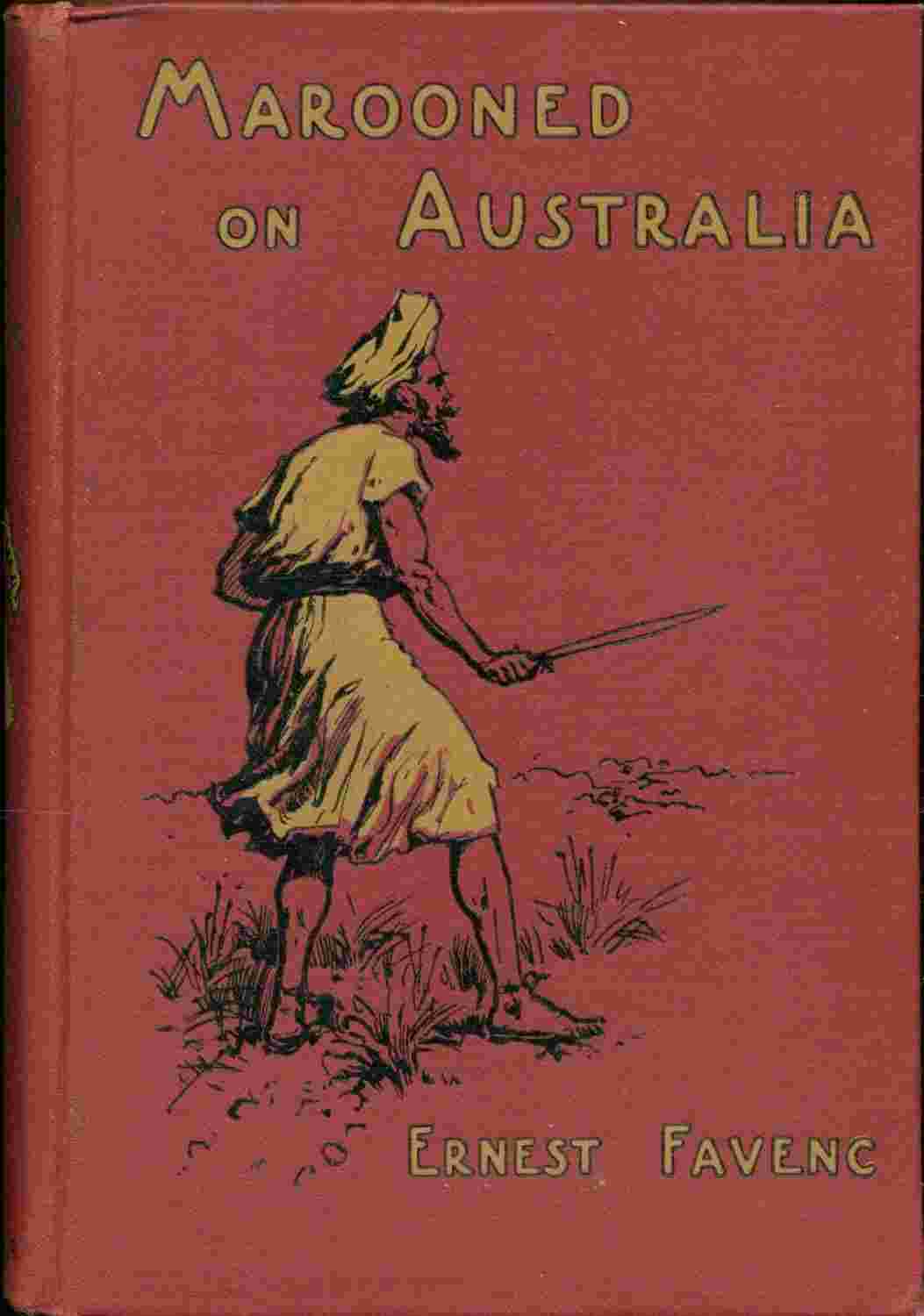
The Project Gutenberg eBook of Marooned on Australia
Title: Marooned on Australia
being the narration by Diedrich Buys of his discoveries and exploits in Terra Australis Incognita about the year 1630 / by Ernest Favenc
Author: Ernest Favenc
Illustrator: Percy F. S. Spence
Release date: April 17, 2023 [eBook #70575]
Language: English
Original publication: United Kingdom: Blackie and Son Limited, 1896
Credits: Al Haines, Chuck Greif and the Online Distributed Proofreading Team at https://www.pgdp.net
Marooned on Australia
HIS DISCOVERIES AND EXPLOITS IN TERRA
AUSTRALIS INCOGNITA ABOUT THE YEAR 1630
BY
ERNEST FAVENC
Author of
“Tales of the Austral Tropics” “The Secret of the Australian Desert”
“The History of Australian Exploration” &c.
BLACKIE AND SON LIMITED
LONDON GLASGOW AND BOMBAY
Dedicated to the Memory of my Friend
Edmond Marin de la Meslee”
lost both an ardent geographer and an
enthusiastic student of the history of
the Austral Continent.
ERNEST FAVENC
PREFACE.
IN the following romance I have endeavoured to associate the tradition of De Gonneville’s visit to Australia with the historical fact of the wreck of the Batavia, and the marooning of two of the mutineers. The wreck of the Batavia is perhaps one of the most murderous tragedies that ever happened in any part of the world. One of the ruffians confessed, before being hanged, to having killed and assisted to kill, twenty-five defenceless people. A full account of the wreck and the massacre will be found in Pinkerton’s Early Voyages.
I have taken a liberty with history in introducing Captain Sharpe, the buccaneer, as in reality he never visited the Australian coast, although some of his crew did. I must also confess to having taken some freedom with chronology as, under the name of Hoogstraaten, I have introduced Abel Janz Tasman many years before his actual advent on the western coast of Australia; and De Witt’s voyage of discovery really took place before the wreck of the Batavia. I trust, however, that in a romance these inaccuracies will be pardoned.
In the appendix the reader will find an account of the setting up of the great Cross by De Gonneville, and the record of Sir George Grey regarding the head carved on the Rock.
CONTENTS
ILLUSTRATIONS
MAROONED ON AUSTRALIA
CHAPTER I
The Wreck of the Batavia—The Mutiny—Return of Pelsart—Marooned.
JEROM CORNELIS! Even now after all the suffering and danger I have gone through, that man’s face, the face of the tempter, comes back to me as vividly as ever.
My father was a substantial merchant of Harlem, and in that town I was born, being the second son. That was the age of discovery, and the thirst for it was inherent in nearly every youth. The wonderful success of the Dutch East India Company had fired all men with enthusiasm, and as I grew towards manhood, I longed to make one of the many bands of adventurers who often left for the East. So persistent did I become that my father at last consented to my going, thinking that a voyage would probably cure me. Having some influence with several of the directors of the great company, he obtained for me a subordinate position as clerk to the supercargo on board of the Batavia, one of a fleet of eleven ships about to sail from the Texel to Java.
Jerom Cornelis was the supercargo. He had been an apothecary in Harlem, and as such I had known him for some time. He was a man of ability and education, and I had a boyish admiration for him. Now I know him to have been a man whose talents were marred by an intense, almost childish vanity, and a disposition, cruel and relentless as the tiger’s. As a lad of eighteen, I saw nothing but the wonderful fascination he exercised, and listened entranced when he dazzled my imagination with pictures of future greatness in the rich islands of the eastern seas.
Our voyage was a stormy one, and as the Batavia had over two hundred souls on board, the discomfort was great. I shared a cabin with Cornelis, and in every way that singular man strove to win my affection. Why he did so I cannot say even to this day.
We had been nearly two months at sea, when Cornelis confided to me a plan he had formed, in conjunction with the pilot and some other mutinous spirits, to seize the ship and turn pirate. I endeavoured to dissuade him, but without avail; he bound me over to secrecy and assured me that my life was safe whatever happened, as he would not allow me to take an active part in it, which I certainly had no intention of doing. The plot, however, was frustrated by the weather and other causes, and although I am certain it came to the ears of our commander, Captain Pelsart, he did not, unfortunately, hang the mutineers out of hand as one would have expected from a man of his determination.
Now one would have thought that this would have revealed to me the true character of Cornelis, but such an infatuated fool was I, and so beguiled by his specious tongue, that I still remained his friend and admirer.
We had now doubled the great southern cape, and storm after storm burst upon us with relentless fury. One by one we lost sight of our consorts and at last found ourselves alone; driven out of our course into an unknown sea.
To add to our distress, Captain Pelsart was confined to his berth with sickness and the vessel was in charge of the pilot, who apparently lost all reckoning. It was on the morning of the 4th June, 1629, for the date is indelibly engraven on my memory, that our voyage was brought to a fatal termination by the vessel striking on a reef of rocks. When I got on deck there was nothing visible but white surf and foam everywhere, and we had to wait until daylight, the ship bumping heavily meanwhile.
Daybreak showed us to be in the neighbourhood of a group of rocky islands, one of which was close to us. Finding that the ship was irretrievably damaged Captain Pelsart proceeded to land the passengers and crew on the nearest island. Great confusion ensued and many of the sailors broached some casks of wine in the cargo and got drunk. Provisions were landed, but very little water, and as none could be found on the island, our captain, after two days, started with a boat’s crew to the mainland, which we could see in the distance and which was supposed to be the mysterious continent known as Terra Australis.
I had been separated from Cornelis in the turmoil of the wreck, and indeed it was not until the Batavia was utterly broken up that he came ashore almost dead. He had been floating for two days on the topmast of the ship, carried backwards and forwards by the current, until at last he drifted near enough to gain the land.
On regaining strength he assumed command, in the absence of the captain, and in spite of all the bloody deeds of that guilty man I will say that he restored some sort of order amongst the demoralized crew and passengers. One of the petty officers named Weberhayes was despatched with some thirty men or more, including some French soldiers in the pay of the Company, to a large island visible to the eastward. If successful in finding water he was to light two fires. The water supply consisting only of rain in the holes in the rock, another smaller party were conveyed to a neighbouring islet.
All this was done in furtherance of a plan maturing in the mind of Cornelis. He retained about him all the ruffians on whom he could rely when the time came to act. This soon arrived. For Pelsart not returning Cornelis threw off the mask. He assembled all his followers at a meeting at which I was forced to attend, and here they all swore a solemn oath to stand by each other, and if Pelsart had gone on to Java and returned with a ship they would endeavour to capture it, if not they would build one out of the remains of the Batavia, and start north on a piratical cruise. But first, the mouths of those who could not be trusted had to be silenced for ever.
That night I was awakened by shrieks, groans, and cries for mercy. Cornelis and his myrmidons were butchering in cold blood the helpless people whom they had not admitted to the conspiracy.
I could do nothing during that night of horror, but try and close my ears to the piteous cries of the victims. Nest morning, with their lust for murder still unsated, they went over to the small island and recommenced their fiendish work on the defenceless people. Unfortunately for Cornelis, however, some few escaped and during the night succeeded in making a raft and crossing to the large island, where Weberhayes and his party were. They informed him of the butchery that had taken place and put him on his guard.
The vanity of Cornelis now got the ascendency of him. He had himself proclaimed Governor-general of the barren, rocky islet we were on, which was christened “Batavia’s Grave”. He had the merchants’ chests broken open, and from the stuffs contained therein uniforms were made for a chosen body-guard. This being done, it was determined to exterminate Weberhayes and his men.
Not knowing of the escape of some of the victims, they rowed up confidently, expecting to take the party by surprise, but were surprised themselves. Weberhayes and his followers, armed only with such rude weapons as clubs and stones, fell upon them suddenly, killed some, and forced the others to make a hasty retreat.
Incensed at this repulse, Cornelis led a fresh assault in person and I was ordered into the boat. I had no stomach for the fight, and did not feel particularly sorry when we got more soundly beaten than before.
Weberhayes’ party now had arms, taken from the dead mutineers, and Cornelis resorted to treachery. He sent the chaplain, whose life had been spared, to negotiate; and meanwhile he tried to bribe the French soldiers with some of the treasure of the Batavia, but they were loyal and at once reported the matter to Weberhayes. A truce was then agreed on. Cornelis was to send over some provisions and receive water in return, of which there was a permanent supply on the island. Weberhayes, however, rightly mistrusted Cornelis and was on his guard; so when a sudden attack was made he was prepared, and not only beat them off with loss, but captured Cornelis.
This was the end of the rebel Governor-general. I never saw Cornelis again until the rope was round his neck.
Now commenced on the island I was on, called “Batavia’s Grave”, a wild pandemonium. There were still some casks of wine left, and the ruffians drank and quarrelled, and fought with knives over useless pieces of silver. With the capture of Cornelis every semblance of a plan seemed to have vanished. Never shall I forget the horror of that time, although I have seen blood flow like water since. Five wretched women who had been spared from the massacre, two of them being the daughters of the chaplain, were stabbed to death by these devils, and how I escaped a knife through my heart I know not.
At last one morning a sail was in sight, and aided by a fair wind a large ship came swiftly on and soon dropped anchor half-way between the island of Weberhayes and “Batavia’s Grave”. Hastily arming themselves a large boat’s crew from our island started to board the ship. Weberhayes was, however, before them. As Pelsart—for it was he with the Sardam frigate—left the ship, intending to land, he was intercepted by Weberhayes who told him the true state of the case. They returned on board and awaited the coming of the other boat. The mutineers, in their gaudy uniforms, were allowed to come well within range. They were then hailed and ordered to drop their weapons overboard and come on board; which they did, and were at once put in irons. Pelsart then landed, but the rest made no resistance and were secured, I being amongst them.
We were kept close prisoners on the island for many days whilst the sailors of the Sardam tried to recover the treasure lost in the Batavia. Then one day we were taken on board. Some of us were interrogated, some not. I had to confess that I had accompanied one of the armed boats which attacked Weberhayes. There was a short consultation in the cabin, then the deadly work of retribution commenced. One after another the murderers were run up to the yard-arm, and then their bodies were thrown into the sea. Cornelis was hung from a higher yard than the others, in acknowledgment of his leadership. They all died sullenly and defiantly.
As I expected a like death, and had now become used to scenes of bloodshed, I looked on in apathetic despair. At last when it seemed that my turn had come, for there was nobody but myself and a sailor named Paul left, the executions ended; for the ropes were unreeved from the blocks, the anchor raised, some sails set, and the ship stood in for the mainland. Not a word was said to either of us. Paul was an old sailor, and one who had kept his hands as free from bloodshed as possible. He looked inquiringly at me, but I could only do the same to him. Neither of us knew what this meant.
When within a short distance of the land the ship hove to, and a boat was lowered. Our irons were struck off, and we were ordered to get in. A short row took us to a spot where there was easy landing on a beach, sheltered by a rocky reef which broke the surf. When the boat grounded we were ordered out; a couple of bags of biscuit, a breaker of fresh water, a tomahawk, and a cutlass were passed on to the beach. As the sailor who placed these things down stooped near me he whispered something that gave me a clue to our fate. He was one of Pelsart’s men and came from my native town of Harlem. The boat’s crew shipped their oars and pulled rapidly back to the Sardam.
Paul muttered a terrible curse and looked at me. There was no longer any doubt. We were marooned on the coast of the great unknown South Land. To die at the hands of the giant savages said to inhabit it, or the more dreadful strange beasts. What the friendly sailor had whispered to me was, “Keep your heart up. Ships may be round here soon.”[A]
So far as I know they never came; when the Sardam’s masts sank beneath the horizon, both Paul and I had looked our last upon an European sail for many long years.
CHAPTER II.
A lonely Night—We make acquaintance with the Natives—Waiting for a Ship—We start for the North—A long hard Journey.
The loneliness of the night that soon closed around us was such as I had never experienced before. Every strange sound or cry of a night-bird startled us from our uneasy sleep on the sand: both of us were heartily glad when daylight banished some of the unknown terrors that had haunted us through the hours of darkness.
After our meagre meal of biscuit and water, I proposed that we should make an excursion a short distance inland, and find out what sort of a place it was where we were abandoned. Paul agreed; and this I must confess here, that, although in after adventures we took opposite sides, and to avenge a great wrong I had to consent to his death, yet during the first years of our miserable exile Paul was the best companion a man could have had.
We hid our water and provisions in a secure place, as we only intended to make a short excursion; then we climbed the low rocks at the back of the beach and found ourselves on a sandy flat, covered with coarse wiry grass. Beyond was a thicket or close forest of low trees and towards this we made our way, Paul armed with the hatchet and I with the cutlass.
We found the thicket barren and grassless, and beyond again was an opening in which we saw, as we thought, a large village of white huts. We listened, but hearing no sound we advanced cautiously towards it. We soon found out our mistake. What we supposed were huts were big mounds of earth built up, as I now know, by a large light-coloured ant. Paul climbed up on the highest of one of these, which was nearly ten feet, and from the top called to me that he could see a low range of hills in the distance, then he came down hastily and whispered that he saw smoke rising a short distance away.
After talking the matter over we agreed that, as we were bound to come in contact with the inhabitants at some time or other, it would be just as well to have it over at once, so we advanced with outward boldness in the direction of the smoke. I confess that my heart sank at the thought of meeting these savage and formidable giants, who were reported to have killed and eaten many of the Company’s sailors, but I kept a good face and we were soon close to the place. We came upon them unexpectedly, for they were squatting round two or three fires cooking shell-fish. They raised a great hubbub when they saw us, and most of them ran away, but some raised their lances in a threatening manner.
Both Paul and I gained courage when we saw these Indians, for they were not giants at all, being rather undersized, with thin legs and arms. They were black and quite naked. We shouted to them, and, having read of such things, I broke off a green bough and held it up. This appeared to please them for they lowered their lances, and after some delay allowed us to approach. One of them then gave a peculiar cry, and the rest of the tribe, including the women and children, approached timidly from their hiding-places.
Conversation was of course impossible, but we made them understand at last that we wanted to find out where they obtained their fresh water. They led us to a sandy patch of ground where there was an old tree with white bark. Here a hole had been dug and covered with boughs. On tasting the water it proved to have a somewhat sweet flavour but was quite fit to drink.
Thus relieved of one of our chief causes of anxiety, we determined to make friends with these wretched Indians and, if possible, live with them until another discovery-ship visited the coast; for I believed in the warning whisper of the sailor. I can never understand why my life was spared. Not on account of my youth, for a poor ship’s boy, younger than I, was hanged. However, it matters little now.
I pass over the time we spent on this portion of the coast, vainly waiting for the ship that never came. We accustomed ourselves to go without clothes, like the Indians, and they taught us to hunt and what roots and berries were fit to eat. On the other hand our cutlass and tomahawk were very useful, as they had only tools of blunt stone. We kept our clothes carefully, in case of being rescued, but in the course of nearly two years this hope grew faint, and then a bold project entered my head. I began to think that to the north this great Terra Australis must run up very close to Java, and that, if we could make our way there, we might be able to cross by the aid of a raft or canoe to some of the islands and get in the track of the Company’s ships. Moreover, the blacks, pointing to the north, had told us that up there lived people who wore clothes. Not like ours, but still they did not go naked. Inquiring still further I found that these people lived on the same land that we were on, the natives being confident that there was no big water to cross. They had never seen these people themselves, as they were a long way off, but they had heard of them from other Indians.
Paul was quite ready to go, when I confided my plan to him, for life amongst these poor Indians was of the most sordid kind, and we could not stand the torment of the swarms of flesh-flies, as could the Indians. They had, however, been very kind to us; for, after all, they could have murdered us at any time and secured the cutlass and hatchet, which they much coveted.
I consulted with Paul how we could reward them, and we finally smashed up the old water-keg, which was now almost useless, and breaking the iron hoops into convenient lengths for knives, distributed them amongst the men of the tribe, who were more delighted with this than if we had given them wallets full of gold.
We had vessels chopped out of soft wood for carrying water, we had learnt how to make fire with two sticks, one old man was coming with us as far as he knew the country, and they gave us a stick with notches cut on it which would ensure our friendly reception by the neighbouring tribe, of whom we had met some members when on our hunting excursions. So we left these poor Indians, who had succoured us in our misery and helplessness, and but for whom we would have died of starvation on that barren coast. They wept and wailed when we turned our faces to the north and left them, for these Indians are like children, easily moved to show emotion, either of anger or grief.
The old man stayed with us three days, then he returned, and we were left alone with an unknown world before us. We journeyed but slowly, for we had to hunt for our food as we went, and that consisted mostly of roots and small vermin, although now and again we managed to secure a large and singular animal which, although possessing four legs, progresses on its hind ones alone, in a series of astounding leaps. It was the time of year when there are many thunder-storms, so that we did not suffer from want of water, and this was of great assistance, for in this dry and hot climate thirst is to be greatly dreaded. We passed through the territory or hunting-grounds of the tribe next to where we had been living without seeing any but a few scattered males, who, as they knew of our existence, did not trouble us or express surprise.
It was a rough journey and we were nearly starved several times. At last we came to a tribe who displayed great hostility at our appearance although none of the others had done so. In fact one tribe had entertained us most hospitably for many months during which it rained incessantly. These Indians, however, would not let us approach them, although it seemed to me that they displayed more fear than anything else.
This made me think that perhaps we were drawing near to the neighbourhood of the strange people who, being evidently more civilized, would in all probability be feared by these other Indians. This I afterwards discovered to be the case.
We found it much harder travelling amongst these hostile or frightened tribes than before, also the days were much hotter and the sun now went right over our heads at noonday so that we had no shadows, which frightened Paul, although usually a bold fellow enough. Moreover, he began to be afraid that we were approaching the country of the giants who had slain the Company’s sailors, and I confess that I had my fears of it as well. We fared miserably, as I said before, for not only had we to hunt for a living, but the Indians of these parts are extremely treacherous, and would follow us for miles, seeking an opportunity to drive their lances at us, and another weapon they had, made of bent wood, which made a whirring noise as it flew, and was very hard to avoid. Fortunately, we had now acquired as much practice as these savages, and I warrant they did not come off best in any fair encounters that we had.
Still, it was weary work having to be always on the watch, and dragged us down sorely. At times we followed the sea-shore, when the sandy formation of the coast allowed it, then again we would be forced back into a desolate region of rocks and thickets.
It must have been two years after leaving the place where we were marooned that we came to a hilly, broken region, whereon there were many of the trees that grow straight up for nearly fifteen or twenty feet and then have tops like bunches of grass. The blacks, our first friends, had taught us how to find out the eatable parts of these trees so that we fared better; and, strange to say, in that region we found no inhabitants, nor traces of any. No old camps, no marks of their stone tomahawks on the tree trunks, no traces of man at all. Although this made us wonder it was a great relief to us; and on that account game was plentiful, there being no Indians to keep the animals in check. So we grew stronger and in better heart, travelling slowly and resting often.
The weather was delightfully fine and water plentiful. In this country there is very little difference in the seasons, save that one part of the year is wet and the remainder dry. The rain comes from the north-west, and during the dry months the wind blows from the exactly opposite direction, namely, the south-east.
CHAPTER III.
The Head on the Rock—A strange People—We are made Welcome—King
Quibibio.
IT was early one morning that we suddenly came to a Rock on which we both caught sight, at the same time, of a rude carving of a man’s head. Much startled, for it was the first sign of human occupation we had seen for some time, we examined it carefully; and we both were struck by observing that this head was not a copy of the natives of the country we had passed through. For these Indians are all most ugly, having blubber lips, flat noses, and low foreheads; but this head was that of a handsome man although without any beard. It was carved in the perpendicular face of the Rock, and the countenance bore a somewhat severe expression; in fact, after such a long and rude separation from any of our kind, both Paul and I felt somewhat awed as we gazed at it.
The Rock bore no other mark nor inscription save this solemn, life-sized head. It was almost on the crest of a rise, and no sooner had we passed it, than we came on to a beaten pathway on which were fresh footmarks, not naked like an Indian’s, but more resembling those of a boot without heels.
I confess that this sudden coming upon the fresh traces of a civilized race so unmanned both of us that we felt a strong inclination to beat a hasty retreat. For you must remember that we had now been about four years living either with savages or by ourselves in a wilderness.
“Shall we follow the path?” I whispered to Paul, for I felt afraid to speak loud.
He looked around and then answered in the same low tone:
“Let us look over the ridge.”
I nodded assent, and carefully and cautiously we advanced to the top. Hiding behind a heap of rocks we looked over.
What did we see?
The ridge we were on sloped abruptly down the other side, into a beautiful open valley, through which ran a broad river. We saw green patches like cultivated fields, thickets of tall trees, low houses with white walls, and, above all, human beings, clothed and apparently wearing a kind of head-dress. Paul and I gazed speechless with amazement. Then, to my astonishment, he burst out crying and sobbing, and I could not help but follow his example.
When we were somewhat calm, we retraced our footsteps and, having repassed the Rock, halted to debate how we should best approach this strange people. All through our wanderings we had carried with us our jerkins and breeches that we might not appear naked before any civilized race we met. We had, of course, never worn them, and they were still in a fair state of preservation, though weather-stained. Some distance back we had crossed a small runlet; to this we returned and proceeded to make our toilet as best we were able. We washed ourselves carefully, and then did what we could to put our wild hair and beards in order. This was hard work, for the cutlass was too blunt for such work; but by lighting a fire and using the glowing ends of sticks we singed each other’s redundant locks down to fair proportions. After we had dressed ourselves, feeling very strange in our unaccustomed clothing, we shook hands with each other and went to meet whatever fate was in store for us.
We had scarcely risen to our feet when we were alarmed by a loud outcry from the very spot on the ridge we had just left. Then followed a strange sound, like the blowing of a horn, and after that all was still.
I said to Paul:
“Let us go on and get it over.”
He assented, and we walked up the ridge.
When about half-way up we saw a party of men approaching. They were dressed in a garment like a long shirt, belted round the waist, and wore small turbans. They were all armed and advanced rapidly towards us; one man in front, who wore a shell slung over his shoulder (which was the occasion of the noise we had heard), was pointing to the ground. Evidently it was the discovery of our barefooted tracks that had alarmed them. So intent were they in looking on the ground that it was not until they were comparatively close that they observed us. They stopped short, in silence, although some lifted their weapons.
We made up our minds for instant death, and stood awaiting it, our only weapon being the almost useless cutlass, which I had thrust in the belt of my jerkin. The tomahawk had long since been worn out, and we had thought it better not to carry native weapons.
To our intense astonishment one man suddenly uttered a shout, and all the raised weapons fell. The cry was taken up, and whilst some ran back towards the valley, the others approached with smiles and gestures of welcome. To this, you may be sure, we were nothing loath to respond, and we soon found ourselves being conducted in state towards the valley.
The man who seemed to be in authority spoke volubly in his own tongue, but we could only shake our heads in reply. I noticed that all the party wore sandals of hide, made, as I found out afterwards, from the skin of the jumping animal I have already spoken of.
We were led in a friendly fashion past the Rock with the head carved on it, and then it was that I remarked for the first time that all our escort were beardless, like the head. Both Paul and I, as I may here well state, were fair men, like most of my countrymen, and although our skins were burnt nearly black, our blue eyes and yellow hair showed at once that we were not native Indians.
We were led down into the valley by a broad well-trodden pathway, and on reaching the foot found many people assembling to see us, having been roused by those who ran back. I noticed but few things then, for our excitement was too great, only that the women wore a garment like the men, and the men being all beardless, the only distinction in the appearance of the sexes was that the women wore their hair long, prankt with flowers, parrots’ wings, and other adornments.
We soon approached a larger cluster of houses, which I supposed to be the heart of the town, although the town was scattered all up and down the valley. The houses were much the same in design, being but one story high, with flat roofs; but this ugliness was relieved by the sides being made sloping, like the sides of a pyramid. Some of the houses were larger than others by reason of having wings thrown out. They were built of mud and coated with a kind of whitewash to preserve them from the rain. There were flowering shrubs and beautiful trees everywhere, for the valley seemed to be most fertile.
Presently we approached what appeared to be the largest of the houses in the town, if such a scattered lot of houses could be called a town. There seemed to be a good deal of bustle going on, and when we arrived close the crowd parted and a fine-looking man came forward, dressed but little better than the rest, with the exception that his turban was bright red whilst all the others wore white.
He approached us eagerly and looked curiously at us, then said something in a language different from what the others had been using, which sounded somewhat familiar to me, but which I still could not understand. He repeated it, and catching a word that sounded like “ar-me” I said it after him. This delighted him hugely, and he looked at me so kindly that, instinctively, I held out both my hands which he seized and shook warmly, then, leaning forward kissed me on both cheeks. Paul followed my example, and all the people standing around seemed as pleased as possible.
The man with the red turban—whom I may as well say at once was the chief, King Quibibio—led us into the house. For the moment we could scarcely see, the room being darkened to keep out the flesh-flies, which here, as in all parts of Terra Australis, are the greatest possible torment. But as they will not enter a darkened room, the Quadrucos, which is the name of these people, keep their houses darkened. Our eyes soon grew accustomed to the dim light, and we found the interior delightfully cool, on account of the thickness of the walls. There were skins and other kinds of mats about the floor but no seats of any kind, for these people always sit or recline on the ground.
The king motioned us to be seated, setting the example by lying down on a rug. He then called out an order in his own language and a boy came in with two cups made of shells, filled with what I now know to be green cocoa-nut milk. After being so long used to tepid, brackish water I thought it the most delicious beverage I had ever tasted. The boy took back the empty cups and presently came in with a large earthenware bowl of water. He washed our feet, which we submitted to quietly enough, and then proceeded to fasten on each of us a pair of sandals, such as were worn by all the others. This seemed to give the king the liveliest satisfaction, and after motioning the boy to leave he resumed his attempts at conversation.
I may as well here mention that the investiture of the sandals made us members of the family. The meaning of it I will describe later on.
Pointing to himself the king said, “Quibibio”, then he pointed to me and I replied, “Diedrich”, this, after some repetitions, he succeeded in mastering. Paul was much easier, and then we practised on the king’s name until we had it perfectly.
We now had time to look about the room, which was spacious and lofty, and although destitute of any furniture but the rugs and mats, seemed exactly suited to the climate. Doorways opened in two or three directions, and before them hung curtains or screens of reeds. Seeing our curiosity the king led us outside, through the doorway by which we had entered, and taking us a little distance away pointed to the wall. We then saw one reason why they were made sloping. Shallow steps, or rather a stairway, was cut in them to enable the inhabitants to easily reach the flat roof.
Quibibio ascended, and we followed him on to a flat roof surrounded by a low parapet. I never saw a lovelier sight than that beautiful valley presented. The white houses seemed to nestle in clumps of verdure, the cultivated fields, though easily discernible, were not separated by walls, for these people possessed no domestic animals, and they rather regarded the fields as serving as a lure to bring in the big jumping animals from the neighbouring hills. It was a most peaceful scene, and, coming to it suddenly, as we did, out of the great desolate wilderness, we could scarce believe but that we were dreaming.
CHAPTER IV.
A Prince and Princess—The Frenchman’s Cross—Quadruco Customs—Weapons
and Drill.
ON descending we found an ample repast laid out on the floor. It consisted of various kinds of game, birds, fish, and boiled herbs. We also found awaiting us two more people, whom Quibibio, by signs, gave us to understand were his son and daughter. I was rather astonished to find these young people so old, as I had taken the king to be only about middle age, but the beardless faces were very deceptive. In fact the only difference noticeable between the Princess Azolta and her brother, Prince Zolca, lay in the length of the hair, and the fact that Azolta wore flowers round her head.
The Quadrucos are a fine race, and as Azolta was a most beautiful girl Paul could not keep his eyes off her during the meal, until I had to tell him that he might give offence. Her twin brother, as I afterwards learned he was, appeared to be of a lively disposition, and to greatly regret that we could not understand each other.
The meal being finished the attendant boy brought round a basin of water for us to wash our hands in; and we then arose from our reclining position, which I and Paul found very irksome.
Azolta retired, as also did Quibibio, leaving his son, Zolca, to entertain us. This he did by smilingly inviting us to walk out. We took our way down a beaten track by the side of the river, which was a broad, sandy stream, with long reaches of water. We soon reached a gorge through which the river descended, or at least the small stream it then was, in a series of cascades. Zolca led us up an easy ascent by the side of this gorge, and we suddenly found ourselves within sight of the ocean. At our feet lay a well-sheltered bay, overlooked by the rise we were on, and beyond was the sea unstudded by a sail. Some large-sized canoes were lying near the beach, and on the rise on which we stood were several men, some with shells slung across their shoulders. Zolca waited quietly until I happened to turn my head slightly, and then I started with surprise, for close to us was reared a wooden Cross, some thirty feet in height.
We approached, and when near it Zolca bent his knee as Roman Catholics do. Paul and I, being of course of the Reformed Religion, did not do so, until it struck me that it would be policy to follow Zolca’s example. I whispered this to Paul, and we then both knelt down.
Then we examined the cross. It was firmly put together and well planted in the earth; but the inscription that had been cut on it, of which I could but detect a few letters, had been almost entirely defaced by the weather. The cross was made of a ships’ spars, and must have been a prominent object from seaward.
Zolca patted the post that formed the cross, and said, two or three times, a word that sounded like “Gon-vil”. This awakened a chord in my memory, which I could not explain until it suddenly flashed before me. And I saw myself a boy in old Harlem, pondering over stories of adventure; and amongst them that of the Norman captain, Paulmier de Gonneville, who discovered a great south land, where he stayed with the natives for six months, finding them very peaceful and gentle, although warlike towards other tribes. My memory now becoming clear, I recalled reading of the great Cross he erected, and how he had taken a prince of the country to France, promising to return with him, which, however, he was prevented from doing.
This, then, was the land, and thus was our friendly reception accounted for. It was more than one hundred years since Paulmier de Gonneville had been there, but the tradition that he would return had evidently been faithfully handed down and preserved. I now saw what course to pursue, and felt thankful that my boyish love of reading about discoveries had given the information.
“Gonneville! Gonneville!” I said eagerly, and the delighted native repeated it. Then he insisted on our returning with him, and on arriving at what may be called the palace, he produced a Latin missal, inside of which I could trace in faded characters: