
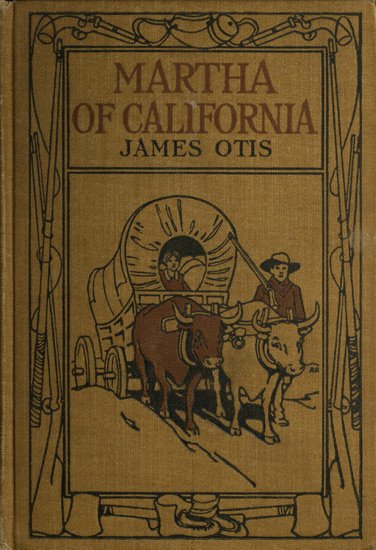
Because the people were not accustomed to thus making an encampment, no little time was spent in getting everything into what the leaders of the company believed to be proper order, and then our mothers set about cooking supper.
In our wagon the stove was pushed back upon the shelf made expressly for it, short lengths of pipe were run through the osnaburg cloth and tied by wire to the topmost part of the rear wagon bow, so they might be held straight, and then mother set about her work much as if she had been at home.
It was most pleasant camping in the open air, and before we had been halted an hour the place was quite homelike.
At nearly every wagon one or more women were making ready for supper; a short distance away the men and the boys were herding the cattle, and near by, inside or out of the inclosure, were scores and scores of idle ones, who, their work being done, were now enjoying a time of rest.
There was much talking and shouting, but above all one could hear that song of the true Pikers:—
"My name it is Joe Bowers,
And I've got a brother Ike.
I came from old Missouri,
Yes, all the way from Pike."
NIGHT IN CAMP
How Ellen and I enjoyed the supper on this first night of the journey! Mother made sour-milk biscuit; the stove worked to perfection, as if delighted because it was being carried to California; and what with cold meat and steaming hot tea it seemed as if I had never tasted anything better than that meal.
Although we had enjoyed ourselves hugely, especially during the first part of the day's march, both Ellen and I were tired, and when mother said we might make up our bed on the bottom of the wagon, we were not only willing, but eager to do so, for after the hearty supper it seemed as if sleep had become a necessity.
Once we had crossed over into Dreamland, our eyes were not opened again until the sun was near to rising; then the shouts of the men and the lowing of the cattle caused us to spring up suddenly, almost fancying that the camp had been attacked by savages, even though we were not yet out of Pike County.
If I had the time, it would please me to describe the journey from our home in Ashley to a town known as Independence, on the Missouri River, where the Oregon trail begins; but since, as father said again and again, we did not really start until we had struck the Oregon trail, it is best that I leave out all that happened while we were coming from Pike County to the Missouri River.
THE TOWN OF INDEPENDENCE
We traveled slowly, because the cows were not easily herded, and, as Eben Jordan said, none of our people were accustomed to such kind of marching.
We did, however, finally arrive at the real starting point after eight days, during which time Ellen and I came to understand that, however pleasant it was to sit in the wagon and look out upon the country through which we passed, it might grow wearisome.
Ellen and I had fancied we would see something very new and wonderful at Independence, and yet, while everything was strange and there was much to attract one's attention, it was not so very different from other settlements through which we had passed.
There was, however, a constant bustle and confusion such as one could not see elsewhere. Enormous wagons, which Eben Jordan said belonged to the traders who went over the Santa Fe trail, were coming into town or going out, each drawn by eight or ten mules and accompanied by Spaniards or Negroes, until one could but wonder where so many people were going.
There were trains, much like our own, belonging to settlers who were going into Oregon, or, like ourselves, into California. Those were halted just outside the town, until the entire settlement was literally surrounded, while among them all, near the wagons of the traders as well as those of the emigrants, lounged Indians, nothing like the people I had imagined the savages to be.
KANSAS INDIANS
As Ellen said, if that was the kind of Indian we should meet with during the journey, then we need have little or no fear, for the savages we saw at Independence were nothing more nor less than beggars, who would greedily pick up and devour anything eatable that was thrown at them. Eben Jordan made himself ridiculous by marching around armed with a rifle, and a huge knife thrust in his belt, as if expecting each instant to be called upon to defend his life.
We were tired of the settlement, even before we had fairly arrived, and after Ellen and I walked through the town, wondering not a little at seeing a number of the houses and stores built entirely of brick, we were content to return to our own encampment, which was about half a mile out on the prairie.
LOOKING INTO THE FUTURE FOR TROUBLE
Up to this time mother and I had but little trouble in preparing the meals whenever we came to a halt; but I heard some of the men say that within a few days after we were once on the trail, all this would be changed. There would be many times when we might not find sufficient fuel to keep a fire in the stove, when we would feel the pangs of thirst because of not being able to get enough water, and when, the stock of provisions which we had brought with us having been consumed, we would know what it was to be hungry.
When I repeated to mother what I had heard, she nodded her head sadly, replying that she had thought of all these things when father first determined to seek a new home in the California country, and she doubted not that we would come to know much suffering, before we arrived at our journey's end.
As may be supposed, I was not in a cheerful mood when Ellen and I went to bed that night. During the half hour or more while we lay there wakeful, we spoke of all the possibilities of the future, and almost regretted that our parents had decided to leave Pike County, for surely they could find nowhere on the face of this earth a place more agreeable in which to live.
A STORMY DAY
When another morning came, it surely seemed as if all my fears were about to be realized, for the day dawned dark and forbidding, the rain came down in torrents, while the wind sighed and moaned as it drove floods of water from one end of the wagon to the other, wetting us completely even before we were awake.
I could not believe father would set off on the journey at such a time as this, and was wondering how we should be able to cook breakfast, when he called to mother that she make ready the morning meal, for in half an hour the train would be in motion.
No one had been sufficiently thoughtful to store beneath the wagon a supply of dry fuel, and the consequence was that we had nothing with which to build a fire, save a few armfuls of water-soaked wood which father and Eben Jordan succeeded in gathering, for where so many emigrants were encamped, fuel of any kind was indeed scarce.
I almost forgave Eben for having appeared so ridiculous when he strutted around fully armed, as I saw him striving to gather wood for us when he might have remained under the cover of his father's wagon; indeed, before many days passed both Ellen and I saw that there was much good in the boy's heart, even though he was too often disposed to make matters disagreeable for us girls.
A LACK OF FUEL
Mother and I made our first attempt at cooking while the stove was beneath the wagon cover and the pipe thrust out through the hole in the rear.
If we had had plenty of dry wood, I have no doubt but that the work could have been done with some degree of comfort; but as it was, we were put to our wits' ends, even to get sufficient heat to boil the water, and when word was given for the company to start, we had not really begun to cook the breakfast.
Of course it would have been dangerous for us to attempt to keep a fire burning while the wagon was moving. Therefore we would have been forced to set off without breakfast, had not Ellen's mother kindly sent us some corn bread which she had baked the night before, and this, with fresh milk, made up our meal.
At the time I thought I was much injured because of not having more food; but before we had come to the land of California I often looked back upon that morning with longing, remembering the meal of corn bread and milk as though it was a feast.
During all the long day, except for half an hour at noon, the patient oxen plodded wearily on amid the rain, oftentimes sinking fetlock-deep in the marshy places. Everything was damp and every place uncomfortable, and at times it seemed as if I could no longer bear up under the suffering.
In order to teach me that, instead of grumbling, I ought to be thankful for the comforts I could enjoy, mother told me to look at those who were exposed to the storm. I saw father and the other men walking beside the oxen, the rain pelting down upon them pitilessly; I heard the cry of a baby in pain; and I soon came to understand that my lot was far less hard than that of many others.
She read me a lesson on patience and contentment, whatever might be my surroundings, until I grew ashamed of having shown myself so disagreeable.
MAKING CAMP IN A STORM
Determined as I was to make the best of whatever might happen, I could not but be disheartened when, nearly at nightfall, we halted to make camp again. The rain was still descending like a cloud-burst; everything around us, including the bedding, seemed saturated with water. Yet I saw the men spread the thin cloth tents, after the wagons had been drawn up in a circle, or made into a corral as the travelers on the trail call it; I saw them wade ankle-deep in the mud, but with never an impatient word or gesture. It appeared sufficient to them if their women and children could enjoy some little degree of comfort.
Again we strove to do our cooking under the wagon covers, and again we were in need of fuel. Ellen and I, with the skirts of our gowns over our heads for protection, scurried here and there, picking up twigs and crying out with delight when we came upon a piece of wood as large as one's fist.
You can well imagine what kind of supper we had that night. The inside of the wagon was filled with smoke, for the short length of stovepipe did not afford a strong draft, and mother labored, with the tears streaming down her cheeks, to fry as much bacon as would satisfy our hunger.
The smoke was so dense that we all wept, smiling even in the midst of our seeming tears when father said, after he had milked the cows and had brought in quite as much water as milk, that it was a question with him whether he could stand better the smoke or the rain. He was inclined to think he had rather be soaked with water than cured like a ham.
Again Eben Jordan showed his kindness of heart, for he insisted upon helping this man and that, milk the cows and herd the oxen and sheep, and he did whatever came to his hand, all the while humming "Joe Bowers."
When Eben came into our wagon later in the evening, Ellen and I treated him very kindly, for we were coming to understand that this boy, who found so much pleasure in vexing us girls, was ever ready to do a good turn to another, even when it cost him much labor and discomfort.
A THUNDERSTORM
During all that night it rained; but shortly after midnight there came up such a terrific storm of thunder and lightning that it seemed as if the very heavens were bursting.
Then all our men and boys were forced to go and quiet the cattle, for the beasts were even as frightened as we girls were, and, so father said, would have stampeded, leaving us to spend the next day searching for them on the prairies, had it not been for the precautions of our people.
When I complained to mother, just after father had gone out into the tempest, that this journey to California was nothing like what I had pictured it, she said mildly that if I was growing disheartened now, it would have been better had I never set out from Pike County, for thus far matters had gone much to our convenience and that shortly we would find real trials and real troubles.
Next morning, however, my spirits rose, for the sun was shining brightly when I awoke; but word was passed around the camp that instead of setting off at once, we might spend two hours drying the bed clothing and such of our belongings as had been saturated during the storm.
Then there was presented such a scene as would have interested any one who had never witnessed the like before. On every wagon tongue were hung blankets and garments of all kinds, and over the wheels of each cart lay feather beds or bolsters, until it must have looked as if every member of our company had spent a day in washing, and was now about to do the ironing.
Eben Jordan went here and there, aiding this one or that when he had done what he might for his mother, all the while singing "My name it is Joe Bowers," until, even before our breakfast had been cooked, fully half the company were joining in that foolish song. Mother said almost fretfully, when Ellen and I took up the refrain, that she wished the senseless words had never been written, or that we had never heard them.
ANOTHER COMPANY OF PIKERS
Although we started off late that morning, owing to the drying out, we halted early in the afternoon, for we had come upon a company of men and women who, like ourselves, were bound for the land of California. The leader of the company was Colonel Russell.
To my surprise and delight these people also proved to be Pikers, having come from a settlement about twenty miles south of our old home. You may readily fancy how enjoyable was that evening, when we visited from wagon to wagon, listening to the stories of what had thus far happened to the company, and repeating our own adventures, if such they could be called.
While we women and girls were thus engaged, the men of both companies decided to travel together, believing that by increasing the number there might be less danger from the Indians, for Eben Jordan said that the savages we saw at Independence were but imitations of the fiercer ones whom we were most likely to meet before our journey's end.
THE STOCK STRAY AWAY
I suppose it was the excitement occasioned by the meeting with Colonel Russell's company, which caused our men in charge of the cattle to be careless during the evening and later in the night, for when morning came we found that nearly all the oxen and a goodly number of the cows had strayed from the camp and disappeared completely.
When Eben Jordan first told us of this, I believed a great disaster had come upon us; but straightway father and half a dozen of the other men mounted the horses and set off across the prairie in search of the missing cattle, as if this was trouble to be expected.
In fact, before many days passed, I came to look upon the straying or the stampeding of the live stock as of little consequence.
We had plenty of time to cook breakfast that morning while the men were searching over the prairie for the cattle, and, much to my surprise, within three hours all the stock had been brought into the encampment and we were making ready once more for the day's journey.
Before noon we arrived at Blue Creek, where we had, as it seemed to me, much trouble because the trail leading to the stream was deep with mud, and the bottom of the creek so soft that our people were forced to wade waist-deep on either side of the wagons, lest the wheels sink so far down that the oxen would not be able to pull the heavy loads across.
Again and again the men laid hold of the wheels, straining every muscle as the drivers of the cattle urged the patient beasts to their utmost exertions, and before all our company had crossed that small creek the day was so nearly at an end that there was nothing left for us to do save camp once more, although we had traveled only six miles since setting out.
Then came Sunday morning, when I believed we would remain idle, for it did not seem right that we should travel on the Lord's day; but, as father said, while we were making such a long journey it was necessary to push ahead during every hour of fair weather, and to take our day of rest only when it was absolutely necessary.
And so, instead of worshiping God as we would have done had we remained in Pike County, we went forward, fording two small creeks and journeying over a dull, level plain, whereon, save flowers, nothing was to be seen to delight the eye.
AN INDIAN VILLAGE
Within an hour of sunset we came to a veritable Indian village, although there were not many of the savages living in it, and Ellen and I took advantage of this first opportunity to see the redskins in their homes.
There were but four men, with perhaps a dozen women and children, all living in lodges made of smoke-dried skins, and looking exceedingly dirty and disagreeable.
We girls were not inclined to linger there long, although the Indians were willing we should, and when our short visit had been brought to a close, they followed us, clustering around our wagons and waiting patiently for food to be thrown to them.
From this time on during a full week we continued to push steadily forward, moving so slowly that even we girls could understand the journey would be exceedingly long and wearisome.
I WEARY WITH SO MUCH TRAVELING
More than once did I reproach myself with having been so eager to leave Pike County, and many times I said to myself that a girl who has a happy home is indeed foolish to wish for a change, lest, like Ellen and me, they find, as mother often says, that they have jumped out of the frying pan into the fire.
One day was much like another. Now the trail would be hard underfoot and the traveling easy, and again we would cross a stream, the bottom lands of which were so marshy that the oxen lugged and strained at their yokes, until oftentimes it was necessary to double up the teams in order that the heavy wagons could be pulled over the soft footing.
The only thing I remember which came to break the monotony of the slow march was when, on a certain evening, father returned with his pockets and hands full of wild onions which he had found on the prairie. Because our meals had consisted chiefly of corn bread and salted meat, I said to myself that now we would have a feast.
But alas! those wild onions were like my dreams about traveling to the land of California. While they looked fair on the outside before being cooked, they were so strong to the taste that one nearly choked in trying to eat them.
EBEN'S BOASTS
Eben Jordan, hearing of my disappointment, said with a laugh that when we came to the country where game was to be found he intended to bring into camp all the fresh meat the company could eat, and one might have thought from the way the boy talked that he believed himself capable of feeding all our company unaided.
It would have been well if Eben had contented himself with predicting the marvels which he counted on performing; but, instead, he reminded me that before we had come into the Land of Promise I might be more than willing to eat wild onions and "smack my lips over the disagreeable food."
It seems that he heard, while in Independence, of the sufferings of some people who had journeyed over that same trail, when they found no game and their provisions were consumed before the march came to an end.
It would have been better, so I said to him, if he had not repeated such things, for surely we were getting all the discomfort that was needed to show how foolish we had been in leaving Pike County, where no one suffered from hunger or thirst, if he had a tongue in his head to make known his desires.
It seemed almost as if the boy was a real prophet, for within a few hours Ellen and I did come to know what thirst—bitter, parching thirst—was like.
We had started out one morning when the rays of the sun beat down upon us so fervently that the wagon covering seemed to be no protection, and the only relief we had was from the gentle breeze which was blowing, not with sufficient force to relieve our suffering, but enough to prevent us from being literally baked.
SUFFERING WITH THIRST
We drank, as did all our company, of the water which we carried in kegs stowed in the wagons, and gave no heed to the fact that the supply was scanty, for until this time there had never been any lack of water.
At noon even the breeze died away; there was not a cloud in the sky, the trail was smooth and hard, running over what father called the tableland of the prairie, and the heat so intense that there were times when it surely seemed as if I could not longer continue to breathe.
Then, when our sufferings were seemingly as great as they could possibly be, mother discovered that our store of water had been exhausted, and called to father, asking that he get a supply from one of the other wagons.
It seemed strange to me then, and does even now, that at almost the same time all our company had run short of water, and from one end of the long train to the other we could not beg enough to moisten our tongues.
Perhaps it was the knowledge that I could not quench my thirst which caused me to suffer more severely, and when father said we must travel no less than twelve miles before coming to any stream, my heart sank within me.
Ellen was suffering quite as much as I, except that she had the good sense to hold her peace, and mother, patient with me as ever, said all she could to prevent me from dwelling too much upon my condition.
Nor was I the only one in that company to suffer severely. Whenever the train came to a halt that the cattle might have a breathing spell, I could hear the smaller children crying for something to drink, and once during the afternoon Eben Jordan came alongside our wagon, asking if our water kegs were empty.
Then I saw upon his face that look of eagerness and desire such as I had read on Ellen's, and when I told him we were suffering from thirst even more than any other members of the company, he shook his head and replied:—
"It is the younger ones who suffer the most, Martha Early, for they cannot be made to understand that it is necessary to wait; while you and I, who are older, know it is only a case of grinning and bearing it as best we may."
IN SEARCH OF WATER
I was irritated because Eben should read me a lesson, for indeed his words sounded like a reproof. I turned away from him, saying to myself that if it was not possible to make the oxen move more rapidly, there was danger of my dying, all of which was foolishness, even wickedness, as you will agree.
To force the beasts to a more rapid pace was absolutely impossible. Already the sheep as well as the oxen were showing signs of exhaustion and panting for water. Their tongues were hanging out, and they moved slowly as if unable to go farther, while five of the cows had dropped down on the trail as if dying.
We were forced to leave them behind, fearing lest if time was spent in trying to get the beasts on their feet again, more of the stock would fall.
I hardly knew how the remainder of that day passed, for I gave no heed to anything save my own suffering, thereby showing myself wickedly selfish, until a great shout went up from those who were in advance, telling that at last, after what seemed like many, many long hours, we had come within sight of a stream of water.
Then the oxen, wild with thirst and smelling the dampness in the air, plunged forward as if in a fury, for the drivers were unable to hold them in check.
In a mad race went every yoke of the cattle, drawing the heavy wagons that lurched first on one side and then on the other as we went over the uneven surface of the trail, until all the contents which had been stowed so carefully were thrown violently about, while we girls and mother had the greatest difficulty to save ourselves from being flung out.
QUENCHING OUR THIRST
The oxen continued on until every yoke of them stood in the creek, and there they halted, drinking eagerly until their sides swelled out as if bursting.
Regardless of the fact that our wagon was standing in not less than twelve inches of water, Ellen and I leaped out and drank from the stream like dogs, too thirsty to wait longer.
I have been in need of water many times since that day, but never have I suffered so keenly, and I now understand that the distress which well-nigh overcame me was caused for the most part by my foolishly dwelling upon the lack of water, whereas if I had forced myself to think of other matters, much pain might have been avoided.
It was impossible to force the oxen across the creek, and we were obliged to make camp on the easterly side, for it seemed as if they would never have done with drinking.
When they were so full that it was impossible to swallow another mouthful, they refused to cross, but struggled to get among the rich grass which covered the bottom lands of the creek.
After the horses, as well as the men and the cattle, had been thus refreshed, half a dozen of our people, among whom was Eben Jordan, rode back on the trail, hoping to drive in some of the cows that had fallen by the wayside. It was not until a late hour in the evening that they returned, bringing with them only two of the animals.
Thus we suffered our first loss on the journey, and it seemed to me a most serious matter; but even before we had come to the trail which led to California, the loss of even twice as many cattle could not have disturbed me, for I had come to believe that we should arrive at that Land of Promise, if indeed we were so fortunate as to survive, almost empty-handed, owing to the difficulties of the way which the beasts could not overcome.
The next day's march was ended early in the afternoon, because then we had come to a stream, and those who were familiar with the trail knew we could not arrive at another place where water would be found until late in the night.
MAKING BUTTER
So we encamped early, and mother decided to set about churning, for long ago our store of butter had been exhausted. We had but a small quantity of cream, all of which had been saved since morning.
No sooner had she begun her work than fully half the women of the company followed her example, and at the side or in the rear of nearly every wagon was a churn set out with either the girls or the boys working the dasher.
As Eben Jordan said when he offered to spell me at the churn, it looked as if we people, who had set out from Ashley to find a new home in the land of California, had decided to abandon the idea and turn all our attention to making butter.
Next morning we were forced to continue the journey before having breakfast, for we were nearing the Kansas River, and would arrive there about noon if the march was begun as soon as daylight. Even then there would be hardly more than time before the sun set to get all our train over, for the stream was so deep that it could not be forded, and we must send the wagons across in boats.
A KANSAS FERRY
Although we were, as one might have supposed, in an uninhabited country, father told me that at this crossing of the Kansas River was a ferry owned by two half-breed Indians, who made a business of freighting heavy wagons across for a fee of one dollar each; but all the live stock would be forced to swim.
Now since none of the boats could carry more than one wagon at a time, you may readily understand how many hours would be needed in order to get all our train from one side of the river to the other, even though it was no more than two hundred yards from bank to bank. Therefore, as I have said, it was necessary we arrive at the ferry at the earliest possible moment, lest night overtake us while half the company yet remained on the eastern shore.
The ferryboats were nothing more than square, shallow boxes, which the Indians pushed across by poles, after the cargo of wagons had been put on board.
Of course the women and the girls had nothing to do with this ferrying, save to remain under the wagon coverings where they would be out of the way. I envied Eben Jordan, who could move about at will, for verily my heart was in my mouth, so to speak, during all the time we were working our slow way across the stream, fearing lest our boat should sink beneath us.
THE SURPRISE AT SOLDIER CREEK
Not until nearly six o'clock were all our company on the western side of the river, and then I supposed that we would immediately make camp; but to my surprise word was given for the train to move on, and we journeyed three miles more, coming to the bank of Soldier Creek before darkness.
It was at this place that a most pleasant surprise awaited us. Colonel Russell's wife, who had walked ahead while our train was being ferried across the river, found quantities and quantities of wild strawberries near the camping place. As soon as we women and girls arrived, we set about gathering the berries, until each family had a good supply of the luscious fruit. Milk was not a poor substitute for cream to us who had been living upon corn bread and salt meat ever since we left the settlement of Independence.
During the next two days we traveled steadily onward, slowly, to be sure, but yet each step, as Ellen said again and again, was taking us nearer the end of the journey. In time I came to be impatient whenever a halt was called, so eager was I to have done with riding, for however comfortable a girl might make herself in one of the wagons, her limbs were certain to become cramped before night.
On the third day after crossing the Kansas River, the leaders of our company decided that a halt was needed in order to give the animals a rest. Their hoofs had become dry and cracked from traveling over the matted grass of last year, which covered the prairie even beneath the new crop, and it was necessary that something be done for them without delay.
I had been looking forward to a full day's halt, even though impatient when we were not moving forward, for Ellen and I had planned to wander as far from the encampment as we could, searching for flowers and wild peas, which grew there in great abundance, so we had been told.
BREAD MAKING
Mother decided that now had come a time when she must bake a plentiful supply of bread, for she was determined not to be put to such straits as we were during the rain storm, when it was next to impossible to build a fire in the stove, and, of course, I was glad to do whatever I might to aid her.
Before father had fairly got the stove out of the wagon and set up where it could be most conveniently used, nearly every other woman in the company had decided to follow mother's example, and then came such a scene as was presented when each family did its churning.
In the rear or at the side of nearly every wagon a stove was set up, and one might see everywhere women rolling or kneading dough, girls running about on errands, and boys doing their share by keeping the fires going.
I must say to Eben Jordan's credit that he was of great assistance to mother and me that day. If he had been a saint upon earth, he could not have done more or worked with greater patience than he did, running from stove to stove when the other boys had neglected their duties.
Mother told him laughingly that many times while we lived in Ashley she had been vexed because of the boyish pranks he played; but from this time onward she should remember what he had done in the way of aiding the cooks, and would overlook almost anything which mischief might prompt him to do.
PRAIRIE PEAS
The baking came to an end, so far as our family was concerned, shortly after noon; then Ellen and I, taking Eben with us as guide and protector, went out in search of peas and brought home enough to supply several families, who had been neighbors of ours, with a generous mess.
Save for the fact that these prairie peas look somewhat like those we have at home, I could find no likeness between the two varieties. The wild peas have a tough rind, and there are several seeds in the middle of each; but after they have been boiled and allowed to remain in vinegar a few hours, they make a fairly pleasing dish.
When we began the march once more, I hoped to see the cattle moving more spiritedly than before the halt; but in this I was mistaken. It seemed to me that they limped painfully, and worse than ever; that I was not mistaken was proved, to my satisfaction at least, when I heard father and another man saying to each other that before many days we should be forced to kill two or three whose feet were in the worst condition.
However, the days went on and our cattle continued to work fairly well, although I noticed that when we came to rough places, such as the crossing of a stream, where it was necessary to climb a high bank on the opposite side, the drivers were forced to double up the teams more often than before, because the poor creatures could not haul so heavy a load as when we first started out.
EBEN AS A HUNTER
Within a week from the time of leaving Soldier Creek, Eben Jordan was indeed puffed up with pride. He came into camp late one afternoon dragging behind him an antelope which he had shot within two miles of where we halted an hour previous. This proof that he had shown himself a skillful hunter, caused the boy literally to swell with joy as he strutted around the body of the beautiful animal while our people were looking at it.
It seemed too bad to kill such an innocent creature as that antelope, and yet I forgot all the cruelty of it when Eben brought to our wagon enough steaks to provide all of us with a slice of fresh meat. Afterward it seemed to me much as if we had been cannibals when we so eagerly devoured the handsome animal.
From that day on, whenever we made camp before dark, Eben went out with his rifle, and more than once he brought in a deer of some kind, dividing the meat generously and fairly among us all.
A HERD OF BUFFALOES
Then came the time when we had our first glimpse of buffaloes, and never shall I forget the scene. We had been traveling in the bottom lands where we found multitudes of paths deeply cut into the ground, which some of our people said had been made by buffaloes; but we girls never so much as dreamed we might be near the beasts, until one morning father called me hurriedly to look out of the wagon.
Then I screamed, for we were literally surrounded by thousands upon thousands of those fierce-looking, yet stupid, beasts, who gave no more heed to our encampment than if they had been accustomed to such things all their lives.
They circled around within a quarter of a mile of where our cattle were feeding, and father said afterward that unless our men had been exceedingly watchful and active, the oxen and cows would have been stampeded beyond a doubt.
EXCITEMENT IN THE CAMP
Our animals were in a high state of excitement, striving to get through the lines of men who guarded them, and of course there was no possibility of our breaking camp until the buffaloes had departed, for, so father said, there was not a driver in the company who could handle half a dozen yoke of oxen while the buffaloes were so near.
Not all our people stood gazing stupidly at this sea of animals as did Ellen and I. You may be certain Eben Jordan was among the first to go out dangerously near the huge beasts, and he was followed by all the men of the company, save those who were guiding our live stock.
I had supposed that the buffaloes would take to their heels when a rifle was discharged; but much to my surprise they paid little or no attention at first to the reports of the firearms.
I dare not venture to say how many of the animals were killed; but certainly it seemed to me, when about noon the entire herd rushed off, the rumbling of their hoofs on the hard earth sounding like thunder, that there were no less than fifty carcasses spread out on the plain within a mile of where our wagons had been drawn up to form a corral.
A FEAST OF BUFFALO MEAT
There was so much game for us to bring in, that during the remainder of the day every man and boy that could be spared was kept busy at work skinning the dead buffaloes or cutting up the flesh.
What a feast we had that evening! We had buffalo tongues baked in the ovens, or in front of small fires which had been built here and there. Then there were what father called hump ribs, steaks, and meat of every kind that could be taken from a buffalo. Each member of the company was eager to learn how every eatable portion of the animal tasted, and, therefore, cooked two or three times as much as could be used at one meal.
Our people had no more than time to skin and cut up the carcasses before dark; on the following morning word was passed around that each family must dry, or smoke-cure, as much of the flesh as possible within the next four and twenty hours.