
INTRODUCTION.
BY
REV. T. O. SUMMERS, D.D.
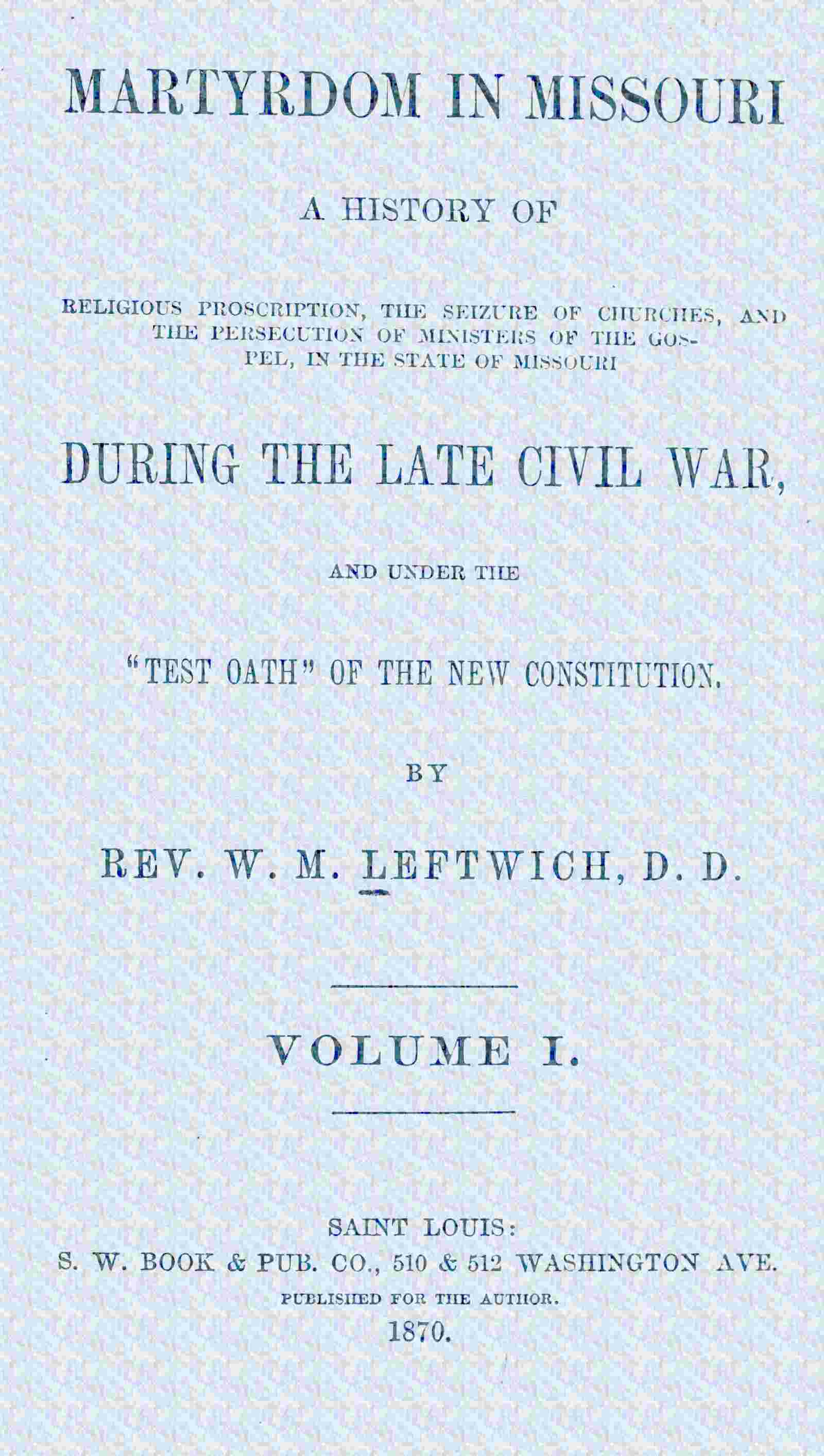
The author of the following work has desired an expression of our opinion in regard to its publication. We have read the manuscript with painful interest, and are free to say that we have had some misgivings as to the expediency of sending it forth to the world. The facts here brought to light are so revolting, and their record is so damaging to the reputation of those by whom they were perpetrated and their aiders and abettors, that we might well hesitate, as to the propriety of their publication. As Methodists, in particular, we are strongly tempted to throw the veil of oblivion over those scenes of oppression and outrage, in which many of our co-religionists of the North bore so conspicuous a part.
But the cause of truth and righteousness demands the publication. There is a measure of retribution which must not be relegated to the “judgment to come,” but which must be dealt out in the present world.
We owe it to “the noble army of martyrs,” whose lives were sacrificed to appease the demands of fanaticism, bigotry, cruelty, and hate, that their murderers shall not go unwhipped of justice—at least, such castigation as the truth of history can inflict.
We owe it to those who were made widows and orphans by the monsters who enacted these bloody scenes, to let the world know that the husbands and fathers of these innocent sufferers were not rebels and traitors, but good men and true, “of whom the world was not worthy.”
We owe it to the institutions of our country to let it be known that the appalling scenes that were enacted during the late reign of terror were not the result of the principles which underlie our Federal and State governments, but of the palpable contravention of them.
We owe it to the ecclesiastical bodies of the South that posterity shall be told who invaded their rights; who robbed them of their churches, parsonages, cemeteries, and seminaries; who murdered, scourged, and plundered, and banished many of their ministers and lay members, including even women and children, because they would not compromise principles which they held dearer than life itself.
It is well for the world to be told that moral heroism has not, like Astræa, left the earth and ascended to the skies. Thank God! there have been heroes in our times; and we are encouraged to believe that the race will not soon become extinct. The night of persecution would bring such stars to view again. Daniel and the “three children,” the Maccabees, the Apostles, Polycarp, Ignatius, and other victims of Pagan persecution in primitive times—the Albigenses, Waldenses, Huguenots, the Marian martyrs, and other victims of papal persecution—Nonconformist and Remonstrant confessors, who “took joyfully,” or at least patiently, “the spoiling of their goods,” imprisonment, exile, and sometimes death—these have had their successors in the fearful times through which we have passed, and the record of them gives us a guaranty that under similar circumstances such heroes will appear again.
In perusing this work one is constantly reminded of the saying of the wise man, “Is there any thing whereof it may be said, See, this is new? it hath been already of old time which was before us.” He had seen similar evils to those which we have seen and suffered. “There is an evil which I have seen under the sun as an error which proceedeth from the ruler: folly is set in great dignity, and the rich sit in low place. I have seen servants upon horses, and princes walking as servants upon the earth.” “So I returned and considered all the oppressions that are done under the sun and behold the tears of such as were oppressed, and they had no comforter.” Then, as in our late calamitous times, good men mourned as they were forced to
The history of these terrible transactions is valuable, too, as an admonitory lesson, teaching us that no sect is absolutely proof against the seductive influence of political power and ascendency. Down to the present decade the Methodists could plume themselves with an honest satisfaction upon the fact that while nearly all other sects had risen to power and abused it to persecuting purposes, they never had. It was, indeed, sometimes insinuated that they never had persecuted because they never had the power to do so. But they contended, and, it was thought, with good reason, that the principles of Methodism, being so pure, spiritual, and catholic, would be a sure safeguard from political alliances, worldly ambitions, and persecuting practices; but, alas! that ground of boasting is taken away. The devil came with his “third temptation” to Northern Methodists, including even bishops of the Church, and they did not say, “Get thee hence, Satan!” They ascended by the devil’s ladder to “thrones of power,” and played such tricks during the continuance of their brief authority as made the angels weep! The wrongs of 1844 and 1848 developed into horrible atrocities in the sun of political prosperity which shone upon them during the war which subjugated the South. The lesson, we repeat, is admonitory. We trust in God no such temptation will ever be set before the Southern Church; it seems to be “a test for human frailty too severe.”
It is not intended by these remarks to inculpate all the ministers and members of the Northern Methodist Church. God forbid! There are thousands among them who have not bowed the knee to Baal. They are attached to the Northern connection because of their location—they denounce the evil deeds of their brethren; indeed, in many instances they are not apprised of them, or honestly believe that they are gross exaggerations.
These enormities, however, are, to a great extent, charged upon the Northern Methodist Connection because they were perpetrated by its bishops and other agents; endorsed, or at least not disowned, by General and Annual Conferences, and have not been repented of until this day. Need any one seek further for a reason why the Southern Church wants no fellowship with those who murder, rob, oppress, and slander its ministers and members, or sanction those who do?
It must not be supposed that we lay all the blame upon Northern Methodists—other Churches furnished their quota of persecution and oppression, though, for obvious reasons, Southern Methodists suffered more from their Northern co-religionists than from any other parties. Thus was it with pagan and popish persecutions—a man’s foes were frequently those of his own household. Apostates have ever been the most bitter and unscrupulous persecutors. This is a painful reflection. The eagle is pierced by an arrow feathered from an eagle’s wing! Thus history repeats itself.
The perusal of this work will teach us not to put our trust in man, not even in princes; no, nor in institutions of our own framing, written constitutions, compacts, and the like, which upon occasion may prove to be worth no more than the parchment on which they are engrossed.
Nothing is perfectly true, and just, and good, and stable, but the kingdom of God. Nevertheless, the recital of the horrors portrayed in this book, which contains a mere modicum of what might be narrated, ought to lead us to thank God most devoutly that these calamities are nearly overpast, and we have the prospect of civil and religious liberty, which we know better than ever how to appreciate. The changes which have taken place in the government of the United States lead many to entertain gloomy anxieties for the future, and to despair of the permanency of republican institutions; yet we venture to hope that a wise, gracious, and powerful Providence will so interpose in behalf of our country that these forebodings will not be realized.
We may just state that we are assured of the truth of many of the details in this work by other testimonies; and for the rest we depend confidently on the accuracy of the author, who has taken great pains in collecting his materials from the most trustworthy sources. He is a reputable minister of the Missouri Conference of the Methodist Episcopal Church, South, and holds himself responsible for all that he narrates.
Nashville, Tenn., Nov. 22, 1869.