
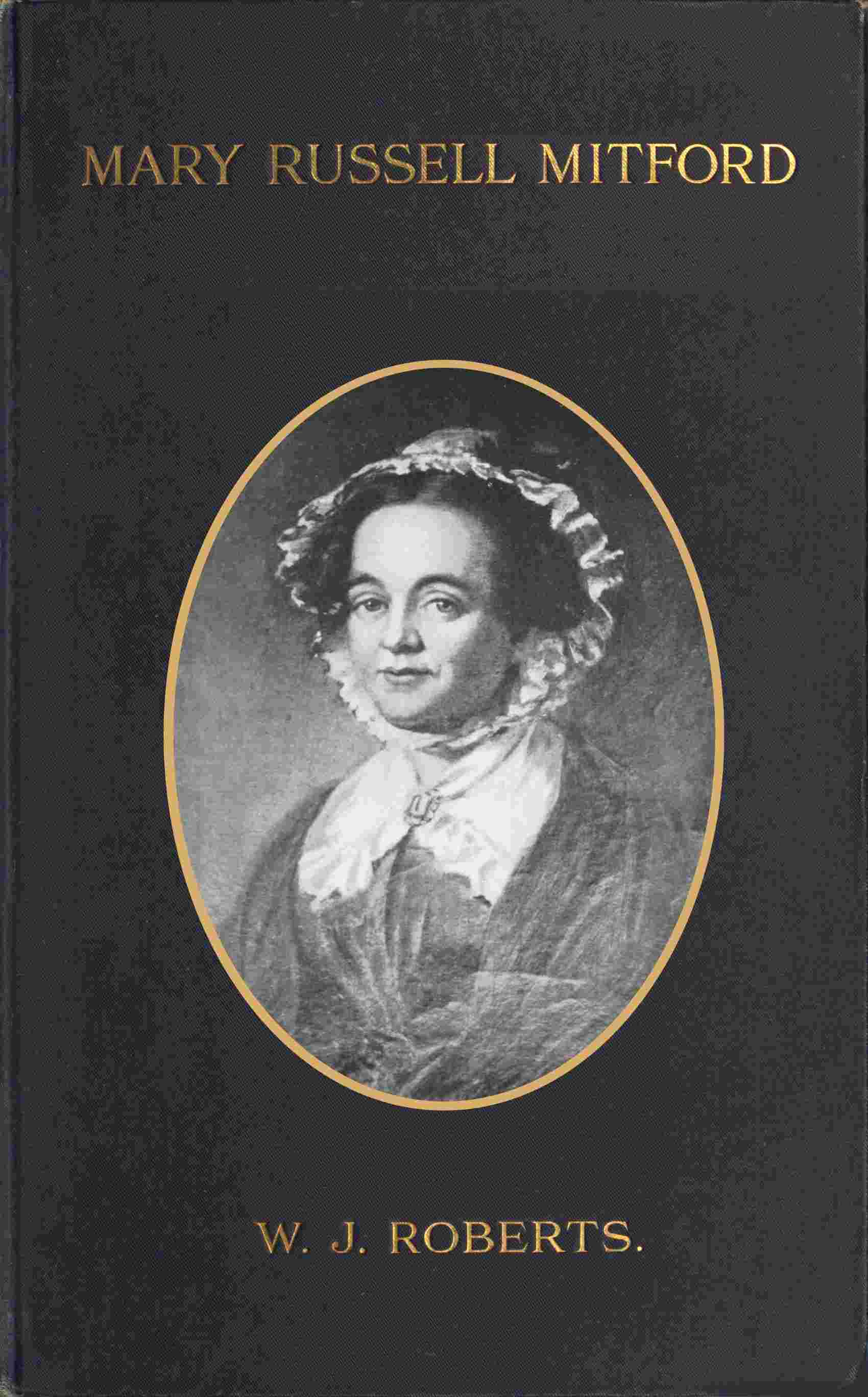
CHAPTER XII
DWINDLING FORTUNES AND A GLEAM OF SUCCESS
Miss Mitford’s great and growing affection for the simple delights of the country is amply proved in some of the letters which she wrote to Sir William Elford during the years 1812-1815, and in the publication of her poems on Watlington Hill and Weston Grove. Of these two works Watlington Hill is, on the whole, in praise of coursing, although it also contains some fine descriptions of scenery which all who know the locality will recognize and appreciate. The piece was originally published as a separate poem and dedicated to “James Webb, Esq., and William Hayward, Esq.,” two coursing friends of her father’s, the last-named being the owner of the Watlington Farm which Dr. Mitford made his headquarters whenever a coursing meeting was in progress in the district. In this form it was published by A. J. Valpy, but later on was embodied in a volume entitled Dramatic Scenes, and published in 1827, by George B. Whittaker.
Weston Grove is a description of the place of that name, near Southampton Water, then the seat of William Chamberlayne, Esq., M.P.—another friend of the Mitfords—to whom the poem was inscribed. Neither of these works had a great sale.
In addition to these Miss Mitford made, in 1813, an attempt to produce a play entitled The King of Poland, concerning which she wrote to her father that “it will be in five acts instead of three, and runs much more risk of being too long than too short. My favourite character is a little saucy page ... and who is, I think, almost a new character on the English stage. We have, it is true, pages in abundance, but then they commonly turn out to be love-lorn damsels in disguise. Now mine is a bona-fide boy during the whole play.”
Late in the year 1815 we find her telling Sir William Elford that she has “been teased by booksellers and managers, and infinitely more by papa, for a novel and a play; but, alas! I have been obliged to refuse because I can only write in rhyme. My prose—when I take pains, is stiffer than Kemble’s acting, or an old maid’s person, or Pope’s letters, or a maypole—when I do not, it is the indescribable farrago which has at this moment the honour of saluting your eyes. This is really very provoking, because I once—ages ago—wrote four or five chapters of a novel, which were tolerably lively and entertaining, and would have passed very well in the herd, had they not been so dreadfully deficient in polish and elegance. Now it so happens that of all other qualities this unattainable one of elegance is that which I most admire and would rather possess than any other in the whole catalogue of literary merits. I would give a whole pound of fancy (and fancy weighs light), for one ounce of polish (and polish weighs heavy). To be tall, pale, thin, to have dark eyes and write gracefully in prose, is my ambition; and when I am tall, and pale, and thin, and have dark eyes, then, and not till then, will my prose be graceful.”
In this outline of qualifications for the writing of graceful prose Miss Mitford did herself scant justice, as time has proved; for while her verse is forgotten, it is her prose alone which has lived and by which she is remembered. Had personal bulk been the deciding factor, then, assuredly she would have been ruled out, for in a previous letter to Sir William—with whom, by the way, she was now on such intimate terms that personal matters of this sort were freely discussed—she had informed him of the “deplorable increase of my beautiful person. Papa talks of taking down the doors, and widening the chairs, and new hanging the five-barred gates, and plagues me so, that any one but myself would get thin with fretting. But I can’t fret; I only laugh, and that makes it worse. I beg you will get a recipe for diminishing people, and I will follow it; provided always it be not to get up early, or to ride on horseback, or to dance all night, or to drink vinegar, or to cry, or to be ‘lady-like and melancholy,’ or not to eat, or laugh, or sit, or do what I like; because all these prescriptions have already been delivered by divers old women of both sexes, and constantly rejected by their contumacious patient.” And this she supplemented by likening herself to “a dumpling of a person tumbling about like a cricket ball on uneven ground, or a bowl rolling among nine-pins.”
Of her prose, we shall find that her earliest descriptive pieces were contained in the letters sent to Sir William and, although they may lack the grace of the later finished work written for publication, they do, at least, prove their author’s possession of “the seeing eye.”
“I am just returned from one of those field rambles which in the first balmy days of spring are so enchanting. And yet the meadows, in which I have been walking, are nothing less than picturesque. To a painter they would offer no attraction—to a poet they would want none. Read and judge for yourself in both capacities. It is a meadow, or rather a long string of meadows, irregularly divided by a shallow, winding stream, swollen by the late rains to unusual beauty, and bounded on the one side by a ragged copse, of which the outline is perpetually broken by sheep walks and more beaten paths, which here and there admit a glimpse of low white cottages, and on the other by tall hedgerows, abounding in timber, and strewn like a carpet with white violets, primroses, and oxlips. Except that occasionally over the simple gates you catch a view of the soft and woody valleys, the village churches and the fine seats which distinguish this part of Berkshire, excepting this short and unfrequent peep at the world, you seem quite shut into these smiling meads.
“Oh, how beautiful they were to-day, with all their train of callow goslings and frisking lambs, and laughing children chasing the butterflies that floated like animated flowers in the air, or hunting for birds’ nests among the golden-blossomed furze! How full of fragrance and of melody! It is when walking in such scenes, listening to the mingled notes of a thousand birds, and inhaling the mingled perfume of a thousand flowers, that I feel the real joy of existence. To live; to share with the birds and the insects the delights of this beautiful world; to have the mere consciousness of being, is happiness.”
That was her picture of Spring. She improved as the year rolled on, and the next January gave play for her pen in a description of hoar-frost.
“A world formed of something much whiter than ivory—as white, indeed, as snow—but carved with a delicacy, a lightness, a precision to which the massy, ungraceful, tottering snow could never pretend. Rime was the architect; every tree, every shrub, every blade of grass was clothed with its pure incrustations; but so thinly, so delicately clothed, that every twig, every fibre, every ramification remained perfect; alike indeed in colour, but displaying in form to the fullest extent the endless, infinite variety of nature. This diversity of form never appeared so striking as when all the difference of colour was at an end—never so lovely as when breaking with its soft yet well-defined outline on a sky rather grey than blue. It was a scene which really defies description.”
It was during this period, notably in 1812, that Miss Mitford must, metaphorically speaking, have begun “to feel her feet” in literary matters. The adulation of her father’s friends in London, backed up by the reviews, which were, generally, favourable to her work, were sufficient proof that she had a public and that, in time, she might hope to secure something like a regular and even handsome income from her pen. In this she was encouraged by Sir William Elford, who did all that was possible to impress upon her the necessity for studied and polished work. To this end he informed her that he was carefully saving her letters, playfully hinting that they might prove valuable some day. This may account for the “high, cold, polish” which William Harness deprecated. The hint was not lost on her and drew from her an amusing and, as events have proved, prophetic reply: “I am highly flattered, my dear Sir William, to find that you think my letters worth preserving. I keep yours as choice as the monks were wont to keep the relics of their saints; and about sixty years hence your grandson or great grandson will discover in the family archives some notice of such a collection, and will send to the grandson of my dear cousin Mary (for as I intend to die an old maid, I shall make her heiress to all my property, i.e. my MSS.) for these inestimable remains of his venerable ancestor. And then, you know, my letters will be rummaged out, and the whole correspondence be sorted and transcribed, and sent to the press, adorned with portraits, and facsimiles, and illustrated by lives of the authors, beginning with the register of their birth, and ending with their epitaphs. Then it will come forth into the world, and set all the men a-crowing and talking over their old nonsense (with more show of reason, however, than ordinary) about the superiority of the sex. What a fine job the transcriber of my letters will have! I hope the booksellers of those days will be liberal and allow the poor man a good price for his trouble; no one but an unraveller of state cyphers can possibly accomplish it,”—this in allusion to the occasional illegibility of her handwriting which elsewhere she described as “hieroglyphics, which the most expert expounders of manuscripts fail to decipher.”
Reference to her manuscripts recalls the trouble some of them entailed on young Valpy, the printer—really a long-suffering and estimable young man—and his staff. For a writer so fully aware of her shortcomings in this matter, as was Miss Mitford, she was extraordinarily impatient and exacting. Poor Valpy did his best according to his lights—and these were not inconsiderable—and was more than usually anxious in the setting-up of Miss Mitford’s work, seeing that, as she remarked in one of her letters, he had “dandled me as an infant, romped with me as a child, and danced with me as a young woman,” but by reason of which, she unkindly concluded, he “finds it quite impossible to treat me or my works with the respect due to authorship.”
Judging by the hundreds of Miss Mitford’s letters which we have handled, full of closely-written and often indecipherable characters, we are of opinion that she was singularly fortunate in finding a printer able and willing to ascertain their meaning. Her condolences with her friend, Sir William, on his “press-correcting miseries” are, though extravagant, very diverting and, in these days of trade-unionism, throw an interesting light on the personnel of Valpy’s little establishment in Tooke’s Court. “I am well entitled to condole with you, for I have often suffered the same calamity. It is true that my little fop of a learned printer has in his employ three regularly-bred Oxonians, who, rather than starve as curates, condescend to marshal commas and colons, and the little magical signs which make the twenty-four letters, as compositors; and it is likewise true, that the aforesaid little fop sayeth—nay, I am not sure that he doth not swear—that he always gives my works to his best hands. Now, as it is not mannerly for a lady to say ‘you fib,’ I never contradict this assertion, but content myself with affirming that it is morally impossible that the aforesaid hands can have that connection with a head which is commonly found to subsist between those useful members. Some great man or other—Erasmus, I believe—says that ‘Composing is Heaven, preparing for publication Purgatory, and correcting for the press’—what, must not be mentioned to ‘ears polite.’ And truly, in my mind, the man was right. From these disasters I have, however, gained something:—‘Sweet are the uses of adversity’; and my misfortunes have supplied me with an inexhaustible fund of small charity towards my unfortunate brethren, the mal-printed authors. For, whereas I used to be a most desperate and formidable critic on plural or singular, definite and indefinite, commas and capitals, interrogations and apostrophes, I have now learnt to lay all blunders to the score of the compositor, and even carry my Christian benevolence so far that, if I meet with divers pages of stark, staring nonsense (and really one does meet with such sometimes), instead of crying, ‘What a fool this man must be—I’ll read no more of his writing!’ I only say, ‘How unlucky this man has been in a compositor! I can’t possibly read him until he changes his printer.’” Nevertheless, and although there might be an occasional author glad to shelter himself behind such an excuse, the fact remains that the work which emanated from Valpy’s press is entitled to the highest encomiums—despite his three Oxonians who, choosing the better part, preferred to compose type rather than sermons.
There is no record that Miss Mitford published anything from the year 1812—when Watlington Hill appeared—until 1819, the interval being occupied with various short trips to London, most of which were, however, only undertaken at the urgent request of friends who were keen on offering hospitality and entertainment. But for this hospitality and the assurance that the visits would entail little or no expense, it is evident that they could not have been indulged in. The Chancery suit still dragged its weary length along and the Doctor continued his lengthy jaunts to town, each trip being followed by the infliction of fresh privation on his wife and daughter. The large retinue of servants which had been installed when the family took possession of Bertram House, had dwindled gradually, until at last it was represented by one, or, at most, two. There was no lady’s maid, and the footman had been replaced by a village lad who, when not waiting at table, had to make himself useful in the garden or stable—the jobs he was really only fitted for. The carriage-horses had gone and were replaced by animals which could be commandeered for farm-work; the result being that, as they were oftenest on the farm, they were rarely available for use in the carriage, thus curtailing the pleasure of the ladies, both of whom greatly enjoyed this form of exercise. Finally, when the carriage required to be repaired and painted, it was found that there was no money in hand, so it was sold and never replaced.
Mrs. Mitford had the greatest difficulty in getting sufficient housekeeping money wherewith to meet their quite modest expenses, until at last the tradesmen refused to supply goods unless previous accounts were settled and ready money paid for the goods then ordered. They were really in the most desperate straits for money—the daughter actually contemplated the opening of a shop—and in one letter we are told that Mrs. Mitford begged her husband to send her a one-pound note, as they were in need of bread! This represented actual want, and yet, through it all, there was scarcely any diminution in the kennel, the occupants of which were a source of the greatest anxiety to Mrs. Mitford, who frequently did not know whither to turn in order to obtain food for them.
In perusing the letters which were written to the various friends of the family during this period, it is astonishing to find little or no evidence of the distress under which the writer suffered. Miss Mitford’s optimism was remarkable, whilst her belief in her father was so strong that even when she found that their miserable condition was due to his losses at the gaming-tables, she only commiserated him and blamed others for cheating and wronging so admirable a man, an attitude of mind which her mother shared!
It was towards the end of the year 1818 that she seriously thought of turning her attention to prose, encouraged by Sir William Elford, who had been struck by her descriptions of the neighbourhood in which she lived. She conceived the idea of writing short sketches illustrative of country scenes and manners, and when she had executed a few of these to her own and mamma’s satisfaction, they were submitted to Thomas Campbell as possible contributions to the New Monthly Magazine, of which he was then the Editor. He would have nothing to do with them, nor did he encourage the writer to try them elsewhere. Nothing daunted, she offered them to one or two other Editors, but still met with refusal until she tried the Lady’s Magazine, the editor of which had the good sense not only to accept them but asked for more. The result to the magazine was that its circulation went up by leaps and bounds, and the name of Mary Russell Mitford, hitherto known only to a limited circle, became almost a household word.