WeRead Powered by ReaderPub
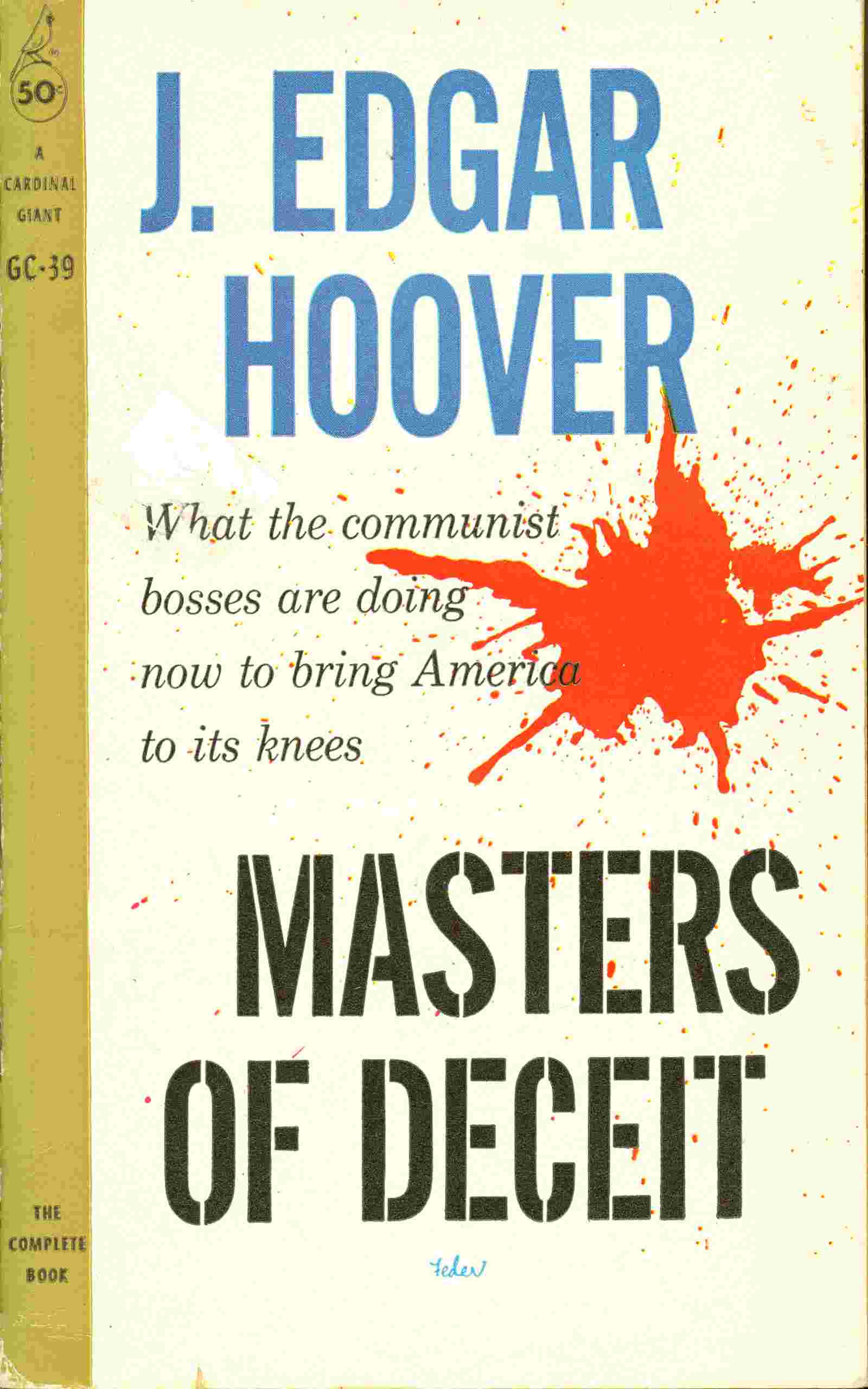
Masters of deceit cover

Masters of deceit

Chapter 104: APPENDICES
Open in WeRead

Explore more books like this:

About This Book

A handbook-style account draws on decades of investigation to explain communism's ideology, organizational methods, and tactics for infiltrating American institutions. It surveys the movement's structure and discipline, describes underground operations, propaganda, front organizations, and recruitment and financing techniques, and illustrates typical practices used to shape members' beliefs. Interspersed are practical warnings and recommendations for citizens and officials on identifying and countering subversive activity, with emphasis on education, vigilance, and civic resistance rather than sensational anecdotes.

APPENDICES

Appendices

I
Key Dates in Lives of Communist “Big Four”

KARL MARX
1818 May 5: Born in Treves (Trier), in the Rhine province of Prussia (Germany).
1842 Met Friedrich Engels for first time in Cologne, Germany.
1843 Married Jenny von Westphalen.
1844 Began lifelong friendship and collaboration with Engels.
1847 Marx, along with Engels, joined the Communist League.
1848 The Communist Manifesto published.
1848-49 Editor-in-chief, Neue Rheinische Zeitung, in Cologne.
1849 Banished from Germany and went to Paris, from which he was also banished.
1849-83 Lived in exile in London.
1852-61 Foreign correspondent for the New York Tribune.
1864 Helped in setting up International Workingmen’s Association (First International) in London.
1867 Volume I of Das Kapital (Capital) published in Hamburg, Germany.
1872 Russian translation of Das Kapital, Volume I, published.
1883 March 14: Died in London.
FRIEDRICH ENGELS
1820 November 28: Born in Barmen in the Rhine province of Prussia (Germany).
1842 Settled in Manchester, England.
1870 Moved to London to work with Marx.
1885 Volume II of Marx’s Das Kapital published as edited by Engels.
1888 Visited United States and Canada.
1894 Volume III of Marx’s Das Kapital published as edited by Engels.
1895 August 5: Died in London.
VLADIMIR I. LENIN
1870 April 22: Born in Simbirsk (now Ulyanovsk), Russia.
1887 May: Brother, Alexander, hanged for plotting to assassinate Czar Alexander III.
1893 Joined underground Social Democratic circle called “Elders.”
1897 May: Exiled to Siberia following a prison term.
1900-05 Traveled, wrote, and conducted work of Russian Social Democratic Labor Party (forerunner of Communist Party of Soviet Union) in Germany, England, Switzerland, Belgium. Returned to Russia in November, 1905.
1905 December: Lenin and Stalin met for first time at Bolshevik Conference, Tammerfors (Tampere), Finland.
1907 Went abroad and did not return to live in Russia until 1917.
1917 April 16: Returned to Russia and arrived in capital, Petrograd (now Leningrad) from Switzerland.
1917 November 7: Directed Bolshevik uprising.
1917-24 Dictator of Soviet Russia.
1924 January 21: Died.
JOSEPH STALIN
1879 December 21: Born in Gori, Georgia, the Caucasus (Russia).
1899 Expelled from theological seminary at Tiflis.
1905 December: Delegate to Bolshevik Conference in Finland and met Lenin for first time.
1906 Participated in Fourth Congress of Russian Social Democratic Labor Party in Stockholm, Sweden.
1902-17 Engaged in revolutionary activities in Russia; arrested and exiled number of times.
1917 Participated in October Revolution of Bolsheviks.
1917-23 People’s Commissar for the Affairs of the Nationalities.
1922 Became General Secretary of the Central Committee of the Russian Communist Party.
1922-29 Consolidation of personal power, leading in 1929 to expulsion of Trotsky from Russia.
1929-53 Supreme dictator of Soviet Russia.
1953 March 5: Died in the Kremlin, Moscow.
1956 Denounced at Twentieth Congress of Communist Party of the Soviet Union.

II
International Communist Organizations and Publications

COMMUNIST LEAGUE
1847 Communist League organized under Marx’s influence from League of the Just.
1852 Communist League dissolved at Marx’s proposal.
FIRST INTERNATIONAL
1864 The First International, or International Workingmen’s Association, founded in London.
1872 First International voted to move headquarters to New York on Engels’ proposal. Split over the proposal caused eventual dissolution.
1876 July 15: First International dissolved in congress at Philadelphia.
SECOND INTERNATIONAL (SOCIALIST)
1889 July 14: The Second International formed at Paris.
1914-18 Effective work of Second International, to all intents and purposes, ended during World War I. Violently attacked by Lenin as “bourgeois.”
THIRD (COMMUNIST) INTERNATIONAL
Also Known As COMINTERN
1919 March 2-6: Formed in Moscow.
1920 July-August: Second Congress of Comintern in Moscow, which adopted the “twenty-one points” of admission.
1935 July 25-August 20: Seventh Congress of Comintern in Moscow, at which United Front program instituted.
1943 June 10: Comintern dissolved.
COMMUNIST INFORMATION BUREAU
Also Known As COMINFORM
1947 Formed in Poland, with headquarters to be in Belgrade, Yugoslavia.
1948 Cominform denounced Tito and threatened expulsion of Tito and his top aides for “hateful” policy toward Russia. Denunciation prepared at meeting of Cominform in Roumania. Yugoslav Communist Party defied charges.
1948 July: Headquarters of Cominform moved to Bucharest, Roumania.
1956 April: Cominform dissolved.
YOUNG COMMUNIST INTERNATIONAL
1919 Young Communist International formed in Berlin.
1943 Dissolved.
INTERNATIONAL COMMUNIST PUBLICATIONS
1919 May: First issue of The Communist International, organ of the Executive Committee of the Communist International.
1943 July 5: Last issue of The Communist International, after dissolution of Comintern.
1947 November 10: For a Lasting Peace, for a People’s Democracy! published in Belgrade, characterizing itself as “Organ of the Information Bureau of the Communist Parties in Belgrade” (published in Bucharest, Roumania after Cominform attack on Tito).
1956 April: For a Lasting Peace, for a People’s Democracy! ceased publication.

III
Communism in Russia

1883 Group for the Emancipation of Labor, first Russian Marxist group, formed in Geneva, Switzerland.
1903 Bolshevik (majority) and Menshevik (minority) factions resulted from split in Second Congress of the Russian Social Democratic Labor Party, held in Brussels and London.
1905 December: Bolshevik Conference in Tammerfors (Tampere), Finland.
1914 Start of World War I.
1917 March: Provisional government formed in Russia. Czar Nicholas II abdicated.
1917 July 20: New revolutionary government formed with Kerensky as Prime Minister.
1917 October 23: Bolshevik Central Committee approved Lenin’s proposal for armed insurrection.
1917 November 7: “Red Guards” and revolutionary troops occupied Petrograd (Russian capital) and overthrew government (called October Revolution).
1917 December: Soviet government signed armistice with Germany and Austria at Brest-Litovsk to end hostilities.
1918 March 3: Russia signed Treaty of Brest-Litovsk, abandoning Poland, Lithuania, the Ukraine, the Baltic provinces, Finland, and Transcaucasia.
1918 March: Soviet government and Party headquarters moved to Moscow.
1921 March: Kronstadt sailors’ unsuccessful revolt against Lenin.
1921 March: Tenth Party Congress adopted Lenin’s New Economic Policy.
1922 March 27-April 2: Eleventh Party Congress elected Stalin General Secretary of the Russian Communist Party (Bolsheviks).
1925 December: Fourteenth Party Congress changed name to Communist Party of the Soviet Union (Bolsheviks) or CPSU (B).
1927 December: Fifteenth Party Congress of CPSU (B) instructed preparation of first Five-Year Plan.
1929 Trotsky arrived in Turkey as exile from U.S.S.R.
1932-33 The Stalin Famine due, in part, to excesses of agrarian policy. Victims estimated from 4,000,000 to 10,000,000 dead.
1933 November 17: Soviet Russia recognized diplomatically by the United States.
1934 September 18: U.S.S.R. formally became member of League of Nations.
1934-38 Purges of Communist Party members and government and military officials as “counter-revolutionaries.”
1936 New constitution approved and adopted by the Eighth Extraordinary Congress of Soviets.
1939 August: Soviet-German Nonaggression Pact ratified.
1939 September 17: Soviet Russia invaded Poland.
1939 November 30: Soviet Russia invaded Finland.
1940 March: Soviet Russia and Finland signed peace terms.
1941 June 22: German armies invaded Russia.
1945 May 9: Stalin announced end of war to Russian people.
1953 March 5: Stalin died.
1953 December 23: Beria executed as “enemy of the people.”
1956 February: Twentieth Congress of the Communist Party of the Soviet Union at which Stalin was denounced. 1957 June: Vyacheslav Molotov, Georgi Malenkov, Lazar Kaganovich, and Dmitri Shepilov denounced as “enemies of the Party.”
1957 October: Marshal Georgi Zhukov, Red Army hero, ousted as Soviet Defense Minister.

IV
Communism in the United States

1918 November: Communist Propaganda League formed.
1919 June 21: National Conference of the Left-Wing of the Socialist Party in New York at which Left-Wing Manifesto adopted.
1919 August 30: Reed-Gitlow left-wing group expelled from emergency Socialist Party convention.
1919 August 31: Communist Labor Party of America formed from Reed-Gitlow group in Chicago.
1919 September 1: Communist Party of America formed in Chicago.
1920 May: United Communist Party of America formed at Bridgman, Michigan.
1921 May: Communist Party of America, Section of the Communist International, formed from Communist Party and United Communist Party at Woodstock, New York.
1921 December: Workers Party of America formed at New York City.
1923 April: Communist Party and Workers Party consolidated at New York.
1925 August: Workers Party of America changed its name to Workers (Communist) Party.
1928 October: Expulsion from Workers (Communist) Party of Trotskyites led by James Cannon.
1929 March: Sixth Convention of Workers (Communist) Party of America at New York changed Party name to Communist Party of the United States of America.
1929 June: Expulsion of Lovestone group from Communist Party.
1939 September: War broke out in Europe. The Comintern and the Communist Party, USA, called war an “imperialist war.”
1941 June: Germany attacked Russia. Communists shifted their “line”—called war a “just war” against fascism.
1944 May: Communist Political Association (CPA) organized when Communist Party, USA, dissolved at Twelfth National Convention in New York.
1945 July: Communist Party reconstituted and Communist Political Association dissolved at an emergency convention as a result of Jacques Duclos’ article in April, 1945, issue of French journal, Cahiers du Communisme.
1948 Arrests of top communist leaders by the FBI under the Smith Act; trial began in January, 1949.
1951-55 Period of intensive underground activity by Communist Party, USA.
1956 Communist Party jolted by Khrushchev’s denunciation of Stalin.
1957 February: Sixteenth National Convention of Communist Party held in New York City.