
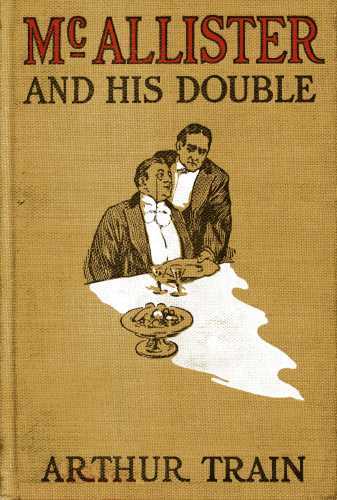
"You think you're a sure winner. But I know you. I know your face."
"I don't know, sir."
"Can't you see what an awkward position you've placed me in?" went on McAllister. "I'm liable to arrest for aidin' in your escape. In fact, that detective has just threatened to take me to Headquarters."
"'Oly Moses!" moaned Wilkins. "Oh, wot shall I do? If you honly get me haway, sir, I promise you I'll never return."
McAllister closed the door, sat down by the bed, and puffed hard at his cigar.
"I'll try it!" he muttered at length. "Wilkins, you remember you always wore my clothes."
"Yes, sir," sighed Wilkins.
"Well, to-night you shall leave the club in my dress-suit, tall hat, and Inverness—understand? You'll take a cab from here at eleven-forty. Go to the Grand Central and board the twelve o'clock train for Boston. Here's a ticket, and the check for the drawing-room. You'll be Mr. McAllister of the Colophon Club, if anyone speaks to you. You're going on to Mr. Cabot's wedding to-morrow, to act as best man. Turn in as soon as you go on board, and don't let anyone disturb you. I'll be on the train myself, and after it starts I'll knock three times on the door."
"Very good, sir," murmured Wilkins.
"I'll send to my rooms for the clothes at once. Do you think you can do it?"
"Oh, certainly, sir! Thank you, sir! I'll be there, sir, never fail."
"Well, good luck to you."
McAllister returned to the big room downstairs. The longer he thought of his plan the better he liked it. He was going to the Winthrops' Twelfth Night party that evening as Henry VIII. He would dress at the club and leave it in costume about nine o'clock. Conville would never recognize him in doublet and hose, and, when Wilkins departed at eleven-forty, would in all likelihood take the latter for McAllister. If he could thus get rid of his ex-valet for good and all it would be cheap at twice the trouble. So far as spiriting away Wilkins was concerned the whole thing seemed easy enough, and McAllister, once more in his usual state of genial placidity, ordered as good a dinner as the chef could provide.
II
The revelry was at its height when Henry VIII realized with a start that it was already half after eleven. First there had been a professional presentation of the scene between Sir Andrew Aguecheek and Sir Toby Belch that had made McAllister shake with merriment. He thought Sir Andrew the drollest fellow that he had seen for many a day. Maria and the clown were both good, too. McAllister had a fleeting wish that he had essayed Sir Toby. The champagne had been excellent and the characters most amusing, and, altogether, McAllister did not blame himself for having overstayed his time—in fact, he didn't care much whether he had or not. He had intended going back to his rooms for the purpose of changing his costume, but he had plenty of clothes on the train, and there really seemed no need of it at all. He bade his hostess good-night in a most optimistic frame of mind and hailed a cab. The long ulster which he wore entirely concealed his costume save for his shoes, strange creations of undressed leather, red on the uppers and white between the toes. As for his cap and feather, he was quite too happy to mind them for an instant. The assembled crowd of lackeys and footmen cheered him mildly as he drove away, but Henry VIII, smoking a large cigar, noticed them not. Neither did he observe a slim young man who darted out from behind a flight of steps and followed the cab, keeping about half a block in the rear. The rain had stopped. The clouds had drawn aside their curtains, and a big friendly moon beamed down on McAllister from an azure sky, bright almost as day.
The cabman hit up his pace as they reached the slope from the Cathedral down Fifth Avenue, and the runner was distanced by several blocks. McAllister, happy and sleepy, was blissfully unconscious of being an actor in a drama of vast import to the New York police, but as they reached Forty-third Street he saw by the illuminated clock upon the Grand Central Station that it was two minutes to twelve. At the same moment a trace broke. The driver sprang from his seat, but before he could reach the ground McAllister had leaped out. Tossing a bill to the perturbed cabby, our hero threw off his ulster and sped with an agility marvellous to behold down Forty-third Street toward the station. As he dashed across Madison Avenue, directly in front of an electric car, the hand on the clock slipped a minute nearer. At that instant the slim man turned the corner from Fifth Avenue and redoubled his speed. Thirty seconds later, McAllister, in sword, doublet, hose, and feathered cap, burst into the waiting-room, carrying an ulster, clearing half its length in six strides, threw himself through the revolving door to the platform, and sprang past the astonished gate-man just as he was sliding-to the gate.
"Hi, there, give us yer ticket!" yelled the man after the retreating form of Henry VIII, but royalty made no response.
The gate closed, a gong rang twice, somewhere up ahead an engine gave half a dozen spasmodic coughs, and the forward section of the train began to pull out. McAllister, gasping for breath, a terrible pain in his side, his ulster seeming to weigh a thousand pounds, stumbled upon the platform of the car next the last. As he did so, the slim young man rushed to the gate and commenced to beat frantically upon it. The gate-man, indignant, approached to make use of severe language.
"Open this gate!" yelled the man. "There's a burglar in disguise on that train. Didn't you see him run through? Open up!"
"Whata yer givin' us?" answered Gate. "Who are yer, anyhow?"
"I'm a detective sergeant!" shrieked the one outside, excitedly exhibiting a shield. "I order you to open this gate and let me through."
Gate looked with exasperating deliberateness after the receding train; its red lights were just passing out of the station.
"Oh, go to—!" said he through the bars.
"Is this car 2241?" inquired the breathless McAllister at the same moment, as he staggered inside.
"Sho, boss," replied the porter, grinning from ear to ear as he received the ticket and its accompanying half-dollar. "Drawin'-room, sah? Yes-sah. Right here, sah! Yo' frien', he arrived some time ago. May Ah enquire what personage yo represent, sah? A most magnificent sword, sah!"
"Where's the smoking compartment?" asked McAllister.
"Udder end, sah!"
Now McAllister had no inclination to feel his way the length of that swaying car. He perceived that the smoking compartment of the car behind would naturally be much more convenient.
"I'm going into the next car to smoke for a while," he informed the darky.
No one was in the smoking compartment of the Benvolio, which was bright and warm, and McAllister, throwing down his ulster, stretched luxuriously across the cushions, lit a cigar, and watched with interest the myriad lights of the Greater City marching past, those near at hand flashing by with the velocity of meteors, and those beyond swinging slowly forward along the outer rim of the circle. And the idea of this huge circle, its circumference ever changing with the forward movement of its pivot, beside which the train was rushing, never passing that mysterious edge which fled before them into infinity, took hold on McAllister's imagination, and he fancied, as he sped onward, that in some mysterious way, if he could only square that circle or calculate its radius, he could solve the problem of existence. What was it he had learned when a boy at St. Andrew's about the circle? Pi R—one—two—two Pi R! That was it! "2πr." The smoke from his cigar swirled thickly around the Pintsch light in the ceiling, and Henry VIII, oblivious of the anachronism, with his sword and feathered cap upon the sofa beside him, gazed solemnly into space.
"Br-r-clink!—br-r-clink!" went the track.
"Two Pi R!" murmured McAllister. "Two Pi R!"
III
Under the big moon's yellow disk, beside and past the roaring train, along the silent reaches of the Sound, leaping on its copper thread from pole to pole, jumping from insulator to insulator, from town to town, sped a message concerning Henry VIII. The night operator at New Haven, dozing over a paper in the corner, heard his call four times before he came to his senses. Then he sent the answer rattling back with a simulation of indignation:
"Yes, yes! What's your rush?"
Special—Police—Headquarters—New Haven. Escaped ex-convict Welch on No. 13 from New York. Notify McGinnis. In complete disguise. Arrest and notify. Particulars long-distance 'phone in morning.
Ebstein.
The operator crossed the room and unhooked the telephone.
"Headquarters, please."
"Yes. Headquarters! Is McGinnis of the New York Detective Bureau there? Tell him he's wanted, to make an important arrest on board No. 13 when she comes through at two-twenty. Sorry. Say, tell him to bring along some cigars. I'll give him the complete message down here."
Then the operator went back to his paper. In a few moments he suddenly sat up.
"By gum!" he ejaculated.
BOLD ATTEMPT AT BURGLARY IN COUNTRY HOUSE
It was learned to-day that a well-known crook had been successful recently in securing a position as a servant at Mr. Gordon Blair's at Scarsdale. Last evening one of the guests missed her valuable pearl necklace. In the excitement which followed the burglar made his escape, leaving the necklace behind him. The perpetrator of this bold attempt is the notorious Fatty Welch, now wanted in several States as a fugitive from justice.
"By gum!" repeated the operator, throwing down the paper. Then he went to the drawer and took out a small bull-dog revolver, which he carefully loaded.
"Br-r-clink!—br-r-clink!" went the track, as the train swung round the curve outside New Haven. The brakes groaned, the porters waked from troubled slumbers in wicker chairs, one or two old women put out their arms and peered through the window-shades, and the train thundered past the depot and slowly came to a full stop. Ahead, the engine panted and steamed. Two gnomes ran, Mimi-like, out of a cavernous darkness behind the station and by the light of flaring torches began to hammer and tap the flanges. The conductor, swinging off the rear car, ran into the embrace of a huge Irishman. At the same moment a squad of policemen separated and scattered to the different platforms.
"Here! Let me go!" gasped the conductor. "What's all this?"
"Say, Cap., I'm McGinnis—Central Office, New York. You've got a burglar on board. They're after wirin' me to make the arrest."
"Burglar be damned!" yelled the conductor. "Do you think you can hold me up and search my train? Why, I'd be two hours late!"
"I won't take more'n fifteen minutes," continued McGinnis, making for the rear car.
"Come back there, you!" shouted the conductor, grasping him firmly by the coat-tails. "You can't wake up all the passengers."
"Look here, Cap.," expostulated the detective, "don't ye see I've got to make this arrest? It won't take a minute. The porters'll know who they've got, and you're runnin' awful light. Have a good cigar?"
The conductor took the weed so designated and swore loudly. It was the biggest piece of gall on record. Well, hang it! he didn't want to take McGinnis all the way to Boston, and even if he did, there would be the same confounded mix-up at the other end. He admitted finally that it was a fine night. Did McGinnis want a nip? He had a bottle in the porter's closet. Yes, call out those niggers and make 'em tell what they knew.
The conductor was now just as insistent that the burglar should be arrested then and there as he had been before that the train should not be held up. He rushed through the cars telling the various porters to go outside. Eight or ten presently assembled upon the platform. They filled McGinnis with unspeakable repulsion.
The conductor began with car No. 2204.
"Now, Deacon, who have you got?"
The Deacon, an enormously fat darky, rolled his eyes and replied that he had "two ole women an' er gen'elman gwine ortermobublin with his cheffonier."
The conductor opined that these would prove unfertile candidates for McGinnis. He therefore turned to Moses, of car No. 2201. Moses, however, had only half a load. There was a fat man, a Mr. Huber, who travelled regularly; two ladies on passes; and a very thin man, with his wife, her sister, a maid, two nurses, and three children.
"Nothin' doin'!" remarked the captain. "Now, Colonel, what have you got?"
But the Colonel, a middle-aged colored man of aristocratic appearance, had an easy answer. His entire car was full, as he expressed it, "er frogs."
"Frenchmen!" grunted McGinnis.
The conductor remembered. Yes, they were Sanko's Orchestra going on to give a matinée concert in Providence.
The next car had only five drummers, every one of whom was known to the conductor, as taking the trip twice a week. They were therefore counted out. That left only one car, No. 2205.
"Well, William, what have you got?"
William grinned. Though sleepy, he realized the importance of the disclosure he was about to make and was correspondingly dignified and ponderous. There was two trabblin' gen'elmen, Mr. Smith and Mr. Higgins. He'd handled dose gen'elmen fo' several years. There was a very old lady, her daughter and maid. Then there was Mr. Uberheimer, who got off at Middletown. And then—William smiled significantly—there was an awful strange pair in the drawin'-room. They could look for themselves. He didn't know nuff'n 'bout burglars in disguise, but dere was "one of 'em in er mighty curious set er fixtures."
"Huh! Two of 'em!" commented McGinnis.
"That's easy!" remarked the mollified conductor.
The telegraph operator, who read Laura Jean Libbey, now approached with his revolver.
McGinnis, another detective, and the conductor moved toward the car. William preferred the safety of the platform and the temporary distinction of being the discoverer of the fugitive. No light was visible in the drawing-room, and the sounds of heavy slumber were plainly audible. The conductor rapped loudly; there was no response. He rattled the door and turned the handle vigorously, but elicited no sign of recognition. Then McGinnis rapped with his knife on the glass of the door. He happened to hit three times. Immediately there were sounds within. Something very much like "All right, sir," and the door was opened. The conductor and McGinnis saw a fat man, in blue silk pajamas, his face flushed and his eyes heavy with sleep, who looked at them in dazed bewilderment.
"Wot do you want?" drawled the fat man, blinking at the lantern.
"Sorry to disturb you," broke in McGinnis briskly, "but is there any wan else, beside ye, to kape ye company?"
Wilkins shook his head with annoyance and made as if to close the door, but the detective thrust his foot across the threshold.
"Aisy there!" he remarked. "Conductor, just turn on that light, will ye?"
Wilkins scrambled heavily into his berth, and the conductor struck a match and turned on the Pintsch light. Only one bed was occupied, and that by the fat man in the pajamas. On the sofa was an elegant alligator-skin bag disclosing a row of massive silver-topped bottles. A tall silk hat and Inverness coat hung from a hook, and a suit of evening clothes, as well as a business suit of fustian, were neatly folded and lying on the upper berth.
At this vision of respectability both McGinnis and the conductor recoiled, glancing doubtfully at one another. Wilkins saw his advantage.
"May I hinquire," remarked he, with dignity, "wot you mean by these hactions? W'y am I thus disturbed in the middle of the night? It is houtrageous!"
"Very sorry, sir," replied the conductor. "The fact is, we thought two people, suspicious characters, had taken this room together, and this officer here"—pointing to McGinnis—"had orders to arrest one of them."
Wilkins swelled with indignation.
"Suspicious characters! Two people! Look 'ere, conductor, I'll 'ave you to hunderstand that I will not tolerate such a performance. I am Mr. McAllister, of the Colophon Club, New York, and I am hon my way to hattend the wedding of Mr. Frederick Cabot in Boston, to-morrow. I am to be 'is best man. Can I give you any further hinformation?"
The conductor, who had noticed the initials "McA" on the silver bottle heads, and the same stamped upon the bag, stammered something in the nature of an apology.
"Say, Cap.," whispered McGinnis, "we've got him wrong, I guess. This feller ain't no burglar. Anywan can see he's a swell, all right. Leave him alone."
"Very sorry to have disturbed you," apologized the conductor humbly, putting out the light and closing the door.
"That nigger must be nutty," he added to the detective. "By Joshua! Perhaps he's got away with some of my stuff!"
"Wot do you want?" drawled the fat man, blinking at the lantern.
"Look here, William, what's the matter with you? Have you been swipin' my whisky. There ain't two men in that drawin'-room at all—just one—a swell," hollered the conductor as they reached the platform.
"Fo' de Lawd, Cap'n, I ain't teched yo' whisky," cried William in terror. "I swear dey was two of 'em, 'n' de udder was in disguise. It was de fines' disguise I eber saw!" he added reminiscently.
"Aw, what yer givin' us!" exclaimed McGinnis, entirely out of patience. "What kind av a disguise was he in?"
"Dat's what I axed him," explained William, edging toward the rim of the circle. "I done ax him right away what character he done represent. He had on silk stockin's, an' a colored deglishay shirt, an' a belt an' moccasons, an' a sword an'——"
"A sword!" yelled McGinnis, making a jump in William's direction. "I'll break yer black head for ye!"
"Hold on!" cried the conductor, who had disappeared into the car and had emerged again with a bottle in his hand. "The stuff's here."
"I tell ye the coon is drunk!" shouted the detective in angry tones. "He can't make small av me!"
"I done tole you the trufe," continued William from a safe distance, his teeth and eyeballs shining in the moonlight.
"Well, where did he go?" asked the conductor. "Did you put him in the drawin'-room?"
"I seen his ticket," replied William, "an' he said he wanted to smoke, so he went into the Benvolio, the car behin'."
"Car behind!" cried McGinnis. "There ain't no car behind. This here is the last car."
"Sure," said the conductor, with a laugh; "we dropped the Benvolio at Selma Junction for repairs. Say, McGinnis, you better have that drink!"
IV
McAllister was awakened by a sense of chill. The compartment was dark, save for the pale light of the moon hanging low over what seemed to be water and the masts of ships, which stole in and picked out sharply the silver buckles on his shoes and the buttons of his doublet. There was no motion, no sound. The train was apparently waiting somewhere, but McAllister could not hear the engine. He put on his ulster and stepped to the door of the car. All the lights had been extinguished and he could hear neither the sound of heavy breathing nor the other customary evidences of the innocent rest of the human animal. He looked across the platform for his own car and found that the train had totally disappeared. The Benvolio was stationary—side-tracked, evidently, on the outskirts of a town, not far from some wharves.
"Jiminy!" thought McAllister, looking at his uncheerful surroundings and his picturesque, if somewhat cool, costume.
For a moment his mental processes refused to answer the heavy draught upon them. Then he turned up his coat-collar, stepped out upon the platform, and lit a cigar. By the light of the match he looked at his watch and saw that it was four o'clock. Overhead the sky glowed with thousands of twinkling stars, and the moon, just touching the sea, made a limpid path of light across the water. At the docks silent ships lay fast asleep. A mile away a clock struck four, intensifying the stillness. It was very beautiful, but very cold, and McAllister shivered as he thought of Wilkins, and Freddy Cabot, and the wedding at twelve o'clock. So far as he knew he might be just outside of Boston—Quincy, or somewhere—yet, somehow, the moon didn't look as if it were at Quincy.
He jumped down and started along the track. His feet stung as they struck the cinder. His whole body was asleep. It was easy enough to walk in the direction in which the clock had sounded, and this he did. The rails followed the shore for about a hundred yards and then joined the main line. Presently he came in sight of a depot. Every now and then his sword would get between his legs, and this caused him so much annoyance that he took it off and carried it. It was queer how uncomfortable the old style of shoe was when used for walking on a railroad track. His ruffle, too, proved a confounded nuisance, almost preventing a satisfactory adjustment of coat-collar. Finally he untied it and put it in the pocket of his ulster. The cap was not so bad.
The depot had inspired the clubman with distinct hope, but as he approached, it appeared as dark and tenantless as the car behind him. It was impossible to read the name of the station owing to the fact that the sign was too high up for the light of a match to reach it. It was clear that there was nothing to do but to wait for the dawn, and he settled himself in a corner near the express office and tried to forget his discomfort.
He had less time to wait than he had expected. Soon a great clattering of hoofs caused him to climb stiffly to his feet again. Three farmers' wagons, each drawn by a pair of heavy horses, backed in against the platform, and their drivers, throwing down the reins, leaped to the ground. All were smoking pipes and chaffing one another loudly. Then they began to unload huge cans of milk. This looked encouraging. If they were bringing milk at this hour there must be a train—going somewhere. It didn't matter where to McAllister, if only he could get warm. Presently a faint humming came along the rails, which steadily increased in volume until the approaching train could be distinctly heard.
"Pretty nigh on time," commented the nearest farmer.
McAllister stepped forward, sword in hand. The farmer involuntarily drew back.
"Wall, I swan!" he remarked, removing his pipe.
"Do you mind telling me," inquired our friend, "what place this is and where this train goes to?"
"I reckon not," replied the other. "This is Selma Junction, and this here train is due in New York at five. Who be you?"
"Well," answered McAllister, "I'm just an humble citizen of New York, forced by circumstances to return to the city as soon as possible."
"Reckon you're one o' them play-actors, bean't ye?"
"You've got it," returned McAllister. "Fact is, I've just been playing Henry VIII—on the road."
"I've heard tell on't," commented the rustic. "But I ain't never seen it. Shakespeare, ain't it?"
"Yes, Shakespeare," admitted the clubman.
At this moment the milk-train roared in and the teamsters began passing up their cans. There were no passenger coaches—nothing but freight-cars and a caboose. Toward this our friend made his way. There did not seem to be any conductor, and, without making inquiries, McAllister climbed upon the platform and pushed open the door. If warmth was what he desired he soon found it. The end of the car was roughly fitted with half a dozen bunks, two boxes which served for chairs, and some spittoons. A small cast-iron stove glowed red-hot, but while the place was odoriferous, its temperature was grateful to the shivering McAllister. The car was empty save for a gigantic Irishman sitting fast asleep in the farther corner.
Our hero laid down his sword, threw off his ulster, and hung his cap upon an adjacent hook. In a moment or two the train started again. Still no one came into the caboose. Now daylight began to filter in through the grimy windows. The sun jumped suddenly from behind a ridge and shot a beam into the face of the sleeper at the other end of the car. Slowly he awoke, yawned, rubbed his eyes, and, catching the glint of silver buttons, gazed stupidly in McAllister's direction. The random glance gradually gave place to a stare of intense amazement. He wrinkled his brows, and leaned forward, scrutinizing with care every detail of McAllister's make-up. The train stopped for an instant and a burly brakeman banged open the door and stepped inside. He, too, hung fire, as it were, at the sight of Henry VIII. Then he broke into a loud laugh.
"Who in thunder are you?"
Before McAllister could reply McGinnis, with a comprehensive smile, made answer:
"Shure, 'tis only a prisoner I'm after takin' back to the city!"
"Mr. McAllister," remarked Conville, two hours later, as the three of them sat in the visitors' room at the club, "I hope you won't say anything about this. You see, I had no business to put a kid like Ebstein on the job, but I was clean knocked out and had to snatch some sleep. I suppose he thought he was doin' a big thing when he nailed you for a burglar. But, after all, the only thing that saved Welch was your fallin' asleep in the Benvolio."
"My dear Baron," sympathetically replied McAllister, who had once more resumed his ordinary attire, "why attribute to chance what is in fact due to intellect? No, I won't mention our adventure, and if our friend McGinnis—"
"Oh, McGinnis'll keep his head shut, all right, you bet!" interrupted Barney. "But say, Mr. McAllister, on the level, you're too good for us. Why don't you chuck this game and come in out of the rain? You'll be up against it in the end. Help us to land this feller!"
McAllister took a long pull at his cigar and half-closed his eyes. There was a quizzical look around his mouth that Conville had never seen there before.
"Perhaps I will," said he softly. "Perhaps I will."
"Good!" shouted the Baron; "put it there! Now, if you get anything, tip us off. You can always catch me at 3100 Spring."
"Well," replied the clubman, "don't forget to drop in here, if you happen to be going by. Some time, on a rainy day perhaps, you might want a nip of something warm."
But to this the Baron did not respond.
"Who in thunder are you?"
A plunge in the tank and a comfortable smoke almost restored McAllister's customary equanimity. Weddings were a bore, anyway. Then he called for a telegraph blank and sent the following:
Was unavoidably detained. Terribly disappointed. If necessary, use Wilkins.
McA.
To which, about noon-time, he received the following reply:
Don't understand. Wilkins arrived, left clothes and departed. You must have mixed your dates. Wedding to-morrow.
F. C.
The Governor-General's Trunk
I
McAllister was in the tank. His puffing and blowing as he dove and tumbled like a contented, rubicund porpoise, reverberated loudly among the marble pillars of the bath at the club. It was all part of a carefully adjusted and as rigorously followed regimen, for McAllister was a thorough believer in exercise (provided it was moderate), and took it regularly, averring that a fellow couldn't expect to eat and drink as much as he naturally wanted to unless he kept in some sort of condition, and if he didn't he would simply get off his peck, that was all. Hence "Chubby" arose regularly at nine-thirty, and wrapping himself in a padded Japanese silk dressing-gown, descended to the tank, where he dove six times and swam around twice, after which he weighed himself and had Tim rub him down. Tim felt a high degree of solicitude for all this procedure, since he was a personal discovery of McAllister's, and owed his present exalted position entirely to the clubman's interest, for the latter had found him at Coney Island earning his daily bread by diving, in the presence of countless multitudes, into a six-foot glass tank, where he seated himself upon the bottom and nonchalantly consumed a banana. McAllister's delight and enthusiasm at this elevating spectacle had been boundless.
"Wish I could do any one thing as well as that feller dives down and eats that banana!" he had confided to his friend Wainwright. "Sometimes I feel as if my life had been wasted!" The upshot of the whole matter was that Tim had been forthwith engaged as rubber and swimming teacher at the club.
McAllister had just taken his fifth plunge, and was floating lazily toward the steps, when Tim appeared at the door leading into the dressing-rooms and announced that a party wanted to speak to him on the 'phone, the Lady somebody, evidently a very cantankerous old person, who was in the devil of a hurry, and wouldn't stand no waitin'.
The clubman turned over, sputtered, touched bottom, and arose dripping to his feet. The "old person" on the wire was clearly his aunt, Lady Lyndhurst, and he knew very much better than to irritate her when she was in one of her tantrums. Still, he couldn't imagine what she wanted with him at that hour of the morning. She'd been placid enough the evening before when he'd left her after the opera. But ever since she had married Lord Lyndhurst for her second husband ten years before she'd been getting more and more dictatorial.
"Tell her I'm in this beastly tank; awful sorry I can't speak with her myself, don'cher know, and find out what she wants. And Tim—handle her gently—it's my aunt."
Tim grinned and winked a comprehending eye. As McAllister hurried into his bath-robe and slippers he wondered more and more why she had rung him up so early. He had intended calling on her after breakfast, any way, but "after breakfast" to McAllister meant in the neighborhood of twelve o'clock, for the meal was always carefully ordered the evening before for half-past ten the next morning, after which came the paper and a long, light Casadora, crop of '97, which McAllister had bought up entire. Something must be up—that was certain. He could imagine her in her wrapper and curl-papers holding converse with Tim over the wire. The language of his protégé might well assist in the process for which the curl-papers were required. There was nobody in the world, in McAllister's opinion, so queer as his aunt, except his aunt's husband. The latter was a stout, beefy nobleman of sixty-five, with a walrus-like countenance, an implicit faith in the perfection of British institutions, and about enough intelligence to drive a watering-cart. He had been rewarded for his unswerving fidelity to party with the post of Governor-General at a small group of islands somewhere near the equator, and had assumed his duties solemnly and ponderously, establishing the Bertillon system of measurements for the seven criminals which his islands supported, and producing quarterly monographs on the flora, fauna, and conchology of his dominion. Just now they were en route for England (via Quebec, of course), and were stopping at the Waldorf.
Tim presently reappeared.
"She says you've got to hike right down to the hotel as fast as you can. She's terrible upset. My, ain't she a tiger?"
"But what's the bloomin' row?" exclaimed McAllister.
Tim looked round cautiously and lowered his voice.
"The Lyndhurst Jewels has been stole!" said he.
II
The Lyndhurst Jewels stolen! No wonder Aunt Sophia had seemed peevish, for they were the treasured heirlooms of her husband's family, cherished and guarded by her with anxious eye. McAllister had always said the old man was an ass to go lugging 'em off down among the mangoes and land-crabs, but the Governor-General liked to have his lady appear in style at Government House, and took much innocent pleasure in astonishing the natives by the splendor of her adornment. The jewelry, however, was the source of unending annoyance to himself, Sophia, and everybody else, for it was always getting lost, and burglar scares occurred with regularity at the islands. It had been still intact, however, on their arrival in New York.
The clubman found his uncle and aunt sitting dejectedly at the breakfast-table in the Diplomatic Suite.
The atmosphere of gloom struck a cold chill to our friend's centre of vivacity. There were also evidences of a domestic misunderstanding. His aunt fidgeted nervously, and his uncle evaded McAllister's eye as they responded half-heartedly to his cheerful salutation. That the matter was serious was obvious. Clearly this time the jewels must be really gone. In addition, both the Governor-General and his lady kept looking over their shoulders fearfully, as if dreading the momentary assault of some assassin. McAllister inquired what the jolly mess was, incidentally suggesting that their hurry-call had deprived him of any attempt at breakfast. His hint, however, fell on barren ground.
"That fool Morton has packed all the jewelry in the big Vuitton!" exclaimed his uncle, nervously jabbing his spoon into a grape-fruit. "To say the least, it was excessively careless of him, for he knows perfectly well that we always carry it in the morocco hand-bag, and never allow it out of our sight." The Governor-General paused, and took a sip of coffee.
"Well," said McAllister, rather impatiently, "why don't you have him unpack it, then?" He couldn't for the life of him see why they made such a row about a thing of that sort. It was clear enough that they were both more than half mad.
"Ah, that's the point! It was sent to the station with the rest of the luggage last evening. Heaven knows it may all have been stolen by this time! Think of it, McAllister! The Lyndhurst Jewels, secured merely by a miserable brass check with a number on it—and the railroad liable by express contract only to the extent of one hundred dollars!" Before Uncle Basil had attained his present eminence he had been called to the bar, and his book on "Flotsam and Jetsam" is still an authority in those regions to which later works have not penetrated. "You see we're leaving at three this afternoon, but why send it all so early unless for a purpose?" Lord Lyndhurst nodded conclusively. He had the air of one who had divined something.
Still Chubby failed to see the connection. Someone, a valet evidently, had packed the jewelry in the wrong place, and then sent the load off a little ahead of time. What of it? He recalled vividly an occasion when the jewels had been stuffed by mistake into the soiled-clothes basket, but had turned up safe enough at the end of the trip.
"If that is all," replied McAllister, "all you have to do is to send your man over to the station and have the trunk brought back. Send the fellow who packed the trunk—this Morton—whoever he is."
"No," said his uncle, studiously knocking in the end of a boiled egg. "There are reasons. I wish you would go, instead. The fact is I don't wish Morton to leave the rooms this morning; I—I need him." Lord Lyndhurst again evaded the clubman's inquiring glance, and eyed the egg in an embarrassed fashion.
McAllister laughed. "I guess your jewelry's all right," said he cheerfully. "Certainly I'll go. Don't worry. I'll have the trunk and the jewels back here inside of fifty minutes. Who's Morton, anyhow?"
"My valet," replied Lord Lyndhurst, lowering his voice, and looking over his shoulder. "You wouldn't recall him. I engaged the man at Kingston on the way out. As a servant I have had absolutely no fault to find at all. You know it's very hard to get a good man to go to the Tropics, but Morton has seemed perfectly contented. Up to the present time I haven't had the slightest reason to suspect his honesty!"
"Well, I don't see that you have any now," said McAllister. "I guess I'll start along. I haven't had anythin' to eat yet. Have you the check?"
Uncle Basil gingerly handed him the bit of brass.
"I secured it from Morton," he remarked, attacking the egg viciously.
"Secured it?" exclaimed McAllister.
The Governor-General nodded ambiguously.
Aunt Sophia during the course of the recital had become almost hysterical, and now sat wringing her hands in the greatest agitation. Suddenly she broke forth:
"I told Basil he had been too hasty! But he would have it that there was nothing else to do! Oh, dear! Oh, dear! Why don't you tell him what you've done?"
"What in thunder have you done?" asked McAllister, now convinced beyond peradventure that his uncle was a candidate for the nearest insane asylum.
Lord Lyndhurst became very red, stammered, and jerked his thumb over his shoulder.
"Yes, secured it! Morton, if you must know it, is locked in the clothes-closet. I locked him!"
"He's in there!" suddenly wailed Aunt Sophia. "Basil put him in! And now the jewelry's no one knows where, and there's a man in the room, and I'm afraid to stay and Basil's afraid to go for fear he may get out, and——"
She was interrupted by a smothered voice that came from within the closet. McAllister was startled, for there was something faintly, vaguely familiar about it.
"It's a bloomin' houtrage, it is! Look 'ere, sir, I'll 'ave you to hunderstand that I gives notice at once, sir, 'ere and now, sir! It's a great hindignity you are a-puttin' me to, sir! Won't you let me hout, sir?" The voice ceased momentarily.
"Isn't it awful!" exclaimed Aunt Sophia. "He's been like that for over an hour!"
"Yes!" added Uncle Basil. "At times he's been actually abusive." But McAllister was lost in an effort to recall the hazy past. Where had he heard that voice before?
"'Ang it, sir! Won't you let me hout, sir," continued Morton. "I'm stiflin' in 'ere, an' I thinks there's a rat, sir. O Lawd! Let me hout!"
McAllister jumped to his feet. Of course he recognized the voice! Could he ever forget it? Had anyone ever said "O Lawd!" in quite the same way as the majestic Wilkins? It could be no other! By George, the old man wasn't such a fool after all! And the jewels! He smote his fist upon the table, while his uncle and aunt gazed at him apprehensively. There was no use exciting their fears, however. It was all plain to him, now. The clever dog! Well, the first thing was to see what had become of the jewels.
"Damn!" came in vigorous tones from the closet, as Wilkins endeavored to assert himself. "It's a bloomin' houtrage, it is! I'll 'ave you arrested for hassault an' bat'ry, I will, if you are a guv'nor! Let me hout, I say!"
III
McAllister lost no time in getting to the Grand Central Station. He was looking for a big Vuitton trunk, and he wanted to find it quick. For this purpose he enlisted the services of a burly young porter, who, for the consideration of a half-dollar, piloted the clubman through the crowded alleys of the outgoing baggage-room, until they came upon the familiar collection of Lord Lyndhurst's paraphernalia of travel. Eagerly he recognized the luggage of his uncle's official household. There were his boot-boxes, his hat-boxes, his portable desk, his dumb-bells, his bath-tub, his medicine chest, the secretary's trunk, the typewriter in its case; there were his aunt's basket trunks, and—yes—there was the big Vuitton. McAllister heaved a sigh of relief. The next thing was to get it back to the hotel as fast as possible.
"That's it," said he to the porter. "Heave it out!" They were standing in a little open space some distance from the entrance. The big Vuitton lay at one side, and about it a row of other trunks roughly in a semicircle. The porter made but one step in the desired direction, then jumped as if he had seen a ghost, for a big basket trunk, standing alone upon its end apart, suddenly shook violently, its lock clicked, the cover swung open, and out jumped a slender, sharp-featured young man with a black mustache. It was Barney Conville, although at first McAllister failed to recognize him.
"Look here you! Don't touch that trunk!" he exclaimed. Then he perceived McAllister, and a look of intense disgust overspread his face.
"It's the Baron!" ejaculated McAllister. "Now what the devil do you suppose he's been doin' in that trunk? Howd'y', Baron," he added pleasantly, holding out his hand. "Hardly expected to see you here. Do you take your rest that way?" pointing to the trunk from which Conville had emerged.
The detective eyed him with disapproval.
"Say," he remarked, disdainfully, "you give me a pain—always buttin' in an' spoilin' everythin'! This here is a plant. I'm waitin' fer a thief—Jerry, the Oyster. They're goin' to try an' lift that big striped trunk over there. It belongs to an old party up to the Waldorf. He's a diplomatico."
"He's my uncle!" cried McAllister.
"Your aunt!" snorted Barney.
"But I want to take that trunk back with me."
"On the level?"
"Sure!"
"Can't help it! This is an important job. The Oyster's the cleverest thief in the business. Works in with all the butlers and valets. Why he's got away with more'n three thousand pieces of baggage. He's the——"
Barney did not finish the sentence. Suddenly he ducked, and grabbing McAllister by the shoulder, pulled him down with him.
"There he is now! Into the trunk! There's no other way! Plenty of room!" He shoved his fat companion inside and stepped after him. McAllister, utterly bewildered, tried to convince himself that he was not dreaming. He was quite sure he had taken only one Scotch that morning, but he pinched himself, and was relieved to get the proper reaction. When he became used to the dim light he discovered that he was ensconced in a dress-box of immense proportions, made of basket work, and covered with waterproofing. Placed on end, with a seat across the middle, it afforded a very comfortable place of concealment. Conville turned the key and locked the cover. Then he poked McAllister in the ribs.
"Great joint, ain't it? Idee of the cap's. Makes a fine plant," he whispered, affixing his eye to a narrow slit near the top.
"Sh-h!" he added; "he's here. There's another peeper over on your side."
McAllister followed his example, gluing his eye to the improvised window, and discovered that they commanded the approach to the big Vuitton. And inside that innocent piece of luggage reposed the glory of his uncle's family, the heirlooms of four centuries! He made an involuntary movement.
"Keep still!" hissed Conville, and McAllister sank back obediently.
A young Anglican clergyman in shovel-hat and gaiters, carrying a dainty silver-headed umbrella in one hand and a copy of The Churchman in the other, had approached the counter. He seemed somewhat at a loss, gazed vaguely about him for a moment, and then stepping up to the head baggage-man, an oldish man with white whiskers, addressed him anxiously.
"I say, my man, I'm really in an awful mess, don't you know! I don't see my box anywhere. I sent it over from the hotel early this morning, and I'm leavin' for Montreal at three. The luggage-man says it was left here by ten o'clock. Do you keep all the boxes in this room?"
The head baggage-man nodded.
"Sorry you've lost your trunk," said he. "If it ain't here we haven't got it, but like as not it's mixed up in one of them piles. If you'll wait for about ten minutes I'll see if I can find it for your Reverence."
The Anglican looked shocked.
"Thanks, I'm sure," he murmured stiffly. He was a slight young man with a monocle and mutton-chops.
"It's very good of you," he added after a pause, with more condescension. "Awfully awkward to be without one's luggage, for I have a service in Montreal to-morrow, and all my vestments are in my box. I fear I shall miss my train."
"Oh, I guess not!" replied the baggage-man encouragingly. "I'll be with you presently. You come in and look around yourself, and if you don't see it I'll help you. This way, sir," and he lifted a section of the counter and allowed the clergyman to pass in.
"My! Ain't he clever!" whispered Barney delightedly.
The clergyman now began a rather dilatory investigation of the contents of the baggage-room, bending over and examining every trunk in sight, and even tapping the one in which they were ensconced with the silver head of his umbrella, but after a few moments, in apparent despair, he took his stand beside the big trunk marked "B. C. L.," and gazed despondently about him. There was nothing in his appearance to suggest that he was other than he seemed, but Barney directed McAllister's attention to the copy of The Churchman, from the leaves of which protruded two diminutive pieces of string, put there, as it might appear, for a book-mark. And now as the Anglican shifted from one foot to the other, ostensibly waiting for the porter, he placed his hands behind him and took a step or two backward toward the big trunk. Chubby was by this time all agog. What would the fellow do? He certainly couldn't be goin' to shoulder the trunk and try to walk off with it!
Suddenly McAllister saw the daintily gloved hands slip a penknife from among the leaves of the magazine and quickly sever the check from the handle of the trunk. The Anglican altered his position and waited until the baggage-man was once more engaged at the other end of the counter. Again this amiable representative of the cloth shuffled backward until the handle was within easy reach, and with a dexterity which must have been born of long practice deftly tied the two ends of string around it. With a quick motion he stepped away in the direction of the counter, and out from the leaves of The Churchman fell and dangled a new check stamped "Waistcoat's Express, No. 1467."
"My good fellow," impatiently drawled the clergyman, approaching the baggage-man, "I really can't wait, don'cher know. I've looked everywhere, and my box isn't here. I don't know whether to blame that beastly luggage-man, or whether it's the fault of this disgustin' American railroad. It's evident someone's at fault, and as I assume that you are in charge I shall report you immediately."