
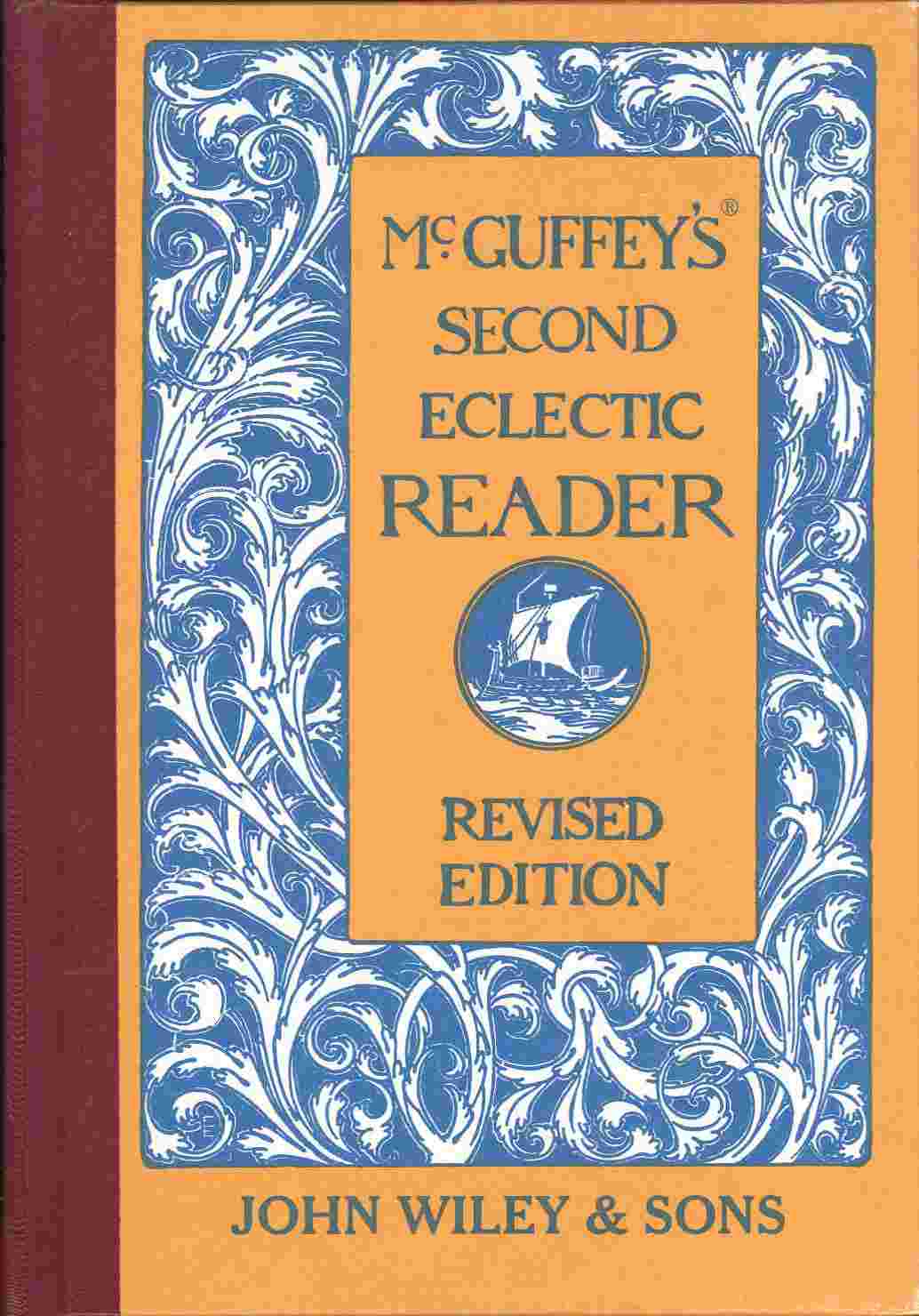
The Project Gutenberg eBook of McGuffey's Second Eclectic Reader
Title: McGuffey's Second Eclectic Reader
Author: William Holmes McGuffey
Release date: June 29, 2005 [eBook #14668]
Most recently updated: February 16, 2024
Language: English
Credits: Produced by Don Kostuch.
MCGUFFEY'S SECOND ECLECTIC READER
Welcome to the schoolroom of 1900. The moral tone is plain. "She is kind to the old blind man."
The exercises are still suitable, and perhaps more helpful than some contemporary alternatives. Much is left to the teacher. Explanations given in the text are enough to get started teaching a child to read and write. Counting in Roman numerals is included as a bonus in the form of lesson numbers.
The author, not listed in the text is William Holmes McGuffey.
Don Kostuch
SECOND
ECLECTIC READER.
JOHN WILEY & SONS, Inc.
New York - Chichester-Weinheim-Brisbane-Singapore-Toronto
Copyright, 1896, by American Book Company
Copyright, 1907 and 1920, by H. H. Vail.
EP316
Preface
In this book, as well as in the others of the Revised Series, most of the favorite drill selections, which constituted one of the leading excellences of MCGUFFEY'S READERS, have been retained. New selections have been inserted only when they seemed manifest improvements on those formerly used.
The plan of this Reader is a continuation and extension of that pursued in the First Reader.
If the pupil is not familiar with the diacritical marks, he should be carefully drilled, as suggested on page 7, until the marked letter instantly suggests the correct sound. He is then prepared to study his reading lessons without any assistance from the teacher.
All new words are given at the head of each lesson. When these are mastered, the main difficulties left for the pupil are those of expression. In the latter portion of the book the simpler derivatives,—such as are formed by adding one or two letters,—possessives, plurals, verbal forms, etc.,—are omitted if the primitive word has been given. In this way the pupil is gradually led to the mastery of words as ordinarily printed.
A few of the most usual abbreviations have been introduced,—such as Mr., Mrs., etc. These should be carefully explained, not only as to their meaning and use, but as to the reason for their use.
Great care has been taken to have the illustrations worthy of the reputation MCGUFFEY'S READERS have attained, and some of the foremost designers of this country have contributed to the embellishment of the book.
Many of these pictures will serve admirably for lessons in language, in extension and explanation of the text. The imagination of the artist has, in some cases, filled in details not found in the text.
The thanks of the publishers are due to very many experienced teachers, who have contributed their valuable suggestions.
June, 1879.
CONTENTS.
- Evening at Home
- Bubbles
- Willie's Letter (Script)
- The Little Star
- Two Dogs
- Afraid in the Dark
- Baby Bye
- Puss and her Kittens
- Kittie and Mousie
- At Work
- What a Bird Taught
- Susie Sunbeam
- If I were a Sun beam
- Henry, the Bootblack
- Don't Wake the Baby (Script)
- A Kind Brother
- My Good-far-nothing
- The Kingbird
- Evening Hymn
- The Quarrel
- The Bee
- The Song of the Bee
- The Torn Doll
- Sheep-shearing
- The Clouds
- Patty and the Squirrel
- The Sparrow
- Sam and Harry
- The Little Rill
- The Boat Upset
- Mary's Letter (Script)
- The Tiger
- The Fireside
- Birdie's Morning Song
- Willie and Bounce
- Willie and Bounce (Concluded)
- The Kitchen Clock
- The New Scales
- The Bear and the Children
- The Little Harebell (Script)
- The Fishhawk
- What the Leaf said
- The Wind and the Leaves
- Mamma's Present
- Mary's Story
- Ralph Wick
- Coasting down the Hill (Script)
- The Fox and the Ducks
- Pretty is that Pretty does
- The Story-teller
- The Story-teller (Concluded)
- The Owl
- The Owl (Concluded)
- Grandfather's Story
- God is Great and Good
- A Good Old Man
- The Greedy Girl
- A Place for Everything
- My Mother (Script)
- The Broken Window
- The Broken Window (Concluded)
- Frank and the Hourglass
- March
- Jenny's Call
- Poor Davy
- Alice's Supper
- A Snowstorm
- Bessie
- Bessie (Concluded)
- Cheerfulness (Script)
- Lullaby
ARTICULATION.
SUGGESTIONS TO TEACHERS.—Thorough and frequent drills on the elementary sounds are useful in correcting vicious habits of pronunciation and in strengthening the vocal organs.
As a rule, only one or two sounds should be employed at one lesson. Care should be taken that the pupils observe and practice these sounds correctly in their reading.
PUNCTUATION.
Punctuation Marks are used to make the sense more clear.
A Period (.) is used at the end of a sentence, and after an abbreviation; as,
James was quite sick. Dr. Jones was called to see him.
An Interrogation Mark (?) is used at the end of a question; as,
Where is John going?
An Exclamation Mark (!) is used after words or sentences expressing some strong feeling; as,
Alas, my noble boy! that thou shouldst die!
The Comma (,), Semicolon (;), and Colon (:) are used to separate the parts of a sentence.
The Hyphen (-) is used to join the parts of a compound word; as, text-book: it is also used at the end of a line in print or script, when a word is divided; as in the word "sentence," near the bottom of page 9. [Transcriber's note: Hyphenation not shown in this HTML edition.]
LESSON I.
- It is winter. The cold wind whistles through the branches of the trees.
- Mr. Brown has done his day's work, and his children, Harry and Kate, have come home from school. They learned their lessons well to-day, and both feel happy.
- Tea is over. Mrs. Brown has put the little sitting room in order. The fire burns brightly. One lamp gives light enough for all. On the stool is a basket of fine apples. They seem to say, "Won't you have one?"
- Harry and Kate read a story in a new book. The father reads his newspaper, and the mother mends Harry's stockings.
- By and by, they will tell one another what they have been reading about, and will have a chat over the events of the day.
- Harry and Kate's bedtime will come first. I think I see them kiss their dear father and mother a sweet good night.
- Do you not wish that every boy and girl could have a home like this?
LESSON II.
- The boys have come out on the porch to blow bubbles. The old cat is asleep on the mat by the door.
- "Ha! ha!" laughs Robert, as a bubble comes down softly on the old cat's back, and does not burst.
- Willie tries to make his bubble do the same. This time it comes down on the cat's face, and makes her sneeze.
- "She would rather wash her face without soap," says Harry. "Now let us see who can make the biggest bubble."
- "Mine is the biggest," says Robert. "See how high it floats in the air! I can see—ah! it has burst."
- "I can see the house and the trees and the sky in mine," says Willie; "and such beautiful colors."
- "How many, Willie?"
- "Red, one; blue, two; there—they are all out. Let us try again."
- "I know how many colors there are," says Harry. "Just as many as there are in the rainbow."
- "Do you know how many that is?"
LESSON III.
LESSON IV.
- Twinkle, twinkle, little star;
How I wonder what you are,
Up above the world so high,
Like a diamond in the sky! - When the blazing sun is set,
And the grass with dew is wet,
Then you show your little light;
Twinkle, twinkle, all the night. - Then, if I were in the dark,
I would thank you for your spark.
I could not see which way to go,
If you did not twinkle so. - And when I am sound asleep,
Oft you through my window peep;
For you never shut your eye,
Till the sun is in the sky.
LESSON V.
- James White has two dogs. One is a Newfoundland dog, and the other is a Scotch terrier.
- The Newfoundland is a large, noble fellow. He is black, with a white spot, and with long, shaggy hair. His name is Sport.
- Sport is a good watchdog, and a kind playfellow. Every night he guards the house while James and his father are asleep.
- In the daytime, James often uses Sport for his horse. He has a little wagon, and a set of small harness which just fits the dog.
- He hitches Sport to this wagon, and drives over the country. In this way, he can go almost as fast as his father with the old family horse.
- The name of James's Scotch terrier is Dodger. He is called Dodger because he jumps about so friskily. He is up on a chair, under the table, behind the door, down cellar, and out in the yard,—all in a minute.
- Dodger has very bright eyes, and he does many funny things. He likes to put his paws up on the crib, and watch the baby.
- The other day he took baby's red stocking, and had great fun with it; but he spoiled it in his play, and James had to scold him.
- Everyone likes to see James White with his two dogs. They always seem very happy together.
LESSON VI.
- "Willie, will you run upstairs, and get my needle book from the bureau?"
- But Willie did not stir. "Willie!" said mamma. She thought he had not heard.
- "I'm afraid," said Willie.
- "Afraid of what?"
- "It's dark up there."
- "What is the dark?" asked mamma. "See! It is nothing but a shadow." And she held her hand between the lamp and the workbasket on the table.
- "Now it is dark in the basket; but as soon as I take my hand away, it is light."
- "Come and stand between the lamp and the wall, Willie. See! There is your shadow on the wall. Can your shadow hurt you?"
- "Oh no, mamma! I am sure it can not hurt me."
- "Well, the dark is only a big shadow over everything."
- "What makes the big shadow, mamma?"
- "I will tell you all about that, Willie, when you are a little older. But now, I wish you would find me a brave boy who is not afraid of shadows, to run upstairs and get my needlebook."
- "I am brave, mamma. I will go. —Here it is."
- "Thank you, my brave little man. You see the dark didn't hurt you."
LESSON VII.
- Baby Bye,
Here's a fly;
We will watch him, you and I.
How he crawls
Up the walls,
Yet he never falls!
I believe with six such legs
You and I could walk on eggs.
There he goes
On his toes,
Tickling Baby's nose. - Spots of red
Dot his head;
Rainbows on his back are spread;
That small speck
Is his neck;
See him nod and beck!
I can show you, if you choose,
Where to look to find his shoes,
Three small pairs,
Made of hairs;
These he always wears. - Flies can see
More than we;
So how bright their eyes must be!
Little fly,
Ope your eye;
Spiders are near by.
For a secret I can tell,
Spiders never use flies well;
Then away,
Do not stay.
Little fly, good day.
LESSON VIII.
- Puss, with her three kittens, had lived in the coal cellar; but one day she thought she would carry them to the attic.
- The servant thought that was not the proper place for them; so she carried them back to the cellar.
- Puss was certain that she wanted them in the attic; so she carried them there again and again, five, six, seven, —yes, a dozen times; for each time the servant took them back to the cellar.
- Poor puss was nearly tired out, and could carry them no longer.
- Suddenly she went away. Where do you think she went?
- She was gone a long time. When she returned, she had a strange cat with her that we had never seen before.
- She seemed to tell him all about her great trouble, and he listened to her story.
- Then the strange cat took the little kittens, one by one, and carried them to the attic. After this he went away, and we have never seen him since.
- The servant then left the kittens in the attic, for she saw how anxious puss was to have them stay there.
- Was not the strange cat kind to puss? This lesson should teach children to be ever ready to help one another.
LESSON IX.
- Once there was a little kitty,
White as the snow;
In a barn he used to frolic,
Long time ago. - In the barn a little mousie
Ran to and fro;
For she heard the little kitty,
Long time ago. - Two black eyes had little kitty,
Black as a crow;
And they spied the little mousie,
Long time ago. - Four soft paws had little kitty,
Paws soft as snow;
And they caught the little mousie,
Long time ago. - Nine pearl teeth had little kitty,
All in a row;
And they bit the little mousie,
Long time ago. - When the teeth bit little mousie,
Mousie cried out "Oh!"
But she slipped away from kitty,
Long time ago.
LESSON X.
- A little play does not harm any one, but does much good. After play, we should be glad to work.
- I knew a boy who liked a good game very much. He could run, swim, jump, and play ball; and was always merry when out of school.
- But he knew that time is not all for play; that our minutes, hours, and days are very precious.
- At the end of his play, he would go home. After he had washed his face and hands, and brushed his hair, he would help his mother, or read in his book, or write upon his slate.
- He used to say, "One thing at a time." When he had done with work, he would play; but he did not try to play and to work at the same time.
LESSON XI.
- Why do you come to my apple tree,
Little bird so gray?
Twit-twit, twit-twit, twit-twit-twee!
That was all he would say. - Why do you lock your rosy feet
So closely round the spray?
Twit-twit, twit-twit, twit-tweet!
That was all he would say. - Why on the topmost bough do you get,
Little bird so gray?
Twit-twit-twee! twit-twit-twit!
That was all he would say. - Where is your mate? come, answer me,
Little bird so gray.
Twit-twit-twit! twit-twit-twee!
That was all he would say.
LESSON XII.
- Susie Sunbeam was not her real name; that was Susan Brown. But every one called her Susie Sunbeam, because she had such a sweet, smiling face, and always brought brightness with her when she came.
- Her grandfather first gave her this name, and it seemed to fit the little girl so nicely that soon it took the place of her own.
- Even when a baby, Susie laughed and crowed from morning till night. No one ever heard her cry unless she was sick or hurt.
- When she had learned to walk, she loved to go about the house and get things for her mother, and in this way save her as many steps as she could.
- She would sit by her mother's side for an hour at a time, and ask her ever so many questions, or she would take her new book and read.
- Susie was always pleasant in her play with other children. She never used an unkind word, but tried to do whatever would please her playmates best.
- One day, a poor little girl with a very ragged dress was going by and Susie heard some children teasing her and making fun of her.
- She at once ran out to the gate, and asked the poor little girl to come in. "What are you crying for?" Susie asked.
- "Because they all laugh at me," she said.
- Then Susie took the little girl into the house. She cheered her up with kind words, and gave her a nice dress and a pair of shoes.
- This brought real joy and gladness to the poor child, and she, too, thought that Susie was rightly called Sunbeam.
LESSON XIII.
- "If I were a sunbeam,
I know what I'd do;
I would seek white lilies,
Roaming woodlands through.
I would steal among them,
Softest light I'd shed,
Until every lily
Raised its drooping head. - "If I were a sunbeam,
I know where I'd go;
Into lowly hovels,
Dark with want and woe:
Till sad hearts looked upward,
I would shine and shine;
Then they'd think of heaven,
Their sweet home and mine." - Are you not a sunbeam,
Child, whose life is glad
With an inner brightness
Sunshine never had?
Oh, as God has blessed you,
Scatter light divine!
For there is no sunbeam
But must die or shine.
LESSON XIV.
- Henry was a kind, good boy. His father was dead, and his mother was very poor. He had a little sister about two years old.
- He wanted to help his mother, for she could not always earn enough to buy food for her little family.
- One day, a man gave him a dollar for finding a pocketbook which he had lost.
- Henry might have kept all the money, for no one saw him when he found it. But his mother had taught him to be honest, and never to keep what did not belong, to him.
- With the dollar he bought a box, three brushes, and some blacking. He then went to the corner of the street, and said to every one whose boots did not look nice, "Black your boots, sir, please?"
- He was so polite that gentlemen soon began to notice him, and to let him black their boots. The first day he brought home fifty cents, which he gave to his mother to buy food with.
- When he gave her the money, she said, as she dropped a tear of joy, "You are a dear, good boy, Henry. I did not know how I could earn enough to buy bread with, but now I think we can manage to get along quite well,"
- Henry worked all the day, and went to school in the evening. He earned almost enough to support his mother and his little sister.
LESSON XV.
LESSON XVI.
- A boy was once sent from home to take a basket of things to his grandmother.
- The basket was so full that it was very heavy. So his little brother went with him, to help carry the load.
- They put a pole under the handle of the basket, and each then took hold of an end of the pole. In this way they could carry the basket very nicely.
- Now the older boy thought, "My brother Tom does not know about this pole.
- "If I slip the basket near him, his side will be heavy, and mine light; but if the basket is in the middle of the pole, it will be as heavy for me as it is for him.
- "Tom does not know this as I do. But I will not do it. It would be wrong, and I will not do what is wrong."
- Then he slipped the basket quite near his own end of the pole. His load was now heavier than that of his little brother.
- Yet he was happy; for he felt that he had done right. Had he deceived his brother, he would not have felt at all happy.
LESSON XVII.
- "What are you good for, my brave little man?
Answer that question for me, if you can,—
You, with your fingers as white as a nun,—
You, with your ringlets as bright as the sun.
All the day long, with your busy contriving,
Into all mischief and fun you are driving;
See if your wise little noddle can tell
What you are good for. Now ponder it well." - Over the carpet the dear little feet
Came with a patter to climb on my seat;
Two merry eyes, full of frolic and glee,
Under their lashes looked up unto me;
Two little hands pressing soft on my face,
Drew me down close in a loving embrace;
Two rosy lips gave the answer so true,
"Good to love you, mamma, good to love you."
LESSON XVIII.
- The kingbird is not bigger than a robin.
- He eats flies, and worms, and bugs, and berries.
- He builds his nest in a tree, near some house.
- When there are young ones in the nest, he sits on the top of a tree near them.
- He watches to see that no bird comes to hurt them or their mother.
- If a hawk, a crow, or even an eagle comes near, he makes a dash at it.
- Though he is so small, he is brave, and he is also very active.
- He never fails to drive off other birds from his nest.
- He flies around and around the eagle, and suddenly strikes him with his sharp bill.
- He strikes at his eye, and then darts away before the eagle can catch him.
- Or he strikes from behind, and is off again before the eagle can turn round.
- In a short time, the great eagle is tired of such hard blows, and flies away. He is very glad to get rid of his foe.
- Is not the little fellow a brave bird?
- Because he can drive off all other birds, he is called the KINGBIRD.
LESSON XIX.
- Now the day is over,
Night is drawing nigh,
Shadows of the evening
Steal across the sky. - Now the darkness gathers,
Stars begin to peep;
Birds, and beasts, and flowers
Soon will be asleep. - Through the lonely darkness,
May the angels spread
Their white wings above me,
Watching round my bed.
LESSON XX.
- Under a great tree in the woods, two boys saw a fine, large nut, and both ran to get it.
- James got to it first, and picked it up.
- "It is mine," said John, "for I was the first to see it."
- "No, it is mine" said James, "for I was the first to pick it up."
- Thus, they at once began to quarrel about the nut.
- As they could not agree whose it should be, they called an older boy, and asked him.
- The older boy said, "I will settle this quarrel."
- He took the nut, and broke the shell. He then took out the kernel, and divided the shell into two parts, as nearly equal as he could.
- "This half of the shell," said he, "belongs to the boy who first saw the nut.
- "And this half belongs to the boy who picked it up.
- "The kernel of the nut, I shall keep as my pay for settling the quarrel.
- "This is the way," said he, laughing, "in which quarrels are very apt to end."
LESSON XXI.
- Bees live in a house that is called a hive. They are of three kinds,—workers, drones, and queens.
- Only one queen can live in each hive. If she is lost or dead, the other bees will stop their work.
- They are very wise and busy little creatures. They all join together to build cells of wax for their honey.
- Each bee takes its proper place, and does its own work. Some go out and gather honey from the flowers; others stay at home and work inside the hive.
- The cells which they build, are all of one shape and size, and no room is left between them.
- The cells are not round, but have six sides. 7. Did you ever look into a glass hive to see the bees while at work? It is pleasant to see how busy they always are.
- But the drones do not work. Before winter comes, all the drones are driven from the hive or killed, that they may not eat the honey which they did not gather.
- It is not quite safe for children to handle bees. They have sharp stings that they know well how to use in their defense.