
The Project Gutenberg eBook of Melmoth the Wanderer, Vol. 1
Title: Melmoth the Wanderer, Vol. 1
Author: Charles Robert Maturin
Release date: December 7, 2016 [eBook #53685]
Most recently updated: October 23, 2024
Language: English
Credits: Produced by David Edwards, Jana Srna and the Online
Distributed Proofreading Team at http://www.pgdp.net (This
file was produced from images generously made available
by The Internet Archive)
Transcriber’s Notes:
Every effort has been made to replicate this text as faithfully as possible, including inconsistencies in spelling, hyphenation, and punctuation.
Some corrections of spelling and punctuation have been made. They are marked like this in the text. The original text appears when hovering the cursor over the marked text. A list of amendments is at the end of the text.
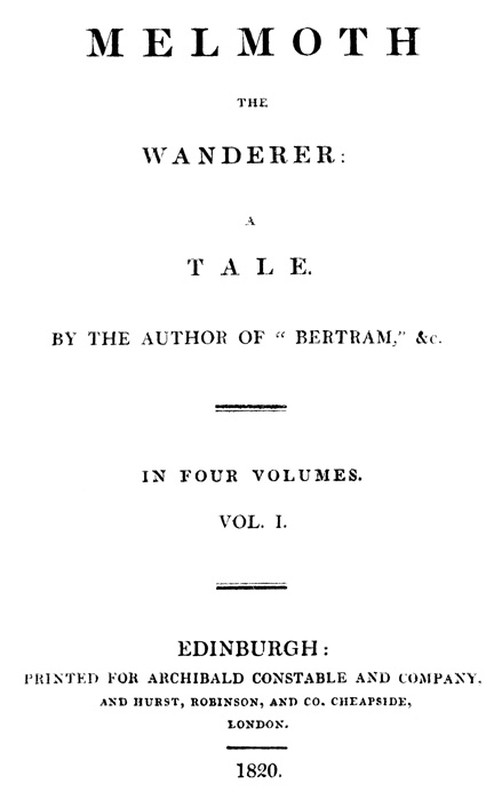
MELMOTH
THE
WANDERER:
A
TALE.
BY THE AUTHOR OF “BERTRAM,” &c.
IN FOUR VOLUMES.
VOL. I.
EDINBURGH:
PRINTED FOR ARCHIBALD CONSTABLE AND COMPANY,
AND HURST, ROBINSON, AND CO. CHEAPSIDE,
LONDON.
1820.
TO THE
MOST NOBLE
THE
MARCHIONESS OF ABERCORN,
This Romance
Is, by her Ladyship’s permission,
Respectfully inscribed by
PREFACE.
The hint of this Romance (or Tale) was taken from a passage in one of my Sermons, which (as it is to be presumed very few have read) I shall here take the liberty to quote. The passage is this.
“At this moment is there one of us present, however we may have departed from the Lord, disobeyed his will, and disregarded his word—is there one of us who would, at this moment, accept all that man could bestow, or earth afford, to resign the hope of his salvation?—No, there is not one—not such a fool on earth, were the enemy of mankind to traverse it with the offer!”
This passage suggested the idea of “Melmoth the Wanderer.” The Reader will find that idea developed in the following pages, with what power or success he is to decide.
The “Spaniard’s Tale” has been censured by a friend to whom I read it, as containing too much attempt at the revivification of the horrors of Radcliffe-Romance, of the persecutions of convents, and the terrors of the Inquisition.
I defended myself, by trying to point out to my friend, that I had made the misery of conventual life depend less on the startling adventures one meets with in romances, than on that irritating series of petty torments which constitutes the misery of life in general, and which, amid the tideless stagnation of monastic existence, solitude gives its inmates leisure to invent, and power combined with malignity, the full disposition to practise. I trust this defence will operate more on the conviction of the Reader, than it did on that of my friend.
For the rest of the Romance, there are some parts of it which I have borrowed from real life.
The story of John Sandal and Elinor Mortimer is founded in fact.
The original from which the Wife of Walberg is imperfectly sketched is a living woman, and long may she live.
I cannot again appear before the public in so unseemly a character as that of a writer of romances, without regretting the necessity that compels me to it. Did my profession furnish me with the means of subsistence, I should hold myself culpable indeed in having recourse to any other, but—am I allowed the choice?
Dublin,
31st August 1820.