
Harriet Beecher Stowe
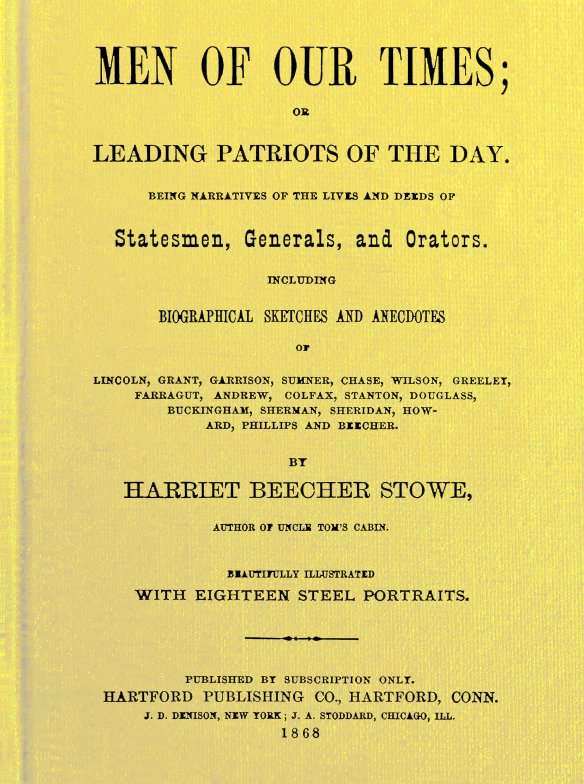
MEN OF OUR TIMES;
OR
LEADING PATRIOTS OF THE DAY.
BEING NARRATIVES OF THE LIVES AND DEEDS OF
Statesmen, Generals, and Orators.
INCLUDING
BIOGRAPHICAL SKETCHES AND ANECDOTES
OF
LINCOLN, GRANT, GARRISON, SUMNER, CHASE, WILSON, GREELEY,
FARRAGUT, ANDREW, COLFAX, STANTON, DOUGLASS,
BUCKINGHAM, SHERMAN, SHERIDAN, HOWARD,
PHILLIPS AND BEECHER.
BY
HARRIET BEECHER STOWE,
AUTHOR OF UNCLE TOM'S CABIN.
BEAUTIFULLY ILLUSTRATED
WITH EIGHTEEN STEEL PORTRAITS.
PUBLISHED BY SUBSCRIPTION ONLY.
HARTFORD PUBLISHING CO., HARTFORD, CONN.
J. D. DENISON, NEW YORK; J. A. STODDARD, CHICAGO, ILL.
1868
Entered according to Act of Congress, in the year 1868, by
HARRIET BEECHER STOWE,
in the Clerk's Office of the District Court of the United States for the District of Connecticut.
Electrotyped by
LOCKWOOD & MANDEVILLE,
HARTFORD, CONN.
DEDICATION.
To the Young Men Of America,
THESE RECORDS
OF THEIR ELDER BRETHREN IN THE REPUBLIC,
ARE INSCRIBED
BY THE AUTHOR.
LIST OF ILLUSTRATIONS.
| PAGE. | ||
| 1. | President Lincoln, | FRONTISPIECE. |
| 2. | Gen. U. S. Grant, | 111 |
| 3. | William L. Garrison, | 154 |
| 4. | Charles Sumner, | 214 |
| 5. | Salmon P. Chase, | 241 |
| 6. | Henry Wilson, | 269 |
| 7. | Horace Greeley, | 293 |
| 8. | Com. D. G. Farragut, | 311 |
| 9. | Gov. John A. Andrew, | 325 |
| 10. | Schuyler Colfax, | 347 |
| 11. | E. M. Stanton, | 363 |
| 12. | Frederick Douglass, | 380 |
| 13. | Gen. P. H. Sheridan, | 405 |
| 14. | Gen. W. T. Sherman, | 423 |
| 15. | Gen. Oliver O. Howard, | 447 |
| 16. | Gov. Wm. A. Buckingham, | 463 |
| 17. | Wendell Phillips, | 483 |
| 18. | Rev. Henry Ward Beecher, | 505 |
PREFACE.
In these sketches of some of the leading public men of our times, the editor professes to give such particulars of their lives, and such only, as the public have a right to know.
Every such man has two lives, his public and his private one. The one becomes fairly the property of the public, in virtue of his having been connected with events in which every one has a share of interest; but the other belongs exclusively to himself, his family, and his intimate friends, and the public have no more right to discuss or pry into its details than they have into those of any other private individual.
The editor has aimed to avoid all privacies and personalities which might be indelicate in relation to family circles. She has indeed, in regard to all the characters, so far as possible, dwelt upon the early family and community influences by which they were formed, particularly upon the character and influence of mothers; but such inquiries relate for the most part to those long dead, and whose mortal history has become a thing of the past.
Whenever the means have been at hand, the family stock from which each man has been derived, has been minutely traced. The question of inherited traits is becoming yearly one of increasing interest, and most striking results come from a comparison of facts upon this subject. The fusion of different races is said to produce marked results on the characteristics of the human being. America has been a great smelting furnace in which tribes and nations have been melted together, and the result ought to be some new developments of human nature. It will always be both interesting and useful to know both the quality of the family stock, and the circumstances of the early training of men who have acted any remarkable part in life.
Our country has recently passed through a great crisis which has concentrated upon it for a time the attention of the civilized world. It has sustained a shock which the whole world, judging by past experience, said must inevitably shatter the republic to fragments, and yet, like a gallant ship in full sail, it has run down the terrible obstacle, and gone on triumphant, and is this day stronger for the collision.
This wonderful success is owing to the character of the people which a Christian Democracy breeds. Of this people we propose to give a specimen; to show how they were formed in early life, from the influences which are inherent in such a state.
We are proud and happy to know that these names on our list are after all but specimens. Probably every reader of this book will recall as many more whom he will deem equally worthy of public notice. There is scarcely one of them who would not say in reference to his position before the public, what Lincoln said: "I stand where I do because some man must stand there, but there are twenty others that might as well have been leaders as myself." On the whole, we are not ashamed to present to the world this list of men as a specimen of the graduates from the American school of Christian Democracy.
So far as we know, the American government is the only permanent republic which ever based itself upon the principles laid down by Jesus Christ, of the absolute equal brotherhood of man, and the rights of man on the simple ground of manhood. Notwithstanding the contrary practices of a section of the States united in the Union, and the concessions which they introduced into the constitution, nobody doubts that this was the leading idea of the men who founded our government. The declaration of American Independence crystalized a religious teaching within a political act. The constitution of the United States still further elaborates these principles, and so strong was the logic of ideas that the conflict of opinions implied in the incidental concessions to opposite ideas, produced in the government of the country a continual and irrepressible discord. For a while it seemed doubtful which idea would triumph, and whether the accidental parasite would not strangle and wither the great original tree. The late war was the outcome of the whole. The fierce fire into which our national character has been cast in the hour of trial, has burned out of it the last lingering stain of compromise with anything inconsistent with its primary object, "to ordain justice and perpetuate liberty."
These men have all been formed by the principles of that great Christian document, and that state of society and those social influences which grew out of it, and it is instructive to watch, in their early life, how a Christian republic trains her sons.
In looking through the list it will be seen that almost every one of these men sprang from a condition of hard-working poverty. The majority of them were self-educated men, who in early life were inured to industrious toil. The farm life of America has been the nursery of great men, and there is scarce a man mentioned in the book who has not hardened his muscles and strengthened his brain power by a hand to hand wrestle with the forces of nature in agricultural life. Frugality, strict temperance, self-reliance and indomitable industry have been the lessons of their early days.
Some facts about these specimen citizens are worthy of attention. More than one-half of them were born and received their early training in New England, and full one-third are direct lineal descendants of the Pilgrim fathers. All, so far as we know, are undoubted believers in the Christian religion—the greater proportion of them are men of peculiarly and strongly religious natures, who have been active and efficient in every peculiarly religious work. All have been agreed in one belief, that the teachings of Jesus Christ are to be carried out in political institutions, and that the form of society based on his teachings, is to be defended at any sacrifice and at all risks.
There is scarcely a political man upon this list whose early efforts were not menaced with loss and reproach and utter failure, if he advocated these principles in the conduct of political affairs. For these principles they have temporarily suffered buffetings, oppressions, losses, persecutions, and in one great instance, Death. All of them honored liberty when she was hard beset, insulted and traduced, and it is fit that a free people should honor them in the hour of her victory.
It will be found when the sum of all these biographies is added up that the qualities which have won this great physical and moral victory have not been so much exceptional gifts of genius or culture, as those more attainable ones which belong to man's moral nature.
Taken as a class, while there is a fair proportion both of genius and scholarship among them, yet the general result speaks more of average talent and education turned to excellent account, than of any striking eminence in any particular direction.
But we regard it as highest of all that they were men of good and honest hearts—men who have set their faces as a flint to know and do the RIGHT. All of them are men whose principles have been tried in the fire, men who have braved opposition and persecution and loss for the sake of what they believed to be true, and knew to be right, and for this even more than for their bravery in facing danger, and their patience and perseverance in overcoming difficulties, we have good hope in offering them as examples to the young men of America.
In respect to one of the names on the list, the editor's near relationship, while it gives her most authentic access to all sources of just information, may be held to require an apology. But the fashion of writing biographies of our leading men is becoming so popular that the only way in which a prominent man can protect himself from being put before the public by any hands who may think fit to assume the task, is to put into the hands of some friend such authentic particulars as may with propriety be recorded. Mr. Beecher has recently been much embarrassed by the solicitation of parties, who notwithstanding his remonstrances, announce an intention of writing his life. He has been informed by them that it was to be done whether he consented or not, and that his only choice was between furnishing these parties with material, or taking the risk of what they might discover in their unassisted researches.
In this dilemma, it is hoped that the sketch presented in this volume, as being undeniably authentic, may so satisfy the demand, that there may be no call for any other record.
H. B. STOWE.
Hartford, January, 1868.
CONTENTS.
| PAGE | |
| CHAPTER I.—ABRAHAM LINCOLN. | |
| The Men of our Time—Lincoln Foremost—The War was the Working-Man's Revolution—Abraham Lincoln's Birth and Youth—The Books he Read—The Thirty Thousand Dollars for Tender—The Old Stocking of Government Money—A Just Lawyer; Anecdotes—His First Candidacy and Speech—Goes to Legislature and Congress—The Seven Debates and Campaign against Douglass in 1858—Webster's and Lincoln's Language Compared—The Cooper Institute Speech—The Nomination at Chicago—Moral and Physical Courage—The Backwoodsman President and the Diplomatists—Significance of his Presidential Career—Religious Feelings—His Kindness—"The Baby Did It"—The First Inaugural—The Second Inaugural, and other State Papers—The Conspiracy and Assassination—The Opinions of Foreign Nations on Mr. Lincoln. | 11 |
| CHAPTER II.—ULYSSES S. GRANT. | |
| A General Wanted—A Short War Expected—The Young Napoleon—God's Revenge Against Slavery—The Silent Man in Galena—"Tanning Leather"—Gen. Grant's Puritan Descent—How he Loaded the Logs—His West Point Career—Service in Mexico—Marries, and Leaves the Army—Wood-Cutting, Dunning and Leather-Selling—Enlists against the Rebellion—Missouri Campaign—Paducah Campaign—Fort Donelson Campaign—Battle of Shiloh—How Grant Lost his Temper—Vicksburg Campaign—Lincoln on Grant's "Drinking"—Chattanooga—Grant's Method of Making a Speech—Appointed Lieutenant-General—The Richmond Campaign—"Mr. Grant is a Very Obstinate Man"—Grant's Qualifications as a Ruler—Honesty—Generosity to Subordinates—Sound Judgment of Men—Power of Holding his Tongue—Grant's Sidewalk Platform—Talks Horse to Senator Wade—"Wants Nothing Said"—The Best Man for Next President. | 111 |
| CHAPTER III.—WILLIAM LLOYD GARRISON. | |
| Mr. Garrison's Birth and Parents—His Mother—Her Conversion—His Boyhood—Apprenticed to a Printer—First Anti-Slavery Address—Advice to Dr. Beecher—Benjamin Lundy—Garrison Goes to Baltimore—First Battle with Slavery—In Jail—First Number of the Liberator—Threats and Rage from the South—The American Anti-Slavery Society—First Visit to England—The Era of Mob Violence—The Respectable Boston Mob—Mr. Garrison's Account—Again in Jail—The Massachusetts Legislature Uncivil to the Abolitionists—Logical Vigor of the Slaveholders—Garrison's Disunionism—Denounces the Church—Liberality of the Liberator—The Southerners' own Testimony—Mr. Garrison's Bland Manners—His Steady Nerves—His use of Language—Things by their Right Names—Abolitionist "Hard Language;" Garrison's Argument on it—Protest for Woman's Rights—The Triumph of his Cause—"The Liberator" Discontinued—Second Visit to England—Letter to Mrs. Stowe. | 154 |
| CHAPTER IV.—CHARLES SUMNER. | |
| Mr. Sumner an instance of Free State High Culture—The "Brahmin Caste" of New England—The Sumner Ancestry; a Kentish Family—Governor Increase Sumner; His Revolutionary Patriotism—His Stately Presence; "A Governor that can Walk"—Charles Sumner's Father—Mr. Sumner's Education, Legal and Literary Studies—Tendency to Ideal Perfection—Sumner and the Whigs—Abolitionism Social Death—Sumner's Opposition to the Mexican War—His Peace Principles—Sumner Opposes Slavery Within the Constitution, as Garrison Outside of it—Anti-Slavery and the Whigs—The Political Abolitionist Platform—Webster asked in vain to Oppose Slavery—Sumner's Rebuke of Winthrop—Joins the Free Soil Party—Succeeds Webster in the Senate—Great Speech against the Fugitive Slave Law—The Constitution a Charter of Liberty—Slavery not in the Constitution—First Speech after the Brooks Assault—Consistency as to Reconstruction. | 214 |
| CHAPTER V.—SALMON P. CHASE. | |
| England and our Finances in the War—President Wheelock and Mr. Chase's Seven Uncles—His Uncle the Bishop—His Sense of Justice at College—His Uncle the Senator—Admitted to the Bar for Cincinnati—His First Argument before a U. S. Court—Society in Cincinnati—The Ohio Abolitionists—Cincinnati on Slavery—The Church admits Slavery to be "an Evil"—Mr. Chase and the Birney Mob—The Case of the Slave Girl Matilda—How Mr. Chase "Ruined Himself"—He Affirms the Sectionality of Slavery—The Van Zandt Case—Extracts from Mr. Chase's Argument—Mr. Chase in Anti-Slavery Politics—His Qualifications as a Financier. | 241 |
| CHAPTER VI.—HENRY WILSON. | |
| Lincoln, Chase and Wilson as Illustrations of Democracy—Wilson's Birth and Boyhood—Reads over One Thousand Books in Ten Years—Learns Shoemaking—Earns an Education Twice Over—Forms a Debating Society—Makes Sixty Speeches for Harrison—Enters into Political Life on the Working-Men's Side—Helps to form the Free Soil Party—Chosen United States Senator over Edward Everett—Aristocratic Politics in those Days—Wilson and the Slaveholding Senators—The Character of his Speaking—Full of Facts and Practical Sense—His Usefulness as Chairman of the Military Committee—His "History of the Anti-Slavery Measures in Congress"—The 37th and 38th Congresses—The Summary of Anti-Slavery Legislation from that Book—Other Abolitionist Forces—Contrast of Sentiments of Slavery and of Freedom—Recognition of Hayti and Liberia; Specimen of the Debate—Slave and Free Doctrine on Education—Equality in Washington Street Cars—Pro-Slavery Good Taste—Solon's Ideal of Democracy Reached in America. | 269 |
| CHAPTER VII.—HORACE GREELEY. | |
| The Scotch-Irish Race in the United States—Mr. Greeley a Partly Reversed Specimen of it—His Birth and Boyhood—Learns to Read Books Upside Down—His Apprenticeship on a Newspaper—The Town Encyclopedia—His Industry at his Trade—His First Experience of a Fugitive Slave Chase—His First Appearance in New York—The Work on the Polyglot Testament—Mr. Greeley as "The Ghost"—The First Cheap Daily Paper—The Firm of Greeley & Story—The New Yorker, the Jeffersonian and the Log Cabin—Mr. Greeley as Editor of the New Yorker—Beginning of The Tribune—Mr. Greeley's Theory of a Political Newspaper—His Love for The Tribune—The First Week of that Paper—The Attack of the Sun and its Result—Mr. McElrath's Partnership—Mr. Greeley's Fourierism—"The Bloody Sixth"—The Cooper Libel Suits—Mr. Greeley in Congress—He Goes to Europe—His Course in the Rebellion—His Ambition and Qualifications for Office—The Key-Note of his Character. | 293 |
| CHAPTER VIII.—DAVID G. FARRAGUT. | |
| The Lesson of the Rebellion to Monarchs—The Strength of the United States—The U. S. Naval Service—The Last War—State of the Navy in 1861—Admiral Farragut Represents the Old Navy and the New—Charlemagne's Physician, Farraguth—The Admiral's Letter about his Family—His Birth—His Cruise with Porter when a Boy of Nine—The Destruction of the Essex—Farragut in Peace Times—Expected to go with the South—Refuses, is Threatened, and goes North—The Opening of the Mississippi—The Bay Fight at Mobile—The Admiral's Health—Farragut and the Tobacco Bishop. | 311 |
| CHAPTER IX.—JOHN A. ANDREW. | |
| Governor Andrew's Death Caused by the War—The Governors Dr. Beecher Prayed for—Governor Andrew a Christian Governor—Gov. Andrew's Birth—He goes to Boston to Study Law—Not Averse to unfashionable and Unpopular Causes—His Cheerfulness and Social Accomplishments—His Sunday School Work—Lives Plainly—His Clear Foresight of the War—Sends a Thousand Men to Washington in One Day—The Story of the Blue Overcoats—The Telegram for the Bodies of the Dead of Baltimore—Gov. Andrew's Tender Care for the Poor—The British Minister and the Colored Women—The Governor's Kindness to the Soldier's Wife—His Biblical Proclamations—The Thanksgiving Proclamation of 1861—The Proclamation of 1862—His Interest in the Schools for the Richmond Poor—Cotton Mather's Eulogy on Gov. Winthrop—Gov. Andrew's Farewell Address to the Massachusetts Legislature—State Gratitude to Gov. Andrew's Family. | 325 |
| CHAPTER X.—SCHUYLER COLFAX. | |
| General William Colfax, Washington's Friend—Mr. Colfax his Grandson—Mr. Colfax's Birth and Boyhood—Removes to Indiana—Becomes Deputy County Auditor—Begins to Deal with Politics—Becomes an Editor—The Period of Maximum Debt—Mr. Colfax's First Year—He is Burnt Out—His Subsequent Success as an Editor—His Political Career as a Whig—Joins the Republican Party—Popularity in his own District—The Nebraska Bill—Mr. Colfax goes into Congress—The Famous Contest for Speakership—Mr. Colfax Saves his Party from Defeat—Banks Chosen Speaker—Mr. Colfax's Great Speech on the Bogus Laws of Kansas—The Ball and Chain for Free Speech—Mr. Colfax Shows the Ball, and A. H. Stephens Holds it for him—Mr. Colfax Renominated Unanimously—His Remarkable Success in his own District—Useful Labors in Post Office Committee—Early for Lincoln for President—Mr. Colfax urged for Post Master General—His Usefulness as Speaker—The Qualifications for that Post—Mr. Colfax's Public Virtues. | 347 |
| CHAPTER XI.—EDWIN M. STANTON. | |
| Rebel Advantages at Opening of the War—They Knew all about the Army Officers—Early Contrast of Rebel Enthusiasm and Union Indifference—Importance of Mr. Stanton's Post—His Birth and Ancestry—His Education and Law Studies—County Attorney—State Reporter—Defends Mr. McNulty—Removes to Pittsburg—His Line of Business—The Wheeling Case—He Removes to Washington—His Qualifications as a Lawyer—He Enters Buchanan's Cabinet—His Unexpected Patriotism—His Own Account of the Cabinet at News of Anderson's Move to Sumter—The Lion before the Old Red Dragon—Appointed Secretary of War—"Bricks in his Pockets"—Stanton's Habitual Reserve—His Wrath—"The Angel Gabriel as Paymaster"—Anecdotes of Lincoln's Confidence in Stanton—Lincoln's Affection for him—The Burdens of his Office—His Kindness of Heart within a Rough Outside—The Country his Debtor. | 363 |
| CHAPTER XII.—FREDERICK DOUGLASS. | |
| The Opportunity for Every Man in a Republic—The Depth Below a White Man's Poverty—The Starting Point whence Fred Douglass Raised Himself—His Mother—Her Noble Traits—Her Self Denial for the sake of Seeing him—She Defends him against Aunt Katy—Her Death—Col. Loyd's Plantation—The Luxury of his own Mansion—The Organization of his Estate—"Old Master"—How they Punished the Women—How Young Douglass Philosophized on Being a Slave—Plantation Life—The Allowance of Food—The Clothes—An Average Plantation Day—Mr. Douglass' Experience as a Slave Child—The Slave Children's Trough—The Slave Child's Thoughts—The Melancholy of Slave Songs—He Becomes a House Servant—A Kind Mistress Teaches him to Read—How he Completed his Education—Effects of Learning to Read—Experiences Religion and Prays for Liberty—Learns to Write—Hires his Time, and Absconds—Becomes a Free Working-Man in New Bedford—Marries—Mr. Douglass on Garrison—Mr. Douglass' Literary Career. | 380 |
| CHAPTER XIII.—PHILIP H. SHERIDAN. | |
| Sheridan a Full-Blooded Irishman—The Runaway Horse—Constitutional Fearlessness—Sheridan Goes to West Point—Sheridan's Apprenticeship to War—The Fight with the Apaches at Fort Duncan—He is Transferred to Oregon—Commands at Fort Yamhill in the Yokima Reservation—The Quarrel among the Yokimas—Sheridan Popular with Indians—He Thinks he has a Chance to be Major Some Day—Sheridan's Shyness with Ladies—He Employs a Substitute in Waiting on a Lady—Sheridan's Kindness and Efficiency in Office Work—He Becomes a Colonel of Cavalry—His Shrewd Defeat of Gen. Chalmers—Becomes Brigadier—The Kentucky Campaign against Bragg—Sheridan Saves the Battle of Perrysville—Saves the Battle of Murfreesboro—Gen. Rousseau on Sheridan's Fighting—Sheridan at Missionary Ridge—Joins Grant as Chief of Cavalry—His Raids around Lee—His Campaign in the Valley of Virginia—He Moves Across and Joins in the Final Operations—His Administration at New Orleans—Grant's Opinion of Sheridan. | 405 |
| CHAPTER XIV.—WILLIAM T. SHERMAN. | |
| The Result of Eastern Blood and Western Developments—Lincoln, Grant, Chase and Sherman Specimens of it—The Sherman Family Character—Hon. Thomas Ewing adopts Sherman—Character of the Boy—He Enters West Point—His Peculiar Traits Showing thus Early—How he Treated his "Pleb"—His Early Military Service—His Appearance as First Lieutenant—Marries and Resigns—Banker at San Francisco—Superintendent of Louisiana Military Academy—His Noble Letter Resigning the Superintendency—He Foresees a Great War—Cameron and Lincoln Think not—Sherman at Bull Run—He Goes to Kentucky—Wants Two Hundred Thousand Troops—The False Report of his Insanity—Joins Grant; His Services at Shiloh—Services in the Vicksburg Campaigns—Endurance of Sherman and his Army—Sherman's estimate of Grant—How to live on the Enemy—Prepares to move from Atlanta—The Great March—His Courtesy to the Colored People—His Foresight in War—Sherman on Office-Holding. | 423 |
| CHAPTER XV.—OLIVER O. HOWARD. | |
| Can there be a Christian Soldier?—General Howard's Birth—His Military Education—His Life Before the Rebellion—Resigns in Order to get into the Field—Made Brigadier for Good Conduct at Bull Run—Commands the Eleventh Corps and Joins the Army at Chattanooga—His Services in the Army of the Potomac—Extreme Calmness on the Field of Battle—Services with Sherman—Sherman's high Opinion of him—Col. Bowman's Admiration of Howard's Christian Observances—Patriotic Services while Invalided at Home—Reproves the Swearing Teamster—Placed over the Freedmen's Bureau—The Central Historic Fact of the War—The Rise of Societies to Help the Freedmen—The Work of the Freedmen's Bureau—Disadvantages Encountered by it, and by General Howard—Results of the Bureau thus far—Col. Bowman's Description of Gen. Howard's Duties—Gen. Sherman's Letter to Gen. Howard on Assuming the Post—Estimate of Gen. Howard's Abilities. | 447 |
| CHAPTER XVI.—WILLIAM A. BUCKINGHAM. | |
| The Buckinghams an Original Puritan Family—Rev. Thomas Buckingham—Gov. Buckingham's Father and Mother—Lebanon, the Birthplace of Five Governors—Gov. Buckingham's Education—He Teaches School—His Natural Executive Tendency—His Business Career—His Extreme Punctuality in Payments—His Business and Religious Character—His Interest in the Churches and Schools—His Benefactions in those Directions—His Political Course—He Accepts Municipal but not Legislative Offices—A Member of the Peace Conference—He Himself Equips the First State Militia in the War—His Zealous Co-operation with the Government—Sends Gen. Aiken to Washington—The Isolation of that City from the North—Gov. Buckingham's Policy for the War; Letter to Mr. Lincoln—His Views on Emancipation; Letter to Mr. Lincoln—Anecdote of the Temperance Governor's Staff. | 463 |
| CHAPTER XVII.—WENDELL PHILLIPS. | |
| Birth and Ancestry of Wendell Phillips—His Education and Social Advantage—The Lovejoy Murder—Speech in Faneuil Hall—The Murder Justified—Mr. Phillips' First Speech—He Defends the Liberty of the Press—His Ideality—He Joins the Garrisonian Abolitionists—Gives up the Law and Becomes a Reformer—His Method and Style of Oratory—Abolitionists Blamed for the Boston Mob—Heroism of the Early Abolitionists—His Position in Favor of "Woman's Rights"—Anecdote of His Lecturing—His Services in the Cause of Temperance—Extract from His Argument on Prohibition—His Severity towards Human Nature—His Course During and Since the War—A Change of Tone Recommended. | 483 |
| CHAPTER XVIII.—HENRY WARD BEECHER. | |
| Mr. Beecher a Younger Child—Death of his Mother—His Step-Mother's Religious Influence—Ma'am Kilbourn's School—The Passing Bell—Unprofitable Schooling—An Inveterate School Joker—Masters the Latin Grammar—Goes to Amherst College—His Love of Flowers—Modes of Study; a Reformer—Mr. Beecher and the Solemn Tutor—His Favorite Poetry—His Introduction to Phrenology—His Mental Philosophy—Doctrine of Spiritual Intuition—Punctuality for Joke's Sake—Old School and New School—Doubts on Entering the Ministry—Settlement at Lawrenceburg—His Studies; First Revival—Large Accessions to the Church—"Tropical Style"—Ministerial Jokes—Slavery in the Pulpit—The Transfer to Brooklyn—Plymouth Church Preaching—Visit to England—Speeches in England—Letters from England—Christian View of England—The Exeter Hall Speech—Preaches an Unpopular Forgiveness. | 505 |