
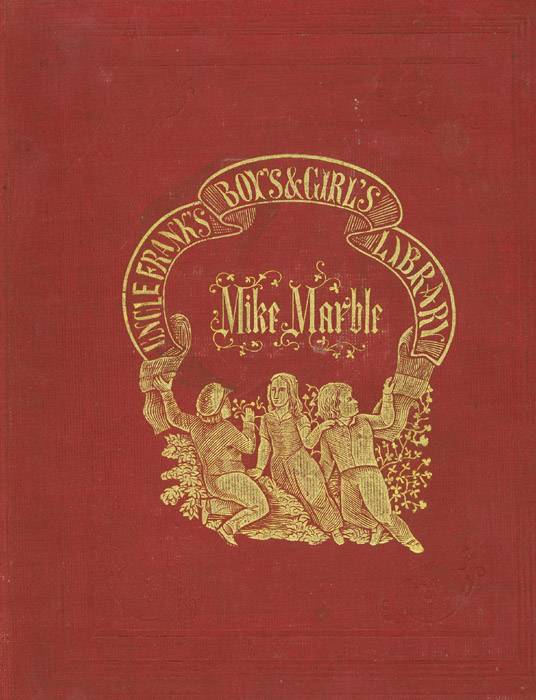
The Project Gutenberg eBook of Mike Marble: His Crotchets and Oddities.
Title: Mike Marble: His Crotchets and Oddities.
Author: Francis C. Woodworth
Release date: March 29, 2008 [eBook #24937]
Most recently updated: January 3, 2021
Language: English
Credits: Produced by Jeannie Howse, Chuck Greif and the Online
Distributed Proofreading Team at https://www.pgdp.net (This
file was produced from images generously made available
by The Internet Archive)
Transcriber's Note:
Obvious typographical errors have been corrected. For a complete list, please see the end of this document.
Click on the images to see a larger version.
MIKE MARBLE:
HIS CROTCHETS AND ODDITIES.
With Tinted Illustrations.
BY
UNCLE FRANK,
AUTHOR OF "A PEEP AT OUR NEIGHBORS," "THE PEDDLER'S BOY,"
"THE DIVING BELL," "WILLOW LANE STORIES," ETC.
BOSTON:
PHILLIPS, SAMPSON & COMPANY,
PUBLISHERS.
Entered, according to Act of Congress, in the year 1852,
By Phillips, Sampson & Co.,
In the Clerk's Office of the District Court of the United States for
the District of Massachusetts.
STEREOTYPED BY
BILLIN & BROTHERS,
No. 10 North William Street, N.Y.
WRIGHT & HASTY,
Printers, 3 Water Street, Boston.
CONTENTS.
| Page | |
| CHAPTER I. | |
| ABOUT CROTCHETS | 7 |
| CHAPTER II. | |
| CROTCHETY FOLKS | 15 |
| CHAPTER III. | |
| LIGHTS AND SHADOWS | 27 |
| CHAPTER IV. | |
| CHIPS FROM BIRCH WOODS | 35 |
| CHAPTER V. | |
| A PAIR OF THIEVES | 54 |
| CHAPTER VI. | |
| PAYING HIM OFF | 68 |
| CHAPTER VII. | |
| MIKE'S CROTCHETS IN WAR-TIME | 92 |
| CHAPTER VIII. | |
| THE BUMBLE-BEES' NEST | 109 |
| CHAPTER IX. | |
| HOW A BARN WAS BUILT | 127 |
| CHAPTER X. | |
| ANOTHER BLOCK OF MARBLE | 134 |
| CHAPTER XI. | |
| MIKE MARBLE'S LAST DAYS | 150 |
ILLUSTRATIONS.
MIKE MARBLE.
CHAP. I.ToC
ABOUT CROTCHETS.
Don't be frightened, reader, at what you see on the title-page of this book, or at the head which I have given to my first chapter. Don't let the idea creep into your head, that I am going to give you a dull and sleepy essay on music. It is not the crotchets which you find in the singing-book, that I intend to talk about; I leave them to those who know more about them than I do. There is a man of my acquaintance, whom I could hunt up without much trouble, and who, if you should ever choose to give him a chance, would talk you deaf, and write you blind, about this sort of crotchets, together with all the members of that noisy family—breves, semibreves, minims, and what not! I'll refer you to him, for all the mysteries of the gamut. Whenever you want to learn them, I assure you he would like no better fun than to teach them to you. I'll not interfere with his trade.
My business is with another family of crotchets. Webster—Noah Webster, the man who made the spelling-book, out of which Uncle Frank learned to say, or rather to drawl his letters—gives, in his large dictionary, as one of the definitions of the word crotchet, this: "a peculiar turn of mind, a whim, a fancy." Here you have just that kind of crotchet that I am going to deal with. Mr. Webster could not have hit my crotchet more exactly, if he had taken aim at it on purpose. It is a peculiar turn of mind, or, if you prefer it, a whim, or a fancy, that I shall talk about, for an hour or so, perhaps longer. Indeed, I am not perfectly sure but I shall find a whole flock of whims and fancies, because, you know, "birds of a feather flock together," and, in that case, I shall give you a peep at a score or two of whims and fancies.
Now, who knows but these crotchets will be worth hearing about? People write large, thick volumes, on drier topics than whims and fancies—that is, to my way of thinking—and I suppose their books are read. Certainly they expect to have them read, or they would not make them. Then why may not my book on crotchets find readers?
If I were to write a book on warts and corns, don't you think the book would get read? I do. I have not the least doubt of it. Suppose, now, it were published in the newspapers, that Messrs. Phillips, Sampson & Company, one of the largest and most respectable publishing houses in the Union, are about to issue a volume, entitled Freaks of the Wart Family, from the pen of Uncle Frank, a man who, first and last, has printed a good deal of sense, together with some nonsense, and who, in this volume, has succeeded in stringing together some of the strangest things that ever saw the light. Suppose that some newspaper should give that item of news, don't you think folks would get the book, when it was published? and don't you think they would read it, or, at all events, skim it over, to see what kind of stuff Uncle Frank had been emptying out of his brain? I think so.
Well, warts and corns are to the body what whims and crotchets are to the mind. The body has freaks—the mind has freaks. Warts don't exactly belong to the body. That is, there could be a very good sort of a body, without a single wart on it; and indeed, if you please, a man would be a more perfect man, if there were no warts about him, from head to foot. So of crotchets. I don't pretend that a person has any thing to boast of, because his head is full of crotchets. Perhaps he would be better without them. Perhaps he would. But warts and crotchets are both found among mankind. Both are freaks of nature, so to speak; of course, both are worth examining. One thing at a time, though. Let us turn our attention, at present, to crotchets.
CHAP. II.ToC
CROTCHETY FOLKS.
A crotchety person, according to this same Noah Webster, whom I have quoted before, is one who has whims or crotchets in the brain. Now a word about these crotchety folks.
I'll tell you what it is, my friend. The older I grow, the more I feel inclined to let every man and woman, every boy and girl, act out himself, or herself. "That is a singular fellow," we often hear it said. "He's as odd as Dick's hat-band. I don't know what to think of him. He seems to be a good sort of a man. But he is odd. His head is as full of crotchets as it can hold."
When I hear a person talk in this style, I feel like saying, "Stop a moment, my dear sir. He's 'a good sort of a man—but,' you say. That shows you are not precisely satisfied with his goodness; and pray, what is the matter with it? Why don't you like it, sir? What particular fault have you to find with it? Come, out with it now."
Press a man, who is talking in this way about a crotchety neighbor, right up to the point, and you will generally find that the reason he does not like him is because he has a different way of saying and doing things from his own.
Now I believe that some folks are odd because they cannot help it. True, there are a great many who are odd, just for the sake of being odd. They are ambitious to be known as singular people. We will let them pass. They certainly work hard to earn the name they love to be known by; and perhaps we ought not to try to rob them of it, or to say any thing very severe about their taste. We will let them pass.
But there are a multitude of other people who are odd, and whose oddities cannot be accounted for in the same way. They are odd, because they were born so. They are odd, because they cannot help being odd. If they should try, with all their might, to do as most of their neighbors do, they would make perfect dunces of themselves; for every body, old or young, makes a dunce of himself, and nothing else, whenever he undertakes to be what he is not—whenever he undertakes to be somebody else. He is not very well acquainted with the race he belongs to, who, as he goes through the world, does not get this truth hammered into him.
Why, at this very moment, I can think of at least a dozen odd people, whom I am in the habit of meeting every day, and who, I verily believe, could no more help their oddities and crotchets than some of their neighbors could help having warts come out on their hands. The crotchets are natural and unavoidable in one case—the warts are natural and unavoidable in the other.
These are my notions about crotchety people, in general, and I have thrown them out, as one throws out feather beds from the garret windows, when the house is on fire—so that the articles that are to be thrown afterward may find a good soft spot to alight on, and not get damaged by their fall.
The truth is, I am going to introduce to you an old gentleman, who had a large head, tolerably well filled with crotchets; and as it is such a common thing for people to raise a hue and cry against every body who has any oddities about him, I thought I would put you on your guard a little, by a word of apology for that entire race of people, who are odd because they cannot be any thing else.
This old gentleman, who, by the way, was a great friend of the little folks, is Mike Marble. I introduce him to you as an old gentleman. But, although he was old, when I first saw him, I must not forget that he was young once—as young as any of my readers—and that he played his part as a boy, as well as his part as a man. There are a good many anecdotes afloat about him and his odd way of doing things, before he grew up to manhood. My grandfather knew him when he was a lad at school. I believe he and Mike were nearly of the same age.
That grandfather of mine, now I think of it, was a great story-teller. I have sometimes nearly half made up my mind, while casting about me, to find some new mine of stories for my young readers, that I would put my thinking cap on, and see if I could not recollect a budget of my grandfather's stories, large enough to fill a book. I am not sure but I will do so one of these days; and, if I do, I shall print the budget, depend upon it.
My grandfather and Mike Marble were as dear to each other as if they had been brothers. They lived not far apart, and went to school together. For some of Mike's crotchets I am indebted to this old friend of his. Others I picked up, here and there, among old people that knew him, and others still I got from a personal acquaintance with him in his old age.
You will excuse me, if I call him Mike sometimes. He was always so called, when he was a boy, I believe. And while you are excusing me for calling him Mike—you see I take you to be very kind and obliging—you will please excuse me, also, if I happen to prefix the title of Uncle to that nickname; for he was known, far and near, as Uncle Mike in his later days.
It is true that Michael was his name correctly and honestly spelled out. But it is equally true that Michael was a name to which he seldom had to answer. At school, and among his playmates, it was always Mike. I really believe, from what I have heard my grandfather say, that not half the boys and girls in his neighborhood could have been convinced, by any common arguments, that his name was Michael. Indeed, I remember having heard that once, when a schoolmate called the fellow by the long name, just to see how it would seem, he and the other boy both burst right out into a perfect roar of laughter over the sound of it. "For pity's sake," said he, when he got over his laughing fit, "don't call me by that hard name again, as long as I live;" and, as he seemed to be quite in earnest, none of the boys ever addressed him by any other name than Mike, after that.
CHAP. III.ToC
LIGHTS AND SHADOWS.
"But who is Mike Marble? where does he live? what sort of a man is he? what kind of oddities has he got?"
My little friend, your questions come out so fast, and there is such a long string of them, that they make me think of the way a whole pack of fire crackers go off, when you touch a coal to one of them, and throw the whole into the street. I am going to tell you ever so many things about this same Mike Marble. Before I get through with him, you will get very well acquainted with him, I think. But Uncle Frank, you know, has got some oddities himself. When he has got any thing to do, he, too, has his own way of doing it.
Some people, I suppose, if they were treating you to a few chapters in the history of this singular man, would weave the threads together in a different manner from mine. They would begin, very likely, by telling where the chap was born, who were his father and mother, how many brothers and sisters he had, what their names were, whether he had any uncles and aunts, and if he had, what kind of uncles and aunts they were, and all that sort of thing. And they would describe Mike's appearance exactly—tell you whether he had black eyes or blue, gray eyes or brown, red eyes or green. But I don't see much use in that.
Indeed, I am not sure but I shall keep you ignorant as to how he looked, and let you learn what there is worth learning in his character—for character is the great thing, after all, you know—by the stories I shall tell of him. I might, it is true, take every branch, and leaf, and bud, and flower, of his character, and pick it all to pieces, and show you, in this way, what he was made of. But you would get tired of all that. So I'll take another course. I'll tell you what he said and did—what he said and did at different times, at different periods in his life, and in different circumstances. Don't you think this is the best way to make you acquainted with him? I do; for, if you find out what a person says, and does, and thinks, you find out what he is.
One or two things, however, I must say about this Mike Marble, by way of general introduction.
He was born at a very interesting period—about nine years before the breaking out of the American Revolution. He was quite an old man before he went to his final rest. Indeed, it is but a few years since I saw his weather-beaten face, all lighted up with smiles. Unlike many other men, when they get to be old, he never made a practice of carping at every thing he saw about him, because it was not exactly in the style of 1776. He believed that there was wisdom among our grandfathers and grandmothers, but that there is wisdom, also, among their grand-children.
I have told you that he had some oddities. I have hinted, too, in a sort of whisper, that I do not consider a man an absolute Pagan, because he happens to be a little odd. Something more than this I could say of Uncle Mike, odd as he was; but I guess you will find out what I think of him, before I get through. Suffice it to say, that, while I didn't like him because he was odd, I did like him, in spite of his oddities. He was a fine old man. As the world goes, he was a most excellent man. He had his faults, a plenty of them; though I have sometimes thought
Some of them did, I know. He had his faults, nevertheless. I confess that. He always had them, no doubt. Faults are common things among mankind and womankind. But, with your consent, we will trip lightly over all that part of our hero's history which is shaded with blemishes.
CHAP. IV.ToC
CHIPS FROM BIRCH WOODS.
One of the worst things I ever heard of in the history of Mike, according to the best of my recollection, was the way he served Billy Birch's dog. You must know something about this Billy Birch. Burt was his real name. But it was changed into Birch by his neighbors, for a reason which I will give you by and bye.
Mr. Burt was a pretty good sort of a man, in his own estimation, but not greatly or generally beloved by his neighbors. He was a church-going man, and had a knack, somehow or other, of getting along decently with the forms—the outside garments, so to speak—of religion. It was really astonishing how glibly he would talk about religion. But as to the practical part of it, he did not succeed as well. That was up-hill work for the old man.
He found it exceedingly difficult to keep himself "unspotted from the world." Some of his nearest neighbors thought they could count a great many worldly spots upon him. I don't know how that was, as I never was acquainted with the man, and ought not to judge him too harshly. Indeed, Uncle Frank must endeavor to keep in mind, that with what measure we mete it shall be measured to us again. But from all the shreds and patches of his history that have come down to the present day, Mr. Birch does seem to have been a selfish man, and a great deal too fond of money.
My young friend, it is one of the most difficult things in this world, to act up to the spirit of the golden rule of our Lord, and do to others as we would have them do to us, when we are as full as we can hold of selfishness. You may lay that thought up in your memory.
Billy Birch found that truth out. What did he care how many newly-planted hills of corn and rows of peas his hens might scratch up, provided the corn was not his corn, and the peas were not his peas, and provided he did not have to suffer for the scratching? Not a mill. He would sit, smoking his pipe—for he was a great smoker—in the old, straight-backed oak chair on the stoop, as cool as a cucumber, while the biggest rooster on his premises, the lord of the whole barn-yard, was leading a regiment of hens and petty roosters in a crusade upon Squire Chapman's corn-field across the way; and if the Squire or one of his boys came over to inform him what havoc the hens were making, and to ask him what to do with the troublesome creatures, the old man would perhaps take his pipe out of his mouth, and, after slowly puffing out a cloud of smoke, would say, "Why, drive them out, to be sure!"
What did he care, if his old mare—who, by the way, was a very nervous sort of a mare, and could not stay long in one spot—what did he care, if the old creature did jump over the six-rail fence around the good parson's field of clover, and eat what she wanted, and trample down, in her nervous way of doing things, a good share of the rest of the clover? Why, it didn't hurt him any. The old miser! It wasn't his field of clover that Katy trampled down. And besides, didn't he pay his minister's tax? and didn't the minister and his family live in better style than he and his family could afford to live in?
Katy loved clover. He wasn't to blame for that, and he didn't know that Katy was to blame. It was a very natural taste, that of his old mare. And why didn't the parson, he should like to know, build his fence higher, if he didn't want his clover eaten up by other people's horses?
What was it to Billy Birch, if his dog did kill a neighbor's sheep, now and then? What did he care, what should he care? If they were his own sheep, that would alter the case. But Cæsar never killed his master's sheep. Wasn't that kind in Cæsar? And as to this sheep-biting habit of his, why it is the nature of dogs to kill sheep. Cæsar must kill somebody's sheep; and if he hadn't picked out a good fat one from this flock, it would have been somebody else's flock. What is the use in making such a fuss about a sheep or two? The loss of one sheep won't break any body. What can't be cured, must be endured. People must take care of their sheep, if they don't want them to be killed.
That is the way this selfish, narrow-minded farmer reasoned and talked. You can see, plainly enough, that he was not the sort of man to be very much respected in the neighborhood. He was not respected. In fact, there was not, in all the parish, a more generally unpopular man than Billy Birch.
The boys, I have heard, bore him a grudge of long standing. It related to the huckleberries and hazel nuts in the old man's birch woods. There were bushels of huckleberries, and almost as many hazel nuts, in those woods. But would you have thought of such a thing? Mr. Birch forbade the boys picking any of his huckleberries or hazel nuts. Ever so many huckleberries decayed on the bushes every year, or were left to be harvested by the birds, because Mr. Birch's family could not pick them all themselves, and he was so tight that he would not let any body else pick them. He was like the dog in the manger, you see. He could not eat the hay himself, and he would not let any body else eat it.
But the meanest thing that I ever heard of his doing, was this: In these same woods—the woods where the huckleberries and hazel nuts grew—there were great multitudes of birch trees, of different species and among the rest, some of that species which goes by the name, among children, of black birch. I need not tell any of my country readers about this kind of birch. They know it well enough. They have eaten birch bark, many a time; and, for ought I know, some of them have felt a tingling sensation in the region of the back and legs, brought about by the use of birch twigs in the hands of some schoolmaster.
Well, Moses Ramble was crossing Billy Birch's woods one day in the spring of the year. For awhile, he whistled along, as merry-hearted as the blue birds that had just returned from their southern tour, and who were chirping on the branches over his head, breaking off, now and then, a few sprigs of birch, from the trees along his path. By and bye, he sat down on the fence, to rest himself, still going on with his whistling, at intervals, when his mouth was not too much occupied with the birch to interfere with the music.
While the merry young fellow was sitting here, feeling at peace with all the world, and not dreaming but all the world was at peace with him, he heard a slight rustling behind him, and, looking over his shoulder, whom should he see but Billy Birch himself, leaning against a chestnut tree, and looking as if he were angry enough to bite in two a hoe handle.
What on earth the man was doing there, history does not inform us, though it used to be more than hinted among the younger citizens in that neighborhood, that he was prowling about in those woods as a spy on the movements of the boys. They said he was just the man for such business.
Moses did not like the appearance of the face that was lowering on him; and, although he was innocent of the slightest intention of doing any harm on the man's premises, he thought it would be safer for him to walk off than it would be to stay there. So he leaped from the fence, and began, leisurely, to walk home.
"Stop, you young heathen!" said Billy Birch.
The little fellow did stop, and stood as still as the old chestnut tree, against which the lord of those woods was leaning.
"What are you munching there, sir?"
Moses, having no suspicion at all that he had been doing any harm to the estate of the old man, replied, frankly and plainly, that he was eating birch.
"Aha!" said the farmer, "you are, eh? I'll teach you to eat my birch. I'll give you as much birch as you will want for a fortnight!"
And he took the twig which Moses was gnawing out of his hands, and whipped him with it, until he made the poor fellow cry out with pain and mortification.
"There, you thief!" he said, after flogging him to his heart's content, "that will teach you to steal my birch, I guess."
From that day the selfish farmer began to be called Birch, in that section of the country; and it was not many months before his name was almost as effectually changed as if he had applied to the legislature of the state to have that body change it for him.
CHAP. V.ToC
A PAIR OF THIEVES.
About that dog of Billy Birch. Have I not promised to tell you something about him, and the accident that happened to him, which accident Mike Marble might have prevented, if he had made the attempt? I have a good mind to tell you about these matters, at any rate, whether I have made such a promise or not.
Mind now, reader, that, in telling this story, I don't mean to have it understood that I think Mike did right. I'll grant that he did wrong. But I mention the fact to show what sort of mischief Mike was up to, and what sort of blemishes those were, which I confess he had in his character; for, as I think I said before, this trick was about as bad a thing as I ever heard of his being guilty of.
Cæsar got to be a great hero in the sheep-killing business—a perfect Nimrod of a dog. It sometimes happens, I fancy, that soldiers who spend more of their time in war, actually shooting people and cutting their throats, after a while, get to liking the trade, and take pleasure in slaughtering human beings, just as a carpenter or a printer might take pleasure in his trade. Well, it got to be somewhat so with Cæsar, it would seem; for it often came to pass that two or three sheep would be killed in one night, when, of course, a single fat one would supply his appetite bountifully for several days, at least. He must have liked the business, or he would have contented himself with killing only a sufficient number of sheep to keep him in food.
The neighbors who suffered from Cæsar's favorite amusement, complained, now and then, to his master. But it did no good. "They must keep their sheep out of the way," the selfish man would say. "Cæsar is a capital family dog. I don't know what I should do without him—he is so faithful." That was as much satisfaction as they could ever get. Billy Birch would not shut up his dog at night, and as for killing him, that was out of the question. He would rather lose his best horse than Cæsar. True, the neighbors might have sued the owner of the dog, and have got the value of their lost sheep in that way. But they were generally peaceable folks, and had a great dread of going to law, especially with one of their own neighbors. The result was, that Cæsar's business prospered more and more every day.
It was in the full tide of his success as a sheep-killer, that he came, one day, into Mr. Marble's door yard, and took his station near the wood pile. Mike saw him, and knew well enough what he came for. His father had just been slaughtering an ox, and some of the dainty pieces of the animal were lying on the wood pile, the scent of which had brought Cæsar to the spot. No doubt, having feasted on mutton so long, he had got a little sick of it, and thought he would make a dinner on beef. He was a dainty fellow, you perceive.
I don't know what put it into Mike's head to play the trick he did on Cæsar. But he had no sooner seen him smelling around among the refuse pieces of the ox's carcass, than he determined to punish him, if possible, for his notorious crimes. So, without saying a word to any body, he gathered up all the choice bits which had tempted the dog to the yard, and placed them within a few feet of the heels of Mr. Marble's old chaise horse, who was standing there, hitched to a gate post, waiting patiently for somebody to come and harness him.
Now this horse, who was called Old Ironsides, was as famous for his kicking habits as Cæsar was for his sheep-killing. He seemed to take up kicking as a sort of amusement, to while away his leisure hours. It was a wonder that Mr. Marble kept him; for he had kicked the old chaise to pieces several times; and as to his stable, he made nothing of kicking off all the boards within reach of his heels, every few nights, just for the fun of the thing, and to show what mighty deeds he could do with his heels.
It is no more than an act of simple justice to Old Ironsides, however, to say, that he was as gentle as a lamb to the children of his master. They could do any thing with him. Often, when he was standing at the door, or in his stable, they would go close to him, and pat him on his neck, and play with him, as if he were one of their own number; and the old fellow would take all their fun good-humoredly. Among all his sins in the kicking line—and he had a great many, first and last, to answer for—he never kicked either of the children. They all loved him, in fact; and many is the dainty morsel he received from their hands.
Well, to go on with the story of Mike's piece of mischief. The dog, as he had expected, trotted along after the pieces of meat, and commenced eating, without any suspicions of harm, right under the battery of the old horse. There he remained for some moments, as Mike says, taking as much comfort eating his dinner, as if he were dining on one of his father's sheep.