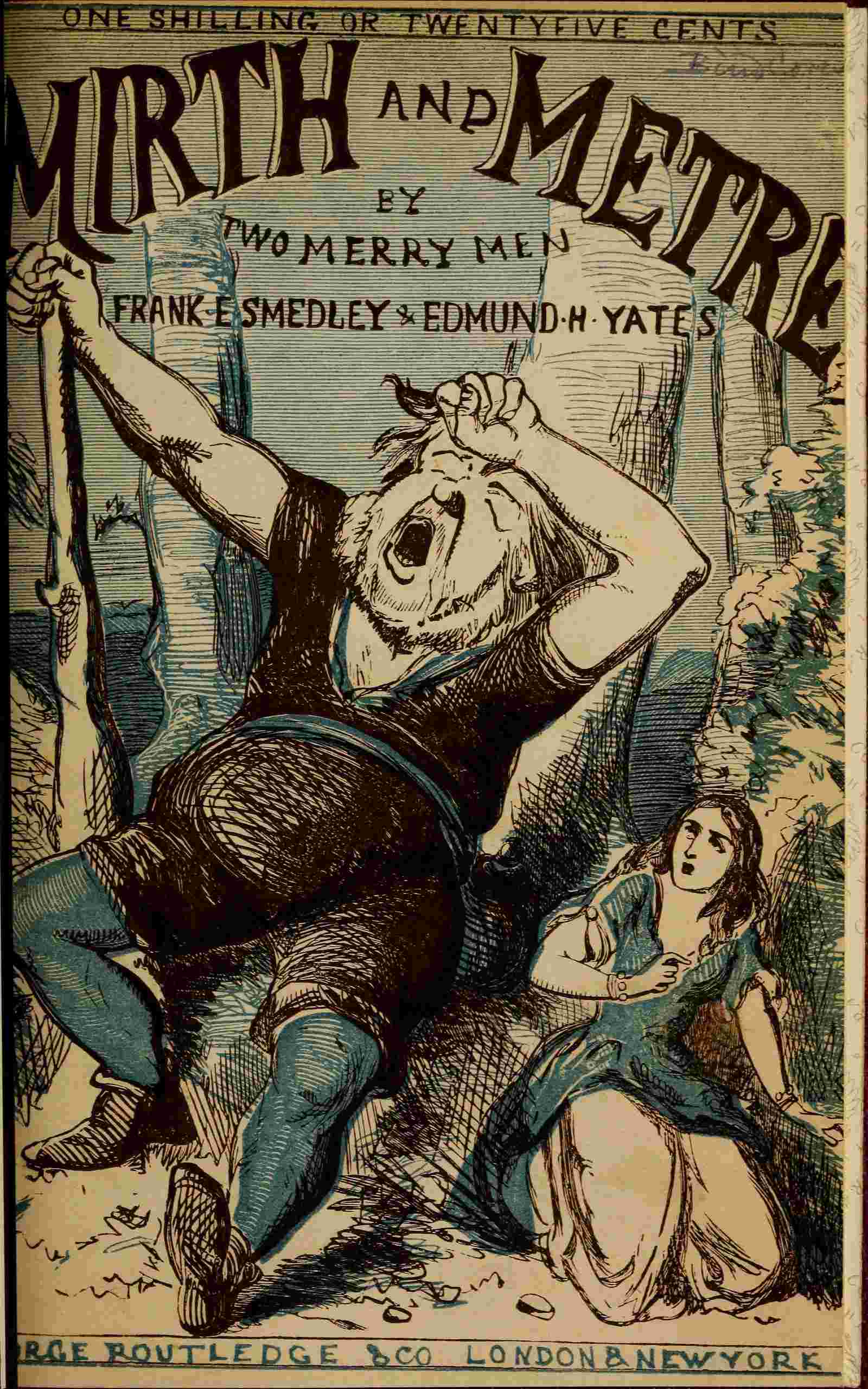
The good King Tidrich rode from Bern
[3](And a funny name had he),
His charger was bay, and he took his way
Under the greenwood-tree;
And ever he sang, as he rode along,
“’Tis a very fine thing
To be a crowned king,
And to feel one’s right arm strong.”
King Tidrich was clad in armour of proof
(Whatever that may be)
And his helmet shone with many a stone,
Inserted cunningly;
While on his shield one might behold
A lion trying
To set off flying,
Emblazoned in burnished gold.
King Tidrich was counting his money o’er,
As he rode the greenwood through,
When he was aware of a “shocking affair,”
And a terrible “to-do;”
Then loudly he shouted with pure delight,
“A glorious row,
I make mine avow;
I’ll on, and view the fight.”
And a fearful sight it was, I ween,
As ever a king did see,
For a dragon old, and a lion bold,
Were striving wrathfully;
But the monarch perceived from the very first—
And it made him sad,
For “a reason he had,”—
That the lion would get the worst.
When the lion saw the royal Knight,
These were the words he said:
“O mighty King, assistance bring,
Or I am fairly sped;
For the battle has been both fierce and long;
Two days and a night
Have I urged the fight,
But the dragon’s unpleasantly strong.”
In a kind of Low Dutch did the lion speak,
Nor his stops did he neglect,
But e’en in his hurry, for Lindley Murray
Preserved a marked respect;
And he managed his H’s according to rule:
Full well I ween
Must the beast have been
Taught at some Public School.
Long paused the royal hero then,
Grave thoughts passed through his brain;
Of his queen thought he, and his fair countrie
[4]He never might see again;
He thought of his warriors, that princely band,
Of Eckhart true,
And Helmschrot too,
And Wolfort’s red right hand.
[5]
But he thought of the lion he bore on his shield,
And he manned his noble breast,—
“’Twixt the lion and me there is sympathy,
And a dragon I detest;
I must not see the lion slain;
Both kings are we,
In our degree,
I of the city and he of the plain.”
The first stroke that the monarch made,
His weapon tasted blood;
From many a scale of the dragon’s mail
Poured forth the crimson flood.
But when the hero struck again,
The treacherous sword
Forsook its lord,
And brake in pieces twain.
The dragon laid him on her back
With a triumphant air,
And flung the horse her jaws across,
As a greyhound would seize a hare.
At a fearful pace to her rocky den,
To serve as food
For her young brood
Away she bore them then.
They were a charming family,
Eleven little frights,
With deep surprise in their light-green eyes,
And fearful appetites;
And they wagged their tails with extreme delight,
For to dine on King
Is a dainty thing
When one usually dines on Knight.
Before them then the steed she threw,
Saddle, and bridle, and crupper,
And bade them crunch its bones for lunch,
While they saved the king for supper;
Saying, she must sleep ere she could sup,
For after the fight
With the lion and knight,
She was thoroughly used up.
A lucky chance for Tidrich:
He sought the dark cave over,
And soon the King did Adelring,
[6]That famous sword, discover:
“And was it here that Siegfried died?
[7]That champion brave,
Was this his grave?”
In grief the monarch cried.
“I have ridden with him in princely hosts,
I have feasted with him in hall;
Sword, you and I will do or die,
But we’ll avenge his fall.”
Against the cavern’s rocky side
The king essayed
The trusty blade,
Till the flames gleamed far and wide.
Up rose a youthful dragon then,
Right pallid was his hue;
For with fear and ire he viewed the fire
From out the rock that flew.
These words he to the king did say:
“If the noise thou dost make
Should our mother awake,
It is thou wilt rue the day.”
“Be silent, thou young viper,”
’Twas thus the king replied,
“Thy mother slew Siegfried the true,
A hero brave and tried;
And vengeance have I vowed to take
Upon ye all,
Both great and small,
For that dear warrior’s sake.”
Then he aroused the dragon old,
Attacked her with his sword,
And a fearful fight, with strength and might
Fought he, that noble lord.
The dragon’s fiery breath, I ween,
Made his cuirass stout
Red hot throughout:
Such a sight was never seen.
Despair lent strength to the monarch then;
A mighty stroke he made,
Through the dragon’s neck, without a check,
He passed his trenchant blade.
At their mother’s fall, each little fright
Began to yell
Like an imp of hell,
And nearly stunned the knight.
He struck right and left with Adelring,
That trusty sword and good,
And in pieces small chopped each and all
Of the dragon’s hateful brood.
King Tidrich thus at honour’s call,
On German land,
With his strong right hand,
Avenged bold Siegfried’s fall.
Now ye whose spirits thrill to hear
The trumpet-voice of fame,
Or love to read of warrior deed,
Remember Tidrich’s name;
And mourn that the days of chivalry
Are past and o’er,
And live no more,
Save in their glorious memory.
Yet when Prince Albert rides abroad,
Our gracious Queen may feel
As well content, as if he went,
Encased in plates of steel;
Relying on the new Police,
Those bulwarks of the State,
That on their beat, no dragons eat
The Prince off his own plate!