
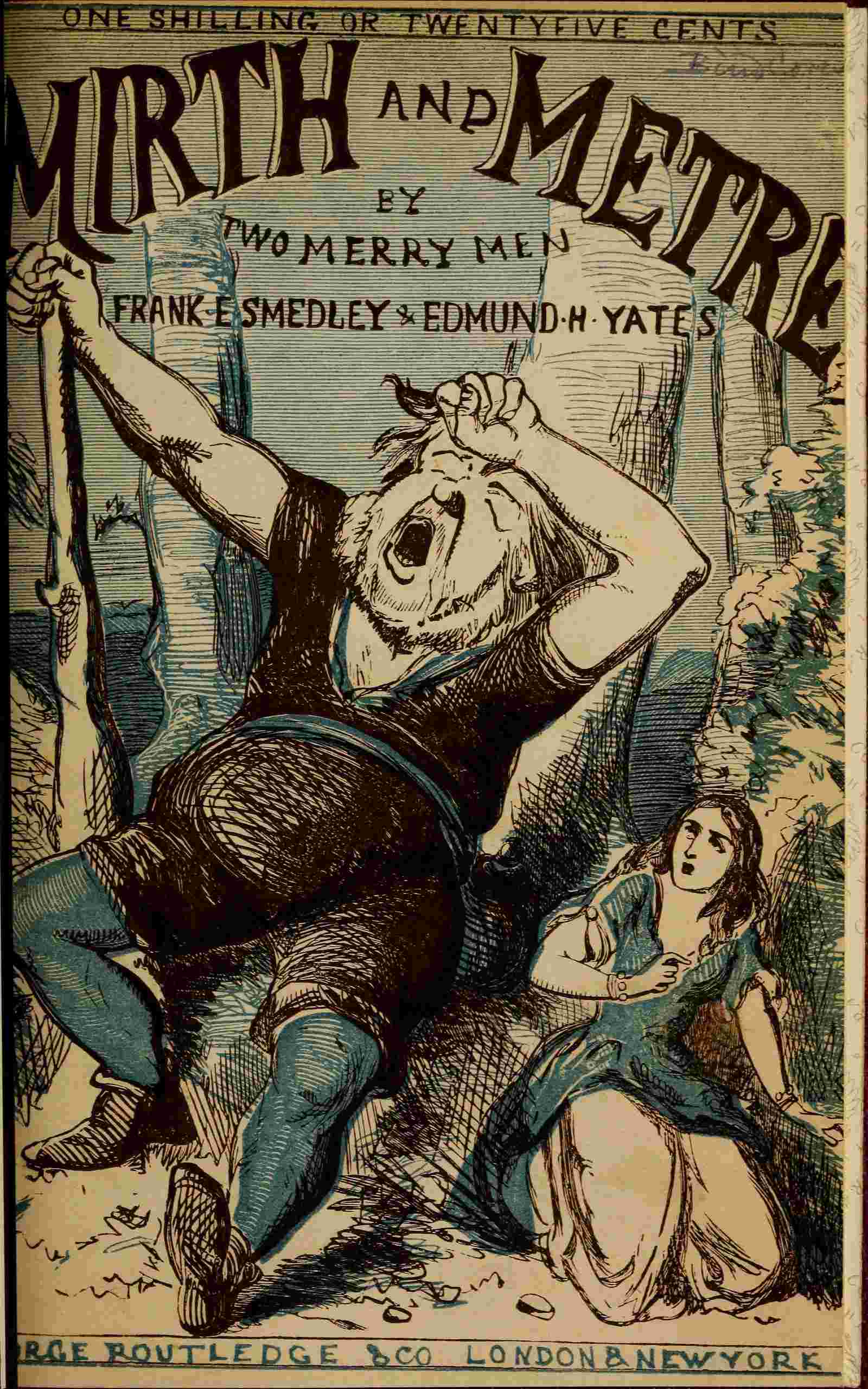
THE FORFEIT HAND;
A LEGEND OF BRABANT.[8]
Fytte ye First.
Geraldus the Abbot sat bolt upright,
Bolt upright, in his great arm-chair,
He ground his teeth, and his beard beneath
Seemed crêpé with anger every hair;
And every hair, whether grizzled or white,
On his head stood erect (as so often the case is,
Whene’er fury or fear better feeling effaces).
Thus encircling his tonsure, which same a smooth space is,
In the desert of scalp a monastic oasis!
Geraldus the Abbot his temper had lost,
Insult had fall’n on the Prelate proud—
Heretic hands in a blanket had tost
Lay Brother Ludwig, one of the crowd
Of the Abbot’s dependents, a useful and able man,
Neither fish, flesh, nor fowl, half a friar, half stable-man.
But this shaking his brain so completely had addled,
That the next time Geraldus’s palfrey he saddled,
He forgot both the girths, an important omission,
Which occasioned a sudden and rude imposition
On our general Mamma: (we allude to the Earth,
Who most kindly supports us, who gave our race birth,
And will give, when breath fails, and we cannot replace it,
Furnished lodgings, a stone, and the motto, “Hic jacet.”)
“Hic” did “jacet” Geraldus, when rashly he tried,
Foot in stirrup, to climb to his saddle and ride;
For the saddle turned round,
And he came to the ground,
With a hollow and pectoral “woughf” kind of sound.
(Printing cannot express it,
But ’twill help you to guess it,
If you’ve ever remarked the peculiar behaviour,
When he rams a large stone, of an Irish pavier.)
Well, he wasn’t much hurt,
But appeared from the dirt,
Which adhered to his mitre and robes, to be rather
A ghastly and horrible sight for a Father
Confessor, who ere he thus rudely was tost
In the mire, was got up regardless of cost.
For this fall he vowed vengeance, and straightway on that theme a
Writ was prepared which wound up with “Anathema!”
Yolenta of Corteryke sat in her bower,
Which was not an arbour
Where earwigs might harbour,
And availing themselves of some al fresco tea-table,
Lie and kick on their backs amidst everything eatable,
But the very best room in the very best tower.
Yolenta was young and Yolenta was fair,
She’d extremely pink cheeks and extremely smooth hair,
And a pair of bright eyes with so roguish a glance in ’em,
That the spirit of mischief and fun seemed to dance in ’em;
And a sweet little foot and a dear little hand,
And a thorough-bred air, and a look of command,
As noble a lady as one in the land.
Yet Yolenta had “suffered;”—her little affairs
Of the heart had gone roughly, a custom of theirs
From time immemorial, since Helen lost Troy,
And pious Æneas made Dido a toy
Of the moment, then left her, a striking variety,
In the uniform course of his orthodox piety.
A young gent was her first love, of birth and condition,
Whose very name, Loridon, seemed an admission
He was formed to adore, but then what’s in a name?
Had they christened him Jack, she’d have “loved him the same,”
Because—mark the reason—her Pa had been rude
To his Guv’nor, which led to a family feud.
So the Lord Lettelhausen called up his son Loridon,
And exclaimed, “Of all girls, to have fixed on that horrid one!
The daughter, you scamp, of the man I detest!
But I’ll never consent! if I do, I’ll be—blest!
Miss Yolenta, indeed! why, my garters and stars!
This is worse than your tricks with latch-keys and cigars!
Now, be off to the wars, nor on any pretences,
Show your face here again till you’ve come to your senses.”
So Malbrook se va-t-en guerre,
In a state of deep despair.
Then Yolenta’s papa thought he’d best take a part in it,
By performing the rôle of the tyrant and Martinet,
And proposed as a suitor,
An old co-adjutor
In many a dark deed, which no one but a brute or
Barbarian would perpetrate, one Baron Corteryke,
Whom he coolly informed her she certainly ought to like,
But, whether or no, in a week’s time must marry—
And his will being the law,
This medieval Bashaw
Pooh-pooh’d Ma’mselle’s suggestion of wishing to tarry,
And so, sending to Gunter, got up, like John Parry,
A first-rate entertainment, and vast charivari;
But yet, after all, was unable to carry
Out his cruel intentions, for ’twixt cup and lip
There occurred in this case a most notable slip;
To describe it, our metre we’ve stol’n, ’twill be seen,
From the song of one “Jock,” who’s sirnamed Hazeldean.
“The kirk was deckt at even-tide,
The tapers glimmered fair,
The Baron Cort’ryke sought his bride,
And this time she was there!
She said, ‘I will,’ as if a pill
Had stuck within her throat,
But fortune kind was still inclined
To grant an antidote;
“For scarce beside the altar stone,
The nuptial knot was tied,
When some vile party, name unknown,
Stabbed Cort’ryke in the side!
His anguish sore, not long he bore,
Physicians wor in vain,
Death did consider, him and his widder,
And eased him of his pain.”
So the lovely Yolenta was “quit for the fright”
Took the name, tin, and castle (a rare widow’s mite)
And wondered how Loridon fared in the fight.
“It was Geraldus’ serving man,
Ludwigus he was hight,
For fair Bettye, that damsel free,
He sighed both day and night;
Fair Bettye at the tapestry wrought,
In Dame Yolenta’s bower;
To ease the pain of this her swain,
She lacked both will and power.
“Dan Cupid, that mischievous boy,
Ludwig to sorrow brought;
For ogling of the fair Bettye,
Him, Dame Yolenta caught;
And as in true love men are still
(As well as oysters) crossed,
Ludwig, to cure his fantasy,
Was in a blanket tossed.”
“Hinc illæ lachrymæ,” thence all these woes!
From this pitching and tossing the shindy arose!
’Tis the voice of a Herald! I heard him proclaim,
That he carries a summons for Corteryke’s dame,
Which sets forth how that same
Fair lady’s to blame,
For the high misdemeanour, the sin, and the shame,
Of tossing a lay brother, Ludwig by name,
In a blanket, whereby she did cut, wound, and maim,
And maliciously injure, and wilfully lame,
And despitefully maltreat, deride, and make game,
And confuse, and abuse, and misuse, and defame!
A monk of Saint Benedict,
Which by a then edict
Was a legal offence; so Yolenta was cited
To appear, and show cause
Why she’d broken the laws,
At the next petty sessions, where she was invited
To plead in her own proper person, and wait a
Decree from my Lord Lettelhausen, the pater
Of poor banished Loridon, likewise the frater
Of the plaintiff Geraldus, an excellent hater
Of all who opposed him, a reg’lar first-rater,
Full of envy and malice, a real aggravator,
Who’d have charmed Doctor Johnson, that learn’d commentator,
Had he chanced but to live a few centuries later.
The Herald he stood in the castle hall,
Seneschal, warder, and page, were there;
And he read his citation fair and free,
In a baritone voice that went up to G,
As loudly as he could bawl.
And he cleared his throat, and he pushed back his hair
With a negligent, nonchalant, jaunty air;
As though he would ask of the bystanding “parties,”—
“Pri’thee what do ye think of me, my hearties?”
Yolenta she smiled, and Yolenta she frowned,
And her delicate foot in a pet tapped the ground;
And when she turned to the herald to greet him,
The flash of her eye seemed to say she could eat him;
Though their points curled up to the knees of his trews,
I’d have been sorry to stand in his shoes.
Then she answered him shortly and sweetly,—
“Ye’re a bold man, Sir Herald, I trow—
A bold and an insolent man, I ween;
A scurrilous knave, I make mine avow;
But perhaps you may find that I’m not quite so green
As your masters imagine. You’ve done it most featly
This time I’ll allow;
But it struck me just now,
When you entered my castle to kick up this row,
You’d have fared quite as well if you’d journey’d on farther;
I’m afraid you’ve, young man, put your foot in it—rather!”
Then she signed with her hand, and six mutes in black armour,
As by magic appeared, laid their lances in rest,
And directed their points to the herald’s bare breast,—
A sight which it must be confessed might alarm a
Brave man in those very unscrupulous days,
When a life more or less, was a mere bagatelle;
And when sticking a porker, or stabbing a swell,
Were alike household duties—a singular phase
In those “sweet” Middle Ages, on which such dependence is
Placed by young ladies with “Puseyite” tendencies.
Howe’er this may be,
Our herald felt he
Had no “call” to assist in this felo de se;
So straight fell on his knee,
And exclaimed, “Don’t you see,
Noble Countess Yolenta, this good jest at present
Is a great deal too pointed and sharp to be pleasant?
I humbly beg pardon,
So pray don’t be hard on
A penitent cove, whose name’s printed this card on.”
Then he handed his pasteboard, gilt type, and a border,
Stamped,
DE RODON.
Heraldic work furnished to order.
Yolenta she smiled, and Yolenta she frowned,
Then light rang her laugh with its silvery sound.
“Rise, valiant De Rodon,” she mockingly cried,
“And behold by what foemen your mettle’s been tried.”
Then each sable spearsman his vizor unclasps,
And six laughing girls with bright mischievous eyes,
Poke their fun at De Rodon, who’s mute with surprise
And disgust, while Yolenta her riding wand grasps,
Sharply switches the recreant kneeling before her,
And turns to depart,—
When up with a start
Springs De Rodon, and pallid with anger leans o’er her.
Then hisses these words in her ear,—“Ere you smile
Or rejoice in your stratagem, listen awhile,
And learn that a herald discharging his duty
Is sacred; despite of your wealth, rank, and beauty,
For the stroke you have dealt me your fair hand is forfeit;
By the axe of the headsman, ere many days, off it
Shall be hewn, and when next men to fury you goad on,
Bear in mind the revenge of the herald De Rodon!”
Fytte ye Second
When the weather is hazy, and not the least sign in
The clouds of their showing a silvery lining;
When a bill’s coming due, and you’ve no chance of meeting it;
When old Harry’s to pay, and the pitch has no heat in it;
When you’re thinking of popping, and suddenly find
That your inamorata’s not that way inclined;
When you’ve published a novel, and find it don’t sell;
When you rise from the wine cup, and don’t feel quite well;
When some six-feet-six monster, by jealousy led,
Suggests “satisfaction” or “punching your head;”
When your wife’s taken cross, or the “olive-branch” sick;
When your wardrobe’s worn out, and your tailor wont “tick;”
When your money’s all gone, and your creditors dun for it;
I think you’ll agree,
That the best plan will be
To (I speak in the language of slang) “cut and run for it.”
Thus, then, reason’d Yolenta of Corteryke, but
With this difference, she “ran” to avoid the “cut”
Of all cuts “most unkindest” (bad grammar, you know,
When it’s written by Shakespeare no longer is so),
Which De Rodon had promised her, axe-ing her hand,
In a manner no woman of feeling could stand
With composure; so straightway Yolenta resolved
To make herself scarce, which manœuvre involved
Much domestic confusion; each man and each maid
Requiring their wages, and board-wages, paid
For a month in advance; while the butler grew crusty
As his oldest port wine; and fair Bettye cried “Must I
Be the cause of this woe—from my dear mistress sever—
Lose my place and my perquisites! which my endeavour
Has still been to draw mild. Well, I never did—never!”
(Then addressing the public at large) “Did you ever?”
These arrangements concluded, Yolenta began
Packing up—the last duty of travelling man—
But the business of life
To maid, widow, or wife,
Except Ida Pfeiffer, that wonder, who can
With umbrella and tooth-brush, reach far Yucatan,
And, like Ariel, span
The earth with a girdle, which some commentator
On Shakespeare imagines must mean the Equator.
Well, she packed up her traps in a leathern valise,
Which contained sundry stockings, a nice new —, but he’s
No gentleman, clearly, who’d Hobbs-like, the locks
Endeavour to pick of so private a box.
Then, by way of disguise, Dame Yolenta decided
(Don’t be horrified, dear lady-readers, though I did
Myself think it strange that my heroine chose
To set out on her rambles attired in such clothes),
For convenience of trav’lling, perhaps, to assume a
Man’s dress—not the epicene compromise, Bloomer,
But the regular masculine propria quæ maribus,
A male coat, a male waistcoat, et ceteris paribus,
A gay cap and feather,
Unfit for bad weather,—
A sword by her side, and a fine prancing horse,
Which she sat, I’m afraid, not “aside” but “across;”
With one groom to attend her—
Nought else to defend her—
Like a “Young Lochinvar” of the feminine gender,
The ill-fated Yolenta rode off at a canter,
And became what the stockbrokers term “a levanter.”
Now you’ll please to suppose,
That she follow’d her nose,
A fine aquiline organ that proudly arose,
Filling just the right space
On her bright sparkling face,
Excelling, as butterfly’s better than grub,
Those unlucky “retroussés” in plain English, “snub,”
Which men always pretend to, and often desire,
But never can really and truly admire;
She followed her nose
To (I blush to disclose
For it does seem so forward; but then no one knows
The whys and the wherefores, the cons and the pros,
Which decide other folks; in the fair sex our trust is
Extreme; so we’ll strive not to do her injustice.)
For some reason unknown, then, she followed her nose
To the camp of King Charles, in which Loridon chose
To wear out his exile, and solace his woes,
By assisting that monarch to conquer his foes.
It were long to relate
All the evils that Fate
Seemed resolved to pour down on our heroine’s pate;
How, on reaching the camp,
She was told that a scamp
Of a Douanier, at the last town she quitted,
Had, as usual, omitted
To see that her passport was legally visé’d;
Although, when she handed his fees to him, he said
It was all right and proper,
And no one would stop her;
Which was false, for it quickly appeared by the law
Of the strong, she was somebody’s prisoner of war;
Next, for fear in her wrath she a breach of the peace
Should commit, or attempt to assault the police,
They disarmed her—laid hands on her watch, chain, and seal
(All the very best gold, and the watch not much thicker
Than a mod’rate sized turnip—no end of a ticker,)
And hurried her off to the then Pentonville
Model Prison, to wait, all forlorn and alone,
And to “carve her name on the Newgate stone,”
Till this terrible somebody’s pleasure was known.
The unpleasant unknown was one Giles de Laval,
A marshal of France, and a very great “pal”
(Or paladin rather), of King Charles le Beau,
(Or “le Gros,” or “le Sot,”
Which, I really don’t know;
But ’twas one of the three, for there’s no nation showers
Such peculiar nicknames on its “governing powers”
As our trusty ally Monsieur Johnny Crapaud,)
This same Giles de Laval, then, who ruled the French host,
And the roast, and the coast, made the most of his post;
Dealt just as he chose
With his friends and his foes,
And was as autocratic, and nearly as fickle as,
That bugbear of Europe, a certain Czar Nicholas—
This identical Giles, for some reason he had,
Seemed resolved that Yolenta should “go to the bad:”
(He possessed such sharp eyes
They pierced through her disguise
At first sight, to her terror, and shame, and surprise),
So he scolded her well, wouldn’t hear her confessions,
But returned her, to answer for all her transgressions,
To Geraldus, in time for the next quarter sessions.
Unhappy Yolenta! Geraldus confined her
In a dungeon, deep, damp, and unpleasant; behind her
Was a ring in the wall, and some rusty old chains,
And there lay in one corner a skull void of brains,
And a horrid leg-bone stood upright in another,
Which must once have belonged to “a man and a brother;”
Then a sturdy support, now a most “unreal mockery,”
A relic suggestively placed there to shock her eye,
And bid her prepare for the doom that awaited her,—
For her dinner they brought her,
Dry bread and cold water,
Wretched food, and by no means enlivening drink,
(Whatever hydraulic George Cruikshank may think
To the contrary,) then, lest they’d not aggravated her
By this treatment, enough, the brutes next dissipated her
Last agreeable illusion, a letter was given her,
Signed and sealed by some friendly (?) anonymous scrivener,
Short, not sweet, for the missive consisted of one
Line, “The Lord Lettelhausen’s no longer a son,”—
From which pleasant allusion,
She reached the conclusion,
That, by some vicious dodge, which she could not discover,
De Laval had “used up” and expended her lover.
Unhappy Yolenta! forsaken, heart-broken,
She drew from her bosom a cherished love-token;
A dark curling lock of her Loridon’s hair,
Fix’d her eyes on it, shed o’er it tears of despair,
Then devoured it with kisses, and dropp’d on her knees,
To implore with deep fervour that Heaven would please
Pardon Loridon’s sins, forgive hers, and so let her
Rejoin, and remain with, one whom she loved better
Far than life; then o’ercome by conflicting emotions,
A fainting fit ended her tears and devotions.
Alas! it is a cruel thing to die,
To leave these hopes and fears, these loves and hates,
For other, though it may be happier, fates;
To go we know not where, we know not why!
To cease to be the thing that we have been,
To be perchance a higher, but a new,
To leave the few we love, the chosen few,
To quit for ever each familiar scene.
To be perchance a lower, to be curst,
For God, who’s great and merciful, is just,
And we, alas! what are we, that we must
By right partake the best, escape the worst?
It is a very bitter thing to die!
To some it is a bitter thing to live!
Patience and faith alone can comfort give,
Patience and faith—the rainbows in the sky.
Ye Last Scene of All.
Gaping and yawning,
Their feather-beds scorning,
All the burghers of Ghent rose betimes in the morning,
For a “shocking event”
Was to take place in Ghent,
And the public delighted in hangings and quarterings,
Mutilations and tortures, and such kind of slaughterings,
Just as much as an Anglican crowd in the present day,
Think attending the “Manning” finale a pleasant day;
So extremely they bustled,
Pushed, jostled, and hustled,
Climbed up lamp-posts, (there were none!) on each rising ground
Stood to view the procession, as slowly it wound
Its way to the cathedral, where, at the high altar
The condemned was “pro se”
To appear, or else be
Declared recusant, most contumacious, defaulter,
Et cetera, et cetera, in fact, all the “bosh”
That the law could devise, horrid stuff which wont wash,
And yet seems to last pretty well through all ages,
Keeps solicitors going, and provides their clerks wages.
’Twas a splendid and beautiful pageant, that same;
First a body of archers and shield-bearers came;
Then some dear little choristers, dressed all in white,
Who each carried a chandelle bénie, or “child’s light,”
Which, being blessed by the Pope, it appears to my thick head,
Must, in spite of its wick, have no longer been wicked;
Next came Abbot Geraldus, profusely ornate
With mitre, and crosier, and garments of state;
Then the Herald de Rodon, in great exultation,
Highly pleased with himself, and the whole “situation;”
Then a servitor, bearing
A big candle, flaring
Up like mad, and creating a vast cloud of vapour,
Or smoke, (which affair was a “penitent taper,”)
On a silver “Lavabo,” a word which they say,
In middle-age Latin, means simply a tray;
And after this penitent candle there came
Our penitent heroine, looking the same,
And feeling—however, I’ll leave you to guess
How the poor thing would feel in so cruel a mess.
Then came something of which the description we’d best give
Is, like Tennyson’s rhymes, it was “sweetly suggestive”—
A large shield, in the centre whereof was depicted
A hand lately severed,—the artist, addicted
(’Twas De Rodon himself) to pre-Raphaelite rules,
Had made the wrist “sanglant” with drops from it “gules.”
Then directly behind this agreeable affair
Came the city “Jack Ketch” with his horrid axe bare!
Then more spearmen; and then rushed the crowd out of breath,
With their eagerness all to be in at the death.
Her eyes dim with despair,
All dishevelled her hair,
And the fair “forfeit hand” with its rounded arm bare,
With brow madly throbbing, and footsteps that falter,—
The wretched Yolenta is led to the altar;
While De Rodon proclaims,
By his titles and names,
That the Lord Lettelhausen, Grand Seigneur, and Knight
Of some half-dozen orders, demands as his right
The forfeited hand of the culprit Yolenta.
Then Geraldus replies, “By the general consent, a
Demand thus in accordance with justice and law
Is granted. Let Lord Lettelhausen now draw
Near the altar, and take, by the Church’s command,
As his right and possession, the forfeited hand!”
A stalwart arm is round her thrown,
Fondly the forfeit hand is pressed;
No more forsaken and alone,
She sinks upon a manly breast.
At length the evil days are past—
Her griefs, her trials, all are over,
Long wept, long sought, regained at last,
’Tis Loridon, her own true lover.
Whose Papa having very obligingly done
The genteel thing, in dying exactly when one
Would have wished him, by that means enabled his son
To step into his shoes, just in time to diskiver a
Mode of enacting the gallant deliverer;
As we’ve tried to rehearse
For your pleasure in verse,
If we’ve happened to fail,—and too clearly you know it,—
Bear in mind that we never set up for a Poet.
Frank E. S.
FOOTNOTES
[8] The facts (?) of this Legend are taken, by poetical licence, from “Legends of the Rhine,” by the author of “Highways and Byways.”
THE FORFEIT HAND.—p. 60.