
When the King spits, the boys with the elephants tails sedulously wipe it up, or cover it with sand; when he sneezes, every person present touches, or lays the two first fingers across the forehead and breast, as the Moors did when they pronounced a blessing, and the Ashantees, invariably, to propitiate one. These troops of boys who carry the elephants tails, are the sons of men of rank and confidence; for whenever the King dignifies a deserving subject, with what may be termed nobility, he exchanges some of his own sons or nephews, (from eight to fourteen years of age,) for those of the individual, who maintains them, and for whom they perform the same offices, as his own and others do for the King. Thus the present King (the short reign of his brother Saï Apokoo being unanticipated) carried an elephants tail before Apokoo, whose kindness and indulgence to the child secured the preference of the monarch.
It is a frequent practice of the King’s, to consign sums of gold to the care of rising captains, without requiring them from them for two or three years, at the end of which time he expects the captain not only to restore the principal, but to prove that he has acquired sufficient of his own, from the use of it, to support the greater dignity the King would confer on him. If he has not, his talent is thought too mean for further elevation. Should he have no good traders amongst his dependents, (for if he has there is no difficulty) usury and worse resources are countenanced, and thought more creditable than a failure, ascribed to want of talent rather than to a regard of principle.
The fees to the King’s household on a captain being raised to a stool, are generally eight ounces. I saw two instances of the King paying them himself; the individuals, very suddenly elevated for extraordinary courage, being too poor to do so. They were immediately dispatched to collect tributes, the per centage on which, (see Laws,) and the douceurs, which may be judged of by the amount provided for them in the settlement of the Commenda palaver, would possess them of a good sum to begin with.
The interference of Amanquateä, Quatchie Quofie, Odumata, and Apokoo, is purchased at a most extravagant rate by offenders, whether foreigners or subjects; it is irresistible with the King; Apokoo is generally preferred; minor influence is purchased in proportion. No subject can sit in public with a cushion on his stool, unless it has been presented to him by the King, or one of the four, who, as well as all the other superior captains, receive a periguin of gold for every oath the King exacts of them.
During the minority, or the earlier part of the reign of a monarch, the linguists and oldest counsellors visit him betimes every morning, and repeat, in turn, all the great deeds of his ancestors. The greatest deference seemed to be paid to aged experience or wisdom.
Apokoo is the keeper of the royal treasury, and has the care of all the tributes, which are deposited, separately, in a large apartment of the palace, of which he only has the key. Numerous and various as the sums are, he disposes of them by a local association which is said to be infallible with him, for the Moorish secretary, (who resided some time at Hio,) only records the greater political events. Apokoo holds a sort of exchequer court at his own house daily, (when he is attended by two of the King’s linguists, and various state insignia,) to decide all cases affecting tribute or revenue, and the appeal to the King is seldom resorted to. He generally reclined on his lofty bed, (of accumulated cushions, and covered with a large rich cloth or piece of silk,) with two or three of his handsomest wives near him, whilst the pleadings were going forward. He was always much gratified when I attended, and rose to seat me beside him. I observed that all calculations were made, explained, and recorded, by cowries. In one instance, after being convinced by a variety of evidence that a public debtor was unable to pay gold, he commuted sixteen ounces of gold, for twenty men slaves. Several captains, who were his followers, attended this court daily with large suites, and it was not only a crowded, but frequently a splendid scene. Before the footoorh or treasury bag is unlocked by the weigher, though it be by the King’s order, Apokoo must strike it with his hand in sanction.
In all public trials, the charges are preferred, in outline, against the criminal by the King’s linguists, and he is always heard fully, and obliged to commit or exculpate himself on every point, and to take the various primary oaths, before the witnesses are confronted with him; of whom he is kept as ignorant as possible until the moment of their appearance. The oaths, sometimes four or five, are progressive, generally beginning by the King’s foot, or some arbitrary form, and are, apparently, not considered awful or decisive; such perjuries being commutable by fine. But when the oath, “by the King’s father,” is administered, every one looks serious, and if, “by Cormantee and Saturday” (see History) is resorted to, there is a gloomy silence; but this is seldom ventured, if the witnesses, (hurried in with a sort of stage effect between that and the former oaths,) confound or perplex the accused.
There are various ways of taking fetish; the two I observed, were, licking a white fowl twice or thrice, and drinking a nauseous vegetable juice without coughing: it was administered by the linguists out of a brass pan in a folded leaf of the plant. If the accused is cleared, he comes forward, and is marked with white chalk by the linguists, after which he bows to, and thanks all the great men in the council. Taking doom is the infallible test, when they consider the case to be too doubtful for human decision. The bark of that tree is put into a large calabash with water, so as to make a strong infusion; it is stirred up whilst the suspected parties sip in turn. It operates, instantaneously and convulsively, as a most violent emetic and purge; those who sip first may recover, and the dregs are frequently left designedly for the obnoxious.[91]
The criers, upwards of a hundred, who always attend the linguists, are all deformed or maimed, to make them more conspicuous; they wear a monkey skin cap, with a gold plate in front, and the tail hanging down behind. Their common exclamations are, Tehoo! Tehing! Odiddee! Be silent! Be quiet! Pray hear! and these are so incessantly uttered, that they are themselves the only interruption. Several less interesting peculiarities are represented in the drawings of the Yam Custom, and associated with other subjects.
A general is appointed to the command of an army by receiving a gold handled sword of the King’s from his hand, (who strikes him gently with it three times on the head,) swearing to return it encrusted with the blood of his conquered enemies. One of the King’s linguists always accompanies an army of any consequence, to whom all the politics of the war are entrusted, and whose talent and intelligence in negotiating, are expected to mature the fruits of the military genius of the general, and to reimburse the expense of the war by heavy fines and contributions. The Ashantees are as superior in discipline as in courage to the people of the water side, though their discipline is limited to the following precautions. They never pursue when it is near sun set; the general is always in the rear; the secondary captains lead the soldiers on, whilst those in command, with a few chosen individuals, urge them forward from the rear with their heavy swords, and cut any man down who retreats until the case is desperate. The first object of the Ashantee in close fight, is, to fire and spring upon the throat of his enemy; to advance every time he fires he feels to be imperative, if his commander thinks it possible, who would, otherwise, if he escaped death in the action, inflict it on him directly it was over. It is one of the sentences of the most popular song in Coomassie, “if I fight I die, if I run away I die, better I go on and die.” They are as the antient Spaniards have been described, “prodiga gens animæ et properare facillima mortem.” The general has his umbrella spread in the rear, and, besides his guard, has several extra muskets ready loaded for those soldiers who may be driven to him in case of reverse. His band plays all the time, and in his assumed contempt for the enemy, it is the etiquette for him to divert himself at some game, whilst the heads of the slain of any rank in the hostile army are sent to him to put his foot on. When the result of an important action is expected, even with an anxiety by no means sanguine, and the messengers are known to be near the capital, the King is always seated in public, with his golden worra board before him, playing with some dignitary; and thus receives the news, to impress the people with confidence by his affected indifference to victory or defeat, when superstition had revealed and fated inevitable success ultimately.
All the superior captains have peculiar flourishes or strains for their horns, adapted to short sentences, which are always recognised, and will be repeated on enquiry by any Ashantee you may meet walking in the streets, though the horns are not only out of sight, but at a distance to be scarcely audible. These flourishes are of a strong and distinct character. The King’s horns uttered, “I pass all Kings in the world.” Apokoo’s, “Ashantees, do you do right now?” Gimma’s, “Whilst I live no harm can come.” Bundahenna’s, “I am a great King’s son.” Amanqua’s, “No one dares trouble me.” This will be further noticed in the chapter on Music. These peculiar flourishes are more particularly for their government in action, for all the soldiery, indeed I might say all the women and children, being familiar with every flourish, the positions of the various chiefs are judged of when they cannot be seen; whether they are advancing, falling back, or attempting to flank the enemy by penetrating the woods, is known, and the movements of all the others become co-operative, as much as possible. The King’s horns go to the market place every night, as near to midnight as they can judge, and flourish a very peculiar strain, which was rendered to me, “King Saï thanks all his captains and all his people for to-day.”
Several of the hearts of the enemy are cut out by the fetish men who follow the army, and the blood and small pieces being mixed, (with much ceremony and incantation,) with various consecrated herbs, all those who have never killed an enemy before eat a portion, for it is believed that if they did not, their vigor and courage would be secretly wasted by the haunting spirit of the deceased. It was said that the King and all the dignitaries partook of the heart of any celebrated enemy; this was only whispered; that they wore the smaller joints, bones, and the teeth of the slain monarchs was evident as well as boasted. One man was pointed out to me, as always eating the heart of the enemy he killed with his own hand. The number of an army is ascertained or preserved in cowries or coin by Apokoo. When a successful general returns, he waits about two days at a short distance from the capital, to receive the King’s compliments, and to collect all the splendor possible for his entrée, to encourage the army and infatuate the people. The most famous generals are distinguished by the addition of warlike names, more terrific than glorious, as they designate their manner of destroying their prisoners. Apokoo was called Aboäwassa, because he was in the habit of cutting off their arms. Appia, Sheäboo, as he beats their heads in pieces with a stone. Amanqua, Abiniowa, as he cuts off their legs.
The army is prohibited during the active parts of a campaign, from all food but meal, which each man carries in a small bag at his side, and mixes in his hands with the first water he comes to; this, they allege, is to prevent cooking fires from betraying their position, or anticipating a surprise. In the intervals, (for this meal is seldom eaten more than once a day,) they chew the boossee or gooroo nut. This meal is very nourishing and soon satisfies; we tried it on our march down. Ashantee spies have been stationed three and four days in the high trees overlooking Cape Coast Castle, with no other supply than this meal and a little water, before the army has shewn itself. There is always a distinct body of recruits with the army, to dispatch those with their knives whom the musket has only wounded, and they are all expected to return well armed from despoiling the enemy, or they are not esteemed of promise, and dismissed to some servile occupation. I could not find that they had any idea of fortifications, though undoubtedly common to the large cities on the Niger.
It is the invariable policy of Ashantee to make the contingency of the power last subdued, the revolters recently quelled, or the allies last accepted, the van of their army throughout the campaign, and very frequently there are no Ashantees but captains with the army; but it is composed entirely of tributaries and allies. Thus Odumata subdued Banda with an army of Gamans. In the Ashantee body of the army, which is always that of reserve, the youngest or last made captain marches and engages first, and the others follow seriatim, until Odumata precedes Quatchie Quofie, Amanqua follows him, and Apokoo precedes the King. Were the country generally open, I have no doubt, necessity and their military genius would have suggested greater arrangement and compactness in their movement, which is nevertheless very orderly. Two divisions of an army are rarely allowed to go the same path, lest, being in want of supplies, the neighbourhood should prove inadequate. Aboidwee, our house master, (see correspondence on the Ashantee suicide) who has 1700 retainers, always precedes the King’s or Apokoo’s division, (which will exclusively occupy the Banda path in the invasion of Gaman) to raise a bamboo house for the King’s reception when he comes up.
Infants are frequently married to infants, for the connection of families; and infants are as frequently wedded by adults and elderly men. The ceremony is to send the smaller piece of cloth, worn around the middle, to the infant, and a handsome dash of gold to the mother, as her care then ceases to be a duty, but becomes a service performed to the husband, who also sends frequent presents for the support of the child. Apokoo told me it was a good plan for a man to adopt who wished to get gold, for as the circumstance was seldom generally known, the most innocent freedom when the girl became ten or eleven years old, grounded a palaver against the individual, though he might consider he was but fondling a child, and be wholly ignorant of her marriage. I afterwards understood from several others, that this view was the leading motive.[92]
It frequently happens, when the family of the wife is too powerful for the husband to venture to put her to death for intrigue, that he takes off her nose as a stigma and punishment, and makes her the wife of one of his slaves. A wife who betrays a secret is sure to lose her upper lip, and, if discovered listening to a private conversation of her husband’s, an ear. Women so maimed are to be met with in all parts of the town. Prostitutes are numerous and countenanced. No Ashantee forces his daughter to become the wife of the man he wishes, but he instantly disclaims her support and protection on her refusal, and would persecute the mother if she afforded it; thus abandoned, they have no resource but prostitution. During the menses, the women of the capital retire to the plantations or crooms in the bush.[93]
In visiting, the chief always gives his principal slaves a few sips of the liquor offered to him, not for security, for it is more frequently after than before he has drank, but as a mark of his favour. He will frequently give his daughter in marriage to a confidential slave, but where there are a few thus distinguished and indulged, (apparently as a political check upon a heterogeneous populace,) there are thousands barely existing.
Their principal games are Worra[94] (see drawing, No. 10.) which I could not understand, and Drafts, which both Moors and Negroes play well and constantly. Their method resembles the Polish, they take and move backwards and forwards, and a king has the bishop’s move in chess. They have another game, for which a board is perforated like a cribbage board, but in numerous oblique lines, traversing each other in all directions, and each composed of three holes for pegs; the players begin at the same instant, with an equal number of pegs, and he who inserts or completes a line first, in spite of the baulks of his adversary, takes a peg from him, until the stock of either is exhausted.
[84]The description of the siege of Pondicherry in Voltaire occurred to me; it will assist the imagination of the reader: “De grands magasins de liqueurs fortes y entretenaient l’ivrognerie et tous les maux dont elle est le germe. C’est une situation qu’il faut avoir vue. Les travaux, les gardes de la tranchée étaient faits par des hommes ivres · · · · · · · · De-là les scènes les plus honteuses et les plus destructives de la subordination et de la discipline. On a vu des officiers se colleter avec des soldats et mille autres actions infâmes, dont le détail, renfermé dans les bornes de la vérité la plus exacte, paraîtrait une exagération monstreuse.”
[85]In Ahanta, at the Contoom or Harvest custom, each family erects its rude altar, composed of four sticks driven in the ground, and twigs laid across the top; the whole is then covered with fresh pulled leaves. A hog, a sheep, a goat, or a fowl is killed, according to the means of the family, and the most delicate parts laid on the altar, a mixture is made of eggs, palm oil, palm wine, the blood of the animal slain, and other ingredients, and also dedicated to the fetish, in small pots placed on the altar. In a few days these altars become so offensive as to render it disagreeable to pass them, but they are never removed.
[87]The Ahanta’s divide time into periods of three weeks. The first week is called Adaï, and is termed the good week, in which much work is done; and traders visit the markets more frequently in this week than at any other time, supposing all they do in it must prosper. The second week is Ajamfoe, or the bad week, in which no work or trade is done, the natives believing every thing undertaken in it must fail. The third week is Adim, or the little good week, in which they both work and trade, but not as much as in the Adaï.
In Fantee they dress the body richly, and usually prop it erect in a chair, exposing it until it is dangerous to do so any longer: they bury it in their house, with as many gold ornaments as they can afford to dedicate. The men called the town drummers are only allowed to die standing, and when expiring are snatched up, and supported in that posture. In Ahanta they frequently exhibit the body chalked all over.
The Ashantees do so not only on solemn occasions, but invariably; and it would seem that the Greeks did, from the following words of Hecuba to Hector,
[90]Suetonius tells us that Augustus sacrificed 300 of the principal citizens of Perusia, to the manes of his uncle Julius. We read in Prevost, that 64080 persons were sacrificed, with aggravated barbarity, in the dedication of a temple in Mexico.
[91]In the Warsaw country there is said to be a more dreadful poison called Sabë: if it is thrown upon the skin, it is absorbed by the pores, and has nearly the same instantaneous mortal effect as when given internally.
[92]On the Coast, the bride’s character is very notoriously published, for part of the husband’s present to her family being a flask of rum, and that not sent until the next day; whether it is brimful, or somewhat wanting, indicates her virginity, or early frailty.
[93]The women of Ahanta, on the same occasion, are prohibited from entering any inhabited place; and if they attempt to go into a house, are heavily fined or punished. If the family is respectable, they generally erect a temporary shed to shelter her; the poorer class are forced to endure the inclemencies of the weather without any retreat.
[94]This game is said to be played in Syria also.
CHAPTER VI.
Architecture, Arts, and Manufactures.
The construction of the ornamental architecture of Coomassie reminded me forcibly of the ingenious essay of Sir James Hall, (in the Edinburgh Philosophical Transactions,) tracing the Gothic order to an architectural imitation of wicker work. The drawings will serve to shew the various and uncommon character of their architectural ornaments, adopted from those of interior countries, and, confessedly, in no degree originating with themselves.
In building a house, a mould was made for receiving the swish or clay, by two rows of stakes and wattle work, placed at a distance equal to the intended thickness of the wall; as two mud walls were raised at convenient distances, to receive the plum pudding stone which formed the walls of the vitrified fortresses in Scotland. The interval was then filled up with a gravelly clay, mixed with water, with which the outward surface of the frame or stake work was also thickly plastered, so as to impose the appearance of an entire thick mud wall. The houses had all gable ends, and three thick poles were joined to each; one from the highest point, forming the ridge of the roof, and one on each side, from the base of the triangular part of the gable; these supported a frame work of bamboo, over which an interwoven thatch of palm leaves was laid, and tied with the runners of trees, first to the large poles running from gable to gable, and afterwards, (within,) to the interlacing of the bamboo frame work, which was painted black and polished, so as to look much better than any rude cieling would, of which they have no idea; a small part appears in the houses in the drawing of Adoom-street (No. 9.) The pillars, which assist to support the roof, and form the proscenium or open front, (which none but captains are allowed to have to their houses) were thick poles, afterwards squared with a plastering of swish. The steps and raised floor of these rooms were clay and stone, with a thick layer of red earth, which abounds in the neighbourhood, and these were washed and painted daily, with an infusion of the same earth in water; it has all the appearance of red ochre, and from the abundance of iron ore in the neighbourhood, I do not doubt it is.
The walls still soft, they formed moulds or frame works of the patterns in delicate slips of cane, connected by grass. The two first slips (one end of each being inserted in the soft wall) projected the relief, commonly mezzo: the interstices were then filled up with the plaster, and assumed the appearance depicted. The poles or pillars were sometimes encircled by twists of cane, intersecting each other, which, being filled up with thin plaster, resembled the lozenge and cable ornaments of the Anglo-Norman order; the quatre-foil was very common, and by no means rude, from the symmetrical bend of the cane which formed it. I saw a few pillars, (after they had been squared with the plaster) with numerous slips of cane pressed perpendicularly on to the wet surface, which being covered again with a very thin coat of plaster, closely resembled fluting. When they formed a large arch, they inserted one end of a thick piece of cane in the wet clay of the floor or base, and bending the other over, inserted it in the same manner; the entablature was filled up with wattle work plastered over. Arcades and piazzas were common. A white wash, very frequently renewed, was made from a clay in the neighbourhood. Of course the plastering is very frail, and in the relief frequently discloses the edges of the cane, giving however a piquant effect, auxiliary to the ornament. The doors were an entire piece of cotton wood, cut with great labour out of the stems or buttresses of that tree; battens variously cut and painted were afterwards nailed across. (See drawing, No. 5.) So disproportionate was the price of labour to that of provision, that I gave but two tokoos for a slab of cotton wood, five feet by three. The locks they use are from Houssa, and quite original; one will be sent to the British Museum. Where they raised a first floor, the under room was divided into two by an intersecting wall, to support the rafters for the upper room, which were generally covered with a frame work thickly plastered over with red ochre. I saw but one attempt at flooring with plank, it was cotton wood shaped entirely with an adze, and looked like a ship’s deck. The windows were open wood work, carved in fanciful figures and intricate patterns, and painted red; the frames were frequently cased in gold, about as thick as cartridge paper.
What surprised me most, and is not the least of the many circumstances deciding their great superiority over the generality of Negroes, was the discovery that every house had its cloacæ, besides the common ones for the lower orders without the town. They were generally situated under a small arch way in the most retired angle of the building, but not unfrequently up stairs, within a separate room like a small closet, (see drawing No. 3.) where the large hollow pillar also assists to support the upper story: the holes are of a small circumference, but dug to a surprising depth, and boiling water is daily poured down, which effectually prevents the least offence. The rubbish and offal of each house was burnt every morning at the back of the street, and they were as nice and cleanly in their dwellings as in their persons.
Drawing No. 3, is one of the oldest houses in Coomassie, inherited by the unfortunate Bakkee, and part of the quarters of the Mission. Its comparative rudeness is evident.
No. 4, is a more modern part of the same house, being one side of a small area about 15 feet square, allotted to the chief officer of the Embassy. These areas are all distinct, and a house consists of an indefinite number of them, some 36 feet square, with several long courts. In paying a visit to a principal man, the state was to detain us some minutes at the door of each area, as he generally received us in the innermost. The figure is one of the King’s body guards, which have been described before. The figures are introduced to shew the proportion of the buildings, and to give some idea of the costume.
No. 5, is the exterior of a bed room of Odumata’s, which is one side of an oblong area in a very retired angle of his house, about 25 feet by 8. The cloth suspended to the left of the door on the top of the steps, hides the bloody stools which are in the recess. The small gallery in front of the upper room is only wide enough for one person to walk in. The recess and small room below accommodate confidential slaves. The bed room was very small, about 8 feet square, but being hung round with a variety of gold and silver ornaments, had a very rich appearance. The bed is generally about 5 feet high, and composed entirely of large silk-cotton pillows piled one above another. The King of Gaman, we were assured, had steps of solid gold to ascend to his bed. A man wearing a crier’s cap, is playing the sanko.
No. 6, is a perspective view of the entrance area to Apokoo’s house; the fourth side is an open fronted building like those on the right and left for attendants to wait in, and for the hearing of palavers. The opposite closed side is a bed room. The figure is playing the bentwa (see Music.)
No. 7, is a part of a piazza, which lines the interior of the wall secluding the palace from the street. The piazza is 200 yards long, and inhabited by captains and other attendants on the King; above is a small gallery. Piles of skulls, and drums ornamented with them, are frequent in this piazza. The figure is a common soldier of Ashantee, his belt ornamented with red shells, and stuck full of knives.
No. 8, is the upper end of the piazza, which is more ornamented, and appropriated to the superior captains, who have each a suite of rooms, marked by the small doors under the piazza. A woman is dancing whilst a man plays the flute and rattle.
No. 9, is a view of part of Adoom-street: each open front denotes the residence of a captain, being used for talking palavers, receiving strangers, observing or superintending customs, and evening recreation. The dwelling is entered by the small door at the side, which generally leads through a narrow passage or court to a large area like No. 6, and thence by various intricate ways to smaller and more retired areas like No. 4 and No. 5. A fetish woman has just quitted the centre house; she has on a white cloth, and various pieces of rich silk are hanging round her girdle, her breasts are confined with a scarf, a fillet encircles her head, in each hand she waves a horse’s tail, and she continues yelling and swinging round and round until she is quite stupified. A weaver and loom are on her right, and a market woman under her shed on the left.
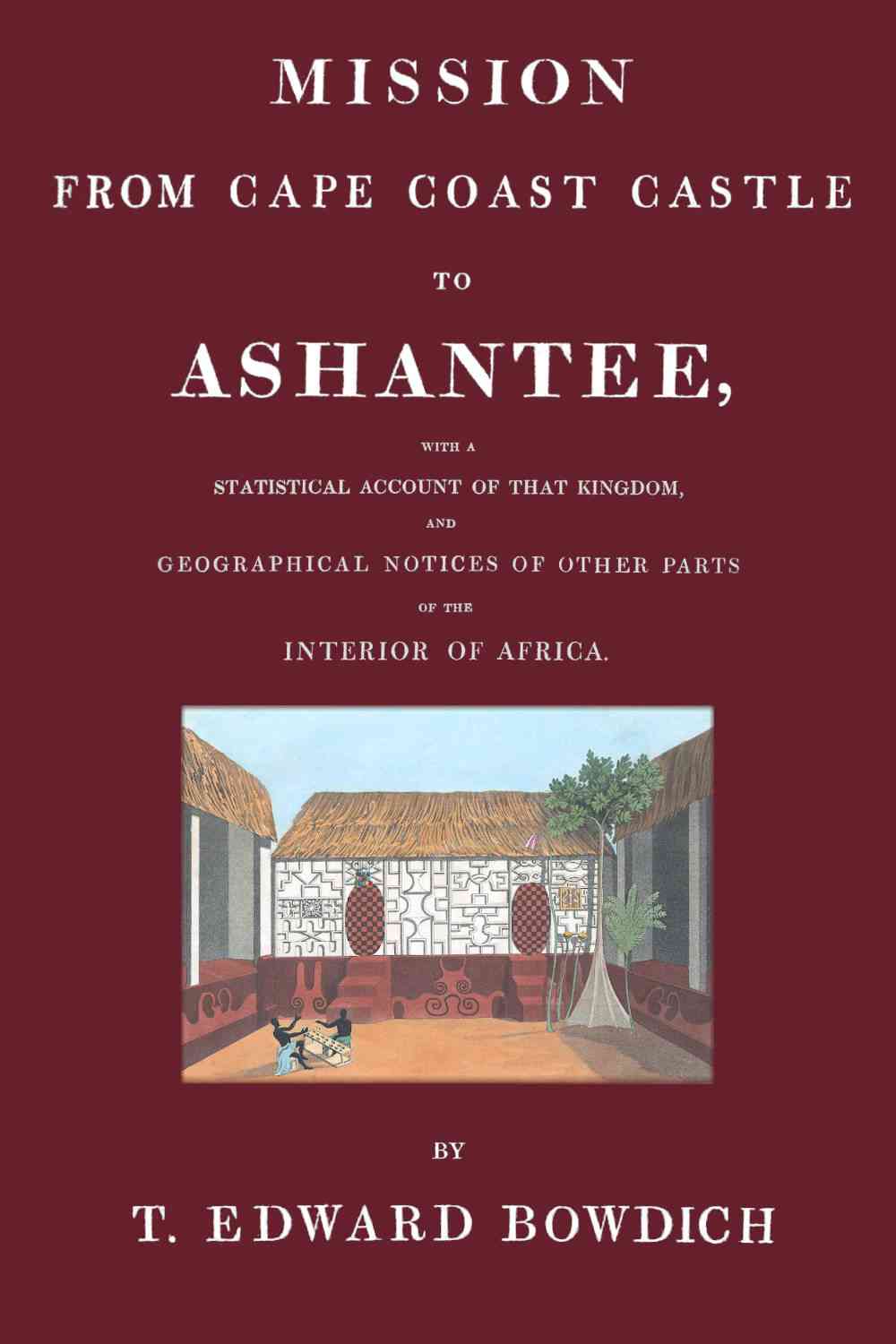
No. 10, is the exterior of the King’s bed room, being one side of an inner area, about 30 feet square. The stunted silk-cotton and the manchineal tree are fetish or sacred, as are the white and red rags at the top of the pole, and the small brass cups supported by the forked sticks. The colored bags hanging over the round doors (the chequering of which is in relief,) contain Moorish charms. The carving of the left hand window is cased in silver, of the right hand, in gold. The two men are playing at Worra. The King made frequent enquiries about the architecture of England, of which we gave him some idea by drawings. He was very fond of referring to a project ascribed to Saï Cudjo, and which he declared he would carry into effect directly the Gaman war was over. This was to build a house for his own immediate residence, roofed with brass pans, beaten into flat surfaces, and laid over an ivory frame work appearing within. The windows and the doors to be cased in gold, and the door posts and pillars of ivory. Whether the Moors originated or encouraged this extravagance by the descriptions in their tales, for some of the stories of the Arabian Nights were commonly in their mouths, or whether it was the scheme of his own disposition, prone to magnificence and novelty, the King dwelt ardently on the intention, and by their frequent conversations on the subject, his chiefs appeared scarcely less anxious for the execution than himself. He meditated great improvements and embellishments in his capital, on his return from the war, when it was intended that every captain should be presented with an extraordinary sum out of the public treasury, for adorning or enlarging his house. The ruined streets between Asafoo and Bantama were to be rebuilt, and the six or seven small crooms between Coomassie and Baramang, (the King’s country residence,) were to be pulled down, and the inhabitants to occupy a wide street to extend from the city to that croom. This was the darling design of the King; he had already made a sound, broad, and almost direct road, and numerous labourers were continuing to bring it as near as possible to a straight line.
The Ashantee loom is precisely on the same principle as the English; it is worked by strings held between the toes; the web is never more than four inches broad. A weaver is represented in the drawing, No. 3, and a small loom complete is amongst the articles for the British Museum. They use a spindle, and not a distaff, for spinning, holding it in one hand, and twisting the thread, (which has a weight at the end,) with the finger and thumb of the other. The fineness, variety, brilliance, and size of their cloths would astonish, could a more costly one be exhibited; in the absence of which, that for the Museum will doubtless be admired for the two first qualities, and for having precisely the same appearance on both sides. I shall notice in the Chapter on Trade, that the richest silks are unravelled to weave into them. The white cloths, which are principally manufactured in Inta and Dagwumba, they paint for mourning with a mixture of blood and a red dye wood. The patterns are various, and not inelegant, and painted with so much regularity, with a fowl’s feather, that they have all the appearance of a coarse print at a distance. I have seen a man paint as fast as I could write. There will be a very fair specimen in the British Museum, the price of painting which was one ackie.
They have two dye woods, a red and a yellow, specimens of which I brought down; they make a green by mixing the latter with their blue dye, in which they excel; it is made from a plant called acassie, certainly not the indigo, which grows plentifully on the Coast. The acassie rises to the height of about two feet, and according to the natives, bears a red flower, but the leaf is not small, fleshy, or soft, nor is it pale or silvery coloured underneath; it is a thin acuminate leaf about five inches long, and three broad, of a dark green.[95] I regret to add, our best specimens of this plant perished in the disasters of our march, and no drawing was made of it, as it bore no flower in that season; it grows abundantly in the woods, and produces a fast and beautiful colour without requiring a mordant. They gather a quantity of the leaves, bruise them in a wooden mortar, and spread them out on a mat to dry, this mass is kept for use, a proportion of it is put into a pot of water and remains six days previous to immersing the thread, which is left in six days, drying it once every day in the sun, it is then a deep lasting blue colour. When a light blue is wished for, the thread is only allowed to remain in the dye pot three days.
They excel in pottery, as the pipes for the Museum will shew; they are rested on the ground when smoked; the clay is very fine, polished (after baking) by friction, and the grooves of the patterns filled up with chalk. They have also a black pottery which admits of a high polish.
The people of Dagwumba surpass the Ashantees in goldsmith’s work, though the latter may be esteemed proficients in the art. The small articles for the Museum, a gold stool, sanko, bell, jaw bone, and drum, are not such neat specimens as I could wish; the man who made them having too much costly work on hand for the King, to pay our trifles his wonted attention; unfortunately too, he was committed to prison before they were quite finished; however, they will give an idea. I weighed out nineteen ackies and a half of gold dust for making these articles, one third of an ackie was lost in melting, and five was the charge of the goldsmith. We lost a beautiful silver pipe in the bustle. Bees wax for making the model of the article wanted, is spun out on a smooth block of wood, by the side of a fire, on which stands a pot of water; a flat stick is dipped into this, with which the wax is made of a proper softness; it takes about a quarter of an hour to make enough for a ring. When the model is finished, it is enclosed in a composition of wet clay and charcoal, (which being closely pressed around it forms a mould,) dried in the sun, and having a small cup of the same materials attached to it, (to contain the gold for fusion,) communicating with the model by a small perforation. When the whole model is finished, and the gold carefully enclosed in the cup, it is put in a charcoal fire with the cup undermost. When the gold is supposed to be fused, the cup is turned uppermost, that it may run into the place of the melted wax; when cool the clay is broken, and if the article is not perfect it goes through the whole process again. To give the gold its proper colour, they put a layer of finely ground red ochre, (which they call Inchuma,) all over it, and immerge it in boiling water mixed with the same substance and a little salt; after it has boiled half an hour, it is taken out and thoroughly cleansed from any clay that may adhere to it. Their bellows are imitations of ours, but the sheep skin they use being tied to the wood with leather thongs, the wind escapes through the crevices, therefore when much gold is on the fire they are obliged to use two or three pair at the same time. Their anvils are generally a large stone, or a piece of iron placed on the ground. Their stoves are built of swish (about three or four feet high) in a circular form, and are open about one fifth of the circumference; a hole is made through the closed part level with the ground, for the nozzle of the bellows. Their weights are very neat brass casts of almost every animal, fruit, or vegetable known in the country. The King’s scales, blow pan, boxes, and weights, and even the tongs which hold the cinder to light his pipe, were neatly made of the purest gold that could be manufactured.
Their blacksmith’s work is performed with the same sort of forge as the above, but they have no idea of making iron from ore, as their interior neighbours do. Their swords are generally perforated in patterns like fish trowels; frequently they make two blades springing parallel from one handle, which evince very fine workmanship. The needles and castanets will only give some idea of their progress. The iron stone is of a dark red colour, spotted with gray, and intermixed with what had all the appearance of lava, they cut bullets out of it for the army, when lead is scarce. I have brought some arrows of native iron. They have no idea of making a lock like the people of Houssa and Marrowa.
They tan or dress leather in Ashantee, but they do this, and dye it, in a very superior manner in Houssa and Dagwumba; see the sandals and cushion in the British Museum, the former varied and apparently stitched; doubting that there could be such stitching, I undid a part, and discovered that they perforated the surface, and then stuck in the fine shreds of leather. The curious will observe, that the patterns of the stool cushion are all produced by paring the surface. They make their soldiers belts and pouches out of elephant or pig skin, ornamented with red shells. (See drawing, No. 7.)
Of their carpenter’s work the stool is a fair specimen, being carved out of a solid piece of a wood called zesso, white, soft, and bearing a high polish; it is first soaked in water. They sell such a stool for about three shillings, in Accra or Fantee it would fetch twenty. The umbrella is even more curious, the bird is cut almost equal to turning, and the whole is so supple that it may be turned inside out. This, only a child’s umbrella, is a model of the large canopies I have described in the procession; I gave a piece of cloth value twenty shillings for it. The sanko or guitar is also neatly made, and the chasteness and Etruscan character of the carving is very surprising. The surface of the wood is first charred in the fire, and then carved deep enough to disclose the original white in the stripes or lines of the patterns.
Numbers of workmen are employed in breaking, rounding, and boring the snail shells, as big as a turkey’s egg generally, and sometimes as large as a conch. They are first broken into numerous pieces, then chipped round, the size of a sleeve button, and afterwards bored with a bow and iron style fixed in a piece of wood. Lastly they are strung, and extended in rows on a log of wood, and rubbed with a soft and bluish gray stone and water, until they become perfectly round.
Their pine apple thread is very strong, and is made from the fineness of a hair to the thickness of whip cord, it bleaches to a beautiful whiteness, and would answer for sewing any strong material, but, when muslin is stitched with it, it is liable to be cut from the harshness. The women frequently join their cloths, and ornament their handkerchiefs with a zigzag pattern, worked with unravelled silks of different colours. The fetish case is a specimen of their needle work, in the manner of chain stitch.