WeRead Powered by ReaderPub
Modern cosmogonies cover

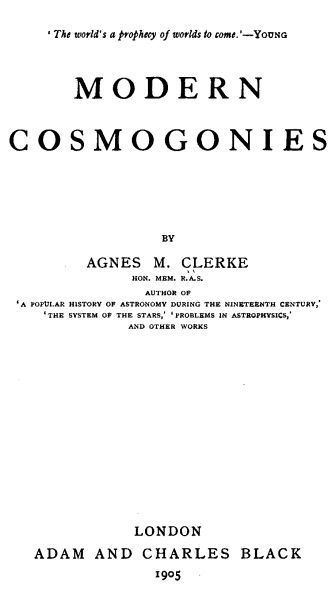
Modern cosmogonies

Open in WeRead

About This Book

The work surveys historical and contemporary explanations for the origin of the universe, tracing philosophical beginnings through scientific theories and critiques. It explains the nebular hypothesis and its refinements, evaluates tidal friction, rotational fission, and meteoritic accretion as formation mechanisms, and explores concepts such as protyle, universal forces, and the ether. It considers morphological types of nebulae, stellar procession, the formation of the solar system, remnant bodies, and concludes with reflections on the emergence of life as a possible outcome of cosmical processes.

About the Author

Clerke, Agnes M. portrait

Agnes M. Clerke

Agnes M. Clerke was a prominent Irish astronomer and science writer known for her contributions to the popularization of astronomy in the late 19th century. Her most notable work, "A Popular History of Astronomy During the Nineteenth Century," provides a comprehensive overview of astronomical discoveries and theories of her time. Clerke's writings often bridged the gap between complex scientific concepts and general readership, making her a significant figure in the field of science communication. In addition to her historical works, she also explored topics such as the Herschel family and modern cosmogonies, reflecting her deep engagement with both the history and the evolving nature of astronomy.

More Books by This Author

You May Also Like