
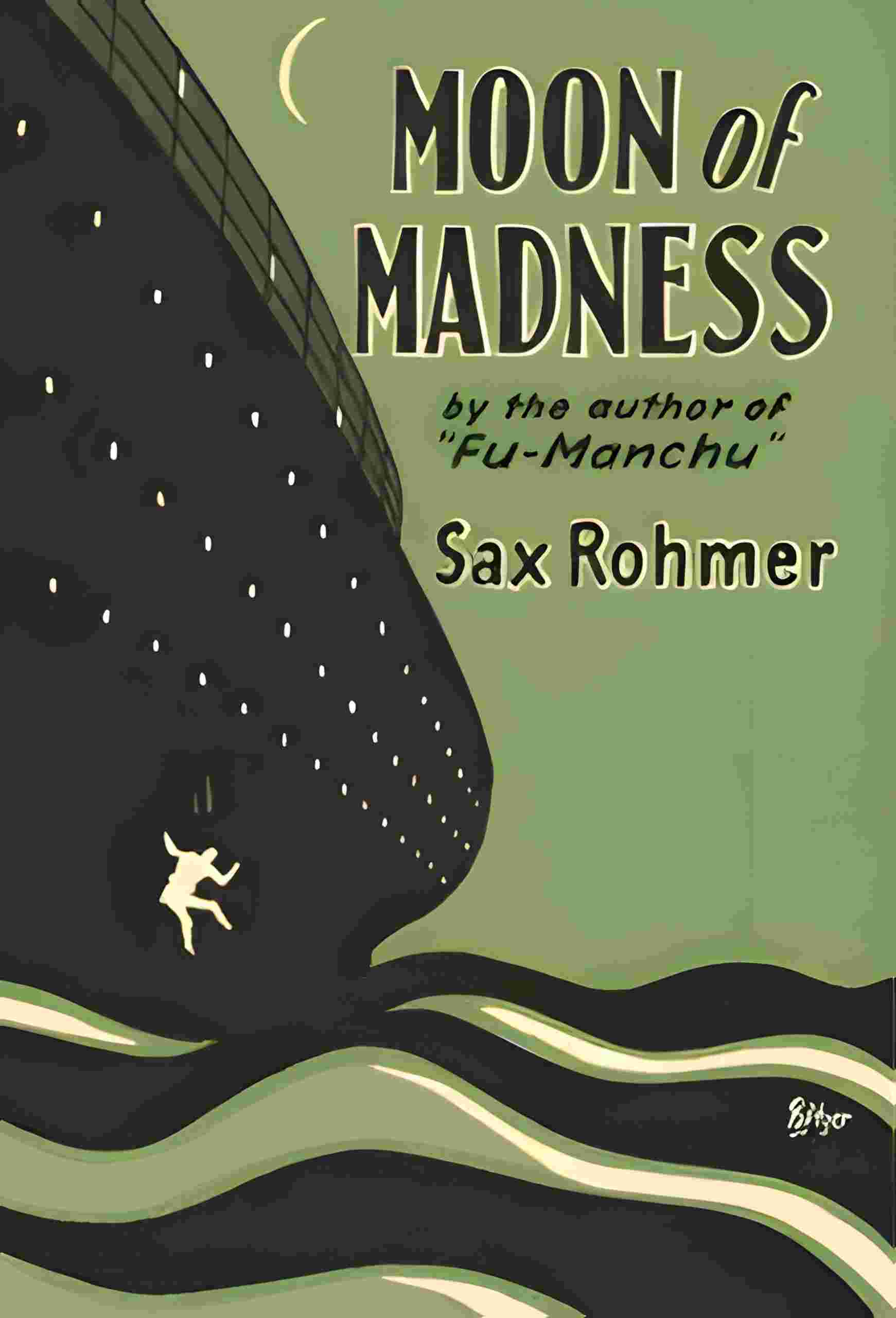
The Project Gutenberg eBook of Moon of madness
Title: Moon of madness
Author: Sax Rohmer
Release date: October 7, 2025 [eBook #77001]
Language: English
Original publication: Garden City: Doubleday, Page & Company, 1927
Credits: an anonymous Project Gutenberg volunteer
Moon of Madness
By SAX ROHMER
GARDEN CITY, NEW YORK
DOUBLEDAY, PAGE & COMPANY
1927
[COPYRIGHT]
COPYRIGHT, 1927, BY DOUBLEDAY, PAGE &
COMPANY. COPYRIGHT, 1926, 1927, BY LIBERTY
WEEKLY, INC. ALL RIGHTS RESERVED.
FIRST EDITION
CONTENTS
III. The Man from the River Plate
XXII. Portrait of a Girl Diving
MOON OF MADNESS
CHAPTER I.
THE GERMAN LINER
“I should love a long glass of iced German lager,” said Nanette. “Besides, I refuse to be deserted for a whole morning.”
Her Japanese parasol lay along the rail of the veranda, her round bare elbows rested upon it and she cuddled her obstinate little chin in upturned palms. I turned to her with a glance in which I had meant to convey rebuke. But the blue eyes danced with mischief and pouting lips smiled impudently, a smile half childish and half elfin.
“Young ladies of eighteen do not drink beer,” I answered paternally. “It isn’t done.”
Jack Kelton came out as I spoke, saw Nanette, and flushed like a girl. When I say “like a girl” I mean like a girl of Victorian literature. To-day one should say “like a boy.” I never saw Nanette blush during all the time I knew her. I saw her grow deathly pale; but this was later.
Jack was good to see in the Madeira sunlight; one of those lean-limbed young Oxonians who strip so well and who always look amazingly clean. Nanette turned a slim shoulder in his direction, and stared out pensively across the bay. I thought that she had the most perfect arms imaginable. So did Nanette.
“I want to go out with you two and Mr. Ensleigh to that ship,” she said, peering aside at the enraptured Jack. “Please ask Mumsy. She likes you—and I love beer.”
Jack and I exchanged glances. We both looked at Nanette; and then beyond to where the subject of controversy lay anchored—a big German out of Bremen, in from the River Plate.
“I have asked her,” Jack declared. “She’s adamant.”
“So have I,” came a cheery voice—and Ensleigh joined the party. “She says that Mr. Kirby is coming to lunch.”
“But I loathe Mr. Kirby!” cried Nanette, turning upon the speaker scornfully. “He’s one of the reasons why I want to go!”
“Is that so, Nan?”
From a long, awning-covered chair near the corner of the veranda Nanette’s mother arose—a gracefully pretty woman who solved the mystery of Nanette’s beauty for those who had met only her father.
“Mumsy! Have you been sitting there all the time?”
“All the time, dear—and I have heard every word! So don’t attempt to take one back!”
Ensleigh, the well-groomed, became all attention. He became attentive from the crown of his perfectly brushed hair to the soles of his spruce white shoes. He placed a chair for Nanette’s pretty mother. He focussed his Zeiss glasses to enable her to view the German liner. She thanked him with a smile that was very like Nanette’s.
“So you loathe poor Mr. Kirby?” she murmured, raising the glasses.
“Hate him poisonously!”
“And you love beer?”
“Simply worship it, Mum! Lager is my vice!”
Her mother lowered the glasses and fought with rising laughter, for Nanette was looking straight at her. Then:
“You little devil!” she said. “I don’t believe a word of it! But your father simply won’t hear of you going on board a German ship. Don’t ask me why. You know him as well as anybody.”
“I’ll ask him myself!” Nanette said, flashing blue eyes rebelliously. “Where is the funny old thing?”
“Nan, dear!”
“Oh, he’s a darling! But he is funny! He’s never forgotten that I was once a baby.”
“You are still a baby, Nan—a mere infant.”
Nanette threw back her shapely bobbed head and laughed scornfully. Wild canaries were love-making in the palm grove below the balcony, and, being poetically inclined, I suppose, I thought that Nanette’s soft rippling laughter was music sweet as theirs.
She turned swiftly. She had all her mother’s grace as well as the divine abandon of youth. With never another glance at any of us, she walked in through the open French window. Jack Kelton’s glance followed the slim, straight figure. Her mother looked up at Ensleigh.
“Have you a daughter?” she asked.
“No,” he replied. “I regret——”
“Don’t regret,” she interrupted; but her smile belied the Chinese solecism to come: “Pray that you may never have a daughter!”
“Really,” Jack began, in his youthful, diffident way, “I don’t think there’s any harm in——”
He was interrupted. Nanette returned, dragging by the hand a very bored, gray-haired gentleman who carried a copy of the Times that was ten days old. The gentleman, blinking through his glasses, was being forced out into the sunshine.
“Now, Pop,” said Nanette firmly, “is there really any reason why I shouldn’t go with Mr. Ensleigh, Mr. Decies, and Mr. Kelton to see that German liner?”
“Well, dear,” her father replied, in his laboured manner, “I am afraid you would be late for lunch, and——”
His glance sought his wife’s. I distinctly detected a negative shake of the head from Nanette’s mother.
“And,” he went on, “your mother thinks that this would be rude, as Mr. Kirby is expected.”
He smiled almost apologetically, patted Nanette on the head, and, Times in hand, returned to his shady lair in the smoke-room. Nanette stared reproachfully at her mother.
“Don’t be huffy about it, darling,” said the latter. “Really, you will only have time for a swim and a sun bath, if you are to make yourself presentable by one o’clock.”
Nanette looked swiftly from face to face. A number of people had now begun to come out from late breakfast. She checked speech, withered poor Jack with a final, comprehensive look of scorn, and walked quickly into the hotel. The last few steps that were visible, as she crossed the threshold, almost consisted of stamping her little feet.
Following a moment of silence:
“Look here, you chaps,” said Jack, “it looks rather mean for us all to desert Nanette. I know we’ve engaged the launch and all that, but it’s beastly tame swimming alone——”
“Don’t worry, Mr. Kelton,” Nanette’s mother broke in. She was smiling. “Nanette will not be swimming alone!”
Poor Jack smiled in return, flushed, and then frowned darkly. His glance constantly sought the entrance to the hotel. But Ensleigh tactfully made the conversation general, and we were discussing the feminine modes of Paris as opposed to those of Buenos Aires when a slight figure arrayed in a pink bathrobe and shaded by a Japanese parasol passed slowly down the path below the terrace; whereupon:
“There goes Nanette!” said Jack, jumping up. “Excuse me. I’ll just run and ask her if she would rather I stayed.”
He hurled himself in the direction of the steps and disappeared. A moment later he reappeared, running after the girl. We watched.
“Nanette!” he called.
Nanette paused, turned, waved her hand, and went on. She walked under a veritable awning of hibiscus, sweeping some of the blossoms off with her parasol. Rounding the corner, she came into view again on a lower path. Her mother leaned over the balcony rail.
“Go after her, Jack!” she called. “Don’t be afraid of her!”
The words reached Nanette. She looked up through flower-laden branches. Her voice came faintly.
“I don’t want him to come after me. I want to be alone.”
Jack Kelton turned and began to walk back up the sloping path. He kept his curly head lowered, taking out a briar from his pocket and fumbling for his pouch. Nanette’s mother glanced at Ensleigh.
“Poor Jack,” she said. “He is very young!”
CHAPTER II.
RESCUE
We did not take the lift down to the landing-stage. It was busy with bathers; therefore we descended by the rambling stairway cut out of the rock. At the bend, I paused.
Half across the bay, far beyond the waddling group who hugged the bathing pool, where the transparent water showed turquoise blue, I saw a flashing of white limbs and glimpsed a pink-covered head lowered to the swell. Came a rapturous murmur behind me.
“Nanette! Gad! That girl swims like a fish!”
“They should follow with the boat,” Ensleigh’s voice broke in on Jack’s. “There’s a beastly current cuts round the headland.”
“She is safe enough,” said I. “Her fairy godmother was a mermaid—or a siren.”
Nevertheless, when we reached the waiting launch, Nanette’s daring had attracted attention. I could not see her mother; but there was a buzz of excited conversation all around, and the brown-skinned professional was making urgent signals to the boatmen.
“She’s right on our course!” cried Jack. “Come on! Hurry up!”
“Don’t worry,” I implored him, tumbling into the launch.
“But she’ll never be able to swim it!” said Ensleigh, jumping in behind me. “Hullo! What’s this!”
He had stumbled over a bulky parcel wrapped up in newspaper. I thought I recognized the Times.
“Please leave alone, sir!” cried the Portuguese in charge. “I aska tella you no touch!”
“Oh!”
Ensleigh stared at him suspiciously, and then we were off.
“Pick her up, Decies!” came a shout from someone on shore. “She’s overdone it this morning. She can never get back!”
The purr of the motor made it difficult to hear the other shouts that followed us. But excitement was growing intense, and I looked out ahead uneasily. I could not see Nanette.
“Can you see her, Decies?” said Jack hoarsely.
“No.”
“There she is!”
The cry came from Ensleigh, and:
“Where?” Jack and I yelled together.
Ignoring us:
“Port, easy!” he directed the man at the wheel. “Now—as she is! Hold it!”
We raced, all out, in the direction of the rash swimmer. A sort of anger claimed me. This crazy performance was a display of girlish pique. I felt particularly sorry for Jack Kelton. He was hanging over the bow in a perfect anguish of terrified expectation. Presently:
“She’s still swimming strongly!” he gasped; then, almost immediately: “My God!”
“What?”
Ensleigh and I were peering ahead over Jack’s shoulder.
“She’s gone down!”
Over the noise of the motor, over the sound of the sea, it reached us dimly—a prolonged, horrified cry from the watchers on shore.
What happened during the next few minutes I am unable to record. I think Jack was fighting with the boatman because he couldn’t get another amp. out of his engine. Ensleigh, I remember, looked dishevelled for the first time in my experience of him. I was drenched with perspiration—and it was not wholly due to the heat of the sun.
Then, dead ahead, not six lengths away, a white arm was thrown up out of the sea.
“Stop her!” I yelled.
Hot on the words came a splash—and Jack was in. He was fully dressed, except that he had shed his college jacket. He reached Nanette as she came up for the second time.
“Reverse! Starboard!”
We described an untidy crescent; and then—Nanette was being hauled aboard. She sank down on the cushions as Jack came clambering over looking like a half-drowned Airedale.
“Nanette!” he panted, and dropped on his knees before her.
She opened starry eyes, and looked at him.
“Yes?” she said.
“Back to the landing-stage,” I heard Ensleigh direct the boatman.
“What’s that!” cried Nanette, surprisingly sitting upright. “Not on your life, Pedro!”
We were riding the swell, the motor silent, and from the now-distant bathing pool I heard a sound of great, prolonged cheering.
Nanette sprang up on the thwart, standing there, poised on tip-toe, a slender young goddess. Jack’s coat was in her hand; and she waved it furiously, looking back to where moving figures showed upon flower-draped terraces.
The cheering was renewed.
“That will relieve Mumsy’s anxiety,” said Nanette, sitting down again. “Please go ahead, Pedro—and would somebody pass me my robe?”
“What!” cried Jack.
Ensleigh tore away the pages of the Times from the mysterious bundle—and there was Nanette’s pink robe!
“Be careful, please!” she said. “My shoes are wrapped up in it.” She turned to Jack, at the same time pulling off her pink bathing cap. “I’m so sorry you jumped in,” she added. “You were a darling to do it, though.”
He had been positively glowering at her; but, at this, he blushed with delight and became a proud and happy man. Nanette shook her tousled head distractingly. Stooping, she pulled out from the folded robe a pair of high-heeled shoes and proceeded to squeeze five tiny wet toes into each of them.
“Nanette!” I said slowly. “Weren’t you drowning?”
She looked up at me.
“Of course I wasn’t drowning!” she returned. “I was swimming under water. I was good for another mile!”
“Nanette!” said Ensleigh. “You will come to a bad end, my child.”
“Please pass me my parasol,” Nanette retorted. “It’s in the locker. And be careful. My bag is inside it.”
The Japanese parasol was discovered. From it, Nanette took a small bag. Surveying herself disdainfully in a square mirror, she combed her hair. She delicately applied lip salve and powdered her impudent nose.
“You are all wet!” said Jack, feasting his eyes.
His case was worse than hers, and I marvelled at the altruism of love.
“The sun will dry me. But, oh! how good that lager will taste! Won’t someone please give me a cigarette?”
I held out a yellow packet, and:
“Nanette,” I said, “one day a Someone will come who will teach you how to behave yourself!”
“Tosh!” said Nanette, taking a Gold Flake. “I’ve outlived that sheikh stuff.”
CHAPTER III.
THE MAN FROM THE RIVER PLATE
As we drew alongside the German, it became evident that we were objects of much interest to her people. I had a good view of the third-class quarters; she had a deck-load of dagoes under her awnings that would have frightened a Chicago bootlegger.
We started up the ladder; and I thought it probable that some of the spectators would either fall overboard or break their necks, so urgently did they crane across the rails.
“They are anxious to see the gallant rescuer,” said Ensleigh.
I knew my dago better. They were anxious to see Nanette’s pretty legs.
On the deck, I turned and looked across to where Funchal climbed the hill. The sunlight was dazzling. I could trace the steep cobbled street, from point to point, down which one may slide in a wicker toboggan; see the square, too, with its powder-blue trees, and imagine the morning gathering at the tables outside the Golden Gate. Away over the bows I looked, and saw the flower-draped cliffs below Reid’s, where, on the lower terrace, over cocktails, Nanette would, I surmised, be the sole topic of conversation.
The lady in question, supremely indifferent to the somewhat marked curiosity of the passengers, was walking aft with Jack, doubtless in quest of the much-desired lager. Jack, his legs encased in sodden flannels, was ridiculously happy because Nanette hung on his arm.
“Leave them alone,” said Ensleigh. “God knows he’s earned it.”
We found our way to the smoke-room and ordered drinks. They were good and cheap. They served to wipe out one more of the old scores I had against our Teutonic friends (nées enemies). It was a distinctly mongrel company. Germans predominated, with a big sprinkling of those nondescripts and none-such usually invoiced as Argentines but sometimes mistaken for Greeks.
One man, who sat alone, puzzled me. He was handsome, in a way. He wore his wavy hair rather long and was dressed in a perfectly cut and immaculately white drill suit. With the aid of a black-rimmed monocle attached to a thick ribbon, he read what looked like an official document.
“By Jove!” Ensleigh exclaimed.
Glancing aside, I saw that he, too, was staring at this romantic individual.
“Looks like John Barrymore,” said I.
“I know,” Ensleigh replied. “But he didn’t wear his hair like that the last time I saw him—coming out of the Salient with what was left of the Irish Guards. By Jove!”
He jumped up and crossed the room. I followed.
“O’Shea!” he cried.
The man addressed dropped his monocle and stood up; then:
“Ensleigh!” he exclaimed, and held out his hand. “Can it be Ensleigh!”
“Ensleigh it is!” was the reply; “and I want you to meet”—drawing me forward—“Mr. Decies. Decies, this is Major Edmond O’Shea.”
The Major readjusted his monocle and looked me over briefly, as if to determine whether he wanted to know me or not. I found myself looking into a pair of the coldest gray eyes that had ever examined my hidden motives.
But, to tell the truth, I was more than a little flurried. For, as Ensleigh spoke, the fact had dawned upon me that I stood in the presence not only of an Irishman of ancient family, nor merely in that of a distinguished British officer, but in the presence of a mess-room tradition; a thing infinitely more wonderful and holy. This was “The O’Shea”—a synonym for all that’s fine under the Colours from Whitehall to Khatmandu.
He dropped his monocle and grasped my hand warmly.
“I am glad to meet you, Mr. Decies,” he said. We formed a trio, and there were some inevitable reminiscences—and more drinks; then:
“What, in the name of wonder, are you doing on this ship?” Ensleigh asked.
O’Shea shrugged his shoulders. He had some queerly Gallic mannerisms. In fact, if one had not known better, one must have written him off as an incurable poseur.
“Peace-time soldiering is a dull business,” he replied. “I take on odd jobs to keep me out of mischief.”
He rang for the steward and ordered drinks in what I believe was unexceptionable German. Following some aimless chatter:
“Are you for Bremen?” asked Ensleigh.
“I don’t know,” said O’Shea surprisingly. He twirled his glass and stared around the smoke-room. “I may come ashore here.”
“You may!” I exclaimed and glanced at the clock. “You have twenty minutes to decide!”
“Two would be sufficient,” he assured me. “I travel light!”
He smiled—and, in the smile, I met for the first time the real O’Shea. The cold gray eyes were cold no longer; they smiled, too—whimsically, lovably. The cloak of inscrutability was dropped, just for a moment, and the clean, brave soul of the man peeped out. A vague dislike vanished as morning mist, and I knew that men would follow Edmond O’Shea into the thickest and the hottest, if he needed them; women, too, perhaps. A man like that is a man born to suffer. But suddenly I understood why the Guards had worshipped him.
“There goes the first shore signal,” said Ensleigh. “We had better rescue Nanette from the lager.”
We found her on deck with Jack and another man who had tacked himself on to the party. He was a poisonously handsome none-such, and his heavy-lidded dark eyes were literally devouring the girl’s dainty beauty. He had come across Jack in London; and now Jack was the most unhappy man in Madeira. Every time roguish blue eyes met lustful brown eyes, he visibly shuddered.
The dark gentleman was presented.
“Ensleigh, Decies—meet Senhor Gabriel da Cunha.”
We met him—reluctantly.
“This,” said Ensleigh, “is Mr. Jack Kelton—Major Edmond O’Shea. Doubtless, Senhor da Cunha, you have met already?”
“No,” murmured O’Shea, bowing coldly. “One does not meet everybody on board.”
“Nanette!” I called.
She had stepped to the rail with Da Cunha. She turned.
“Yes?”
“I want you to know Major Edmond O’Shea.”
She came forward and I introduced them formally. Nanette gave one quick, startled look at O’Shea—and O’Shea, noting her unusual attire, smiled. Nanette dropped her lashes, said something meaningless, and ran back to Da Cunha.
I heard Jack grind his teeth. When he joined the pair at the rail I stood at his elbow.
“We must be saying good-bye, Mr. da Cunha,” he began, but:
“Not good-bye at all!” Da Cunha exclaimed, turning and resting one hand on Nanette’s shoulder. “I am undecided until this morning, but now—it is settled! Here, in Madeira”—he indicated distant hills—“I have a bungalow, so charming. Do you know—” he included us all in the conversation—“that in Funchal is what they call a ‘blind spot’ in radio? Yes. But in my bungalow, high up, I have the most perfect set in the island; and one night—to-night, maybe—” he glanced aside at Nanette—“we shall dance to your Savoy band!”
“You are going ashore, then?”
“But certainly! It is settled. Is it not?”
The question was addressed to Nanette, and:
“I should just hate to lose you so soon,” she replied. “Let’s go and see if your things are in the boat.”
Side by side with the radiantly smiling Da Cunha, she hurried forward. She glanced at Jack, at me, at Ensleigh. O’Shea was watching her, but she avoided his gaze. He turned and went in at the saloon entrance.
The last gong sounded. Jack had suddenly disappeared. I stared at Ensleigh. He whistled softly.
“Nanette has been bitten at last,” he remarked.
“Yes,” I said, “I think she has.”
Da Cunha’s baggage was loaded into Reid’s launch and we all got aboard. We were surrounded by a babbling gang in boats who held up Madeira lace and cane chairs and shawls and bedspreads, desperately inviting bids from the passengers. It was distracting, so that I scarcely noticed a steward coming down the ladder, carrying a suitcase and a valise. Jack sat right astern, his hands plunged in the pockets of his sodden flannels. Then, suddenly, I realized that someone was beside me.
I turned—and met the cold gray eyes of O’Shea!
“Good heavens!” I exclaimed. “Your decision was a sudden one!”
“Yes,” he replied, “it was—very.”
“Hullo, O’Shea!” cried Ensleigh. “This is fine!”
Nanette bent toward Da Cunha, talking animatedly.
CHAPTER IV.
AT THE CASINO
A party of us went down to the Casino that night, consisting of Nanette, Nanette’s mother, Ensleigh, and myself. Jack excused himself on the plea that he had promised to play somebody five-hundred up. Nanette had been put through the hoop well and truly for her escapade, but she looked none the worse for this parental correction.
Newly from the seclusion of a French convent, she was learning the dangerous truism that beauty governs mankind.
Da Cunha was waiting at the Casino—and Nanette pretended to be surprised. Her mother really was surprised, and maternally alarmed. She was a woman of the world and she knew her Da Cunhas.
The said Da Cunha wanted to dance. Nanette loved dancing and danced divinely. Therefore she decided to play roulette.
“Please, Mumsy,” she pleaded—“until I have lost a pound!”
Her mother consented, silently signalling me to sit beside Nanette at the table. Whilst Nanette’s mother danced with Ensleigh, I chaperoned Nanette.
The game was dull. Da Cunha constantly urged the superior charms of the ballroom. But Nanette played on. Presently:
“Do you think Jack will come along?” she asked.
“I hope so.”
An interval in which Nanette lost five shillings, then:
“Had you met Major O’—what’s his name—before?”
“No. I had heard of him.”
“Really? Is he famous?”
“I suppose he is—in a way.”
“But listen!” Da Cunha exclaimed, “this is so boring! Let us dance.”
“Not until I’ve lost my pound,” said Nanette firmly.
More aimless play, then:
“I saw your Major man when we first went on board, you know,” said Nanette, casually staking her all on a number. “Jack and I peeped into the smoke-room, and—he was in there.”
“Really. Is that so?”
“Yes. Wasn’t it odd I should meet him, after—seeing him like that?”
“Very odd.”
Nanette’s fortune was swept away by the croupier. She remained unperturbed. She kept throwing quick little glances all about the room, and now:
“Please take me out on the terrace and get me a long, cool drink,” she asked.
We stood up and crossed to the open doors. Da Cunha grabbed Nanette’s arm and led her out. As I followed, I glanced aside, and saw Jack coming in. He looked very flushed. He was literally glaring after the pair in front of me. I waved to him, but he swung around and went out again.
It was dark on the terrace and at first I couldn’t see Nanette. Then I glimpsed a raised white arm over in a distant corner. She was standing with her back to the railing and Da Cunha stood in front of her, bending forward, one hand resting beside her and his face very close to hers.
“What about that long, cool drink?” said I.
Nanette immediately ran to me.
“Oh, please!” she cried. “I’m simply gasping! Where shall we sit? Somewhere by the windows—where we can watch.”
She was excited, and it was clear enough that Da Cunha had been making love to her. He turned, and I heard him snap his fingers.
“Why not here?” he suggested. “How beautiful is the view in the moonlight, with the dark groves and twinkling lamps.”
“No,” said Nanette, selecting a table near an open window. “I feel chilly and I want to watch the dancing.”
“If you are cold, let us dance.”
Nanette shook her head and opened a tiny jewelled cigarette case. She bent toward me.
“A match, please,” she begged.
She was quite determined, and so we sat there sipping iced drinks until Nanette’s mother and Ensleigh joined us. There were inquiries for Jack, but I said nothing—for the boy had been palpably drunk.
Nanette was unable to mask her preoccupation, constantly looking into the lighted rooms, then, suddenly, halfway through a Charleston, she jumped up.
“Come on,” she said to Da Cunha, and threw her wrap to me—“let’s dance!”
He was on his feet in an instant and the two went in. Nanette’s mother was playing, and as I stood up I glanced toward the table.
O’Shea was standing watching the play.
Nanette and Da Cunha began to dance. Da Cunha danced perfectly, with all the sensuous grace of a none-such; but the look in his dark eyes raised my gorge to a hundred and twenty in the shade. Nanette floated in his arms like a bit of thistledown; her tiny feet seemed scarcely to brush the floor. He talked to her constantly, and sometimes she smiled up at him; but, always, she glanced into the roulette room as they passed. Ensleigh joined us.
“Yes,” said he, “little Nanette is in the throes of her first infatuation.”
As he spoke, she went past in Da Cunha’s arms, and frowned at Ensleigh—because he blocked her view of the roulette table.
“She is,” I agreed.
She danced every dance after that with Da Cunha, becoming more and more animated as the night wore on. Then her mother moved an adjournment. Of course, Nanette objected.
“Mumsy,” she said. “Mr. Da Cunha has invited us all to drive up to his bungalow. We can dance to the Savoy band. Think of it!”
But her mother refused to think of it. Da Cunha was not defeated yet, however. His car was waiting. He would drive the party to Reid’s. In the end this invitation was accepted. Nanette, her mother, Ensleigh, and I elected to go.
“How many can you take?” Nanette asked.
“Oh, six easily.”
“I wonder if anyone else is going back?” said Nanette.
Following her glance:
“I might ask Major O’Shea if he is ready,” said I. “Do you mind, Senhor da Cunha?”
“But of course not!” he replied, looking like Cæsar Borgia thinking out a new prescription.
O’Shea thanked me. He preferred to walk.
“And I dislike Senhor Da Cunha,” he added.
Therefore the five of us packed into a flamingo-red Farman that stood before the Casino. I thought that if brass helmets had been served out, we should have done credit to any fire brigade. Da Cunha, of course, had Nanette beside him in front. I could hear his constant murmur over the roar of the engine. He took us up to Reid’s at an average of about fifty-five.
Nanette’s mother steered Nanette to bed, and Da Cunha did not stay long. I sent a page to look for Jack, but he was not in his room.
At about midnight, O’Shea joined us. We went out on to the terrace, pipes going, and sat watching the fairyland of the gardens below, with the winking lights of Funchal climbing the slopes beyond. Presently I heard a faint movement, and:
“Oh!” said a voice in the darkness.
We all turned—and there was Nanette, distracting in déshabille.
“I can’t sleep, and I left my book out here!” she explained.
“Let me look,” said Ensleigh.
But he looked in vain.
“May I stay awhile and smoke a cigarette with you?” Nanette pleaded; “or were you telling funny stories?”
She stayed—seated on the arm of my chair. There was not much conversation, but after awhile O’Shea got up and disappeared. Nanette began to talk, then, with feverish animation, until presently O’Shea came back, carrying a loose coat.
Very gracefully, he placed it around Nanette’s shoulders.
“You must be cold,” he said.
Nanette glanced up at him, then down again—and shivered. But it was not because she was cold.
Later, long after Nanette reluctantly had retired to her room, Jack was driven up from Funchal. We put him to bed without arousing anyone.
“I’ll kill that slimy Da Cunha,” he declared thickly—and went to sleep.
O’Shea surveyed him through the black-rimmed monocle.
“I wonder if cats and pretty girls know how cruel they are?” he murmured.
CHAPTER V.
“IN FIVE MINUTES”
The days wore on in that lotus-eaters’ paradise and I became an audience of one at a comedy designed to end in drama. There was a mystery that intrigued me vastly, and Ensleigh shared my curiosity.
I could not imagine what the O’Shea was doing in Madeira.
Da Cunha, palpably, had broken his journey to pursue Nanette. He positively haunted the hotel. I found it hard to believe that any such motive had inspired the Major. Ensleigh, with singular density, believed that Nanette was desperately infatuated with Da Cunha. I let him think so, and studied O’Shea.
This strange man spent a large part of every day seated on his balcony, reading and writing. What he read or what he wrote, nobody knew. On occasions, he disappeared for hours: and no one knew where he went.
It was queer, too, how many times Nanette strolled through the unfrequented part of the gardens below this balcony. Sometimes, but rarely, she would be alone, sometimes with Jack, more often with Da Cunha. But, always, she paused to glance in her mirror and powder her nose before she turned the corner. O’Shea, apparently, never noticed her.
She would loiter around the bathing pool for hours in the morning and then suddenly throw off her robe and plunge into the sea with an easy, gliding dive like a young dryad. By this token I would know that O’Shea was sauntering down the steps.
As she went in, Da Cunha and Jack would take the water like twin ducks. It was a miracle that they never tried to drown each other.
O’Shea was a hard man to know; a lonely man. I was honestly proud of the fact that, little by little, he began to unbend to me, to grant me something like friendship. Occasionally he would join me on the cocktail terrace before lunch; and Nanette would ask him for matches and then run back to her mother, Ensleigh, Jack, Da Cunha, and the rest of the party who, amongst them, had enough matches to fire the building.
Da Cunha was ceaselessly persevering in his endeavours to take her for drives, to take her fishing, and to dance with her to the strains of the Savoy band. Her mother negatived these plans.
One day a very (apparently) indignant Nanette came across to where I was sitting with O’Shea. Jack followed.
“Mr. Decies!” she burst out, “Gabriel wants to drive me out to a perfectly wonderful cliff. You lie on the edge and look down I don’t know how many hundred feet. Now, do you see any earthly reason why I shouldn’t go?”
“I don’t suppose Decies sees any earthly reason why I shouldn’t,” said Jack. “But I haven’t been invited.”
“You are always quarrelling with Gabriel,” Nanette retorted, fixing a cigarette in her holder. “Please, Major, would you give me a light?”
As she stooped over the match that he struck for her, I could see her eyes—looking at every wave in his hair, seeking out the hint of powder at his temples, studying his long, sensitive fingers. He threw the match away, and:
“You are such a restless little girl,” he said. “Why not spend a few peaceful hours in the garden, reading? Let me lend you a book.”
Coming from any other source, this suggestion would have provoked a scathing rejoinder, but:
“Thank you,” said Nanette simply, “I will.”
She sat for that entire afternoon in a secluded corner of the garden, a comfortable, empty chair drawn up beside her own, reading a Russian novel—and waiting for O’Shea to join her.
But he didn’t.
That evening the comedy became drama. I was to learn in a few short hours how Nanette’s alluring beauty had averted tragedy from a royal house. And this was how it developed:
A rather special dance had been arranged—I forget why; and O’Shea, quite the best-dressed man in the hotel, was last to go to his room and first down. He could get into black quicker than anyone I have ever met. You may know Reid’s green and yellow jazz cocktail bar? Well, as I looked in, having changed, there was O’Shea on a tall stool studying a dry Martini through his monocle. The way his bow was tied excited my envy; it was a poem in white piqué.
We had the bar to ourselves, and presently: “How long do you expect to stay in Madeira?” I asked.
He shrugged his shoulders and smiled—that rare and revealing smile.
“In the strictest confidence, Decies,” he replied—and suddenly his gray eyes grew steely; he was smiling no longer—“until I have in my possession a certain small black dispatch-box.”
“What!” I exclaimed.
“It contains,” he went on, “some unfortunate correspondence compromising a royal personage; and if it ever reaches the Communist base in London, I hesitate to imagine the consequences.”
“Good heavens!” said I, and formed my lips to convey an unspoken name.
O’Shea nodded.
“Exactly,” he replied. “That was what took me to the Argentine; but the Reds’ man—a dangerous and clever agent—doubled on me in Buenos Aires, and so you met me on my way back to Europe.”
“Then you have it!” I cried.
“No, damn it! I haven’t!” said he; “or would I be sitting on this stool? It’s getting desperate, Decies! There’s a British destroyer standing off Funchal waiting my radio that I’m coming on board!”
I said nothing for a few moments. Then I thanked him for his confidence.
“I confide in you with a definite purpose,” he replied. “I claim to be a judge of men, and I judge you to be one who would stand by in a rough house. I may need help, after all. If I do, the facts being as we know them, can I call on you?”
We solemnly shook hands—as Nanette came racing in.
She was flushed with excitement, and wearing a new frock. Her blue eyes shone like stars when she saw O’Shea. She looked adorable, and was well aware of the fact. Her happiness was that of the girl who knows herself to be perfectly gowned. It was completed now that Fate had ordained O’Shea to be the first man to see her so.
Jumping on to a tall stool:
“Do you like me?” she demanded naïvely.
“You look as though you had come straight from fairyland,” I said. “Let me order you something, to prove you are mortal.”
“Oh, no, please!” cried Nanette. “Mumsy would play Hamlet if she caught me drinking cocktails! Give me just a sip of yours!”
She drank from my glass, watching me with roguish eyes; then, turning to O’Shea:
“Am I smart enough to be honoured with a dance this evening, Major?” she asked—but the note of raillery faded as she met his glance, and she dropped her bobbed head, looking down at tiny blue and silver shoes.
“The honour would be mine, Nanette,” he said, in the gentle way he had of addressing all women.
Nanette bit her lip and jumped to the floor, as her mother came to look for her.
“Good gracious, Nanette!” she exclaimed. “In the bar! And your frock, dear! I see, now, why you wouldn’t have me with you to try on!”
“Please don’t, Mumsy!” cried Nanette. “Will you never allow me to grow up!”
The blue-and-silver frock was certainly daring for a débutante. It was pure Paris; but Nanette’s sweet shoulders were worth displaying.
“You are altogether too naked, dear!” her mother declared.
“I wear less when I’m swimming!” argued the reasonable Nanette.
“Never mind. Please wear your wrap, dear, or a scarf—at least during dinner.”
And so the famous evening began.
Da Cunha had managed to get himself invited to the dinner party that included Nanette, and Jack sat facing him. Ensleigh, O’Shea, and I shared a bachelor table.
When the dancing began, I missed O’Shea. Nanette danced with me, but very abstractedly, alternately watching the door and the open French windows. There are few things more provoking than to dance with a pretty girl who wants to dance with someone else.
Da Cunha claimed her quite often and she suffered his public love-making in a way that nearly led to an outburst from Jack. The storm broke when O’Shea appeared. Nanette had begun dancing with Jack, but she did not finish. She dragged him across the floor to O’Shea, and:
“Please say you will dance,” she pleaded. She turned to her flushed partner. “Then we will finish our fox-trot, Jack,” she added.
“I hate to refuse,” O’Shea replied, and his voice was very gentle; “but I came down to beg you to excuse me. I find that I must go out—on most urgent business. Don’t be angry. I mean it, Nanette.”
Nanette was not angry—but she was deeply humiliated. Every woman in the room had marked her descent upon the aloof O’Shea, confident in her radiant young beauty.
“I don’t want to dance any more,” she said petulantly, when the Major had gone, “at least, not to this silly band.”
“It’s an excellent band, dear,” her mother replied, watching Nanette with a sudden maternal anxiety.
“They play such old stuff,” Nanette declared. “ ‘Brown Eyes, Why Are You Blue?’ is wildly out of date. They are liable to break into ‘Rock of Ages’ almost any minute!”
“Then what do you want to do?”
“I want to drive up to Gabriel’s and dance to the Savoy band.”
“Nanette!”—her mother spoke sharply—“I have already told you that I absolutely refuse. You heard what your father said?”
“No, Mumsy, I didn’t,” Nanette replied. “You told me. I would like to ask Pop.”
But “Pop” had retired with a Financial News and three old copies of the Morning Post.
“Then I’m going to bed,” Nanette announced. “I have a headache.”
She turned and walked from the ballroom. Da Cunha detained her in the doorway, but only for a moment. Then he crossed the floor and went out on to the terrace. A few minutes later I strolled up to my room to get a pipe. The window was open, and I lingered in the dark for a moment, held by the moon-magic of the night. As I stood there, I heard a soft call:
“Nanette!”
Nanette’s room was below and to the left of mine. I looked out. I could see a slender silvery figure leaning over the balcony.
“Is that you, Gabriel?”
“Yes, dear.”
“In five minutes!”
CHAPTER VI.
THE BUNGALOW IN THE HILLS
Personality is a queer thing. Nobody has quite defined it yet. In my wild quest of a plan to save Nanette from herself, without letting her mother know and without compromising her, I came straight to what looked to me like an inevitable decision—I decided to tell O’Shea.
What I thought he could do that I couldn’t do alone, God knows; but the Guards used to feel like that about him.
One fear I had: that he should have started out on whatever mysterious business called him. I raced across to his room. It was in darkness. I went hareing down to the lounge. Dancing was in full swing; no sign of O’Shea. I grabbed the hall porter.
“Has Major O’Shea gone out?”
“No, sir. Not this way.”
I turned, hope reborn—and there stood O’Shea reading a note that a chambermaid had just handed to him!
“O’Shea!” I cried.
He glanced up. His face was very stern. His eyes glinted icily.
“Go and get Kelton,” he said. “Bring him here—alone.”
“But Nanette——”
“I know all about Nanette. Bring Kelton to me.”
I ran. I was under orders. But it was a service of love.
Jack was in the bar—quite alone. He looked at me in a lowering way.
“Nanette’s in danger,” I said briefly. He jumped up. “Come quickly.”
When we got to the hall porter’s sanctum, and he saw who was waiting, he pulled up with a jerk.
“What the hell has he got to do with it?” he demanded.
“Mr. Kelton!”
O’Shea was watching him.
“Well, what is it?”
“This!” O’Shea handed him the note. “You read it, too, Decies.”
Jack and I read together:
Have gone to Gabriel’s bungalow to dance. If you get this in time, will you join us?
Nanette.
Jack crushed the paper into a ball.
“My God! The little fool!” he said. “Why did she send this to you?”
O’Shea stared the angry lover down, then:
“Because she is very young,” he answered, without one note of anger. “Don’t blame her, Kelton—and don’t blame me. Blame the customs of to-day. Leave me out. You are going to save her from Da Cunha.”
“Has she started?”
“I fear so.”
“Then where’s the chance? That swine has a Farman racer!”
“True, but he can’t race at night on those roads. It will take him half an hour.”
“We have no car!”
“We don’t need one. I happen to know a route—a mere goat track—by which we can climb to the bungalow almost as quickly as he can drive there.”
“You mean it?” asked Jack hoarsely.
“As it happens, I was about to take a stroll in that direction when this note reached me.”
“Come on!” said Jack.
* * * * *
I have the haziest recollection of that appalling climb. O’Shea knew the way like the palm of his hand. Under a sickle moon that looked so near in its white purity one almost felt one could reach up and grasp it, we climbed, panting and sweating. From the gardens of the valley we broke up through banana plantations where the great bursting pods banged our heads as we stooped to follow that tireless guide. We scaled a sheer hillside steep as a roof. We crawled along a path less than a yard wide, with a gorge yawning hundreds of feet below in which the vineyards shrank to a close green carpet.
We came to the red earth of the uplands. Our feet sank in it as in moss. Pines barred our way, rank on rank. Away to the left, below, beyond, the still sea shone like lapis lazuli.
“Ssh! Quiet!” O’Shea ordered.
We pulled up. I looked at Jack. He might recently have come out of the hot-room in a Turkish bath. His collar was a mere farce; a loop of exhausted linen. I believe I was no more spruce. I looked at O’Shea. That remarkable man appeared to be as well-dressed as usual.
“Single file,” he commanded. “Not a sound.”
We crept on, breathing heavily; and presently, through those sentinel pines on the crest, it reached us—the music of the Savoy orchestra, playing in a distant Strand!
“Thank God! We are in time!” said O’Shea.
We sighted Da Cunha’s bungalow through the thinning trees. Lights shone out from three tall windows fronting on an L-shaped stoop. The windows were open, and O’Shea made his dispositions.
“Kelton,” he directed, “take the window on your right front. Keep out of sight. Wait your moment. Time it. We shall not interfere.” He held out his hand. “This is your chance. Make the most of it.”
Jack grasped the extended hand, and:
“Thank you, sir!” he said.
He went off through the pines, stooping warily.
We gave him time to reach his post; then O’Shea and I made a detour and crept up on to the veranda so that we looked into Da Cunha’s bungalow from a window opposite to that which concealed Jack.
The room was sparsely furnished. It had a polished floor from which the few rugs had been removed. There was champagne in an ice bucket on a buffet. There was the most elaborate and costly wireless set I had ever beheld. A Moorish lamp hanging from the beamed ceiling gave light. I could see two good pictures—both nudes—and a long, deep, cushioned divan. At the Savoy, they were playing Jerome Kern’s “Who,” and Nanette and Da Cunha were dancing to it.
I have said that the none-such danced perfectly. His dancing on this night was inspired—inspired by passion. He did not merely hold Nanette, he enveloped her; with his arms, with his ardent, lascivious eyes.
She swam into view and out of view like a dream-nymph hypnotized by a satyr. Her expression was indefinable as I saw it. A sort of exaltation was there, born of adventure and sensuous music. I could not know whether she had tasted the wine; but there was a dawning doubt, too, a doubt of herself that was not yet fear.
Then the music ceased, and we heard remote applause.
Da Cunha disconnected the set and led Nanette to the divan. He seated himself beside her, smiled, and put his arm around her bare shoulders. She made a little whimsical grimace, but did not protest. Then she glanced at him quickly—and he stooped and kissed her. It was a lingering kiss, which she ended by pushing him away.
Their conversation reached us as a mere murmur; but Nanette imperatively negatived further advances and pointed in the direction of the buffet. Da Cunha shrugged, smiled, and crossed to the ice bucket.
I had both fists so tightly clenched that they hurt; but O’Shea’s hand held my wrist like a human manacle. Jack’s inaction astounded me. Then, under the urge of O’Shea’s iron restraint, I began to think. After all, poor Jack held no rights over Nanette, and he was too unworldly to grasp the inwardness of this scene. She had suffered Da Cunha’s kiss. Jack was still waiting for his cue.
It came shortly after Da Cunha returned with two beaded glasses. I had watched Nanette whilst the man had poured out the wine; and I knew that, at last, pique, rebellion, having died their natural deaths, she realized her position.
He set the glasses on a little coffee table and drew it beside the divan. Nanette asked him to connect up with the Savoy again. He shook his head and smilingly handed her one of the glasses. She put it down, untouched. Da Cunha drained the other, replaced it on the table, and, suddenly throwing himself on his knees, clasped the girl in eager arms and burst into a torrent of passionate speech.
Nanette shrank back on the divan. Da Cunha followed her. He kissed her hands, her arms, her shoulders. He devoured her with his lips.
She writhed in his clasp, uttered a half-stifled cry, and wrenching one arm free, tried to thrust him away.
Then Jack came in.
He covered the course in four running strides, stooped, seized Da Cunha around the neck, and jerked him on to his feet. Whereon followed—catastrophe.
Jack slipped on the polished floor, stumbled, tried to recover—and fell.
Da Cunha twisted about and kicked him above the left temple.
He lay prone.
“Jack!” cried Nanette. “Jack!”
O’Shea’s grip on my wrist was like a vise.
“Wait,” he said. “The boy’s down but he’s not out!”
O’Shea was right. Nanette’s voice recalled him. Da Cunha wore only light dancing shoes.
Jack rolled over, avoided a second swinging kick, and came to his feet, shaking his tawny head like a terrier with a flea in his ear.
“Jack!” cried Nanette again.
She crouched on the divan, wide-eyed. Her shoulder strap had slipped; and Nanette will never know how beautiful I know she is. Even as I saw, guiltily, she readjusted it—and the fight started.
Blood was trickling into Jack’s eyes. He kept dodging and trying to clear his sight. It upset his judgment, beyond a doubt; added to which his skull must have been humming like a beehive. Remember, too, the climb he had put in.
To my intense annoyance, the none-such proved able to box as well as he danced and kicked. He took all a trained fighter’s advantage of Jack’s double handicap. Some punishment came his way, but it was not heavy—and he kept registering killing body blows on his opponent. Jack might have planted a lucky one before it was too late. But Nanette defeated him.
“Jack!” she cried, a sob in her voice. “Don’t let him beat you!”
Half-dazed, the boy paused, dropped his hands—and Da Cunha recorded a tremendous right well below the belt. Jack went down—to stay.
“The dirty swine!” I exclaimed.
O’Shea slipped a revolver into my hand.
“I don’t think there are any servants about to-night,” he said. “But see that I’m not interrupted.”
He stepped in through the open window, twirling his monocle on its black ribbon. It was not pose; it was nerves. The man was human. He was fighting for composure.
Da Cunha faced him, and:
“You!” came, as a sort of rapturous sigh, from the divan.
The two men confronted each other for an electric moment; then:
“You are a very dirty fighter, Da Cunha,” said O’Shea smoothly. “But, as you are probably tired, I suggest that you give me the black dispatch-box that you have locked in your bedroom—and we will say no more about it.”
Da Cunha’s expression became complicated. My own brain was revolving like a merry-go-round. This sudden revelation was too much for me—that Da Cunha was a Red agent!
“Go to hell!” was the reply. “Who are you?”
“You are very forgetful,” said O’Shea.
As he spoke, he reached out a long, lazy left. It looked effortless, but it was perfectly timed, perfectly measured. It started in the ball of his suddenly rigid right foot and from there carried every amp. of energy in his body to the point of Da Cunha’s jaw.
There was a pleasant snapping sound. Da Cunha went down like a poleaxed ox.
Nanette sat silent, a second Niobe.
“Decies!” cried O’Shea. “The revolver! We have no time to waste!”
I ran in, passing the weapon to him.
“Attend to Kelton,” he directed. “We must get him away.”
He crossed to a door right of the divan and went into a room beyond, which was dimly lighted.
“Mr. Decies——” Nanette began.
Came the sound of a pistol shot… a second! There followed a splintering crash. Nanette leapt to her feet, and turned—as O’Shea came out again, carrying a small black dispatch-box. He put it on the coffee table.
Jack stirred and groaned. Nanette’s gaze never left O’Shea. And now, timidly approaching him:
“I was mad,” she whispered. “Oh, thank you!” She swayed and sank into his arms, her perfect lips raised to his in offering. “Can you forgive me?”
He held her for a moment, very tenderly, looking into her eyes, then:
“I have nothing to forgive, little girl,” he said. “You have been foolish, but I don’t think you will ever be so foolish again.”
Gently, he set her aside, and:
“Decies,” said he, “lend a hand with Kelton. We will borrow the Farman.”