
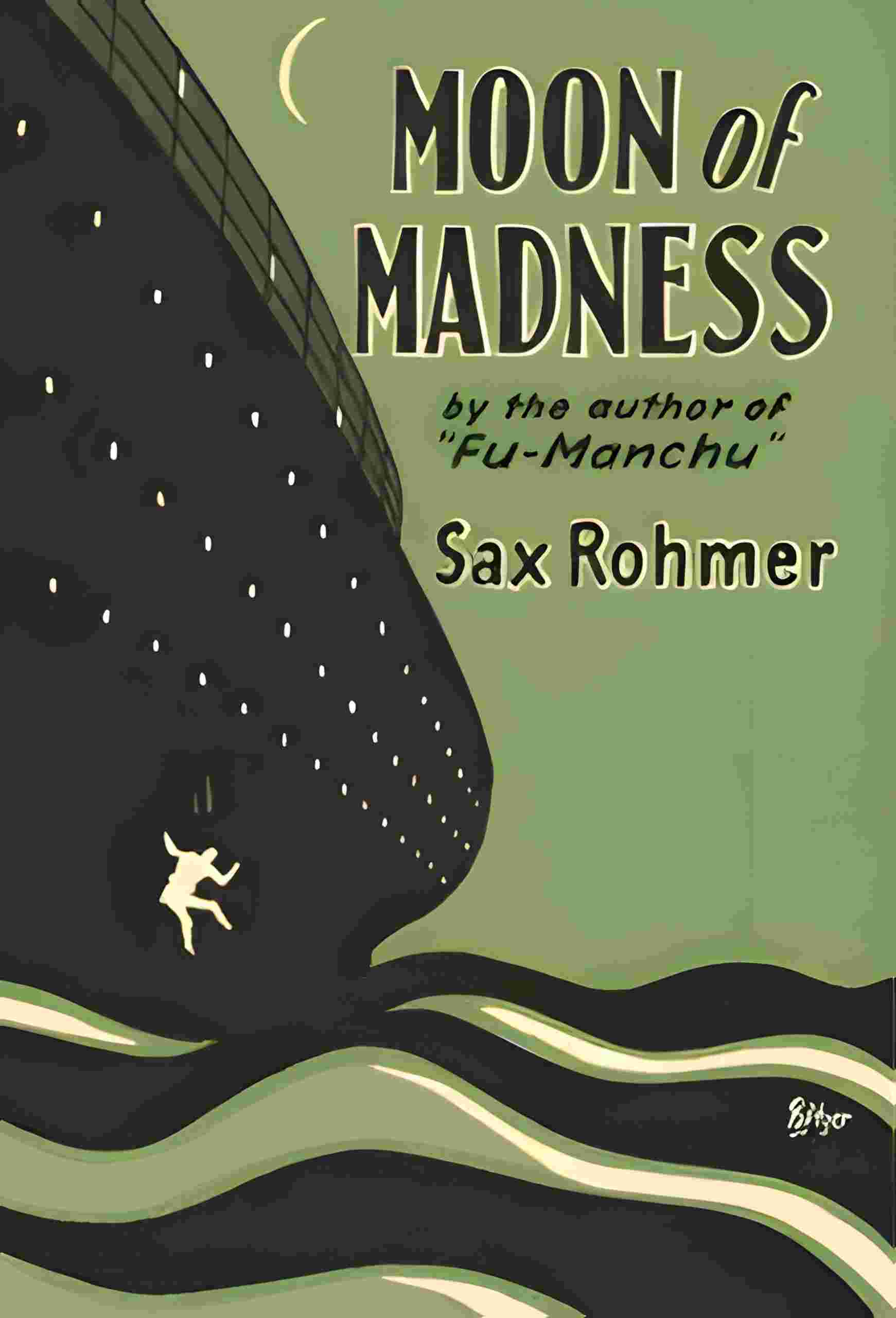
CHAPTER VII.
A SHORT NOTE
Wonderful to relate, we managed to keep secret the story of Nanette’s indiscretion. Her mother never knew that she had left her room. And it was toward dusk of the following day that the first act of the tragi-comedy came to a close.
To Ensleigh’s inquiries touching my disappearance from the dance, I had returned evasive replies. Jack kept his room, for good and sufficient reasons, and O’Shea had gone into the town early and had not come back. Nanette remained invisible.
For all the glory of the Madeiran sunshine and the wonder of the flowers, black depression sat heavily upon us.
I was lounging on the terrace at about six o’clock wondering what Nanette was doing and whether her mother suspected anything, when O’Shea suddenly walked out to me.
“Hello!” I cried. “I thought you had gone for good!”
“No,” he answered musingly, “not yet.”
He sank into a chair, as though dog weary.
“Had a hard day?” I asked.
“Fairly,” he replied; “but I’ve done my job. I suspect there are harder to come.” He paused, then: “Have you seen Nanette?” he asked.
“No,” I stared at him. “O’Shea, tell me if you resent my frankness—but that girl’s madly in love with you.”
“I don’t resent it, Decies,” he answered. “I know she thinks she is. But Nanette is very young. There is something you don’t know—that nobody else will ever know.”
I looked into the gray eyes. But they were not cold: they were on fire! I drew a sharp breath.
“O’Shea——” I began.
He nodded, and gripped my hand hard.
“Yes!” he said simply. “From the first moment I saw her. I daren’t trust myself to see her again. You understand? It’s quite impossible.”
“But why?”
“For many reasons. Thank God, she’s young enough to forget.”
There was a short silence, which is more memorable to me than many long conversations.
“What shall you do?” I asked.
He pointed across the bay.
Trailing a pennant of smoke in her wake, the greyhound shape of a destroyer raced for the harbour.
“I sail in an hour,” he answered. “I can take care of myself, Decies, but Nanette is of an age when a—silly attachment might spoil years of her life. So”—he took a letter from his pocket—“I have done a cruel thing. I have said what isn’t true—God knows it isn’t true! Her pride will do the rest. Will you give it to her—after I have gone?”
The promise was made. I thought of Nanette’s fresh young loveliness, which this man, who wanted her madly, might have taken as an unconditional gift. I thought of certain others I had met. I recalled that we moved in the year of freedom, 1927. And I wondered.
I have known some good Irishmen and some bad. But Edmond O’Shea would be a mighty fine advertisement for any race on earth.
Nanette came down to dinner, and I can never forget her expression when she saw O’Shea’s deserted table.
My task was going to be a hard one.
I took her out to the terrace afterward. Away on the distant horizon I could trace a faint wisp of smoke.
“Do you mean,” she said, and her voice had changed strangely, “that Major O’Shea—has gone?”
I looked at her, a sweet picture in the moonlight. And little Nanette had grown up. She watched me with a woman’s eyes.
I handed the note to her. She ran to the library window, tearing open the envelope as she went. I turned away and tried to trace the slender smoke trail fading, fading on a distant horizon.
A cry brought me sharply about.
Nanette stood before me, her eyes blazing, her face deathly white.
“Do you know what is in this?” she demanded.
“I do not, Nanette.”
And indeed I shall never know; but I know what it cost him to write it.
A moment she stood so, glaring at me. Then, frenziedly she began to tear the letter into tiny fragments, and:
“How dare he!” she cried. “Oh, God! how dare he!”
Whereupon she burst into such passionate sobs that it was agony to hear them. Dropping into a chair on the deserted terrace, she cried until my heart ached.
It was her first love, and a very big one. An O’Shea inspires nothing petty. But she had courage, and pride.
She conquered her weakness, and stood up.
“You are very kind, Mr. Decies,” she said. “I am sorry I made a fool of myself.”
Then she went in, walking very upright.
I spent a wretched evening, and when I retired to my room, sleep simply would not come. I got up, with an idea of smoking a pipe, but, first, I crossed to the open window. On a moon-dappled path below the terrace I espied a moving figure; and Burns’s words flashed through my mind: “The best-laid schemes o’ mice and men…”
Nanette was stealing among the flowers, collecting tiny fragments of the torn letter that a light evening breeze had blown from the terrace above. It was a hurt, an affront; but it was the only thing of his she had.
CHAPTER VIII.
THE CALL
“Telegram, sir!”
I sat up with a start. Morning sunlight flooded the large bare room. Wild canaries were singing outside my window. Slowly, facts began to assert themselves. I had been dreaming that I was taking tea at Stewarts with the Duchess of York and Mr. Tom Mann, when Trebitch Lincoln had appeared through a window, holding a bomb in his hand. Now, I realized that I had read news of all in a week-old Daily Mail recently; but that actually I was in bed at Reid’s Hotel, Funchal.
The radio message that the boy had brought up was crisp enough, but it effectually banished my drowsiness.
Please call on British consul at once. Vitally urgent. Am holding you to our bargain.
O’Shea.
A bargain based upon the survival of so old an institution as the British Empire is not lightly denied: I thought that perhaps my dreams had been prophetic. Nor was Edmond O’Shea the man to send such a message except under stress extraordinary.
As I hurriedly bathed, shaved, and dressed, I reviewed the position. There was O’Shea, homeward bound with a packet of letters whose publication would further Red anarchy a number of points. There was myself, George Decies, who in a neutral way had helped to secure these. There was Gabriel da Cunha, agent of the nightmare called Communism, nursing a broken jaw as a result of foregoing transactions. And there was Nanette.
Even as her name brought the dainty image to my mind, from under the open window came a soft call:
“Coo—oo!”
I crossed, struggling with an intractable tie; and there on the balcony below was Nanette.
To know that the most provocatively pretty girl one has ever met is madly in love with a better man and to behave sanely in her company is an acid test of what I have heard termed “British poise.”
She shaded her eyes with her hands, looking up at me. Her arms were a delicate brown colour on their outer curves where the sun had tanned them, and by comparison ivory white beneath. With a background of flowers against distant sea blue, Nanette made a picture exquisite to remember in old age but disturbing to a comparatively young bachelor. Temptation is sweet only when there is a chance of falling.
“What a horrid tie,” she said. “Please wear the gray one with silver stripes, as it’s our last day in Madeira.”
There was a wistful note in her appeal, and, looking down at little Nanette, slowly a memory came: I had worn that gray tie on the day we had met O’Shea.
I suppressed a sigh, “admirin’ how the world was made.” At eighteen, there are many things that even Miss 1927 doesn’t know. There was one that Nanette did not even suspect. There was another that I knew of; but this not my own secret. I was unselfish enough to wish I could tell her.
“Very well, Nanette,” I replied, and lingered, looking down.
“Are you going to swim this morning—for the last time?”
“No. I have to go into the town.”
“I don’t think I shall swim, then,” said Nanette. “May I come with you? Or is it a stag party?”
Before I could reply:
“Please remember your packing!” came a voice from below.
Nanette’s mother stepped out onto the balcony and looked up at me in mock severity. Seeing her, beside her daughter, I reflected that the lucky man who won Nanette would acquire a bride who would always be beautiful. “Consider well the mother of thy beloved,” says an Arab poet. “In her behold thy beloved-to-be.”
“Pop is doing his to-night,” Nanette protested.
I visualized “Pop,” sole occupant of the family table in the dining room, dealing with a solid English breakfast, regardless of flies, temperature, and the indifferent quality of the bacon.
“He has none to do, dear,” was the reply. “I do it for him.”
“But, darling,” Nanette wheedled, bobbed head pressed against her mother’s shoulder, “there are hours and hours. Please let me off.”
In the end she had her way, and we set out together along the dusty road. There would be disappointment this morning down at the bathing pool, I mused, peering aside at the piquant face shaded by a Japanese parasol. Nanette wore no hat, and I said to myself that if all the women who were bobbed had such shapely heads as Nanette’s, the world would be very beautiful.
“Did you tell Jack you were going?” I asked.
“No.” Nanette aroused herself from a reverie. “I forgot.”
Poor Jack! And he would have sold his Blue for a smile from Nanette.
The road to the town is very picturesque; and I might have counted George Decies a happy man had I not known that my charming companion loved to be with me only because I formed a link with her memories of someone else. Down the steep slope we walked, talking but little. An old roadmaker doffed his hat, smiled, and bade us good-morning. I sensed his kindly, appreciative glance following us. Funchal is famous for honeymoons.
Past the gardens of the Casino and the flower-cloaked balconies of villas we went. I forced myself to think of my real mission. Common sense whispered that I should have driven down in a fast car. Sense of duty demanded that I should conceal the nature of my business from Nanette.
“Shall you be long with the consul?” she asked.
“I don’t expect to be,” I replied.
“Then I will go along and have a simply perfect shawl I saw sent up to Mum,” said Nanette. “She won’t like it. But I love it.”
We were just about to turn into that steep and narrow street that leads to the square, when:
“Hi! hi! Hullo there!” we were hailed.
We turned. Bumping along in a sledge behind two sweating patient oxen, was Jack.
“Hullo, Jack,” said Nanette. “Mr. Decies has to see the consul and I’m going shopping. Want to come along?”
“Rather!” cried Jack. “Jump in.”
We proceeded to the consulate in the bullock cart, escorted by a battalion of flies with fixed bayonets.
“Meet you at the Golden Gate,” called Jack.
He was absurdly happy when I left him with Nanette and climbed the narrow stairs to the consul’s office.
The British consul was a quiet little official automaton who had buried his heart in somebody’s grave and had nothing left to hope for.
“Good-morning, Mr. Decies,” he said, and smiled rather sadly as I plumped an ornamental object down on the table.
“Good Lord!” said I.
It was Nanette’s handbag, a frivolous trifle from Paris, which she had asked me to take care of as we got into the bullock cart. I had been carrying it unconsciously.
“You are early,” the consul went on, “and I have not quite finished decoding a dispatch which I am instructed to deliver to you. The main point, however, is this: Major O’Shea arrives in Madeira to-morrow night, and——”
“Oh!” A faint cry interrupted him. “I’m so sorry——”
We both turned and looked up.
Nanette stood in the doorway, her blue eyes so widely opened as to convey an impression of fear.
“I came for my bag,” she said. “I didn’t mean to intrude.”
CHAPTER IX.
MOON OF MADNESS
Fifteen minutes later I was in possession of the facts—and faced with a problem.
“This chap Da Cunha,” said the consul, “isn’t Portuguese, in spite of his name. He’s some kind of what-not. He has the biggest radio outfit in the island up at his summer bungalow.”
“He’s a Communist agent.”
“I know,” the other returned quietly, “but it wasn’t my business to mention it first. He crashed in his car the other day and he’s dry-docked for repairs in a house he owns down here in the town. I know the surgeon who’s attending.”
I did not contradict him, for I was reading once again the body of the decoded message:
Arrive Funchal Harbour 2 A.M. Friday morning. Please meet me. Arrange for accommodation privately. No one must know. Letters have all been photographed. See Da Cunha does not slip away. Watch Arundel Castle. Try to learn if any associate of Da C. sails. Prevent if possible. I count on you.
O’Shea.
“Not a ship has cleared for European ports since Major O’Shea left,” said the consul. “So there’s a good chance.”
“He’s returning in the destroyer?”
“I don’t think so.” He glanced at a list of shipping. “Although this dispatch came from her. My idea is that they intercepted the Yeoward boat and put him on board. She’s due here at the time stated.”
“Devilish awkward,” I murmured. “It’s late to cancel my sailing. I’m booked in the Arundel Castle.”
“I’ll step across to Blandy’s with you,” said the consul, standing up and reaching for his hat. “We can get you transferred to a later boat. Leave the finding of private accommodation to me, too.”
“Do you know of any one associated with Da Cunha?”
“No. Da Cunha has property in Madeira, but he’s rarely here. Nearly all I know about him I have learned officially.”
We settled our business at the Union Castle agent’s, thanks to consular aid, and, the morning growing insufferably hot, my friend agreed that something icy through a straw was indicated. When we arrived at the Golden Gate this theory proved to be popular. A party from Reid’s that included Nanette’s mother had arrived, and Jack was sharing Nanette with a stranger whose ancestors had known more about how the Pyramid was built than you or I can ever hope to learn.
He reminded me of my London stockbroker until he was introduced as Macalister. He had a real-estate smile that was not unattractive, and my first, natural impression was that he had recently purchased the island from the Portuguese and was running his eye over the property. Presently, however:
“And how is our friend, Gabriel?” Nanette asked. Then, turning to me: “I met Mr. Macalister with Gabriel da Cunha,” she explained.
I forget how Macalister replied, for I was exchanging significant glances with the consul. A few moments later that competent official took the floor.
“So you are leaving Madeira, Mr. Macalister?” he asked.
“No,” the other replied, sharing an appreciative look between the cigar that he had just lighted and Nanette. “I had hoped to sail in the Arundel Castle, but I have been delayed.”
The consul put several more leading questions to Macalister, in a chatty way, but I rather lost track of the conversation. Nanette was in a mood of feverish animation, which I knew, from experience, meant mischief. The party had been over to Blandy’s apparently, and had learned that accommodation in the Arundel Castle was limited. Nanette and Jack talked happy nonsense about camping out in boats and what not. Then I made an announcement.
“Somebody is lucky,” I said. “My berth will be vacant.”
This statement was received with gratifying consternation.
“You surely can’t mean that you are not coming with us?” Nanette’s mother exclaimed.
Two pairs of eyes I particularly noted at this moment—the heavy-lidded brown eyes of Mr. Macalister and the wide-open blue eyes of Nanette.
“Unhappily, yes,” I replied. “Unfortunate, very; but I must wait for the Royal Mail boat.”
There was a sort of farewell dance at Reid’s that night. Quite a number of people were leaving in the Arundel. Nanette persistently avoided me; and I doubled-up with Jack in a scowling competition having for target Mr. Julian Macalister, who had dropped in after dinner and monopolized Nanette.
Once, pausing near me:
“Do you know what they call the crescent moon here?” she asked.
“No.”
“Moon of Madness.”
She laughed and danced on. Jack scowled. I wondered.
At the cocktail bar, during an interval, things bordered on the hectic. I have been honoured in the friendship of some of Mr. Macalister’s race who were very courtly gentlemen. Mr. Macalister was not as one of these.
“Don’t look so gloomy, my lad,” he said to Jack. “It takes a man of experience to please a young girl.”
Jack had boxed for his college and was no mean craftsman. I rapidly took in the powerful but fleshy form of Macalister and prepared to mourn his passing. He smiled confidently; but one could have got roughly about the same odds on a peanut in a monkey-house, when:
“Mr. Decies!” said someone at my elbow.
Jack was just descending in a leisurely way from his tall stool. He paused as I turned. The British consul stood behind us.
“A word in private,” said he.
I grabbed Jack’s arm.
“Come along, too,” I urged.
He hesitated, then:
“Perhaps you’re right,” came with manifest reluctance.
We walked out into the lounge; and the consul handed me a scribbled note.
“Received in code to-night,” he explained.
Detain Julian Macalister at any cost.
Jack had left us, going to look for Nanette, and:
“From O’Shea?” I asked.
“No. From Scotland Yard!”
“But he’s not sailing!”
The consul met my gaze of inquiry.
“That radio set of Da Cunha’s is very well informed,” he said. “Macalister knew of this move before I did. He only cancelled to-day.”
CHAPTER X.
THE ARUNDEL CASTLE SAILS
I cannot pretend that I was a happy man as I climbed the ladder of the Arundel Castle on the following morning. All my friends were leaving, and the affection and admiration that I had for Edmond O’Shea could not recompense me for their loss. My only consolation lay in the knowledge that, unhonoured and unsung though I should be, yet, in a modest way, I was doing my job of work toward saving Great Britain from the Reds.
An inward-bound liner, by the time she makes Madeira, offers a ripe crop of studies to the psychologist. The gay Conrads, who have learned the truth of Leonard Merrick’s unmoral dictum, “a man is young as often as he falls in love.” The anxious-eyed women who have lost what their men have found. A score of flirtations and two or three intrigues, followed with interest by the midnight watch and reported in routine to the purser. The odd men out, too, are always rather pathetic. It was wonderful how many lonely eyes lighted up when Nanette stepped on to the deck. Even some of the Conrads prepared to change their minds.
Baggage was missing, of course. Nanette’s mother had lost a wardrobe trunk, nothing less.
“Don’t worry,” said Nanette’s father, in his imperturbable way. “It will turn up.”
“It will be Nan’s turn to worry,” was the reply. “All her things are in it!”
Nanette, the irresponsible, had disappeared with Jack in quest of her new quarters. She professed to be the victim of a dreadful theory that her stable companion was an elderly Boer lady with gout.
Coffee-coloured boys were diving off the boat-deck; vendors of lace shouted themselves hoarse from a flotilla of small craft that clung to the steamer like wasps to a honey-pot; Portuguese lightermen shrieked amiable execrations at one another; nobody could find the missing trunk, nobody could find Nanette; Nanette’s father said both would turn up—and the Bay of Funchal embraced it all with peaceful beauty.
When the last shore-signal was sounded, I found Jack beside me. He was plainly in a panic.
“Here, I say,” he exclaimed. “I thought Nanette was with you!”
“And I thought she was with you!”
“When did you see her last?”
“When she went to look for her cabin.”
“But she came back to fetch you!”
“She didn’t arrive.”
“Hurry up, please,” urged the officer on the gangway. “You’re last for the shore, sir.”
Jack turned and ran in at the saloon entrance. I could see no one else I knew; so there was nothing for it but to tumble down the ladder. Reid’s launch had gone, and I took the boat in which some customs people, office men, and others were going ashore.
They had turned steam on to the anchor and the ladder was swinging up as we drew away. I stood in the boat, searching the decks far above me, their rails lined with unfamiliar faces. From the white-capped, gold-laced officers on the bridge, I worked down, deck by deck. I caught a momentary glimpse of some folks I knew and waved automatically; but of Nanette’s party I could see nothing.
Then sounded faintly a bell. Straggling boats seemed to be drawn astern of the liner by some powerful current. There was movement in the placid water; a swell rocked us. One could see the churning of the screw in clear blue sea. Renewed waving—and the Arundel Castle was homeward bound for Southampton, with mails, mixed cargo, several potential weddings, and a broken heart or so.
As I stepped from the boat on to the stone stairs and went up to the jetty, I paused, looking back. I was shortly to meet Edmond O’Shea, and the thought was pleasurable, but I would have given much to have been aboard the liner now headed for the open sea.
I walked up the tree-lined street, sighing when I passed the shop where Nanette had found that wonderful shawl. The square, you may recall, is planted with those trees that flourish principally in South Africa and bear a light blue blossom. In the sunshine of early morning it seemed to me that all the streets were dim with an azure born of the flowers.
Only two tables had been placed outside the Golden Gate. At one of them a girl was seated, her elbows on the table, her chin propped upon clenched hands. She stirred slightly, and I saw the sunlight gleaming in her hair.…
I stood stock still. Then I began to run.
Nanette looked up.
She was pale. Her widely opened eyes were the colour of those flowers—misty blue. And they said, “I am afraid. I am ashamed. Don’t be angry with me.”
“Nanette!” I whispered.
She bit her lip and turned her head aside quickly; then:
“I was mad to do it,” she confessed. “I am sorry—now. Please send a message to the ship. They will be frantic.”
“But—your things? You will have to wait for a whole week.”
“They are in the small wardrobe trunk. I bribed Pedro to leave it behind. Oh, please, Mr. Decies!” She clutched my arm and I felt how she trembled. “Look after me. I am so frightened.”
CHAPTER XI.
THE PHOTOGRAPHS
The S.S. Aguila of Messrs. Yeoward Brothers dropped her anchor on to the rocky bottom of Funchal Harbour at fifteen minutes after two A.M. under a perfect moon like the crescent of Islam; a true Moon of Madness.
They had the ladder down in a trice, and my boat drew alongside. I ran up to the deck—and there was Edmond O’Shea in a white drill suit, more like John Barrymore than ever with the moonlight gleaming on his wavy hair.
We shook hands in silence, whilst his searching gray eyes looked into mine and mine told him all that I was helpless to conceal. Then:
“It was good of you, Decies,” he said. “My message has put you out?”
“I had booked in the Arundel; but it didn’t matter. My time is my own.”
Indeed, already the spell of The O’Shea was on me. There are many names honoured in connection with the Grand Parade, but ask one of the men who knows what happened on the Retreat when Smith Dorrien sent for O’Shea; a company commander then, and only a major now. We all won the war, according to our own accounts; the old Irish Guards—what’s left of them—would convince you that Edmond O’Shea helped us.
“What has happened?” I asked him.
He gave me the facts, whilst we enjoyed the hospitality of the captain who was delighted to have been instrumental in helping so distinguished a passenger.
“The original letters are safe in Whitehall, Decies. But I found pinholes showing where they had been stuck on a board—obviously to be photographed! We sent a radio to Captain McPhee here, and I doubled back. The mails will be watched at Southampton; but I don’t fear the mails. Some trusted agent will carry the photographs. I wired headquarters for likely birds.”
“Scotland Yard replied,” said I. “One, Julian Macalister, is under surveillance.”
O’Shea’s cold eyes fixed me.
“Who’s watching him?” he asked.
This brought me to it, and I gulped a quick drink before replying:
“Nanette.”
His expression changed; then:
“So they are still here?” he said.
“She is still here.”
The captain excused himself gracefully, on a plea of duty; and I told O’Shea.
“You think she overheard you in the consul’s office?”
“I know she did. She admitted it.”
“And so you told her—the rest?”
“Was I wrong?”
O’Shea stood up and paced the room a couple of times; then:
“I don’t know,” said he. “Let’s go ashore.”
Fate has playfully set me in some queer situations, but I can recall none stranger than that in which I found myself now. O’Shea, occupying a room in the consul’s house, and engaged in private consultations with the military governor and others; Nanette, studiously declining to meet him—although his return to Funchal was the reason of her being there; Da Cunha, incapacitated, and only able to act through Macalister; the latter gentleman dancing attendance on Nanette.
“He doesn’t know that I know anything,” she said to me. “And he doesn’t know that Major O’Shea is here.”
We were taking tea on the terrace of Reid’s; the adorably pretty girl who had “missed the boat” and my innocent self subjects of much inaccurate speculation. Two frantic radios had been brought out to Nanette: one from her mother and one from Jack.
“Please answer them for me,” was all she had said.
“Nanette!” I looked into the childish blue eyes, in which, when O’Shea was mentioned, I had seen the woman-light shine. “I feel responsible for you. In playing with a dangerous man like Macalister you take risks which you don’t understand.”
“I’m going to find out where the photographs are!”
“Because of—O’Shea?”
She looked at me bravely.
“No,” she lied—yet did not know she lied. “Because Major O’Shea insulted my intelligence. I am going to find out for my own sake.”
I dined with O’Shea in the town that night. He was frantically worried. That Macalister was the man to whom the task had been assigned of getting the photographs to Red headquarters he could not doubt. But where were they? And how did Macalister propose to smuggle them through?
“Where is Nanette?” he asked suddenly.
“Dining with Macalister at Reid’s.”
“Damn!” said O’Shea; then: “Go back and look after her,” he begged. “I can’t stand it, Decies. You shouldn’t leave her.”
“She dismissed me!”
“Report yourself for duty. ’Phone me here.”
I arrived at the hotel fifteen minutes later. The hall porter handed me a note as I ran in. I tore the envelope open in a sort of frenzy. This was the message:
Photographs are on board a motor cruiser belonging to Gabriel da Cunha. I can’t find out where it is. But Macalister goes in it to-morrow morning to Las Palmas and from there by steamer to England. Have gone with him to the Casino. Will keep him as long as possible. Can’t do any more.
Nanette.
When I ’phoned to O’Shea, I heard him groan.
“Send someone from the hotel to stand by her,” he said; or, rather, it was an order. “I can find out where Da Cunha’s boat lies by using the military wires. It’s hell, Decies, but I daren’t take chances. Join me here. But make sure she is safe.”
CHAPTER XII.
THE MOTOR CRUISER
The governor’s car, a Cadillac—tribute to the far-flung efficiency of American salesmanship—was driven by the chauffeur over what I took to be the edge of a sheer precipice. I inhaled noisily. Then we were gliding down a cobbled road that, serpentine, embraced a fairy port.
Nestling in a cleft, a volcanic chasm, its terraced roofs silvered by the crescent moon, lay a town asleep. Patches of colour, as though a Titan artist had thrown uncleaned palettes into the hollow, crowded upon and overlay the white walls. Green fronds peeped above pools of shadow. A beautiful auditorium, this town looked down upon the eternal drama of the sea.
O’Shea spoke to the chauffeur in Portuguese. His command of unpronounceable languages was not the least of his acquirements. The powerful brakes were applied and our switchback descent ceased.
We proceeded on foot.
Where a low stone wall prevented the traveller from falling through the roof of a villa some twenty feet below, O’Shea pulled up, grasped my arm, and pointed.
Displaying her graceful, creamy shape like a courtesan stretched upon blue velvet, a fine-lined motor boat rode in the tiny harbour. Lights shone out from her cabin ports. O’Shea unbuttoned the coat that he wore over dinner kit and began to twirl his monocle to and fro upon its black ribbon about an extended finger.
“There is Da Cunha’s boat,” said he; “and there, no doubt, is what we are after. But it looks——”
“As though Nanette had failed to keep Macalister?”
O’Shea turned to me, and his eyes gleamed very coldly in the moonlight.
“Decies,” he said, “you remind me of an unpleasant truth: that if I succeed in this matter I shall be indebted to a girl.”
“She will have done a big thing for England.”
“I don’t begrudge her that. It would hurt me to think she had done it for me.”
For a moment I hesitated; then:
“I think she knows it,” I ventured, “and wants to hurt you.”
“Why?”
“Because you hurt her.”
He stared very fixedly out over the harbour for some moments, but he did not seem to have taken offence. At last:
“If I had married very young, Decies,” he said, “and God had been good to me, I might have had a daughter like Nanette. Even if there were no other reason, shouldn’t I be a blackguard to think of her except as a wilful child?”
But I could find no answer. This man’s codes were beyond me. Young though he was in the days of the Big Push, he had won a name that had outlasted those of a score of general officers and more than one field marshal. The fact came home to me and brought with it a great humility, that I was not of the stuff that histories are made of.
“Suppose we go and look for a boat,” I said.
O’Shea aroused himself—for he had his dreams even as you and I.
“A boat it is,” said he. “As I have no official status whatever, there’s nothing for it but frank piracy. Are you game?”
“Every time.”
We went on down the sloping cobbled street. Presently it led us through the heart of the little town, where shuttered windows told of citizens asleep and only a zealous dog broke the silence. This until, as we were about to come out on the water front, from a high balcony stole the strains of a guitar.
O’Shea paused, looking up. A dim light might be discerned. He glanced at me, smiled, and we passed on. Love is an art with the Southerners.
I have wondered since, reviewing that journey, during which both our minds, I think, were busied with plans for boarding the motor boat and securing the incriminating photographs, that no premonition touched me. “Nanette had failed to keep Macalister,” I had said, noting the lighted cabin. Yet Nanette had dared to slip away from the Arundel Castle and to remain alone in Funchal. I should have known my Nanette.
Drawn up beside a quay, a red blotch in the moonlight, was a long-nosed French car.
“Da Cunha’s Farman,” I exclaimed. “Macalister is on board.”
But O’Shea did not reply. He was starting out in the direction of the lighted craft, a thirty-eight-foot motor cruiser, very handy in smooth water but a dirty brute, I thought, in a choppy sea. Then:
“I am wondering,” he murmured.
“What?”
“Why he is lying out there and not alongside? There is no boat at the stair.”
At first, the full significance of his remark missed me. My concern was with the problem of how we were to find transport. Then, something in the quality of that fixed stare with which my companion watched the lighted ports, his poise, as if listening, prepared me for what was to come.
The tones of a coarse voice, raised hilariously, reached my ears, coming from the cruiser’s cabin. A trill of laughter followed, youthful, musical. My heart missed a beat. I clutched O’Shea’s arm.
“My God!” I said, “he has Nanette with him!”
Involuntarily, my gaze went upward, to where in cold serenity the Moon of Madness raised her crescent lamp.
O’Shea from the pocket of his light coat took a revolver. He placed it in his soft hat and crammed the hat tightly on his head. He began to peel his dinner jacket.
“I’m going for a swim,” said he. “Coming?”
But he was not alone in the idea. Before I could frame any reply came sounds of loud laughter, a scuffling of feet—and I saw Nanette run out on to the after-deck. She wore a blue-and-silver dance frock. I heard Macalister call to her and I heard her laughing answer; but I could not distinguish a word.
I saw her raise her arms as though to unfasten the string of beads about her neck. She stooped swiftly, stood upright again—and Macalister was beside her.
There was a shrill cry—half laughter, half hysteria. Nanette disappeared in the shadow of the awning. I heard the man’s voice, his heavy tread.…
Nanette reappeared at the bow of the boat.
Heroism is always beautiful, whether it spring from love of country or love of man. The dance frock had vanished, shed like the sheath of a chrysalis when the moth is born. A silver moon-goddess stood at the prow. She stooped, once, twice—I thought to discard her shoes. Then, as Macalister came stumbling forward, Nanette dived almost soundlessly into the still blue sea.
And Nanette could swim like a seal.
Macalister craned over the side. For one moment I think he contemplated following. Then the bobbed head came up two lengths away. Behind the swimmer, on a tow-line of beads, floated a flat, square portfolio.
I glanced once at O’Shea—and that man of action was stricken to stone. Fists clenched, he stood, watching a girl of eighteen doing the work he had come to do—and doing it for him.
Macalister was hauling in his anchor. The motor started with a roar. Then Nanette saw us. She was halfway to the shore.
“Please throw one of the rugs on the steps,” came gaspingly. “And go away! Start the car up!”
When, a few minutes later, a very wet Nanette, wrapped in a light top coat, confronted O’Shea, I don’t know quite what happened.
“There are your photographs,” I heard her say. “If I never see you again, at least think I was not such a fool as you supposed.”
With all her dear bravado, she could not still the trembling of her voice. I saw O’Shea’s pale face, and turned aside. That meeting was one I can never forget. Yet the details will always be hazy.
Macalister was in the picture somewhere. I think I knocked him down. I don’t remember why. But I fancy it was not because of any attempt to recover the portfolio but because he grossly misunderstood the situation.
Then, I recall, O’Shea stooped, lifted Nanette, and walked up the sloping cobbled street under a smiling moon. He had suffered as only the few can suffer, to make her forget him. His sacrifice had been rejected by the Great Goddess.
Once, Nanette peeped up at him swiftly. I saw her eyes. Then she hid her face against his shoulder. I think Nanette was crying. But I know Nanette was happy.
CHAPTER XIII.
THE GRASS ORPHAN
“Public men should never indulge in private correspondence,” said O’Shea. “Such indiscretions sometimes lead to war. I understand that all Napoleon’s social engagements were made by proxy.”
He turned toward me, his arm resting on the rail of the balcony. There were times when O’Shea looked extraordinarily handsome. To-day, I thought he appeared almost haggard. In his spruce white suit with Madeiran sunlight making play in the waves of his hair, he had all that curious atmosphere of romance that made him attractive to women and unpopular with men who knew no better. But his eyes were tragically tired.
I saw him glance at a square portfolio that lay upon the table in the shadows of my room.
“Six photographic negatives,” he went on musingly, “and twelve prints—as all the letters photographed ran to more than one page. It’s odd to reflect, Decies, that these scraps of film and paper might light a bonfire big enough to burn up a whole Empire.”
Odd indeed; yet I knew it to be true. For that relentless loom which the Arabs call Kismet had drawn me into the pattern of this human carpet woven of anarchy, love, sacrifice, and God knows what other threads. I knew; therefore:
“Why not destroy them?” said I.
O’Shea shook his head.
“My instructions are to deliver them intact to headquarters,” he replied.
“Are you returning in the Royal Mail boat?”
“No. They are sending for me.”
“Lodge them in the bank, then.”
“Contrary to instructions, Decies. They must remain in my charge.”
I met the fixed stare of his cold gray eyes.
“In which respect,” said I, “your instructions resemble mine.”
“And do honour to both of us,” he added.
I lighted a cigarette, smiling perhaps a trifle wryly. When a wayward beauty of eighteen deliberately misses the boat home and her parents radio an eligible bachelor that they hold him responsible for her safety, one sits up and takes notice. Traditional English phlegm is called upon to do its best.
On the terrace above the bathing pool, a band was playing jazz. Below my windows a multi-coloured cascade of flowers poured down, wave upon wave, to meet the deep blue ocean. Sounds of laughter came floating up. Little yellow birds darting gaily from palm to palm appeared to find life a thing of song. I wondered. Was it Abraham Lincoln who confessed that he could mould men but not circumstance?
“It seems absurd,” said O’Shea, breaking a long silence. “But do you know what I was thinking?”
“No.”
“That, after all, Madeira is a very lonely island.”
He stared at me fixedly, until:
“What do you mean exactly?” I asked.
“Decies,” he said, “the Reds have had a nasty set-back in England. But there’s propaganda there”—he pointed to the portfolio—“for which Moscow would pay a substantial fortune. They have forty-eight hours to act.”
“But only two agents in the island—one out of the ring.”
“Gabriel da Cunha has a mysterious radio set in his bungalow. He will be in touch with his chief—and his chief is a dangerously clever man.”
The official records of the Irish Guards afford sufficient credentials for the courage of Major Edmond O’Shea. He was watching me with that close regard which seemed to concern itself with one’s subconscious self, so pointedly did it penetrate; and, rather fatuously:
“You are surely not nervous about your charge?” I queried.
He continued to watch me for a moment, then:
“No,” he replied, and his expression grew abstracted. “Oddly enough, I was thinking of yours.”
He turned aside, toying with the black-rimmed monocle that he rarely wore unless he were annoyed. At the Guards’ depot in Essex it used to be said that the appearance on parade of O’Shea wearing his monocle made bayonets rattle.
Precisely what he had in mind I found myself at a loss to imagine, and before I had time to ask:
“Please, are you at home?” cried a voice from below.
I crossed to my balcony and looked down.
Nanette stood on the terrace. The sunshine made a glory of her tousled head as she laughed up at me. A stout German seated near by in a cane lounge-chair found his attention engrossed by the unashamed beauty of a pair of slim legs that had suddenly interfered with his view of the bay. They were delicately sunburned to the knees, which—the brevity of modern frocks and a habit of going stockingless had forced me to learn—were dimpled. One suspects that Cleopatra had dimpled knees.
“Yes, Nanette,” said I. “Where have you been?”
“Bathing. You should know that, Mr. Decies. You are sadly neglecting your grass orphan!”
She looked very lovely. The German tourist raised envious eyes to my balcony, their envy magnified by heavily rimmed goggles.
“Please come down and join the party.”
“Very well, Nanette,” I answered.
But when I turned back and reëntered my room, O’Shea and the portfolio were gone. And I knew that little Nanette would be disappointed.
Presently, side by side, we walked down a shady path strewn with fallen hibiscus blossom. Nanette was very silent. An American training ship manned by naval cadets lay in the bay, and, at a bend in the path, Nanette paused. She stared out at the little vessel—“a painted ship upon a painted sea.”
“One of the boys from the cadet ship is with our party,” she said. “He’s nice. I have promised to dance with him to-night. He’s from Boston,” she added.
“Has he got late shore leave then?” I asked.
“No,” Nanette answered in a dreamy voice, moving on. “I don’t think so. He just wants to stop. They are going to the Azores from here. Where is—or are—the Azores?”
“Quite a long way,” I answered vaguely; for Nanette really didn’t want to know.
There was small envy in my heart regarding the cadet from Boston. He was being used as a diversion by a distractingly pretty girl whose heart was not in the game. However, it is the mission of youth to learn, and the poor fellow would “learn about women from her.”
I met him in due course. He was being lionized by a group seated around a table beneath a gay umbrella that cast pleasing shadows.
Nanette unblushingly monopolized him, and his joy was ghastly to behold. He would cheerfully have deserted his ship for her.
The sister of the British consul, who was acting as a sort of official chaperone to our grass orphan, kept throwing appealing looks in my direction. But I was helpless, and I knew it. A hundred times Nanette’s glance sought the steps. And if only O’Shea had joined us, the eyes of the infatuated young man from Boston might have been opened before he doomed himself to cells for a siren’s smile.
But O’Shea did not join us.
When I drifted down to dinner that evening, I missed him. I waited in the cocktail bar in vain. Nanette peeped in, too. At last, there was nothing for it but to dine alone. And constantly the blue eyes of Nanette, who had been “adopted” by a charming couple from the North Country, were turned in my direction. Always she smiled—but only to hide her disappointment.
The cadet blew along in due course, flushed with excitement, and was greeted by a very composed Nanette. Accompanied by her temporary “parents,” she bore the young man away to the Casino.
I made up my mind to walk down later. But I was largely concerned with the absence of O’Shea. I hung about until after nine o’clock and was prepared to go out, when I saw him crossing the lounge. He beckoned to me, and:
“They are not idle, Decies,” he said. “Da Cunha’s radio has been busy.”
“Have you picked anything up?”
“No. Conditions in the town are bad. But there’s something afoot.”
“Short of burglary, what can they do?”
He stared at me vacantly; then:
“I don’t know,” he confessed.
But we were to learn—and very soon.
A disturbance in the lobby proclaimed itself.
“What’s the trouble?” said I.
Even as I spoke, the worthy man from Lancashire, whose wife had taken Nanette under her wing, came hurrying in. He was pale.
“My God! Decies,” he exclaimed. “Did you send a car to the Casino for Nanette?”
“No!” I replied blankly.
“Damn it! I suspected there was something wrong!”
“Quick!” said O’Shea. “What has happened?”
The other spoke very breathlessly.
“Someone brought her a message—from you, Mr. Decies. She ran out without a word. Young Clayton, the cadet, ran after her.”
“Well?” O’Shea urged.
“When I got to the door, they told me that both had driven off in a car that was waiting by the gate.”
“Did anyone actually see this car?” O’Shea demanded.
“No. It stood out in the roadway.”
“Then who brought the message?”
“A boy idling at the gate.”
“You questioned him?”
“Closely,” replied the man from Lancashire. “He did not know the chauffeur and only had a glimpse of the car.”
“But I don’t understand,” said I dazedly.
“I followed,” the hoarse voice went on, “but just this side of the bridge, where it’s so lonely and dark at night, I nearly ran over Clayton! He was insensible. He’s out in the hallway now! Nanette—has disappeared!”
Very deliberately, O’Shea adjusted his monocle.
“Decies,” he said coldly, “why, in God’s name, didn’t you stick to your post?”
CHAPTER XIV.
THE PORTFOLIO
Born leaders of men do not achieve leadership; men force it upon them. Here was a panic-stricken group, soon augmented by the manager and a doctor who chanced to be in the hotel. One was for communicating with the police; another urged the military; all were anxious to enlarge the news.
We were in a room on the right of the entrance, the medical man bending over an insensible cadet. O’Shea quietly closed the door. And I have since remembered how instinctively we all turned and faced him.
“Doctor,” he said, “how soon will he recover?”
The Portuguese physician shook his head.
“Do not count upon him,” he answered gravely. “A tremendous blow on the back of his skull. I cannot examine him properly here. He must be taken at once to the hospital.”
“An accident?”
“But certainly, no! Foul play. Some blunt weapon. I suspect a sandbag.”
“Shall I telephone the police?” the manager asked.
“No,” said O’Shea. “Get young Clayton away as quickly as possible. Gentlemen”—he included us all in a comprehensive glance—“let us keep this affair to ourselves.”
“What!” I cried.
But indeed, beyond that one word I could not go. Inertia at such a time astounded me.
“There is a well-known policy of war,” O’Shea went on: “Masterly inactivity. We have no Service de Sûreté and no Scotland Yard in Madeira. A clumsy hue and cry could serve no better purpose than to drive the enemy into some more remote hiding place.”
“But, Nanette!” I burst out.
Then I met O’Shea’s glance. I noted the grim set of his jaw. I saw how pale he was.
“Your remark was rather unnecessary, Decies,” he said. “I recently pointed out to you that Madeira is a very lonely island. If you can suggest any plan for locating the whereabouts of Nanette, do so.”
Then I understood. And I think I groaned.
“There are so many roads they might have taken,” the manager explained. “And what means have we of tracing the car? There are no traffic police in Madeira. Such a thing has never happened here before. Certainly not in my time.”
“What villain has done it?” came in agonized North Country dialect. “Oh, the poor little lass!”
“Madeiran blood runs very hot,” said the physician.
“No doubt,” O’Shea agreed. “And Nanette is a lovely child. But do you believe there is any one amongst her acquaintances mad enough to commit such an outrage?”
“Why do you say ‘amongst her acquaintances’?” I asked stupidly.
“Because your name was used to induce her to go,” O’Shea answered. “Ultimately, she must be found. Her abductor knows this. Therefore he is prepared to make terms.”
Came a rap on the door.
“Yes?” said the manager.
A hall porter appeared. Major O’Shea was wanted on the telephone. As he went out:
“Come to my room in five minutes, Decies,” he directed.
The five minutes that followed form a blur in my memory. There were hushed voices. There was movement; a still figure being carried through the hall to where a car waited out in the scented darkness. Someone kept saying, “We must do something. We must do something,” over and over again. There was a woman who sobbed with a Lancashire accent.
Then I stood in O’Shea’s room. He was seated on the side of the bed.
“I was right,” he said. “It’s a move in the Red game!”
“What!”
My wild, distorted ideas were tumbled over one another by that statement. They fought in my brain, seeking fresh formation.
“I knew that if my theory were sound they would waste no time. That was Julian Macalister on the ’phone. It’s the photographs they’re after, Decies!”
Whereupon: “Thank God!” I exclaimed.
O’Shea raised his eyes to me.
“I forgive you,” he said softly, “for preferring my ruin to Nanette’s.”
Certainly the swift tragedy of the last half hour must have numbed my brain. O’Shea had watched me, not angrily, for several moments before the full meaning of his words gripped my mind.
I dropped into an armchair.
Gabriel da Cunha and Julian Macalister, Communist agents, had triumphed at the eleventh hour!
“My special duties as a secret service officer end to-night.” It was O’Shea who spoke, but his voice seemed to come hollowly from a great distance. “My resignation from the regiment must follow.”
I spoke never a word.
“There is just one thing, Decies, you can do.”
Then I roused myself. I looked eagerly at O’Shea. I think, in that dark hour, I would have crawled through the hottest alleyways of hell to save him. “Why, in God’s name, didn’t you stick to your post?” Those words of his would sound in my ears for many a long day to come.
“You can enable me to resign,” he went on. “It would be preferable to being gazetted: ‘The King having no further use for this officer’s services.’ ”
“Anything,” I said. “I will do anything.”
A party of serenaders, playing gently on guitars and singing a languorous love-song, passed along the road below. Their voices mingled in perfect harmony. A sea breeze bore perfume into the room. And I thought that this soft island, set like a jewel above the brow of Africa, might once have been the home of Calypso, stealing men’s senses.
“It may seem mere splitting of hairs,” O’Shea went on. “But it serves my purpose, and so I ask you to do it.”
He took up the precious portfolio, which lay upon the bed beside him.
“I forced the lock last night,” he said, “but had it repaired and fitted with a key in the town this morning. I removed the seals intact and replaced them. Here is the key.” He held it out upon his open palm. “Take it.”
I took it, wondering and waiting.
“Now take the portfolio,” said he. “You will find it is locked. Hide it where you please. But its security means everything to me, to Nanette, and to England.”
“You mean,” I began, “that I——”
“I mean,” O’Shea took me up, “that you may pay this price to ransom her. I cannot. You have sworn no oath of allegiance to the Crown. I have.”
“Good God!” I cried. “The decision is to rest with me!”
“As a private citizen you can choose between the claims of your country, in this very difficult matter, and the claims of a helpless girl who has been given into your charge. As an officer, I have no choice.”
He spoke in a low, monotonous voice. But I shall remember every word of his instructions whilst memory lasts.
“You must not tell me where it is concealed. It should be in some place, though, that is quickly accessible.”
“But, O’Shea! Are they sending someone to make terms?”
“They are. At eleven o’clock to-night.”
“Why not have him arrested?”
O’Shea stared at me, and smiled. But it was a cold smile.
“Julian Macalister is coming in person,” he replied. “News of this unfortunate occurrence having reached him and our mutual friend, Gabriel da Cunha, both are anxious to place their extensive knowledge of the island at our disposal. On what charge should you propose to arrest Macalister?”
“Directly he declares his real object, upon a triple charge of blackmail, abduction, and attempted murder!”
“And then?”
“Well, surely——”
“My dear fellow!” O’Shea stood up and sighed wearily. “Racks and boiling oil would never be sanctioned by the civil governor. Personally, I should prescribe them.”
I was silenced. O’Shea was right.
“Under Portuguese law the case would take weeks,” he added. “It would be adjourned to Lisbon. No. We cannot leave her in unknown hands——”
He turned, the sentence unfinished, and walked across to the balcony.
I knew that if she had never met Edmond O’Shea little Nanette would have been safe in England that night. And I knew that he knew.
Taking up the portfolio, I went out, closing the door very quietly.
CHAPTER XV.
TERMS WITH THE ENEMY
I had noted a loose floor board in my room. With the aid of a knife blade, I succeeded in lifting it, revealing a dusty cavity. Here I hid the portfolio. I replaced the board and slipped the key on to my ring with others that I habitually carried.
That I was destined to be present at the interview with Macalister, I foresaw clearly enough. How best to prepare myself it was not easy to determine. Primarily I had to focus upon keeping my temper. O’Shea plainly wanted to be alone.
I looked into the cocktail bar. Two men whom I knew were drinking highballs, and:
“Hullo, Decies,” said one, “what’s this crazy rumour about your little friend?”
The words offended me. I suppose I was in a mood for it. Since the fateful morning that Nanette had missed the boat, many questionable glances had been cast upon me.
“It’s what you say,” I answered shortly: “a crazy rumour.”
Then I went out.
I crossed the lobby and stood in the porch for a while, breathing the warm perfume of the gardens. A man and a girl were walking down the slope toward the terraces. He had his arm about her waist.
The open road called to me. Lighting my pipe, I set out. Drivers of bullock carts solicited my patronage, but I ignored them and walked on. I had no idea where I was going. I think I was merely running away from myself. I could not banish the illusion that Nanette was hiding behind some tree; that she would suddenly leap out at me with mock reproaches for my neglect of the grass orphan.
Twice I thought I saw her slender figure in the distance.
O’Shea was ruined. This was the idea that ultimately came to the top and stayed there. O’Shea was ruined. The blind love of a child-woman had wrecked the best man it had ever been my lot to know. She had stayed for O’Shea. No one suspected it. But I knew.
This was the sequel.
Lonely in my knowledge of all it might mean—when, willy-nilly, I should have surrendered the portfolio—I tramped on. A great, cold jewel, the moon lighted my way. By a stagnant cistern, green with slime, I pulled up. I had walked half the distance to the Casino.
This cistern was infested by poisonous insects with nasty habits in their tails and a social custom of leaving red-hot visiting cards. I turned back, scratching viciously.
A party homeward bound to Reid’s in a car offered me a lift.
I thanked them but preferred to walk.
“… Having no further use for this officer’s services.” Yes, I could save him from that.
The hall porter said that Major O’Shea was in his room. Therefore, having a curiosity respecting Macalister, I took up a strategic position on a shadowed bench in that miniature palm grove which commands the porch. I told the porter where he could find me.
I had waited but a short time when Macalister arrived, in the pomp and circumstance of a glorious Farman. A chauffeur, whose pedigree connected with apes more recently than usual, drove the red torpedo in at the gate with much skill and even more noise. I stood up to see Macalister alight.
He entered Reid’s proprietorially. He was in evening kit, wore a straw hat boasting a band of well-known colours, to which he was not entitled, and smoked a successful cigar decorated with what looked like the Order of the Garter. If he was nervous he showed no sign of the fact.
One has heard many jokes aimed at the courage of the Jew. Sometimes from members of his own race. In justice to one whom I shall always dislike, I wish to say that Julian Macalister, bearing a Scottish name, was fearless as any man who ever wore the tartan.
Caliban drove the Farman out into the road again, and I settled down with my pipe to await O’Shea’s summons.
It came sooner than I had expected. Mr. Macalister was all of a man of business.
“Major O’Shea asks you to step up to his room, sir,” said the hall porter.
Knocking out my pipe, I made my way upstairs. On the side of the angels though I might be, I found myself not wholly at ease. I rapped at O’Shea’s door and walked in.
Macalister was seated in an armchair, a stump of fat cigar between his teeth. The band was absent. I presumed that he had smoked it.
O’Shea stood, facing me, by the open window. “I hope I have not dragged you from pleasant company. But Mr. Macalister here has presumed to question a statement of mine.”
“Cut it out,” said Macalister. “This is business.”
“Mr. Macalister,” O’Shea resumed blandly—and now I noted that he wore his monocle—“is not personally responsible for his defects of education. Forgive him, Decies. The facts, briefly, are these: You may recall that I recently placed in your care a certain portfolio, the contents of which you know?”
“You did,” said I.
“My reason,” O’Shea continued, “was that I feared an attempt by Mr. Macalister or his friends to recover this portfolio. I mentioned my fears to you at the time.”
“You did,” I repeated.
“Mr. Macalister,” O’Shea turned to him, “Mr. Decies, here, has the portfolio and a new key which I have had made. The portfolio is locked. I don’t know what he has done with it. Therefore your proposals are useless.”
Macalister rolled the cigar stump. With a thumb and forefinger he removed fragments from his mouth—of what, I cannot say; possibly the band. Then:
“I believe you,” he granted. “I never doubted your word. You’re damned up-stage but you don’t lie.”
“Thank you,” said O’Shea.
The tone in which he spoke puzzled me at the time. It was so oddly sincere.