
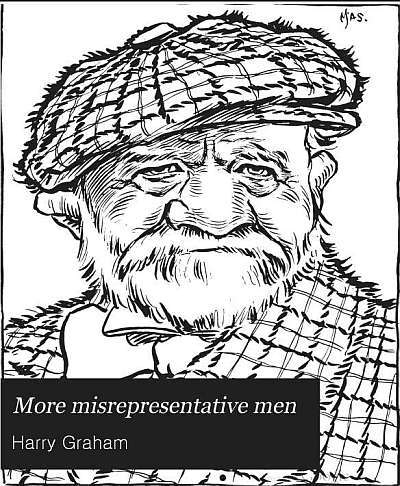
The Project Gutenberg eBook of More Misrepresentative Men
Title: More Misrepresentative Men
Author: Harry Graham
Illustrator: Malcolm A. Strauss
Release date: July 19, 2011 [eBook #36782]
Most recently updated: January 7, 2021
Language: English
Credits: Produced by Mark C. Orton, Matthew Wheaton and the Online
Distributed Proofreading Team at https://www.pgdp.net (This
book was produced from scanned images of public domain
material from the Google Print project.)
More Misrepresentative Men
Harry Graham
More Misrepresentative Men
By Harry Graham
Author of
"Ruthless Rhymes for Heartless Homes,"
"Misrepresentative Men,"
"Ballads of the Boer War,"
"Verse and Worse," etc., etc.
PICTURES BY
Malcolm Strauss
NEW YORK
Fox, Duffield & Company
MCMV
Copyright, 1905, by
FOX, DUFFIELD & COMPANY
Published in September, 1905
To
E. B.
Contents
| PAGE | |
| Author's Foreword | 9 |
| Publisher's Preface | 14 |
| Robert Burns | 18 |
| William Waldorf Astor | 33 |
| Henry VIII | 42 |
| Alton B. Parker | 48 |
| Euclid | 54 |
| J. M. Barrie | 65 |
| Omar Khayyam | 72 |
| Andrew Carnegie | 78 |
| King Cophetua | 85 |
| Joseph F. Smith | 90 |
| Sherlock Holmes | 98 |
| Aftword | 109 |
List of Illustrations
| Andrew Carnegie | FRONTISPIECE |
| FACING PAGE |
|
| Robert Burns | 18 |
| William Waldorf Astor | 34 |
| Henry VIII | 42 |
| Alton B. Parker | 48 |
| Euclid | 54 |
| J. M. Barrie | 66 |
| Omar Khayyam | 72 |
| King Cophetua | 86 |
| Joseph F. Smith | 90 |
| Sherlock Holmes | 98 |
Authors Foreword
(To the Publisher)
We poets at our desks are toiling,
To earn a modicum of bread,
And keep the pot a-boiling;
The fabric of our laboured wit.
The coming of this Autumn season,
When bards are driven to display
Their feast of rhyme and reason;
With hectic brain and loosened collar,
We chase the too-elusive dollar.
Despise our masterly inaction,
And shake their faces in our fist,
Demanding satisfaction,
We view with vague or vacant mind
The grim agreements we have signed.
Its timely share of cash assistance,
The author (like the dentist) lives
A hand-to-mouth existence;
And Publishers, those modern Circes,
Make pig's-ear purses of his verses.
The features of the furtive jester!
Compelled by contracts to curtail
His moments of siesta!
A true White Knight is he to-day
(Nuit Blanche, as Stevenson would say).
Constructing this immortal sequel,—
A work which no one could excel,
And very few can equal,—
A volume which, I dare to say,
Is epoch-making, in its way.
These verses shall retain their label;
When Herford is a thing forgot,
And Ade an ancient fable;
When Goops no longer give a sign
Of Burgess's empurpled kine.
Your well-secreted virtues viewing;
Who never let your right hand know
Whom your left hand is doing;
Who hold me firmly in your grip,
And crack your cheque-book, like a whip!
You have in me an avis rara,
So write a princely cheque, and make
It payable to bearer;
I love you, as I said before,
But oh! I love your money more!
Publisher's Preface
(To the Author)
Your grasping greed shall not avail!
In vain you venture to unfold
Your false prehensile tale!
The width of your capacious maw.
Of your malevolent effusions;
'Tis I who bear the brunt of all
Your libellous allusions;
To bolster up your turgid verse,
I jeopardise my very purse!
The Publisher you scorn to thank,
And when you manage to decrease
His balance at the bank,
Your face is lighted up with greed,
And you are lantern-jawed indeed!
Until your coiffure is imbedded,
And you at last, perchance, shall tire
Of growing so hot-headed,
And realise that being funny
Is not a mere affair of money.
A fragrant bouquet will I pick,
Of rare exotics, blossoms, flow'rs
Of speech and rhetoric;
I'll add a thistle, if I may,
And, round the whole, a wreath of bay.
To mark your affluent condition,
Exotics to inspire your soul
To further composition.
Come, set the bays upon your brow!
* * * * *
Well, eat the thistle, anyhow!
Robert Burns
Excite the reader's just impatience,
He wearies of Sir Walter Scott's
Melodious verbal collocations,
And with advancing years he learns
To love the simpler style of Burns.
Of that obscure robustious diction,
Which like a form of fungus grows
Amid the Kailyard school of fiction;
In Crockett's cryptic caves one sighs
For Burns's clear and spacious skies.
On Barrie's wealth of wit fantastic,
Creator of that unsurpass'd
If most minute ecclesiastic;
Yet even here the eye discerns
No master-hand like that of Burns.
Exhale a sanctimonious odour,
Their vintage is but Schnapps, at best,
Their Scotch is simply Scotch-and-sodour!
They cannot hope, like Burns, to win
That "touch which makes the whole world kin."
And virtues in Maclaren see,
Or want but little here below,
And want that little Lang, maybe;
Each renegade at length returns,
To praise the peerless pow'rs of Burns.
And Tennyson himself confesses,
The radiance of the dewdrop shares,
The berry's perfect shape possesses;
And even William Wordsworth praises
The magic of his faultless phrases.
Whose lofty genius we adore so,
Was only human, like ourselves,—
Perhaps, indeed, a trifle more so!
And joined a thirst that nought could quench
To morals which were frankly French.
With boon companions, bent on frolic,
To inns of ill-repute, where lay
Refreshments—chiefly alcoholic!
(But I decline to raise your gorges,
Describing these nocturnal orgies.)
So long and ardently he flirted,
And e'en the least suspicious friend
Would feel a trifle disconcerted,
When Burns was sitting with his "sposa,"
"As thick as thieves on Vallombrosa!"
And showed some conjugal alarm,
When Burns implored him not to fuss,
Enquiring calmly, "Where's the harm?"
Replied at once, with perfect taste,
"The harm is round my consort's waist!"
His fair but fickle bride denoting,
And she, with scathing repartee,
Assented, wilfully misquoting,
(Tho' carefully brought up, like Jonah),
"A poorer thing—and yet my owner!"
By Burns' amatory glances;
The most suburban spinsters learnt
To welcome his abrupt advances;
When Burns was on his knee, 'twas said,
They wished that they were there instead!
Of angry parents' interference;
They deemed his courtship so polite,
So captivating his appearance;
So great his charm, so apt his wit,
In local parlance, Burns was IT!
Encouraged his unwise flirtations;
For love of Burns they moped and sighed,
And, while their nearest male relations
Were up in arms, the sad thing is
That they themselves were up in his!
The kind in vogue with ancient Druids,—
Inscribed "Amari Aliquid,"
(Which means "I'm very fond of fluids!"),
On either side, as meet supporters,
The village blacksmith's lovely daughters.
As Shakespeare says (Hey Nonny! Nonny!),
But one should always keep in view
That "tout comprendr' c'est tout pardonny";
In judging poets it suffices
To scan their verses, not their vices.
. . . . . .
The poets of the present time
Attempt their feeble imitations;
Are economical of rhyme,
And lavish with reiterations;
The while a patient public swallows
A "Border Ballad" much as follows:—
Jamie lad, I lo'e nae ither,
Jamie lad, I lo'e ye weel,
Like a mither.
Jamie's ganging doon, whateffer,
Jamie's ganging doon the burn,
To Strathpeffer!
Jamie's comin' hame, I'm thinkin',
Jamie's comin' hame to dee,
Dee o' drinkin'!
Dinna greet sae sair!
Gin ye canna, winna, shanna
See yer lassie mair!
Wha' hoo!
Wha' hae!
Strathpeffer!
Some lines which I myself indited.
Carnegie, when he read them, wrote
To say that he was quite delighted;
Their pathos cut him to the quick,
Their humour almost made him sick.
An' gin ye thole ahin' the kirk,
I'll gar ye tocher hame fra' work,
Sae straught an' primsie;
In vain the lavrock leaves the snaw,
The sonsie cowslips blithely blaw,
The elbucks wheep adoon the shaw,
Or warl a whimsy.
The cootie muircocks crousely craw,
The maukins tak' their fud fu' braw,
I gie their wames a random paw,
For a' they're skilpy;
For wha' sae glaikit, gleg an' din,
To but the ben, or loup the linn,
Or scraw aboon the tirlin'-pin
Sae frae an' gilpie?
The cairngorm clap in ilka cap,
Och, hand me o'er
Ma lang claymore,
Twa, bannocks an' a bap,
Wha hoo!
Twa bannocks an' a bap!
. . . . . .
O fellow Scotsman, near and far,
Renowned for health and good digestion,
For all that makes you what you are,—
(But are you really? That's the question)—
Be grateful, while the world endures,
That Burns was countryman of yours.
Foregather with your fellow cronies,
To masticate the haggis (cann'd)
At Scottish Conversaziones,
Where, flushed with wine and Auld Lang Syne,
You worship at your country's shrine!
William Waldorf Astor
OW blest a thing it is to die
For Country's sake, as bards have sung!
(To quote the vulgar Latin tongue);
And yet to him the palm we give
Who for his fatherland can live.
In terms that never can grow cold,
How well the bold Horatius
Played bridge in the brave days of old;
And we can read of hosts of others,
From Spartan boys to Roman mothers.
From poet, pedagogue, or pastor,
The picture of a patriot
So truly typical as Astor;
And none has ever shown a greater
Affection for his Alma Mater.
His heart inflexible as starch is,
Whene'er he hears upon a band
The too prolific Sousa's marches;
And from his eyes a tear he wipes,
Each time he sees the Stars and Stripes.
To European health resorts,
The fact that "there's no place like home"
Is foremost in our hero's thoughts;
And all in vain have people tried
To lure him from his "ain fireside."
By wayward breezes widely blown,
He stops at the Astoria,
"A poor thing" (Shakespeare), "but his own;"
And nothing that his friends may do
Can drag him from Fifth Avenue.
To scale, as a prospective bride,
The bare six-story tenement
Where foreign pauper peers reside;
But men like Astor all disparage
The so-called Morgan-attic marriage.
May buy a mansion in Belgravia,
Have footmen there with powdered hair
And frigidly correct behaviour;
But marble stairs and plate of gold
Leave Astor absolutely cold.
That fronts some Surrey riverside,
Would wound his socialistic sense,
And pain his patriotic pride;
He would not change for Castles Highland
His cabbage-patch on Coney Island.
A palace of Venetian gilding,
Appear to him not half so sweet
As any modern Vanderbuilding;
He views, without an envious throe,
The wolf that suckled Romeo!
Their mead of praise from some may win;
Our hero cannot do without
Peanuts and clams and terrapin;
Away from home, his soul would lack
The cocktail and the canvasback.
'Mid busy London's jar and hum.
On quiet Broadway he would stand,
Saying "Americanus sum!"
His smile so tranquil, so seraphic,—
Small wonder that it stops the traffic!
(This lapse of grammar pray forgive,)
So simply satisfied to be,
Contented with his lot to live,—
Whether or not it be, I wot,
A little lot,—or quite a lot?
With any tiny piece of earth,
So long as he can find it there
Within the land that gave him birth;
Content with simple beans and pork,
If he may eat them in New York!
And spend it far across the seas,
Like landlords of the Em'rald Isle,
Denounced notorious absentees,
I pray you imitate the Master,
And stay at home like Mr. Astor!
And leave your fatherland behind you,
Without an effort to recall
The sentimental ties that bind you,
I should be grateful if you could
Contrive to stay away for good!
Henry VIII
ITH Stevenson we must agree,
Who found the world so full of things,
That all should be, or so said he,
As happy as a host of Kings;
Yet few so fortunate as not
To envy Bluff King Henry's lot.
Tho' somewhat lacking in religion,
Who joined a courtly manner to
The figure of a pouter pigeon;
And was, at time of feast or revel
A ... well ... a perfect little devil!
Are hard for modern minds to swallow,
Two lofty virtues he displayed,
Which we should do our best to follow:—
A passion for domestic life,
A cult for what is called The Wife.
Six times (to make a misquotation)
He managed, at the Canon's mouth,
To win a bubble reputation;
And ev'ry time, from last to first,
His matrimonial bubble burst!
And well-blacked, button boots, he entered
The Abbey's bust-congested aisle,
With ev'ry eye upon him centred;
Six times he heard, and not alone,
The march of Mr. Mendelssohn.
In order to complete the marriage,
'Mid painful show'rs of boots and rice,
He sought the shelter of his carriage;
Six times the bride, beneath her veil,
Looked "beautiful, but somewhat pale."
Six females of undaunted bearing,
Two Annes, three Kath'rines, and a Jane,
Enjoyed the privilege of sharing
A conjugal career so chequer'd
It almost constitutes a record!
That Henry missed his true vocation;
A husband by profession he,
A widower by occupation;
And, honestly, it seems a pity
He didn't live in Salt Lake City.
His plural marriage views, unbaffled;
Nor had recourse to dull divorce,
Nor sought the service of the scaffold;
Nor looked for peace, nor found release,
In any partner's predecease.
He might have hired a timely motor,
And sent each wife in turn to stay
Within the confines of Dakota;
That State whose rigid marriage-law,
Is eulogised by Bernard Shaw.
And, in the present generation,
A wife is seldom woo'd and won
By prospects of decapitation.
For nowadays when Woman weds,
It is the Men who lose their heads!
Alton B. Parker
Established a sublime tradition,
Who gave the Man Behind the Hoe
His proud proconsular position;
When Cincinnatus left his hens,
And beat his ploughshares into pens.
Descended from some humble attic,
The Presidential nominee
Of those whose views are Democratic;
From Millionaire to Billiard Marker
They plumped their votes for Central Parker.
Possessing neither wealth nor beauty,
But gifted with a really ex—
—Traordinary sense of Duty;
In Honour's list I place him first,—
With Cæsar's Wife and Mr. Hearst.
Since first he laid aside his rattle,
Was wont to cultivate the soil,
Or milk his father's kindly cattle;
To groom the pigs, drive crows away,
Or teach the bantams how to lay.
With tastes essentially bucolic,
Eschewed the straightcut cigarette,
And shunned refreshments alcoholic;
His simple pleasure 'twas to plumb
The deep-laid joys of chewing gum.
Attained to years of indiscretion,
To preach the Solomonian text
So popular with that profession,
Which honours whom (and what) it teaches
More in th' observance than the breeches.
Head of a legal institution,
Enjoying huge retaining fees
As counsel for the prosecution.
(Advice to lawyers, meum non est,—
Get on, get honour, then get honest!)
Beyond the bounds of birth or station,
And gain, as jurist of repute,
A continental reputation.
(Don't mix him with that "Triple Star"
Which lights a more unworthy "bar.")
A judge, arrayed in moral ermine,
As from the Bench he sentences
His fellow-man, and other vermin,
And does his duty to his neighbour,
By giving him six months' hard labour.
He bears aloft the golden standard,
For he whose motto is "Advance!"
To baser coin has never pandered.
No eulogist of War is he,
"Retrenchment!" is his dernier cri.
With strength like concentrated Eno,
He did his very utmost to
Emancipate the Filipino,
A fickle public chose Another,
Who called the Coloured Coon his Brother.
Euclid
When Ptolemy was King, that is,
Whose benefices used to show'r
On all the local charities,
And by his liberal subscriptions
Was always spoiling the Egyptians—
A proud and primary position
For training scholars not devoid
Of geometric erudition;
Where arithmetical fanatics
Could even live in (mathem)-attics.
This Institution the possessor
Of one who occupied with fame
The post of principal Professor,
Who had a more expansive brain
Than any man—before Hall Caine.
Perplexed his algebraic knowledge;
With ease he balanced the accounts
Of his (at times insolvent) College;
He was, without the least romance,
A very Blondin of Finance.
Without a moment's hesitation,
Elucidated easily
The most elab'rate calculation
(His washing got, I needn't mention,
The local laundry's best attention).
Blue-spectacled and inoffensive,
He hid a judgment and a nous
As overwhelming as extensive,
And cloaked a soul immune from wrong
Beneath an ample ong-bong-pong.
Whom 'twas his duty to take care of,
He loved to prove the truth of truths
Which they already were aware of;
They learnt to look politely bored,
Where modern students would have snored.
That All is greater than a Portion,
Requires no dialectic lore,
Nor any cerebral contortion;
The public's faith in facts was steady,
Before the days of Mrs. Eddy.
(From which Society still suffers)
Was all the trouble Euclid took
To teach the game of Bridge to duffers.
Insisting, when he got a quorum,
On "Pons" (he called it) "Asinorum."
Provoked his partner's strongest strictures;
He hardly knew the cards by name,
But realised that some had pictures;
Exhausting ev'rybody's patience
By his perpetual revocations.
O'er dummy's hand he loved to linger,
Denoting ev'ry card in turn,
With timid indecisive finger;
And stopped to say, at each delay,
"I really don't know what to play!"
His ev'ry suit in turn unguarding;
He trumped his partner's "best card in,"
His own egregiously discarding;
Remarking sadly, when in doubt,
"I quite forgot the King was out!"
By what the look upon his face was,
When safety lay in leading through,
And where, of course, the fatal ace was;
Assuring the complete successes
Of bold but hazardous "finesses."
From distant Assouan to Cairo,
To mark the place where dwelt a race
Mistaught by so absurd a tyro;
And nothing but occult inscriptions
Recall the sports of past Egyptians.
"Où sont indeed les neiges d'antan?"
The modern native much prefers
Debauching in some café chantant,
Nor ever shows the least ambition
To solve a single Proposition.
You knew no English interloper;
For Allah's Garden was not then
The pleasure-ground of Alleh Sloper,
Nor (broth-like) had your country's looks
Been spoilt by an excess of "Cooks."
Discoursed in dull but tender tones;
Not yours the modern Dahabeahs,
Supplied with strident gramophones,
Imploring, in a loud refrain,
Bill Bailey to come home again.
And drawn, perhaps, by alligators,
Were not the modern Juggernaut-
Child-dog-and-space-obliterators,
Those "stormy petrols" of the land
Which deal decease on either hand.
Defiled the desert's dusky face
With orange peel and paper bags,
Those emblems of a cultured race;
Or cut the noble name of Jones,
On tombs which held a monarch's bones.
The sunny clime you once frequented,
And note the way we moderns play
The game you thoughtfully invented,
The knowledge of your guilt would force yer
To feelings of internal nausea!
J. M. Barrie
At mention of my hero's name!
Was ever set so huge a heart
Within so small a frame?
So much of tenderness and grace
Confined in such a slender space?
So wise, so whimsical, so witty!
Whose magic little fairy-pen
Is steeped in human pity;
Whose humour plays so quaint a tune,
From Peter Pan to Pantaloon!)
Such kindliness without an end,
That children clamber on his knee,
And claim him as a friend;
They somehow know he understands,
And doesn't mind their sticky hands.
With energy that nothing wearies,
Assured that he will never check
Their ceaseless flow of queries,
And grateful, with a warm affection,
For his avuncular protection.
Or beats them all at blowing bubbles,
They tell him how the dormouse died,
And all their tiny troubles;
And drag him, if he seems deprest,
To see the baby squirrel's nest.
Pursue the Indians in the wood,
Feed the prolific guinea-pig
With inappropriate food;
Do all the things that mattered so
In happy days of long ago.
For, 'neath the magic of his brain,
The young are younger than before,
The old grow young again,
To dream of Beauty and of Truth
For hearts that win eternal youth.
With well-developed Little Marys,
Look almost human when they show
Their faith in Barrie's fairies;
Their blank lethargic faces lighten
In admiration of his Crichton.
Attempt to fan some dying ember,
He brings the happy days of old,
And bids their hearts remember;
Recalling in romantic fashion
The tenderness of earlier passion.
So little leisure for the Nurs'ry,
Whose interest in babykind
Is eminently curs'ry,
New views on Motherhood acquire
From Alice-sitting-by-the-Fire!
At times of sunshine or of trouble,
In Sentimental Tommy find
Their own amazing double;
To each in turn the mem'ry comes
Of some belov'd forgotten Thrums.
That strong poetic sense is clinging
Which hears, in ev'ry human heart,
A "late lark" faintly singing,
A bird that bears upon its wing
The promise of perpetual Spring.
At problems for the modern stage;
His simpler methods reach and touch
The Young of ev'ry age;
And first and second childhood meet
On common ground at Barrie's feet!
Omar Khayyam
Has earned the Epicure's diploma,
Not one of them, as I aver,
So much deserved the prize as Omar;
For he, without the least misgiving,
Combined High Thinking and High Living.
Upon a somewhat slender pittance;
And Persia is, as you may know,
The home of Shahs and fubsy kittens,
(A quite consistent habitat,
Since "Shah," of course, is French for "cat.")
You interrupted, impolitely—
Not loosely, like his fellow-men,
But, vicê versâ, rather tightly;
And drank his share, so runs the story,
And other people's, con amore.
He often found some Constellation
Which others could not see without
Profuse internal irrigation;
And snakes he saw, and crimson mice,
Until his colleagues rang for ice.
As dry as the proverbial "drummer,"
And quite believed that (let me quote)
"One swallow does not make a summer,"
Supplied a model to society
Of frank, persistent insobriety.
* * * * *
Ah, fill the cup with nectar sweet,
Until, when indisposed for more,
Your puzzled, inadhesive feet
Elude the smooth revolving floor.
What matter doubts, despair or sorrow?
To-day is Yesterday To-morrow!
Let finger-bowls with vodka foam,
And seek the Open Port within
Some dignified Inebriates' Home;
Assuming there, with kingly air,
A crown of vine-leaves in your hair!
A slice of cake, some ice-cream soda,
A lady with a tuneful voice,
Beside me in some dim pagoda!
A cellar—if I had the key,—
Would be a Paradise to me!
And bottles of Lafitte to fracture
(And, by-the-bye, the word La-feet
Recalls the mode of manufacture)—
I contemplate, at easy distance,
The troublous problems of existence.
To change Creation's partial scheme,
To mould it to a fresh design,
More nearly that of which I dream,
Most probably, my weak endeavour
Would make more mess of it than ever!
With balm to lubricate the throttle;
For "Heav'n helps those who help themselves,"
So help yourself, and pass the bottle!
. . . . . .
What! Would you quarrel with my moral?
(Waiter! Leshavanotherborrel!)
Andrew Carnegie
Where ev'ry little barefoot child
Correctly lisps his mother-tongue,
That Scotch is drunk, as well as spoken,
There dwells a man of iron nerve,
A millionaire without a peer,
Possessing that supreme reserve
Which stamps the caste of Vere de Vere,
And marks him out to human ken
As one of Nature's noblemen.
Is surely much to be excused,
Since they have had no choice, you see,
Of the material to be used;
But when his noiseless fabric grew,
He builded better than he knew.
To him Success alone is vital;
He deems the wealthy cabman's "rank"
As good as any other title;
To him the post of postman betters
The trade of other Men of Letters.
Some nice but indigent patrician,
He urges to select instead
A coachman of assured position,
Since safety-matches, you'll agree,
Strike only on the box, says he.
A splendid palace he has built,
Equipped with all the luxury
Of plush, of looking-glass, and gilt;
A style which Ruskin much enjoyed,
And christened "Early German Lloyd."
The floor is covered, well I know;
The walls are thick with tambourines,
Hand-painted many years ago;
Ah, how much taste our forbears had!
And nearly all of it was bad.
Each "cosy corner" set apart,
Was modelled in the Regent Street
Emporium of suburban art.
"O Liberty!" (I quote with shame)
"The crimes committed in thy name!"
A swimming-bath, a barrel-organ,
Electric light, and even drains,
As good as those of Mr. Morgan,
There was a time when Andrew C.
Was not obsessed by l. s. d.
In Pittsburg, where, I've understood,
You have to exercise some guile
To do the very slightest good;
But he kept doing good by stealth,
And doubtless blushed to find it wealth.
To meet a starving people's need
By making gifts of libraries
To those who never learnt to read;
Rich mental banquets he provides
For folks with famishing insides.
He pours his opulent libations;
His vast deserted Halls of Fame
Increase the gaiety of nations.
But still the slums are plague-infested,
The hospitals remain congested.
. . . . . .
Carnegie, should your kindly eye
This foolish book of verses meet,
Please order an immense supply,
To make your libraries complete,
And register its author's name
Within your princely Halls of Fame!
King Cophetua
I am indeed unwilling,
For none of his adventures are
Particularly thrilling;
Nor, as I hardly need to mention,
Am I addicted to invention.
You must already know it,
Since it has been narrated by
Lord Tennyson, the poet;
I could a moving tale unfold,
But it has been so often told.
My early education,
If Tennyson will pardon me
A somewhat free translation,
I'll try if something can't be sung
In someone else's mother-tongue.
So runs the story's title
(An explanation, I'm afraid,
Is absolutely vital),
Express'd, as I need hardly mench:
In 4 a.m. (or early) French:—
Lui fait l'apparence divine,—
Enfin elle a très bonne mine,—
Elle arrive, ne portant pas
De sabots, ni même de bas,
Pieds-nus, au roi Cophetua.
Vêtu de ses robes de fête,
Va la rencontrer, et l'arrête.
On dit, "Tiens, il y en a de quoi!"
"Je ferais ça si c'était moi!"
Il saits s'amuser donc, ce roi!
Cette enfant luit de mieux en mieux,
Quand même ses habits soient vieux.
En voilà un qui loue ses yeux,
Un autre admire ses cheveux,
Et tout le monde est amoureux.
Un charme tel que celui-là
Alors le bon Cophetua
Jure, "La pauvre mendiante,
Si séduisante, si charmante,
Sera ma femme,—ou bien ma tante!"
Joseph F. Smith
The weight of marriage ties is such
That many mere, male, mortals find
One wife enough,—if not too much;
I see no no reason to abuse
A person holding other views.
Have not acquired the plural habits,
Which we are apt to delegate
To Eastern potentates,—or rabbits;
We should regard with open mind
The more uxoriously inclined.
Who deems monogamy a myth;
(One of that too prolific clan
Which glories in the name of Smith);
A "Prophet, Seer, and Revelator,"
With the appearance of a waiter.
To thrive in manner most bewild'rin',
With close on half a dozen wives,
And nearly half a hundred children;
And views with unaffrighted eyes
The burden of domestic ties.
Each one a model of the Graces;
He knows his children all by name,
But cannot recollect their faces;
A minor point, since, I suppose,
Each one has got its popper's nose!
Such old-world luxuries as his,
When, after work, he hastens to
The bosoms of his families
(Each offspring joining with the others
In, "What is Home without five Mothers?").
Most ordinary men's digestions;
Five ladies all conversing hard,
And fifty children asking questions!
Besides (the tragic final straw),
Five se-pa-rate mamas-in-law!
To find a telescopic mansion;
For each successive family
The space sufficient for expansion.
("But that," said Kipling, in his glory—
"But that is quite another storey!")
Or else a too diffuse affection,
Has, for a wife in ev'ry port,
An unappeasing predilection,
Would designate as "simply great!"
The mode of life in Utah State.
His mad but meaningless advances
To more than one fair maid, and takes
A large variety of chances,
Need have no fear, in such a place,
Of any breach-of-promise case.
I have no slightest cause for quarrel;
Nor do I doubt at all that they
Are quite exceptionally moral;
Their President has told us so,
And he, if anyone, should know.
But 2 percent lead plural lives,
Perhaps the other 98
Are just—their children and their wives!
O stern, ascetic congregation,
Resisting all—except temptation!
Unless for trouble one were looking,
In having wives on either arm,
And one downstairs—to do the cooking.
A touching scene; with nought to dim it.
But fifty children!—That's the limit!
Incur a merely dual bond;
One wife, brunette, to scrub the floor,
And one for outdoor use, a blonde;
Thus happily could I exist,
A moral Mormonogamist!
Sherlock Holmes
The "Green-goods man" his cocktail, when
He toast Gaboriau's Le Coq,
Or Pinkerton's discreet young men;
But beer in British bumpers foams
Around the name of Sherlock Holmes!
Who (woodcock-like) exist by suction,
Uplift your teeming tankards to
The great Professor of Deduction!
Who is he? You shall shortly see
If (Watson-like) you "follow me."
As you go in), stands Baker Street,
Exhibited with proper pride
By all policemen on the beat,
As housing one whose predilection
Is private criminal detection.
Presents to him an easy task;
His placid, penetrating eyes
Can pierce the most secretive mask;
And felons ask a deal too much
Who fancy to elude his clutch.
Too paltry for his needs is found;
No knot too stubborn to undo,
No prey too swift to run to ground;
No road too difficult to travel,
No skein too tangled to unravel.
A gnat impinging on his eye,
Possess a meaning subtler far
Than humbler mortals can descry.
A primrose at the river's brim
No simple primrose is to him!
Combined with blurred articulation,
Displays a man's capacity
For infinite ingurgitation;
Obliquity of moral vision
Betrays the civic politician.
A marked resemblance to a bloater,
Whom Sherlock, by deduction, guessed
To be the victim of a motor;
Whereas, his wife (or so he swore)
Had merely shut him in the door!
Recalled the sun-kissed autumn leaf,
Though friends attributed it to
Some secret or domestic grief,
Revealed to Holmes his deep potations,
And not the loss of loved relations!
Who proved a conjugal deceiver;
Her offspring were a Maltese Cat,
Two Dachshunds and a pink retriever!
Her husband was a pure-bred Skye;
And Sherlock Holmes alone knew why!
To plunge in anecdotage deep,
At once will Sherlock recognise
Each welcome harbinger of sleep:
That voice which torpid guests entrances,
That immemorial voice of Chauncey's!
All unannounced into the room,
To say, like pressmen of New York,
"Er—Mr. Shakespeare, I presoom?"
By name "The Manxman" Holmes would hail,
Observing that he had no tale.
Of Zion, dreariest of havens,
Does bashful Dowie emulate
The prophet who was fed by ravens;
To Holmes such affluence betrays
A prophet who is fed by jays!
. . . . . .
With Holmes there lived a foolish man,
To whom I briefly must allude,
Who gloried in possessing an
Abnormal mental hebetude;
One could describe the grossest bétise
To this (forgive the rhyme) Achates.
Obtusely, painfully polite;
Who played the unambitious rôle
Of parasitic satellite;
Inevitably bound to bore us,
Like Aristophanes's Chorus.
. . . . . .
But London town is sad to-day,
And preternaturally solemn;
The fountains murmur "Let us spray"
To Nelson on his lonely column;
Big Ben is mute, her clapper crack'd is,
For Holmes has given up his practice.
Will he his sinuous path pursue,
Till, like the weasel (when awake),
Or deft, resilient kangaroo,
He leaps upon his quivering quarry,
Before there's time to say you're sorry.
Effecting some burglarious entry,
(While Sherlock, on the garden lawn,
Enacts the thankless rôle of sentry),
Discover, to their bitter cost,
That felons who are found—are lost!
The Chronicles he proudly fabled;
The violin and morphia-case
Are in the passage, packed and labelled;
And Holmes himself is at the door,
Departing—to return no more.
Though Watson clings about his knees;
He hastens to his country seat,
To spend his dotage keeping bees;
And one of them, depend upon it,
Shall find a haven in his bonnet!
And tears upon our cheeks are shining,
We recognise that ev'ry cloud
Conceals somewhere a silver lining;
And hear with deep congratulation
Of Watson's timely termination.
Aftword
Peruse my incoherent medley,
Prepared to let your arrows fly,
With cruel aim and purpose deadly,
Desist a moment, ere you spoil
The harvest of a twelvemonth's toil!
The crusted jokes of days gone by,
What conscious plagiarists we are:
Molière and Seymour Hicks and I,
For, as my bearded chestnuts prove,
Je prends mon bien où je le trouve!
On Chestertonian paradox;
My humour, in the best of taste,
Like Miss Corelli's, never shocks;
For sacred things my rev'rent awe
Resembles that of Bernard Shaw.
Each victim of my pen and brain,
And should I tread upon his feet,
How lightly I leap off again;
Observe with what an airy grace
I fling my inkpot in his face!
An inexpensive gift for Mother,
Will fine this foolish book of rhyme
As apposite as any other,
And suitable for presentation
To any poor or near relation.
This work should prove a priceless treasure;
To persons who have none at all,
A never-ending fount of pleasure;
A mental stimulus or tonic
To all whose idiocy is chronic.
Which category you come under),
Will, after due reflection, find
My verse a constant source of wonder;
'Twill make you think, I dare to swear—
But what you think I do not care!