
The Project Gutenberg eBook of More "Short Sixes"
Title: More "Short Sixes"
Author: H. C. Bunner
Illustrator: Charles Jay Taylor
Release date: April 6, 2017 [eBook #54491]
Most recently updated: October 23, 2024
Language: English
Credits: Produced by Chuck Greif, MWS and the Online Distributed
Proofreading Team at http://www.pgdp.net (This file was
produced from images generously made available by The
Internet Archive/American Libraries.)
|
(In certain versions of this etext [in certain browsers] clicking on the image, will bring up a larger version.) (etext transcriber's note) |
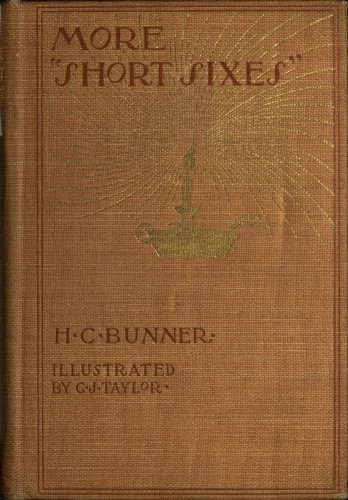
MORE “SHORT SIXES.”
MORE “SHORT SIXES”~
BY H·C·BUNNER~
ILLUSTRATED BY C·J·TAYLOR·
KEPPLER & SCHWARZMANN·PUBLISHERS.
PUCK BUILDING·NEW·YORK·MDCCCXCIV··
Copyright, 1894, by Keppler & Schwarzmann.
TO
A. L. B.
Contents.
THE CUMBERSOME HORSE.
T is not to be denied that a sense of disappointment pervaded Mr. Brimmington’s being in the hour of his first acquaintance with the isolated farm-house which he had just purchased, sight unseen, after long epistolary negotiations with Mr. Hiram Skinner, postmaster, carpenter, teamster and real estate agent of Bethel Corners, who was now driving him to his new domain.
Perhaps the feeling was of a mixed origin. Indian Summer was much colder up in the Pennsylvania hills than he had expected to find it; and the hills themselves were much larger and bleaker and barer, and far more indifferent in their demeanor toward him, than he had expected to find them. Then Mr. Skinner had been something of a disappointment, himself. He was too familiar with his big, knobby, red hands; too furtive with his small, close-set eyes; too profuse of tobacco-juice, and too raspingly loquacious. And certainly the house itself did not meet his expectations when he first saw it, standing lonely and desolate in its ragged meadows of stubble and wild-grass on the unpleasantly steep mountain-side.
And yet Mr. Skinner had accomplished for him the desire of his heart. He had always said that when he should come into his money—forty thousand dollars from a maiden aunt—he would quit forever his toilsome job of preparing Young Gentlemen for admission to the Larger Colleges and Universities, and would devote the next few years to writing his long-projected “History of Prehistoric Man.” And to go about this task he had always said that he would go and live in perfect solitude—that is, all by himself and a chorewoman—in a secluded farm-house, situated upon the southerly slope of some high hill—an old farm-house—a Revolutionary farm-house, if possible—a delightful, long, low, rambling farm-house—a farm-house with floors of various levels—a farm-house with crooked Stairs, and with nooks and corners and quaint cupboards—this—this had been the desire of Mr. Brimmington’s heart.
Mr. Brimmington, when he came into his money at the age of forty-five, fixed on Pike County, Pennsylvania, as a mountainous country of good report. A postal-guide informed him that Mr. Skinner was the postmaster of Bethel Corners; so, Mr. Brimmington wrote to Mr. Skinner.
The correspondence between Mr. Brimmington and Mr. Skinner was long enough and full enough to have settled a treaty between two nations. It ended by a discovery of a house lonely enough and aged enough to fill the bill. Several hundred dollars’ worth of repairs were needed to make it habitable, and Mr. Skinner was employed to make them. Toward the close of a cold November day, Mr. Brimmington saw his purchase for the first time.
In spite of his disappointment, he had to admit, as he walked around the place in the early twilight, that it was just what he had bargained for. The situation, the dimensions, the exposure, were all exactly what had been stipulated. About its age there could be no question. Internally, its irregularity—indeed, its utter failure to conform to any known rules of domestic architecture—surpassed Mr. Brimmington’s wildest expectations. It had stairs eighteen inches wide; it had rooms of strange shapes and sizes; it had strange, shallow cupboards in strange places; it had no hallways; its windows were of odd design, and whoso wanted variety in floors could find it there. And along the main wall of Mr. Brimmington’s study there ran a structure some three feet and a half high and nearly as deep, which Mr. Skinner confidently assured him was used in old times as a wall-bench or a dresser, indifferently. “You might think,” said Mr. Skinner, “that all that space inside there was jest wasted; but it ain’t so. Them seats is jest filled up inside with braces so’s that you can set on them good and solid.” And then Mr. Skinner proudly called attention to the two coats of gray paint spread over the entire side of the house, walls, ceilings and woodwork, blending the original portions and the Skinner restorations in one harmonious, homogenous whole.
Mr. Skinner might have told him that this variety of gray paint is highly popular in some rural districts, and is made by mixing lamp-black and ball-blue with a low grade of white lead. But he did not say it; and he drove away as soon as he conveniently could, after formally introducing him to Mrs. Sparhawk, a gaunt, stern-faced, silent, elderly woman. Mrs. Sparhawk was to take charge of his bachelor establishment during the day time. Mrs. Sparhawk cooked him a meal for which she very properly apologized. Then she returned to her kitchen to “clean up.” Mr. Brimmington went to the front door, partly to look out upon his property, and partly to turn his back on the gray paint. There were no steps before the front door, but a newly-graded mound or earthwork about the size of a half-hogshead. He looked out upon his apple-orchard, which was further away than he had expected to find it. It had been out of bearing for ten years, but this Mr. Brimmington did not know. He did know, however, that the whole outlook was distinctly dreary.
As he stood there and gazed out into the twilight, two forms suddenly approached him. Around one corner of the house came Mrs. Sparhawk on her way home. Around the other came an immensely tall, whitish shape, lumbering forward with a heavy tread. Before he knew it, it had scrambled up the side of his mound with a clumsy, ponderous rush, and was thrusting itself directly upon him when he uttered so lusty a cry of dismay that it fell back startled; and, wheeling about a great long body that swayed on four misshapen legs, it pounded off in the direction it had come from, and disappeared around the corner. Mr. Brimmington turned to Mrs. Sparhawk in disquiet and indignation.
“Mrs. Sparhawk,” he demanded; “what is that?”
“It’s a horse,” said Mrs. Sparhawk, not at all surprised, for she knew that Mr. Brimmington was from the city. “They hitch ’em to wagons here.”
“I know it is a horse, Mrs. Sparhawk,” Mr. Brimmington rejoined with some asperity; “but whose horse is it, and what is it doing on my premises?”
“I don’t rightly know whose horse it is,” replied Mrs. Sparhawk; “the man that used to own it, he’s dead now.”
“But what,” inquired Mr. Brimmington sternly, “is the animal doing here?”
“I guess he b’longs here,” Mrs. Sparhawk said. She had a cold, even, impersonal way of speaking, as though she felt that her safest course in life was to confine herself strictly to such statements of fact as might be absolutely required of her.
“But, my good woman,” replied Mr. Brimmington, in bewilderment, “how can that be? The animal can’t certainly belong on my property unless he belongs to me, and that animal certainly is not mine.”
Seeing him so much at a loss and so greatly disturbed in mind, Mrs. Sparhawk relented a little from her strict rule of life, and made an attempt at explanation.
“He b’longed to the man who owned this place first off; and I don’ know for sure, but I’ve heard tell that he fixed it some way so’s that the horse would sort of go with the place.”
Mr. Brimmington felt irritation rising within him.
“But,” he said, “it’s preposterous! There was no such consideration in the deed. No such thing can be done, Mrs. Sparhawk, without my acquiescence!”
“I don’t know nothin’ about that,” said Mrs. Sparhawk; “what I do know is, the place has changed hands often enough since, and the horse has always went with the place.”
There was an unsettled suggestion in the first part of this statement of Mrs. Sparhawk that gave a shock to Mr. Brimmington’s nerves. He laughed uneasily.
“Oh, er, yes! I see. Very probably there’s been some understanding. I suppose I am to regard the horse as a sort of lien upon the place—a—a—what do they call it?—an incumbrance! Yes,” he repeated, more to himself than to Mrs. Sparhawk; “an incumbrance. I’ve got a gentleman’s country place with a horse incumbrant.”
Mrs. Sparhawk heard him, however.
“It is a sorter cumbersome horse,” she said. And without another word she gathered her shawl about her shoulders, and strode off into the darkness.
Mr. Brimmington turned back into the house, and busied himself with a vain attempt to make his long-cherished furniture look at home in his new leaden-hued rooms. The ungrateful task gave him the blues; and, after an hour of it, he went to bed.
He was dreaming leaden-hued dreams, oppressed, uncomfortable dreams, when a peculiarly weird and uncanny series of thumps on the front of the house awoke him with a start. The thumps might have been made by a giant with a weaver’s beam, but he must have been a very drunken giant to group his thumps in such a disorderly parody of time and sequence.
Mr. Brimmington had too guileless and clean a heart to be the prey of undefined terrors. He rose, ran to the window and opened it. The moonlight lit up the raw, frosty landscape with a cold, pale, diffused radiance, and Mr. Brimmington could plainly see right below him the cumbersome horse, cumbersomely trying to maintain a footing on the top of the little mound before the front door. When, for a fleeting instant, he seemed to think that he had succeeded in this feat, he tried to bolt through the door. As soon, however, as one of his huge knees smote the panel, his hind feet lost their grip on the soft earth, and he wabbled back down the incline, where he stood shaking and quivering, until he could muster wind enough for another attempt to make a catapult of himself. The veil like illumination of the night, which turned all things else to a dim, silvery gray, could not hide the scars and bruises and worn places that spotted the animal’s great, gaunt, distorted frame. His knees were as big as a man’s head. His feet were enormous. His joints stood out from his shriveled carcass like so many pine knots. Mr. Brimmington gazed at him, fascinated, horrified, until a rush more desperate and uncertain than the rest threatened to break his front door in.
“Hi!” shrieked Mr. Brimmington; “go away!”
It was the horse’s turn to get frightened. He lifted his long, coffin-shaped head toward Mr. Brimmington’s window, cast a sort of blind, cross-eyed, ineffectual glance at him, and with a long-drawn, wheezing, cough-choked whinny he backed down the mound, got himself about, end for end, with such extreme awkwardness that he hurt one poor knee on a hitching-post that looked to be ten feet out of his way, and limped off to the rear of the house.
The sound of that awful, rusty, wind-broken whinny haunted Mr. Brimmington all the rest of that night. It was like the sound of an orchestrion run down, or of a man who is utterly tired of the whooping-cough and doesn’t care who knows it.
The next morning was bright and sunshiny, and Mr. Brimmington awoke in a more cheerful frame of mind than he would naturally have expected to find himself in after his perturbed night. He found himself inclined to make the best of his purchase and to view it in as favorable a light as possible. He went outside and looked at it from various points of view, trying to find and if possible to dispose of the reason for the vague sense of disappointment which he felt, having come into possession of the rambling old farm-house, which he had so much desired.
He decided, after a long and careful inspection, that it was the proportions of the house that were wrong. They were certainly peculiar. It was singularly high between joints in the first story, and singularly low in the second. In spite of its irregularity within, it was uncompromisingly square on the outside. There was something queer about the pitch of its roof, and it seemed strange that so modest a structure with no hallway whatever should have vestibule windows on each side of its doors, both front and rear.
But here an idea flashed into Mr. Brimmington’s mind that in an instant changed him from a carping critic to a delighted discoverer. He was living in a Block House! Yes; that explained—that accounted for all the strangeness of its architecture. In in instant he found his purchase invested with a beautiful glamour of adventurous association. Here was the stout and well-planned refuge to which the grave settlers of an earlier day had fled to guard themselves against the attack of the vindictive red-skins. He saw it all. A moat, crossed no doubt by draw-bridges, had surrounded the building. In the main room below, the women and children had huddled while their courageous defenders had poured a leaden hail upon the foe through loop-holes in the upper story. He walked around the house for some time, looking for loop-holes.
So pleased was Mr. Brimmington at his theory that the morning passed rapidly away, and when he looked at his watch he was surprised to find that it was nearly noon. Then he remembered that Mr. Skinner had promised to call on him at eleven, to make anything right that was not right. Glancing over the landscape he saw Mr. Skinner approaching by a circuitous track. He was apparently following the course of a snake fence which he could readily have climbed. This seemed strange, as his way across the pasture land was seemingly unimpeded. Thinking of the pasture land made Mr. Brimmington think of the white horse, and casting his eyes a little further down the hill he saw that animal slowly and painfully steering a parallel course to Mr. Skinner, on the other side of the fence. Mr. Skinner went out of sight behind a clump of trees, and when he arrived it was not upon the side of the house where Mr. Brimmington had expected to see him appear.
As they were about to enter the house Mr. Brimmington noticed the marks of last night’s attack upon his front door, and he spoke to Mr. Skinner about the horse.
“Oh, yes,” said Mr. Skinner, with much ingenuousness; “that horse. I was meaning to speak to you about that horse. Fact is, I’ve kinder got that horse on my hands, and if it’s no inconvenience to you, I’d like to leave him where he is for a little while.”
“But it would be very inconvenient, indeed, Mr. Skinner,” said the new owner of the house. “The animal is a very unpleasant object; and, moreover, it attempted to break into my front door last night.”
Mr. Skinner’s face darkened. “Sho!” he said; “you don’t mean to tell me that?”
But Mr. Brimmington did mean to tell him that, and Mr. Skinner listened with a scowl of unconcealed perplexity and annoyance. He bit his lip reflectively for a minute or two before he spoke.
“Too bad you was disturbed,” he said at length. “You’ll have to keep the bars up to that meadow and then it won’t happen again.”
“But, indeed, it must not happen again,” said Mr. Brimmington; “the horse must be taken away.”
“Well, you see it’s this way, friend,” returned Mr. Skinner, with a rather ugly air of decision; “I really ain’t got no choice in the matter. I’d like to oblige you, and if I’d known as far back that you would have objected to the animal I’d have had him took somewheres. But, as it is, there ain’t no such a thing as getting that there horse off this here place till the frost’s out of the ground. You can see for yourself that that horse, the condition he’s in now, couldn’t no more go up nor down this hill than he could fly. Why, I came over here a-foot this morning on purpose not to take them horses of mine over this road again. It can’t be done, sir.”
“Very well,” suggested Mr. Brimmington; “kill the horse.”
“I ain’t killin’ no horses,” said Mr. Skinner. “You may if you like; but I’d advise you not to. There’s them as mightn’t like it.”
“Well, let them come and take their horse away, then,” said Mr. Brimmington.
“Just so,” assented Mr. Skinner. “It’s they who are concerned in the horse, and they have a right to take him away. I would if I was any ways concerned, but I ain’t.” Here he turned suddenly upon Mr. Brimmington. “Why, look here,” he said, “you ain’t got the heart to turn that there horse out of that there pasture where he’s been for fifteen years! It won’t do you no sorter hurt to have him stay there till Spring. Put the bars up, and he won’t trouble you no more.”
“But,” objected Mr. Brimmington, weakly, “even if the poor creature were not so unsightly, he could not be left alone all Winter in that pasture without shelter.”
“That’s just where you’re mistaken,” Mr. Skinner replied, tapping his interlocutor heavily upon the shoulder; “he don’t mind it not one mite. See that shed there?” And he pointed to a few wind-racked boards in the corner of the lot. “There’s hoss-shelter; and as for feed, why there’s feed enough in that meadow for two such as him.”
In the end, Mr. Brimmington, being utterly ignorant of the nature and needs of horse-flesh, was over-persuaded, and he consented to let the unfortunate white horse remain in his pasture lot to be the sport of the Winter’s chill and bitter cruelty. Then he and Mr. Skinner talked about some new paint.
* * *
It was the dead waist and middle of Mr. Brimmington’s third night in his new house, when he was absolutely knocked out of a calm and peaceful slumber by a crash so appalling that he at first thought that the side of the mountain had slid down upon his dwelling. This was followed by other crashes, thumps, the tearing of woodwork and various strange and grewsome noises. Whatever it might be, Mr. Brimmington felt certain that it was no secret midnight marauder, and he hastened to the eighteen-inch stairway without even waiting to put on a dressing-gown. A rush of cold air came up from below, and he had no choice but to scuttle back for a bath-robe and a candle while the noises continued, and the cold air floated all over the house.
There was no difficulty in locating the sounds. Mr. Brimmington presented himself at the door of the little kitchen, pulled it open, and, raising the light above his head, looked in. The rush of wind blew out his light, but not before he had had time to see that it was the white horse that was in the kitchen, and that he had gone through the floor.
Subsequent investigation proved that the horse had come in through the back door, carrying that and its two vestibule windows with him, and that he had first trampled and then churned the thin floor into match-wood. He was now reposing on his stomach, with his legs hanging down between the joists into the hollow under the house—for there was no cellar. He looked over his shoulder at his host and emitted his blood-curdling wail.
“My Gracious!” said Mr. Brimmington.
That night Mr. Brimmington sat up with the horse, both of them wrapped, as well as Mr. Brimmington could do it, in bed-clothes. There is not much you can do with a horse when you have to sit up with him under such circumstances. The thought crossed Mr. Brimmington’s mind of reading to him, but he dismissed it.
* * *
In the interview the next day, between Mr. Brimmington and Mr. Skinner, the aggressiveness was all on Mr. Brimmington’s side, and Mr. Skinner was meek and wore an anxious expression. Mr. Brimmington had, however, changed his point of view. He now realized that sleeping out of Winter nights might be unpleasant, even painful to an aged and rheumatic horse. And, although he had cause of legitimate complaint against the creature, he could no longer bear to think of killing the animal with whom he had shared that cold and silent vigil. He commissioned Mr. Skinner to build for the brute a small but commodious lodging, and to provide a proper stock of provender—commissions which Mr. Skinner gladly and humbly accepted. As to the undertaking to get the horse out of his immediate predicament, however, Mr. Skinner absolutely refused to touch the job. “That horse don’t like me,” said Mr. Skinner; “I know he don’t; I seen it in his eyes long ago. If you like, I’ll send you two or three men and a block-and-tackle, and they can get him out; but not me; no, sir!”
Mr. Skinner devoted that day to repairing damages, and promised on the morrow to begin the building of the little barn. Mr. Brimmington was glad there was going to be no greater delay, when, early in the evening, the sociable white horse tried to put his front feet through the study window.
But of all the noises that startled Mr. Brimmington, in the first week of his sojourn in the farm-house, the most alarming awakened him about eight o’clock of the following morning. Hurrying to his study, he gazed in wonder upon a scene unparalleled even in the History of Prehistoric Man. The boards had been ripped off the curious structure which was supposed to have served the hardy settlers for a wall-bench and a dresser, indifferently. This revealed another structure in the form of a long crib or bin, within which, apparently trying to back out through the wall, stood Mr. Skinner, holding his tool-box in front of him as if to shield himself, and fairly yelping with terror. The front door was off its hinges, and there stood Mrs. Sparhawk wielding a broom to keep out the white horse, who was viciously trying to force an entrance. Mr. Brimmington asked what it all meant; and Mrs. Sparhawk, turning a desperate face upon him, spoke with the vigor of a woman who has kept silence too long.
“It means,” she said, “that this here house of yours is this here horse’s stable; and the horse knows it; and that there was the horse’s manger. This here horse was old Colonel Josh Pincus’s regimental horse, and so provided for in his will; and this here man Skinner was to have the caring of him until he should die a natural death, and then he was to have this stable; and till then the stable was left to the horse. And now he’s taken the stable away from the horse, and patched it up into a dwelling-house for a fool from New York City; and the horse don’t like it; and the horse don’t like Skinner. And when he come back to git that manger for your barn, the horse sot onto him. And that’s what’s the matter, Mr. Skimmerton.”
“Mrs. Sparhawk,” began Mr. Brimmington—
“I ain’t no Sparhawk!” fairly shouted the enraged woman, as with a furious shove she sent the Cumbersome Horse staggering down the doorway mound; “this here’s Hiram Skinner, the meanest man in Pike County, and I’m his wife, let out to do day’s work! You’ve had one week of him—how would you have liked twenty years?”
MR. VINCENT EGG AND THE WAGE OF SIN.
VINCENT EGG and the daughter of his washerwoman walked out of the front doorway of Mr. Egg’s lodging-house into the morning sunlight, with very different expressions upon their two faces.
Mr. Vincent Egg, although he was old and stout and red-nosed and shabby in his attire, wore a look that was at once timorous, fatuous, and weakly mendacious; a look that tried to tell the possible passer-by that his red nose and watery eyes bloomed and blinked in the smiles of Virginie. Virginie, although she was young and pretty and also thin of face and poverty-stricken of garb, wore a look which told you plainly and most honestly beyond a question, that she had no smiles for Mr. Egg or for any one else. They walked down the middle of the street side by side, but that they could not very well help doing, for the street was both narrow and dirty, and the edges of the stone gutter down its midway offered the only clean foothold in its entire breadth. As they walked on together, Mr. Egg made a few poor-spirited attempts to start up a gallant conversation with the girl; but she made no response whatever to his remarks, and strode on in dark-faced silence, her empty wash-basket poised between her lank right hip and her thin right elbow. Mr. Egg hemmed and cleared a husky throat, and employed both his unsteady hands in setting his tall, shabby silk hat upon his head in such a manner that its broad brim might keep the sunlight out of his eyes.
Mr. Vincent Egg was in the little city of Drignan on business. His lodgings were in the rue des Quatres Mulets, because they were the cheapest lodgings he could find. There are prettier towns than Drignan, and even in Drignan there are many better streets than the rue des Quatres Mulets. But it was much the same to Mr. Egg. He took his shabby lodgings, the rebuffs of the fair, the sunlight of other men’s fortunes dazzling his weak eyes—all these things he took with an easy indifference of mind so long as life gave him the little he asked of it, namely: a periodic indulgence in alcoholic unconsciousness. A simple drunk, once a month, of at least a week’s duration, was what Mr. Egg’s soul most craved and desired; but if his fluctuating means made the period of intoxication briefer or the period of sobriety longer, he bore either event with a certain simple heroism. He wanted no “spree,” no “toot,” no “tear;” a modest spell of sodden, dreamy, tearfully happy soaking in the back-room of some cheap wine-shop where he and his ways were known—this was all that remained of ambition and aspiration in Mr. Egg’s life; which had been, for the rest, a long life, a harmless life (except in the stern moralist’s sense), and a life that was decidedly a round, complete and total failure in spite of an exceptional allotment of abilities and opportunities. Mr. Egg had been many things in the course of that long and varied life—lawyer, doctor, newspaper-man, speculator, actor, manager, horse-dealer and racetrack gamester, croupier (and courier, even, after a fashion)—and heaven knows what else beside, of things avowable and unavowable. Just at present, he was supplying an English firm of Tourist-Excursion Managers with a guide-book of their various routes, at the rate of eighteen-pence per page of small type, and his traveling expenses—third-class. He had just finished “doing up” the district last allotted to him; and, after two weeks’ of traveling about, he had spent another fortnight in writing up his notes in a dingy little lodging-house room in the rue des Quatres Mulets. He knew his ground thoroughly, and that was the cheapest place.
Such was Mr. Vincent Egg, after a half-century of struggle with the world; and something of an imposing figure he made, too, in his defeat and degradation. His nose was red, his cheeks were puffed and veined, there were bags under his bloodshot eyes, his close-cropped hair was thin, his stubby little gray moustache, desperately waxed at the ends, gave an incongruously foreign touch to his decidedly Anglo-Saxon face—and his clothes were shockingly shabby. But then he wore his clothes, as few men in our day can wear clothes; and they were his clothes; his very own, and not another’s. People often spoke of him, after seeing him once, as “that big, soldierly-looking old man in the white hat.” But he did not wear a white hat. His hat, which was one of the largest, one of the jauntiest and one of the oldest ever seen, had also been, in its time, one of the blackest. It was his coat that gave people an idea of his having something about him that suggested white. It was a tightly-buttoned frock-coat of an indescribable light-dirty color. Most hopelessly shabby men cling to some standard of taste in dress that was the standard in their last-remembered days of prosperity. That coat—if it were one coat and not only one of a long-lived family—marked the fact that the last season of prosperity Mr. Egg had enjoyed was a season, now some twenty years gone, when the London “swells” or “nobs,” or whatever they called them then, wore frock-coats of certain fashionable light shades of fawn and mouse-color, then known, I believe, as “London Smoke” and “French Gray.” While it can not be said that Mr. Egg’s coat was familiar in every quarter of Europe (for it rarely staid long enough in any one place), it had certainly been seen in all. And more than one Austrian officer, after passing Mr. Egg in that garment of pallid, dubious and puzzling hue, had turned sharply around to satisfy himself that it was not a uniform-coat in a condition of profanation. A certain state and dignity that still clung to this coat, and the startling cleanness of his well-scissored cuffs and collars were all that remained to give Mr. Egg a hold upon exterior respectability.
With such a history, Mr. Egg was naturally well versed in the freemasonry of poverty and need. As his eyes became accustomed to the sun, he looked at the girl’s pinched face, and his tones suddenly changed. Vincent Egg spoke several languages, and he knew all their social dialects and variations. It was in friendly and familiar speech that he addressed the girl, and asked her—What was the matter? and, Was the business going ill?
If Virginie had been the poor girl you meet with in the stories written by English ladies of a mildly religious turn of mind, she would have dropped a little curtsey and said with a single tear, “Indeed, sir, I had not meant to speak, but you have hit upon the truth. The business goes very ill, indeed, and without help I do not see how my poor mother can survive the Winter.” But Virginie, obeying the instincts of her nature and her education, responded to Mr. Egg with a single coarse French adjective which is only to be rendered in English, I am afraid, by the word “stinking.”
Mr. Egg was not in the least shocked. He cast his blinking eyes about him at the filthy roadway, at the narrow old stone houses that crowded both sides of the street with the peaked roofs of their over-hanging upper-stories, almost shutting out the sky above his head, at the countless century-old stains of damp and rust and shameful soilure upon their dull faces, and he said simply:
“Fichu locale!”
Thereby he amply expressed to his hearer his opinion that if the business deserved the adjective she had accorded it, the explanation was to be found in its unfortunate location. This opened the flood gates of Virginie’s speech. She told Mr. Egg that he was entirely right about the location, and gave him a few casual corroborative details which showed him that she knew what she was talking about. She also confided to him enough of her family affairs to account for the bitterness of her spirit and her contempt for mirthful dalliance. It was nothing but the old endless story of poverty in one of its innumerable variants. This time the father, a jobbing stone-mason, had not only broken his leg in Marseilles, but on coming out of the hospital had got drunk, assaulted a gend’arme, made a compound fracture of it, and laid himself up for several months. This time the mother had a rheumatic swelling of one arm, which hindered her in her washing. This time the eldest boy had got himself into some trouble in trying to evade the performance of his term of military duty. This time the youngest child had some torturing disease of the spine that necessitated—or rather needed—an operation. And, of course, as at all times, there were five or six hungry mouths, associated with as many pairs of comparatively helpless hands, between Virginie and that youngest. And as to business, that was certainly bad. It was particularly bad of late—although it was always bad in Drignan. Virginie told Mr. Egg that he was “rudement propre,” or “blazing clean”—clean as they were not in Drignan, she assured him. In fact, it appeared, this strange English gentleman, who had paid as high as a franc-and-a-half a week for his washing, had been accepted by Virginie’s family as designed in the mercy of Divine Providence to tide them over their period of distress. His departure at the end of two weeks was a sore disappointment in a financial point of view.
Vincent Egg was a very kind-hearted man, and he listened to this recital, and uttered sympathetic ejaculations in the right places. He was sorry about the youngest child, very sorry; he had known a case like it. Perhaps, he suggested, business might pick up. Messrs. Sculry & Co., the great English managers of Tourists’ Excursions, were going to make Drignan a stopping-place for their excursions on the way to Avignon. It was going to be a stopping-place of only a few hours, but, perhaps, it might bring some business. Who knew? Virginie brightened up when she heard this, and said that was so. Those English, she remarked, were always washing—no disrespect intended to the gentleman.
“And here,” she said, as they came abreast of a narrow gateway on the other side of the street from Mr. Egg’s lodging-house, “is where I live. It is on the ground floor. Will Monsieur come in and see the baby?” And her eyes lit up for the first time with a real interest—the interest, half-proud, and half-morbid, of a poor, simple creature who longs to exhibit to the world the affliction of monstrosity which sets her poor household apart from others of its kind.
Now, Mr. Egg had not the slightest desire to see the baby, and he had no intention whatever of going in; but, glancing through the narrow doorway, he saw a succession of arches in the courtyard beyond, and some old bits of mediæval masonry, which excited his curiosity. If this were the remains of some old monastery that had escaped his notice, it might mean a half-page more—nine-pence—in his guide-book. He strolled in by Virginie’s side, heedless of her chatter. No; it was not the ruin
of an ecclesiastical structure. The courtyard was only a part of an old stable and blacksmith-shop; old, but no older probably than the rest of that old street, which might have been standing at the time of Louis XIV—though it probably wasn’t. From its proximity to a canal that marked the line of an old moat, Mr. Egg made a safe guess that it was a small remnant of the stables and farriery attached to the barracks of the original fortifications of the town.
At any rate, it was no fish for the net of Messrs. Sculry & Co.’s guide-book compiler; and he was turning to go, when Virginie, who had supposed that he was merely following in her lead, to feast his eyes upon the sick baby, said simply, as she pushed open a door, “This way, Monsieur,” and, before he knew it, he had entered his washerwoman’s room.
Although it was a ground-floor room, damp, dark and old, it was clean with a curious sort of cleanness that seems to belong to the Latin races—a cleanness that gives one the impression of having been achieved without the use of soap and water: as if everything had been scraped clean instead of being washed clean. Virginie’s mother was clean, too, in spite of her swollen and helpless arm, and the three or four children who were playing on the stone floor were no dirtier than healthy children ought to be between washes. But Mr. Egg had hardly had time to take more than cursory note of these facts before his attention was riveted by the sick child in the French woman’s arms—so pitiful a little piece of suffering childhood that a much harder-hearted man than Mr. Vincent Egg might readily have been shocked at the sight of it. As for Mr. Egg, he simply dropped into a seated posture upon a convenient bench, and stared in the fascination of pity and horror.
Mr. Egg knew little of children and less of their diseases. In the ordinary course of things, such matters were not often brought to his attention; and, to tell the truth, had he known what he was to see there, no persuasion would have induced him to enter that poor little room. Now that he did see it, however, he could not move his eyes: the spectacle had for him a hideous attraction of novelty. Virginie and her mother exhibited the poor little misshapen thing, and rattled over the history of the case with a volubility which showed that it was no new tale. For fifteen minutes their visitor sat and stared in horrified silence; and, when at last he made his way back to the street, he found that his mind was in a more disturbed state than he had known it to be in many years.