
Army Burying Ground in Jockey Hollow.
NO. 19. RECONSTRUCTED ARMY HOSPITAL HUT, 1779-80.
Immediately adjacent to the Army Burying Ground (No. 18), visitors may see a log structure of the type used for hospital purposes while the Continental Army lay encamped in Jockey Hollow. This building was reconstructed by the National Park Service from a description and plans prepared by Dr. James Tilton, Hospital Physician in 1779-80, and later Physician and Surgeon General, United States Army.
NOS. 20-21. FIRST AND SECOND PENNSYLVANIA BRIGADE CAMPS, 1779-80, AND RECONSTRUCTED OFFICERS’ HUT.
About 400 feet east of the reconstructed Army Hospital Hut (No. 19), on the west slope of Sugar Loaf Hill, and cutting diagonally across the Grand Parade Road, are the campsites occupied in 1779-80 by the Pennsylvania Division commanded that winter by Maj. Gen. Arthur St. Clair. In this division were the 1st and 2d Pennsylvania Brigades. The former, under Brig. Gen. William Irvine, was composed of the 1st, 2d, 7th, and 10th Pennsylvania Regiments, with a combined total enlistment, in December 1779, of 1,253 men. In the latter, under Col. Francis Johnston, were the 3d, 5th, 6th, and 9th Pennsylvania Regiments, with a corresponding enlistment, at the same period, of 1,050 men. The official uniform of all these troops was blue, faced with red; the buttons and linings, white.
On the First Pennsylvania Brigade campsite may be seen a reconstruction, by the National Park Service, of the type of log hut used as quarters by officers of the Continental Army in 1779-80 (p. 16).
Reconstructed Army Hospital Hut.
NO. 22. GRAND PARADE, 1779-80.
North of the Grand Parade Road, below the east slope of Sugar Loaf Hill, is the level ground “between the Pensylvania & the York encampment” which served as the Grand Parade used by the Continental Army in 1779-80. Here the camp guards and detachments assigned to outpost duty usually reported for inspection, and the troops were sometimes paraded to witness military executions. The ground was also used for drill purposes. Near the Grand Parade was the “New Orderly Room” where courts martial were frequently held, and where Washington’s orders were communicated to the army.
NO. 23. HAND’S BRIGADE CAMP, 1779-80, AND RECONSTRUCTED SOLDIERS’ HUT.
Parallel to the north side of the Tempe Wick Road, about 300 feet southeast of where it joins the Jockey Hollow Road, is the campsite occupied in 1779-80 by Hand’s Brigade, named for its commanding officer, Brig. Gen. Edward Hand. In this brigade were the 1st and 2d Canadian and the 4th and New 11th Pennsylvania Regiments, with a combined total enlistment, in December 1779, of 1,033 men. The official uniform of the Pennsylvania regiments was blue, faced with red; the buttons and linings, white. How all the Canadians were clothed is unknown, but some of them probably wore brown coats, faced with red, and white waistcoats and breeches.
This identical campsite was occupied by part of the Pennsylvania Line early in the winter of 1780-81, and from about February 7 to July 8, 1781, by the New Jersey Brigade of the Continental Army. Here occurred the great mutiny of the Pennsylvanians on New Year’s Night 1781 (pp. 27-28).
On the Hand’s Brigade campsite may be seen a reconstruction, by the National Park Service, of the type of log hut used by private soldiers of the Continental Army in 1779-80 (p. 16).
NOS. 24-25. FIRST AND SECOND CONNECTICUT BRIGADE CAMPS, 1779-80.
About 600 feet northeast of the Tempe Wick Road, along the south and east slopes of Fort Hill (No. 15), are the campsites occupied early in 1779-80 by the 1st and 2d Connecticut Brigades. The former, under Brig. Gen. Samuel Holden Parsons, was composed of the 3d, 4th, 6th, and 8th Connecticut Regiments, with a combined total enlistment, in December 1779, of 1,680 men. In the latter, under Brig. Gen. Jedediah Huntington, were the 1st, 2d, 5th, and 7th Connecticut Regiments, with a corresponding enlistment, at the same period, of 1,367 men. The official uniform of all these troops was blue, faced with white; the buttons and linings, white.
Both brigades left camp for detached duty “on the Lines” at Springfield and Westfield early in February 1780. On returning to camp, about the middle of May, they occupied the log huts vacated by the Maryland troops on April 17 preceding (Nos. 13-14). It was there that the 4th and 8th Connecticut Regiments rose in mutiny soon afterward (p. 18).
Some of the log huts built by the 1st Connecticut Brigade were occupied by Pennsylvania troops early in the following winter, previous to the mutiny which broke out on New Year’s Day 1781 (pp. 27-28).
NO. 26. SITE OF KEMBLE HOUSE, WAYNE’S QUARTERS, 1780-81.
At the northwest corner of Mount Kemble Avenue (U. S. Route 202) and the Tempe Wick Road is the site of Kemble Manor, built about 1765 as a residence for the Honorable Peter Kemble, one of the wealthiest and most influential men in the late colonial period of New Jersey history. Here were the quarters of Brig. Gen. William Smallwood, of the Maryland Line, in 1779-80; and of Brig. Gen. Anthony Wayne, of the Pennsylvania Line, in 1780-81. From “Mount Kemble,” early on the morning of January 2, 1781, Wayne wrote a hurried letter to Washington describing the Pennsylvania Mutiny, which had taken place but a few hours before (pp. 27-28). In the nineteenth century the Kemble House was moved some distance north of its original location. It no longer bears much resemblance to the structure of Revolutionary War times.
NO. 27. STARK’S BRIGADE CAMP, 1779-80.
Along the east slope of Mount Kemble, on the west side of Mount Kemble Avenue (U. S. Route 202), about five-sixths of a mile northwest of its intersection with the Tempe Wick Road, is the campsite occupied in 1779-80 by Stark’s Brigade, named for its commanding officer, Brig. Gen. John Stark. In this brigade were Webb’s and Sherburne’s Connecticut Regiments, Jackson’s Massachusetts Regiment, and the 2d Rhode Island Regiment, with a combined total enlistment, in December 1779, of 1,210 men. This site is privately owned and not accessible to park visitors. The official uniform of both the Connecticut and Rhode Island troops was blue, faced with white; the buttons and linings, white.
NO. 28. KNOX ARTILLERY CAMP, 1779-80.
One mile west of Morristown, along the main road to Mendham (New Jersey Route 24), and at the base of a hill opposite the further end of Burnham Park, is the site occupied in 1779-80 by the Light Artillery Park and the Artillery Brigade of the Continental Army under Brig. Gen. Henry Knox. In this brigade were the 1st, 2d, 3d, and 4th Artillery Regiments. Knox’s quarters were nearby on what is now Kahdena Road, at a place called “Duchman’s.” The official artillery uniform was “Blue faced with Scarlet, Scarlet Lining, Yellow buttons, Yellow bound hats, Coats edged with narrow lace or tape and button holes bound with the same.”
How To Reach the Park
Only about 30 miles west of New York City, the park may be reached by automobile from the east via New Jersey Route 24, from the south and north via New Jersey Route 32 (U. S. Route 202), and from the west via New Jersey Routes 6, 10, 5N, and 32. Regional bus lines serve Morristown from main points in the metropolitan area. The town is also located on the D. L. & W. Railroad, whose local trains stop at Morris Street, about 5 minutes’ walk from the Ford Mansion and the historical museum.
Establishment and Administration
The first step toward the establishment of Morristown National Historical Park was taken in 1873, when the Washington Association of New Jersey was formed to preserve the Ford Mansion “through future generations as a memorial of George Washington.” Among the first of its kind in America, this organization continues active today.
As time passed, the need for saving other historic remains connected with the Revolutionary War history of this locality became more apparent. In the late 1920’s, under the energetic leadership of former Mayor of Morristown Clyde Potts, a strong movement developed with that end in view. This was finally crowned with success when the Federal Government, under an act of Congress approved March 2, 1933, accepted from the Washington Association, from the Town of Morristown, and from Mr. Lloyd W. Smith, well-known collector of Washingtonia, munificent and patriotic gifts of those invaluable properties which together now constitute Morristown National Historical Park. The area was dedicated on July 4 following, as a unit in the National Park System administered by the National Park Service, United States Department of the Interior, for the benefit and inspiration of the people.
About 958 acres in extent, the reservation has at present three separate geographical units: Headquarters Area (Ford Mansion and historical museum), Fort Nonsense Area, and Jockey Hollow Area. All communications concerning the park should be addressed to the Superintendent, Morristown National Historical Park, Morristown, N. J.
Visitor Facilities
The park is open to visitors every day but Monday, including Sunday and all holidays except New Year’s Day, Thanksgiving Day, and Christmas Day.
Entrance to nearly all historic sites and buildings in the area is free, subject only to the application of park rules and regulations. Wherever a nominal admission charge is made, complete information on the amount involved is clearly posted on a nearby sign, or may be obtained easily upon request from any park employee.
Members of the park staff are on duty to receive and assist visitors at the Ford Mansion, the historical museum, and the Wick House. Descriptive folders and other information may be obtained at all three of these points without charge; sales publications may be purchased at the historical museum only. Personal guide service is not normally available, but educational and other organized groups are given special attention when arrangements are made in advance with the superintendent, and as staff limitations permit.
There are no camping, lodging, or restaurant facilities at the park itself. Limited space is available in Jockey Hollow for visitors who wish to bring basket lunches, but no fires are permitted anywhere in the area. It is also unlawful to hunt, trap, or disturb wildlife; to injure or take away trees, flowers, or other vegetative growth; or to deface or remove other Government property. Visitors must leave the park by 6 p. m. during the winter months, and by 8 p. m. at other times of the year.
Related Areas
Included in the National Park System are many other important areas connected with various periods in American history. In addition to Morristown National Historical Park, those commemorating phases of the Revolutionary War are: Saratoga National Historical Park, N. Y.; Colonial National Historical Park, Va.; Kings Mountain National Military Park, S. C.; Guilford Courthouse National Military Park, N. C.; Cowpens National Battlefield Site, S. C.; George Washington Birthplace National Monument, Va.; Moores Creek National Military Park, N. C.; Washington Monument, Washington, D. C.; Statue of Liberty National Monument, N. Y.; and Independence National Historical Park (project), Philadelphia, Pa.
U. S. GOVERNMENT PRINTING OFFICE: 1950 O-F—888640
NATIONAL PARK SERVICE
Historical Handbook Series
No. 1 Custer Battlefield
No. 2 Jamestown, Virginia
No. 3 The Lincoln Museum and the House Where Lincoln Died
No. 4 Saratoga
No. 5 Fort McHenry
No. 6 Lee Mansion
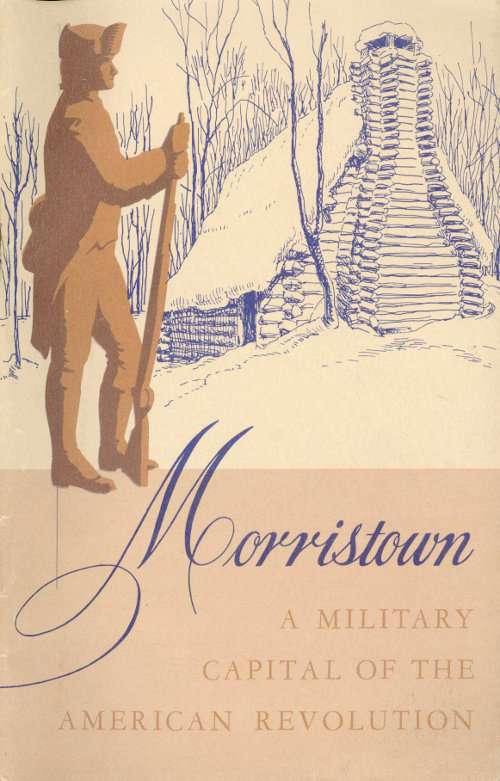
No. 7 Morristown, a Military Capital of the Revolution
No. 8 Hopewell Village
No. 9 Gettysburg
American canteen
Transcriber’s Notes
- Silently corrected a few typos.
- Retained publication information from the printed edition: this eBook is public-domain in the country of publication.
- In the text versions only, text in italics is delimited by _underscores_.