
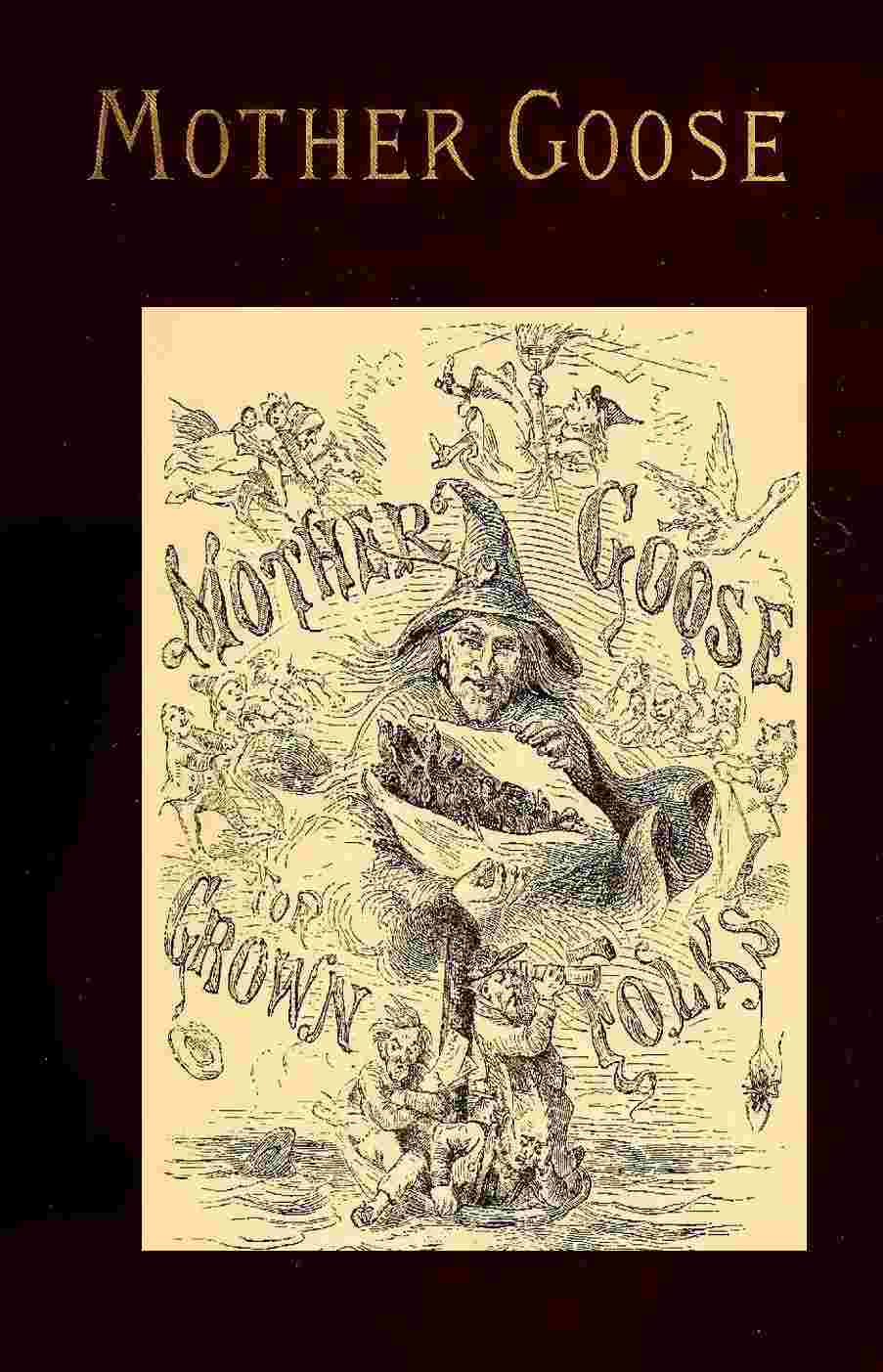
The Project Gutenberg eBook of Mother Goose for Grown Folks
Title: Mother Goose for Grown Folks
Author: A. D. T. Whitney
Illustrator: Augustus Hoppin
Release date: April 1, 2014 [eBook #45301]
Most recently updated: October 24, 2024
Language: English
Credits: Produced by David Widger from page images generously
provided by the Internet Archive
MOTHER GOOSE FOR GROWN FOLKS
BY MRS. A. D. T. WHITNEY
Illustrated By Augustus Hoppin
Boston
Houghton, Mifflin And Company
1883
Original
Original
Original
Original
CONTENTS
INTRODUCTORY.
Somewhere in that uncertain "long ago,"
Whose dim and vague chronology is all
That elfin tales or nursery fables know,
Rose a rare spirit,—keen, and quick, and quaint,—
Whom by the title, whether fact or feint,
Mythic or real, Mother Goose we call.
Of Momus and Minerva sprang the birth
That gave the laughing oracle to earth:
A brimming bowl she bears, that, frothing
high
With sparkling nonsense, seemeth non-
sense all;
Till, the bright, floating syllabub blown by,
Lo, in its ruby splendor doth upshine
The crimson radiance of Olympian wine
By Pallas poured, in Jove's own banquet-
hall.
The world was but a baby when she came;
So to her songs it listened, and her name
Grew to a word of power, her voice a spell
With charm to soothe its infant wearying
well.
But, in a later and maturer age,
Developed to a dignity more sage,
Having its Shakspeares and its Words-
worths now,
Its Southeys and its Tennysons, to wear
A halo on the high and lordly brow,
Or poet-laurels in the waving hair;
Its Lowells, Whittiers, Longfellows, to sing
Ballads of beauty, like the notes of spring,
The wise and prudent ones to nursery use
Leave the dear lyrics of old Mother Goose.
Wisdom of babes,—the nursery Shak-
speare stilly—
Cackles she ever with the same good-will:
Uttering deep counsels in a foolish guise,
That come as warnings, even to the wise;
As when, of old, the martial city slept,
Unconscious of the wily foe that crept
Under the midnight, till the alarm was heard
Out from the mouth of Rome's plebeian
bird.
Full many a rare and subtile thing hath
she,
Undreamed of in the world's philosophy:
Toss-balls for children hath she humbly
rolled,
That shining jewels secretly enfold;
Sibylline leaves she casteth on the air,
Twisted in fool's-caps, blown unheeded by,
That, in their lines grotesque, albeit, bear
Words of grave truth, and signal prophecy;
And lurking satire, whose sharp lashes hit
A world of follies with their homely writ;
With here and there a roughly uttered hint,
That makes you wonder at the beauty
in't;
As if, along the wayside's dusty edge,
A hot-house flower had blossomed in a
hedge.
So, like brave Layard in old Nineveh,
Among the memories of ancient song,
As curious relics, I would fain bestir;
And gather, if it might be, into strong
And shapely show, some wealth of its
lost lore;
Fragments of Truth's own architecture,
strewed
In forms disjointed, whimsical, and rude,
That yet, to simpler vision, grandly stood
Complete, beneath the golden light of
BRAHMIC.
If a great poet think he sings,
Or if the poem think it's sung,
They do but sport the scattered plumes
That Mother Goose aside hath flung.
Far or forgot to me is near:
Shakspeare and Punch are all the same;
The vanished thoughts do reappear,
And shape themselves to fun or fame.
They use my quills, and leave me out,
Oblivious that I wear the wings;
Or that a Goose has been about,
When every little gosling sings.
Strong men may strive for grander thought,
But, six times out of every seven,
My old philosophy hath taught
All they can master this side heaven.
LITTLE BOY BLUE.
"Little boy blue! come blow your horn!
The sheep in the meadow, the cows in the corn!
Where's little boy blue, that looks after the sheep?
He's under the hay-mow, fast asleep!"
Of morals in novels, we've had not a few;
With now and then novel moralities too;
And we 've weekly exhortings from pulpit
to pew;
But it strikes me,—and so it may chance
to strike you,—
Scarce any are better than "Little Boy
Blue."
For the veteran dame knows her business:
right well,
And her quaint admonitions unerringly
tell:
She strings a few odd, careless words in a
jingle,
And the sharp, latent truth fairly makes
your ears tingle.
"Azure-robed Youth!" she cries, "up to
thy post!
And watch, lest thy wealth be all scattered
and lost:
Silly thoughts are astray, beyond call of
the horn,
And passion breaks loose, and gets into the
corn!
Is this the way Conscience looks after her
sheep?
In the world's soothing shadow, gone sound-
ly asleep?"
Is n't that, now, a sermon? No lengthened
vexation
Of heads, and divisions, and argumenta-
tion,
But a straightforward leap to the sure ap-
plication;
And, though many a longer harangue is
forgot,
Of which careful reporters take notes on
the spot,
I think,—as the "Deacon" declared of his
"shay,"
Put together for lasting for ever and aye,—
A like immortality holding in view,
The old lady's discourse will undoubtedly
"dew"!
HICCOKY, DICCORY, DOCK.
"Hiccory, diccory, dock!
The mouse ran up the clock.
The clock struck one, and down she run:
Hiccory, diccory, dock!"
She had her simple nest in a safe and cun-
ning place,
Away down in the quiet of the deep, old-
fashioned case.
A little crevice nibbled out led forth into
the world,
And overhead, on busy wheels, the hours
and minutes whirled.
High up in mystic glooms of space was
awful scenery
Of wires, and weights, and springs, and all
great Time's machinery;
But she had nought to do with these; a
blessed little mouse,
Whose only care beneath the sun was just
to keep her house.
For this was all she knew, or could; with-
out her, just the same
The earth's great centre drew the weight;
the pendulum went and came;
And days were born, and grew, and died;
and stroke by stroke were told
The hours by which the world and men
are ever growing old.
It suddenly occurred to her,—it struck her
all at once,—
That living among things of power, her-
self had been a dunce.
"Somebody winds the clock!" she cried
"Somebody comes and brings
An iron finger that feels through and fum-
bles at the springs;
"And then it happens; then the buzz is
stirred afar and near,
And the hour sounds, and everywhere the
great world stops to hear.
I don't think, after all, it seems so hard a
thing to do.
I know the way—I might run up and
make folks listen too."
She sprang upon the leaden weight; but
not the merest whit
Did all her added gravity avail to hurry it.
She clambered up the steady cord; it wav-
ered not a hair.
She got among the earnest wheels; they
knew not she was there.
She sat beside the silent bell; the patient
hammer lay
Waiting an unseen bidding for the word
that it should say.
Only a solemn whisper thrilled the cham-
bers of the clock,
And the mouse listened: "Hiccory! hie—
diccory! die—dock!"
Something was coming. She had hit the
ripeness of the time;
No tiny second was outreached by that ex-
ultant climb;
In no wise did the planet turn the faster to
the sun;
She only met the instant, but the great
clock sounded—"One!"
What then? Did she stand gloriously
among those central things,
Her eye upon the vibrant bell, her heel
upon the springs?
Was her soul grand in unison with that
resounding chime,
And her pulse-beat identical with the high
pulse of Time?
Ah, she was little! When the air first
shattered with that shock,
Down ran the mouse into her hole. "Hic,
diccory! die—dock!"
Too plain to be translated is the truth the
tale would show,
Small souls, in solemn upshot, had better
wait below.
BO-PEEP.
"Little Bo-Peep
Has lost her sheep,
And does n't know where to find 'em;
Let 'em alone,
And they 'll come home,
And bring their tails behind 'em."
Hope beckoned Youth, and bade him keep,
On Life's broad plain, his shining sheep,
And while along the sward they came,
He called them over, each by name;
This one was Friendship,—that was Health;
Another Love,—another Wealth;
One, fat, full-fleeced, was Social Station;
Another, stainless, Reputation;
In truth, a goodly flock of sheep,—
A goodly flock, but hard to keep.
Youth laid him down beside a fountain;
Hope spread his wings to scale a mountain;
And, somehow, Youth fell fast asleep,
And left his crook to tend the sheep:
No wonder, as the legend says,
They took to very crooked ways.
He woke—to hear a distant bleating,—
The faithless quadrupeds were fleeting!
Wealth vanished first, with stealthy tread,
Then Friendship followed—to be fed,—
And foolish Love was after led;
Fair Fame,—alas! some thievish scamp
Had marked him with his own black stamp!
And he, with Honor at his heels,
Was out of sight across the fields.
Health just hangs doubtful,—distant Hope
Looks backward from the mountain slope,—
And Youth himself—no longer Youth—
Stands face to face with bitter Truth.
Yet let them go! 'T were all in vain
To linger here in faith to find 'em;
Forward!—nor pause to think of pain,—
Till somewhere, on a nobler plain,
A surer Hope shall lead the train
Of joys withheld to come again
With golden fleeces trailed behind 'em!
SOLOMON GRUNDY.
"Solomon Grundy
Born on Monday,
Christened on Tuesday,
Married on Wednesday,
Sick on Thursday,
Worse on Friday,
Dead on Saturday,
Buried on Sunday:
This was the end
Of Solomon Grundy."
So sings the unpretentious Muse
That guides the quill of Mother Goose,
And in one week of mortal strife
Presents the epitome of Life:
But down sits Billy Shakspeare next,
And, coolly taking up the text,
His thought pursues the trail of mine,
And, lo! the "Seven Ages" shine!
O world! O critics! can't you see
How Shakspeare plagiarizes me?
And other bards will after come,
To echo in a later age,
"He lived,—he died: behold the sum,
The abstract of the historian's page"
Yet once for all the thing was done,
Complete in Grundy's pilgrimage.
For not a child upon the knee
But hath the moral learned of me;
And measured, in a seven days' span,
The whole experience of man.
BOWLS.
"Three wise men of Gotham
Went to sea in a bowl:
If the bowl had been stronger,
My song had been longer."
Mysteriously suggestive! A vague hint,
Yet a rare touch of most effective art,
That of the bowl, and all the voyagers in't,
Tells nothing, save the fact that they did
start.
There ending suddenly, with subtle craft,
The story stands—as 'twere a broken
shafts—'
More eloquent in mute signification,
Than lengthened detail, or precise relation.
So perfect in its very non-achieving,
That, of a truth, I cannot help believing
A rash attempt at paraphrasing it
May prove a blunder, rather than a hit.
Still, I must wish the venerable soul
Had been explicit as regards the bowl
Was it, perhaps, a railroad speculation?
Or a big ship to carry all creation,
That, by some kink of its machinery,
Failed, in the end, to carry even three?
Or other fond, erroneous calculation
Of splendid schemes that died disastrously?
It must have been of Gotham manufacture;
Though strangely weak, and liable to frac-
ture.
Yet—pause a moment—strangely, did I
say?
Scarcely, since, after all, it was but clay;—
The stuff Hope takes to build her brittle
boat,
And therein sets the wisest men afloat.
Truly, a bark would need be somewhat
stronger,
To make the halting history much longer.
Doubtless, the good Dame did but gener-
alize,—
Took a broad glance at human enterprise,
And earthly expectation, and so drew,
In pithy lines, a parable most true,—
Kindly to warn us ere we sail away,
With life's great venture, in an ark of
clay,
Where shivered fragments all around be-
token,
How even the "golden bowl" at last lies
broken!