
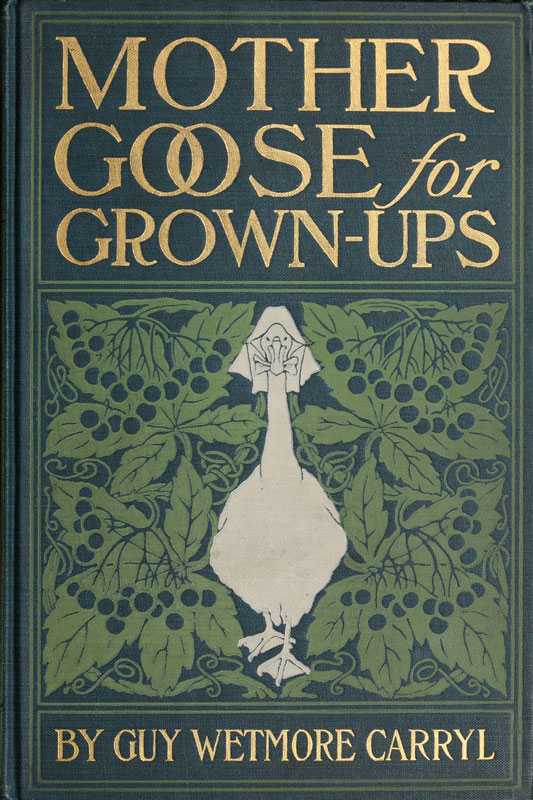
The Project Gutenberg eBook of Mother Goose for Grown-ups
Title: Mother Goose for Grown-ups
Author: Guy Wetmore Carryl
Illustrator: Peter Newell
Gustave Verbeek
Release date: October 25, 2015 [eBook #50310]
Most recently updated: October 22, 2024
Language: English
Credits: Produced by Suzanne Shell, Melissa McDaniel, and the Online
Distributed Proofreading Team at http://www.pgdp.net (This
file was produced from images generously made available
by The Internet Archive/American Libraries.)
Transcriber's Note:
Obvious typographical errors have been corrected. Inconsistent spelling and hyphenation in the original document have been preserved.
MOTHER GOOSE FOR GROWN-UPS
MOTHER GOOSE
FOR GROWN-UPS
By GUY WETMORE CARRYL
With Illustrations by Peter
Newell and Gustave Verbeek
NEW YORK AND LONDON
HARPER & BROTHERS
1900
Copyright, 1900, by Harper & Brothers.
All rights reserved
TO CONSTANCE
In memory of other days,
Dear critic, when your whispered praise
Cheered on the limping pen.
How short, how sweet those younger hours,
How bright our suns, how few our showers,
Alas, we knew not then!
If but, long leagues across the seas,
The trivial charm of rhymes like these
Shall serve to link us twain
An instant in the olden spell
That once we knew and loved so well,
I have not worked in vain!
NOTE
I have pleasure in acknowledging the courteous permission of the editors to reprint in this form such of the following verses as were originally published in Harper's Magazine, the Saturday Evening Post, and the London Sketch.
G. W. C.
CONTENTS
| PAGE | |
| The Admirable Assertiveness of Jilted Jack | 3 |
| The Blatant Brutality of Little Bow Peep | 9 |
| The Commendable Castigation of Old Mother Hubbard | 15 |
| The Discouraging Discovery of Little Jack Horner | 21 |
| The Embarrassing Episode of Little Miss Muffet | 27 |
| The Fearful Finale of the Irascible Mouse | 33 |
| The Gastronomic Guile of Simple Simon | 39 |
| The Harmonious Heedlessness of Little Boy Blue | 47 |
| The Inexcusable Improbity of Tom, the Piper's Son | 53 |
| The Judicious Judgment of Quite Contrary Mary | 59 |
| The Linguistic Languor of Charles Augustus Sprague | 65 |
| The Mysterious Misapprehension Concerning a Man in Our Town | 71 |
| The Opportune Overthrow of Humpty Dumpty | 77 |
| The Preposterous Performance of an Old Lady of Banbury | 83 |
| The Quixotic Quest of Three Blind Mice | 89 |
| The Remarkable Regimen of the Sprat Family | 95 |
| The Singular Sangfroid of Baby Bunting | 101 |
| The Touching Tenderness of King Karl the First | 107 |
| The Unusual Ubiquity of the Inquisitive Gander | 113 |
ILLUSTRATIONS
| PAGE | ||
| "'WILL YOU TELL ME IF IT'S STRAIGHT?'" | Frontispiece | |
| "SHE WAS SO CHARMINGLY WATTEAU-LIKE" | Facing p. 10 | |
| "NOW SIMON'S TASTES WERE MOST PROFUSE" | Facing p. 40 | |
| "WHILE BY KICKS HE LOOSENED BRICKS" | Facing p. 78 | |
| "SHE PLUCKED HIM WITH RELENTLESS FROWN" | Facing p. 114 |
THE ADMIRABLE ASSERTIVENESS
OF
JILTED JACK
A noble and a generous mind
Was Jack's;
Folks knew he would not talk behind
Their backs:
But when some maiden fresh and young,
At Jack a bit of banter flung,
She soon discovered that his tongue
Was sharp as any ax.
A flirt of most engaging wiles
Was Jill;
On Jack she lavished all her smiles,
Until
Her slave (and he was not the first)
Of lovesick swains became the worst,
His glance a strong box might have burst,
His sighs were fit to kill.
One April morning, clear and fair,
When both
Of staying home and idling there
In sloth
Were weary, Jack remarked to Jill:
"Oh, what's the sense in sitting still?
Let's mount the slope of yonder hill."
And she was nothing loth.
But as she answered: "What's the use?"
The gruff
Young swain replied: "Oh, there's excuse
Enough.
Your doting parents water lack;
We'll fill a pail and bring it back."
(The reader will perceive that Jack
Was putting up a bluff.)
Thus hand in hand the tempting hill
They scaled,
And Jack proposed a kiss to Jill,
And failed!
One backward start, one step too bold,
And down the hill the couple rolled,
Resembling, if the truth were told,
A luggage train derailed.
With eyes ablaze with anger, she
Exclaimed:
"Well, who'd have thought! You'd ought to be
Ashamed!
You quite forget yourself, it's plain,
So I'll forget you, too. Insane
Young man, I'll say oafweederzane."
(Her German might be blamed.)
But Jack, whose linguist's pride was pricked,
To shine,
Asked: "Meine Königin will nicht
Be mine?"
And when she answered: "Nein" in spleen,
He cried: "Then in the soup tureen
You'll stay. You're not the only queen
Discarded for a nein!"
The moral's made for maidens young
And small:
If you would in a foreign tongue
Enthrall,
Lead off undaunted in a Swede
Or Spanish speech, and you'll succeed,
But they who in a German lead
No favor win at all.
THE BLATANT BRUTALITY
OF
LITTLE BOW PEEP
Though she was only a shepherdess,
Tending the meekest of sheep,
Never was African leopardess
Crosser than Little Bow Peep:
Quite apathetic, impassible
People described her as: "That
Wayward, contentious, irascible,
Testy, cantankerous brat!"
Yet, as she dozed in a grotto-like
Sort of a kind of a nook,
She was so charmingly Watteau-like,
What with her sheep and her crook;
"She is a dryad or nymph," any
Casual passer would think.
Poets pronounced her a symphony,
All in the palest of pink.
Thus it was not enigmatical,
That the young shepherd who first
Found her asleep, in ecstatical
Sighs of felicity burst:
Such was his sudden beatitude
That, as he gazed at her so,
Daphnis gave vent to this platitude:
"My! Ain't she elegant though!"
Roused from some dream of Arcadia,
Little Bow Peep with a start
Answered him: "I ain't afraid o' yer!
P'raps you imagine you're smart!"
Daphnis protested impulsively,
Blushing as red as a rose;
All was in vain. She convulsively
Punched the young man in the nose!
All of it's true, every word of it!
I was not present to peep,
But if you ask how I heard of it,
Please to remember the sheep.
There is no need of excuse. You will
See how such scandals occur:
If you recall Mother Goose, you will
Know what tail-bearers they were!
Moral: This pair irreclaimable
Might have made Seraphim weep,
But who can pick the most blamable?
Both saw a little beau peep!
"SHE WAS SO CHARMINGLY WATTEAU-LIKE"
THE COMMENDABLE CASTIGATION
OF
OLD MOTHER HUBBARD
She was one of those creatures
Whose features
Are hard beyond any reclaim;
And she loved in a hovel
To grovel,
And she hadn't a cent to her name.
She owned neither gallants
Nor talents;
She borrowed extensively, too,
From all of her dozens
Of cousins,
And never refunded a sou:
Yet all they said in abuse of her
Was: "She is prouder than Lucifer!"
(That, I must say, without meaning to blame,
Is always the way with that kind of a dame!)
There never was jolli-
Er colley
Than Old Mother Hubbard had found,
Though cheaply she bought him,
She'd taught him
To follow her meekly around:
But though she would lick him
And kick him,
It never had any effect;
He always was howling
And growling,
But goodness! What could you expect?
Colleys were never to flourish meant
'Less they had plenty of nourishment,
All that he had were the feathers she'd pluck
Off an occasional chicken or duck.
The colley was barred in
The garden,
He howled and he wailed and he whined.
The neighbors indignant,
Malignant
Petitions unanimous signed.
"The nuisance grows nightly,"
Politely
They wrote. "It's an odious hound,
And either you'll fill him,
Or kill him,
Or else he must go to the pound.
For if this howling infernally
Is to continue nocturnally—
Pardon us, ma'am, if we seem to be curt—
Somebody's apt to get horribly hurt!"
Mother Hubbard cried loudly
And proudly:
"Lands sakes! but you give yourselves airs!
I'll take the law to you
And sue you."
The neighbors responded: "Who cares?
We none of us care if
The sheriff
Lock every man jack of us up;
We won't be repining
At fining
So long as we're rid of the pup!"
They then proceeded to mount a sign,
Bearing this ominous countersign:
"Freemen! The moment has come to protest
And Old Mother Hubbard delendum est!"
They marched to her gateway,
And straightway
They trampled all over her lawn;
Most rudely they harried
And carried
Her round on a rail until dawn.
They marred her, and jarred her,
And tarred her
And feathered her, just as they should,
Of speech they bereft her,
And left her
With: "Now do you think you'll be good!"
The moral's a charmingly pleasing one.
While we would deprecate teasing one,
Still, when a dame has politeness rebuffed,
She certainly ought to be collared and cuffed.
THE DISCOURAGING DISCOVERY
OF
LITTLE JACK HORNER
A knack almost incredible for dealing with an edible
Jack Horner's elder sister was acknowledged to display;
She labored hard and zealously, but always guarded jealously
The secrets of the dishes she invented every day.
She'd take some indigestible, unpopular comestible,
And to its better nature would so tenderly appeal
That Jack invoked a benison upon a haunch of venison,
When really she was serving him a little leg of veal!
Jack said she was a miracle. The word was not satirical,
For daily climbing upward, she excelled herself at last:
The acme of facility, the zenith of ability
Was what she gave her brother for his Christmas Day repast.
He dined that evening eagerly and anything but meagerly,
And when he'd had his salad and his quart of Extra Dry,
With sisterly benignity, and just a touch of dignity,
She placed upon the table an unutterable pie!
Unflagging pertinacity, and technical sagacity,
Long nights of sleepless vigil, and long days of constant care
Had been involved in making it, improving it, and baking it,
Until of other pies it was the wonder and despair:
So princely and so prominent, so solemn, so predominant
It looked upon the table, that, with fascinated eye,
The youth, with sudden wonder struck, electrified, and thunder struck,
Could only stammer stupidly: "Oh Golly! What a pie!"
In view of his satiety, it almost seemed impiety
To carve this crowning triumph of a culinary life,
But, braced by his avidity, with sudden intrepidity
He broke its dome imposing with a common kitchen knife.
Ah, hideous fatality! for when with eager palate he
Commenced to eat, he happened on an accident uncouth,
And cried with stifled moan: "Of it one plum I tried. The stone of it
Had never been extracted, and I've broke a wisdom tooth!"
Jack's sister wept effusively, but loudly and abusively
His unreserved opinion of her talents he proclaimed;
He called her names like "driveller" and "simpleton" and "sniveller,"
And others, which to mention I am really too ashamed.
The moral: It is saddening, embarrassing, and maddening
A stone to strike in what you thought was paste. One thing alone
Than this mischance is crueller, and that is for a jeweller
To strike but paste in what he fondly thought to be a stone.
THE EMBARRASSING EPISODE
OF
LITTLE MISS MUFFET
Little Miss Muffet discovered a tuffet,
(Which never occurred to the rest of us)
And, as 'twas a June day, and just about noonday,
She wanted to eat—like the best of us:
Her diet was whey, and I hasten to say
It is wholesome and people grow fat on it.
The spot being lonely, the lady not only
Discovered the tuffet, but sat on it.
A rivulet gabbled beside her and babbled,
As rivulets always are thought to do,
And dragon-flies sported around and cavorted,
As poets say dragon-flies ought to do;
When, glancing aside for a moment, she spied
A horrible sight that brought fear to her,
A hideous spider was sitting beside her
And most unavoidably near to her!
Albeit unsightly, this creature politely
Said: "Madam, I earnestly vow to you,
I'm penitent that I did not bring my hat. I
Should otherwise certainly bow to you."
Though anxious to please, he was so ill at ease
That he lost all his sense of propriety,
And grew so inept that he clumsily stept
In her plate—which is barred in Society.
This curious error completed her terror;
She shuddered, and growing much paler, not
Only left tuffet, but dealt him a buffet
Which doubled him up in a sailor-knot.
It should be explained that at this he was pained:
He cried: "I have vexed you, no doubt of it!
Your fist's like a truncheon." "You're still in my luncheon,"
Was all that she answered. "Get out of it!"
And The moral is this: Be it madam or miss
To whom you have something to say,
You are only absurd when you get in the curd
But you're rude when you get in the whey.
THE FEARFUL FINALE
OF THE
IRASCIBLE MOUSE
Upon a stairway built of brick
A pleasant-featured clock
From time to time would murmur "Tick"
And vary it with "Tock":
Although no great intelligence
There lay in either word,
They were not meant to give offence
To anyone who heard.
Within the pantry of the house,
Among some piles of cheese,
There dwelt an irritable mouse,
Extremely hard to please:
His appetite was most immense.
Each day he ate a wedge
Of Stilton cheese. In consequence
His nerves were all on edge.
With ill-concealed impatience he,
Upon his morning walk,
Had heard the clock unceasingly,
Monotonously talk,
Until his rage burst every bound.
He gave a fretful shout:
"Well, sakes alive! It's time I found
What all this talk's about."
With all the admirable skill
That marks the rodent race
The mouse ran up the clock, until
He'd crept behind the face,
And then, with words that no one ought
To use, and scornful squeals,
He cried aloud: "Just what I thought!
Great oaf, you're full of wheels!"
The timepiece sternly said: "Have done!"
And through the silent house
It struck emphatically one.
(But that one was the mouse!)
To earth the prowling rodent fell,
In terror for his life,
And turned to flee, but, sad to tell,
There stood the farmer's wife.
She did not faint, she did not quail,
She did not cry out: "Scat!"
She simply took him by the tail
And gave him to the cat,
And, with a stern, triumphant look,
She watched him clawed and cleft,
And with some blotting paper took
Up all that there was left.
THE GASTRONOMIC GUILE
OF
SIMPLE SIMON
Conveniently near to where
Young Simple Simon dwelt
There was to be a county fair,
And Simple Simon felt
That to the fair he ought to go
In all his Sunday clothes, and so,
Determined to behold the show,
He put them on and went.
(One-half his clothes was borrowed and the other half was lent.)
He heard afar the cheerful sound
Of horns that people blew,
Saw wooden horses swing around
A circle, two and two,
Beheld balloons arise, and if
He scented with a gentle sniff
The smells of pies, what is the dif-
Ference to me or you?
(You cannot say my verse is false, because I know it's true.)
As Simple Simon nearer came
To these attractive smells,
Avoiding every little game
Men played with walnut shells,
He felt a sudden longing rise.
The sparkle in his eager eyes
Betrayed the fact he yearned for pies:
The eye the secret tells.
('Tis known the pie of county fairs all other pies excels.)
So when he saw upon the road,
Some fifty feet away,
A pieman, Simple Simon strode
Toward him, shouting: "Hey!
What kinds?" as lordly as a prince.
The pieman said: "I've pumpkin, quince,
Blueberry, lemon, peach, and mince:"
And, showing his array,
He added: "Won't you try one, sir? They're very nice to-day."
Now Simon's taste was most profuse,
And so, by way of start,
He ate two cakes, a Charlotte Russe,
Six buns, the better part
Of one big gingerbread, a pair
Of lady-fingers, an eclair,
And ten assorted pies, and there,
His hand upon his heart,
He paused to choose between an apple dumpling and a tart.
Observing that upon his tray
His goods were growing few,
The pieman cried: "I beg to say
That patrons such as you
One does not meet in many a moon.
Pray, won't you try this macaroon?"
But soon suspicious, changed his tune,
Continuing: "What is due
I beg respectfully to add's a dollar twenty-two."
Then Simple Simon put a curb
Upon his appetite,
And turning with an air superb
He suddenly took flight,
While o'er his shoulder this absurd
And really most offensive word
The trusting pieman shortly heard
To soothe his bitter plight:
"Perhaps I should have said before your wares are out of sight."
"NOW SIMON'S TASTES WERE MOST PROFUSE"
THE HARMONIOUS HEEDLESSNESS
OF
LITTLE BOY BLUE
Composing scales beside the rails
That flanked a field of corn,
A farmer's boy with vicious joy
Performed upon a horn:
The vagrant airs, the fragrant airs
Around that field that strayed,
Took flight before the flagrant airs
That noisome urchin played.
He played with care "The Maiden's Prayer;"
He played "God Save the Queen,"
"Die Wacht am Rhein," and "Auld Lang Syne,"
And "Wearing of the Green:"
With futile toots, and brutal toots,
And shrill chromatic scales,
And utterly inutile toots,
And agonizing wails.
The while he played, around him strayed,
And calmly chewed the cud,
Some thirty-nine assorted kine,
All ankle-deep in mud:
They stamped about and tramped about
That mud, till all the troupe
Made noises, as they ramped about,
Like school-boys eating soup.
Till, growing bored, with one accord
They broke the fence forlorn:
The field was doomed. The cows consumed
Two-thirds of all the corn,
And viciously, maliciously,
Went prancing o'er the loam.
That landscape expeditiously
Resembled harvest-home.
"Most idle ass of all your class,"
The farmer said with scorn:
"Just see my son, what you have done!
The cows are in the corn!"
"Oh drat," he said, "the brat!" he said.
The cowherd seemed to rouse.
"My friend, it's worse than that," he said.
"The corn is in the cows."
The moral lies before our eyes.
When tending kine and corn,
Don't spend your noons in tooting tunes
Upon a blatant horn:
Or scaling, and assailing, and
With energy immense,
Your cows will take a railing, and
The farmer take offense.
THE INEXCUSABLE IMPROBITY
OF
TOM, THE PIPER'S SON
A Paris butcher kept a shop
Upon the river's bank
Where you could buy a mutton chop
Or two for half a franc.
The little shop was spruce and neat,
In view of all who trod the street
The decorated joints of meat
Were hung up in a rank.
This Gallic butcher led a life
Of highly moral tone;
He never raised his voice in strife,
He never drank alone:
He simply sat outside his door
And slept from eight o'clock till four;
The more he slept, so much the more
To slumber he was prone.
One day outside his shop he put
A pig he meant to stuff,
And carefully around each foot
He pinned a paper ruff,
But, while a watch he should have kept,
His habit conquered, and he slept,
And for a thief who was adept
That surely was enough.
A Scottish piper dwelt near by,
Whose one ungracious son
Beheld that pig and murmured: "Why,
No sooner said than done!
It seems to me that this I need."
And grasping it, with all his speed
Across the Pont des Invalides
He started on a run.
Then, turning sharply to the right,
Without a thought of risk,
He fled. 'Tis fair to call his flight
Inordinately brisk.
But now the town was all astir,
In vain his feet he strove to spur,
They caught him, shouting: "Au voleur!"
Beside the Obelisk.
The breathless butcher cried: "A mort!"
The crowd said: "Conspuez!"
And some: "A bas!" and half a score
Responded: "Vive l'armée!"
While grim gendarmes with piercing eye,
And stern remarks about: "Canaille!"
The pig abstracted on the sly.
Such is the Gallic way!
The piper's offspring, his defeat
Deep-rooted in his heart,
A revolutionary sheet
Proceeded then to start.
Thenceforward every evening he
In leaders scathed the Ministry,
And wished he could accomplish the
Return of Bonaparte.
The moral is that when the press
Begins to rave and shout
It's often difficult to guess
What it is all about.
The editor we strive to pin,
But we can never find him in.
What startling knowledge we should win
If we could find him out!
THE JUDICIOUS JUDGMENT
OF
QUITE CONTRARY MARY
Though Mary had the kind of face
The rudest wind would softly blow on;
Though she was full of simple grace,
Sweet, amiable, and kind, and so on;
I would not have you understand
That she was meek. You'd be mistaken.
She worked out logarithms, and
Her favorite essayist was Bacon.
And, though not positive, I think
She'd heard about Savonarola,
Had studied Maurice Maeterlinck,
And read the works of Emile Zola,
And Emerson's and some of Kant's,
And all of mine and Shopenhauer's;
But still she cultivated plants,
And spent her life in tending flowers.
She had a little hedge of box,
Azalias, and a bed of tansy,
A double row of hollyhocks,
And every different kind of pansy:
And, though so innocent of look,
She'd lovers by the scores and dozens,
And learned, by talking with the cook,
To tell her friends they were her cousins.
The first was French, the second Greek,
The third was born upon the Mersey,
The fourth one came from Mozambique,
The fifth one from the Isle of Jersey.
I cannot tell about the rest,
But, judging from their dress and faces,
They came from north, east, south, and west,
But all of them from different places.
Now, such was Mary's sense of pride,
Despite their fervent protestations,
Before she vowed to be a bride
She set them all examinations:
She asked each one to tell the date
Of Washington and Cleopatra,
Name Dickens' novels, and locate
The site of Yonkers and Sumatra.
But so it chanced that, from a score
Of suitors resolute and haughty,
One gained a mark of sixty-four,
And all the rest were under forty.
One swain alone the rest outclassed;
Because of one audacious guess, he
This strict examination passed
When Mary asked the date of Crécy.