
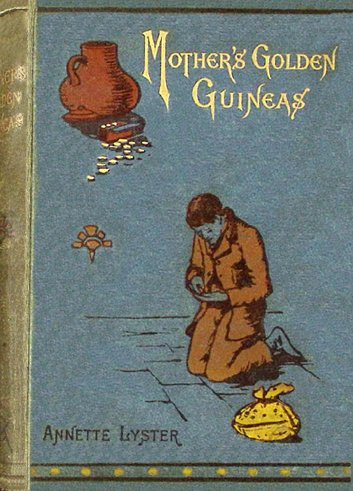
The Project Gutenberg eBook of Mother's golden guineas
Title: Mother's golden guineas
Author: Annette Lyster
Illustrator: Frederic George Kitton
Release date: August 2, 2025 [eBook #76620]
Language: English
Original publication: London: Society for Promoting Christian Knowledge, 1889
Transcriber's note: Unusual and inconsistent spelling is as printed.
"ONE MIGHT DO," THOUGHT TOM,
LOOKING AT THE BRIGHT COINS.
Frontispiece.
MOTHER'S GOLDEN GUINEAS.
BY
ANNETTE LYSTER
AUTHOR OF "GRANNIE," "FAITHFUL," "OUT IN THE COLD,"
"THE WHITE GIPSY," "ALONE IN CROWDS," ETC.
ILLUSTRATED BY F. G. KITTON.
—————————————
PUBLISHED UNDER THE DIRECTION OF THE COMMITTEE
OF GENERAL LITERATURE AND EDUCATION APPOINTED BY THE
SOCIETY FOR PROMOTING CHRISTIAN KNOWLEDGE.
—————————————
LONDON:
SOCIETY FOR PROMOTING CHRISTIAN KNOWLEDGE
NORTHUMBERLAND AVENUE, CHARING CROSS, W.C.;
43, QUEEN VICTORIA STREET. E.C.
BRIGHTON: 135, NORTH STREET.
NEW YORK: E. & J. B. YOUNG AND CO.
CONTENTS.
CHAPTER
VII. "THREE CHEERS FOR CAPTAIN EGERTON!"
VIII. A "CUTTING-OUT" EXPEDITION
X. TOM'S ONE HUNDRED AND FIFTY GUINEAS
XII. BETTER THAN GOLDEN GUINEAS
MOTHER'S GOLDEN GUINEAS.
CHAPTER I.
BURDECK.
SOMEWHERE between Wakefield and Doncaster, but much nearer Wakefield, there is a little village called Burdeck, which even in these days of progress is but a small place, and of no importance in any way. But in the days of which I am about to tell you something, it was so utterly insignificant, so little known except to the few who lived there, and to the nobleman of whose estate it formed part, that had it been swallowed up by an earthquake, some time might have elapsed before it was missed. Yet to the twenty or thirty families who lived there, Burdeck was just as interesting and important as London is to such of my readers as may happen to live there; nay, perhaps more important, because you know other places as well as London, while to the people of Burdeck, Burdeck was the world—with Wakefield at a distance. No coach came near Burdeck; it returned no member to Parliament; a newspaper would have been of little use, for there were few who could read, and fewer still who cared to do so.
In Burdeck it was held to be not quite commendable to do anything but what one's parents had done in their day. The farms were not very extensive, but the farmers throve and employed a good deal of labour, the labourers living in the little village. There was almost no actual poverty, and no discontent. Things were as they had always been, and therefore were as they ought to be. I do not mean that there was no grumbling; the Burdeckers were Englishmen, and they grumbled heartily at many things. At the weather, at the charges Giles the blacksmith made for shoeing horses, etc., at the extortion practised at the one little shop, at the length of time the cobbler took to "welt" the shoes; oh yes, they grumbled, but then they enjoyed it. If all these small afflictions had been removed, if the weather had always suited them, the blacksmith had lowered his prices, the bread, bacon, and cheese had been cheaper, and the cobbler more punctual, Burdeck would have been at a loss for something to talk about. There were many things they could have better spared than their little grumbles.
All this took place early in the present century, now growing very old. Of course in these enlightened days no one grumbles.
It was a lovely evening in June; the work of the day was done, and the labourers had reached home, and were most of them employed in making a solid meal, each in his own clean and comfortable kitchen. Burdeck was a very clean place. The good women, not being overworked, kept a bright look-out on each other, and to have a dirty, untidy house, or to send out one's children ragged and unwashed, were sins soon visited by general condemnation.
But if there was one cottage more trimly-neat, inside and outside, one garden better stocked with vegetables of the common sorts, and brighter with the sweet old common flowers than the rest, that cottage and garden belonged to Thomas Adderley, ploughman at the Hill Farm. For Thomas was a sober, industrious man, and he had a wife who was a treasure in herself; a good, busy, thrifty woman, who found time for many small industries, besides bringing up her family carefully and comfortably.
There was a certain peddler who went his rounds regularly in that part of the country, and he always brought to Mrs. Adderley a quantity of woollen yarn, which she knit up into stockings, mittens, cuffs, and comforters, all of which he bought from her at his next visit. Then, too, she kept bees, and every autumn a dealer from Wakefield came out with his light cart, and bought all her honey and spare wax. She also kept a few hens, and if she did not make money by her eggs, she saved money by them, which is as good; she seldom sold eggs, but the bacon went twice as far when there was a fine dish of fried eggs with it. She worked in the garden herself, and taught the children to help her, so that honest Thomas could rest after his hard day's work, instead of having to turn out after supper to dig his garden. There was a fine apricot on one side of the cottage door, and a pear on the other, and the Wakefield shopkeeper bought all the fruit. Mrs. Adderley pruned and trimmed those trees herself, and woe betide the child who should be so misguided as to touch the fruit.
"I'm saving up against a rainy day," she said, "and you must help instead of hindering. Look, now—I'll take down the box and show you my golden guineas. One of these days you may be very glad to get help from that box, and when you want it, you'll be welcome to it. But you must not waste our substance now. Health and strength don't last for ever, and I mean to have something saved against a rainy day."
But even before a "rainy day" came, mother's golden guineas were called upon for help. When Sam, the eldest son, set up the horse and cart by which he now earned such good wages, mother gave him every penny she had to help him, the rest he had saved himself. When Dolly, the only girl, married Harry Sands, mother's golden guineas bought some useful furniture for the young couple. And when poor Harry was killed by a kick from a vicious horse, within a year of his marriage, and Dolly broke her heart and died, leaving her baby to her mother's care, the guineas had to pay for the two funerals. Poor mother! Little joy had she in that expenditure, though you may be sure she was pleased to do things "creditably."
You may imagine that, with all these calls upon the hoard, the number of guineas was not at any time very great. There would often be only one, with a few silver coins on their way to be transformed into a second by-and-by. Mrs. Adderley always got her friend the peddler to take her silver and give her gold, for, she said, "one might be tempted to spend a shilling or two, when one would not break into a guinea." Sometimes there were three, and more than once there had been five—but at the time when my story opens there were actually ten! For Sam had saved up by degrees, and had repaid his mother what she had given him when he bought his horse, and the fruit and honey had been very abundant last year. They promised well now, and Mrs. Adderley, standing in her doorway on the evening in June of which I spoke, mentioned this pleasing fact to her good man Thomas, who was steadily eating bread, bacon, and eggs, and drinking milk, in the cheery kitchen.
Beside him sat his son Sam, and on his knee was perched little Dolly, his grandchild, now three years old, and the pet of the whole household. Mrs. Adderley's cup and plate showed that she had been partaking of the meal; and there were another cup and plate on the table, not used as yet.
"Come your ways in, woman," said Thomas, as he popped a specially crisp morsel of bacon into Dolly's ready mouth, "and finish your supper. I doubt Tom wants no supper to-night."
"Dear, dear, Thomas, I wish the lad was home! I don't know how he expects to keep a place if he behaves like this!"
"If he behaves like what?" inquired Thomas. "Come, my woman, you'll have to tell me."
"Well—but you won't be hard upon him, Thomas, for he's a spirity, wild lad, and hardness will only harden him.—Oh, there's old Jerry Dwight. Tom's always after him, with his talk of Hull and Liverpool and sea-going that he's always gabbling about. Maybe he'll know.—Master Dwight! Master Dwight! Stop a bit!" She ran to the little gate. "Did you see our Tom to-day, Master Dwight?"
"Did I see who?" said old Dwight, putting his hand up to his ear—only to gain time, for he heard well enough.
"Our Tom! He hasn't come home yet."
"Your Tom? Ah yes, Tom—young Thomas Adderley. A fine, strapping, stirring lad, is Tom. And don't you believe, Mrs. Adderley, that you'll ever make such another as Sam out of Tom. Tom has notions. You just give him a little money, and let him go seek his fortunes. Tom would—"
"Master Dwight, I'm not one bit obliged to you for giving words to such a notion. Seek his fortunes, indeed! Seek a halter, you mean. Your wanderers do mostly end like that. Since I can remember, only two lads left Burdeck, and one of them 'listed for a soldier, and was shot dead in forran parts. The vicar rode over on a week-day to tell his mother, and you might have heard her screams a mile off. And the other was hanged in York city for sheep-stealing. Tom's a little bit idle and rampagious, but he'll settle down and be a comfort yet, if you'll let him alone with your talk of seeking fortunes. If fortunes are so easy to come by, why didn't 'you' get one with all your wandering? You just leave my Tom alone—do now, Master Dwight; I ask it as a favour."
"I leave your Tom alone?" old Dwight piped up in his shrill, cracked voice. "You get Tom to leave 'me' alone, and 'tis little I shall run after him. Your Tom is just the plague of my life. I be three score and ten years old, and 'twould become me to be thinking frequent of my latter end. And just when I'm set down in a sunny corner most conformable for a quiet think, with maybe a little nap to rest me after it, comes your Tom, begging and praying to hear of my adventures when young. Not that I blame him, for he's got some spirit and is clever beyond most Burdeck folk, and no doubt he finds me better company than a lot of fellows that never saw anything but Burdeck, and can scarce believe that the sun shines on other places.
"I've been to Hull, I have; and was born in Liverpool, and was once in London. If you disbelieve me, ask my darter. No doubt Tom likes to hear what one like me can tell him. But, anyhow, I didn't eat him alive this time, for here he comes. Good evening, Mrs. Adderley. I must be getting towards home."
Mrs. Adderley looked, and beheld her hopeful Tom just parting from a boy and girl of about his own age—Lucy Trayner and one of her numerous brothers, part of a family which lived in the next cottage. Tom stood talking to Lucy for a few moments, then came on, meeting old Dwight on his way.
"You'll catch it, my boy," said Dwight; "there's your mother on the look-out for you."
Tom laughed and ran on—a fine, well-grown, handsome lad of about fifteen, tall for his age, and strong and active beyond the common.
"Tom, where have you been all this day? Master Minchin sent a lass to see about you, at twelve—and I thinking you had gone to your work like a good lad!"
"Well, mother, I told old Minchin last night that I'd never take hold of a hay-fork again for him at fourpence a day. I do a man's work, and he must give me a man's wages. I want to save some money. So, you see, it's not my fault I wasn't at work. And I've had a grand day in the oak wood with Lucy Trayner, and I'm as hungry as a wolf, so come along and give me my supper."
"Supper's over," she said, "and father's ill-pleased, and said you'd get no supper to-night."
Tom whistled a lively tune as they both walked up to the house.
Thomas Adderley was now standing in the doorway.
"Where have you been, Tom?" said he.
"In the wood, father."
"Not at your work at all, then? I suppose Farmer Minchin will be dismissing you now—as Farmer Bell did at Christmas, and Farmer Cunlip at Hallowmass! Tom, I never lifted my hand to one of ye yet, but seems to me you'd be the better for a leathering."
"Farmer Bell dismissed me because I said 'twasn't fair to make me work Christmas Day, minding his horses, without paying me for it. Farmer Cunlip said I was idle, but 'twas his own son was idle. Old Minchin didn't dismiss me—'I' dismissed him."
At these audacious words the whole family—father, mother, and Sam—exclaimed, "Oh, laws!" Even little Dolly said it, but she was a little late with it, and ended by a delighted burst of baby laughter.
"I haven't said aught to surprise you so. I told old Minchin I would not work for him any more at fourpence a day. I do as much as any of the men, and he knows it, and I want to be saving money. He said he'd see me further, so I didn't go to-day."
"Mother," said Thomas, "this boy of yours will be a credit to us yet. He'll come to the gallows as sure as eggs is eggs. The boldness of him! I've had too much patience with you, Tom, that's how 'tis. Go to bed this moment, without any supper, not so much as a crust. I'll go to Farmer Minchin, and see if he'll overlook your folly just this once. You're a boy till you're eighteen, as all Burdeck knows, and, boy or man, you're bound to do as good a day's work as you can. Let me hear no more of this nonsense. If Farmer Minchin won't take you back, I'll go to Giles the blacksmith. Little Ben that blows the bellows is sick, and I'll hire you to him. It's small pay, and Giles is as like to give you a blow as a word—but 'twill do ye good. Now, mother, not a bite of anything is he to get, but go to bed empty. Idle, saucy fellow, as doesn't know when he's well off!"
It was not often that quiet Thomas Adderley made so long a speech, and that he should scold one of his children was a thing unheard of, as he "left all that to the missus" generally.
Accordingly, every one was much impressed. Dolly cried; Mrs. Adderley looked vexed and sorry; Sam made his escape from the scene, and went to visit Jane Waters, the girl he was slowly "courting;" even Tom failed to whistle as he stole off to bed, and lay down, hungry and weary, to think over his evil doings.
CHAPTER II.
TOM MAKES A HORSE-SHOE.
ADDERLEY came home late that night, and found his wife waiting for him, with a pint of beer warming on the hob, and a "bite" of bread-and-cheese on the table, ready for him.
"I thought you'd be hungry, Thomas," said she. "And now tell me, what did Master Minchin say?"
"Says Tom will come to the gallows yet."
"O mercy! My fine boy! But I don't mind Master Minchin. He's a hot-tempered man, and maybe he's angered at losing Tom."
"Maybe, but he 'says' he's glad to be rid of him. Says as Tom puts the other lads up to mischief, and gives impudence when spoken to. Only two days gone, when he was helped to his dinner, he took his plate in his two hands and walked all up the room to where Mrs. Minchin was cutting the bacon, and holds out the plate to her, and says, 'Ma'am, will ye please to show me the bacon?' says he. 'I see the cabbage and the bread,' says he. Mrs. Minchin, she up'd and boxed his ears, and says he, 'That's no argument,' and the men and lasses all sniggering."
Mrs. Adderley turned her face away, and her voice shook a little as she said—
"O laws, how could he have the face? No wonder you look grave over it, Thomas."
"Mother, you're laughing."
"Well," said she, "but will the Minchins take him back?"
"No. 'He' would, but 'she' wouldn't have it. So I saw Giles, and 'tis true he wants a boy. It's a poor place for a strapping fellow like Tom—only twopence a day and his dinner. But it will take the conceit out of him, and I'm not set on his earning money to save. Don't you be soft with him, now, and say he may keep part of that twopence. Say he eats more than twopence, but that it's better than nothing. I don't believe it's for any good he wants to be saving. He ain't like Sam."
"No, but you can't deny, Thomas, he's cleverer than Sam. See how he mended them stools. Carpenter couldn't do it handier. See how he patched his shoes t'other day. Cobbler couldn't beat it. And can tell every letter, though he got no more schooling than the others, and Sam can't tell the letters of his own name on his cart, no more than I can myself. Oh, he's clever both with his head and his fingers, and if we could 'prentice him in Wakefield, Thomas, he'd do well."
"'Prentice him in Wakefield! Woman dear, are ye losing your wits? Why, Master Bell's sons, two of 'em, is 'prenticed there, and I wonder what Farmer Bell and my own master would say if I tried to do the like with 'my' son? Little work I'd get, I do expect. Set Tom up, forsooth! Let him work honest for his daily bread, as his father, and my father, and 'his' father, ay, and 'his' father again, if so be he had one, did before him. No good comes of being proud and above your station. I'll keep Tom's nose to the grindstone for a goodish bit, and then maybe master will take him on, under me, and I'll teach him to plough, and have my eye upon him."
With these words, Thomas swallowed the last morsel of bread-and-cheese, and took up the pot of beer.
"Here, mother, take your share; and don't fret about Tom—I'll soon bring him in. Why, you've took no more than if you was a sparrer. Take another drop. Ye won't? Well, here's your health, then. We can't waste the good beer."
He finished the beer slowly, the better to enjoy it, and then said in a lower voice—
"I think I'll have a look at Tom. If I find him awake and hungry, a crust of bread won't set him up too much."
He crossed the kitchen, and opened the door of the little room where the boys slept. And finding Tom in bed and snoring, he never suspected how nearly he had caught him wide awake and listening eagerly at the keyhole.
"He's asleep. He'll make up for it at breakfast, never fear," said Thomas. "Sam isn't in bed."
"No; he's not in yet. You go off to bed, and I'll wait for Sam. He won't be long. Reg'lar as a clock, Sam is."
"Jenny Waters is a lucky young maid," remarked Thomas.
Mrs. Adderley said nothing—privately she thought her Sam a great deal too good for Jane Waters.
In a very short time, the house was shut up and every one was asleep, save Tom. He was hungry, and could not get to sleep, so he lay thinking.
"Reg'lar as clockwork, Sam is! Of course he is! He's just such another as father. It's my belief father wouldn't rise in life if he could. I'm not so. I want to get rich and have a farm, like old Minchin—only never will I be such a screw. And I want to see the world, and to have a chance to be something but a ploughman or a carter, and I will too. Old Dwight says if I had a few guineas, but I'd go if I had a few shillings saved. And I'm to blow the bellows—work fit for a four-year-old—for twopence a day, and I'm not to be let save! Well, I'm glad I know it's a set plan, for, if not, I might have gone on from day to day till I got to be as stupid as the rest of them. To work with Giles till the conceit is taken out of me, and then to learn ploughing under father's eye! Well, we'll see."
He fell asleep at last. When he had eaten a most tremendous breakfast next morning, he asked very innocently—
"Am I to go to Master Minchin's, father?"
Father, very naturally, improved the occasion.
Tom listened dutifully. Having heard that he was to go to the forge, he said not one word of remonstrance, but walked off, whistling. He was always whistling or singing.
Tom kept his place for about a week, and if Giles had cared to teach him his craft, this story would probably never have been written. For Tom took a fancy to the blacksmith's work, and longed to try his hand at it. And one day Giles, coming in suddenly, found his own hopeful son, a lazy young giant, blowing the bellows, and Tom Adderley working manfully at a horse-shoe. Moreover, at a better shoe than young Giles had yet made, though he was supposed to be learning. Giles dismissed Tom that night.
"Little Ben," he said, "is all right now, and you will easily get work. I don't want you about the forge, mind. Don't be coming here after my boys—I won't have it."
Tom whistled, and walked home.
"Father, Giles has dismissed me."
"And why, Tom?"
"'Cause I made a better horse-shoe than young Giles can, and he's afraid I'll learn the trade and set up for myself."
"The conceit of this boy!" cried Thomas Adderley, much moved. "I must go to Giles and see what he says."
"I don't know what he'll say, father, but I've told you the truth. I went to work to-day while he was out—young Giles is lazy and was glad to give up the hammer to me. Old Giles came in, and when he looked at the shoe, and then at me, I guessed how 'twould be. Three days, mother—there's sixpence."
Adderley went to the forge. Giles told him that Tom was idle, and had spoilt a horse-shoe, fiddling at it with the hammer, because his eye was off him for a moment. He preferred having little Ben, who was quite well again.
"My boy says he made a good horse-shoe," said Adderley.
"Judge for yourself; there 'tis," answered Giles.
But he did not say that he had heated the shoe and beaten it out of shape since Tom's departure.
"Tom Adderley's too clever for me," Giles said to his wife that night. "He'd be a better smith in six months than our boy will ever be; it wouldn't do at all."
Thomas Adderley went home, much grieved at this fresh instance of Tom's conceit. He hated to do it, but Tom really wanted a flogging so badly that he must have one; and he had one, and was sent off to bed afterwards. It was by no means a severe beating, and Tom was none the worse—except mentally. He had told the truth, and father would not believe him. He would have liked to be a blacksmith, and Giles would not let him. He had lost one place after another, and knew that it would be very hard to get work.
"I'll run away," muttered Tom. "I'll go to sea, and be a sailor, and see the world. I've good brains and strong arms, and I won't stay here to be treated like a baby. Let me see now; I must have 'some' money. Maybe Master Dwight would lend me some. He has savings, I know. I'll ask him, anyhow."
Tom was sent, next day, to work in the garden, as his father had nothing better to propose. He worked for an hour or so, and then jumped over the fence into the Trayners' garden. Peeping in at the window, he saw his friend Lucy alone in the kitchen, so he ran round to the door and went in.
"Lucy dear, if you hear that I've run away, don't you believe it—I mean, I'm going to run away, but I'll surely come back. I can't stay here, Lucy. I'll go, and I'll see the world, and get a lot of money, and then I'll come home and buy a farm, and marry you, Lucy, for I'm very fond of you. Don't you tell any one that I said a word to you, but I couldn't go with saying good-bye."
Lucy, a pretty, gentle girl, not burdened with more brains or more learning than her neighbours, was terribly frightened. She was sure he'd be caught and brought home, and beaten. She was sure he'd be lost, and starved to death. She was sure he'd get to be a great man, and forget every one at Burdeck, including herself. Tom combated all these predictions one by one; to the last, his reply was perhaps more sincere than gallant.
"That's impossible," said he, "for though I might forget you, Lucy, and every one else, I never could forget mother—nor father, though he did not believe me. Well, good-bye, Lucy; you'll see me again one of these days—maybe riding in my carriage, or on a fine horse. 'Then' you'll be proud of me. Mind now, keep my secret."
He ran off, leaving Lucy in tears.
Tom found old Dwight in his usual summer retreat, a warm corner in his son-in-law's garden. It is to be hoped that he had reflected duly on his latter end, for he was certainly taking the little doze which he had mentioned as being refreshing after that exercise. However, he woke up, and said he was glad to see Tom.
"I like you, Tom. You've got some brains, and you know the difference between a man like me and these fellows, honest fellows all of 'em, but that never saw the tenth milestone out o' Burdeck."
"I 'do' know the difference," said Tom, eagerly, "and I've made up my mind, Master Dwight, that I'll do as you did. I'll see the world. I'm going to run away. I'll be a sailor, and I'll make my fortune. I know I shan't do it all at once, but you'll see, I'll do it. And I want your advice and help."
"Seems to me," said old Dwight, "as you've pretty well made up your mind without my advice."
"Yes—to go. But tell me what you would advise me to do."
"Go to Hull—there's your place. How to get there, you say. Well, go to Wakefield—you know the road that leads to Wakefield. There's a coach goes through Wakefield, and at the coach office they'll tell you how to get to Hull. But let me tell you, my lad, you might do better than go for a sailor."
"Oh, but I must see the world!" cried Tom. "I'm that tired of everything here that it's like a hunger in me—the wish to see the world. And, Master Dwight, would you lend me money enough to pay the coach, and just to live till I get to Hull?"
"Oh, that's a very different matter," said Master Dwight, slowly. "Tom, I don't see how I could do that. To give you money to run away—when your father found it out, he'd have me in Wakefield Jail, he would. It's against the law, my boy. That's the plain truth. Only for that, I should be very glad to oblige you, and I think you're quite right to go, but I can't break the law for you."
It did not occur to Tom, at the moment, to doubt Master Dwight's assertion about the law. He looked very downcast.
"D'ye mind, my boy, what you told me once about your mother having some money saved? You talk her over, and get her to give you a guinea or so. If she lent you a good sum—say, 'ten' guineas for argument's sake—you'd be able to set up in some small way o' business, and you're sharp enough to make money, if you once had a decent start. Tell her it's only a lend, and that you'll surely pay it back. You'll do well, Tom; and when you're a rich man, you'll remember poor old Jeremiah Dwight that taught you, and heartened you up, and helped you all he could."
Master Dwight seemed quite affected, no doubt by his own generosity with Mrs. Adderley's money. If you ask me why he encouraged Tom to run away, I must confess that it was partly because he had so often sneered at the Burdeck people for their contented stupid ways that he felt ashamed to say a word against the result of his own words. Again, he found Burdeck very dull, and the row that would ensue when Tom was missed promised to be amusing.
"Well," remarked Tom, after a short pause for reflection, "you'll keep my secret, Master Dwight, though you can't help me? For I shall go, even if I go with only this—" holding out twopence—"in my pocket. I must run home now, or I may be missed. Good-bye, Master Dwight; I'm thankful to you for all you've taught me."
He ran off, and found that he had not been missed. For the rest of the day he worked very hard in the little garden.
CHAPTER III.
TOM GOES TO SEA.
ALL that afternoon, as Tom hoed and thinned the growing crops in the tiny garden, he was thinking over his difficulties, and determining upon his future course of action.
Not determining to run away, that was already a settled thing. That very night should see him on his way. But not to Hull. Reflecting over what had passed between himself and old Dwight, Tom did not feel satisfied with the conduct of that old humbug, and it struck him that old Dwight would, perhaps, give his father a hint to search for him on the Wakefield road, and might even mention Hull. Dwight had told him that there was a great seaport town on "the other side," as Tom put it, called Liverpool. It was further off, Dwight said, but even if he walked the whole way, he would get there in time.
To walk he had no objection, but then he had no idea how long it would take to get there, and to depend on twopence-worth of bread was not to be thought of. Money "must" be had somehow. If he asked mother to lend it, she would not only refuse, but she would tell his father all about it. This would put an end to the whole thing, he would be so well watched. To tell mother was out of the question. But when she saw him back again with a pocketful of money, and dressed like the sailor in Master Dwight's song-book—a volume out of which the old man had taught the boy many a song—in blue jacket, loose trousers, blue cap, and a knife with a twisted string to it, then she would forgive him, no matter how he got the money, particularly as he would restore it to her, and as much again as—well, as she had lent him.
To come back a sailor, with plenty of money and grand stories about foreign countries, such as he had heard from Master Dwight, who, however, had never seen foreign countries himself—this was the least unlikely of Tom's visions concerning his future return home. To drive up to his father's door in a grand coach with six horses and four servants—such as Master Dwight had seen in London—to ask,—
"Does Master Adderley live here?"
And then, when father, mother, Sam, and little Dolly had all gazed with respectful admiration at this wonderful apparition, to say,—
"Don't you know me? I'm Tom; and, mother, here's your money, and a lot more—"
This also was among those foolish visions. And before you laugh at him and say that no boy of fifteen could have been such a fool, remember that Tom, though naturally a clever, active-minded fellow, was more ignorant than any boy of fifteen in these days could well imagine. The only school in Burdeck was kept by an old woman, who could read (after a fashion), but who could not write at all. She kept the smaller children out of their mothers' way for a couple of hours every day; some of them learned their letters, some did not. Tom knew all the letters, both capital and small, and that was literally all the knowledge for which he was indebted to his school-days.
Things that we learn so early in life that I think some of us forget that we did not know them by nature—that England is an island, for instance, and what an island is; that all the world does not speak the same language; that in some places it is very hot, and in others very cold;—of all these common facts Tom was utterly ignorant, and very ignorant people are very childish in their ideas. So you need not laugh at poor Tom, who had bright, quick-working brains, and nothing for them to work on.
Then, again, he had hardly any knowledge of religion. Things were in a sad state in England then, and Burdeck, like many another place, had no resident clergyman. The little old grey church was opened for service every Sunday at four o'clock, a gentleman who had two other churches to serve read the service and preached a short sermon. Mrs. Adderley was a God-fearing woman, and lived up to her light—would that we all did the same. She taught Tom that if he was good, he would go to heaven, if bad, to hell; that it was wrong to lie or steal; and that he ought to say "Our Father" every morning and every night—at night adding the old lines about "Matthew, Mark, Luke, and John—" and she could teach him no more, for she knew no more.
Well, to go back to Tom. He did not say to himself, in so many words, "This night I'll open mother's hiding-place and take some of her golden guineas." But, for all that, he had the thought in his mind, and planned everything carefully. When night came, and he had been informed that Farmer Bell would give him a few days' work gathering stones off a field (Tom felt quite insulted), the family went to bed, and every one was soon asleep. Every one but Tom, and he was particularly wide awake.
He waited a good long time. Comfortable snores resounded through the house—Sam snored nearly as loudly as his father. Tom got up and dressed himself, but did not put on his shoes. The moon was bright, and there were neither shutters nor curtains to any of the windows, so that he had plenty of light. He got out his small stock of clothing and made it up into a neat bundle, which he tied up in a gay red handkerchief. Then he ventured out into the kitchen.
On the top shelf of the dresser stood an old, old pot—so old that no tinker would attempt the mending of it. In the pot there was a box, in the box a cunningly tied up parcel, in the parcel a smaller box, and in that box were "mother's golden guineas." There was no lock on either box, Mrs. Adderley trusting for safety to the exceeding ingenuity of her hiding-place. A worn-out iron pot! Who would think of searching in it for her golden guineas?
Tom quietly and cautiously lifted a stout stool, placed it before the dresser, and took down the pot. He descended carefully from the stool, and placed the pot on the floor. Then he lifted off the lid. After a pause, he removed the various coverings, until he came to the little wooden box which formed as it were the kernel of this big nut.
"One might do," thought Tom, looking at the bright coins, "but then I should be ever so much longer about making my fortune. It's better to take—half. Yes, I'll take half. No, I'll take all! Mother won't mind my taking all a bit more than if I take only half. It's only borrowing, and when I pay it back double, as I mean to do, she'd rather get twenty than only ten. Yes, but I do wish I could let her know that it's only borrowing. It can't be helped; she'll know when I come back."
And Tom took the ten golden guineas; then suddenly put one back into the box, muttering—
"I'll never 'say' I did that. I'll call it ten all the same."
Well, do you know, for some time Tom felt more surprised at his own moderation in replacing one guinea than at his bad conduct in taking the rest! Surely it is true that "the heart is deceitful."
He replaced the packings exactly as he found them, tied the money into the corner of his neck-kerchief and hid it in his bosom, lifted the pot to the old place, replaced the stool by the fire, and crept back into his bedroom. Sam still slept profoundly. This was lucky, as Tom had determined to leave the house by the little window just over his own bed, as the house door creaked so much that to open it might be dangerous. It was a very small window, but to judge by the ease and quickness with which Tom, having first tossed out his bundle, crept through and closed it from the outside, one might have been led to conclude that it was not the first time he had used it as a means of leaving the house. And indeed he had found it handy, in the apple season.
In the morning, great was the commotion. Tom was gone; so were his clothes. Adderley, poor dull good man, would never have remarked the footprints under Tom's window, but Mrs. Adderley saw them. She insisted on going to question old Dwight, who, however, gave her no real help, for he remarked that no doubt the lad would make for Hull, by Wakefield. Thomas Adderley lost a day's work by walking to Wakefield to make inquiries. Tom had not gone by any coach; that, he thought, he could feel sure of. And Mr. Trotter, the shopkeeper who bought Mrs. Adderley's fruit and honey, promised to write to a cousin in Hull and have inquiries made there. But, as we know, Tom had gone in quite the other direction, and so, of course, nothing came of these efforts.
If Thomas lost a day's work looking for Tom, his wife lost many a night's sleep thinking of him. But she did not discover the loss of her golden guineas for some time. She never dreamed that Tom would touch them.
If I were to recount all Tom's adventures on his journey, my space would be full. So I must content myself with saying that he got on much better than he deserved, and that he reached Liverpool safely. So far was he from feeling sorry for his conduct, that he had never been so happy in all his life. The world was so large, the people so amusing, and every morning he was laying up knowledge and experience for future use.
His natural shrewdness enabled him to behave prudently, and he was fortunate in falling in with honest people when he arrived in Liverpool. He asked a man who was painting some shutters in a small street to tell him where he could get decent lodgings, and the man pointed out a respectable place. The woman who managed this house took a fancy to Tom's handsome face, and had many a talk with him. Finding that he wished to go to sea, she introduced him to her cousin Peter Robins, a man who had been a sailor all his life. Robins took the lad to his captain, and finally Tom was transformed into "ship's boy" on board the "Star of the Sea," commanded by Captain George Collins, belonging to the great firm of Parker and Co., and trading to the West Indies.
Tom was very fortunate in his captain; indeed, in everything he was more fortunate than he knew himself at the time. Those were rough days; and many terrible tales are told of the sufferings of ship's boys, and even of full-grown sailors, whose captain chanced to be a bad, cruel man. But Captain Collins was a good, even-tempered man, very particular about his men, and very just in all his dealings with them. Some merchant captains allowed their men to bring with them a few articles to sell on their own account, at the various ports at which they touched; and Captain Collins was one of these. Robins had made quite a nice sum of money in this way; and when Tom confided to him that he had a little money and wished to do the same, Robins gave him all the help he could.
Tom became the happy proprietor of a little box filled with goods of the most tempting description. Very much surprised was Tom when Robins laughed heartily at his desire to "have a few warm woollen things for the winter."
"There's no winter out there, Tom!"
"No winter? Mr. Robins, you're laughing at me."
"For all that, 'tis very true. It's never cold there, and those black fellows cannot stand cold at all. Our cook died at Port Royal one voyage, and the captain hired a free black man to fill his place, promising to bring him back without charge next voyage. Well, he never had to do that; poor Quashy—he had a name, but we called him Quashy—he died a day or so after we landed. Just the cold—nothing else."
"Did you say 'black' people?" said Tom. "Not really black, for sure?"
"Black as my shoe; and they'll always buy crimson or yellow handkerchiefs to wear on their heads."
"Well, I'm longing to be there," said Tom. And he paid for his goods, but carefully concealed the rest of his money. However, Robins must have perceived that he had some money left, for he presently said—
"Tom, you had no need to go to sea. Why are you going?"
"Oh, I want to see the world and make my fortune," replied Tom.
"Well, I've made up my mind to go on with Captain Collins till I have a certain sum of money saved. Then I mean to buy a good boat—a Portsmouth wherry, maybe—and—set up for myself. You'll be a smart sailor by that time, Tom, and I like your looks. If you turn out as I expect, I'll give you a chance of making a fortune as 'is' a fortune. Not only a few guineas saved up, but—" and Robins made a gesture, flinging out both arms to indicate the immense size of the fortune "he" meant to make.
Tom thought Mr. Robins a very nice man.
The "Star of the Sea" sailed the next day—one of a number of vessels which were convoyed by three frigates and a few smaller armed ships. Without such protection no ships ventured far out of port in those days of war and plunder.