
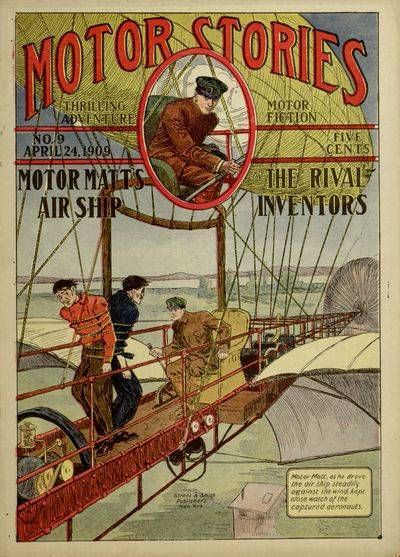
There was a very perceptible odor of gasolene in the back yard. The moment Carl sniffed it, he gave vent to a stifled yell and grabbed the policeman's arm with both hands.
"What's to pay now?" demanded the policeman.
"Der air-ship!" gasped Carl.
The officer threw a startled look at the sky.
"No, no, it ain'd oop dere," went on Carl. "It vas in dis pack yardt—yah, so helup me! Der gasolene used in der modor make der shmell. Don'd you ondershtand? Dey filled der tank here, und shpilled some oof der gasolene! Dose fellers haf run off from dis blace mit Matt, und dey have dook him along. Ach, himmelblitzen, vat a luck!"
CHAPTER VII.
JERROLD, BRADY'S RIVAL.
"Thunder!" cried the policeman, catching the Dutch boy's drift, "you're right, as sure as my name is Sam Harris! Your friend went off in that air-ship."
"He ditn't vent," protested Carl, in a temper, "he vas dook."
"Well, he was carried off in the thing, no matter whether he went of his own free will or was taken by force. If we each of us had a pair of wings we might follow the flyin' machine, but we ain't got 'em, so we'll have to do what we can on the ground."
"Dere iss a palloon house oudt on der roadt py der rolling mills," suggested Carl. "Meppy der Hawk vas dere. Dot's vere Prady keeps him ven he ain'd sky-hootin' t'roo der clouds. Meppy ve go und take a look at der palloon house, eh?"
"I know the place, and it won't do any harm to go there and look—but the fellow who ran off with your friend would be foolish to drop down there."
"Vell, foolish or nod, ve look efery blace vat ve can."
The balloon house was not a great way from that part of Hoyne Street, and Harris and Carl reached it after a cross-lots walk of five minutes.
They found the great doors open, but there was no air-ship in the place and no one on watch around it. Furthermore, an examination of the interior showed that an extensive clean-up had been made of the various tools which Matt and Carl had seen in the place during the afternoon. Everything of value had been removed.
Carl explained all this for the officer's benefit.
"It's a cinch the owner of the air-ship has changed his headquarters," commented Harris. "Brady, you say, the fellow's name is? Well, he's an inventor. One of his inventions is a patent 'jimmy'—which, of course, he wouldn't dare to patent. We've been watching his air-ship operations, here in South Chicago, but they seemed straight and legitimate enough."
"Do you know dot feller, Hamildon Jerrold?" asked Carl.
"Sure, I know him. He's all right, Jerrold is, although everybody looks on him as a harmless sort of crank."
"He don'd lif in dot blace vere der chimney fires iss?"
"No; he hangs out in a different part of town."
"Den, you see, it vas a put-oop chob all aroundt. It vas Prady, I bed you, vat sendt dot delegram, got Matt in a drap, und den flew off mit him in der Hawk. Meppy ve make a call on Jerrold?"
"I'll call up the department and report," said Harris, "so they can send another man on my beat while I'm fooling around on this case."
They hurried back into town and the officer unlocked one of the lamp-post boxes and reported to headquarters.
"All right," said he as he rejoined Carl. "Now we'll put in the rest of the night, if we have to. If Brady has had a hand in the robberies that have been going on here, this is liable to be good and profitable work for me."
Jerrold lived almost a mile from the place where Harris had done his telephoning. He had a large, rambling old house set far back in a dense mass of trees and shrubbery.
"He's a good deal of a hermit," explained Harris, as he and Carl proceeded along the walk to the front door. "A harmless old skate, but he's pretty broad between the eyes, at that."
It was after midnight, and, as might be supposed, the house was dark. A knock on the door brought a night-capped head from an upper window.
"Who's down there?" demanded a voice. "Is it you, Payne?"
"No, Mr. Jerrold," answered Harris, "it's a police officer. I've come to see you on important business."
"Have you found the Hawk?" cried Jerrold; "did you get back the plans those rascals stole from me?"
"Come down and let us in," said the officer. "We want to talk with you."
"Wait a minute."
The head was withdrawn and the window dropped. A little while later, the front door opened and Jerrold showed himself, carrying a candle. Carl recognized him as one of the two men who had been pursuing the Hawk in the buggy.
"Don'd you know me, Misder Jerrold?" asked Carl.
The inventor stared at him and shook his head. Thereupon Carl explained where and when they had met. Jerrold's brows wrinkled in a frown.
Leading his callers into a small sitting room he asked them to sit down.
"What do you know about this fellow Brady, Jerrold?" asked Harris, by way of getting at the business in hand.
"I know he's a scoundrel!" declared Jerrold with emphasis. "He's a good mechanic, though, and in spite of his shady record I took him on here to help me build my air-ship, the Eagle. After he had been with me for a while, I found he was stealing my ideas and building an air-ship of his own. Then I discharged him. Since then he's been attending to his own operations and I have been attending to mine. There are several important points about my machine, though, which Brady has been anxious to discover. He has tried to bribe Payne, the man who works for me, to give up a set of my blue prints, and he has tried to get them in other underhand ways. At about eleven o'clock, yesterday, three of Brady's men tried out-and-out robbery. That safe was forced"—Jerrold pointed to a small steel safe in one corner of the room—"and the roll of blue prints taken out. Payne and I were in the workshop at the time. We had just put the finishing touches to the Eagle and were inflating the bag for a trial. I heard a suspicious sound from the house and ran into this room. One of the thieves had just cleared an open window, another was getting out and the third was making ready to go. I had a wrench in my hand and I hurled it at the man in the room. He dropped without a groan. Payne came, just then, and we went after the other two. Brady's air-ship was waiting for them in the rear of the house, and the two robbers got into it and were away before we could catch them. Payne and I got a horse and buggy, as quick as we could, but by that time the air-ship was no more than a speck in the sky, off to the south. We followed, keeping the course the air-ship had taken. The men aboard didn't seem to know how to handle the craft very well, and I was hoping some accident would happen, that the craft would come down and that I would be able to get back my blue prints."
Jerrold halted for a little, his face flaming with anger and indignation.
"I haven't my patents, yet," he went on, in a few moments, "and haven't even been able to establish a caveat, so, you see, if Brady should get ahead of me at the patent office he would snatch a fortune out of my hands. For," and here the inventor threw back his head with laudable pride, "I claim to have invented an air-ship that can be used for commercial purposes—the first machine of the kind that will successfully navigate the air against the strongest wind that blows. But if that scoundrel Brady takes from me the fruits of my toil, I shall be ruined!"
Jerrold's body slumped forward in his chair, and he crouched there in an attitude of extreme dejection.
"Where's the fellow you knocked down with the wrench?" asked Harris, his professional mind dealing with the more practicable aspects of the case.
"When Payne and I got back to the room, after pursuing the other two rascals to the Hawk," answered Jerrold, "the man had vanished. I suppose he recovered from the effects of the blow and took himself off."
"He vas der feller vat drove der modor in der Hawk," explained Carl, "und ven he vas pud down und oudt, der odder fellers made poor vork oof triving der machine. Aber dot ain'd vat I got on my mindt, schust now." Carl pulled the roll of blue prints from his pocket. "Dere, Misder Jerrold," said he, "iss vat you lost. Take it mit der gombliments oof Modor Matt—my bard who iss gone I don'd know vere. Oof you hat shtopped a leedle in der puggy, und toldt us vat I haf heardt schust now, den, by shinks, you vould haf got der bapers pack a long dime ago."
A cry of delight broke from Jerrold's lips. For a moment he stared at the roll, then swooped down on it with both hands, caught it away from Carl and began removing the wrapper with trembling fingers.
"Here they are, here they are," he crooned joyfully, pawing the blue prints over and counting them, one by one; "they're all here, and——"
He stopped short and stared blankly at the envelope, which had fallen out of the blue-prints and dropped on the carpet.
"What's that?" asked Harris.
"I don't know," replied Jerrold; "it's nothing of mine and wasn't in the safe, to my recollection, at the time the blue prints were taken."
"Well, it may be yours, for all that. If it was in the roll, it stands to reason it must have been in the safe. Better open it. Probably you can tell from the contents whether it is yours or not."
Harris picked up the envelope and handed it to Jerrold. The latter took it from him with a puzzled expression on his face.
"I'm pretty sure this isn't mine," said he, turning the envelope over and over.
"Well, you've got to be absolutely sure," returned Harris.
Jerrold, thus urged, tore open the envelope, drew out the sheet and cast his eyes over it.
"No," he declared, "it doesn't belong to me. The thieves must have put it in with the blue prints."
"Let's have a look at it," said the officer.
Drawing closer to the candle, Harris proceeded to read the letter. While he read, his face brightened and a look of surprise and exultation rose in his eyes.
"Another clue, and a hot one!" he cried. He whirled on Carl. "With this as a guide," he went on, "it's dollars to doughnuts we can trace your friend and get him away from that scoundrel, Brady!"
"Ach, vat a habbiness!" expanded Carl. "Readt it oudt to me, Harris, und be kevick ad it."
CHAPTER VIII.
JERROLD'S GRATITUDE.
"The letter," explained Harris, "was written by Brady, and was evidently entrusted to the men in the Hawk for delivery to some one else. It's full of pointers, and a slicker bit of evidence it would be hard to find. And to think how it dropped into the hands of Motor Matt! The whole affair sounds like a 'pipe.'"
"Tell me about that!" cried Jerrold, his shock of joy having passed and left him leisure for other things. "Who is this Motor Matt, and how did he happen to get hold of the blue prints?"
"Ve vill go ofer dot lader, Misder Jerrold," said Carl, impatiently. "Schust now, dough, I vant to hear vat der ledder say. Readt him oudt, Harris! I vas so uneasy ofer it I don'd vas aple to sit shdill."
"It's addressed to a man called Whipple," went on Harris, "and here's the way it runs:
"'Grove, Needham and Harper, with one of my improved jimmies, are going to make another try for those blue prints of Jerrold's. If they get them—and I think they can, for our plans are well laid—they'll carry the papers to Willoughby's swamp in the Hawk and leave them with you. We will quit our operations in South Chicago, clean out the balloon house (I have already sold the building for old lumber) and make our future headquarters in the swamp. It will be safer there. After we improve the Hawk according to Jerrold's plans, we will have a ship in which we can go anywhere, and with which we can do anything. All we need is a competent motorist—Harper's good enough for an amateur, but we need a professional. I'll try and bring one with me, when I come. Meanwhile, until I show up at the swamp, I want you to take good care of the blue prints.
"'H. B.'"
A great light dawned on Carl during the reading of the letter—a light so strong that it left him blinking.
"Py chimineddy," he gurgled, "I know now vy dot Prady run off mit Matt! He say in der ledder dot he vants some brofessional to run dot air-ship. Vell, Matt knows more as anypody aboudt modors, und so Prady dook him off. Vat a high-hantet pitzness! Und Prady has captured a hornet oof he dit pud know it! He vill t'ink he has a handtful ven he dries to make Matt vork for him."
"From this," proceeded Harris, waving the letter, "it seems that Brady had already laid his plans to quit South Chicago. In the letter, over his own signature, he admits sending three of his men to steal the blue prints. By a chance, and owing to the course of events in keeping the driver of the air-ship from getting away with the other two thieves, this roll and the letter dropped into the hands of Motor Matt. Undoubtedly, Motor Matt has been taken to Willoughby's swamp."
"Und vere iss dot?" asked Carl.
"I know about the swamp," went on Harris, "for I helped some Chicago officers run down a couple of escaped prisoners there, once. It's a bad hole, but there is a sort of island in the middle of it that has been the resort of criminals for a good many years. To get through the water, and mud, and tangled bushes to the island is a hard job for any one who has to go on foot. Still, it can be done. Brady and his men, of course, can use the Hawk, and all they have to do is to sail through the air and drop down where they want to go. The difficulties of the swamp won't bother them at all. The place is about four miles from Lake Station, Indiana."
"Vell," said Carl, eagerly, "led's go dere. Der kevicker vat ve go, der kevicker vat ve can helup Matt. He iss my bard, und he needs me now."
The Dutch boy got up and started for the door. Bounding from his chair, Jerrold overtook him and grabbed his arm.
"Wait!" he commanded, "I've only got a faint grasp of the situation, but from what I can figure out you're going to need me. First, though, I want to hear all about this Motor Matt. He has done a whole lot for Hamilton Jerrold, and Jerrold is a man who always tries to pay his debts. Tell me how the blue prints got into the hands of Motor Matt."
"Aber ve vas in a hurry!" cried Carl. "Villoughpy's svamp iss a goot vays off, und——"
"You'll save time in the end by losing a little here and now," averred Jerrold, drawing Carl to a chair and pushing him down into it. "Go on! Give me the whole of it, between you, and be quick."
There was a compelling note in the inventor's words and manner, that demanded attention. Carl yielded and struck into an explanation of the events of the preceding afternoon. Whenever his impatience led him to skip any of the details, Harris, who recognized the advantage of letting Jerrold know everything, picked up the ignored detail and made Carl go over it.
Jerrold's interest and excitement increased as he listened. When Carl described how he and Matt had fought with Brady and Pete at the balloon house and kept them from getting the blue prints, Jerrold clapped his hands and shouted "Bravo!" And when Carl told of the bogus telegram that had brought the boys to South Chicago, Jerrold's face clouded with indignation and anger.
"Motor Matt," declared Jerrold, when Carl had finally finished, "has done a lot for me, and he's going to find that Hamilton Jerrold knows how to be grateful. I agree with Harris that there is hardly a doubt but that Brady has taken young King to Willoughby's swamp. Brady wants the young motorist for the Hawk, and intends to have him, whether or no. According to Harris, the swamp's a difficult place to get at for those not equipped with an air-ship. That's where I come in. This way, friends!"
With that, the inventor caught up his candle and led the way through the house and out at a back door.
By then it was nearly three o'clock, and the very darkest part of the night. A gust of wind blew out the candle, which had been about as effective as a glow-worm, and the three were left at the foot of the rear steps staring at a fluttering expanse of canvas.
The canvas formed a sort of V-shaped tent, long and high and secured with many guy-ropes. Because of the darkness it was difficult to get any kind of an idea as to the size of the tent, but that was a minor point.
"I'll have to get a lantern," said Jerrold. "Wait a minute."
"I've got a dark lantern, Jerrold," interposed Harris, "and I guess that will do."
"Fine!" exclaimed Jerrold, as Harris switched on the current and swung the beam of light around him. "This way," the inventor added, and ducked through the end of the tent.
In the gloomy interior a weird sight was disclosed—something so new and novel as to send an uncanny sensation along the nerves of Carl and Harris.
Here was another cigar-shaped gas-bag, and another suspended car. The car itself was stationary, but the bag, because of the drafts that surged through the tent, was bobbing and swaying like some monster, anxious to be unleashed.
The flickering gleam from the dark lantern could only disclose a part of the air-ship at a time.
"Ach," muttered Carl, "dot makes my nerfs shake und shake like anyt'ing. Sooch a horrible t'ing vat it iss!"
"That's because you're not familiar with such a craft," said Jerrold. "Payne and I have worked over it for years, and only yesterday saw the completion of our labors. It was six o'clock last night before the bag was fully inflated. We had to use common illuminating-gas, too, and the not more buoyant hydrogen. I have called the air-ship the 'Eagle,' and if you sweep that light along the side of the bag you will see the name."
This was a bit of byplay that took time and was utterly needless, but a great pride throbbed in the inventor's words, and even the smallest detail of the air-ship was fraught with the utmost importance to him.
"Everything about the craft," Jerrold went on, "is of the very best. The motor is the lightest, strongest and most powerful ever constructed. The car will carry half a dozen, easily. Sand-bags are suspended from each end of the gas-bag. When I pull in the sand-bag at the front end, the equilibrium is displaced, the bag points upward, and the propeller forces the air-ship to rise. So, when I wish to descend, I pull in the sand-bag at the rear point of the bag. When both bags are hanging loose, the Eagle swims in the air on an even keel. Now, the steering rudder, which also helps in maneuvering the ship, is a little idea of my own and——"
"Ach, hang der shdeering rutter!" broke in Carl, impatiently. "Harris und I haf got to go afder Matt und ve can't vait aroundt here any longer. Ve haf got to go py dot svamp, und——"
"Exactly!" broke in the inventor. "The Eagle, fully inflated and with a tank full of gasoline, is waiting for a trial spin in the morning. I have the honor to propose that we use the craft now, proceed to Willoughby's swamp and rescue Motor Matt. That will save time, and a whole lot of hardships in forcing your way through mud and water and tangled brush in order to reach the island."
Harris had already gathered the inventor's idea, even before he began putting it into words; Carl, however, had not anticipated the suggestion, and he was dazed by it.
"You mean to dake us py der svamp in der Eagle?" he asked, in some trepidation.
"Yes."
"Ach, himmel! I nefer rode mit a air-ship. Vill I be seasick py it?"
"I don't think so. You see, I have never navigated an air-ship myself, but I'll bank on the Eagle doing its work. I can run the engine."
"Vat oof it shouldt durn oopside town mit us vile ve vas a mile in der air?"
"I'll guarantee it won't do that."
"Vell, vedder or nod," said Carl, "I am going afder my bard. Oof der tangers vas greadt, I take dem; und oof dey vasn't so greadt, den I take dem, too. Matt vouldt do more as dot for me, yah, I bed you!"
Harris was also afflicted with doubts.
"The ground has always been good enough for me, Jerrold," said he, "and whenever I get my feet off it and go up any distance I have a bad case of vertigo. If I should get dizzy and fall off the car——"
"You won't," interrupted the inventor; "people never get dizzy in balloons."
"You're sure it won't tip over and spill us out?"
"Positive."
"You don't know much about it yourself, you know, having never been up in it."
"That scoundrel, Brady, has used the Hawk with fair success, and the Hawk is modeled on the same lines as the Eagle, only the Eagle has improvements which Brady was not able to get hold of and put on his own machine. Shall we go to the rescue of Motor Matt? Come, my friends, time is flying."
"Und ve ought to be flying, too," said Carl, now eager to make the ascension.
"I'll take a chance," observed Harris.
"Good!" applauded Jerrold.
The next moment he had vanished in the darkness and could be heard pulling at some ropes. In less than a minute the entire top of the tent fell away, revealing the stars.
"Get into the car," said Jerrold, "there, just forward of the driver's seat."
With the aid of his lantern Harris picked out the place where he and Carl were to stow themselves, and they climbed into the car as directed.
Immediately after that, Jerrold got over the rail and took his seat at the levers. It was impossible to see just what he was doing, but the clank of a lever came from his vicinity and slowly the front of the gas-bag began to point upward.
"Now we're ready," called the inventor.
The popping of a motor began and gradually gathered into a swift murmur.
"And now we're off," added Jerrold. "Stay right where you are and don't change your positions unless I tell you."
The whir of the propeller started, and the house and shrubbery began slipping away from under those in the car.
"Ach, du lieber!" gasped Carl. "Der eart' vas falling avay from us. I vill say my brayers forvarts, packvarts und sidevays, oof it vill helup any."
"I've got a bad case of rattles, myself," admitted Harris. "But it's for your pard, my boy."
"You bed my life!" returned Carl, "aber I never dit anyt'ing pefore for dot bard oof mine dot dook so mooch nerf as vat dis toes. I vill shud my eyes, und you dell me, blease, ven ve reach der svamp!"
CHAPTER IX.
ABOARD THE HAWK.
Taken at a disadvantage and with two brawny ruffians ranged against him, Motor Matt was unable to make any defense. As he lay on the floor, head and shoulders still swathed in the window-curtain, one of his antagonists held him while the other bound his hands and feet with a rope. He was then lifted and carried for some distance. Naturally he could have no idea where or in what direction he was being carried.
A few steps were descended and he heard a door softly closed. The cool air of outdoors laved his hands—he was sensible of that, although the hot stuffiness of the curtain prevented the night air from reaching his face.
He was lifted over something, he did not know what, and laid down in cramped quarters. A conversation was going on around him, but in tones so low he was not able to distinguish the words. He fancied that he heard the girl's voice, although his head was so muffled he could not be sure.
Presently the unmistakable explosions of a motor came to him.
"Brady is taking me away somewhere in an automobile," he thought, and wondered where Carl was that he could not see the machine.
A moment later he felt a gentle, swaying motion as though he was being gently swung in a hammock.
Several minutes passed, and then Brady's voice spoke, in a tone so loud that Matt was able to hear what he said.
"Take the curtain off his head, Pete, and untie him. It's time he took hold here. Keep your revolver handy for use in case he gets obstreperous. He's full of ginger and will have to be tamed."
Matt felt some one working at his cords. They were stripped away quickly, and the curtain whisked from his head. He jumped up, the floor under him swinging with the quick move and almost upsetting him.
"Careful, there!" warned Brady. "Where do you think you are, anyhow?"
Matt was dumfounded. Overhead was the long gas-bag of the Hawk. In front of him, at the mechanism of the machine, sat a dusky form which he recognized as belonging to Brady. Brady's hands were on the levers.
With a shout of anger Matt jumped toward Brady, the car lurching and swaying with his frantic movements.
"Stand where ye are!" came the husky, threatening voice of Pete, from behind. "Do as I tell ye, King, or I'll shoot."
Matt turned around. Standing with his back braced against an upright timber that held the car to the oval ring under the gas-bag was Brady's burly assistant. He held a dark object in his hand and Matt knew it must be a revolver.
"Where are you taking me?" demanded Matt.
"Turn around this way," said Brady. "Now that you know what'll happen to you if you get too hostile, maybe we can have a bit of a talk together."
"Don't shoot!" implored a feminine voice; "I don't want to have any shooting, dad!"
The voice came from a bundle on the floor, close to where Pete was standing. By looking sharply, Matt was able to see a white, ghost-like face hovering against the rail.
The girl had been brought along with them! Matt was glad, for her sake, that he had not got into a rough-and-tumble with Brady.
Without seeming to pay the girl more than passing attention, the young motorist turned toward the man in the chair.
"Well?" said he, crisply. "What have you got to say about this, Brady? I guess you could be arrested for what you've done, all right."
Brady laughed.
"How's a policeman coming up here to get at me?" he asked. "An air-ship is a great thing for a fellow who wants to turn a few tricks in spite of the law."
"That's your game, is it? Well, what have you to gain by running off with me? I told you I didn't have that roll of papers."
"I'm out the blue prints, but I'm in a good motorist. I'll not be able to improve the Hawk according to Jerrold's plans, but I guess I've got hold of a driver that's good enough to make up for most of the improvements."
"If you think I'm going to drive this car for you," said Matt, "you're away off in your calculations."
"That's what you think now, but you'll change your tune before long," said Brady, easily. "I know this air-ship pretty well, and I installed the motor. All it needed for that was a good machinist and a good inventor. I'm not a good driver, though, and I've picked you for the job. The offer I made back at the house goes. Five hundred a month. Pretty good pay, eh, for a boy of your age?"
"I don't care how much you offer, Brady. As I have already told you, no amount of money could hire me to work for you. You're a scoundrel, clear through. What you've done to-night proves it.
"Bear a little to the left, Brady!" called Pete, who was evidently on the lookout. "You're getting too far to the north."
Brady moved one of the levers, and the ease and certainty with which the air-ship swung to the new direction brought Matt's admiration uppermost. Never had he been able to resist the lure of untried machinery, and here was an experience so novel that it carried him out of his troubled environment, so to speak. For a moment, suspended in that starlit void and swimming noiselessly through the night, he yielded himself to the fascinations of the new experience.
"How powerful a motor have you?" he asked.
"Ten horse-power," answered Brady, "and it weighs forty pounds."
"How do you steer the machine up and down, and right and left?"
"That's where I've got the bulge on Jerrold. One rudder with two cross-section planes does all of that. This lever here—I don't know whether you can see it or not from where you stand—gives the up and down 'dip' to the rudder that makes the machine rise or fall. By moving the lever right or left, the air-ship turns in the corresponding direction."
"Take me back," ordered Matt, "and land me at the place where you took me from."
"You've got a picture of me doing that!" scoffed Brady. "Now that I've caught you, I'm going to keep you, see? You're just the sort of a lad I need in my business. Grove and Needham, when they finally got back to South Chicago with the air-ship, told me all about you. If I'd known what I do now at the time you called at the balloon house, I'd have taken a different tack."
A muttered imprecation came from Pete. He was thinking of his fall over the barrel.
"Those fellows got back without breaking their necks, did they?" queried Matt.
"Just about. When they told me what had happened, I sent off that telegram."
"We might just as well look this thing square in the face, Brady," said Matt. "You've acted the part of a scoundrel in your dealings with me, and you haven't gained anything by it. If you don't turn back and put me down in South Chicago, I'll make more trouble for you than you can well take care of."
"I'll take my chances on that, my bantam. I like your spirit, and we're going to get along fine. Just cast in your lot with mine, and I'll make a rich man out of you. In the Hawk we can travel all over this continent, from Hudson Bay to Patagonia. Where men never went before, we can go. No mountain range is so high that we can't cross it, and no desert is so barren that we can't wing our way comfortably over it."
Matt stared at the dark figure in the chair. If any honest man had talked to him in that way, the young motorist would have been tempted to become an aeronaut, for he could see plainly the possibilities of a serviceable air-ship; but as for Brady, he was a criminal, and that cut him off from any consideration on Matt's part.
The young motorist sank down on his knees and looked over the side of the car. They were perhaps a thousand feet in the air. Houses, villages, dark expanses of timber and lighter stretches of meadow swept past them, moving out from under the car like a dark panorama.
Driving an automobile at speed was like flying, but here was flying itself. The new sensation gripped Matt and thrilled him in every nerve.
"How are we heading, Pete?" called Brady.
Pete was leaning over the opposite side of the car, looking forward.
"I'm jest tryin' to git my bearin's, Brady," he answered. "It's so pesky dark it's hard to make out jest where we are."
Matt stole a look at Pete's back. The hand gripping the revolver lay on the rail. By one quick move Matt could have snatched the weapon. As the idea swept through his mind he cautiously changed his position.
Just then a soft hand rested on his and he saw the girl's face pressed close.
"Don't do anything desperate!" she whispered, imploringly. "Do whatever dad says—it will be better for you. When we get to where we're going, I'll help you escape, and——"
"I think, Brady," called Pete, "that ye're still too fur to the north. Better shift a leetle more to the left. I won't be sartin, though, that I'm right."
"I ought to be there on the lookout," answered Brady. "Come here, King, and take the engine."
The girl's words had influenced Matt powerfully. On top of that was the alluring prospect of handling a new machine.
"I'll take the engine for a while, Brady," said he, getting up, "but you're to remember I'll not hire out to you."
"All I ask is for you to handle the motor," replied Brady. "You'll come to your oats quick enough, I'll gamble on that. You watch King, Pete," he added to the other man, "and make sure he sends the Hawk where I tell him to. If he tries to send her anywhere else, you know what to do."
"That's no josh," answered Pete.
Brady left the chair and went forward. Matt dropped into the vacant seat and began studying the various levers with his groping hands.
CHAPTER X.
WILLOUGHBY'S SWAMP.
Pete kept his weapon prominently displayed, and through the gloom Matt could see the ruffian's arm partly lifted as though ready on the instant to bring the firearm into use. This alert attitude on Pete's part, however, was more for show than for anything else—at least, Matt so regarded it. Brady was not anxious to go to desperate extremes with Matt, especially since he wanted him as driver for the air-ship.
Brady, taking up a position where he could peer ahead, was scanning the dim landscape sharply.
"Swing her to the left!" he called.
Matt instantly applied the steering lever. Instead of swinging to the left, however, the Hawk made a half-turn to the right.
Up came the revolver. With a sharp cry, the girl reached up and caught Pete's arm.
"To the left, I said!" roared Brady.
"You'll have to give me the chance to learn the machine," answered Matt, coolly, as he continued working the lever and brought the Hawk around to the proper course. "These levers are new to me. When we steer an auto we do it with a wheel."
"I thought ye knowed all about motors," jeered Pete.
"I know something about motors," replied Matt, "but not the first thing about air-ships."
As near as Matt could judge, they were proceeding at a speed of something like thirty miles an hour. He speeded up the engine a little and was surprised at the smoothness with which it worked. The propeller hummed in a low, husky drone that was quite different from the song of the cylinders.
He moved the steering lever backward a couple of notches. Immediately the rudder was tilted and the Hawk began to climb upward.
"Stop that!" yelled Brady. "We're high enough. What are you trying to do?"
"Learning the machine," answered Matt, and threw the lever forward.
The front end of the gas-bag tipped downward, and the air-ship slid toward the earth with a suddenness that almost threw Brady over the rail.
"That'll do you!" he whooped. "Get her on a level again, and be quick about it. You can handle the machine, all right, and I don't want you to do anything but what you're told."
"All right," said Matt quietly.
For five minutes longer they continued to swim onward through the air. A long string of lights shot across the gloomy landscape below them, and a whistle came upward from the earth with startling distinctness.
"There goes a train, whistlin' fer Lake Station," remarked Pete.
"We'll be over the town in a minute," said Brady, "and then it won't be long until we get to the swamp."
"What swamp?" asked Matt.
"Never ye mind," was Pete's surly rejoinder. "Ye're here to obey orders an' not ask any fool questions."
"I don't think it very foolish for a fellow to ask where he's being taken."
"Mebby not, but ye ain't findin' anythin' out, see?"
Matt had been doing a good deal of guessing about Carl. What would his chum do? What was he doing then? He felt pretty sure that Carl would get into the house and go through it from cellar to roof.
But Matt knew that Carl had a good sensible head in cases of emergency. Now and again the Dutch boy's temper was apt to make trouble with his reasoning, but in the long run Carl could always be counted on to do the right thing.
So Matt was not worrying very much about his chum. Carl would take good care of the blue prints and ultimately they would find their rightful owner.
"Ha!" exclaimed Brady, suddenly, "there's the signal! I'll go back and take charge of the motor while we make the landing, Pete, and you take the lookout."
Matt gave place to Brady and then stood at the rail, watching developments curiously.
Below the air-ship was a great splotch of black shadow, stretching away on all sides as far as the eye could reach. Evidently this was the swamp. The Hawk was sailing across the swamp toward a big fire that glowed in the distance.
With Brady steering and Pete directing, the Hawk approached closer and closer to the fire.
"Drop 'er, Brady!" Pete presently called; "we're close on the island."
The nose of the air-ship ducked downward and, for perhaps twenty seconds, she raced earthward; then Brady diminished the speed of their descent by slow degrees.
Matt, braced on the sloping floor of the car, watched the fire apparently come up toward them. A little later he was able to make out three human figures against the firelit background below, and a bare little plateau took vague form under his eyes.
He watched the landing keenly, and noted how Brady suddenly shifted the steering rudder so as to bring the Hawk on an even keel, the lower supports of the car just grazing the ground.
The three figures by the fire ran close.
"How's everything, Brady?" cried a voice.
"Finer than silk," called back Brady. "Stand by to catch the ropes, you fellows."
The murmur of the motor ceased, the revolving propeller came to a stop, and Pete flung out two ropes, one on each side of the car.
The ropes were caught by the men on the ground, a bight of each was thrown around a stout stake driven into the earth at an angle, and the air-ship was drawn down and safely moored.
Matt was now able to understand why Brady had taken his place as driver for the landing. Not only was the method of making a landing new to Matt, but there was also danger, unless one was familiar with the place, of scraping the trees that covered the swamp and hemmed in the cleared space called the "island."
Matt started to spring over the rail of the car.
"Stop, King!" cried Brady. "You don't want to make a bolt for the timber and get mired in the swamp, do you? Just remember you're still under orders. Take him to the roost, Needham, you and Whipple. Better tie him up until he gets used to the place and to our society. He's a bit strange, here, and none too willing to stay."
"Did you bring the loot, Brady?" called one of the men.
"Sure! This is moving-day with us and you didn't think I was going to leave all that stuff on Hoyne Street, did you? Get out of the car, King," he went on, to Matt. "Whipple and Needham will take care of you."
Two of the three men had stepped to the side of the car. In the light of the fire, which was blazing at a safe distance from the air-ship, Matt discovered that Needham and Grove had been the two aeronauts who had had such hard luck with the Hawk during the preceding day.
Needham, who, with Whipple, was facing Matt and waiting for him to get over the air-ship's rail, gave a husky laugh.
"We got out of that scrape, all right," said he, "even if we did lose our drag-rope."
"And you got me into another scrape," said Matt. "You fellows will pay for this!"
"Chirp low, young feller," warned Whipple, catching him by the arm as he gained the ground; "your cue is to make friends with us an' not bluster about what ye're goin' ter do. There's five husky men here, an' we're all surrounded by a swamp that would mire ye up ter the eyes if ye tried ter git through it. Oh, I reckon ye won't git away ter make any of us pay fer anythin'! This way, an' step lively."
With Needham and Whipple on each side of him and hanging to an arm, Matt was led across the open space, past the fire, and to the door of a small, roughly built shanty. A little way off there was another building, fully as small but apparently somewhat better built.
"This here's the roost," announced Whipple, "an' it's where ye're ter pass the rest o' the night. Come in, an' come peaceable."
It was part of Matt's plan, hastily formed on the air-ship just after the girl had spoken to him, to accept passively whatever came his way—at least for a time. The girl had said that she would help him escape, and there was that about her which had awakened his confidence. Not only that, but there was also something in the girl's face that had aroused his sympathy. She had a history, he was sure, and one that was far from pleasant.
There were five cots in the "roost," and Matt was told to lie down on one of them.
"Harper used to sleep there," remarked Needham, as Matt stretched himself out on the hard bed, "and the deuce only knows where poor old Harper is now. You're taking his place, King, and so it's only right you should have his cot."
It was on Matt's tongue to say that Needham had another guess coming, but he held his peace. He would not show too much of the hostile side of his feelings until he had had a chance to talk with the girl.
"What's the use of tying me," expostulated Matt, as ropes were being put in place around his wrists and ankles, "if it's impossible for me to get away?"
"Orders," answered Whipple, curtly.
After Matt was made secure, Whipple and Needham went out of the hut. The young motorist had had a trying day, and even his exciting situation was powerless to keep the sleep from his eyes. He dozed off, while his thoughts were trying to straighten out the queer tangle in which events had bound him. He roused up for a moment when Pete, Whipple, Needham and Grove came into the hut and dropped down on their cots, but almost immediately he went to sleep again.
It seemed as though he had hardly closed his eyes the second time before he was awakened by a light hand pressed upon his forehead. The other cots in the room were empty, it was morning, and the girl was standing beside him.
"I have brought your breakfast," said she, in a low voice. "We can talk a little, but will have to be quick. Dad, or some of the men, may come in here at any second! There's a lot that you've got to know, and——"
She was interrupted by the sharp explosion of a firearm outside. Stifling a cry, she whirled from the cot and ran to the open door.
CHAPTER XI.
A FOE IN THE AIR.
"What is it?" asked Matt, struggling up on the cot.
No revolver had caused the report he had heard. From the sound he knew that a rifle had been fired.
A babel of excited voices now came to him from without, accompanied by sounds of running feet diminishing rapidly in the distance. Then came another report, and another, both from a more distant point than the first.
The girl stepped through the doorway and was looking upward.
"Take off these ropes!" called Matt. "Let me get out there and see what is going on!"
The girl turned and reentered the hut. Her face wore an expression of the utmost concern.
"No," said she, "I can't release you just now. If dad was to come and find that I'd set you free, he would suspect me at once and that would spoil my plans."
"But what was the cause of that shooting?" persisted Matt.
"There's another air-ship over the island——"
"Another air-ship?" echoed Matt.
"Yes. It must be Jerrold's, although how he ever found out where dad was is more than I know. Dad and the rest were shooting at the air-ship with rifles."
"I'll bet it's somebody who's come looking for me!" exclaimed Matt. "If your father and his gang should kill anybody——"
"They won't," interrupted the girl, confidently; "dad knows better than to do anything of that kind. They'll try to put a bullet or two into the gas-bag of the air-ship and frighten Jerrold away."
"Go and take another look," said Matt, anxiously. "See what they're doing."
The girl glided to the doorway again.
"The other air-ship is moving off," the girl reported, with a measure of relief in her voice, as she came back. "I think the bullets must have injured the propeller, or some of the machinery, for the air-ship is moving very slowly and seems to be in trouble."
"Did you see how many were aboard?"
"There were three in the car—one of them was Jerrold, and he was managing the motor."
"The other two," asked Matt, eagerly, "do you know who they were?"
"One of them was in uniform, and looked like a policeman. The other was short and thick-set and looked like a German."
"Carl!" exclaimed Matt, jubilantly. "Good old Carl! How did he ever find out where I was, I wonder?"
"I'll bet dad is trying to guess the same thing," said the girl. "He'll be badly cut up over this. But it's no more than he ought to expect," she added. "Whenever a man breaks the law he'll have to pay for it, sooner or later."
"What has your father been doing?" asked Matt.
"I came to talk with you about that. While I'm giving you your breakfast, I'll tell you my plans. Dad, and all the rest except Whipple, are off in the swamp, somewhere, keeping track of Jerrold's air-ship, and that will give us a chance."
Matt swung his bound feet over the edge of the cot, and while he sat there the girl drew a chair close and began giving him his breakfast.
"Dad has been doing a lot of criminal things," said the girl, "and all he built that air-ship for was to make it easy for him to rob people and get away without being found out. Didn't you guess that when I showed you that article in the paper? I thought you might."
"I've been mighty thick-headed," answered Matt, between mouthfuls, "and I never thought the thing through that far. Possibly it's because so much has been happening to me since I went into that place on Hoyne Street."
"It's nearly broken my heart having dad act like he's been doing," said the girl, her lips quivering. "If mother had lived she'd have kept dad straight, but when she died dad just seemed to go to the dogs. He has tried to make the people in South Chicago think he was just an honest inventor, but, even at that, he stole all his ideas from Jerrold. That balloon house, that he built out of some of the proceeds of his first robbery, was put up for what they call a 'blind.' With a big house like that, out in plain sight, dad felt that everybody would think his work was open and aboveboard. When he committed any robberies, the Hawk was taken from the shed in the dead of night, and Harper would steer it for the place they were to rob. The blackest kind of a night was always selected, and only flat-topped buildings were robbed. You see, the air-ship would alight on the roof, and dad and the rest would break into the building from the top. When they left they always went in the same way they came, and the police were puzzled because they could not find any clues in the lower part of the buildings."
"It was a slick scheme," commented Matt.
"That's the way Hartz & Greer's place was robbed," proceeded the girl. "Dad and the rest got fifteen thousand dollars' worth of goods from Hartz & Greer, and for more than a week the stuff has been hidden in that house on Hoyne Street. But now dad has left South Chicago for good and all. He's afraid the police are beginning to suspect him, and that Jerrold might try to do something on account of those stolen blue prints."
It was perfectly plain to Matt that the girl's recital of these crimes, in which her father had played the leading part, was anything but easy for her. She was talking from a sense of duty, and Matt honored and admired her for the stand she was taking.
"It doesn't seem possible," said he, gently, "that Brady is your father."
"But he is," she answered brokenly, "and he has brought shame and disgrace on me. But what could I do? Dad knows how I feel about his actions, and he has watched me and kept me away from other people ever since he began his stealing. When you came to the house, last night, it was the first chance I have had to tell what I know. I overheard dad and Pete planning what they were going to do if you came, and—and I hoped you would come, although I knew you would never leave the house until you were taken away as dad's prisoner. I felt sure, though, that I could help you to escape, and I feel even more sure of that now than I did before."
"What is your name?" asked Matt, his eyes full on the girl's face.
"Helen," she answered.
"What are your plans, Helen?" he asked.
"My plan," she went on, "is for you to get away from the swamp in the Hawk, and to take the stuff stolen from Hartz & Greer with you. That will stop everything, for dad will be perfectly helpless without the air-ship. Then, too, you can return the stolen diamonds and jewelry to Hartz & Greer, and that will go far toward righting one wrong. When you are back in South Chicago, you can send the police here and—and they can capture dad and the rest."
Matt had finished eating and the girl had put aside the dishes. Suddenly she broke down and hid her face in her apron. For a few moments she sobbed convulsively.
Small wonder her feelings overcame her! In carrying out her ideas of right and justice, she had planned to give her own father into the hands of the law.
"You're a noble girl, Helen!" declared Matt. "But how am I to get away in the air-ship and to take the stolen property with me?"
"You already know how to run the machine," said the girl, recovering herself a little and looking up, "and when the right time arrives I will come here and take off your ropes. As for the stolen property, I will see to it that that is put in the car before you start. There will be danger in what you do, but, from what I have heard, you know how to win out in spite of it."
"I will run any risk to get away from here," returned Matt, gravely, "but when I go you must go with me. This is no place for you—with such a thieving gang!"
"I must stay here," the girl said resolutely. "Even though I am sending my father to prison I want to be with him to the last. If something isn't done," she continued passionately, "he will go on and on, constantly from bad to worse, and perhaps some time"—her face blanched as she spoke—"he might receive worse than a prison sentence. It is the only way to save him."
It was clear that Helen Brady had spent much time in thinking out and planning her present course, and how much mental anguish and bitterness of spirit her conclusion had cost her, only she could know.
"I am ready to do whatever you want me to," said Matt, "and if you think it best to stay here, all right. I still believe, though, you ought to leave this place with me."
"No, no," she replied firmly. "I have thought it all out a dozen times, and I have made up my mind as to what it is right for me to do. You must get away from here in the air-ship. With the Hawk taken away from him, dad will be helpless."
"Haven't you any friends or relatives to whom you could go?" asked Matt.
"I have relatives on my mother's side, but they won't have anything to do with dad or me—simply because dad is what he is. They have asked me to leave dad and come to them, but I know my place and what it is right for me to do."
A brief silence fell between the two, during which Matt turned the queer problem over in his mind.
"When do you think your plan can be carried out?" he asked presently.
"It has got to be soon, if at all," she answered. "I don't know what effect this appearance of Jerrold's air-ship over the swamp will have on dad, but I hope it won't interfere with my plans. We'll have to wait a little while and see. Whipple is watching the Hawk now, and——"
Just at that moment a heavy step was heard outside. A man appeared in the doorway, stared in at Matt and the girl for an instant, and then strode into the hut.
The man was Brady, and his face was black as a thundercloud.
"What're you doing here so long?" he cried angrily to the girl. "Clear out! I've got something I want to talk over with King."
With a supplicating look at her father, the girl got up and passed out of the hut.
CHAPTER XII.
BRADY CHANGES HIS PLANS.
"You've played the devil with me, and no mistake!" scowled Brady, whirling on Matt the moment the girl was gone.
"I don't see how you make that out," said Matt. "You're the one that's made all the trouble, Brady."
Brady's little eyes glittered as they rested on Matt. For a few moments he paced angrily back and forth across the hut.
"How in thunder," he cried suddenly, "did Jerrold ever manage to get a line on me? He was over the swamp, a short time ago, with his air-ship, and he'd have landed here if we hadn't driven him off. Jerrold knows where I am, and he has the means of getting to the island. We've crippled his craft, though, and he's had to haul off for repairs. While he's gone, I've got to change my plans, somehow, and be ready for him when he comes back. That Dutch kid who was with you at the balloon house yesterday was in the car of the air-ship, and there was also a policeman along. How did that come?"
"You know as much about it as I do, Brady," replied Matt. "I disappeared from that Hoyne Street house, last night, and I suppose my chum has been getting clues about me and following them up. That's the kind of a lad he is."
"Where did he get any clues that would bring him out here?"
"Give it up."
Brady took a few more turns across the room, presently halting in front of Matt.
"You didn't bring that roll of blue prints to Hoyne Street, last night," said he. "Where did you leave it?"
"Left it out in front of the house," grinned Matt.
Brady started.
"In front of the house?" he echoed.
"Yes."
"Cached?"
"Certainly."
"Under the sidewalk?"
"No; in the pocket of my Dutch pard."
Brady stared incredulously. Then he swore.
"That Dutchman was out in front all the while you were in the house?"
Matt nodded.
"He came with me from Chicago. I got to thinking there might be a trap in the house, and that some one was there who wanted the blue prints, so I made up my mind that it would be a wise move to leave Carl out in front, and to let him keep the roll."
"That chum of yours must have seen the Hawk when she climbed out of the back yard," growled Brady, "but how in the fiend's name was he able to get Jerrold and the Eagle and follow us? It was dark, and we had a long start of them."
"One guess is as good as another," said Matt, calmly. "I told you you'd get yourself into trouble if you tried to make a prisoner of me. The best thing you can do now is to send me back to South Chicago in the air-ship."
"Think I'm a fool?" snarled Brady. "It may be that you're all that stands between me and my men and capture. I'll hang onto you, King, and I'll let that Dutch pard of yours know that if Jerrold don't keep away from this swamp with his air-ship you're going to connect with your finish. It's neck or nothing with me, now, and I'll go any length to keep myself out of the 'pen.' I've laid out a fine campaign for the Hawk, and I don't intend to have all my plans nipped in the bud, right at the start-off."
"I suppose," said Matt, scathingly, "that your campaign is one of robbery, and that you're going to make a pirate ship out of the Hawk?"
"That's where you put your finger on the right button!" declared Brady. "I'm going to be a freebooter, and take my toll wherever I can find it. It's easy to swoop down on a lot of spoil, pick it up and make off with it. And what can the law do?" He laughed mockingly. "Policemen will have to have wings to get anywhere near me."
"And that's what you wanted me for, is it?" cried Matt, indignantly; "to drive the Hawk around through the air and help out your villainous plans! I would let you kill me first."
"Rot! I'm going to stick to my original intentions, but there's got to be something of a change in my immediate plans. We've all got to pull out of here and to take what plunder we've got cached in the swamp. The Hawk will have to make three or four trips, and they must be made before Jerrold and his air-ship can interfere with us. If Jerrold fixes up his air-ship and comes back, we'll just tell him what will happen to you if he lingers in the vicinity of the swamp. I'm banking on that to send him packing again, and to keep him out of sight until I can make a change of base. You'll go away on the Hawk's first trip, and it will probably be only half an hour before you can start."
Brady started for the door, but halted before he reached it and faced around.
"Either one of two things happened to put that Dutchman and Jerrold on my track," said he. "Either Harper has been caught, and has told what he knows, or else a letter I gave Needham to deliver to Whipple, here in the swamp, has fallen into the hands of the police. It don't make much difference, though, how Jerrold got next to our hang-out. The main thing is that he knows where we are, and that you will be put in a mighty tight corner if he keeps on trying to make trouble for me. That's about all, King. I want you to understand what you're up against and be ready for whatever happens. I'm not going to have my plans knocked galley-west just as I'm on the point of launching them."
With another black scowl, expressive of his savage determination, Hector Brady strode out of the hut.
Matt was beginning to understand why Helen preferred to see her father in prison rather than free to carry out his campaign of lawlessness. Possessing a practical air-ship like the Hawk, Brady could commit untold depredations and snap his fingers in open defiance of the law.
The young motorist shuddered to think of the scoundrel's comprehensive plans, and of the part he had intended to make his prisoner play in them.
Helen's reasoning was logical, and the expedient she had suggested was as simple as it was effective. By taking the Hawk away from Brady she would make it impossible for him to follow out his nefarious schemes. The beautiful simplicity of the countercheck aroused Matt's admiration.
But how was the countercheck to be brought about? The appearance of Jerrold's air-ship over the swamp had made doubly difficult the work the girl was counting upon having done. Not only that, but the coming of the Eagle had increased Matt's peril. There was no doubt in the young motorist's mind but that Brady would go to any extreme in order to keep himself and his companions from being captured.
All these different aspects of the situation floated through Motor Matt's mind swiftly. Two or three minutes after Brady had left the hut, and while Matt was still considering the problem that confronted the girl, Helen herself stole in through the door.
Her face was haggard, but her eyes were bright and full of resolution.
"You shouldn't be here," protested Matt. "Your father suspected something when he found you with me a little while ago and ordered you away. What if he should come back and see you here again?"
"I don't think he'll come back, but I've got to take the risk, even if he does." The girl spoke quickly and steadily and made her way swiftly to Matt's side. "Dad has changed his plans—I was listening to all he said, out there at the back of the hut. He's going to use the Hawk to take us all away from the swamp, and you're going to go on the Hawk's first trip! That means that we must do what we can, at once. If we fail now, everything is lost."
She was breathlessly eager, but her calmness at such a moment surprised Matt. Lifting her hands she took a small poniard from the bosom of her dress, bent down and severed the cords that secured Matt's hands. Then, with one downward stroke of the keen blade, she freed his feet.
"Where are your father and the rest of the men?" asked Matt.
Before she answered, Helen glided to the door and took a cautious look outside.
"Some of the stolen goods have been hidden among the bushes of the swamp," said she, returning to Matt. "You are to be sent away with the loot, on the first trip, and dad himself will have to take you. He, and everybody except Whipple, have gone to the swamp. Whipple has a rifle and is guarding the Hawk. Whatever we do, Matt, we've got to do in a hurry. The bag of goods taken from Hartz & Greer is behind this hut," she pointed to an unglazed opening in the rear wall as she spoke. "While the rest are in the swamp, I will go to the Hawk and talk with Whipple, getting around on the other side of him so that his back will be in this direction. While I am holding his attention, you will creep up on him from behind and, between us, we will try and get the rifle. It's a desperate chance, but we will do the best we can."
"You're a brave girl, Helen!" declared Matt.
"I'm doing what I think is right, and that always helps a person's courage. I'm more worried about you than I am about myself. If anything should go wrong—if anything should happen to you because of the help you are giving me——"
For the first time her voice faltered. Matt reached out and caught her hand reassuringly.
"Don't fret about me," said he. "There won't be any trouble about my getting the best of Whipple, with you to help. Is the Hawk all ready for a flight? I mean is there plenty of gasoline in the tank, and plenty of oil?"
"Yes, dad has seen to that. So far as the air-ship is concerned, it is ready to carry you quickly and safely out of the swamp. Now I will steal out of the hut and talk with Whipple."
Once more she started for the door. Hardly had she reached it, however, when she drew back with a gasp of consternation. Turning, she beckoned to Matt.
"Too late!" she whispered, her voice sharp with anguish and disappointment. "Oh, why have they come just at this time!"
Matt glided quickly to her side and peered out through the half-opened door.
What he saw was well calculated to discourage him and the girl.