
CHAPTER XIII.
INTO THE SWAMP.
Needham, Pete, Grove and Brady had not been long carrying out their work of recovering the cached goods. They were returning from the edge of the bushy timber, ascending the slight elevation of the "island" on their way to the Hawk, each bearing an armful of plunder.
In his stealings, Brady had not bothered with bulky articles but had confined himself to "lifting" smaller and richer loot. The stuff was all in small sacks.
As the men walked past the "roost" on their course to the air-ship, Matt and the girl withdrew from the door to avoid being seen. Through a crack in the wall, however, they were able to keep close track of what went on.
On reaching the Hawk, the bundles were deposited on the ground. Whipple, leaning on his rifle, stood watching while the bags were heaped up at the side of the air-ship.
For a few moments the villainous crew had their heads together in close and earnest conversation. Now and again their eyes were lifted aloft, evidently on the alert for some sign of the Eagle. Brady, it could be seen, did most of the talking. Suddenly, after a sharp scrutiny overhead, Brady whirled around and started for the hut.
"He's coming after you!" half sobbed the girl.
"What's the reason I can't escape through that window in the rear wall," asked Matt, hurriedly, "and take refuge in the swamp?"
The idea seemed to electrify the girl.
"I hadn't thought of that," she whispered, catching his arm and starting for the window. "The back of the hut is close to the trees and bushes on this side of the island, and I know something about the reefs of dry ground running through the swamp in the vicinity of this place. Come!" she added; "we must hurry."
Her despair had vanished in a flash, and her steadiness and resolution had all come back. She climbed through the window and, as Matt followed, she was picking up a small bag that had stood close to the rear wall.
Without speaking, and once more clasping his arm, she hurried him into the tangled bushes that came up to within a few feet of the hut. There, screened by a dense thicket, they paused to note further developments.
Their position, of course, rendered it impossible for them to see the front of the hut, but they were so close they could hear Brady's oath of astonishment and alarm when he discovered that Matt was missing.
The next moment Brady could be seen rushing around the side of the hut and a little way in the direction of the group standing beside the Hawk.
"He's gone!" roared Brady. "The cub's got loose and skipped!"
The rest were roused into frantic activity.
"I'll sw'ar he didn't git out while I was watchin' the Hawk," cried Whipple. "Anyways, he can't be fur off."
"Hustle around!" fumed Brady. "Get into the swamp, every man-jack of you, and find that whelp wherever he is. I wouldn't have him get clear for a thousand, cold!" All the gang forthwith became exceedingly busy. They darted off in various directions, and Brady himself, accompanied by Grove, started for the side of the island from which Matt and the girl were watching.
"We'll have to get away from here!" breathed the girl, turning. "Follow me, Matt, and be careful where you step. If you're not careful, you may find yourself mired in the swamp."
"Trust me for that," answered Matt. "I'll carry this," he added, taking the bag from the girl's hands.
The swamp, into which they were now headed, presented a matted tangle of undergrowth growing among the trees. Through the bushes could be seen a glimmer of stagnant water, and the whole place seemed as dank and loathsome as a tropical jungle.
The girl picked her way carefully, parting the bushes ahead of her and stepping from hummock to hummock. Finally they reached a little bare uplift of dry earth, and halted to listen. They could hear nothing of pursuit, and the girl drew a long breath of relief.
"Dad don't know that I've explored this swamp," said she. "I have lived on the island for nearly six months—dad used to keep me here while he was doing his thieving in South Chicago, so I wouldn't be able to tell what I know and give him away, I guess."
She sank down on the flat piece of turf for a few moments' rest. The ground, although dry, shivered under them as they moved, and seemed every moment as though about to give way beneath their weight and let them down into the morass.
"This is a treacherous-looking place," remarked Matt, peering off into the trees and bushes that hemmed them in on every side.
"It's all of that," replied the girl.
"It would be easy for a person to get lost."
"Not easy for me, as I know it too well."
"If I can get away in the Hawk," went on Matt, after a brief silence, "this will make it necessary for you to go with me."
"Why?" she queried, lifting her wide, dark eyes to his.
"Can't you understand? Your father and his men will discover that you are not on the island, and they will suspect that you helped me out of the hut. What will your father do when he finds that out?"
A shiver swept through the girl's slight form.
"I suppose he will half kill me," she answered. "But I shall stay with him. I am his daughter, and it's my duty to be with him to the end."
"You mustn't be foolish," said Matt, inclined to get out of patience. "You're carrying your idea of duty to your father altogether too far."
"I've thought it all out," she answered firmly, "and my mind is made up. Please don't try to argue with me. It may not be possible for you to get away in the air-ship now," she added, with a sigh of regret. "If you can't, I will try and get you through the swamp. I don't know anything about it, though, after we get a little away from the island."
"Then," proceeded Matt, not giving up his argument that Helen Brady should go away with him, "your father will be madder than ever when he finds out you have taken the goods stolen from Hartz & Greer."
"That's what I expect, but it's right that the stuff should be returned. A person ought to have principles, Matt, and I don't think a person amounts to much if he or she can't stand a little suffering on account of their principles."
"That's right, too," muttered Matt.
"There's fifteen thousand dollars' worth of diamonds and jewelry in that bag," Helen went on, "and Hartz & Greer have offered a reward of twenty-five hundred to any one who will return the property."
"That money will go to you," said Matt, promptly. "It's right that it should. Look at the risks you're taking to have it put into the hands of its rightful owners again! Some time, Helen, you will be rid of your father, and then the money will come handy."
She was gazing at him steadily, and there was something of rebuke in her eyes.
"You don't mean that, Matt," said she, quietly.
"Why not?" he demanded.
"Would it be right for me to take a reward for returning property my own father had stolen?"
Matt was amazed by the simple directness of the girl's reasoning. And she was right, entirely right. Nevertheless it took one of fine character to reason and to act as the girl was doing.
"If you succeed in getting away with the bag," Helen continued, "I want you to give it back to the rightful owners. Tell them it comes from Hector Brady's daughter, and that she hopes they will not be too hard on her father."
"You bet I'll tell them," said Matt. "What's more, I'll get through this swamp on foot, if I have to, and I'll consider it a mighty fine thing to lug the bag along and turn it over to Hartz & Greer."
"I felt sure you'd help me," murmured the girl. "There was something in your face that told me you could be depended on the moment I looked at you at the door of that Hoyne Street house."
"Then the impression was mutual," said Matt. "If I hadn't read honesty in your face, along with a desire to help me, I'd have made a rush out of that room in the Hoyne Street place the moment I read your warning on the fly leaf of the book."
"It was well you didn't do that. You'd have been caught. Pete was behind the window curtain all the time. That was why I had to write what I wanted you to know, and call your attention to it indirectly. If you had——"
The girl was interrupted by a distant rustle of bushes. Stifling the words on her lips, she sprang erect.
"Dad's coming this way," she whispered. "I don't think he has the least idea where we've gone, but he seems to be blundering in the right direction. We'll have to hurry on."
Once more they resumed their flight, Matt carrying the bag and carefully following in his companion's footsteps.
The way became increasingly difficult, and the bushes even denser than they had been at the point where they had entered the swamp. Then, too, the hummocks which offered them foothold became farther apart so that it was necessary to leap almost blindly through the brush in getting from one to another.
Occasionally they halted and listened, but were unable to hear any sound behind them to indicate that Brady and Grove were still on the right track.
Just as Matt was congratulating himself that they had again eluded their pursuers, a cry from the girl, muffled but full of distress, reached him.
Between him and her a screen of bushes intervened, and the cry had come a moment after she had taken a headlong plunge through the leafy tangle.
Not knowing what could have happened, and fearing the worst, Matt shifted the bag to his other arm, drew his leather cap well down over his forehead so that the visor would protect his eyes, and leaped boldly after the girl.
By good luck, rather than by any calculation on his part, he landed on a shaking hummock, and found that Helen had plunged into the watery morass.
Dropping the bag, he reached down, grasped her about the waist and dragged her from the clutching grip of the swamp.
"We'll have to go back," were the girl's first words, as he held her on the narrow foothold.
"Why?" he asked.
She waved her hand in the direction toward which they were going.
An open space, clear of trees and bushes, lay before them—a veritable quagmire with not a place in all its extent where they could set their feet.
They would have to go back! With Brady and Grove on one side of them, and this impassable bog on the other, it looked as though they had been caught between two fires.
CHAPTER XIV.
A DESPERATE CHANCE.
Once more the girl was plunged into despair.
"We'll have to give up," she whispered, tearfully. "We have tried hard, but luck is against us. For several minutes we have been traveling over ground I know nothing about. When I saw that open stretch of swamp, my heart failed me and I fell off the firm ground. You see what a horrible place this is, Matt!"
"Isn't there any way to get around to the other side of the island?" he asked.
"Yes, we could have done that, but I was trying to take you as far as I could toward the other edge of the swamp."
"We'll have to give that up, now, and work our way around the island."
"In going back," faltered the girl, "we may meet dad and Grove!"
"We must take the chance," he answered; "there's nothing else for it."
"And in going around the island," proceeded the girl, dejectedly, "we may meet some of the others who are looking for us."
"That's another risk we will have to run. Come on," he continued, picking up the bag. "I'll lead the way back."
"You've got a way about you," said Helen, "that gives a person courage."
"A fellow would be a pretty poor stick," returned Matt, "who couldn't keep his nerve with a girl like you to help him."
Helen's dress was torn by the bushes, and her hands and face were scratched and bleeding; but she seemed to mind her physical discomforts very little, so eager was she to have Matt's escape prove successful.
Listening intently for any sounds made by Brady and Grove, Matt and the girl started back over the course they had recently covered.
They had not gone far when the sounds they feared came to them. As they stood together and listened, they could hear Brady and Grove talking back and forth. Their voices, and the crashing of the bushes, were growing rapidly in volume, and proved that they were coming closer.
The girl began to tremble. Matt pressed her hand reassuringly. Off to the right of the course they had been following his quick eye detected a foothold among the matted bushes. He pointed it out to his companion.
"Get there, quick!" he whispered.
She leaped for the spot at once, and he was not slow in following her. Then, crouching down, they peered through the thicket.
Brady came jumping into sight, clutching a revolver in his hand.
"I'm positive I heard something ahead, Grove!" he cried.
"It must be King, then," answered Grove, floundering along in the rear. "He's been makin' a better hike of it through this blasted swamp than I ever thought he could."
"There's an open stretch farther along," went on Brady, grimly. "That'll stop him, and we'll have him in a few minutes."
Brady leaped out of sight, and Grove likewise jumped past and vanished.
The girl had scarcely breathed while the two men were so close to them.
"Now we've got a chance," whispered Matt. "While they're going on toward that open part of the swamp, we'll get back toward the island and double around it."
"We won't have to go far, now," rejoined the girl, her hopes rising, "before we can turn to the right and start around the island."
Matt continued to lead the way back, making the best time he possibly could. When the girl called softly to him, he stopped.
"Here's where we turn," said she. "I'd better go ahead from now on."
He waited for her to gain his side, then followed as she continued to make her way onward through the bewildering tangle. Time and again Matt, if alone, would have lost his bearings, but Helen, being on familiar ground, was never for one moment at a loss.
Their one fear now was that they should encounter some of the others who were searching, but they heard nothing to cause them the slightest uneasiness.
At last, after half an hour of tiring work, Helen drew to a halt.
"We're about opposite the place where the air-ship is moored," said she.
"That's where we want to be," answered Matt. "Make for the edge of the island, Helen, as close to the air-ship as you can get."
Once more the girl started off. The bushes thinned perceptibly as they came closer and closer to the solid ground. This rendered the going easier, and it also enabled Matt and the girl to make less noise in getting through the undergrowth. In nearing the island they redoubled their caution, and when they finally reached a spot from which they could look out and take in the situation in the vicinity of the "roost" and the air-ship, they congratulated themselves on the care they had exercised.
They were not more than a dozen feet from the place where the Hawk was secured.
Two rifles were leaning against the car, and two of the men—Grove and Needham—were sitting on the ground, occasionally looking aloft.
Brady, Whipple and Pete were no where in sight.
"We must have crippled that air-ship of Jerrold's pretty badly," Needham was saying. "If King hadn't made this delay for us, the Hawk would have been well away on her first trip."
"That kid is a slippery customer," growled Grove. "The old man is riled for fair over the way he's cuttin' up."
"What's the use o' botherin' with him? The thing to do is to cut out o' this an' leave King in the swamp."
"I reckon Brady'd do that, if it wasn't for the bag of loot King seems to have taken along with him."
Both men had thrown off their hats, and Grove was nursing a number of scratches on his face and hands.
"We had a rough time of it," said he, "an' the old man sent me back to find out if any of the rest had had any success. If King had been found, I was to fire a signal-shot with one of the rifles."
"Hang the luck, anyhow!" snorted Needham. "It was the worst thing Brady ever done when he tangled up with King. The lad has a will of his own, an' I knew well enough he'd never take hold an' help us out runnin' the motor."
"King has got more backbone than any fellow of his age I ever saw, and that's a fact. The girl must have helped him. And that's another place where Brady has been lame, all along. He ought to have sent the girl away, somewhere. She hasn't got any business hanging out with a gang like this."
While Matt had been watching and listening, he had been turning over several plans in his mind. Here was a chance, albeit a desperate one, for getting hold of the air-ship.
He turned to the girl.
"Helen," he whispered, "I'm going to see if I can't capture the Hawk."
"You can't," she returned, fearfully. "Grove and Needham are armed and—and they'll shoot."
"They can't shoot if I get hold of those rifles first," went on Matt, still speaking in guarded tones.
"How will you do that?"
"Their backs are toward us. I'll creep as close to the Hawk as I can, then, if they hear me, as they probably will, I'll make a rush for the guns."
The girl was silent for a moment.
"There's nothing else to be done," she whispered, at last. "Count on me, Matt, to do whatever I can to help."
"You keep back, Helen," he counseled. "If I succeed in getting the guns, I won't need your help; if I don't, your help would do little good. Here I go."
Slowly and cautiously Matt crept out of the bushes. The car of the air-ship was between him and the men, and this served to screen him, up to a certain point; but the two rifles were leaning against the opposite side of the car, and in order to lay hold of them he would either have to go around the long framework, or else cross the car. He made up his mind to take the latter course.
Without being discovered, he managed to reach the side of the car; then, just as he was rising to step over the rail, Needham caught sight of him.
With a wild yell Needham gained his feet. The yell brought Grove up like a shot. For an instant, the two rascals were paralyzed by the unexpected appearance of Matt. Their moment of inaction afforded the young motorist just the opportunity he needed.
Flinging himself into the car, and across it, he snatched the rifles away from the rail, just as the hands of Grove and Needham were outstretched to take them.
One of the weapons he flung behind him.
"Nail him!" cried Grove; "down him, before he gets a chance to shoot!"
Needham, no less than Grove, realized the necessity of capturing Matt. Matt, however, had no intention of using the remaining rifle on either of the two men; neither did he have it in mind to let them get away, or rough-handle him.
As the two rushed forward, Matt flung the rifle to his shoulder, and his gray eye sparkled menacingly along the barrel.
"Keep off!" he warned, swaying the muzzle of the gun back and forth so as to keep both men under it; "keep away from me and stand right where you are! I mean business, right from the drop of the hat, and you fellows might as well understand it."
CHAPTER XV.
A DARING ESCAPE.
The menace of the steady gray eye and the swaying gun muzzle were enough for Grove and Needham.
"Here's a go!" growled Needham, casting a yearning look around him toward the timber.
"I'm going to make a 'go' of it, all right," averred Matt, grimly, "no two ways about that. What are you doing with your right hand, Needham?"
Needham's hand had wandered toward his hip. Matt was watching both scoundrels so sharply that not a move they made escaped him.
Needham brought his hand around in front of him.
"What are you trying to do, King?" queried Grove, evidently seeking to gain time and give Brady, Pete or Whipple a chance to come on the scene.
"I'm trying to get away from this place," replied Matt, "and I've not much time to waste in talk. I guess you know that fully as well as I do."
Still keeping the rifle trained on the two men, he climbed out of the car to the ground.
"Now," he went on, "I'll tell you fellows what you're to do, and then we'll be able to work quicker. You will both get into the car, and get in together so that I can cover you more easily with this one gun. Needham will then place his back against the upright timber that helps suspend the car from the hoop—and mind you take the timber farthest from the driver's seat. On the bottom of the car there's a coil of small rope. With that, Grove will tie Needham to the upright. Is that clear?"
"Why, what the blazes——" began Grove, but Matt cut him short.
"There's no time for talk, I tell you!" he called, sharply. "Brady and the other two may show up here, and I'm going to have this work done before that happens."
"But——"
"Get into the car!"
Matt's finger flexed ever so slightly upon the trigger of the gun. The watchful eyes of Grove and Needham detected the movement and both made haste to tumble into the car.
"I'd give a farm to know what you've got up your sleeve," growled Needham, as he backed slowly against the upright timber.
"Move more quickly," warned Matt, "or you'll find what I've got in this gun. I used to be in Arizona, and I know how they deal with matters of this sort down there. They're not in the habit of wasting so many words as I'm doing. Pick up that rope, Grove," he added, "and get busy with it. Mind you tie hard knots! No fast-and-loose plays at this stage of the game."
Grove was a bit languid in his operations, and as he worked he gave more attention to the quarters from which Brady, Pete and Whipple might be expected than he did to the tying of Needham.
"Grove," called Matt, sternly, "I'm not going to bother much more with you! Move faster, and pass some of that rope around Needham's arms. I don't want his hands left free. Pull the coils tighter."
After a fashion, Grove got his comrade tied.
"Will that do you?" he demanded, gruffly, turning to glare at Matt.
"That will answer. Now turn your back to Needham's."
"Say, by thunder I'm not going to stand for——"
"Turn your back!"
Matt shoved the muzzle of the rifle toward Grove's breast, and the man made haste to place himself against the upright piece of the car's framework.
It was Matt's intention, then, to drop the rifle and proceed with the tying of Grove himself, but the girl suddenly appeared and climbed into the car.
"I'll do the rest, Matt," said she, picking up the loose end of the rope.
Matt had planned to have the girl remain in the thicket, taking no part in his operations; but she had different ideas.
Grove and Needham both glared at the girl.
"The old man will make you sorry for this!" fumed Grove.
"I expect he will," replied the girl. "He has made me sorry for a lot of things lately."
Around and around the bodies of the two men Helen coiled the rope. Then, when she had come to the end of it, she made it fast with a knot.
Pausing a moment after she had finished, she drew a revolver out of Needham's hip-pocket and dropped it on the driver's seat.
"You had better have that in your own hands, Matt," said she, quietly. "It will be easier to handle than the rifle."
"Don't get out of the car, Helen," called Matt, as the girl was about to climb over the rail. "You can't stay here after this."
"I can and I must."
Her resolve to remain with her father was unshaken; but there was a bright light in her eyes which Matt had not seen there before. Evidently the success that was attending Matt's plans to get away with the air-ship had lifted a grievous load from her spirits.
Walking around the car, Helen picked up the bag which they had taken with them into the swamp.
"This must go with you, Matt," she continued, pushing the bag under the driver's seat, "along with the rest of the stuff piled up on the ground there."
While she was on that side of the car she cast off the mooring-rope and flung it into the air-ship.
Matt dropped the rifle and released the rope on the other side.
The Hawk was now in readiness to take to flight. With nothing to hold it, the gas-bag began to feel the effects of the wind that was blowing and to move about in answer to the faint gusts. But it rode on an even keel, for its buoyancy had to be accelerated by the propeller before it would rise, or could be maneuvered.
The girl had started toward the bags, heaped up on the ground. Before she could reach them, however, a loud yell from the opposite side of the island caused her to halt in consternation.
"Dad!" she cried, wildly; "he's coming!"
"Brady! This way, quick!"
The clamoring whoops went up from Needham and Grove as they struggled fiercely to free themselves.
Matt, seeing that there was not an instant to be lost, leaped into the car and tilted the steering-rudder at an angle which would carry the air-ship upward.
"Come along!" he shouted to the girl as he started the engine. "Get into the car, Helen!"
"Hurry, hurry!" screamed the girl, running directly away from the car and in the direction of Brady and Pete, who were making for the Hawk at a run.
A pang of regret ran through Matt at the thought of leaving Helen Brady behind to bear the brunt of her father's anger; but there was no time for argument. He started the propeller, and the Hawk began to move up the airy incline toward the tops of the trees that walled in the edge of the "island."
The struggles of Matt's two prisoners became desperately frantic. So violently did they wrestle with their bonds that the car tipped and swayed dangerously. Matt had no time to give to them, just then, being wholly wrapped up in the maneuvering of the Hawk.
He gave the rudder a further tilt, throwing the air-ship to an angle that caused Grove's feet to slip from under him, so that only the support of the rope and the upright held him to his place.
"Shoot!" he bellowed. "Why don't you blaze away at him, Brady?"
Brady had evidently held his fire, hoping to get the air-ship back without injury; and, even now, as his rifle and Pete's began to crack murderously, the target of their bullets was Matt.
Two or three of the leaden spheres zipped past Matt's head, missing him by the narrowest of margins. Strangely enough, however, Matt was more worried about the harm the bullets might do the gas-bag, or the machinery, than he was about any damage they might do him.
Faster and faster he speeded up the engine, and the Hawk raced toward the clouds. She cleared the tops of the trees, gained the clear sky, and, at a height of five hundred feet, was brought to an even keel.
Then, and not till then, did Matt venture a look below. He was just in time to catch one fleeting glimpse of those he had left behind on the "island." What he saw aroused his anger and indignation.
Helen, still true to her resolve to help Matt, had seized hold of her father's rifle and was struggling to keep him from using it. The minute figures were strangely clear, and Matt saw Brady lift his fist and strike the girl down. Then the tops of the trees interposed and cut off the unpleasant sight. Matt faced about, a steely glint in his gray eyes.
"Here's a fine lay out!" Grove was clamoring, far gone with chagrin and baffled rage. "One kid, single-handed, captures two of us and runs off with the air-ship, right under the noses of Brady and the rest! Oh, well, we're entitled to all we get out of this. We don't deserve anything better."
"You'll get something more than you expect," said Matt, picking up the revolver and pushing it into his pocket, "if you don't stop squirming around like that. It's hard to steer when you're rocking the car in such a fashion. You fellows are my prisoners, so make the best of it."
"Yes," growled Grove, "and us two aeronauts will have a fine tale to tell when you take us where you're going to. You've stolen this car. That'll cook your goose for you."
"Brady," answered Matt, "can have his air-ship back whenever he wants to show up and claim it."
There followed a brief silence, during which Matt noted that the wind was brisk, and from the north, and exulted over the speed the Hawk developed in the teeth of it.
Needham was first to break the silence.
"If I had my hat, and was able," said he, craning his head around to get a look at Matt, "I'd take it off to you."
The lad in the driver's seat made no response. He was hurrying toward South Chicago.
Where was the Eagle? The skies in every direction were clear and the other air-ship was nowhere to be seen.
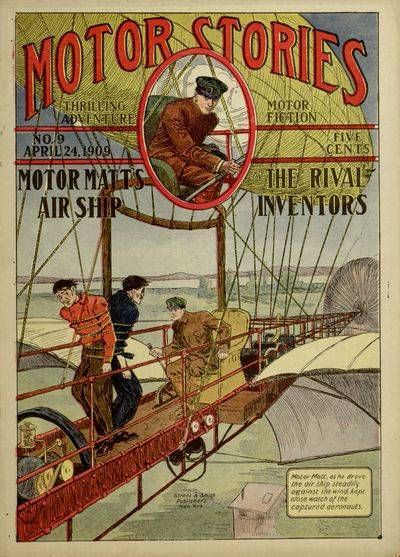
Motor Matt, as he drove the air-ship steadily against the wind, kept close watch of the captured aeronauts.
CHAPTER XVI.
THE END OF THE MID-AIR TRAIL.
The failure of Carl, Harris and Jerrold to make a landing on the "island" has already been recorded.
They had seen the Hawk, moored at one edge of the cleared space, and they had seen Brady and the others; but, of course, it had been impossible for them to see anything of Matt. The young motorist, at that time, was bound hand and foot and lying on the cot in the hut.
With bullets flying around them and threatening injury to the Eagle, it was not policy to remain hovering over such a nest of desperate scoundrels very long.
"We'll get out of here," cried Harris, angrily, "and come back with men and guns enough to give those fellows a taste of their own medicine. Don't let any harm come to the air-ship, Jerrold. We're going to need her, later."
Just as Harris finished speaking, a bullet slapped into the motor and the machinery at once began to go wrong.
"Too late," responded Jerrold grimly; "they've already nipped us."
"Py chimineddy," roared Carl, "I vish I hat somet'ing vat I could shoot mit ad dem fillains!"
Limping and staggering, Jerrold managed to urge the Eagle out of harm's way.
"She won't drop on us, will she?" asked Harris, looking anxiously downward at the tree-tops.
"No," replied Jerrold, "the gas-bag is uninjured, so we can't fall; and the motor is working, too, after a fashion, and that enables us to make a slow rate of speed. But there will have to be some repairs before we can do anything more with the air-ship."
"Where'll we go to make them? Back to South Chicago?"
"Lake Station is nearer. We'll come down there and ascertain the extent of the damage. It may be that we shall have to go back to South Chicago if the injury is at all serious."
"All right," acquiesced Harris. "I'll be able to do some telephoning and get a few more men out here from headquarters. I'll have them bring rifles, and then we'll give Brady a set-to that he'll remember."
"I ditn't see Matt in der blace," mourned Carl.
"He may have been there," said Harris. "There were two sheds, and they may be keeping your chum a prisoner in one of them."
"Vell, vile ve're avay fixing oop der Eagle, meppy dose fellers pack dere vill fly off mit demselufs in der Hawk. Oof dey do dot, den ve vill have some drouple for our pains."
"We shall have to keep watch of the sky in the direction of the swamp," said Jerrold. "By doing that we can tell whether or not the Hawk gets away."
Carl made that his work.
"I don'd know how I can see mit der naked eye ven ve ged py Lake Sdation," he remarked.
"We'll have to hunt up a spyglass, or a pair of binoculars," suggested Harris.
"Vat oof der Hawk moofs pefore we ged dem?"
"Then we'll be up against it, and no mistake."
There was a lot of excitement in the little town of Lake Station when a real, sure enough air-ship descended close to the blacksmith shop. The whole population gathered and stared.
While Jerrold was busy tinkering with his crippled motor, Carl succeeded in finding an old-fashioned spyglass and climbed with it to the top of the highest building in town. There he perched himself on the edge of the roof and watched continually in the direction of Willoughby's swamp.
Meanwhile, Harris had been talking with police headquarters in South Chicago. As a result, three officers were detailed to catch the first train for Lake Station.
The repairs to be made to the Eagle were somewhat extensive, and taxed the capacity of the blacksmith shop. Had Jerrold been in his own workroom he could have fixed up the motor more easily and quickly, but to take the Eagle back to South Chicago would have resulted in a loss of time.
Hour after hour the inventor labored, helped by the blacksmith and eyed with wonder by the townspeople. The detail of officers arrived, and they could do nothing but wait until the Eagle was ready to carry them to the "island" in the swamp. Any attempt to reach the "island" on foot was hardly to be considered.
While Jerrold's labors were nearing completion, a yell from Carl called the attention of Harris.
"What's the matter with you?" he shouted.
Carl was dancing around on the roof top, waving the spyglass frantically.
"Come oop!" he cried, wildly. "Der Hawk is gedding avay mit itseluf! Ach, plazes, vat a luck!"
Harris made haste to reach the top of the building where Carl had been patiently waiting and watching.
"Pud der spyglass to your eye, Harris," said Carl, "und look off to der nort'. Ach, dose fellers haf made some ged-avays, und I bed you dey have dook Matt along!"
With the glass at his eye, Harris swept the horizon in the direction indicated by Carl. Finally he found what he was looking for—an oblong blot gliding through the heavens and proceeding in a northerly direction.
"That's the Hawk, all right," said he, in a tone of intense disappointment, "but why is it heading in that direction?"
"Prady vouldn't dare go pack by Sout' Chicago," said Carl. "I bed you somet'ing for nodding he has got anodder hang-oudt in dot tirections. Ach, vat vill I do for dot bard oof mine?"
Gloomily the two descended from the roof, and Carl returned the spyglass to its owner.
Half an hour later the Eagle was ready for flight, and the officers and Carl got aboard. It was decided to proceed to the swamp and look over the "island" and then, if nothing of importance developed, to return to South Chicago.
The Eagle's motor, apparently, worked as well as ever, and the four miles separating Willoughby's swamp from Lake Station were covered in record time.
As they neared the "island" the officers made ready to use their guns. There was no hostile demonstration, however, and not a soul was anywhere in sight. The Eagle descended, and the officers, accompanied by the anxious Carl, proceeded to make a search.
They found nothing but two meagerly furnished houses, apparently recently deserted. Silence reigned everywhere, ominous of events that had happened.
"Vell," said Carl, gloomily, "dis means dot I haf got to do some more looking for Modor Matt. Der gang haf made off mit him some more, und I vas so tisappointed as I can't dell."
For that matter, they were all disappointed—Jerrold in particular. Motor Matt had served Jerrold well, and the inventor had been anxious to make him some repayment in kind.
But there was nothing left for the air-ship party to do but to point the Eagle toward home. As the air-ship passed the rolling mills and came close to the balloon house where Brady had formerly housed the Hawk, it was observed by those in the car that the doors of the big building were closed, and that two officers had mounted guard in front of them.
"That means something," muttered Harris. "Drop lower, Jerrold, so I can talk with those two cops."
Jerrold descended until the top of the car was nearly on a level with the balloon house, and Harris leaned over the guard rail.
"Hello!" he called. "What are you fellows doing there?"
"Watching the air-ship," was the astounding answer.
"Do you mean to say that Brady's air-ship is in that balloon house?"
"Sure."
"Has Brady been captured?"
"Why, no. You went after him, didn't you?"
"We went after him, but he and his men fired on us and damaged our motor. We went to Lake Station to fix the machinery, and while we were there we caught sight of the Hawk, through a spyglass, making north. As soon as we could, we started for the swamp, but there was no one there. Naturally, we supposed that Brady and his gang had made their escape, and it's mighty surprising to hear that the Hawk is back in its old cage and didn't bring Brady along."
"The Hawk brought Motor Matt——"
Carl gave a yell and nearly fell out of the car.
"Modor Matt?" he shouted. "Vas you shdringing me, oder iss it shdraight goots?"
"I'm giving it to you straight," answered the officer on the ground. "Motor Matt got away from the swamp and brought two prisoners with him, in the Hawk. They were two of the men who robbed Jerrold of his plans."
"Zum lauderbach haben, mich shtets——" began Carl, singing loudly and then interrupting himself to gloat. "Dot's my bard vat dit dot! Yah, so! Leedle Modor Matt who iss alvays doing t'ings vat you don'd oxbect. He has shtarred himseluf some more, you bed you! Vere iss Modor Matt now, officer?" Carl called down.
"He took a train into Chicago—said he was behind his schedule for that five-day race. The two prisoners are at police headquarters."
"Well, by thunder!" muttered Harris, mopping his face with a red handkerchief, "that Motor Matt must be a regular young phenomenon!"
"I never heard of anything to beat him!" averred Jerrold.
"Und you nefer vill!" declared Carl. "He iss vone oof dose fellers vat can't be peat."
"You might take us to police headquarters, Jerrold," suggested Harris.
"Und you mighdt shtop on der vay py der railroadt sdation," piped Carl. "I vant to ged py Chicago so kevick as der nation vill led me."
When Carl next saw Matt, the young motorist was spinning around the great oval in a Jarrot machine, which he knew so well and had driven to victory in Kansas. The five-day race was not for one driver alone, but several drivers were to be at the steering wheel of each car. Matt had reached the Coliseum just in time to take his place in the racing schedule.
Every time Matt whirled around the oval, Carl had something to say to him, but it was not until evening that the boys were able to get together for a talk.
They decided between them that Brady, and those whom Matt had left on the "island," must have made their escape from the swamp by a secret route known only to themselves.
Where Harper, the driver of the Hawk was, was likewise a mystery to the police.
Matt had turned the bag of loot stolen from Hartz & Greer over to the police with instructions to say that it was recovered by Miss Brady, and that no reward would be accepted for its return.
"How you tink dot air-ship pitzness is, anyvays, Matt?" asked Carl, when the boys had had their talk out and were ready to crawl into bed.
"I like it," answered Matt, enthusiastically, "and I wish I could have more of it!"
His wish was destined to fulfillment, for, as events proved, his thrilling work in South Chicago and at Willoughby's swamp was but the beginning of a series of air-ship experiences. Matt may have congratulated himself with the thought that he was through with Hector Brady, but Brady was by no means done with Matt—as will be made clear in the story to follow.
THE END.
THE NEXT NUMBER (10) WILL CONTAIN
Motor Matt's Hard Luck;
OR,
THE BALLOON-HOUSE PLOT.
An Old Friend—A Trap—Overboard—Rescued—Buying the Hawk—Matt Scores Against Jameson—At the Balloon House—The Plot of the Brady Gang—Carl is Surprised—Helen Brady's Clue—Jerrold Gives His Aid—Grand Haven—The Line On Brady—The Woods by the River—Brady a Prisoner—Back in South Chicago.
| MOTOR STORIES | |
| THRILLING ADVENTURE | MOTOR FICTION |
NEW YORK, April 24, 1909.
TERMS TO MOTOR STORIES MAIL SUBSCRIBERS.
(Postage Free.)
Single Copies or Back Numbers, 5c. Each.
| 3 months | 65c. |
| 4 months | 85c. |
| 6 months | $1.25 |
| One year | 2.50 |
| 2 copies one year | 4.00 |
| 1 copy two years | 4.00 |
How to Send Money—By post-office or express money-order, registered letter, bank check or draft, at our risk. At your own risk if sent by currency, coin, or postage-stamps in ordinary letter.
Receipts—Receipt of your remittance is acknowledged by proper change of number on your label. If not correct you have not been properly credited, and should let us know at once.
|
Ormond G. Smith, George C. Smith, |
} | Proprietors. |
STREET & SMITH, Publishers, 79-89 Seventh Avenue, New York City. |
THE BIG CYPRESS.
The rifle cracked and the piece of boiler plate, which had been erected as target against the bank fifty yards away, fell shattered like a pane of glass.
"How's that, Colonel Fearon?" coolly inquired the young fellow, who had fired the shot, as he turned to the tall, sallow-faced man who stood beside him.
A curious expression crossed the latter's face, but he answered quickly, "Amazing, Rutherford! Simply astonishing. I could never have believed such a thing possible. A pom-pom shell could hardly have smashed the plate more effectually."
The boy—he was hardly more—laughed. "I thought it would startle you, colonel. Will you feel justified in sending me up to Washington?"
"I reckon that's the place for you to go to, Rutherford. The war department'll need that new bullet of yours in their business. You mean to tell me you invented that bullet all by yourself?"
"I did, colonel. You see, I was always fond of dabbling in chemistry and the idea for this came to me one day when I was at work in my father's store. I didn't worry about it much, until the poor old man went broke, and then it struck me there was money in it. It was the mayor of our town, Orangeville, told me to come to you. He said that you could give me the proper introductions."
"He was right," said Colonel Fearon. "I can fix you up with the proper people. Let me have a shot."
Lionel Rutherford handed the colonel a cartridge, which outwardly looked precisely similar to an ordinary rifle cartridge. He then walked across the lawn of fine Bermuda grass, put a fresh piece of steel plate in position, and came back.
The colonel fired, and, as before, the tough steel simply sprang to pieces and lay in scattered fragments on the grass.
"I reckon there's more money in this than in keeping store," said the colonel thoughtfully. "Rutherford, I'll be pleased if you'll stay here at my house for a day or two till I can write to the proper people."
Young Rutherford thanked him warmly and the two walked back toward the long, low, wide verandaed house.
Late that night the colonel and his son, Randal Fearon, sat together in the well-appointed smoking room and talked earnestly in low tones.
"There's thousands in it, father," said the younger man sharply. "Thousands!"
"I know that as well as yourself," returned the other irritably. "But the invention's not yours or mine."
"What's Rutherford?" sneered Randal. "Here he is, a fellow who's never known anything of life, who's lived all his days in a little one-horse backwoods town, and now he's going to roll in riches while we are on the edge of bankruptcy."
He paused, and glanced at his father, who sat fidgeting uneasily. The colonel, fine-looking man that he was, was as weak-willed as his tall, thin, sharp-faced son was strong.
"A real nice scandal there'll be when we go smash," went on Randal Fearon. "Think of the headlines. 'Fraudulent Bankruptcy. Prominent Floridian lives beyond his means.' How the yellow press'll revel in it!"
Again the colonel moved uneasily. "I don't see how you're going to get the specifications from him, anyhow," he said at last.
"You leave that to me," replied Randal with sneering emphasis.
"Look you here, Randal, I won't have any violence." For once Colonel Fearon spoke decidedly.
"I guess you needn't worry your head about that," answered Randal. "I've got the whole plan cut and dried. You've asked him to stay?"
"Yes," said the colonel. "He will stay."
Randal laughed as if pleased. "That's all right. To-morrow we'll settle it, Pete Dally and I."
"How?"
"I'll tell you in the morning. Don't worry yourself. As you are so anxious to avoid it, I promise you there shall be no violence."
Randal chuckled in ugly fashion as he got up, flung the stump of his cigar into the fireplace, and, lighting a small hand lamp, left the room.
"How much farther have we got to go before we run into any of this game you talked about, Mr. Fearon?" asked Rutherford as he stopped and wiped the perspiration from his streaming face.
"I thought we'd have seen a buck before now," replied Randal Fearon. "We don't often have to come this far into the Big Cypress to find game, do we, Pete?"
"No, sah; we gen'rally finds it quite clos' to the aidge of de swamp," said Pete, who was a burly, square-shouldered negro with a face as black as ebony.
Rutherford was rather puzzled. That morning Randal Fearon had suggested that it would be very good fun to go shooting in the Big Cypress, a huge tract of wild, swampy forest, the edge of which was about five miles from Colonel Fearon's place.
"You might try the effect of some of your explosive bullets," Randal had suggested; and Rutherford had laughed and said that there wouldn't be much left of any game smaller than a buffalo or an elephant if struck by one of his projectiles.
All the same, being a keen sportsman, he had willingly agreed to the shoot. What puzzled him was that they should have tramped for hours through this steaming bush, which reeked with signs of game, and yet not seen a single thing to shoot at.
"Don't you worry. We shall find deer soon," said Randal when Rutherford expressed his astonishment. "We're getting near a good place now. I reckon we'd better stop and eat our dinner first. Pete, make a fire."
Pete Dally dropped the big haversack he was carrying over his broad shoulders, and obeyed. In a very few minutes a fire was blazing, and the fragrant fumes of frying bacon and strong coffee filled the close, steamy air. Lionel Rutherford, tired by the long tramp and the hot-house atmosphere of the jungle, enjoyed the meal greatly.
After they had finished they marched on again. They had left the pine trees behind, and were pushing along a narrow track through a forest of great ilex, bastard oak, and magnolia. The undergrowth was of saw palmetto, growing in huge, impenetrable clumps, among which the muddy track wound in and out.
The scent of yellow jasmine was almost stifling, but the only life visible was an occasional cardinal bird with its vivid crimson plumage, or a stub-tailed water moccasin which raised its triangular, copper-hued head with an ugly hiss and dragged itself sluggishly out of sight among the tangled herbage.
The path was so narrow that they were compelled to walk in single file. Randal made Pete lead the way. More than once the negro had tried to drop behind, but each time Randal roughly ordered him to push ahead.
The silence of the swamp grew as oppressive as the intense heat. It began to get upon young Rutherford's nerves.
"A tough place to get lost in," he said at last.
Randal turned quickly. There was a queer expression on his sharp face as he replied:
"Yes, pretty bad, I reckon."
Somehow, Rutherford fancied there was something sinister in his tone.
"I don't like the chap," he thought to himself. "I wish I hadn't come." Then common sense got the better of his fears. "It's the place, not the people, that's worrying me. These big hamaks are worse than a desert. There you can see the sky; here it's like one great, green prison."
"Look out, sah. Dah's a wild cat in dat tree," suddenly hissed Pete Dally, and slipped out of the path into the thicket. "Quiet or youse done frighten him."
Rutherford, all excitement, slipped his rifle from his shoulder.
But Randal barred his way. He was standing still, peering up into the tree indicated.
"Where? I don't see it," he exclaimed harshly.
"Dere it am, sah. On dat big fork," declared Pete, pointing. And then as Randal stepped forward, the negro slipped back round a clump of palmetto, and Rutherford felt a hand fall sharply on his arm, while these words were whispered in his ear:
"Dat man mean you no good, sah. Watch me, an' doan' do what he say."
He turned in amazement, but Peter was already gone. He had glided back, and was standing at Randal's elbow, pointing out the exact spot where he alleged he had seen the cat.
But there was no cat there now, and Rutherford wondered if there ever had been. Randal cursed Pete angrily, and once more they moved forward.
Rutherford, more worried than he cared to own even to himself, followed, as before, the last of the little procession.
It was getting late and the bullfrogs had begun to bellow harshly in unseen pools in the forest. But there was no decrease in the sullen heat. Not a breath stirred the moist, stagnant air, and the farther they went the thicker grew the tangled vegetation till there was no longer any sign of a path. In unbroken silence the three forced their way through primeval forest.
Presently trees broke away, and they stood upon the muddy marge of a reedy lagoon, across the stagnant waters of which the low sun cast a lurid light.
"Here we are," said Randal Fearon sharply. "This is where the deer come down to drink. You wait, Rutherford, in the bushes here, and you'll soon get a shot. Pete and I will take up our places on the far side. Then whatever comes some of us will get a buck."
"Watch me, and don't do what he says." Pete's words were ringing in Rutherford's ears. He cast a glance at the negro. Pete made a quick sign, which the English boy took to mean that he was to follow instead of remaining.
Next moment Randal had plunged off through the palmetto with Pete at his heels.
"What's it all mean?" muttered Rutherford angrily. "Is Fearon fooling me, or is it Pete? Of the two, I infinitely prefer the nigger. I'll do what he says."
He left his shelter, and moved as quietly as possible on the track of the other two.
Sure enough, they did go round the pool! Rutherford began to wonder if he was wrong; whether Pete for some unknown reason was fooling him.
The going was dreadful. The ground below the almost impenetrable palmetto was deep mud. Swarms of mosquitoes rose and stung viciously. Lionel was afraid that the crashing of the parted bushes would betray him.
He knew he was falling a long way behind, and panic seized him that he might lose the others. Though young Rutherford had lived all his life in America, yet he had never been in a big swamp like this. The store had kept him busy.
At last he reached the spot which Randal had pointed out as his own shooting station. To his horror, there was no one there. Randal and Pete had both disappeared. He was alone in the tangled heart of this monstrous swamp, and knew that without help he could never hope to find his way out.
After the first moment of panic Lionel Rutherford pulled himself together. He had plenty of pluck. He rapidly considered the situation. For some reason best known to himself Randal Fearon wished to abandon him, to lose him in the swamp. But he himself had no idea of dying of hunger, fever, or snakebite in this impenetrable wilderness. He had two courses open—go back and try to find his way out along the trail they had come by, or follow after Randal and Pete.
There were no objections to the first. It was a very long way, and it was doubtful if he could find it even in broad daylight. As it was, it would be dark in an hour. Besides, Pete had certainly meant him to follow.
Randal must mean to spend the night in the swamp. That was clear. Therefore he must have some camping place.
"I'll follow," muttered the boy between set teeth, and started off.
Though the sun was not yet down, it was already dusk beneath the thick shade of the towering timber, and in the half light the trail was most difficult to follow. The others had long ago passed out of hearing.
The night life of the swamp was waking. Enormous owls hooted weirdly, then came the thundering bellow of a bull alligator, and presently above all these the ghastly, half-human shriek of a panther calling to its mate.
Stumbling and struggling, Lionel hurried on. In a little he came to a thick belt of tall saw grass. The two pairs of footmarks entered it, but the trails beyond were so confused with the passage of deer and other animals that the boy recognized with a shock that he could not follow the human footsteps.
Very near despair, he turned back. No, he could not find Randal's trail. He stopped. "I'm done!" he muttered hopelessly, and stood straining his ears for any sound of his former companions.
Just then, as he was almost giving up, he caught sight of a morsel of something white stuck on a broken stem beside the trail. It was a tiny piece of paper, and on it, marked with a muddy finger tip, an arrow pointing in a certain direction.
"Pete!" exclaimed Lionel joyfully. A load rolled off his mind. Marking the direction carefully, he pushed on fast. Now he was on the lookout, he found other signs; a broken twig, a stick, laid in the path.
Darkness fell rapidly. There is little twilight in Florida.
"They can't go much farther," he said. He was right. In a very short time the dull glow of a fire showed where the others had camped.
"What shall I do?" he asked himself. "Go right up and tackle Randal Fearon? No; he'd have some excuse ready, and I'd only get Pete into trouble. I must wait till Randal goes to sleep."
The mosquitoes were savage. Young Rutherford, tired and hungry, found it maddening to wait in the damp gloom, and watch Randal gorge on the supper which Pete cooked. Nearly two hours passed before Randal, having finished a cigar, rolled himself, head and all, in a blanket and lay down.
A few minutes more, and a snore told Rutherford it was safe to venture closer.
Pete heard him, and glided out. The black man chuckled silently when he saw the boy. "Reckoned you'd be along, sah. You foun' de sign Pete lef' for you. Now de firs' thing is you eat. Den we talk."
He put corn, bread, and bacon into Rutherford's hands, and the boy made a hearty meal.
"Now, sah," said Pete. "You see what dat man want to do. He lose you in de swamp, den go home, say you fell in de water and was drowned. Den he an' his dad, dey take dat blow-up bullet ob yours an' sell him."
Lionel Rutherford was aghast. He had never dreamed of such wickedness.
"But we beat dem," went on Pete, with a chuckle. "I like you, an' I hate dat Randal."
"What can we do?" asked Lionel eagerly.
"Why, we play de same trick on him he try play on you. We take all de stuff, go off, an' leab him. He no more find his way out of de Big Cypress dan you. Only Pete know de trails."
"That won't do, Pete," returned Lionel sharply. "I won't be any party to murder."
Pete was amazed. He expostulated strongly.
"No, I'll tell you what we will do, Pete. We'll go off and hide, and let him think he's lost. We'll follow and watch, and when he's got the soul nearly scared out of him we'll find him again. See?"
Pete saw. He chuckled again in high good humor. "Dat's a very fine game, sah. We play dat to-morrow morning. Now I take de things away, an' when Randal wake he find no breakfast, no Pete, no nothing."
"He done lost hisself, sure pop!" declared Pete.
It was nine o'clock next morning, and Lionel Rutherford and the negro had been following Randal for more than an hour.
His language when he woke up and found Pete gone had been something appalling.
Having found that this did no good, he had started off back along the track they had come by on the previous day, but in less than ten minutes he was off it; and the two, who followed at a discreet distance, had watched his growing fury and fright when he found himself quite lost in the pathless depths of the wilderness.
"He can't go dat way much furder," observed Pete. "He gettin' down in de deal bad swamp. He go in up to his fool neck if he don't be keerful."
Sure enough the quaking muck-land broke beneath the young scoundrel's weight, and in he went. With a yell of fright he caught at a branch, pulled himself out, and staggered back.
"What's he going to do now?" whispered Lionel.
"Reckon he going climb dat tree an' see whar he am."
Pete was right. Randal began shinning up the stem of a tall, slender tree by the water's edge, the only one which seemed to give a possible view of any of the surrounding country. No doubt he thought he might spot the trail from the summit.
Rutherford, who had been staring hard at the tree, suddenly clutched Pete's arm. "What's that thing up in the branches just above him?" he asked sharply.
Pete took a long stare. "By golly, sah, it am a snake! An' a mighty big one, sure!"
Rutherford started forward, slipping a cartridge into his rifle.
"Don't shoot, sah," whispered Pete. "Dat ain't no poison snake. It am only a old white oak snake."
"Looks like an ugly customer," muttered Lionel.
At this moment Randal reached the first boughs and stood up. The movement alarmed the snake, which raised its ugly head and hissed sharply.
Randal heard the hiss, and, turning, saw the reptile. He gave a scream of terror, and almost lost his hold. Then he backed rapidly on to a branch which actually overhung the creek.
"Time to end this now," said Rutherford, raising his rifle. "I shall shoot the snake."
Pete seized his arm. "De snake won't hurt him, sah. But dey will."
He pointed to the water. The big alligator had seen Randal, and silently moved up till it was just beneath him. Another of almost equal size had also risen to the surface. Yellow eyes agleam, the hideous brutes were watching for this rash intruder upon their domain.
At the very instant there was a snapping crackle. The bough on which Randal cowered was breaking. And the wretched man, clinging vainly for a hold, had caught sight of the huge reptiles below. He screamed till the forest resounded with his agonizing cries.
He snatched at the branches above, but could reach only twigs, which broke in his grasp. He was falling clean into the open jaws of the alligators.
If Rutherford's rifle had been loaded only with an ordinary cartridge nothing could have saved Randal. It was just pure luck that he had flung one of his explosives into the breech.
Simultaneous with Randal's fall the rifle spoke. The bullet caught the nearest alligator on the side of the head, and the air was full of mangled fragments of flesh and bone.
Into this horrible geyser Randal dropped heavily and vanished.
Next moment he rose again, and struck out madly for the bank.
"I can't shoot again," cried Lionel. "I should kill him if I did."
"Dere ain't no need to," said the negro. "You done scared de stuffin' out ob dat oder gator."
"Thank goodness he's safe," exclaimed Lionel as Randal scrambled ashore and fell in a heap on the bank. "Now we'd better get him home."
Pete laughed. "Yes, sah. I reckon he done had enough ob de Big Cypress."
When Randal came round Rutherford soon realized he had no more to fear. The fellow's nerve was broken. He shivered and trembled like a frightened child.
They took him home, and then Lionel went boldly to Colonel Fearon, and told him the whole story plump and plain. When he had finished the colonel sat speechless. His face was gray and pinched.
Lionel looked at him. "I shan't make any trouble for you," he said coolly. "All I want is those introductions. Write them now, and I'll take them myself to Washington."
Without a word the colonel obeyed.
Lionel Rutherford is now a rich and rising man. Pete is his faithful major-domo. Whenever Lionel gets a holiday the two go off down south for a week or two of shooting. But they never again penetrated the desolate depths of the Great Cypress.