
A WINTER STORY OF COLORADO.
The wild beasts upon Hicks Mountain were limited almost entirely to the coyotes; these persisted, in spite of advancing settlement, but in this section of Colorado the grey wolf, the mountain-lion, and the bear had been practically exterminated. For five years the stock had run the hills quite unmolested. A coyote will kill sheep, but its depredations are confined otherwise to the poultry, barring now and then a sick and abandoned calf.
However, in the winter of 1905, rumors spread that the grey wolves had returned. Calves were being killed and eaten, sows mutilated, and even large steers torn about the legs and chest. One rancher discovered in the timber across the pasture from his house the remains of a yearling heifer killed only that night; whatever had attacked it had devoured it, hide and all, to the very largest bones, leaving only the scattered remnants of a skeleton.
Now, a mountain-lion would have eaten part and buried the rest; a bear would also have eaten part, and saved the rest for later; coyotes would only have gnawed and mangled the carcass; the great grey wolf alone would have worked a destruction so complete.
The ground was bare of snow, and covered with pine-needles, thus being unfavorable for tracks. Mr. Jeffries had heard no howling. Nevertheless, the grey wolf, the stockman's scourge, was blamed.
Traps were set, and poisoned meat was discreetly put out, but only the coyotes suffered, apparently. Then Ned Coswell, early one morning, while searching for a lost milk-cow, came over a little rise, and saw below him in a hollow in the park a number of wolfish animals collected about a dead body, tearing at it. Ned was unarmed, but, spurring his horse, he rode down upon them recklessly, whooping.
"There were about a dozen of them," related Ned, "and I knew they weren't wolves, because they were colored differently, more like dogs. They looked at me coming, and, boys, I didn't know for a minute whether they were going to get out of the way or not. Old Medicine Eye"—his horse—"wasn't a bit afraid; just pricked his ears and kept on, which made me think all the more they weren't wolves.
"They were dogs, boys, nothing but dogs. There was a brindled one that looked like a bulldog, and several woolly dogs, like sheep-dogs, and one big black-and-white shaggy fellow, biggest of all. They all lifted their heads, and stood staring at me, and I was beginning to think that maybe I'd been in too much of a hurry. But first one sneaked off, showing his teeth, into the brush, and another and another, and they all went, and I was mighty glad to have them go. They'd been eating at a dead steer—mine, too—but I don't know whether they'd killed it or not. I wish I'd had a gun."
After that the ranchers made it a habit again to carry a gun of some kind when out on the range. However, for a long time nobody, when armed, caught any glimpse of the wild dogs. That is likely to be the case in hunting; the unprepared frequently have the opportunities.
For instance, Frank Warring, while on his way home from town in his wagon, toward evening of a cloudy day, beheld the pack cross the road right in front of him, the animals in single file, one following another, silent as specters, noses outstretched, the big, shaggy black-and-white fellow leading. In the rear were two or three puppies, perhaps nine months old. Frank had no gun. Somebody else also saw the pack.
The brutes' depredations continued, being limited, so far as we could ascertain, to our vicinity, as if they had selected Hicks Mountain for a hunting-ground. They hunted without howling. A spasmodic, rabid bark was the only sound that we could attribute to them, but it was sufficient.
We were afraid of this wild pack; more afraid than of wolves. There is something uncanny about a dog gone wild, for he combines the lessons taught by domesticity with the instincts of savagery.
As nobody from our section had missed dogs, we concluded that this band had come down upon us from Wyoming, a hundred and fifty miles north. Up in Wyoming wild dogs had been bothering the sheep-range. Probably energetic measures adopted by the irate sheep men had driven the marauders to seek new fields.
Finally, Sam Morris had a chance to retaliate. He was hunting deer afoot. The day was dark and snowy. As he was sitting motionless beside a boulder, watching the slope below and the ascent across the draw, the dog-pack suddenly streamed out from the pines down there, and all at a lope threaded the bottom of the draw, onward bound. The shaggy black-and-white was leading, as usual.
Sam's gun was loaded with buckshot, and he waited greedily, that he might get more than one dog with his charge. But the animals were too shrewd to travel bunched; they left intervals, as do the wolves when trailing, and when at last Sam would desperately have "whanged away," his gun missed fire. Rather chagrined was Sam, telling his tale afterward. He confirmed the previous statements that the pack was variously colored, made up of different breeds; a strange invasion surely.
The trail through the draw remained unobliterated, for no snow fell for two weeks thereafter. We found that the dog-pack was utilizing this draw for a pass. It appeared to lead from one favorite point to another. The trail grew more distinct, but it scarcely widened; the dogs stepped always, so it seemed, in the same spots. It was vain to set traps; the disturbance of the snow was noticed at once. Poison was disregarded. The pack kept on ranging the country and attacking stock.
Sam was anxious to retrieve himself, and he and I agreed to put in our time watching that trail until we should "fix" some of those outlaws. I remember that it was the tenth day of January, and toward four o'clock in the afternoon, when, for perhaps the sixth or seventh time, we ensconced ourselves between two boulders on the slope overlooking the trail below.
The sky was cloudy; a snowstorm was evidently approaching. Cloudy days seemed to be those upon which the dog-pack was most likely to be sighted. Probably upon such days it emerged earlier on account of the waning light. This afternoon we had been in ambush only a half-hour when the pack appeared.
In silent, single file the pack came trotting out of the timber on our right, and across before us, following the trail in the draw. The big, black-and-white, shaggy fellow was the first; next to him was the brindle. I recognized them, for every narrative had contained them.
I don't know exactly why, but the sight of them all, trotting so silently, so swiftly, business-bent, thrilled me with a little chill. About their steady gait was something ominous, unreal. A pack of wolves I could have surveyed without special emotion, for I should have known what to expect, but a pack of dogs, gone wild—ugh! They are neither dogs nor wolves, but, as has been said, an uncanny blending.
We had agreed what to do. Sam only nudged me, and levelled his gun. There was an instant of suspense, and we fired practically together.
We had rifles, and were using black powder, and the smoke was momentarily thick. When it cleared, the shaggy leader was kicking in the snow, and the brindle was lying still. My bullet had not sped quite as truly as Sam's; his aim had been the brindle. The rest of the pack were racing madly onward, and although we fired twice more, we did not hit any of them.
We went down to our victims. The brindle had just life enough in him to snarl at us ere he died. The big black-and-white was gasping.
Then a strange thing occurred. As I stood over him, he wagged his bushy tail; his eyes were not wild, but soft, suffering, appealing. He was now all dog and would turn to his chosen friend, man, for sympathy and aid.
"Poor old chap!" I said.
His eyes were glazing fast; he hauled himself on his side over the snow toward me.
"Look out!" warned Sam.
But there was no need. With a final effort, the animal just managed to lick my boot-toe, and with his head upon it, he shivered and was still. I declare, a lump rose in my throat.
As I bent to pat his coat—I love dogs, and he had struck me right to the heart, marauder though he had been—I felt a collar round his neck, concealed by his long, curly hair. Upon the collar was a plate, engraved "Prince." Somebody's "Prince" had he been, somebody's pet. But whose?
A more perfect example of atavism, reversion to type—call it what you will—would be hard to present.
The dog-pack never again, as far as there was evidence, traversed that trail. Nor was it seen again upon Hicks Mountain. It seemed almost as if it had been composed of weird phantoms, like the spectral packs of German and Provençal legend, and had dissolved at our gunshots.
ESPECIALLY IMPORTANT!!
MOTOR STORIES
A New Idea in the Way of Five-Cent Weeklies.
Boys everywhere will be delighted to hear that Street & Smith are now issuing this new five-cent weekly which will be known by the name of MOTOR STORIES.
This weekly is entirely different from anything now being published. It details the astonishing adventures of a young mechanic who owned a motor cycle. Is there a boy who has not longed to possess one of these swift little machines that scud about the roads everywhere throughout the United States? Is there a boy, therefore, who will not be intensely interested in the adventures of "Motor Matt," as he is familiarly called by his comrades?
Boys, you have never read anything half so exciting, half so humorous and entertaining as the first story listed for publication in this line, called "Motor Matt; or, The King of the Wheel." Its fame is bound to spread like wildfire, causing the biggest demand for the other numbers in this line, that was ever heard of in the history of this class of literature.
Here are the titles to be issued during the next few weeks. Do not fail to place an order for them with your newsdealer.
No. 1.—Motor Matt; or, The King of the Wheel.
No. 2.—Motor Matt's Daring; or, True to His Friends.
No. 3.—Motor Matt's Century Run; or, The Governor's Courier.
No. 4.—Motor Matt's Race; or, The Last Flight of the "Comet."
No. 5.—Motor Matt's Mystery; or, Foiling a Secret Plot.
No. 6.—Motor Matt's Red Flier; or, On the High Gear.
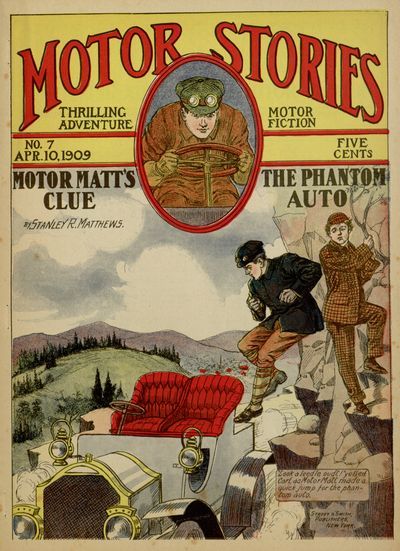
No. 7.—Motor Matt's Clue; or, The Phantom Auto.
No. 8.—Motor Matt's Triumph; or, Three Speeds Forward.
No. 9.—Motor Matt's Air-ship; or, The Rival Inventors.
| 32 LARGE SIZE PAGES | SPLENDID COLORED COVERS |
PRICE, FIVE CENTS PER COPY
AT ALL NEWSDEALERS, OR SENT POSTPAID BY THE PUBLISHERS UPON RECEIPT OF THE PRICE.
STREET & SMITH, Publishers, NEW YORK
THE BEST OF THEM ALL!!
MOTOR STORIES
IT IS NEW AND INTENSELY INTERESTING
We knew before we published this line that it would have a tremendous sale and our expectations were more than realized. It is going with a rush, and the boys who want to read these, the most interesting and fascinating tales ever written, must speak to their newsdealers about reserving copies for them.
MOTOR MATT sprang into instant favor with American boy readers and is bound to occupy a place in their hearts second only to that now held by Frank Merriwell.
The reason for this popularity is apparent in every line of these stories. They are written by an author who has made a life study of the requirements of the up-to-date American boy as far as literature is concerned, so it is not surprising that this line has proven a huge success from the very start.
Here are the titles now ready and also those to be published. You will never have a better opportunity to get a generous quantity of reading of the highest quality, so place your orders now.
No. 1.—Motor Matt; or, The King of the Wheel.
No. 2.—Motor Matt's Daring; or, True to His Friends.
No. 3.—Motor Matt's Century Run; or, The Governor's Courier.
No. 4.—Motor Matt's Race; or, The Last Flight of the "Comet."
TO BE PUBLISHED ON MARCH 22nd
No. 5.—Motor Matt's Mystery; or, Foiling a Secret Plot.
TO BE PUBLISHED ON MARCH 29th
No. 6.—Motor Matt's Red Flier; or, On the High Gear.
TO BE PUBLISHED ON APRIL 5th
No. 7.—Motor Matt's Clue; or, The Phantom Auto.
TO BE PUBLISHED ON APRIL 12th
No. 8.—Motor Matt's Triumph; or, Three Speeds Forward.
Price, Five Cents To be had from newsdealers everywhere, or sent,
postpaid, upon receipt of the price by the publishers
STREET & SMITH, Publishers, NEW YORK
Transcriber's Notes:
Cover image may be clicked to view a larger version.
Retained some unusual spellings (e.g. "bloming") within dialogue on the assumption they are intentional.
Page 4, changed "Billy Ruffin" to "Billy Ruffian" to match second instance of ship's nickname.
Page 12, added missing quote after "while I was down in Phœnix."
Page 13, removed unnecessary quote after "slaps from his cousin Ralph."
Page 17, removed unnecessary quote before "It was impossible, of course...." Changed "intendeing" to "intending" ("What Motor Matt was intending to do").
Page 18, changed "Someting" to "Something" ("Something was about to happen").
Page 19, removed unnecessary apostrophe after "Mings" ("Mings was in such a position").
Page 20, changed "medding" to "meddling" ("meddling with Sercomb's business").
Page 21, changed "Mat" to "Matt" ("Matt started along the gully").
Page 25, changed "than" to "that" ("frame that enclosed").
Page 26, changed "in" to "is" ("house is like").
Page 28, changed "Villianous" to "Villainous" in "Villainous Plot."