
THE DEATH BITE.
"Well, Ed, let us hear from you to-night. You are always talking of strategy, flanks, and other soldiering knickknacks. Now tell us a story."
The boys drew their chairs about the roaring fire, which cast its ruddy glow about the room, while without the north wind held revelry in the branches of the trees.
Ed looked over the top of his paper, and smiled.
"What's that you say, Bib? I can't tell much of a story."
Ed drew his chair to the fire. A chorus of supplications came from all parts of the room, and Ed laid aside his paper.
"In the early spring of 1863 we were encamped near the Pamunky River, about the time they were undermining the enemy's fort on the other side of the river. One rainy night a party of us were formed and marched out. It was well known the enemy was not far off, and I felt anything but pleasant. The rain poured down in a deluge, and we picked our way through the woods by the blinding flashes of lightning which now and then illumined the forest. The heavy rains had transformed the ground into a swamp. Near the edge of the forest we halted and separated in squads of five.
"By good luck I had charge of one squad. From under our overcoats we drew our spades and waited for the rain to slack.
"'Now, Ed,' said the lieutenant, 'you take your men and select a spot and dig a rifle pit, and if anything comes in your way bang away at it, for things are getting hot.'
"A few minutes more and the lieutenant and his party were gone. Between two huge trees we began to dig, and in a few hours we had finished our pit. The boys tumbled in and all were soon asleep, except Barry; he was a down-Easter and had been through most of the campaigns.
"The rain ceased falling, and no sound reached us save the pattering raindrops as the wind dislodged them from the trees.
"I had scarcely taken forty winks, when Barry poked me in the ribs. I awoke immediately.
"'Look there!' he whispered.
"I looked over the pit and saw a small light swaying to and fro. I thought at first it was a will-o'-the-wisp.
"'Will I fire at it?' asked Barry.
"'You know your orders, don't you?' I replied. 'Let us both fire at it.' Both of our muskets were shoved over the top of the pit, and taking a hasty aim, we fired.
"A loud yell followed the reports, and we saw the light fly upward and fall to the ground; then all was darkness, and the same quietness returned.
"'I wonder is he dead?' was the question that arose; and then the boys returned to their corners and slumbered on.
"Soon the faint gray streaks of morning began to light up the east; and as I felt very thirsty I took my canteen, and clambered out of the pit, and started off. A few minutes' walk brought me to a small creek, and I filled my canteen and stooped to drink. The snapping of a twig caused me to look up; and my hair fairly raised, for not two yards from me stood a powerful man dressed in gray; he had pistols, a musket and an ugly-looking toothpick. A low chuckle came from his lips, and I gave myself up for lost, as I had not even so much as a penknife with me. In my eagerness to get water I forgot all. The Confederate seemed to read me through, for he said:
"'Well, Yank, have you got enough water?'
"I managed to say 'Yes'.
"'Well,' he said, 'get away from here, and think yourself lucky.'
"It did not take me long to get away from that spot. Then I noticed, for the first time, that our pit was dug on the top of a little hill. A few yards off on the other side of the creek stood a large barn. I could see forms walking about from where I now stood. The man I had met walked toward the barn. The boys in the pit saw him, and the muzzles of their guns frowned over the top in a minute. At that moment a detachment of men came to relieve us. They had hardly reached us, when from behind the barn a party of soldiers hove in sight, dragging a small fieldpiece, and in a moment more a crashing iron ball came tearing in our midst. With whoops and yells the enemy dashed on our little party, and we were soon engaged hand to hand. I felt myself hurled to the ground and a hand tightening about my throat. Then the fear of death stole upon me, and the strength of a Hercules took possession of my limbs. I turned my assailant over and placed my knee on his breast.
"In vain I looked about for something to put an end to the struggling man whom I held, but could find nothing. In his belt I saw the handle of a knife. I seized it with one hand, but in doing so my grasp relaxed upon his throat, and before I could prevent it he had my finger in his mouth, and his teeth closed upon it. I fairly howled with pain and drove the knife into his heart several times. His jaws grew rigid in death and his teeth cut slowly to the bone and partly bit that, too. How I yelled! If it had been taken off at once the pain would have been nothing, but being bitten slowly off was intense. I had to pry open his jaws with the knife to get my finger out of his mouth."
Ed paused and the boys crowded about him, and the second finger was minus an inch. We all dispersed that night thinking there has been many an adventure that befell the brave boys of which the public will never know anything.
MIGRATION OF RATS.
In nearly all countries a seasonal movement of rats from houses and barns to the open fields occurs in spring, and the return movement takes place as cold weather approaches. The movement is noticeable even in large cities.
More general movements of rats often occur. In 1903 a multitude of migrating rats spread over several counties of western Illinois. They were noticed especially in Mercer and Rock Island Counties. For several years prior to this invasion no abnormal numbers were seen, and their coming was remarkably sudden. An eye-witness to the phenomenon informed the writer that as he was returning to his home by moonlight he heard a general rustling in the field near by, and soon a vast army of rats crossed the road in front of him, all going in one direction. The mass stretched away as far as could be seen in the dim light. These animals remained on the farms and in the villages of the surrounding country, and during the winter and summer of 1904 were a veritable plague. A local newspaper stated that between March 20 and April 20, 1904, F. U. Montgomery, of Preëmption, Mercer County, killed three thousand four hundred and thirty-five rats on his farm. He caught most of them in traps.
In 1877 a similar migration occurred into parts of Saline and Lafayette Counties, Mo., and in 1904 another came under the writer's observation in Kansas River Valley. This valley for the most part was flooded by the great freshet of June, 1903, and for about ten days was covered with several feet of water. It is certain that most of the rats in the valley perished in this flood. In the fall of 1903 much of the district was visited by hordes of rats, which remained during the winter, and by the following spring had so increased in numbers that serious losses of grain and poultry resulted.
No doubt the majority of the so-called migrations of rodents are in reality instances of unusual reproduction or of enforced migration owing to lack of food. In England a general movement of rats inland from the coast occurs every October. This is closely connected with the closing of the herring season. During the fishing the rodents swarm to the coast, attracted by the offal left from cleaning the herring, and when this food supply fails they hasten back to the farms and villages.
In South America periodic plagues of rats have taken place in Parana, Brazil, at intervals of about thirty years, and in Chili at intervals of from fifteen to twenty-five years. These plagues in the cultivated lands follow the ripening and decay of the dominant species of bamboo in each country. The ripening of the seed furnishes for two or more years a favorite food for rats in the forests, where the animals multiply greatly; when this food fails they are forced to the cultivated districts for subsistence. In 1878 almost the entire crops of corn, rice, and mandioca in the State of Parana were destroyed by rats, causing a serious famine.
An invasion of black rats in the Bermuda Islands occurred about the year 1615. In a space of two years they had increased so alarmingly that none of the islands was free from them. The rodents devoured everything which came in their way—fruit, plants, and even trees—so that for two years the people were destitute of bread. A law was passed requiring every man in the islands to set twelve traps. In spite of all efforts the animals increased, until they finally disappeared with a suddenness which could have resulted only from a pestilence.
SOME GREAT CATASTROPHES.
"It is the general opinion that earthquakes constitute the most terrible of the world's catastrophes, both as regards loss of life and destruction of property," says an English writer. "This, however, is not so. The convulsion in southern Italy killed not less than two hundred thousand people, and in this respect it is easily the most dreadful occurrence of its kind. The historic Lisbon earthquake, which ranks next below it in regard to the number of fatalities, caused fifty thousand deaths in that one city alone and about an equal number elsewhere. The South American one of 1867 was responsible for thirty thousand. That which destroyed Aleppo in 1822 slew twenty thousand. These are the four worst earthquakes concerning which anything like reliable statistics are obtainable, and the total combined loss of life, it will be observed, did not, at any rate, exceed three hundred and fifty thousand.
"But when the Yellow River burst its banks in September, 1887, more than seven million people were drowned in the resultant great flood, which covered to an average depth of six feet a populous Chinese province the size of Scotland. Thus, in this one catastrophe, more lives were lost than in all the earthquakes recorded in the world's history. Then, again, there is pestilence. The black death killed in China, where it broke out, thirteen million people; in the rest of Asia, twenty-four million, and thirty million in Europe, or sixty-seven million in all. In India alone, and that within the past twelve years, bubonic plague has slain over six million people, and the epidemic still rages.
"Famines run plagues a close second. The one that raged in Bombay and Madras in 1877 slew five million people; and that which prevailed in northern China in the same year, and which was due to the same climatic causes, cost nine million five hundred thousand lives."
LATEST ISSUES
MOTOR STORIES
The latest and best five-cent weekly. We won't say how interesting it is. See for yourself. High art colored covers. Thirty-two big pages. Price, 5 cents.
20—Motor Matt Makes Good; or, Another Victory for the Motor Boys.
21—Motor Matt's Launch; or, A Friend in Need.
22—Motor Matt's Enemies; or, A Struggle for the Right.
23—Motor Matt's Prize; or, The Pluck That Wins.
24—Motor Matt on the Wing; or, Flying for Fame and Fortune.
25—Motor Matt's Reverse; or, Caught in a Losing Game.
26—Motor Matt's "Make or Break"; or, Advancing the Spark of Friendship.
27—Motor Matt's Engagement; or, On the Road With a Show.
28—Motor Matt's "Short Circuit"; or, The Mahout's Vow.
29—Motor Matt's Make-up; or, Playing a New Rôle.
30—Motor Matt's Mandarin; or, Turning a Trick for Tsan Ti.
31—Motor Matt's Mariner; or, Filling the Bill for Bunce.
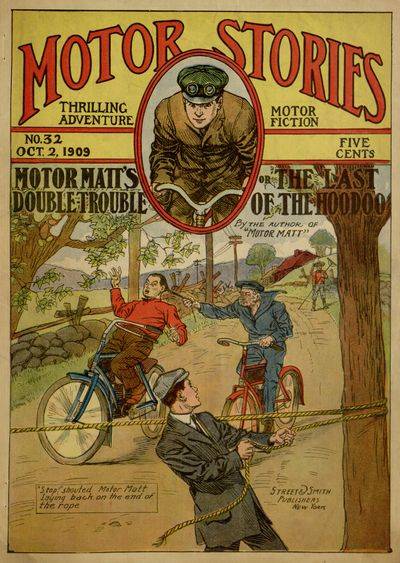
32—Motor Matt's Double-trouble; or, The Last of the Hoodoo.
33—Motor Matt's Mission; or, The Taxicab Tangle.
TIP TOP WEEKLY
The most popular publication for boys. The adventures of Frank and Dick Merriwell can be had only in this weekly. High art colored covers. Thirty-two pages. Price, 5 cents.
691—Dick Merriwell's Dandies; or, A Surprise for the Cowboy Nine.
692—Dick Merriwell's "Skyscooter"; or, Professor Pagan and the "Princess."
693—Dick Merriwell in the Elk Mountains; or, The Search for "Dead Injun" Mine.
694—Dick Merriwell in Utah; or, The Road to "Promised Land."
695—Dick Merriwell's Bluff; or, The Boy Who Ran Away.
696—Dick Merriwell in the Saddle; or, The Bunch from the Bar-Z.
697—Dick Merriwell's Ranch Friends; or, Sport on the Range.
698—Frank Merriwell at Phantom Lake; or, The Mystery of the Mad Doctor.
699—Frank Merriwell's Hold-back; or, The Boys of Bristol.
700—Frank Merriwell's Lively Lads; or, The Rival Campers.
701—Frank Merriwell as Instructor; or, The Skill of the Wizard.
702—Dick Merriwell's Cayuse; or, The Star of the Big Range.
703—Dick Merriwell's Quirt; or, The Sting of the Lash.
704—Dick Merriwell's Freshman Friend; or, A Question of Manhood.
NICK CARTER WEEKLY
The best detective stories on earth. Nick Carter's exploits are read the world over. High art colored covers. Thirty-two big pages. Price, 5 cents.
652—The Green Box Clue; or, Nick Carter's Good Friend.
653—The Taxicab Mystery; or, Nick Carter Closes a Deal.
654—The Mystery of a Hotel Room; or, Nick Carter's Best Work.
655—The Tragedy of the Well; or, Nick Carter Under Suspicion.
656—The Black Hand; or, Chick Carter's Well-laid Plot.
657—The Black Hand Nemesis; or, Chick Carter and the Mysterious Woman.
658—A Masterly Trick; or, Chick and the Beautiful Italian.
659—A Dangerous Man; or, Nick Carter and the Famous Castor Case.
660—Castor the Poisoner; or, Nick Carter Wins a Man.
661—The Castor Riddle; or, Nick Carter's Search for a Hidden Fortune.
662—A Tragedy of the Bowery; or, Nick Carter and Ida at Coney Island.
663—Four Scraps of Paper; or, Nick Carter's Coney Island Search.
664—The Secret of the Mine; or, Nick Carter's Coney Island Mystery.
665—The Dead Man in the Car; or, Nick Carter's Hair Line Clue.
666—Nick Carter's Master Struggle; or, The Battle With the Man-monkey.
667—The Airshaft Spectre; or, Nick Carter's Shrewd Surmise.
For sale by all newsdealers, or will be sent to any address on receipt of price, 5 cents per copy, in money or postage stamps, by
STREET & SMITH, Publishers, 79-89 Seventh Avenue, New York
IF YOU WANT ANY BACK NUMBERS of our Weeklies and cannot procure them from your newsdealer, they can be obtained from this office direct. Fill out the following Order Blank and send it to us with the price of the Weeklies you want and we will send them to you by return mail. POSTAGE STAMPS TAKEN THE SAME AS MONEY.
| ________________________ 190 | |||||
| STREET & SMITH, 79-89 Seventh Avenue, New York City. Dear Sirs: Enclosed please find ___________________________ cents for which send me: | |||||
| TIP TOP WEEKLY, | Nos. | ______________________ | BUFFALO BILL STORIES, | Nos. | ______________________ |
| NICK CARTER WEEKLY, | " | ______________________ | BRAVE AND BOLD WEEKLY, | " | ______________________ |
| DIAMOND DICK WEEKLY, | " | ______________________ | MOTOR STORIES, | " | ______________________ |
|
Name ________________ Street ________________ City ________________ State ________________ | |||||
A GREAT SUCCESS!!
MOTOR STORIES
Every boy who reads one of the splendid adventures of Motor Matt, which are making their appearance in this weekly, is at once surprised and delighted. Surprised at the generous quantity of reading matter that we are giving for five cents; delighted with the fascinating interest of the stories, second only to those published in the Tip Top Weekly.
Matt has positive mechanical genius, and while his adventures are unusual, they are, however, drawn so true to life that the reader can clearly see how it is possible for the ordinary boy to experience them.
HERE ARE THE TITLES NOW READY AND THOSE TO BE PUBLISHED:
1—Motor Matt; or, The King of the Wheel.
2—Motor Matt's Daring; or, True to His Friends.
3—Motor Matt's Century Run; or, The Governor's Courier.
4—Motor Matt's Race; or, The Last Flight of the "Comet."
5—Motor Matt's Mystery; or, Foiling a Secret Plot.
6—Motor Matt's Red Flier; or, On the High Gear.
7—Motor Matt's Clue; or, The Phantom Auto.
8—Motor Matt's Triumph; or, Three Speeds Forward.
9—Motor Matt's Air Ship; or, The Rival Inventors.
10—Motor Matt's Hard Luck; or, The Balloon House Plot.
11—Motor Matt's Daring Rescue; or, The Strange Case of Helen Brady.
12—Motor Matt's Peril; or, Cast Away in the Bahamas.
13—Motor Matt's Queer Find; or, The Secret of the Iron Chest.
14—Motor Matt's Promise; or, The Wreck of the "Hawk."
15—Motor Matt's Submarine; or, The Strange Cruise of the "Grampus."
16—Motor Matt's Quest; or, Three Chums in Strange Waters.
17—Motor Matt's Close Call; or, The Snare of Don Carlos.
18—Motor Matt in Brazil; or, Under the Amazon.
19—Motor Matt's Defiance; or, Around the Horn.
20—Motor Matt Makes Good; or, Another Victory for the Motor Boys.
21—Motor Matt's Launch; or, A Friend in Need.
22—Motor Matt's Enemies; or, A Struggle for the Right.
23—Motor Matt's Prize; or, The Pluck that Wins.
24—Motor Matt on the Wing; or, Flying for Fame and Fortune.
25—Motor Matt's Reverse; or, Caught in a Losing Game.
26—Motor Matt's "Make or Break"; or, Advancing the Spark of Friendship.
27—Motor Matt's Engagement; or, On the Road With a Show.
28—Motor Matt's "Short Circuit"; or, The Mahout's Vow.
To be Published on September 6th.
29—Motor Matt's Make-up; or, Playing a New Role.
To be Published on September 13th.
30—Motor Matt's Mandarin; or, Turning a Trick for Tsan Ti.
To be Published on September 20th.
31—Motor Matt's Mariner; or, Filling the Bill for Bunce.
To be Published on September 27th.
32—Motor Matt's Double-trouble; or, The Last of the Hoodoo.
PRICE, FIVE CENTS
At all newsdealers, or sent, postpaid, by the publishers upon receipt of the price.
| STREET & SMITH, | Publishers, | NEW YORK |
Transcriber's Notes:
Added table of contents.
Images may be clicked to view larger versions.
Page 3, changed "come, on then" to "come on, then."
Page 4, added missing period after "asked Pardo."
Page 7, corrected "Mat" to "Matt" in "Matt continued to sit." Corrected "let's some one else" to "let some one else."
Page 8, corrected typo "mardarin" in "bluff us out of helping the mandarin."
Page 9, corrected "Mat" to "Matt" in "Matt and I will put the kibosh."
Page 13, corrected typo "tellling" in "no telling when the pallavering."
Page 14, corrected typo "folowing" in "excitement following Bunce's discovery." Corrected typo "Gardenvile" in "between the spring and Gardenville."
Page 18, corrected typo "flutering" in "fluttering his hand reassuringly." Corrected "spiritsails" to "spritsails."
Page 21, corrected typo "your'" in "while you're tied up."
Page 23, corrected typo "boad" in "marsh on one side of the road."
Page 25, added missing period after "kept at his work."
Page 29, removed unnecessary quotes around paragraph beginning "They believed that America tapered..."