
SPECIALISTS IN THE WOODS.
Only people who have poked around up there more or less realize how many persons make a living out of the Maine woods. This reference is not to the lumbermen and the pulp stuff choppers. Their presence in the woods is a matter of course. This is a word about the army of specialists. One might say that they are the gleaners who follow the red-shirted reapers whose harvest is the giants of the forests. The side issues of the Maine woods feed many mouths; and speaking about mouths there are, of course, the gum pickers.
Some people have an idea that spruce gum is gathered in the forest by the lumbermen at odd jobs. It may be remarked in passing that from 4:30 a. m. until dark the Maine loggers have something else to do. They haven't any hankering to climb trees.
Practically all the spruce gum of commerce is gathered by men who make it their business and work at it as steadily as a man in a factory. You will find the snowshoe trail of these busy chaps zigzagging through pathless stretches, and if you happen to be up that way you will see their camp-fires glowing deep in many a lonely glen.
Few people behold them at their work. The constant supply of gum in store windows shows they are kept busy.
There is more or less excitement about gum picking. The standard price for gum is $1 a pound, and a fancy article of clear nuggets brings $1.50. Some days when lucky strikes are frequent the gum picker can clear from $5 to $10.
The gum picker can sell even the scraps and chippings. The patent spruce gum maker boils those down. Several medicine firms also make a spruce gum cough balsam.
Maine gum pickers usually travel in pairs. Some go on their own hook, others are employed by wholesale druggists. Usually they range over wide territory, sleeping here and there in the deserted logging camps that sprinkle northern Maine. A few fresh boughs of browse in the bunks and some strips of bark over the habitable corner of the camp make the place a comfortable home.
If a city man happens to be ordered into the woods by his physician he would do well to take up gum picking for his pastime, even if he does not care for the money. There is just enough activity about it to keep a man's mind clear and his muscles healthy. It takes him abroad through the crisp winter air and gives him an excuse for "hucking it."
A gum picker's equipment comprises warm clothing, snowshoes, climbers—such as telegraph linemen use—a curved chisel in the handle of which a pole may be set, a good jack-knife and a gun. These are the necessaries.
Almost as necessary is a good supply of tobacco, for if you can imagine a gum picker sitting down of an evening by the camp fire and cleaning his day's pick of gum without clouds of smoke about his head your imagination pictures a very cheerless scene.
There is a special thing about gum picking—the daily expenses are small. The men cannot register at hotels or patronize saloons. It is either a deserted camp or the lee side of a tree at night.
As they are obliged to tote their household supplies on a moose sled, they are frugal in their diet. With plenty of work, a few bushels of beans, flour, and molasses, a gum picker is fixed nicely for a long and cold winter. He figures that it costs him about 50 cents a week, and if he is handy with his gun he reduces expenses materially.
Of course it is rather lonely sometimes in the deep woods, but there is a pretty bright side to the picture.
The gum picker rolls off his bunk in the morning, his nostrils full of the good green savor of the spruce boughs beneath his head all night. He fries his bacon, warms his beans and sloofs at his steaming tin of tea.
Then he has a leisurely smoke before the sputtering embers of the fire, gets his kit on his back and his gum bag under his arm, ties a lunch of biscuit and gingerbread in his handkerchief, straps on his snowshoes, and trudges away into the forest, his pipe trailing blue smoke behind in the sparkling air of the winter morning.
The gum picker must have a good eye for trees. A careless and myopic man would travel over acres of territory and miss the dollars right along. The shrewd picker, the experienced man, runs his practiced eye along every trunk.
Here and there he sees a tall spruce marked by a seam through which its life-blood has oozed for years. The bubbles have crept out and have been clarified day by day in the sun and the rain. They have absorbed the odoriferous breath of the forest.
There they are at last, amber and garnet nuggets, ready for the picker's chisel and for the teeth of the gum-chewing girls far away in the city. Sometimes the picker goes up on his climbers and taps and ticks and picks like a giant woodpecker. Sometimes the tree is felled.
The gum king of the Moosehead region is a rather cranky old chap, who has been at the business ever since he was a youth. He roams all over that region and has reduced the thing to a science.
At regular intervals he makes a trip through some remote district and wounds the spruces with his ax and chisel. Then after a few years he travels around that way and gathers the gum.
It is only in Maine that the great gum nuggets with centres like the red of a dying coal are obtained, and the folks that chew gum say that for yanking qualities this gum beats the world.
The Maine hoop pole man makes even better wages than his brother the gum picker. The hoop pole man follows along in the wake of the loggers.
He barbers the face of the hillsides of stuff that no one else wants. He is after the second growth, as the young birch and ash are called. These spring up around the rotting stumps.
The hoop pole man takes a horse with him in his tours. He cuts the poles, and the horse hauls them to camp by daylight. Evenings the pole man fashions the hoops with a draw shave, sitting beside a roaring fire and sucking at his black pipe.
Sometimes the poles are sold round, but the harvester who trims his own stuff and shaves the hoops receives two or three cents each for the finished products, and that pays. The hoop pole business is pretty steady work, but the evenings are pleasant, after all, with the slish of shaves, the crackle of the fire and the rumble of story telling. Even the rabbit, up-ending outside, looks in through the windows at the light and warmth, waggles his ears and wishes he might join the group.
As soon as the hoop poles are sold each is marked across with red chalk a little way from the end. For some time in certain parts of Maine persons did a snug business by stealing poles, but nowadays no dealer will buy any that have been thus marked. Yet sometimes the canny thief cuts off the ends that bear the chalk mark.
A while ago one man sold his hoop poles to a dealer, who marked them and laid them in his sled. Then the seller came around by night, stole the poles, cut them off and sold them to another dealer as hoops for half barrels. It may be seen, therefore, that the city man doesn't know all the tricks. If this enterprising hoop pole man could have got the hoops once more he could have trimmed them down and disposed of them as hoops for nail kegs.
Then there is the axe handle man. He needs ash of a larger growth than the hoop pole saplings. The trees are chopped in the fall, and then by means of a "froe" and axe each handle is roughly blocked out. Then they are buried so that they may season without cracking.
As an additional precaution against parting of the fibres the broad end of each handle is daubed with a sort of paint the principal ingredient of which is grease. Ash goes to pieces easily if the sun gets at it and the axe handle man must be careful of his wares. The rough handles are sent away to the factory as soon as the snow comes.
Of all tough jobs the ship knee man has the worst in the woods. The knees bring good prices, but the man who gets them out earns every cent.
He goes prospecting with an axe, hunting for hack or back juniper or tamarack. When one is found he looks to see if it has the proper crook in its root. If the right angle is there and the root proves sound he sets to work digging it out—and it is a muscle racking job.
The man who is after hemlock bark for the tanneries is another chap who strays far in the woods, for the bark is away back nowadays.
The Indian who hunts after basket stuff or birch bark for a canoe hull is the most patient searcher. The big birches are few and far between in the Maine woods, and sometimes an Indian from the Penobscot or Passamaquoddy tribe will tramp a hundred miles before he finds a tree that will yield a piece of bark without knothole or crack and which will be large enough for a canoe.
A number of men are now making good money in the Maine woods by searching the brooks for fresh water clams. They are getting some good pearls from these bivalves. Some hunters in the Moosehead region recently found a pearl valued at $200.
The most unsocial folk in the Maine forests are the trappers. They don't want anyone within twenty miles of them. Gunners will steal from the traps, they believe, and lumbermen scare away game. Even bobcats rob them, as bloody smears near a rifled trap indicate.
Some of the old trappers have a twenty-mile circuit of traps and resent it if any neighbors come that way. Some of the biggest rough and tumbles that the Maine beavers have ever witnessed have been fought out by bow-legged old trappers who have chanced to cross trails and have believed that they were being crowded on a hundred square miles of territory.
MISSOURI WILLOW FARM.
East Kansas City is one of the most important centres in the Missouri Valley in the business of shipping willows. In the last three months alone the Kansas City Southern Railway has hauled from there 140 flat carloads of trimmed willows, and is taking out more as fast as the willow plantations can furnish the crop.
The roots of the willows keep the sand from shifting along the river banks; but the use of the tops of willows in fighting currents of water is comparatively new. Government work with willows requires that the trees shall be more than twelve feet high and between 3/4 and 2-1/2 inches in diameter at the butts. After a patch of these trees has been cut the ground looks like a stubblefield of corn. The new sprouts, however, look more like a field of wheat—if wheat only had that peculiar reddish tinge that willows take on at this time of the year. In two and a half to three years after cutting willows will grow up again to the size required for dikes or for plaiting into mats.
The willows now being bought by the railway are for use in checking the inroads of the Arkansas River between Spiro and Fort Smith, Ark. The dikes that are being constructed run out into the river 150 feet and are of willows held in place with large steel cables. Since December 11 nearly 800 carloads of trees—not all of these willows—have been dumped into the river.
The sand filling the crevices between the bundles of willows makes a strong and economical pier. The steel cables insure the safety of the pier until the sand has done its work.
In cutting and trimming the willows the harvesters use nothing but ordinary corn knives.
ANIMALS THAT DREAD RAIN.
Lions, tigers, and all the cat tribe dread rain. On a rainy day they tear nervously up and down their cages, growling and trembling. The keepers usually give them an extra ration of hot milk. That puts them to sleep.
Wolves love a gray day of rain. They are then very cheery. Treacherous as the wolf is, no keeper need fear him on a rainy day. He is too happy to harm a fly.
Snakes, too, like rain. They perk up wonderfully as the barometer falls and the damp makes itself felt in their warm cases of glass.
Rain makes monkeys glum. They are apt from instinct, when they see it through the window, to clasp their hands above their heads and sit so for hours. That attitude, you know, makes a kind of shelter. It is the primitive umbrella. So, when it rained, the naked primitive man and woman sat gloomily in the primeval swamps of giant ferns.
LATEST ISSUES
BUFFALO BILL STORIES
The most original stories of Western adventure. The only weekly containing the adventures of the famous Buffalo Bill. High art colored covers. Thirty-two big pages. Price, 5 cents.
406—Buffalo Bill's Fiesta; or, At Outs with the Duke of Cimarron.
407—Buffalo Bill Among the Cheyennes; or, The Rescue of Paquita.
408—Buffalo Bill Besieged; or, Texas Kid's Last Trail.
409—Buffalo Bill and the Red Hand; or, The Ranch of Mystery.
410—Buffalo Bill's Tree-Trunk Drift; or, The Cold Game "Gent" from Red Tail.
411—Buffalo Bill and the Spectre; or, A Queer Layout in Spook Cañon.
412—Buffalo Bill and the Red Feathers; or, The Pard Who Went Wrong.
413—Buffalo Bill's King Stroke; or, Old Fire-top's Finish.
414—Buffalo Bill, the Desert Cyclone; or, The Wild Pigs of the Cumbres.
415—Buffalo Bill's Cumbres Scouts; or, The Wild Pigs Corralled.
416—Buffalo Bill and the Man-wolf; or, The Mystery of the Adobe Castle.
417—Buffalo Bill and His Winged Pard; or, Indian Against Indian.
418—Buffalo Bill at Babylon Bar; or, The Mountain Pirates.
419—Buffalo Bill's Long Arm; or, The Game-cock of Shasta.
BRAVE AND BOLD WEEKLY
All kinds of stories that boys like. The biggest and best nickel's worth ever offered. High art colored covers. Thirty-two big pages. Price, 5 cents.
322—Always to the Front; or, For Fun and Fortune. By Cornelius Shea.
323—Caught in a Trap; or, The Great Diamond Case. By Harrie Irving Hancock.
324—For Big Money; or, Beating His Way to the Pacific. By Fred Thorpe.
325—Muscles of Steel; or, The Boy Wonder. By Weldon J. Cobb.
326—Gordon Keith in Zululand; or, How "Checkers" Held the Fort. By Lawrence White, Jr.
327—The Boys' Revolt; or, Right Against Might. By Harrie Irving Hancock.
328—The Mystic Isle; or, In Peril of His Life. By Fred Thorpe.
329—A Million a Minute; or, A Brace of Meteors. By Weldon J. Cobb.
330—Gordon Keith Under African Skies; or, Four Comrades in the Danger Zone. By Lawrence White, Jr.
331—Two Chums Afloat; or, The Cruise of the "Arrow." By Cornelius Shea.
332—In the Path of Duty; or, The Fortunes of Officer Dan Deering. By Harrie Irving Hancock.
333—A Bid for Fortune; or, True as Steel. By Fred Thorpe.
334—A Battle with Fate; or, The Baseball Mascot. By Weldon J. Cobb.
335—Three Brave Boys; or, Adventures in the Balloon World. By Frank Sheridan.
MOTOR STORIES
The latest and best five-cent weekly. We won't say how interesting it is. See for yourself. High art colored covers. Thirty-two big pages. Price, 5 cents.
1—Motor Matt; or, The King of the Wheel.
2—Motor Matt's Daring; or, True To His Friends.
3—Motor Matt's Century Run; or, The Governor's Courier.
4—Motor Matt's Race; or, The Last Flight of the "Comet."
5—Motor Matt's Mystery; or, Foiling a Secret Plot.
6—Motor Matt's Red Flier; or, On The High Gear.
7—Motor Matt's Clue; or, The Phantom Auto.
8—Motor Matt's Triumph; or, Three Speeds Forward.
9—Motor Matt's Air-Ship; or, The Rival Inventors.
10—Motor Matt's Hard Luck; or, The Balloon House Plot.
11—Motor Matt's Daring Rescue; or, The Strange Case of Helen Brady.
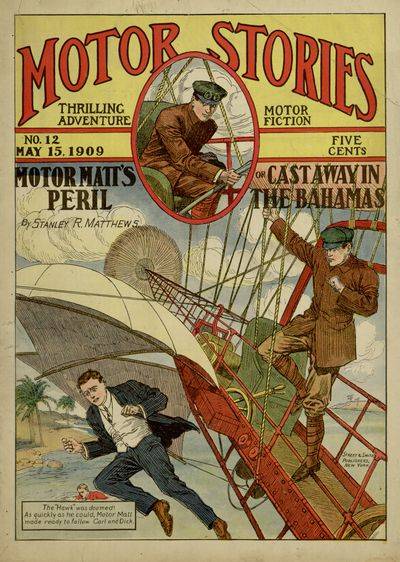
12—Motor Matt's Peril; or, Castaway in the Bahamas.
For sale by all newsdealers, or will be sent to any address on receipt of price, 5 cents per copy, in money or postage stamps, by
STREET & SMITH, Publishers, 79-89 Seventh Avenue, New York
IF YOU WANT ANY BACK NUMBERS of our Weeklies and cannot procure them from your newsdealer, they can be obtained from this office direct. Fill out the following Order Blank and send it to us with the price of the Weeklies you want and we will send them to you by return mail. POSTAGE STAMPS TAKEN THE SAME AS MONEY.
| ________________________ 190 | |||||
| STREET & SMITH, 79-89 Seventh Avenue, New York City. Dear Sirs: Enclosed please find ___________________________ cents for which send me: | |||||
| TIP TOP WEEKLY, | Nos. | ______________________ | BUFFALO BILL STORIES, | Nos. | ______________________ |
| NICK CARTER WEEKLY, | " | ______________________ | BRAVE AND BOLD WEEKLY, | " | ______________________ |
| DIAMOND DICK WEEKLY, | " | ______________________ | MOTOR STORIES, | " | ______________________ |
|
Name ________________ Street ________________ City ________________ State ________________ | |||||
ADVENTURES OF A BOY GENIUS
MOTOR STORIES
Most five-cent weeklies are founded upon the adventures of boy wonders who perform all sorts of impossible feats and who never act or talk as a boy really does. This is displeasing to the intelligent boy of the present day, who is better educated, and who, consequently, demands more logical reading than the old-time boy did.
The boys who want to learn something from what they read, as well as to be interested by it, will never find another publication that will satisfy them so well as MOTOR STORIES. "Motor Matt" is not an impossible boy character. He is simply a youth who has had considerable training in a machine shop where motors of all kinds were repaired, and who is possessed of a genius for mechanics. His sense of right and wrong is strongly developed, and his endeavors to insure certain people a square deal lead him into a series of the most astonishing, but at the same time the most natural, adventures that ever befell a boy.
Buy the current number from your newsdealer. We feel sure that you will be just as enthusiastic about it as the fifty thousand other boys throughout the United States have become.
HERE ARE THE TITLES NOW READY:
No. 1.—Motor Matt; or, The King of the Wheel.
No. 2.—Motor Matt's Daring; or, True to His Friends.
No. 3.—Motor Matt's Century Run; or, The Governor's Courier.
No. 4.—Motor Matt's Race; or, The Last Flight of the "Comet."
No. 5.—Motor Matt's Mystery; or, Foiling a Secret Plot.
No. 6.—Motor Matt's Red Flier; or, On the High Gear.
No. 7.—Motor Matt's Clue; or, The Phantom Auto.
TO BE PUBLISHED ON APRIL 12th
No. 8.—Motor Matt's Triumph; or, Three Speeds Forward.
TO BE PUBLISHED ON APRIL 19th
No. 9.—Motor Matt's Air-ship; or, The Rival Inventors.
TO BE PUBLISHED ON APRIL 26th
No. 10.—Motor Matt's Hard Luck; or, The Balloon House Plot.
TO BE PUBLISHED ON MAY 3d
No. 11.—Motor Matt's Daring Rescue; or, The Strange Case of Helen Brady.
TO BE PUBLISHED ON MAY 10th
No. 12.—Motor Matt's Peril; or, Cast Away in the Bahamas.
Price, Five Cents At all newsdealers, or sent, postpaid, by the publishers
upon receipt of the price.
STREET & SMITH, Publishers, NEW YORK
Transcriber's Note:
Added table of contents.
Images may be clicked to view larger versions.
Page 4, removed unnecessary apostrophe from "let's" in "That lets the dago out."
Page 12, changed "Ruffin" to "Ruffian" for consistency with previous volumes.
Page 21, corrected speaker from Carl to Matt in first sentence of chapter XIII.
Page 30, changed "jobbs" to "jobs" ("lumbermen at odd jobs").