
THE MASKED LIGHT.
CONCLUSION.
It was the enemy! we were completely trapped. The tables were turned upon us; yet, even as the fight was lost, we won it. Shots crossed and recrossed about me. One flash on my left showed me a man's face and the glitter of a bayonet as he thrust at me. I struck it on one side with the muzzle of my gun, firing point-blank into him as I parried it. As he dropped back another leaped up, stamping on him to gain me. He fired from the hip, and the powder singed my hair. I clubbed my musket and struck down at him, slipped on the bowlder, and down we crashed, clenched together, he, underneath, falling on his head twelve feet below. His arms relaxed and I rolled clear. By sheer instinct alone I kept flat, for men were now leaping down, while the shrill whistle of a leaden hailstorm passed over me.
For a moment I thought it was the end of us all; but out of the din I recognized a voice on our right calling shrilly: Chloe's voice. Our friends were reënforcing us from the ford. The attackers, caught on the flank, broke and fled. I rose up at last. The foot of the lighthouse just loomed faintly visible, and I saw the last of the enemy rush over the dark heap and gain the shelter of the building.
That dark heap was now linked to our position by a chain of dead and wounded men; their retreat had cost them more than the attack.
We had not escaped scatheless. Seven men killed outright, and nine wounded. Before we had time to move a single man to a more comfortable position, we were driven to the shelter of our rocks by a withering fire which broke out from every window and loophole of the chapel. We clung to the lee of the rocks. The air was dusty with chips and splinters of stone.
As I at last recovered my wits, I found that some one else was sheltering under the same rock. It was Chloe, all breathless, disheveled, and wringing wet.
"Take mine, capitan," she cried, on seeing me without a rifle. And she passed me a handful of cartridges from the bosom of her dress. I loaded in haste, but Henrico began to roar above the din that not a shot was to be fired. It was growing lighter every moment, and as yet the enemy could only aim by the line of the dead and wounded. But, for all that, the bombardment went on unceasingly.
Chloe, her breath recovered, was, despite her crouching position, tidying herself to something more woman-like. I asked her for the news. "Oh," she cried, "they found us, tumbled on us, but they paid!—one, two, three, four, five!" checking them off on her fingers. "Then we heard you. The sergeant knew you had been surprised—by the sound he knew. So, back came ten of us. He was just dying."
"Ah," I said.
"Yes," continued she, braiding her hair. "We all die; but I put my crucifix round his neck. He said we were to come to you. So we left him."
Suddenly she paused and listened eagerly, as if to catch some other sound in the rattle of the firing.
"Listen also, capitan," she said, and pulled me close to her side where we could get a sight of the sea between two huge rocks. Faintly, we heard the unmistakable moan of a steamship's siren. It was the troop ship! she was calling like some blind, lost thing for guidance.
It was now between light and dark, yet to a ship in the open a shore light would show boldly out at sea. The same thought moved both Chloe and myself. She rose to her feet to peer over the shelter, but something moved in me hotly, and I pulled her down on the instant and looked over myself.
Every window of the lighthouse vomited smoke and flashes. Above, the lantern still cast level rays on the screen. But no sooner had my eye fallen on the latter, than I cried out in dismay. A man was crawling hand over hand on the wire and cutting down the sheet. Already a third was hanging loose, and a section of light streamed seaward.
Involuntarily I called out to Chloe and pointed out the sight. Quick as light she whipped up the rifle, but, as she pulled the trigger, I knocked up the muzzle. And I could have done no other thing even if it had lost all. It was a magnificent thing to see a man do; he was a dead man as soon as sighted, so near he hung to us. Chloe slipped in another cartridge. In a second we were struggling for possession of the weapon. At the first grip I cleverly thrust her back on the rock with the barrel across her chest; only for a moment, for, with a swift, sinuous movement, she flung me sideways, and down we went, I underneath. She hissed like a wild cat, her short upper lip held clear of her white teeth, and her eyes a depth of black and fire. I believe in her mad rage she would have worsted me, but, as we grappled, the walls of the creek fairly shivered under the boom of a startling concussion. A heavy gun had been fired to seaward. The war ship had caught the trooper! Another and another explosion followed, and, at the sound, the rifle fire dropped. A shout of triumph rang in the rocks and about us.
We dropped the gun and peered over our rock, and saw a white flag limply hanging from the lighthouse. The man on the wire was crawling painfully back to the other side. I could not help but start up and give him a cheer with the whole of my breath.
Chloe looked in my face, her black eyes big with wonder, a child again.
"That's because he is as brave a man as ever carried a gun," said I.
"Do the Americans always cheer an enemy?" asked she.
"If he's brave."
With that she leaped on to the rock, and, throwing back her head, sent a shrill "huzza!" to the distant man, who had now gained the firm ground. He turned and saw us, waved his hand and fled.
All our men were streaming after Henrico toward the lighthouse, where the enemy sullenly filed out and flung down their rifles. Seventeen I counted, all that remained of the strong command.
Presently the doctors arrived from the cruiser, and began their grim trade on a flat rock. But the most evil sight was to see the lighthouse, forgotten by all, unblinkingly staring into the face of the now open day.
But the night's work had not been wasted by us, for by sunset we were honored guests on the cruiser, with a passage home before us.
Chloe had brought off in her uncle's boat the odds and ends from our lodgings. The anchor cable was rattling on the deck, and at that we shook hands with her, and said good-by. She stood and looked at us, and we noticed she had put on her gala dress. Still she remained, till Gilbert suddenly cried: "Goodness, we've forgotten. But we'll send you our debt as soon as we get home to New York—never you fear, Chloe."
"No! never," she cried, "not that; no money owing." She turned, her red lips open and eyes brimming; she stooped, kissed Gilbert in her arms! swung round, kissed me full and fair, and was gone with a flutter of skirt and clicking of shoe heels on the brass ledges of the stair.
The last we saw of San José was a lonely boat and a woman waving and waving till she faded in the dusk and distance.
THE END.
SPANISH CEDAR LOGS.
In the early days of cigar box manufacture in California, they were made almost exclusively of Spanish cedar. But that wood has become very scarce and high priced of late years, and other woods are taking its place to a certain extent.
And one of those woods is California redwood. In California at present the cigar box makers use about one-fourth redwood; the balance is composed of Spanish cedar and what is known to the trade as "imitation" lumber, which is nothing more than the common poplar and basswood of New England, sawed up, planed, and then stained in imitation of Spanish cedar, or veneered with Spanish cedar, because Spanish cedar is par excellence the real stuff for cigar boxes.
The gilt edge cigars all have to be packed in Spanish cedar, else there is a kick from the opulent and fastidious smoker, who claims that the natural aroma of the wood imparts an improved flavor to the cigars.
This may be a superstition, but as the well-to-do lovers of the weed are perfectly willing to pay for it the trade are only too anxious to flatter their customers' tastes.
It is a luxury and one that is growing more and more expensive; for in the early days of cigar box making Spanish cedar could be bought at $55 a thousand feet; now it costs $95 a thousand feet.
Now some one asks where and how is Spanish cedar obtained? Right here on the Pacific coast; but not in California, however, replete as her resources are. You have to go away south along the Mexican and Central American coasts for this special kind of lumber. And California has driven a trade in Spanish cedar ever since cigar box making had its inception on the Pacific coast; in fact, there is hardly a product of any part of the known world that does not come to the port by the Golden Gate.
The ever restless coasting schooners are the craft that bring our Spanish cedar logs up out of the tropics, and it is a peculiar trade—not only the maritime part of the traffic, but that part which is performed on land; for that part is done along the primitive ways of the easy going Mexican and Central American.
It is to be presumed that away back in the early days of maritime traffic on the lower coast there were supplies of Spanish cedar logs that could be obtained at the regular ports of entry; but evidently such a supply, if it ever existed, finally became exhausted, and as nobody down in those regions had the enterprise to build railroads from their seaports into the lumber regions of the interior, the stock of cedar had to be picked up all along the coast, wherever the wood could be found. That made the transfer of the logs from the shore to the vessel's side a very laborious undertaking and one no white man would ever have thought of resorting to.
But first in order comes the cutting of the cedar timber and the transportation of the logs to the shore. This, too, was done by the simple-minded Mexicans and Central Americans. Of course, at first these people cut the timber nearest the seashore, and then kept working back into the country, a process that involved more and more labor, because the distance of transportation was all the time increasing.
The cedar trees were chopped down and then cut up into logs varying in length from six to twelve feet, according to the size of the trees. These logs were then hewn square, ranging in size from nine inches to two feet.
This was done in order that they might be packed closely when on board of the California schooners. Then along came a swarthy Castilian, a pair of oxen attached to one of those funny wooden two-wheeled carts, with axle bare.
Upon this cart, called a carita, were loaded a number of logs, the number, of course, depending upon the size, and were lashed on, with one end dragging upon the ground behind. In this way the logs were hauled to the sea coast and deposited just above high tide line. After a while Spanish cedar began to grow scarce along the ocean belt, and then the Mexicans went up the rivers and creeks and cut cedar timber along the banks. The logs were rolled into the streams and driven down to the sea, either loose or in rafts, and were loaded thence upon the California schooners.
Now, there was a certain season when the loading of cedar logs down along the southern coast upon the schooners from the north was practicable, and that was in what California calls the winter season, when in southern waters the weather is the calmest of any season during the year. For there were no deep water harbors or extensive ocean piers whereat to find dockage for the schooners, and the loading had to be done offshore at any point where there might be a quantity of logs awaiting shipment. So the California sailing masters used to go cruising down the southern coast, keeping a sharp lookout for signals from ashore indicating the presence of a cargo. At a given signal they would tack to larboard and pull in as close to the beach as the soundings would permit. Sometimes they would have to anchor as much as two miles offshore.
When all was ready for loading two of the Mexicans on shore would seize a log, watch for the next incoming comber, and just as it was about to break on the beach they would start, rush through it with their log in hand, and would then find themselves in comparatively smooth water.
As soon as deep water was reached the two men would start to paddle the log out to the waiting vessel. There was a man on each side of the log, and each man had one arm flung over the log, while the other was left free to do the paddling. Arriving at the vessel's side the log would be caught by the crew of the craft and pulled on board. The two swimmers would then turn about and swim back to the shore for another log. By this slow and laborious process the vessel was finally loaded, the logs paid for, and the prow turned northward.
For this kind of labor the Mexicans were paid $1 a day each in Mexican money, worth only about fifty cents in United States currency. But the Mexicans appeared to be quite well satisfied with their wages, and could save something out of their pay for a rainy day; because living was cheap in that kindly climate—a bunch of bananas and some cakes sufficing for food, with mescal to drink, and anyone could sleep out of doors under a palm tree with perfect comfort.
The traffic in Spanish cedar logs has fallen off a good deal of late years in consequence of their growing scarcity, and California cigar box makers have been obliged to send to eastern seaports for a part of their supply, the lumber finding its way into those ports from Cuba and Gulf of Mexico ports.
COOKING THE VENISON STEAK.
There are various ways of cooking venison steak, but the recipe given by Game Warden Walter Neal is still pronounced the best by Maine woodsmen. It is that followed by Hannibal Hamlin and other famous hunters and diners.
"Get a buck deer that is fat and not over five years of age," says Mr. Neal. "One that weighs one hundred pounds is better than no deer, though the best should weigh nearly two hundred pounds. Before the body is cold, if possible, slash off some thick slices of steak. Have them nearly two inches thick and big enough to cover the bottom of an old-style spider if possible.
"Now get a thick and heavy cast-iron spider red-hot above the coals. Be sure and do this, because the hotter the spider is the better. And when the spider is glowing and sparkling with heat, slap in a slice of steak. Do not use any butter or any form of fat, but let the raw meat fall direct upon the hot iron, and then let it sizzle and smell and smoke for about a minute.
"Now flop it over on the other side, and repeat until the camp is so full of choking smoke and the smell of burning meat that you must carry the heated spider outdoors to get your breath.
"Tip the burnt and smoking steak on to a big plate, slash it deeply all over the surface with a sharp knife and throw on butter until the meat is afloat. Then salt and pepper to taste, after which nobody needs any directions as to what to do next.
"Venison cooked in this way and eaten with strong coffee and hot cream of tartar biscuit forms the best meat that it is possible to serve to kings and queens or jacks. And I know exactly what I am talking about."
The market men and hotel cooks of eastern Maine make a sharp distinction between the flesh of the deer that is raised in Maine and that which is captured by the hunters in the Southern States, calling the home product venison and all other kinds deer meat, or if the animals are very small and without fat, they modify the term and scornfully call it deer veal.
The newest Bangor plan of cooking venison is to cut moderately thick slices from the round of a buck and grill the flesh over a white-hot fire of anthracite, letting the greedy flames lick and bathe the curling meat and crisp its edges until it is hot clear through and cooked on the outside, though still somewhat rare in the interior.
The person who is said to have introduced this manner of cooking from Canada is Edward Stetson, president of the First National Bank of Bangor, who spends much time every year in his camp back from North Twin Dam on the west branch of Penobscot River. So particular is Mr. Stetson concerning how the venison of his shooting must be prepared for his guests in camp that before the beginning of open season every year he sends up the necessary anthracite by rail, his servants carrying it in baskets from the station far back into the wilderness, where it is used solely for broiling venison.
The men of unclassified employment who pass from May to October in raising hay, oats and potatoes to sell to the near-by lumber camps and who swing axes in the deep woods from October to May declare that the best venison is from the carcass of a buck shot in November and frozen and hung up under cover until midwinter.
BABY OSTRICHES.
Three cunning little gray-and-white ostriches were ushered into the world at the Florida Ostrich Farm and Zoo recently, a remarkably good result from a setting of fifteen eggs. Everybody, from Manager Fraser down to the most subordinate attaché of the resort, was gloriously happy over the event.
The life, habits, and characteristics of the ostriches are really interesting. Starting with the mating of the grown birds, which are allowed to select their mates, the male bird prepares the nest, a hollow in the sand, generally in a secluded spot in his pen, about one and a half feet deep and twelve feet in circumference. The hen lays about twelve to eighteen eggs, one every other day. The eggs are from fifteen to eighteen inches in circumference, and, weigh about three to four and a half pounds each, the shell being from one-sixteenth to one-eighth of an inch thick, sufficiently strong to withstand a decided blow. After laying her nest of eggs the birds begin setting, the hen in the daytime and the male ostrich covering the eggs at nighttime. They remain on the nests constantly from forty-two to forty-five days, never leaving it, except for food twice a day. Even then the male bird covers the nest frequently while his mate seeks her food.
The chick when ready to hatch will usually break or pip the shell itself; but at times the hen ostrich will assist by breaking it with her breast bone, by pressing upon it, helping the chick out by lifting it out with her beak, and shaking the shell from its body.
The first growth of ostrich chicks is remarkably fast, as from ten days of age up to six months old they grow at the rate of a foot a month. After six months they grow more slowly.
At first both sexes are similar in color and appearance, and are almost undistinguishable until about fifteen or eighteen months old. That which has been a mixture of drab, white, and brown on the male, begins to darken, and finally at about four years old becomes a decided black. The feathers on the female remain drab during her entire life. Baby ostriches do not eat for three days after hatching. The third day they begin to stand up and take notice like a child, and after being taught to eat by having bits of their food placed in their bills, they very quickly discover the use of their bills, and pick up their own food.
The chicks must be carefully fed and have fine especially prepared food, including plenty of fine grit and fresh, clean water. Their first crop of feathers matures at eight months.
MINK FARM IN OREGON.
Tom Staten has established a farm for the raising of mink at Rattlesnake Point, on the upper Klamath Lake. About a hundred of the animals are housed in cages or cabinets, and seem to do well and thrive in captivity, as they are all fat and sleek looking.
The animals are so tame that they will take food from the hand, although one has to be careful in handling them, as the mink is treacherous and has very sharp teeth. As mink in this county increase about five fold Mr. Staten expects to have something over five hundred in his cages next year. The value of their fur alone will aggregate about $3,000, but live female minks sell for a much higher figure than their hide alone is worth.
LATEST ISSUES
MOTOR STORIES
The latest and best five-cent weekly. We won't say how interesting it is. See for yourself. High art colored covers. Thirty-two big pages. Price, 5 cents.
1—Motor Matt; or, The King of the Wheel.
2—Motor Matt's Daring; or, True To His Friends.
3—Motor Matt's Century Run; or, The Governor's Courier.
4—Motor Matt's Race; or, The Last Flight of the "Comet."
5—Motor Matt's Mystery; or, Foiling a Secret Plot.
6—Motor Matt's Red Flier; or, On The High Gear.
7—Motor Matt's Clue; or, The Phantom Auto.
8—Motor Matt's Triumph; or, Three Speeds Forward.
9—Motor Matt's Air-Ship; or, The Rival Inventors.
10—Motor Matt's Hard Luck; or, The Balloon House Plot.
11—Motor Matt's Daring Rescue; or, The Strange Case of Helen Brady.
12—Motor Matt's Peril; or, Castaway in the Bahamas.
TIP TOP WEEKLY
The most popular publication for boys. The adventures of Frank and Dick Merriwell can be had only in this weekly. High art colored covers. Thirty-two pages. Price, 5 cents.
669—Frank Merriwell's Great Work; or, Getting the Right Start.
670—Dick Merriwell's Mind; or, The Ideal of Manhood.
671—Dick Merriwell's "Dip;" or, The Mysterious Movements of a Hat.
672—Dick Merriwell's Rally; or, Making a Fighting Finish.
673—Dick Merriwell's Flier; or, The Champions of the Ice.
674—Frank Merriwell's Bullets; or, A Steady Nerve and a Sure Hand.
675—Frank Merriwell Cut Off; or, The Result of the Great Spring Rise.
676—Frank Merriwell's Ranch Boss; or, Big Bruce and the Blossoms.
677—Dick Merriwell's Equal; or, The Fellow with the Flying Feet.
678—Dick Merriwell's Development; or, The All-around Wonder.
679—Dick Merriwell's Eye; or, The Secret of Good Batting.
680—Frank Merriwell's Zest; or, The Spirit of the School.
681—Frank Merriwell's Patience; or, The Making of a Pitcher.
682—Frank Merriwell's Pupil; or, The Boy with the Wizard Wing.
683—Frank Merriwell's Fighters; or, The Decisive Battle with Blackstone.
684—Dick Merriwell at the "Meet"; or, Honors Worth Winning.
NICK CARTER WEEKLY
The best detective stories on earth. Nick Carter's exploits are read the world over. High art colored covers. Thirty-two big pages. Price, 5 cents.
633—The Moving Picture Mystery; or, Nick Carter's Blindest Trail.
634—The Tiger-tamer; or, Nick Carter's Boldest Strategy.
635—A Strange Bargain; or, Nick Carter's Dead-shot Circus Case.
636—The Haunted Circus; or, Nick Carter Lays a Ghost.
637—The Secret of a Private Room; or, Nick Carter Makes an Experiment.
638—A Mental Mystery; or, Nick Carter on a Difficult Trail.
639—The Sealed Envelope; or, Nick Carter's Search for a Lost Fortune.
640—The Message in Blue; or, Nick Carter's Clue to a Vast Conspiracy.
641—A Dream of Empire; or, Nick Carter and the Queen of Conspirators.
642—The Detective's Disappearance; or, Nick Carter is Saved by Adelina.
643—The Midnight Marauders; or, Nick Carter's Telephone Mystery.
644—The Child of the Jungle; or, Nick Carter's Ingenious Ruse.
645—Nick Carter's Satanic Enemy; or, The Case of an Easy Mark.
646—Three Times Stolen; or, Nick Carter's Strange Clue.
647—The Great Diamond Syndicate; or, Nick Carter's Cleverest Foes.
For sale by all newsdealers, or will be sent to any address on receipt of price, 5 cents per copy, in money or postage stamps, by
STREET & SMITH, Publishers, 79-89 Seventh Avenue, New York
IF YOU WANT ANY BACK NUMBERS of our Weeklies and cannot procure them from your newsdealer, they can be obtained from this office direct. Fill out the following Order Blank and send it to us with the price of the Weeklies you want and we will send them to you by return mail. POSTAGE STAMPS TAKEN THE SAME AS MONEY.
| ________________________ 190 | |||||
| STREET & SMITH, 79-89 Seventh Avenue, New York City. Dear Sirs: Enclosed please find ___________________________ cents for which send me: | |||||
| TIP TOP WEEKLY, | Nos. | ______________________ | BUFFALO BILL STORIES, | Nos. | ______________________ |
| NICK CARTER WEEKLY, | " | ______________________ | BRAVE AND BOLD WEEKLY, | " | ______________________ |
| DIAMOND DICK WEEKLY, | " | ______________________ | MOTOR STORIES, | " | ______________________ |
|
Name ________________ Street ________________ City ________________ State ________________ | |||||
ADVENTURES OF A BOY GENIUS
MOTOR STORIES
The boys who want to learn something from what they read, as well as to be interested by it, will never find another publication that will satisfy them so well as MOTOR STORIES. "Motor Matt" is not an impossible boy character. He is simply a youth who has had considerable training in a machine shop where motors of all kinds were repaired, and who is possessed of a genius for mechanics. His sense of right and wrong is strongly developed, and his endeavors to insure certain people a square deal, lead him into a series of the most astonishing, but at the same time the most natural adventures that ever befell a boy.
HERE ARE THE TITLES NOW READY:
1—Motor Matt; or, The King of the Wheel.
2—Motor Matt's Daring; or, True to His Friends.
3—Motor Matt's Century Run; or, The Governor's Courier.
4—Motor Matt's Race; or, The Last Flight of the "Comet."
5—Motor Matt's Mystery; or, Foiling a Secret Plot.
6—Motor Matt's Red Flier; or, On the High Gear.
7—Motor Matt's Clue; or, The Phantom Auto.
8—Motor Matt's Triumph; or, Three Speeds Forward.
9—Motor Matt's Air Ship; or, The Rival Inventors.
10—Motor Matt's Hard Luck; or, The Balloon House Plot.
11—Motor Matt's Daring Rescue; or, The Strange Case of Helen Brady.
12—Motor Matt's Peril; or, Cast Away in the Bahamas.
To be Published on May 17th.
13—Motor Matt's Queer Find; or, The Secret of the Iron Chest.
To be Published on May 24th.
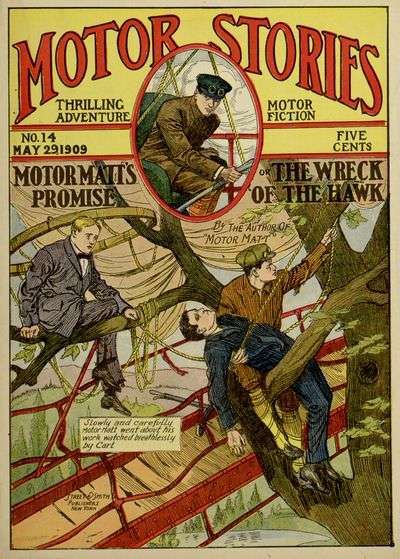
14—Motor Matt's Promise; or, The Wreck of the "Hawk."
To be Published on May 31st.
15—Motor Matt's Submarine; or, The Strange Cruise of the "Grampus."
To be Published on June 7th.
16—Motor Matt's Quest; or, Three Chums in Strange Waters.
PRICE, FIVE CENTS
At all newsdealers, or sent, postpaid, by the publishers upon receipt of the price.
STREET & SMITH, Publishers, NEW YORK
Transcriber's Notes:
Images may be clicked to view larger versions.
Page 6, changed "you're" to "your" in "he's your double."
Page 7, added missing end quote to "And bring the receipt to me here, to-morrow."
Page 11, added missing comma before "you can gount on me."
Page 12, changed "everwhelming interest" to "overwhelming interest."
Page 16, corrected "reconnoit-tring" to "reconnoitring." Added missing quote before "It might have been some superstitious...."
Page 19, changed "anway" to "anyway" ("What do you think of yourself, anyway?").