
A SNOWBALL FIGHT.
By HORATIO ALGER, Jr.
The snow had fallen to the depth of six inches during the night, filling in the yards and covering the door-steps, throughout the town of Conway. Among those who hailed the arrival of the snow with joy was Frank Taylor, a boy of fourteen, the son of the Widow Taylor, who lived in a miserable little tenement not far from the mill. Why he was glad to see the snow will soon appear.
Early in the morning he shoveled a path to the street, and then putting his shovel over his shoulder, said to his mother:
"I'm going over to Squire Ashmead's to see if he doesn't want me to shovel paths in his yard."
"He's got a boy of his own," said Mrs. Taylor; "perhaps he will do it."
Frank laughed.
"Sam Ashmead is proud and lazy," he said. "You won't catch him shoveling paths. I think I shall get the job. I want to earn something so that you need not sit all day sewing. It is too hard for you."
"I ought to think myself lucky to get employment at all," said the widow.
"I wish I could get steady work somewhere," said Frank; "but I've tried and tried, and it seems impossible."
"Willing hands will not want work long," said his mother.
"I hope not, mother. But I must be going, or somebody will get the start of me."
While Frank is on his way to Squire Ashmead's, a few words of explanation may be given. His mother had been a widow for two years. Her husband had been a man of some education, having at times taught school, but he had never succeeded in laying up any money, and his widow was left almost penniless. Frank, who was a stout boy, and a good boy as well, had earned something by doing odd jobs, but had failed to obtain permanent employment. The burden of their joint support, therefore, was thrown upon his mother, who was very industrious with her needle, but was compelled to labor beyond her strength. All this troubled Frank, who felt that, as a stout, strong boy, he ought to bear at least half the expense.
In due time he reached Squire Ashmead's, and was glad to see that the snow remained undisturbed.
He rang the bell, and asked if he might shovel the paths that were necessary.
Squire Ashmead was absent in New York, to which city he had gone the morning previous on business, but his wife agreed to employ Frank.
He went to work with a will, and soon had a path dug from the front door to the gate. A path was also required from the back door to the stable, which was situated in the rear of the house. This was quite a distance, and as Frank wished to do the work thoroughly, it required considerable time.
He was about half through this portion of his task when a snowball whistled by his ear.
Looking round quickly, he saw Sam Ashmead standing at the corner of the house, engaged in making a fresh snowball.
"Don't fire any more snowballs, Sam Ashmead," said Frank.
"I shall, if I please," said Sam.
"I haven't time to fire back now," said Frank. "Wait till I get through, and we'll have a match if you like."
"But I don't like," said Sam scornfully. "Do you think I would have a match with a beggar like you?"
"I am no beggar, Sam Ashmead," said Frank, "and if I were I don't think I would beg of you."
"Oh, you're mighty proud," sneered Sam, "considering that you live in an old hut not half as good as our stable."
"Yes, I am poor, and I live in a poor house," said Frank calmly, "but that isn't a crime that I know of. Some time I shall live in a better house, I hope."
So saying, he went back to work, and began shoveling the snow vigorously. He did not anticipate any further attack from Sam, but in this he soon found himself mistaken.
In the course of a minute he felt a pretty hard blow in the center of his back, and looking round saw Sam Ashmead laughing insolently.
"How does that feel?" asked Sam.
"That's the second snowball you've fired at me," said Frank quietly, but there was a light in his eyes as he spoke. "I advise you not to fire another if you know what is good for yourself."
"So you threaten me, do you? Suppose I fire again, what's going to happen?" demanded Sam, with an unpleasant sneer.
"I think you will be sorry for it," said Frank.
Sam hesitated a moment, but only a moment. He was a year older than Frank, and larger in size. Certainly he ought to be a match for him. But he did not believe that Frank would have the audacity to touch him, the son of Squire Ashmead, the richest man in the village. He therefore deliberately made another snowball, and firing it, struck Frank in the back of his head.
Frank no sooner felt the blow than he threw down his shovel, and ran toward his assailant.
"Keep off, you beggar!" said Sam.
"It's too late," said Frank. "I warned you not to fire again."
Sam placed himself in an attitude of defense, but found himself seized violently round the middle, and before he fairly knew what was going to happen he was lying in a snow-bank with Frank standing over him.
He struggled to his feet mad with rage, and "pitched into" Frank, as the boys express it, and endeavored to retaliate in kind. But Frank was watchful and wary, and evading the attack, seized him again when his strength was half spent, and Sam found himself once more occupying an involuntary bed in the snow.
A third struggle resulted in the same way. Sam was furious, but he saw that Frank was more than a match for him.
Just then a servant called out from the door:
"Master Sam, your mother says it's time for you to be going to school."
To tell the truth, Sam was rather glad of the summons, as it gave him an excuse for retiring from the contest.
"I'll be even with you yet," he said, shaking his fist at Frank. "I'll let my father know how you insulted me, you young beggar!"
"If anybody has been insulted, I have," said Frank. "You must remember that you began it."
Sam scowled vindictively, and brushing the snow from his coat went into the house. Before Frank finished the path at the back of the house he was gone to school.
Mrs. Ashmead sent out fifty cents to Frank for his morning's work, with which he went home, well satisfied, wishing that he might earn as much every day. He wondered a little whether Sam would tell his father what had occurred between them. He did not speak of it to his mother, for she was nervous, and would be troubled by it, as she received considerable work to do from the Ashmead family which she might fear would be taken away.
On the afternoon of the next day, however, Frank received a note, which proved to come from Squire Ashmead. It ran as follows:
"Frank Taylor: Please call at my office to-morrow morning at ten o'clock.
James Ashmead."
This note Frank thought best to show to his mother.
"What does it mean, Frank? Have you any idea?" she asked.
Frank thereupon told her the story of his difficulty with Sam.
"It may be about that," he said.
"Oh, dear," said the widow. "I'm afraid he's very angry. I hope you will apologize, Frank."
"No, mother," said Frank, "I don't see why I should. I only defended myself from a bully. I should be ashamed to do anything else. I didn't hurt him, and didn't intend to, but I wanted to teach him that he couldn't insult me without having to pay for it."
"I am afraid some harm will come of it," said the widow anxiously.
"Don't trouble yourself, mother," said Frank soothingly. "If we do only what's right, God will take care of us."
Still it was with some anxiety that Frank made his way the next morning to the office of Squire Ashmead. This gentleman was the agent of a large manufactory in the town, of which also he was a considerable owner, so that he received an income of over ten thousand dollars a year, which made him the most prominent and influential citizen in the town.
When Frank entered the office, Squire Ashmead was conversing with a stranger on business.
"Sit down," he said, turning to Frank. "I will be at leisure in a moment."
"Well," he said, after the stranger had departed, "Sam tells me you and he have had a little difficulty."
"Yes, sir," said Frank. "I would like to explain how it occurred."
"Very well. Go on."
It will be unnecessary to give the explanation, as it was strictly in accordance with the facts.
"Do you blame me for what I did?" asked Frank, at the end.
"No, I do not," said the squire. "Sam acted like a bully, and was properly punished. Let that pass. Now let me ask you how you and your mother are getting along?"
"Poorly, sir," said Frank. "If I could have steady work, it would be different, but that I cannot get. It troubles me to see my mother work so hard all day. I think it is too much for her."
"How would you like to come into my office?"
Frank's eyes sparkled.
"I should think myself very lucky, sir, to get so good a chance."
"I want some boy whom I can trust, who can grow up to the business, and after a time relieve me of a portion of my cares. I would take Sam, but I am sorry to say, though he is my own son, that he would not answer my purpose. I have heard good accounts of you from your teacher and the people in the village. I will take you at a salary of six dollars a week, to be increased from time to time if you will suit me. Can you come Monday morning?"
"Yes, sir," said Frank, "and I will do my best to give you satisfaction."
"Very well, my lad. Good morning."
Frank left the office, feeling as if his fortune was made. His mother, who was awaiting the result of the interview anxiously at home, was overwhelmed with astonishment at the unexpected good fortune of her son. Sam was disagreeably surprised, and tried to shake his father's resolution, but Squire Ashmead was a sensible man, and not to be moved.
Frank commenced his duties the next Monday. He was so faithful that he was rapidly advanced, and at twenty-one was receiving twelve hundred dollars a year. At twenty-five, on the sudden death of Squire Ashmead, he succeeded to his agency, and now lives with his mother in the mansion at which he once thought himself lucky to be permitted to shovel the paths. As for Sam, he squandered the handsome property received from his father, and died at thirty from the effects of intemperate habits.
SECRETS OF TRICK SHOOTING.
When a champion rifle shot fires blindfolded at a wedding-ring, or a penny held between his wife's thumb and finger, or, seated back to her, shoots, by means of a mirror, at an apple upon her head or on a fork held in her teeth, the danger of using a bullet is obvious. None, of course, is needed; the explosion is enough. The apple is already prepared, having been cut into pieces and stuck together with an adhesive substance, and a thread with a knot at the end, pulled through it from the "wings," so that it flies to bits when the gun is fired, is "how it is done."
Generally, the more dangerous a feat appears the more carefully is all danger guarded against. In the "William Tell" act the thread is often tied to the assistant's foot. When, again, the ash is shot off a cigar which the assistant is smoking, a piece of wire is pushed by his tongue through a hollowed passage in the cigar—thus thrusting off the ash at the moment of firing.
A favorite but simple trick is the shooting from some distance at an orange held in a lady's hand. Great applause is invariably forthcoming when the bullet drops out on her, cutting open the fruit. It is inserted by hand earlier in the evening.
Another popular trick is that of snuffing out lighted candles. Half a dozen are placed in front of a screen in which as many small holes are bored, one against each candlewick. At the moment of firing, a confederate behind the screen sharply blows out each candle with a pair of bellows. This trick was accidentally exposed one evening by a too zealous assistant. The lady in the gallery pulled the trigger, but the rifle failed to go off; the candle, however, went out just the same.
In most instances, where a ball or other object has to be broken on a living person's head, blank cartridge is used and the effect produced by other means. A special wig, with a spring concealed in it, worked by a wire under the clothes, is generally used, the confederate manipulating the spring simultaneously with the firing of the rifle. As the ball is of extremely thin glass, a mere touch suffices to shatter it.
In these exhibitions some of the rifle "experts" invite gentlemen from the audience to testify that the weapon is indeed loaded. The cartridge shown looks very well, but it is a shell of thin wax blackened to resemble a leaden bullet. It would not hurt a fly.
REELFOOT LAKE.
The physical history of Reelfoot Lake, of night-rider fame, is not without a certain interest of its own. The lake came into existence as the result of a series of earthquakes, which began in December, 1811, and continued until June, 1812.
Some authorities say that the earthquakes merely heaved up a great ridge of land across the path of the Reelfoot River, which runs into the Mississippi, and that this dam caused the water to back up and broaden out and form a lake; but the favorite account in the neighborhood is to the effect that the ground sank, springs were opened up, neighboring creeks diverted from their course, and the overflowing water of the Mississippi rushed in during the flood season of the spring of 1812.
It is said that for an hour and a half the waters of the Mississippi flowed up-hill while filling up the depression caused by the earthquakes. Both accounts likely have this much of truth in them that the entire configuration of the ground was changed by the earthquakes. Big Lake, west of the Mississippi, in Arkansas, is said to have been formed in the same way at the same time.
Reelfoot Lake is sixteen or eighteen miles long, very irregular in shape, and covers from 35,000 to 40,000 acres of land. It varies in width from a mile in some places to four or five miles in others. The northern end is extended by a series of sloughs and bayous into Kentucky.
The most distinctive feature of the lake's appearance, the feature which first impresses and stays longest with the observer's fancy, is a certain grotesque effect, as if a set of crazy men had been operating a pile-driver there for the last century, for the trunks, stumps, and stark branches of dead trees stick out of it everywhere in desolate parody of some such human handiwork; far below the surface the fish dart among the boles and branches where the squirrels frolicked a hundred years ago.
There are beautiful spots here and there, but the effect, as a whole, is not beautiful; at its best, when the mist rises and myriad protruding tree trunks are white and ghostly in the moonlight, it is weird; the general remembrance is of something uncouth. It is a kind of sloven lake that has preferred to sit down with its hair uncombed all day long, but at night it does manage to achieve a touch of wizard dignity.
A FLOATING SLUM.
Stand beside the imperial custom-house at Canton and let the eye range down the river toward Hongkong. As far as the sight can reach lie boats, boats, and again boats. These are no ordinary craft, mere vessels of transport plying hither and thither, but the countless homes of myriad Chinese, in which millions of human beings have been born, have lived, and have died. They are the dwellings of the very poor, who live in them practically free from rent, taxes, and the other burdens of the ordinary citizen.
The Tankia—which means boat-dwellers—as the denizens of these floating houses are called, form a sort of caste apart from the rest of the Cantonese. The shore-dwellers regard them as belonging to a lower social order; and indeed they have many customs, peculiar to themselves, which mark them as a separate community. How the swarming masses of them contrive to support existence is a mystery, but their chief mode of employment is in carrying merchandise and passengers from place to place.
WILD HORSES OF NEVADA.
Horses are cheap in Nevada. On the government ranges, where they are protected by game-laws, droves of wild horses exist which in the aggregate are said to amount to fifteen thousand. Formerly there was a law in Nevada permitting the shooting of these wild horses for their hides, but there were hunters who were not particular, and the ranchers found their domestic horses disappearing if they let them out on the range. So their shooting was prohibited, and since that time the droves have grown to be exceedingly troublesome. They can be domesticated, but they are not needed there, and it costs too much to ship them East. It seems a pity that, while so many sections could use them to advantage, the transportation problem makes it impossible to get them at a price which they are worth.
ESPECIALLY IMPORTANT!!
MOTOR STORIES
A New Idea in the Way of Five-Cent Weeklies.
Boys everywhere will be delighted to hear that Street & Smith are now issuing this new five-cent weekly which will be known by the name of MOTOR STORIES.
This weekly is entirely different from anything now being published. It details the astonishing adventures of a young mechanic who owned a motor cycle. Is there a boy who has not longed to possess one of these swift little machines that scud about the roads everywhere throughout the United States? Is there a boy, therefore, who will not be intensely interested in the adventures of "Motor Matt," as he is familiarly called by his comrades?
Boys, you have never read anything half so exciting, half so humorous and entertaining as the first story listed for publication in this line, called "Motor Matt; or, The King of the Wheel." Its fame is bound to spread like wildfire, causing the biggest demand for the other numbers in this line, that was ever heard of in the history of this class of literature.
Here are the titles to be issued during the next few weeks. Do not fail to place an order for them with your newsdealer.
No. 1. Motor Matt; or, The King of the Wheel.
No. 2. Motor Matt's Daring; or, True to His Friends.
No. 3. Motor Matt's "Century" Run; or, The Governor's Courier.
No. 4. Motor Matt's Race; or, The Last Flight of the Comet.
| 32 LARGE SIZE PAGES | SPLENDID COLORED COVERS |
PRICE, FIVE CENTS PER COPY
AT ALL NEWSDEALERS, OR SENT POSTPAID BY THE PUBLISHERS UPON RECEIPT OF THE PRICE.
STREET & SMITH, Publishers, NEW YORK
THE BEST OF THEM ALL!!
MOTOR STORIES
IT IS NEW AND INTENSELY INTERESTING
We knew before we published this line that it would have a tremendous sale and our expectations were more than realized. It is going with a rush, and the boys who want to read these, the most interesting and fascinating tales ever written, must speak to their newsdealers about reserving copies for them.
MOTOR MATT sprang into instant favor with American boy readers and is bound to occupy a place in their hearts second only to that now held by Frank Merriwell.
The reason for this popularity is apparent in every line of these stories. They are written by an author who has made a life study of the requirements of the up-to-date American boy as far as literature is concerned, so it is not surprising that this line has proven a huge success from the very start.
Here are the titles now ready and also those to be published. You will never have a better opportunity to get a generous quantity of reading of the highest quality, so place your orders now.
No. 1.—Motor Matt; or, The King of the Wheel.
No. 2.—Motor Matt's Daring; or, True to His Friends.
No. 3.—Motor Matt's Century Run; or, The Governor's Courier.
No. 4.—Motor Matt's Race; or, The Last Flight of the "Comet."
TO BE PUBLISHED ON MARCH 22nd
No. 5.—Motor Matt's Mystery; or, Foiling a Secret Plot.
TO BE PUBLISHED ON MARCH 29th
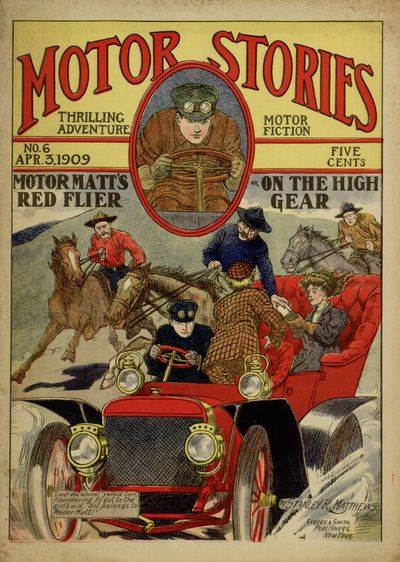
No. 6.—Motor Matt's Red Flier; or, On the High Gear.
TO BE PUBLISHED ON APRIL 5th
No. 7.—Motor Matt's Clue; or, The Phantom Auto.
TO BE PUBLISHED ON APRIL 12th
No. 8.—Motor Matt's Triumph; or, Three Speeds Forward.
Price, Five Cents To be had from newsdealers everywhere, or sent,
postpaid, upon receipt of the price by the publishers
STREET & SMITH, Publishers, NEW YORK
Transcriber's Note:
Added table of contents.
Cover image may be clicked to view larger version.
Retained some inconsistent hyphenation (e.g. "motorcycle" vs. "motor-cycle").
Retained some inconsistent spellings in dialect (e.g. "becase" vs. "bekase").
Page 3, added missing comma after ""Vell, py shinks." Added missing apostrophe after "doan" in "Why doan' yo'-all git." Removed unnecessary quote after "Matt stopped the Red Flier."
Page 4, removed unnecessary quote after "Legree was about to secure it?"
Page 5, changed "as she pointed" to "as he pointed."
Page 10, "would came after it" looks like a typo but has been retained in case it is intentional dialect.
Page 14, removed unnecessary quote before "Matt's pulses quickened."
Page 18, added missing period after "Josh turned to stare along the road."
Page 19, changed "Mat" to "Matt" in "Matt was intending to push the stone."
Page 20, the sentence "As he yanked the lever savagely, the popping from up the road sounding like the rapid discharge of a Gatling gun." seems incorrect, but it is reproduced as originally printed.