
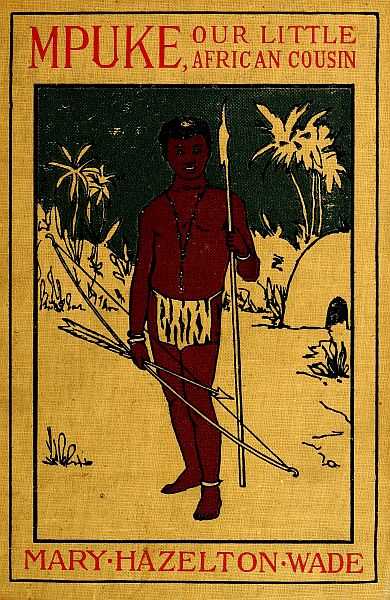
The Project Gutenberg eBook of Mpuke, Our Little African Cousin
Title: Mpuke, Our Little African Cousin
Author: Mary Hazelton Blanchard Wade
Illustrator: L. J. Bridgman
Release date: February 3, 2013 [eBook #41976]
Most recently updated: October 23, 2024
Language: English
Credits: Produced by Emmy, Dianna Adair and the Online Distributed
Proofreading Team at http://www.pgdp.net (This file was
produced from images generously made available by The
Internet Archive)
Our Little African Cousin
Little Cousin Series
(TRADE MARK)
Each volume illustrated with six or more full-page plates in tint. Cloth, 12mo, with decorative cover, per volume, 60 cents
LIST OF TITLES
By Mary Hazelton Wade
(unless otherwise indicated)
| Our Little African Cousin |
| Our Little Alaskan Cousin |
| By Mary F. Nixon-Roulet |
| Our Little Arabian Cousin |
| By Blanche McManus |
| Our Little Armenian Cousin |
| Our Little Australian Cousin |
| By Mary F. Nixon-Roulet |
| Our Little Brazilian Cousin |
| By Mary F. Nixon-Roulet |
| Our Little Brown Cousin |
| Our Little Canadian Cousin |
| By Elizabeth R. MacDonald |
| Our Little Chinese Cousin |
| By Isaac Taylor Headland |
| Our Little Cuban Cousin |
| Our Little Dutch Cousin |
| By Blanche McManus |
| Our Little Egyptian Cousin |
| By Blanche McManus |
| Our Little English Cousin |
| By Blanche McManus |
| Our Little Eskimo Cousin |
| Our Little French Cousin |
| By Blanche McManus |
| Our Little German Cousin |
| Our Little Greek Cousin |
| By Mary F. Nixon-Roulet |
| Our Little Hawaiian Cousin |
| Our Little Hindu Cousin |
| By Blanche McManus |
| Our Little Hungarian Cousin |
| By Mary F. Nixon-Roulet |
| Our Little Indian Cousin |
| Our Little Irish Cousin |
| Our Little Italian Cousin |
| Our Little Japanese Cousin |
| Our Little Jewish Cousin |
| Our Little Korean Cousin |
| By H. Lee M. Pike |
| Our Little Mexican Cousin |
| By Edward C. Butler |
| Our Little Norwegian Cousin |
| Our Little Panama Cousin |
| By H. Lee M. Pike |
| Our Little Persian Cousin |
| By E. C. Shedd |
| Our Little Philippine Cousin |
| Our Little Porto Rican Cousin |
| Our Little Russian Cousin |
| Our Little Scotch Cousin |
| By Blanche McManus |
| Our Little Siamese Cousin |
| Our Little Spanish Cousin |
| By Mary F. Nixon-Roulet |
| Our Little Swedish Cousin |
| By Claire M. Coburn |
| Our Little Swiss Cousin |
| Our Little Turkish Cousin |
L. C. PAGE & COMPANY
New England Building, Boston, Mass.
MPUKE
|
||
By L. C. Page & Company
(INCORPORATED)
All rights reserved
Published, June, 1902
Sixth Impression, August, 1908
Seventh Impression, October, 1909
Preface
Far away, toward the other side of the round earth, far to the east and south of America, lies the great continent of Africa. There live many people strange to us, with their black skins, kinky, woolly hair, flat noses, and thick lips. These black people we call Africans or negroes, and it is a little child among them that we are going to visit by and by.
Different as these African people of the negro race are from us, who belong to the white race, they yet belong to the same great family, as we say. Like all the peoples of all the races of men on this big earth, they belong to the human family, or the family of mankind. So we shall call the little black child whom we are going to visit our little black cousin.
We need not go so far away from home, indeed, to see little black children with woolly, kinky hair and flat noses like the little African. In the sunny South of our own land are many negro children as like the little negro cousin in Africa as one pea is like another. Years and years ago slave-ships brought to this country negroes, stolen from their own African homes to be the slaves and servants of the white people here. Now the children and great-grandchildren of these negro slaves are growing up in our country, knowing no other home than this. The home of the great negro race, however, is the wide continent of Africa, with its deserts of hot sand, its parching winds and its tropical forests.
So, as we wish to see a little African cousin in his own African home, we are going to visit little black Mpuke instead of little black Topsy or Sammy, whom we might see nearer by.
It's away, then, to Africa!
Contents
| CHAPTER | PAGE | |
| I. | The Boy | 9 |
| II. | Blacksmith and Dentist | 17 |
| III. | Work and Play | 23 |
| IV. | The Elephant Hunt | 28 |
| V. | Song and Story | 35 |
| VI. | The Battle Feast | 46 |
| VII. | The African Medicine-man | 53 |
| VIII. | The Gorilla | 60 |
| IX. | The Gorilla Hunt | 70 |
| X. | The Race of Dwarfs | 76 |
| XI. | How the Dwarfs Live | 79 |
| XII. | Spiders | 85 |
| XIII. | Land-Crabs | 93 |
List of Illustrations
| PAGE | |
| Mpuke | Frontispiece |
| The Village | 21 |
| Hunting Elephants | 29 |
| "His followers look upon him with the greatest admiration" | 47 |
| "He sat down on his haunches" | 74 |
| "Afterward the whole roof is covered with leaves" | 80 |
Our Little African Cousin
CHAPTER I.
Are you ready for a long journey this morning? Your eyes look eager for new sights, so we will start at once for Mpuke's strange home. We will travel on the wings of the mind so as to cross the great ocean in the passage of a moment. No seasickness, no expense, and no worry! It is a comfortable way to travel. Do you not think so?
Yes, this is Africa. Men call it the "Dark Continent" because so little has been known of it. Yet it is a very wonderful land, filled with strange animals and queer people, containing the oldest monuments, the greatest desert, the richest diamond mines, in the world.
Some of the wisest people in the world once lived here. Large libraries were gathered together, thousands of years ago, in the cities of this continent.
Yet the little negro whom we visit to-day is of a savage race. He is ignorant of civilised ways and customs. He knows nothing of books and schools. I doubt if he even knows when his birthday draws near; but he is happy as the day is long; his troubles pass as quickly as the April showers.
Let us paint his picture. We must make his eyes very round and bright and black. The teeth should be like the whitest pearls. His head must be covered with a mass of curly black wool. His lips are red and thick, while his skin is black and shining. He is tall and straight, and has muscles of which any boy might well be proud. He is not bothered by stiff collars or tight shoes. He is not obliged to stay in the house when he has torn a hole in his stocking, or ripped his trousers in climbing a tree, because he does not own any of these articles of clothing.
From morning until night, and from night until morning again, he is dressed in the suit Mother Nature provided for him,—his own beautiful glossy skin. She knew well that in the hot land near the equator, where Mpuke was born, he would never feel the need of more covering than this.
One of the first things Mpuke can remember is the daily bath his mother gave him in the river. In the days of his babyhood he did not like it very well, but gave lusty screams when he was suddenly plunged into the cold water. Yet other babies and other mothers were there to keep him company. It is the custom of his village for the women to visit the shore every morning at sunrise to bathe their little ones. What a chattering and screaming there is as one baby after another receives his ducking! Then, spluttering and choking and kicking, he is laid up on the bank to wriggle about on the soft grass, and dry in the sunshine. Now comes a toss upon mother's back, and the procession of women and babies hastens homeward through the shady pathway.
It lies in the very heart of Africa, this home of Mpuke's. The houses are so nearly alike that we almost wonder how the black boy can tell his own from his neighbour's. It can more properly be called a hut than a house. It has low walls made of clay, and a high conical roof thatched with palm leaves. There is not a single window; the narrow doorway faces the one street running through the village. A high wall is built all around the settlement. There are two reasons for this: in the first place, the wild animals must be kept out, and secondly, the village is protected in case another tribe of black people should come to make war upon it. It is sad that it is so, but we know that the negroes spend much of their time in fighting with each other.
There is a small veranda in front of Mpuke's home. It is roofed with the long grasses which are so plentiful in this country, and is a comfortable place for the boy to lie and doze during the hours of the hot midday. The house itself nestles in a grove of banana-trees and stately palms. It makes a beautiful picture. I wish we could take a good painting of it home to our friends.
Look! here comes Mpuke's father. He is the chief of the village, and all the people bow before his greatness and power. We must show proper respect to such an important person, so please don't laugh, although he is certainly an amusing sight.
He is a strong, well-built man, but his body is coloured in such a ridiculous fashion with white and yellow chalk that it reminds us of the clowns at the circus. The braids of wool on his chin look like rats' tails, and others stick out at the sides of his head from under his tall hat of grass. He has a string of charms hanging around his neck; he thinks these will protect him from his enemies, for he is a great warrior. His only clothing is a loin cloth made from the leaves of the pineapple-tree. His good wife wove it for him. His eyebrows are carefully shaved. As he walks along, talking to himself (the negroes are always talking!) he is trying to pull out a hair from his eyelashes with his finger-nail and knife.
This odd-looking man was chosen by the people to be their chief because he is so brave in fighting and so skilful in hunting. He has had many a battle single-handed with an angry elephant or furious panther. He has killed the cobra and the gorilla. He could show you the skulls of the enemies he has slaughtered in battle. He bears many scars beneath that coat of chalk, the marks of dangerous wounds he has received.
Mpuke honours and fears his father, and hopes in his boyish heart that he may grow up to be a chief like him, and have as many daring adventures. His greatest pleasure is in the mock battles which he has with the other boys of the village. Each one must be provided with a wooden spear and a blunt knife before he is ready for the game. Then the boys gather in the open field they use for a playground. This sport is a serious thing; it is a training for the hard fighting which is sure to come later in their lives. The boys rush at each other as if in dead earnest. Hours sometimes pass before either side gains a victory.
CHAPTER II.
When the first rays of the morning sun find their way through the tree-tops, the village wakes up. It is the best part of the day in any land, but especially in all tropical countries. The women come hastily out of the doorways, and prepare to get breakfast. All the cooking must be done out-doors, and soon a row of fires can be seen burning brightly in front of the houses. Mpuke's mother is very busy. She must boil the manioc pudding and bake some hippopotamus meat for a hearty meal.
Manioc takes the place of flour with the black man. It looks somewhat like the potato, but the bulbs are not ready to gather till the plant is about fifteen months old. It is a very stringy vegetable. The women gather it in baskets and sink them in the river for a few days. They must stay there until the vegetables have fermented. This fermentation makes them mealy; it also makes it easy to draw out the tough fibres. The manioc is afterward kneaded into dough and made into round puddings, which are boiled several hours.
Mpuke's mother is a careful cook. When her manioc pudding is taken from the fire it is snowy white. It is a wholesome dish, and Mpuke is very fond of it. You may not agree with him unless you like sour milk; for the pudding has a flavour very much like that.
As soon as the meat is cooked, it is cut up and placed in earthen jars, a quantity of pepper is added, and palm oil poured over it to make a rich gravy.
The men eat their breakfast first. When it is finished they sit around under the trees while the women and children satisfy their hunger. The manner in which these people eat is not at all nice, but we must always remember they have never been taught a better way.
There is no table to set; no knives, or forks, or spoons. The savages use only the kind they carry around with them, furnished by Mother Nature when they were born.
They gather around the jars and take out the pieces of meat with their fingers, sopping up the gravy with the manioc bread. Now for some palm wine to quench their thirst. The meal is quickly over. We are glad, for it has not been pleasant to watch.
Both men and women join in a friendly smoke. From the laughing and chattering they must be having a merry time.
But it is growing warm as the sunshine finds its way through the foliage, and there is much work to do before the stifling noon hours.
The women and children hurry away to their plantations of sweet potatoes, or groundnuts (peanuts), or tobacco. Some of the men get their spears and bows and arrows for hunting. Others prepare nets for fishing in the river. Every one is so busy that the village suddenly becomes quiet.
We will follow Mpuke on his way to the blacksmith, who is also the dentist in this little settlement. "What," we say, "is it possible that a savage knows how to fill teeth?" We discover that his work is of a very different kind from that of any dentist we ever met in white man's land. His business is to grind the beautiful white teeth of the people till they are wedge-shaped. Mpuke is going to his hut to-day for this very purpose. His father has a small looking-glass he bought from the white traders, and when Mpuke is a good boy he is allowed to take it and look at himself for a few minutes. He will take great delight in viewing his teeth after they have been ground to the fashionable shape. There is some danger of his growing vain over the compliments he will receive. In the eyes of his own people he is a handsome boy, and needs only the finishing touch to his teeth to make him a beauty.
It is to be hoped that he will not become a dandy when he grows up. His mind, however, is very busy in thinking of warfare and hunting, and he is inclined to scorn the men who think too much of their looks.
See! There is one of the village dandies, now. He is strutting along like a peacock, and expects every one to stop and look at him. He has spent a long time in plastering his hair with clay well mixed with palm oil. The oil is fairly dripping from his face and neck now. We certainly can't admire this style of beauty, so we will turn our attention to the hut on the other side of the road.
The man in the doorway is busy at his work. He is shaping jars and dishes out of clay. Some of the jars are beautiful in shape. Wouldn't you like to buy one of them? A few beads or a bit of bright calico would pay him well, according to his ideas.
Hark! There is the sound of a hammer. Let us take a peep inside of this next hut; we must discover what is being done here. A metal-worker is making armlets and anklets of copper. They will find a ready sale in the village, for no woman considers herself well-dressed unless she is able to wear a number of such ornaments. She is willing to work very hard on the plantation if she can earn enough jewelry to make a rattling noise and a fine display as she walks along.
CHAPTER III.
The dentist works steadily for an hour or so upon Mpuke's teeth; but he grows warm and tired, and says he has done enough filing for one morning. The boy has been very patient and has not uttered a sound of complaint during the painful operation. But now he is delighted to be free, and hurries off to the shore of the river to work on the canoe he is building. His father helped him cut down a large tree, but he is doing all the rest of the work alone. He has worked many days in hollowing out the trunk of the tree. He has shaped it into a narrow, flat-bottomed boat. The paddles are beautifully carved, and there is very little left to be done now except the making of the sail.
That is easy work. The long grasses are already gathered, and he sits on the bank of the river weaving them into a large, firm mat. This will serve as well as canvas for the sail.
What pleasure he will take in this canoe! Many a day he will spend in it, sailing along under the shade of the tall trees which line the river's banks. Many a fish he will catch and bring to his mother for the next meal. He delights in the sport, and does not seem to mind the myriads of gnats and mosquitoes which would send us home in a hurry.
But the black boy's life is not all play. He has had regular work to perform from the time when he began to walk alone. He must learn to make the rattan war shields, shape spears for battle, and weave nets for trapping fish and game. In fact, Mpuke must be ready to help his elders in all their occupations.
The boy has a sister who is nine years old. She looks very much like her brother, and has the same happy disposition. She has many duties, but they are quite different from her brother's.
She is a good cook, young as she is. She can broil a buffalo steak to perfection; it is her work to gather the insects and caterpillars which are considered dainties at the feasts of the black people. She weaves the mats on which the family sleep at night. She helps her mother raise the tobacco, and gathers the peanuts and stores them away for the rainy season.
But let us go back to the river, where Mpuke is giving the finishing touch to his sail. As he turns his head to get a cooling breeze, it brings to his nostrils the smell of the dinner cooking in the village. He knows he must not be late at meal-time, and, besides, he has a good appetite for each of the day's three hearty meals.
He hurries down the path, thinking of the favourite dish his mother has promised him to-day. Do you care to taste it? It is boiled crocodile. The broth is seasoned with lemon juice and Cayenne pepper. "How kind my mother is," thinks Mpuke, "to cook such savoury messes. There are few boys so fortunate as I am. I will try to be a good son, and, if the white traders ever come this way again, I will buy her a chain of beads long enough to wind three times around her neck."
With these thoughts the boy reaches home, but the whole village is in a state of much excitement; great news has just been brought by one of the men. He has discovered a herd of elephants feeding in a forest swamp only a few miles distant. He says that he counted at least a hundred of them.
The black people know that the elephant's sleeping time is from about eleven in the morning till three or four in the afternoon. It is the time that the people themselves take for rest; but to-day there is no noonday nap for Mpuke's village.
Dinner is eaten in haste. The men rush in and out of the houses getting their spears, bows, and poisoned arrows in readiness. The chief orders his assistants to get out his treasured elephant gun. It is the most valuable possession in the village. A small fortune (as the black people count) was given for it to the white traders. The chief's eyes shine, as he says to himself: "This shall bring down an elephant to-day."
CHAPTER IV.
Mpuke is wildly delighted when he finds that he may go on the hunt. But he is warned to be very quiet; he must not even whisper as the party creeps through the dense forest.
The hunt will be a failure unless the elephants are taken by surprise while they are sleeping. The men know that the wind is in their favour, since it is blowing from the elephants toward them. Otherwise, the keen-scented creatures would quickly discover the approach of their enemies.
Listen! do you hear that queer noise? It is the champing sound the elephants make in their throats when they are asleep. The hunters creep nearer and nearer; more and more and more carefully, if possible, they turn aside the thick undergrowth of trees and bushes. Ah! Mpuke's father is within a dozen yards of the herd. He looks keenly about till he discovers a huge tusker; he gives a signal to two of his followers to bring up the gun. It is carefully placed and aimed at a spot in the elephant's forehead about four inches above the eyes. It is a vital spot. Two of the best marksmen of the party direct their poisoned arrows at the heart. If all succeed in reaching the parts aimed at there will be nothing to fear. But if the huge creature is only slightly wounded, woe to Mpuke and this company of men who are taking their lives in their hands at this moment! A maddened elephant is a fearful creature to encounter.
Hush! Steady now! Bang! sounds the gun. At the same moment the arrows are let loose from the bows. The bullet was aimed well. It enters the exact spot intended. The arrows do their work. The king of the forest rolls over on his side without a sound. There is not even a death struggle, but there is a sudden commotion among the rest of the herd; it is as though a whirlwind had arisen. Every animal is instantly awake; the herd closes together like a great army. There is an angry uproar, a tremendous trumpeting and bellowing; the forest echoes and re-echoes with the sound. The ground shakes beneath their feet. Madly plunging through the forest, the elephants flee in an opposite direction from the men. As they rush onward, great limbs of trees are torn off as though they were only straws.
Suppose they had turned toward the hunters, instead of from them! It is useless to think of it,—for this time, at least, no one has been harmed. And now the men gather around their prey lying lifeless on the ground.
"Owi?" ("Is it dead?") Mpuke anxiously whispers. His father assures him of the fact, and allows the boy to take part in cutting the flesh away from the monstrous prize.
In a few moments the women of the village appear, carrying baskets. They have followed the party at a distance; they knew their help would be needed if any prey were secured.
The hunt has been a marvellous success. It often happens that hunters are obliged to wait in the underbrush for hours before they can get near enough for a good shot, or to gain such a position as to be able to cut the sinews of the sleeping elephant's legs with their spears, for this makes the animal helpless.
But the safest and most common way of hunting elephants is to dig immense pits near their feeding-grounds. These are covered over with branches. The unwary elephant who comes this way makes a false step, and falls helpless into the pit. It is an easy matter then for the men to approach and kill him, either with their spears or bows and arrows.
But we must turn again to Mpuke and his companions. It is not long before the busy workers have removed all the flesh, and packed it in the big baskets. The monstrous ears must be saved; they will be useful to take the place of carts in harvest time. Two of the strongest men are loaded with the ivory tusks; they must be kept to sell to the traders.
The party hurries homeward, chattering in childish delight over the fun they will have this evening. They leave behind them only the skeleton of the huge animal which two hours since was so powerful.
As soon as they reach the village the boys are put to work. They must dig a pit, and bring wood to fill it. A fire must be kindled and kept burning till the sides of this earthen oven are thoroughly heated. After this the fire is put out, and one of the elephant's legs is laid in the oven.
The women bring green wood and fresh grass to lay over the roast, after which the hole is plastered tightly with mud. But the queer oven is not yet closed tightly enough. The loose earth taken from the pit is piled high above it, so that no heat can possibly escape.
You wonder how long the people must wait before their roast can be served. It will be a day and a half, at least; but when the time does come to open the pit the cooks will find enough tender, juicy meat to furnish every one in the village with a hearty meal.
The leg of an elephant is the most eatable portion of the animal; the rest of the flesh is tough and fibrous, although the negroes eat it, and enjoy it very much. The women smoke it, much as our people smoke ham, and in this way they can keep it a long time for use.
CHAPTER V.
It has been a busy day for every one. In the short twilight the people gather about under the trees for music and story-telling. Mpuke runs to his house for his xylophone, and begins to play a sweet, sad air. One by one his neighbours join in an accompaniment with their rich voices. The African is a natural lover of music; he uses it to express all his feelings.
It is a weird sight,—this group of black people rocking their bodies to and fro to keep time with the music. As they enter more deeply into the spirit of the evening song the expressions of their faces change; they seem to forget themselves, and become a part of the music itself.
And now the frogs add their voices to the chorus. The crickets and cicadas pipe their shrill notes, while at short intervals a hoarse sound, between a groan and a whining bark, is wafted upwards from the river. It comes from a lonely crocodile who, no doubt, would like to join the company. It is much better for their comfort that he remains where he is.
Mpuke's xylophone is made of strips of soft wood, differing in length, fastened over a set of calabashes. In each calabash a hole has been carefully bored and covered over with spider's web. Perhaps you mistook the calabash for a gourd, which looks much like it. It is a curious growth which forms on the trunks of certain trees near Mpuke's home.
Our little friend makes sweet liquid music on his crude instrument. He calls it a marimba. The village metal-worker made it for the boy in return for many presents of fish.
"That is a good lad," said the man, "he is thoughtful and generous. I will make him happy."
After the people have finished their songs, there is music on other instruments besides Mpuke's. Look at that big fellow blowing into an ivory horn. He needs to have a strong pair of lungs if he is going to continue very long. What a dirge-like noise he makes! But when the tom-tom begins to sound, everybody is roused and joins in a wild dance.
The people wind in and out among the trees, round and round again, laughing, shouting, and singing, until they sink out of breath on the grass.
Mpuke is so tired he can hardly keep his eyes open. He drags himself into the hut where his sister lies on her mat, already sound asleep. Listen! what is that scuttling noise among the dried leaves in the corner? Mpuke's bright black eyes are helped by the moonlight streaming through the doorway. He discovers that it is a green lizard, which he knows to be quite harmless. But it is always wise to be watchful.
One night, not many moons ago, as the black boy counts time, he found a centipede close to his bare feet when he woke up suddenly in the night. He is quite sure that a good spirit roused him to save his life.
At another time a lizard of the most deadly kind must have shared the boy's mat with him through the night. At any rate, he found the lizard at his side when his eyes opened to the morning light.
But Mpuke is too sleepy to think about unpleasant things, and in another moment he is dreaming of the roasted elephant that will make to-morrow's feast.
A week passes by. We will visit Mpuke once more as he is eating his early breakfast.
A messenger from the next village comes rushing in to the people. He has run ten miles this morning through the forest paths, and has brought word to Mpuke's father from his own chief. The two men are blood-brothers, and have promised to stand by each other in all troubles and dangers. "Blood-brothers," you say, "what does that mean?" When the chiefs were only boys they went through a sacred ceremony together. An arm of each was cut till the blood ran, then the two arms were pressed together, and the blood was allowed to mingle.
They must never quarrel again. No cruel words or deeds should ever pass between them, because they are now bound together by the strongest of all ties.
But what is the message that causes such a state of excitement? It tells that enemies are approaching. It means war, and preparation for awful deeds. Mpuke's father is asked to come to the help of his blood-brother. Will he join him to meet the advancing foes?
There is only one answer possible; not a moment must be lost. The order is given to sound the war-drums; the people burst into an exciting battle-song; blasts from ivory trumpets can be heard throughout the village; the men cover their faces with charcoal and hastily seek the medicine-man. He must provide them with charms to protect them from danger. Poor fellow, he is the busiest one of all the people, making little packages of beads, shells, and stones for each soldier to wear as a talisman.
The women are at work getting the spears and arrows together; they must also sharpen the knives for their husbands and sons.
These ignorant savages make a hideous sight to our eyes when the fury of war seizes them. It is such a pitiful thing that they are ready to take the lives of their brother blacks for the slightest reason, and that they delight so greatly in war.
Now the men hurry down to the river's side. They jump into their canoes, and are out of sight as soon as they pass a bend in the banks of the stream. Mpuke watches them with glistening eyes; he longs to follow them, but he has been told to remain at home to protect his mother and sisters in case of danger.
He knows already what war means; it was only last year that his own village was attacked. Young as he was, he stood all day behind the spiked wall, sharpened spear in hand, doing his part to defend his home. He was wounded in the leg on that terrible day, and for a long time afterward lay sick with fever. His sister was so good to him during that trying time; hour after hour she sat at his side on the veranda, and kept the flies and mosquitoes from his wound with a broom she made of an elephant's tail.
Mpuke thinks of this as he goes home through the forest path. Suddenly he stops quite still; his eyes roll in terror. A huge serpent lies coiled but a few feet away; he does not notice Mpuke, for his beadlike eyes are fastened on a monkey standing on the ground in front of him. The snake is charming it. He will force it to its own death, and yet he does not stir; it is the monkey that moves. It comes nearer and nearer to the monster; it makes a frightened cry as it advances.
Mpuke knows he cannot save its life, as he has no weapon with which to attack the serpent. He would like to run, but does not stir until the monkey, having come close to its charmer, is suddenly strangled in the folds of its powerful body. The boy does not wait to see the snake devour his prey, but hurries homeward, without once daring to turn round.
The fires have all been put out. The women and children are talking in whispers. They wish to make as little noise as possible while the men are away, lest they be attacked by wild beasts or some passing band of savages.
Night comes; there is no sound of returning warriors. Mpuke sits in the doorway of his home, listening; his mother and sister are beside him. It draws near midnight, and yet there is no sleep for the anxious watchers.
Hark! faintly at first, then more and more plainly, the fighting song of the returning warriors is borne to them on the evening wind. And now they can hear the sound of paddles and shouts of boisterous laughter.
The men must have been victorious or they would not come home so gaily. There are but a few more minutes of waiting before the black heroes enter the village. We call them heroes, for that is the way their families think of them.
The men are tired, excited, and stained with blood. They are bringing home two of their comrades wounded, and the dead body of another. They have six prisoners taken from the enemy. These poor wretches are bound with ropes; they know their fate too well. They are now slaves, and must hereafter do the hardest work for their new masters.
The customs of their own settlement are different from those of Mpuke's village. They will suffer from homesickness, and will have many new things to which they must get used.
It seems strange to us that in travelling a short distance in the heart of Africa the people are found to differ from each other so much in language, habits, and even dress. For, scanty as it is, the style of decoration of one tribe varies greatly from that of another.
For instance, in Mpuke's home we know it is the fashion to have wedge-shaped teeth, while not far away the people think that a really beautiful person must have the teeth pointed. In one village the women wear wooden skewers pierced through their noses; in another, their principal ornaments consist of metal rings in the ears, and metal armlets, anklets, and bracelets.
Among some tribes, the men's hair is braided in queer little tails, while others have it knotted at the back of the head and at the chin in tight bunches.