
I
MR. BELLOC’S ARTS OF CONTROVERSY
I am the least controversial of men. Public disputations have rarely attracted me. For years I have failed to respond to Mr. Henry Arthur Jones, who long ago invented a set of opinions for me and invited me to defend them with an enviable persistence and vigour. Occasionally I may have corrected some too gross public misstatement about me—too often I fear with the acerbity of the inexperienced. But now, in my sixtieth year, I find myself drawn rather powerfully into a disputation with Mr. Hilaire Belloc. I bring an unskilled pen to the task.
I am responsible for an Outline of History which has had a certain vogue. I will assume that it is known by name to the reader. It is a careful summary of man’s knowledge of past time. It has recently been reissued with considerable additions in an illustrated form, and Mr. Belloc has made a great attack upon it. He declares that I am violently antagonistic to the Catholic Church, an accusation I deny very earnestly, and he has produced a “Companion” to this Outline of mine, following up the periodical issue, part by part, in the Universe of London, in the Catholic Bulletin of St. Paul, Minnesota, in the Southern Cross of Cape Colony, and possibly elsewhere, in which my alleged errors are exposed and confuted.
In the enthusiasm of advertisement before the “Companion” began to appear, these newspapers announced a work that would put Mr. Belloc among the great classical Catholic apologists, but I should imagine that this was before the completed manuscript of Mr. Belloc’s work had come to hand, and I will not hold Catholics at large responsible for all Mr. Belloc says and does.
It is with this Companion to the Outline of History that I am to deal here. It raises a great number of very interesting questions, and there is no need to discuss the validity of the charge of Heresy that is levelled against me personally. I will merely note that I am conscious of no animus against Catholicism, and that in my Outline I accept the gospels as historical documents of primary value, defend Christianity against various aspersions of Gibbon’s, and insist very strongly upon the rôle of the Church in preserving learning in Europe, consolidating Christendom, and extending knowledge from a small privileged class to the whole community. I do not profess to be a Christian. I am as little disposed to take sides between a Roman Catholic and a Protestant. Mr. Belloc will protest against that “Roman,” but he must forgive it; I know no other way of distinguishing between his Church and Catholics not in communion with it, as I am between a pterodactyl and a bird.
Disconcerting Pose of Mr. Belloc
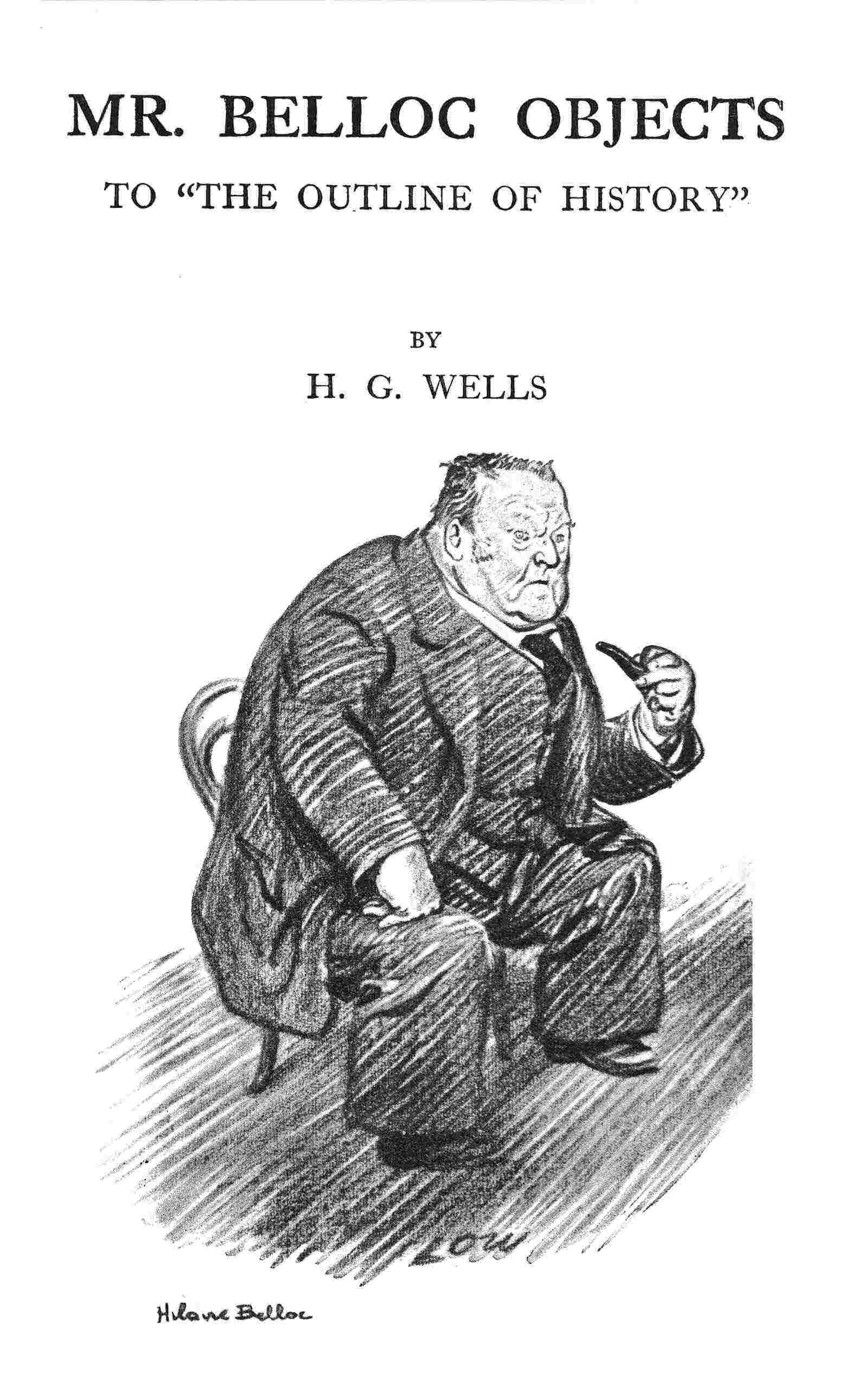
In this art of controversy it is evident that great importance attaches to pose. This is plain from the very outset of Mr. Belloc’s apologia. From the beginning I have to be put in my place, and my relationship to Mr. Belloc has to be defined. Accustomed as I am to see Mr. Belloc dodging about in my London club, and in Soho and thereabouts, and even occasionally appearing at a dinner-party, compactly stout, rather breathless and always insistently garrulous, I am more than a little amazed at his opening. He has suddenly become aloof from me. A great gulf of manner yawns between us. “Hullo, Belloc!” is frozen on my lips, dies unuttered. He advances upon me in his Introduction with a gravity of utterance, a dignity of gesture, rare in sober, God-fearing men. There is a slow, formal compliment or so. I have, I learn, “a deservedly popular talent in fiction.” I am sincere, an honest soul. My intentions are worthy. But the note changes; he declares I am a “Protestant writing for Protestants,” and there is danger that my Outline may fall into Catholic hands. Some Catholics may even be infected with doubt. His style thickens with emotion at this thought, and he declares: “One Catholic disturbed in his faith is more important than twenty thousand or a hundred thousand or a million of the average reading public of England and America.” That is why he is giving me his attention, syndicating these articles and swelling himself up so strongly against me. That is why he now proposes to exhibit and explain and expose me in the sight of all mankind. It is controversy, and everyday manners are in abeyance.
The controversial pose reveals itself further. The compliments and civilities thin out and vanish. Mr. Belloc becomes more magisterial, relatively larger, relatively graver, with every paragraph. He assumes more definitely the quality of a great scholar of European culture and European reputation, a trained, distinguished, universally accepted historian. With what is evidently the dexterity of an expert controversialist and with an impressiveness all his own, he seems to look over and under and round the man he knows, and sketches in the man he proposes to deal with, his limitations, his pitiful limitations, the characteristics, the disagreeable characteristics, that disfigure him. It is a new Wells, a most extraordinary person. I learn with amazement the particulars with which it is necessary to instruct that Catholic soul in danger before the matter of my book can be considered. I see myself in the lurid illumination of Catholic truth.
Remarkable Portrait of Mr. Wells
To begin with, I am “an intense patriot.” This will surprise many readers. I dread its effect on Mr. Henry Arthur Jones, whose favourite tune upon the megaphone for years has been that I am the friend of every country but my own. Will he intervene with a series of articles to “My dear Belloc”? I hope not. I might plead that almost any chapter of the Outline of History could be quoted against this proposition. But Mr. Belloc is ruthless; he offers no evidence for his statement, no foothold for a counter-plea. He just says it, very clearly, very emphatically several times over, and he says it, as I realise very soon, because it is the necessary preliminary to his next still more damaging exposures.
They are that I am an Englishman “of the Home Counties and London Suburbs”—Mr. Belloc, it seems, was born all over Europe—that my culture is entirely English, that I know nothing of any language or literature or history or science but that of England. And from this his creative invention sweeps on to a description of this new Wells he is evoking to meet his controversial needs. My admiration grows. I resist an impulse to go over at once to Mr. Belloc’s side. This, for example, is splendid. This new Wells, this suburban English Protestant, has written his Outline of History because, says Mr. Belloc, “he does not know that ‘foreigners’ (as he would call them) have general histories.”
That “as he would call them” is the controversial Mr. Belloc rising to his best.
Mr. Belloc, I may note in passing, does not cite any of these general histories to which he refers. It would surely make an interesting list and help the Catholic soul in danger to better reading. The American reader, at whose prejudices this stuff about my patriotism is presumably aimed, would surely welcome a competing Outline by a “foreigner.” Mr. Belloc might do worse things than a little translation work.
Then the Royal College of Science shrivels at his touch to a mechanics’ institute, and the new Wells, I learn, “does really believe from the bottom of his heart all that he read in the text-books of his youth.” The picture of this new Wells, credulous, uncritical devourer of the text-books supplied by his suburban institute, inveterate Protestant, grows under the pen of this expert controversialist. I have next to be presented as a low-class fellow with a peculiar bias against the “Gentry of my own country,” and this is accordingly done. “Gentlemen” with whom I have quarrelled are hinted at darkly—a pretty touch of fantasy. A profound and incurable illiteracy follows as a matter of course.
Gathering Courage of Mr. Belloc
Mr. Belloc’s courage gathers with the elaboration of his sketch. He is the type to acquiesce readily in his own statements, and one can see him persuading himself as he goes along that this really is the Wells he is up against. If so, what is there to be afraid of? If there is a twinge of doubt, he can always go back and read what he has written. The phraseology loses its earlier discretion, gets more pluckily abusive. Presently words like “ignorance” and “blunders” and “limited instruction” come spluttering from those ready nibs. Follows “childish” and “pitiable” and “antiquated nonsense.” Nothing to substantiate any of it—just saying it. So Mr. Belloc goes his way along the primrose path of controversy. He takes a fresh sip or so from his all too complaisant imagination. New inspirations come. I have “copied” things from the “wrong” books. That “copied” is good! One can see that base malignant Wells fellow, in his stuffy room all hung with Union Jacks, with the “wrong,” the “Protestant” book flattened out before him, copying, copying; his tongue following his laborious pen. Presently I read: “It is perhaps asking too much of our author to adopt a strictly scientific attitude.” This, from an adept in that mixture of stale politics and gossip which passed for history in the days of Mr. Belloc’s reading, to even the least of Huxley’s students, is stupendous!
Still he swells and swells with self-importance and self-induced contempt for his silent and invisible antagonist. The pen runs on, for does not the Catholic press wait for its latest great apologist? The thin film of oily politeness in the opening paragraphs is long since gone and done with, and Mr. Hilaire Belloc is fully himself again and remains himself, except for one or two returns to patronising praise and the oil squirt, for the rest of these remarkable papers.
His are, I suppose, the accepted manners of controversy—and what wonderful manners they are! I note them, but I cannot emulate them.
There is, however, one reference to the unlettered suburbanism of this ideal Wells too good to lose. I had almost let it slip by. It is an allusion to a certain publication in French. “There may be no translation,” Mr. Belloc throws out superbly at the height of his form, “but Mr. Wells ought to have heard of”—the out-of-date monograph in question. “There may be no translation...”! How feeble sounds my protest that for all practical purposes I read French as well as I do English, and that in all probability if it came to using a German, Spanish, Portuguese, or Italian scientific work I could give Mr. Belloc points and a beating.
Reflections upon the Real Mr. Belloc
But I have said enough to justify incidentally my habitual avoidance of the arts of controversy. I cannot inflate myself in this fashion. I cannot do the counter to this attitude. I was born and I shall die “familiar.” What seems to make Mr. Belloc feel brave and happy would make me feel sick. On this he has presumed overmuch. There are limits to my notorious gentleness and modesty, and they have been reached by Mr. Belloc in these articles. His skill is undeniable; no other writer could better his unpremeditated condescension, his apparently inadvertent insults. And yet the facts beneath all this insolent posturing are quite well known and easily verifiable. I cannot imagine whom it is intended to deceive for any length of time.
Mr. Belloc is a man four years my junior, and his academic career was briefer and not more brilliant than mine. Since he came down from Oxford to the world of London thirty years ago, he has done no original historical work of any distinction. He has been a popular writer as I have been a popular writer, and he is no more if no less a scholar than I am. There has been much incidental and inconsequent brightness in his discursive career—funny verses and stories, an amusing rather than a serious period in Parliament, much pamphleteering, lecturing and speaking; he has been active and erratic; now he would be urging on an anti-Semitic campaign; now, in association with Horatio Bottomley, attempting to hound Masterman, his old friend and rival, out of politics; the war made him the most confident of military “experts,” and he has done quite a number of clever revivifications of this or that historical event. That is his record. It gives him a respectable position in the republic of letters, in which also my position is respectable. No doubt he has every right and very considerable qualifications for the criticism of such a popular work as my Outline. But there is nothing in his career and nothing in his quality to justify this pose of erudition and insolent superiority he assumes towards me, and which he has made an integral part of his attack. He has assumed it entirely in relation to this controversy. He has thrown ordinary courtesy and good manners to the winds because only in that way can he hope for a controversial advantage over me.
The Clue to Mr. Belloc’s Disconcerting Pose
This disconcerting pose is part of his attack. That is why I am obliged to discuss it here. Upon many points the attack is almost pure pose; there is no tangible argument at all. It is very important to note that and bear that in mind. It has to be borne in mind when Mr. Belloc is accused of inordinate vanity or of not knowing his place in the world. I doubt even if he is really very vain. I realised long ago that his apparent arrogance is largely the self-protection of a fundamentally fearful man. He is a stout fellow in a funk. He is the sort of man who talks loud and fast for fear of hearing the other side. There is a frightened thing at the heart of all this burly insolence. He has a faith to defend, and he is not sure of his defence. That mitigates much of his offence, even if it mitigates little of his offensiveness.
Let me say a word or so more of excuse and explanation for him. These personalities of his are, so to speak, not a personal matter. There is more in them than that. Mr. Belloc’s attack upon my Outline does not stand alone among his activities; it is part of a larger controversy he wages against the modern, the non-Catholic vision of the world. He has carried on that controversy since his Balliol days. The exigencies that oblige him to pretend, against his better knowledge and common civility, that I am petty and provincial and patriotic and wilfully ignorant and pitifully out-of-date, oblige him to pretend as much about most of those who stand for modern science and a modern interpretation of history. He would pretend as hard about Sir Ray Lankester, for example, or about Professor Gilbert Murray or Sir Harry Johnston or Professor Barker, as he does about me. It is a general system of pretence. It is a necessary part of—I will not say of the Catholic attitude, but of his Catholic attitude towards modern knowledge.
The necessity for a pose involving this pretence is not very difficult to understand. Long before Mr. Belloc embarked upon the present dispute he had become the slave of a tactical fiction, which reiteration had made a reality for him. He evoked the fiction as early, I believe, as his Oxford days. It may have been very effective at Oxford—among the undergraduates. Then perhaps it was consciously a defensive bluff, but certainly it is no longer that. He has come at last to believe absolutely in this creature of his imagination. He has come to believe this: that there is a vast “modern European” culture of which the English-speaking world knows nothing, of which the non-Catholic world knows nothing, and with which he is familiar. It is on his side. It is always on his side. It is simply and purely Belloccian. He certainly believes it is there. It sustains his faith. It assuages the gnawing attacks of self-criticism that must come to him in the night. Throughout these papers he is constantly referring to this imaginary stuff—without ever coming to precisions. Again and again and again and again—and again and again and again, he alludes to this marvellous “European” science and literature, beyond our ken.
He does not quote it; it does not exist for him to quote; but he believes that it exists. He waves his hand impressively in the direction in which it is supposed to be. It is his stand-by, his refuge, his abiding fortress. But, in order to believe in it, it is necessary for him to believe that no other English-speaking men can even read French, and that their scepticism about it is based on some “provincial” prejudice or some hatred of Catholics, or southern people, or “Dagoes,” or “foreigners,” or what you will. That is why Nature wilfully ignores the wonderful science of this “Europe”; and why our Royal Society has no correspondence with it. But he has to imagine it is there and make his readers imagine it is there, and that there is this conspiracy of prejudice to ignore it, before he can even begin to put up any appearance of a case against such a résumé of current knowledge as the Outline of History.
Graceful Concessions to Mr. Belloc
All this rough and apparently irrelevant stuff about his own great breadth and learning and my profound ignorance and provincialism, to which he has devoted his two introductory papers, is therefore the necessary prelude to putting over this delusion. That stream of depreciation is not the wanton personal onslaught one might suppose it to be at the first blush. If he has appeared to glorify himself and belittle me, it is for greater controversial ends than a mere personal score. We are dealing with a controversialist here and a great apologist, and for all I know these may be quite legitimate methods in this, to me, unfamiliar field.
Few people will be found to deny Mr. Belloc a considerable amplitude of mind in his undertaking, so soon as they get thus far in understanding him. Before he could even set about syndicating this Companion to the Outline of History he had to incite a partisan receptivity in the Catholic readers to whom he appeals, by declaring that a violent hatred for their Church is the guiding motive of my life. He had to ignore a considerable array of facts to do that, and he has ignored them with great courage and steadfastness. He had to arouse an indifferent Catholic public to a sense of urgent danger by imposing this figure of a base, inveterate, and yet finally contemptible enemy upon it. His is a greater task than mere dragon-slaying. He had to create the dragon before he could become the champion. And then, with his syndication arrangements complete, while abusing me industriously for ignorance, backwardness, and general intellectual backwoodism, he had to write the whole of these articles without once really opening that Humbert safe of knowledge which is his sole capital in this controversy. Time after time he refers to it. Never once does he quote it. At most he may give us illusive peeps....
Now and then as we proceed I shall note these illusive peeps.
I can admire great effort even when it is ill-directed, and to show how little I bear him a grudge for the unpleasant things he has induced himself to write about me, and for the still more unpleasant things he tempts me—though I resist with a success that gratifies me—to write about him, I contemplate a graceful compliment to Mr. Belloc. In spite of the incurable ignorance of French and that “dirty Dago” attitude towards foreigners Mr. Belloc has so agreeably put upon me, it is my habit to spend a large part of the winter in a house I lease among the olive terraces of Provence. There is a placard in one corner of my study which could be rather amusingly covered with the backs of dummy books. I propose to devote that to a collection of Mr. Belloc’s authorities. There shall be one whole row at least of the Bulletins of the Madame Humbert Society, and all the later researches of the Belloc Academy of Anonymous Europeans, bound in bluff leather. There will be Finis Darwinis by Hilario Belloccio, and Hist. Eccles. by Hilarius Belloccius. I may have occasion to refer to other leading authorities in the course of this controversy. I shall add to it as we proceed.
And so, having examined, explained, disposed of, and in part apologised for, Mr. Belloc’s personalities and the pervading inelegance of his manners, I shall turn with some relief from this unavoidably personal retort to questions of a more general interest. I propose as my first study of these modern Catholic apologetics, so valiantly produced by Mr. Belloc and so magnificently published and displayed by the Catholic press, to follow our hero’s courageous but unsteady progress through the mysteries of Natural Selection. And after that we shall come to Original Sin and Human Origins in the light of Mr. Belloc’s science and the phantom science of those phantom naturalists and anthropologists he calls to his assistance.