
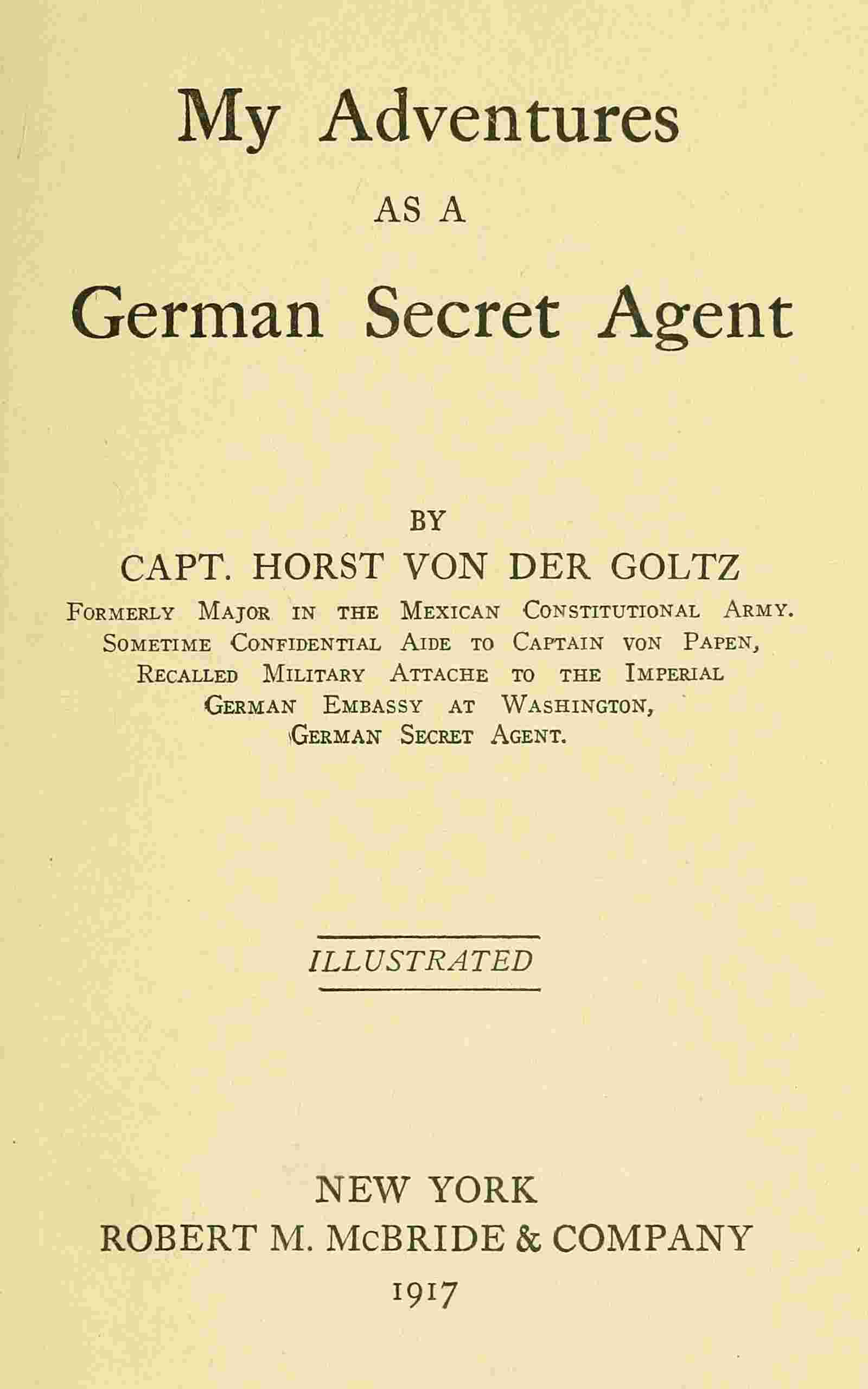
My Adventures as a German
Secret Agent
CHAPTER I
I find an old letter, containing a strange bit of scandal—and its contents draw me into the service of the Kaiser.
On March 29th, 1916, the steamer Finland was warped into its Hudson River dock and I hurried down the gang plank. I was not alone. Agents of the United States Department of Justice had met me at Quarantine; and a man from Scotland Yard was there also—a man who had attended me sedulously since, barely two weeks before, I had been released under rather unusual circumstances from Lewes prison in England; the last of four English prisons in which I had spent fifteen months in solitary confinement waiting for the day of my execution.
My friend from Scotland Yard left me very shortly; soon after, I was testifying for the United States Government against Capt. Hans Tauscher, husband of Mme. Johanna Gadski, the diva. Tauscher, American agent of the Krupps and of the German Government, was charged with complicity in a plot to blow up the Welland Canal in Canada during the first month of the Great War. During the course of the trial it was shown that von Papen and others (including myself) had entered into a conspiracy to violate the neutrality of the United States. I had led the expedition against the Welland Canal and I was telling everything I knew about it. Doubtless you remember the newspapers of the day.
You will remember how, at that time, the magnitude of the German plot against the neutrality of the United States became finally apparent. You will remember how, in connection with my exposure came the exposure of von Igel, of Rintelen, of the German Consul-General at San Francisco, Bopp, and many others. With all of these men I was familiar. In the activities of some of them I was implicated. It was I, as I have said, who planned the details of the Welland Canal plot. I shall tell the true story of these activities later on.
But first let me tell the story of how I became to be concerned in these plots—and to do that I must go back over many years; I must tell how I first became a member of the Kaiser’s Secret Diplomatic Force (to give it a name) and incidentally I shall describe for the first time the real workings of that force.
I have been in and out of the Kaiser’s web for ten years. I have served him faithfully in many capacities and in many places—all over Europe, in Mexico, even in the United States. I served the German Government as long as I believed it to be representing the interests of my countrymen. But from the moment that I became convinced that the men who made up the Government—the Hohenzollerns, the Junkers and the bureaucrats—were anxious merely to preserve their own power, even at the expense of Germany itself, my attitude toward them changed. That is why I write this book—and why I shall tell what I know of the aims and ambitions of these men—enemies of Germany as well as of the rest of the world.
I was not a spy; nor was I a secret service agent. I was, rather, a secret diplomatic agent. Let me add that there is a nice distinction between the three. A secret diplomatic agent is a man who directs spies, who studies their reports, who pieces together various bits of information, and who, when he has the fabric complete, personally makes his report to the highest authority or carries that particular plan to its desired conclusion. His work and his status are of various sorts. Unlike the spy, he is a user, not a getter, of information. He is a free lance, responsible only to the Foreign Office; a plotter; an unofficial intermediary in many negotiations; and frequently he differs from an accredited diplomatic representative, only in that his activities and his office are essentially secret. Obviously men of this type must be highly trained and reliable; and their constant association with men of authority makes it necessary that they, themselves, be men of breeding and education. But above all, they must possess the courage that shrinks at no danger, and a devotion, a patriotism that knows no scruples.
This, then, was the calling into which I found myself plunged, while still a boy, by one of the strangest chances that ever befell me, whose life has been full of strange happenings.
As I recall my adolescence I realize that I was a normal boy, vigorous, wilful, fond of sport, of horses, dogs and guns, and I know that but for the chance I speak of, I should have grown up to the traditions of our family—Cadet school—the University—later a lieutenancy in the German Army—and to-day, perhaps, death “somewhere in France.”
And yet, in that boyhood that I am recalling, I can remember that there were other interests which were far greater than the games that I loved, as did all lads of my age. Mental adventure, the matching of wits against wits for stakes of reputation and fortune, always exercised an uncanny fascination over my mind. That delight in intrigue was shown by the books I read as a boy. In the library of my father’s house there were many novels, books of poems, of biography, travel, philosophy and history; but I passed them by unread. His few volumes of court gossip and so-called “secret history” I seized with avidity. I used to bear off the memoirs of Maréchal Richelieu, the Cardinal’s nephew, and read them in my room when the rest of the household was asleep.
I recall, too, that there was another tendency already developed in me. I see it in my dealings with other boys of that day. It was the impulse to make other people my instruments, not by direct command or appeal, but by leading them to do, apparently for themselves, what I needed of them.
Such was I, when my aunt who had cared for me since the death of my parents some years before, fell ill and later died. I was disconsolate for a time and wandered about through the halls and chambers of the house, seeking amusement. And it was thus that one day I came upon an old chest in the room that had been hers. I remembered that chest. There were letters in it—letters that had been written to her by friends made in the old days when she was at court. Often she had read me passages from them—bits of gossip about this or that personage whom she had once known—occasionally, even, mention of the Kaiser.
Doubtless, too, I thought, there were passages which she had not seen fit to read to me: some more intimate bits of gossip about those brilliant men and women in Berlin whom I then knew only as names. With the eager curiosity of a boy I sought the key, and in a moment had unlocked the chest.
There they lay, those neat, faded bundles, slightly yellow, addressed in a variety of hands. Idly I selected a packet and glanced over the envelopes it contained, lingering, in anticipation of the revelations that might be in them. I must have read a dozen letters before my eye fell upon the envelope that so completely changed my life.
It lay in a corner of the chest, as if hidden from too curious eyes—a yellow square of paper, distinguished from its fellows by the quality of the stationery alone, and by its appearance of greater age. But I knew, before I had read fifty words of it, that I was holding in my hands a document that was more explosive than dynamite!
For this letter, written to my aunt years before, by one of the most exalted personages in all of Germany, contained statements which, had they been made by any one else, would have been treason to utter, and which cast the most serious doubts upon the legitimacy of the Kaiser, Wilhelm II.
I realize fully that what I have written will seem grossly improbable to most of my readers. I know that few persons will believe me. And since I cannot prove what I have said, since the letter is no longer in my possession, I can ask you only to consider the facts and to weigh for yourself the probabilities of my statement.
Those of you whose memories go back to the last twenty years of the nineteenth century, will readily recall the notorious ill-feeling that existed between Wilhelm II and his mother, Victoria, the Dowager Empress Friederich. Stories have too often been told of this enmity, culminating in the virtual banishment from Berlin of the Queen Mother, for me to need do more than mention them. But what is not so generally known is the small esteem in which Victoria was held by the entire German people. During the twenty years of her married life as the wife of the then Crown Prince Friederich, she was treated by Berlin society with the most thinly-veiled hostility. Even Bismarck made no attempt to conceal his dislike for her, and accused her—to quote his own words—of having “poisoned the fountain of Hohenzollern blood at its source.”
Victoria, for her part, although she seems to have had no animosity toward the German people, certainly possessed little love for her eldest son, and did her best to delay his ascension to the Imperial throne as long as she could. When in 1888 Wilhelm I was dying, she tried her utmost to secure the succession to her husband, who was then lying dangerously ill at San Remo. “Cancer,” the physicians pronounced the trouble, and even the great German specialist, Bergman, agreed with their diagnosis. There is a law that prevents any one with an incurable disease, such as cancer, from ascending the Prussian throne; but Victoria knew too well the attitude of her son, Wilhelm, toward herself, not to wish to do everything in her power to prevent him from becoming Emperor so long as she could. In her extremity she appealed to her mother, Queen Victoria of England, who sent Mackenzie, the great English surgeon, to San Remo to report on Friederich’s condition. Mackenzie opposed Bergman and said the disease was not cancer; and the physicians inserted a silver tube in Friederich’s throat, and in due course he became Emperor Friederich III.
But in spite of Mackenzie and the silver tube, Friederich III died after a reign of ninety-eight days—and he died of cancer.
Now what was the reason for this hostility between mother and son and between Empress and subjects? There have been many answers given—Victoria’s love for England, her colossal lack of tact, her impatient unconventionality. Berlin whispered of a dinner in Holland years before, when Victoria had entertained some English people she met there—people she had never seen before—and had finished her repast by smoking a cigar. That in the days when the sight of a woman smoking horrified the German soul! And Berlin hinted at worse unconventionalities than this.
As for the animosity of the Kaiser, that was attributed to the fact that he held her responsible for his withered left arm.
Plausible reasons, all of these, and possibly true. But consider, if you will, the rumors that followed Victoria all her life—the story of an early attachment to the Count Seckendorf, her husband’s associate during the Seven Weeks’ War of 1866—the reports, sometimes denied but generally believed, of her marriage to the Count not long before her death. Consider, too, the dissimilarity between the Kaiser and the other men of his race—big, slow-minded, amiable men—so unlike Wilhelm II, with his aggressive, alert personality, his quick mind and his Piedmontese face. And can you not imagine the attitude of a woman who had been guilty of infidelity and yet retained her sense of national honor—the hesitancy she might feel at seeing the child of this infidelity upon the throne, and so perpetrating a gigantic fraud upon a people and a husband whom she respected if she did not love? And have not women been known to hate, rather than love, the offspring of a guilty union?
True or not, these suppositions—what does it matter? You can see, can you not, why I believed that my letter told the truth, and why I knew that here was a plaything which would astound the world, if made public?
But what to do with this letter to which I attached so much importance? Something impelled me not to speak of it to my family. But who else was there?
In my perplexity I did an utterly foolish thing. I put my whole confidence in a man’s word. There was, serving at a nearby fortress, a General Major von Dassel, who was in the habit of coming to our house quite regularly. To him I went, and under pledge of silence I told him my story. Of course, he broke the pledge and left immediately for Berlin. All doubts, if I had any, as to the importance of the document vanished with him. And if I had any misgivings concerning my own importance they quickly vanished, too. Back from Berlin, with General Major von Dassel came an agent of the Reichs Kanzler. He did not come to our house; instead von Dassel sent for me to go to his headquarters in the fortress. I met there a solemn frock-coated personage who, so he said, had come down from Berlin especially to see me. Imagine my elation! I was in my element; what I had hoped for had at last happened. The pages of Richelieu and of my secret histories were coming true. Another man and I were to lock our wits in a fight to the finish—that pleasure I promised myself. He was a worthy opponent, an official, a professional intriguer. As I looked into his serious, bearded face, I built romances about him.
The agent of the Chancellor wanted my document and my pledge to keep silent about its contents. Through sheer love of combat, I refused him on both points. He tried persuasion and reason. I was adamant. He tried cajolery.
“It is plain,” he said, in a voice that was caressingly agreeable, “that you are an extremely clever young man. I have never before met your like—that is, at your age. A great career will be possible to such a young man if only he shows himself eager to serve his government, eager to meet the wishes of his Chancellor.”
Of course, I was delighted with this flattery, which I felt was entirely deserved. I began to believe that I was a person of importance. I became stubborn—which always has been one of my best and worst traits. I saw that the gentleman in the frock-coat was becoming angry; his serious eyes flashed. Apparently much against his will, he tried threats; he suavely pointed out that if I persisted in my resolve not to turn over the document, destruction yawned at my feet. The threats touched off the fuse of my romanticism. I felt I was leading the life of intrigue of which I had read.
“If you will wait here,” I told him, “I shall go home and get the document for you.”
The Chancellor’s representative stroked his beard, deliberated a moment and seemed uncertain.
“Oh, the Junge will come back all right,” put in the General Major von Dassel. But the Junge did not come back. My family had always been excessively liberal with money, and I had enough in my own little “war chest” to buy a railroad ticket, and a considerable amount besides. So I promptly ran off to Paris; and to this day I don’t know how long the gentleman in the frock-coat waited for me in von Dassel’s office.
The terrors and thrills and delight of that panic stricken flight still make me smile. No peril I have since been through was half as exciting.... Berlin!... Köln!... Brussels! It was a race against apprehension. I was happily frightened, much as a colt is, when it shies at its own shadow. Although I was in long trousers and looked years older than I was, I had not sense enough to see the affair in its true light—a foolish escapade which was quite certain to have disagreeable consequences. And so I fled from Berlin to Paris.
From Paris I fled, too. There, any circumstance struck my fevered imagination as being suspicious. After a day in the French capital, I scurried south to Nice and from Nice to Monte Carlo. Precocious youngster, indeed, for there I had my first experience with that favored figure of the novelist, the woman secret agent. No novelist, I venture to say, would ever have picked her out of the Riviera crowd as being what she was. She wore no air of mystery; and though attractive enough in a quiet way, she was very far from the siren type in looks or manners. The friendliness that she, a woman of the mid-thirties, showed a lonely boy was perfectly natural. I should never have guessed her to be an agent of the Wilhelmstrasse had she not chosen to let me know it. Of course, the moment she spoke to me of “my document,” I knew she had made my acquaintance with a purpose. If the dear old frock-coated agent of the Chancellor had been asleep, the telegraph wires from Berlin to Paris and Nice and Monte Carlo had been quite awake.
The proof that I was actually watched and waited for thrilled me anew. It also alarmed me when my friend explained how deeply my government was affronted. Soon the alarm outgrew the thrill and in the end I quite broke down. Then the woman in her, touched with pity, apparently displaced the adventuress. We took counsel together and she showed me a way out.
“Your document,” she said, “has a Russian as well as a German importance. Why not try Petersburg since Berlin is hostile? For the sake of what you bring, Russia might give shelter and protection.”
Remember, I was very young and she was all kindness. Yes, she discovered for me the avenue of escape and she set my foot upon it in the most motherly way. And I unknowingly took my first humble lesson in the great art of intrigue. For as I learned years afterwards, that woman was not a German agent but a Russian!
But at that time I was all innocent gratitude for her kindness. I was thankful enough to proceed to Petersburg by way of Italy, Constantinople and Odessa. Of course, she must have designated a man unknown to me to travel with me, and make sure that I reached the Russian capital. To my hotel in Petersburg, just as the woman had predicted, came an officer of the political police, who courteously asked me not to leave the building for twenty-four hours. The next day the man from the Okrana came again. This time he had a droshky waiting, with one of those bull-necked, blue corduroy-robed, muscular Russian jehus on the box. We were driven down the Nevsky-Prospect to a palace. Here I soon found myself in the presence of a man I did not then know as Count Witte. He greeted me kindly, merely remarking that he had heard I was in some difficulties, and offering me aid and advice. My letter was not referred to and the interview ended.
So began the process of drawing me out. A fortnight later the matter of my information was broached openly and the suggestion was made that if I delivered it to the Russian Government, high officials would be friendly and a career assured me in Russia, as I grew up. But by that time Germany had changed her attitude. Her agents also reached me in St. Petersburg. From them I received new assurance of the importance of the document. If I would release it—so the German agent who came to my hotel told me—and keep my tongue still, Berlin would pardon my indiscretion and assure me a career at home. Russia or Germany? My decision was quickly made. That very night I was smuggled out of Petersburg and whisked across the frontier at Alexandrovna, into Germany; and the letter passed out of my hands—for the time being.