
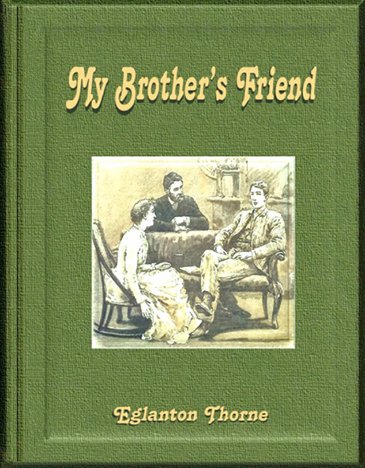
"The idea of likening my baby's eyes to a kitten's!" cried Mabel, indignantly. "Oh, Dorothy, how can you bear to leave that darling!" she said to me when the nurse had carried her precious charge back to his own domain, from which he had been brought for my inspection. "I thought you would have been with me to see him from day to day. It is so silly of you to go to Mrs. Lyell's. You could have studied just as well here, if you must be a governess. There is plenty of room for you in this house. I could give you a sitting-room of your own, if you liked."
"Do not speak of it, please, Mabel," I said; "it is out of the question that I should live here."
"It is very wrong of you to say so, Dorothy. Do you know that poor father always thought that you would live with me if anything happened to him? Howard told him that you should have a home here."
I looked up at her, a little startled by her words, which gave me fresh enlightenment with regard to the past. She saw my change of expression, and exclaimed quickly, "Ah, I thought that you would feel differently if you knew that father wished it."
"I am not yet convinced that father did wish it," I said, coolly. "At least I am sure that he would not wish me to do what is so averse to my feelings."
"Oh, Dorothy, why are you so proud? Why will you accept nothing from Howard?"
"Why?" I repeated, angrily. "I should think you might understand. I do not choose to accept as bounty what should be mine by right."
"By right? But you have no right, Dorothy. Father mortgaged the business and everything belonging to it to Howard."
"I know that well enough," I answered; "but do you think Howard should have let him do it? Something might have been reserved for us—some share in the business, at least."
"But you do not understand," said Mabel, looking much annoyed with me. "You are so headstrong, Dorothy. Do you know that father would have been a bankrupt but for Howard? He had sunk thousands of pounds in the tannery, and was losing money by it every year, and all because he would go on tanning in such a bungling, old-fashioned way, using methods that have been abandoned for ages by most tanners, Howard says."
"You may call father's tanning bungling if you like, Mabel," I said, coldly; "but I know this, for I have heard him say so, that no customer ever found fault with his leather."
"Oh, the leather was good, no doubt; but Howard introduced into the yard a method by which the hides could be tanned in half the time, and bring in a much larger profit. If poor father had lived to share its success, things might have been better for him and for you."
"But as it is," I interrupted her scornfully, "Howard has trumped everything. Well, poor father was always unfortunate, and Howard, I suppose, is just as lucky."
"You ought not to talk so, Dorothy; you have really nothing to complain of. Howard is ready to give Edmund any help he needs, and, so clever as he is, he is sure to make his way in the world. For you there is this beautiful home with every comfort, if you will have it. And if you lived here, where you would meet nice people, instead of going governessing to see nobody, you would have every chance of making a good marriage and being comfortably settled in life."
"Thank you for the suggestion," I exclaimed, hotly. "No doubt you would enjoy making a match for me according to your mind; but as long as I have a head and hands capable of honest work, I will never degrade myself by marrying for the sake of getting a home. Say no more about my living with you, Mabel; it is out of the question."
"So I see," said Mabel, stung in her turn. "After what you have said, Dorothy, I cannot wish that you should live with me."
Thus our talk ended. Mabel was not the woman to allow that her husband could do wrong; nor would she soon forget what I had said about him. In spite of Edmund's warning, I had caused a breach to open between me and my sister.
====================
CHAPTER VIII.
A QUIET HOME.
I ARRIVED at Mrs. Lyell's on the last day of May, having on my way thither stayed for a few days in London, at Miss Carefull's. During that interval, I to some extent shook off the inevitable sadness that fell upon me as I closed a chapter in my book of life by saying farewell to my dear old home. I was looking forward with somewhat of interest and curiosity to my sojourn with Mrs. Lyell when I stepped from the train on to the East Weylea, platform that afternoon in May.
I knew that the house was close by; but having luggage with me, I took the solitary fly that was waiting outside the station. I was driven, it seemed to me, about a hundred yards along the broad, main road to London—the metropolis was not more than six miles distant—ere the driver turned his horse into a narrower, more rural road, and drew up before two high iron gates which, dismounting, he proceeded to throw open.
Whilst he did so, I had time to take in the appearance of a long, two-storied house built of pale brick, and wearing an expression—for houses as well as persons have expressions—of neat, staid respectability. There were two wings to the house: that to the left, as I afterwards learned, contained the kitchens and servants' rooms; that to the right, which had false windows, the coach-house and stables. Between the house and the iron gates lay a garden bright with flowers, unlike most gardens in having a pond set in the centre of its circular lawn, round which on either hand swept a broad carriage drive to the house.
As I drove by, I caught sight of the white and green buds of water-lilies floating on the surface of the pond, and noted the tree it seemed to me a kind of ash—quaintly clipped to the form of an open umbrella, which stood on the lawn between the pond and the sweep of gravel in front of the house.
But ere I could observe more, the fly came to a standstill before the square porch, and I saw that the don was open, and an elderly woman attired in black, with white cap and apron, was waiting to receive me.
"Miss Carmichael, I suppose," she said, coming forward to assist me to alight. "My mistress is expecting you. If you will walk this way, miss, I will see to your luggage."
So saying, she took my bag and led the way across a square hall into which a broad shallow staircase descended.
Even in those few seconds I received an impression of dainty purity as I crossed the hall with its shining oilcloth, soft rugs, spotless paint, and was conscious of the exquisite country freshness which pervaded the house. Throwing open a door on the left, the servant announced me, and I entered a long, lofty room with a large French window at its further end, overlooking, as I saw at a glance, another garden at the back of the house.
But my attention was immediately engaged by a little form which rose from an easy chair and came towards me with outstretched arms. How can I describe Mrs. Lyell as I then saw her? It is not always easy to recall our first impressions of a face we have learned to love—a friend who has become most dear to us; but I will try.
I saw a tiny woman wearing a black stuff gown, relieved by a soft grey shawl and a widow's cap of snowy white. Her face was withered and wrinkled, her hair silvery, the hands which clasped mine so tenderly were shrunken and bony from age. I had not expected to see so aged a woman. Mrs. Lyell was nearly eighty, and eighty seems very old to nineteen. I was wont to shrink from the very old, but Mrs. Lyell's appearance inspired me with neither awe nor repugnance, for the aged, furrowed face was radiant with goodwill, and the faded eyes shone with the light of a pure and loving soul.
"Welcome, dear Dorothy," she said, in her gentle, quavering tones; "you are welcome both for your own and for your parents' sake. Your father has often spoken to me of you, and I am very glad to see you at last."
It was natural to me to restrain emotion in the presence of others. Since my father's death scarce anyone had seen me weep; but now tears rose in my eyes as I stooped to receive Mrs. Lyell's warm kisses, and I had hard work to keep from crying. She saw how I was moved and was silent for a few moments, merely showing her sympathy by stroking my hand which she held in hers.
"How tall you are, my love!" she said, presently. "I had no idea you were such a tall girl."
And indeed I felt very tall and big as I stood before that wee, fragile-looking old lady.
"I am dreadfully tall!" I said, apologetically. "A great deal too tall."
"Never mind, dear, that is a matter beyond our control. The Bible reminds us, does it not, that we cannot add one cubit to our stature? And it makes no difference whether we are short or tall as long as we try to be good. But here comes Sarah; I daresay you will like her to take you to your room. We shall have tea in half an hour's time."
The servant who had admitted me now appeared. She was a thin, sallow woman, almost as tall as I was, but rather crooked of figure. She must have been many years younger than her mistress, but she looked old to me, for her hair was grey, and there were wrinkles on her forehead, and crow's-feet about her eyes. I caught her black eyes examining me with a hard, narrow gaze, which was not agreeable, and though she was very polite as she attended me upstairs, her voice and manner were not pleasing to me.
The room in which she left me was furnished according to old-fashioned ideas of comfort. There was a huge four-post bedstead hung with snowy dimity, and holding a mountainous feather bed, covered with a heavy knitted counterpane. White textures, too, curtained the window, shrouded the looking-glass, and enveloped in voluminous folds the dressing-table. A large Bible lay on a table at the foot of the bed, and beside the table stood a high-backed, luxuriously cushioned elbow-chair. I smiled as my eyes fell on it. It was the chair for an old lady or an invalid, but hardly one in which I should care to sit often.
On taking possession of a new room, I always hasten to the window, for it is a matter of importance to me what sort of outlook my bedroom commands. I did so now, and, drawing back the curtain, looked down upon another garden, even pleasanter than that through which I had approached the house. My eyes rested on a large, well-kept lawn, soft as velvet, green as emerald, in the centre of which stood a fine mulberry tree not yet in full leafage. At each extremity of the lawn on the side fronting the house rose, like a giant sentinel, a tall walnut tree, still brown and irresponsive to the touch of spring, though the other trees In the garden were showing their freshest green. I could see little more of the garden save a deep border of flowers and a laurel hedge behind it, above which rose the trunks and foliage of sundry fruit trees; but the prospect held me long at the window. I dearly loved a garden, and there was more than the garden to be seen, for beyond it stretched a fair expanse of fields and hedgerows, with wooded uplands faintly visible in the distance, through a veil of blue haze.
Suddenly I remembered the punctuality practised in that house, and that I had to unpack some of my things, and rearrange my dress ere going downstairs. I was as expeditious as possible; but when I entered the dining-room, tea was waiting, and Mrs. Lyell had already taken her place at the table.
She requested that I would be kind enough to pour out the tea. Of course, I willingly complied; but how strange I felt as I seated myself before the handsome antique silver equipage! Then Mrs. Lyell folded her hands and bent her head with a reverent, childlike air, and, to my surprise, offered up, not a formal grace, but a short prayer, in which she thanked God for bringing me there in safety, and prayed that His blessing might rest on me.
I knew not what to think of this proceeding, it seemed to me so odd. I scarcely liked it, and yet I could not help being touched by the simple, trustful spirit the prayer breathed. I grew accustomed afterwards to Mrs. Lyell's habit of thus, at the beginning of a meal, pouring forth in brief but earnest prayer the thoughts and desires uppermost in her heart.
It was very pleasant, that first meal I took with Mrs. Lyell. The dainty nicety of the table arrangements, the homemade bread, the delicious butter, the rich cake and sweet biscuits on which the cook prided herself, were all duly appreciated by me. Whilst I took my tea, my eyes wandered to some portraits placed on the mantelshelf. There was a miniature painting of a lady in a very short-waisted gown, with her hair piled in a high crown above her brows, which, greatly as the little wrinkled face beside me had altered since then, I could yet recognise as representing Mrs. Lyell in early life! The portrait, wrought in similar style, of a gentleman wearing the straight-cut coat and stiff stock of a previous age, I concluded to be that of the deceased Mr. Lyell. Between these, in a pretty morocco frame, was a portrait which was quite modern, the photograph of a young man with a bright, animated countenance. The face seemed to smile as I looked at it; but the smile was in the eyes alone; the strong, well-cut mouth was firmly closed.
This portrait attracted me. It had a fascination which drew my eyes to it again and again, so that Mrs. Lyell, who sat with her back to the mantelpiece, seeing my glance constantly turning in that direction, asked me at length—
"What do you see there, my dear, that interests you so much?"
"Oh!" I stammered, a little embarrassed by the question. "I was only looking at that likeness."
"Whose likeness? My nephew's? Ah, you may well admire that; a good face, has he not? He is my grand-nephew, Leonard Glynne by name. His father died in India years ago when Leonard was a mere child, and his mother did not survive her husband many years. She was my dearly loved niece."
I looked at the portrait with still more interest. Leonard! I liked the name. It suited him, I fancied, for I felt sure that he was brave and strong.
"It was very sad for him to lose both his parents," I said.
"Yes, a great loss; but he was brought up in the home of his father's brother at Bournemouth, and his uncle was very good to him. Since he grew into manhood, he has lived in London, for he does business in the city."
"Do you see him often?" I asked.
"Not very. He spends his Sundays with me when he has no other engagement, and he drops in now and then to ask how I am. But he has many friends, and his company is so much in request that I do not see him very often, although he lives near. I do not complain of that. An old woman's society is not very enlivening to a young man, and there is little to interest him here. But Leonard is very good and kind when he comes, dear fellow!"
I could not wonder that Mr. Leonard Glynne was popular with his acquaintances, for his looks seemed to testify to a happy, genial nature. When should I see this nephew of Mrs. Lyell's?
"He has just gone off for a month's tour in Switzerland," Mrs. Lyell said, as if in answer to my thought. "He came in last night to bid me good-bye. I see more of him than I used to since I made him the present of a horse. My motives for doing so were rather interested; but he was delighted with the gift. Now he need no longer complain of the distance Weylea is from the city. He can ride to and fro and see his friends, and is to a great extent independent of the railway."
"It was a happy thought of yours," I said, longing to ask some questions but too shy to do so.
"Yes," said Mrs. Lyell, smiling; "I forget now what made me think of such a thing. I suppose he gave me a hint that he should like a horse."
"It must be lovely in Switzerland at this time," I said, with a little sigh.
"It is a most beautiful country at any time, I suppose; but in June the flowers are said to be so lovely," replied Mrs. Lyell. "Leonard has been there before. He is very fond of travelling; rather too fond, I think, sometimes; but, perhaps, I should not say so, for it is a pure and elevated pleasure he finds in beholding the grandeur and beauty of the works of God."
When we rose from the table, Mrs. Lyell asked me if I should like to take a turn in the garden. Perhaps she caught some wistful glance I cast in that direction, for I was longing to get amongst the trees and flowers. She could not accompany me, she said, with a smile, for she was so feeble and so susceptible to cold that she rarely went out, and then only in a bath chair or carriage.
With what pleasure I opened the window, stepped on to the little stone balcony, and ran down the steps into the garden! Our dear old garden at home was a wilderness compared with this well-kept, well-ordered ground; but somehow the one reminded me of the other. Ah, how I came to love Mrs. Lyell's garden in after days! At this hour, I could almost weep to think how it has vanished, and of the commonplace, suburban houses which stand, row after row, on the ground where roses once flourished, and apples and pears mellowed in the autumn sunshine.
And yet it was an ordinary garden enough; there were no tortuous mazes, no leafy alcoves or miniature glens. Straight down, on either side, ran a broad gravel path, intersected here and there by other paths, equally straight. Best I liked the lower part, where apple and pear trees grew amidst cabbages and kitchen stuff, where fruit trees were trained against the walls; where there were thickets of gooseberry and currant bushes, and where a bed of strawberry plants promised a fine crop of that luscious fruit.
As I paced the garden paths on that fair May evening, whilst a thrush perched on the mulberry tree made the air ring with his sweetly-thrilling notes, my heart was content. So elastic are our spirits when we are young, that in spite of the sorrowful changes I had recently experienced, I was not unhappy. Mrs. Lyell and her surroundings were different from what I had expected. Everything was much pleasanter than Mabel's representations, or rather my imagination enlarging upon Mabel's representations, had led me to expect. Already I loved the dear old lady, and believed that I should be happy with her. I was not afraid of the quietude and monotony which Mabel had warned me I should find hard to bear.
Presently, however, I felt constrained to go indoors. Mrs. Lyell was seated in her easy chair knitting. I fetched some needlework, and sat down beside her. She talked to me very kindly about my father and mother, and asked questions concerning Mabel and Edmund. I must confess that the hour we spent thus seemed long to me.
At a quarter to nine Sarah appeared, bringing a couple of tall candles. She closed the shutters, lighted the candles, wheeled her mistress's chair to the table, and placed a Bible and prayer-book before her. Then the household came in for family worship. How old everyone about the place seemed! I had encountered in the garden an old gardener, bent double with years, who had scowled at me, as though he thought so young a being had no right to be there, and now as I saw that the cook was even older than Sarah, and the housemaid, supposed to be young, was a woman considerably past thirty, I felt myself ridiculously juvenile compared with everyone about me.
Immediately after prayers Mrs. Lyell retired to her own room, where, as she explained to me, she took her supper of gruel. She begged me to excuse her leaving me, saying that she found it necessary for her health to live by rule, and never on any account deviated from her mode of life. As she said this, Sarah stood waiting to lead her upstairs. I half suspected that she, even more than her mistress, believed in a strict observance of rule.
Mrs. Lyell kissed me tenderly as she said good-night. The younger servant brought in a light repast for my solitary consumption. I ate it contentedly, and, not long after, I too went to bed. I laid my head on the pillow that night with a feeling of deep thankfulness. I had gained the quiet, peaceful shelter I needed till I could furnish myself with the means of winning independence.
CHAPTER IX.
I EXPLORE THE NEIGHBOURHOOD, AND
BECOME ACQUAINTED WITH MR. LEONARD GLYNNE.
I WAS downstairs by eight o'clock the next morning, for I had always been accustomed to early hours. My appearance took the housemaid, who was dusting the dining-room, by surprise. Breakfast would not be ready for half an hour, she said, so I betook myself to the garden, which looked most inviting in the bright sunlight of the first June morning.
Birds were fluttering to and fro between the lawn and the mulberry tree, picking up their breakfast with much satisfaction. A delicious breath of sweet-briar was wafted to me as I descended the stone steps from the balcony. There were rose trees here and there on the beds, and roses were trained across the rustic arches, which at each end of the laurel hedge crossed the broad gravel path where it led down into the more homely kitchen garden. Some of these were in bloom, and by standing on tiptoe I managed to secure one half-blown beauty, which I fastened in my gown.
To the left of the house, as I stood facing it, was a long greenhouse. It had been locked on the previous evening, and I had only been able to catch tantalising glimpses of the flowers through the glass, but now I saw that the door stood open. I hastened to enter it. There was nothing more rare to be seen within than fine geraniums and fuchsias, with maidenhair and other ferns; but I enjoyed looking at the bright flowers.
Close beside the door of the greenhouse was a door leading into the stable-yard. This, too, stood open, and through it I caught sight of a young man engaged in grooming a fine chestnut horse. It was a lovely creature, light and graceful in movement; and being an ardent lover of animals, I could not resist standing in the doorway to watch it. I admired the horse's shapely head, its bright, glossy coat, and the dainty white fore-foot with which it was proudly pawing the ground as if anxious to draw attention to his beauty.
I knew enough of horses to be sure that this was a valuable animal, and I wondered a little, for it scarcely seemed fit to draw the brougham which I saw standing in the yard. I should have thought, moreover, that an old lady like Mrs. Lyell would have preferred to use a less highbred, spirited animal than this appeared.
Presently the man turned and saw me watching him at his task. I ventured a "Good morning," to which he responded awkwardly. I made a remark on the beauty of the day, but elicited nothing beyond a sheepish assent. I heard afterwards that he was the son of the morose-looking old gardener I had encountered the evening before. Evidently he had inherited the taciturn temperament of his parent.
I turned back towards the house and met Clara, the housemaid, coming to tell me that breakfast was on the table. I went indoors and sat down to the meal in solitary state. How I longed for my dear kittens, which I had had to consign to the tender mercies of Salome! As yet I had seen neither cat nor dog upon Mrs. Lyell's premises.
On inquiry I learned from Sarah that Mrs. Lyell never came down before noon, and then, when strong enough, she spent the interval till luncheon in reading and answering her letters, for she had rather a large correspondence, and, although it took her some time to indite a letter, preferred writing herself, whenever possible, to employing an amanuensis. Mrs. Lyell's way of spending her morning fitted in well with my own plans. It left me free to devote to study the hours till dinner.
Soon after breakfast I established myself with my books in the library, a small square room, the window of which looked into the front garden, whilst it communicated by means of folding doors with the large drawing-room lying parallel to the dining-room, and having French windows opening on to the stone balcony at the back of the house. The library Mrs. Lyell had told me I might consider my own room whenever I desired seclusion. It was furnished with high book-shelves, which, however, I found, to my disappointment, contained only the oldest and driest of books. However, as Miss Carefull had lent me a number of books, and planned for me a course of work with these, I was not dependent on the resources of Mrs. Lyell's library, to which no book had been added since her husband's death, some years before I was born.
To one so unused to application as I was, it was not easy to settle to work amidst strange surroundings. For some time my eyes would keep wandering to the window, and I found myself idly watching the insects fluttering above the pond, the old bent gardener going leisurely about his work, or the few passers along the quiet road, who, especially if children, would often pause and stand peering through the iron gates at the pretty garden within. At last, a sense of shame roused me, I goaded my flagging resolution with the thought of all that depended on my exertions, and set to work in good earnest. The rest of the morning fled quickly.
Not till the dinner hour came did I see Mrs. Lyell. She met me with the sweet, serene kindness which is one of the greatest charms of the aged.
"Well, my love, have you been at work?" she said, tenderly. "Not working too hard, I hope; you must not overdo it. Your cheeks look rather pale. Do you not think so, Sarah?"
"Yes, madam; Miss Carmichael does not appear strong," said the maid.
"You are mistaken," I replied, rather vexed by this remark; "I am as strong as possible."
But this statement neither seemed able to believe. Hardly a day passed after this without Mrs. Lyell's giving me a similar warning against over-work, and it was one of the trials of my new position that everyone in the household would persist in treating me as if I were very delicate. I was warned against running into the garden without my hat; if I stayed there too late in the evening, Sarah would presently appear with a shawl for me and a reminder that the dew was falling, and she feared my shoes were thin; whilst endeavours to dose me with bark, port wine, and beef tea tried my temper sadly.
After dinner I sat and talked with Mrs. Lyell for a while, and read to her scraps from the newspaper. She was rather deaf, but was not aware of her infirmity, and had a great dislike to anyone, as she expressed it, "shouting at her as if she were deaf," so I had some difficulty in modulating my voice so as to catch her ear without annoying her by its loudness.
Presently Sarah appeared and took her mistress upstairs, where she always rested for an hour or so of an afternoon. Now I was free to take a walk, and I lost no time in setting off, being anxious to see what sort of a place Weylea was.
It was a large scattered village, quaint and rustic still, though London was fast encroaching on it. Its bounds extended for many miles; there was North and South Weylea, besides East Weylea, where Mrs. Lyell resided, though perhaps as they lay a mile or two apart, each place so styled deserved to be regarded as a separate village.
I wandered along the winding street of East Weylea, looking with pleasure on the old-fashioned houses, many of them the abodes of gentlefolks, and the thatched cottages and funny little shops scattered between. I was struck with the number of narrow fenced passages, overhung by fine trees, which ran in and out amongst the houses. Following one of these it brought me, after many windings, into the main London road again, which I had already crossed in order to gain the village.
I was now, however, at a point at some distance from Mrs. Lyell's. The old road looked very pleasant, and, allured by the delight of walking amidst fresh scenes, I pressed on without thinking how far I was going.
Presently, at the corner of a cross-road, the name Beechwood caught my eye. Was I near Beechwood? I must go there and take a look at the place where my brother's friend lived. So I turned into the narrower road. A pleasant road it was, with tall hedges and grand old trees skirting it, very different from the roads about Burford. Here and there the footpath rose considerably higher than the road, and I caught glimpses of the country around, bright with the emerald verdure of early summer.
But I had some way to go ere I reached Beechwood. Down one long hill and then up another equally long and steep I went, ere the road opened into a broad village green, bounded on either side by plantations of noble trees. All my life I have been a lover of trees, and I rejoiced to find that the neighbourhood of Weylea was remarkable for the beauty of its trees.
Crossing the green, I went on along a road shaded by stately beeches, till I came to some large iron gates. These, I felt sure, guarded the way to Beechwood Hall. I looked through the gates only to see that the carriage drive turned sharply to the left, and the house was not visible. No one was in sight, and so keen was my curiosity that I ventured to step inside the gates, and passed before the windows of the little lodge in order to satisfy myself.
Yes, there was the old and rather broken avenue of beeches, which Edmund had described to me, and the stately old house, forming three sides of a square. I looked intently at it for a few seconds, not liking to move nearer; then, turning, abruptly, I almost knocked over a little lady who had just come out of the lodge. Though little, however, she was sturdy, and quickly recovered from the shock of the collision.
"I beg your pardon, I am sure," I stammered, hot and confused, as I met the inquiring glance of her calm, grey eyes.
Even in my confusion, her face I struck me as different from any other I had ever seen. There was such a look of strength and loving kindness, blended with a certain sadness in her expression. She wore a black gown of rich material, though simply made; there was a narrow border of white within her close-fitting bonnet, and a long veil floated behind it.
"Do not mention it; I was to blame as much as you," she said, brightly; "I was looking at Mrs. Grey, and did not see you were so near."
She spoke in a sweet, clear, buoyant tone, the sweetest voice it seemed to me that I had ever heard; and I think so still.
Bowing, I turned away without another word. What she thought of my presence there I could not conjecture. Mrs. Grey, standing at the door of the lodge with her baby in her arms, eyed me curiously as I went by.
As I walked back to Weylea, I remembered that Edmund had spoken of a widowed sister of Ralph Dugdale's, who lived at Beechwood Hall. This, then, was she. As I came to this conclusion, I asked myself again, "What could she have thought of me?"
She did not look as if she could think unkindly of anyone. I carried with me a vivid impression of her face. She could not have been many years older than myself, but her look revealed depths of character into which I could not penetrate. It was strange how in so brief a meeting, this stranger had fascinated me. I could not help thinking about her all the way home. Was it a proof that she was destined to play an important part in the development of my life? I had no presentiment that it was so.
When I reached Mrs. Lyell's, Sarah opened the door to me and told me, with suppressed indignation in her bearing, that tea had been on the table for a quarter of an hour, and Mrs. Lyell was waiting for me. I had committed the unpardonable sin of arriving late for a meal. Mrs. Lyell looked grave as she inquired if I had met with any accident to detain me.
After tea, Mrs. Lyell asked me if I had yet written to my sister to acquaint her with the fact of my safe arrival at Weylea. I replied in the negative.
"Then you will do so, my dear, will you not?" she inquired, rather anxiously.
"Oh! There is no need to write," I said, carelessly; "Mabel will not disturb herself about me."
Mrs. Lyell looked at me in surprise. "Are you not fond of your sister, Dorothy?" she asked, after a pause.
"Oh, yes," I exclaimed, "I used to love her intensely before she married; but since then she has been so different. And now she has a baby, she will care less for me than ever."
A pained expression came to Mrs. Lyell's face. "Then you have all the more to love, dear," she said, gently. "It grieves me to hear you say that you used to love your sister. You cannot know what true love is, or you would not speak so. We do well to guard and cherish our own love, but it is a mistake to exact love in return. Believe me, Dorothy, it is far better to love than to be loved."
I was silent, feeling rather piqued at being told that I did not know what true love was.
"What sort of a man is your brother-in-law?" inquired Mrs. Lyell, a few minutes later. "Do you love him, Dorothy?"
"No, that I do not," I answered, decidedly. "There are some people we cannot love, and he is one."
"Pardon me, dear," said Mrs. Lyell, gravely, "there is no one whom it is impossible to love. We are told to love even our enemies, and God does not require of us that which we cannot do."
"It is impossible to me!" I broke in, hotly. "I cannot love a man who is harsh and selfish and unjust, and who makes it clear that he hates me."
"Oh, my dear, do not speak so," said Mrs. Lyell, looking grieved. "I know you cannot love what is wrong and unlovely, but whilst we hate the sin we should love the sinner, if only that he is one of the children of our Father in heaven. However wrong people may be, we can always pray for them, and we soon learn to love those we pray for."
But her words did not touch me; I could not receive them then. I did not continue the discussion, because I was fearful of saying what would grieve her still more. To please Mrs. Lyell, I sat down and wrote a letter to Mabel, but I wrote in a cold, constrained manner, for I still felt angry with my sister. This done, I settled to needlework till Mrs. Lyell invited me to have a game of draughts with her. Thus the long evening passed.
This first day at Weylea was a specimen of most of the days I spent there during the next month. The only break in their monotony was that once a week I went up to London in order to take French and arithmetic lessons at Miss Carefull's. I must say I often wearied of the unbroken routine. To be constantly in the society of the aged, however dear and good they be, is a trying experience for any young person. There were days when I found Mrs. Lyell's oft repeated narrations exceedingly tedious, and the stillness of the house so oppressive, that I longed to scream, sing, dance—do anything, in short, to break the quietude.
The wet days were the worst, and we had many ere the month of June was past. If it were fine, I could relieve my irritation by a scamper round the garden, though sometimes my enjoyment of such childish abandonment was checked by catching sight of Sarah's face at an upper window, gravely watching me. She never lost an opportunity of watching me, yet I felt that her interest in me was not kindly. Instinctively I knew that she disliked me, though why was a mystery to me, unless it were that she was jealous of her mistress's love for me, which the dear old lady made more and more manifest as we became better acquainted with each other.
Oh, how I longed sometimes for the presence of young life in that staid household! A strange feeling would come over me as if I, too, were growing old. The only young thing on the premises beside myself apparently was the beautiful chestnut horse, and I was not content till I had made friends with him. To do so, I had first to conciliate his taciturn guardian, and win from him the freedom of the stable. I was not to be deterred by Sam's representations that his charge was uncertain of temper, and might as like as not kick out at me.
I fell into the habit of slipping round to the stable almost as often as I went into the garden. Opening the door and advancing to the side of the loose box, I would call the horse in the most coaxing, alluring manner I could assume. His name I had not yet discovered. He had a name, I knew, for I had asked Sam, and he had pronounced it several times for my benefit, leaving me, however, no wiser than that the name was something like "Hairy Hal," which seemed too absurd. However, without the aid of a name, I soon succeeded in winning the horse's confidence, and he would turn towards me with evident pleasure when I appeared, and would put his lovely head over the side of the box, that I might stroke his nose and give him the piece of sugar that he loved.
Every day Sam took the horse out for exercise; but I did not see him between the shafts of the brougham. Mrs. Lyell talked of taking me for a drive, but day after day went by and the wind was too cold or the air too damp for her to venture out. But towards the end of June there came such a lovely warm day that even Sarah owned that her mistress would run no risk in taking a drive. The carriage was ordered for three o'clock, and came round punctually to the moment. A few minutes before, the postman had arrived, bringing Mrs. Lyell a letter with a foreign postmark.
"From Leonard," she said, with pleasure, as she opened it.
He had written dutifully to his aunt once or twice during his absence, but his letters, which I was permitted to see, were very short, and gave only the barest information as to his doings. This was no exception.
"Only a few lines to tell me that he will be at home by the end of the week," said Mrs. Lyell, as she laid it down.
Upon which we went out to the carriage, I rather curious to see how my chestnut beauty would deport himself under rein. But though the brougham familiar to my eyes stood before the door, a horse of another hue and build was harnessed to it, and it was not Sam who sat on the box. Yet I had never seen but one horse or man in Mrs. Lyell's stables.
"Why, Sarah!" I exclaimed, in my surprise. "This is not the horse I generally see in the stable."
Sarah looked at roe as if she thought I had taken leave of my senses. "To be sure not, miss," she said. "Do you think Mr. Glynne would let his horse draw the brougham?"
"Oh! Is that his horse?" I asked, bewildered.
"Certainly it is. My mistress has not kept a horse for years. So seldom as she drives out, it would be no good. When she wishes to use the carriage, she has a horse and man from the livery stables at the Stag's Head." So saying, Sarah helped her mistress into the carriage, and carefully arranged the cushions and wraps about her.
"My dear," said Mrs. Lyell, as I took my place beside her, "you look very puzzled."
"I cannot understand it," I replied. "Does Mr. Glynne live here, that he keeps his horse in your stables?"
"He does not live in my house," said Mrs. Lyell, "but he lives close by. His lodgings are within ten minutes' walk. How strange that you did not know! I must have told you. We will drive that way, and you shall see where he lives."
It was certainly strange that I should have remained so long in ignorance of this fact. I remembered now that in speaking of the horse, Sam had once or twice referred to Mr. Glynne in a way that seemed to me rather irrelevant.
Was it strange that my heart grew lighter as I received this news? After all I was not the only young person connected with Mrs. Lyell's household. There was another who would surely pass to and fro here pretty frequently if he did not tarry. I suppose my face must have brightened, too, with this thought, for suddenly I caught Sarah's eyes fixed upon me with a gaze which seemed to say that she could read what was passing in my mind. Doubtless she credited me with subtler hopes than I had conceived of, for there was something in her look that made me colour deeply as we drove from the door.
On Saturday afternoon I was sitting with Mrs. Lyell. It was a fine day, but I had not been farther than the garden, having worked myself into a headache that morning, which made me languid and depressed. There had been no visitors to the house during the week. Callers were rare at Mrs. Lyell's, though sometimes old friends from distant parts of London would come to take luncheon and spend a few hours with her; but now for several days not even the most frequent visitor, the old clergyman, whose dreary, drawling talk, usually confined to a discussion of his own and Mrs. Lyell's health, and the deathbeds he had lately attended, used to strain my slender patience to the utmost, had been in. I was rather startled, therefore, when, as I was trying to pick up some dropped stitches in Mrs. Lyell's knitting, the stillness of the house was suddenly broken by a sharp, decided peal of the house-bell.
"That sounds like Mr. Glynne's ring, ma'am," observed Sarah, who was laying the table for tea.
"Ah, it is he, no doubt," said Mrs. Lyell; "he has come back, dear fellow."
To my vexation I felt the colour rising in my cheeks, and at the same time was aware that Sarah's keen eyes were upon me. Yet it was not pleasure that I felt at the thought of making Mr. Leonard Glynne's acquaintance. The shyness at meeting strangers, for which Mabel had so often rallied me, came over me once more. I was annoyed that Mrs. Lyell's nephew should arrive just now, when I was headachy and out of sorts.
He it was, however, and in another minute he was in the room, greeting his aunt in the kindliest fashion, and listening, with amusement sparkling in his eyes, to her exclamations at his sunburnt, healthy appearance. How bright of hue, how strong and vigorous he looked as he stood bending down to the pale, withered little old lady in the arm chair. Stealing a glance at him, I decided that the photograph did not do him justice; he was even better-looking than it made him appear.
"You see I have a young companion now, Leonard," said his aunt; "this is Miss Dorothy Carmichael, of whom you have heard."
As we shook hands, his eyes met mine with a curious, questioning glance. Perhaps he wondered what sort of girl could be content to share his aged aunt's quiet home. Anyhow, I divined that I had some interest for him.
"Yes, I am rather brown," he said, in reply to Mrs. Lyell's remarks; "but so would you be, aunt, if you had been toiling up mountains or crossing glaciers beneath a burning sun as I have."
"I AM GLAD MRS. CARSDALE IS BETTER."
Whereupon his merry glance sought mine, and I laughed, as did Mrs. Lyell, too, at the idea of her achieving such exploits.
"I suppose you did not meet with any one whom you knew abroad?" said Mrs. Lyell.
"Oh, yes; I met with several acquaintances. At Chamounix, I fell in with the Carsdales. Mrs. Carsdale is better; they talk of coming home in the autumn."
"Indeed!" said Mrs. Lyell, with a certain stiffness of manner and change of face, of which I had learned the meaning.
Who were the Carsdales? I had not heard of them before. Clearly they were not favourites with Mrs. Lyell. Good, kind-hearted, little woman that she was, she had her prejudices I knew. After a minute, her manner softened, and she said, though not without an appearance of effort, "I am glad Mrs. Carsdale is better."
We sat down to take tea. What a different meal it was from any I had yet taken in Mrs. Lyell's house. Some shyness was at first experienced by me as I presided, with that bright, brown face opposite to me and the brown eyes constantly watching me. But the feeling soon passed. It was pleasant to meet the gaze of Leonard Glynne, pleasant to listen to his talk. Mrs. Lyell enjoyed it as much as I did, for she had no difficulty in hearing his clear, strong tones.
When tea was over, Mr. Glynne rose, saying that he must go round to the stable and see how his horse had fared during his absence.
I suppose he saw that I looked interested, for he asked me if I would come too. "But perhaps you do not care for horses," he added.
"On the contrary," I replied, "I care for them so much that I have already made friends with your steed."
"Indeed!" he said, with a look of pleasure. "I am glad that Ariel has had someone to pet him in my absence."
"Ariel!" I cried. "So that is the name! I could get from Sam nothing nearer it than 'Hairy Hal.'"
We laughed merrily at Sam's defective pronunciation. How good it was to laugh once more with a congenial companion! I had not had such a laugh since I came to Mrs. Lyell's. We made a long visit to Ariel, and strolled about the garden for a while before going in. By that time a perfect sense of comradeship united us.
The rest of the evening was passed in looking at the Swiss views Leonard Glynne had brought with him, and listening to his animated description of the scenes they represented, with many an amusing story of his adventures. Very short that evening seemed. It left me strangely happy, with an indefinable sense that everything had changed, and my life at Weylea could no longer be devoid of interest.
====================
CHAPTER X.
SWEET AND BITTER;
FLOWERS AND THORNS.
MY dream of happier days was not altogether illusive. Leonard Glynne's return made a marked difference in my life at Mrs. Lyell's. The days were no longer all alike—colourless and uneventful. There were sharp contrasts between them—some were bright, some dark. I lived in those days, the young, eager life within me making itself felt by many a quick heart throb, many a thrill of pain or feverish glow of rapture that was akin to pain.
But for a while I drank of a sweet, intoxicating cup of delight. I first sipped it on the Sunday following my introduction to Leonard Glynne. He joined me as I sat in Mrs. Lyell's square, crimson-curtained pew in the old ivy-grown church at East Weylea; he walked home with me at the close of the service, and spent the remainder of the day with us. I remember how we strolled about the garden together in the afternoon whilst Mrs. Lyell rested, how he searched the strawberry bed to find for me the first ripe strawberries, and how he picked for me a rose growing against the house-wall and just beyond my reach. He was hardly more than an inch taller than myself, and this incident led to a discussion of our heights, in which he delicately conveyed to me his admiration for my tall stature. Ah, my foolish woman's mind which retains such trifles, but lets weightier matters slip!
Mrs. Lyell was too feeble to go to church. Leonard and I went again in the evening, and after service he took me for a walk. It was a cool, delicious evening. The walk was delightful to me, and I could see that he enjoyed it no less. How we talked as we went along—pure nonsense for the most part, I fear. We forgot how time was passing, and barely got back to Mrs. Lyell's in time for prayers. But the dear old lady did not seem displeased. The day ended as happily as it had begun.
The next day Leonard came in again, rather to his aunt's surprise, I thought. And throughout that week I saw him constantly. For if he did not come to the house, I somehow chanced to see him as he passed to or from the stable. Sometimes he would have a long ride before breakfast, and bring his horse in just as I was taking my morning stroll round the garden. He would be sure to catch sight of me, and, leaving Ariel to Sam's care, he would join me for a few minutes ere he returned to his lodgings.
Then, as we walked round the garden, I seldom failed to see Sarah's face pressed against the pane of her mistress's bedroom window. But I could defy her watching eyes. There was no harm in walking and talking with Leonard Glynne, my new-found friend, who understood me so perfectly, and who seemed to find as much pleasure in my company as I found in his.
One evening, I had been to the post-office in the village, and was returning to the house through the front garden, just as Leonard came in from his ride. As soon as he saw me, he checked his horse and alighted. I paused to stroke Ariel's graceful neck, and he bent his head to me so prettily as he recognised me.
"Oh, you beauty!" I exclaimed. "How lovely it must be to ride you!"
"Do you think so? Would you like to try him?" asked Leonard, eagerly. "Come, jump up; you need not be afraid; I'll lead him."
I needed little persuasion, for I had no timidity where animals were concerned. In another minute, with Leonard's assistance, I sprang on to the saddle. Then he led the horse two or three times round the garden. Ariel's paces were delightful. To me, who had never ridden anything above a rough pony, it was the height of enjoyment to be mounted on such a creature, and I said so.
"I am glad you like it," said Leonard; "you shall have a ride on him one day; I can easily borrow a side-saddle. I have no doubt Ariel will carry a lady, though I will have him tried to avoid all risk."
Of course I protested against his taking such trouble on my account, but in vain. I had already discovered that Leonard Glynne was remarkably firm of purpose. Whatever he willed to do, he did, as a rule, and it was so in this case.
In spite of Mrs. Lyell's nervous dislike to the thought of my risking my life on a horse, in spite of sundry difficulties, he would not give up the idea. He succeeded in borrowing not only a side-saddle but a habit for me. It was rather short, but I managed to adapt it to my use, and, thus equipped, I started one evening for my first ride, mounted on Ariel and escorted by Leonard Glynne, who rode a less elegant animal hired from the stables at the Stag's Head.
I was not an accomplished rider, and Leonard had to give me some instructions as we went along. I did my best to profit by them, promising that he should one day be proud of his pupil. I think we each liked our respective "róles" of teacher and learner. For me the enjoyment of that ride was perfect.
We took a long round, passing Beechwood on the way. As we approached Beechwood Hall, I reined in my horse, and looked curiously through the iron gates, smiling to myself as I recalled the droll incident that had occurred there the day I first saw it.
"I take an interest in this place, because it is the home of my brother's friend, Ralph Dugdale," I said to my companion.
"Ralph Dugdale!" he repeated, looking at me rather fixedly. "Is he your brother's friend?"
"Yes," I said, "they are both at Trinity, and are very great friends, though Mr. Dugdale is a fellow-commoner and Edmund only a sizar."
"Then you know Dugdale, too, I suppose?" said Leonard.
"Oh, yes, I know him," was my reply. "He came to see us on the day that Mabel was married. He was so nice; I liked him very much. Do you know him?"
"Yes," said Leonard, so curtly that I asked, in surprise—
"Do you not like him?"
"Certainly. I have no cause to feel otherwise towards him. I am not intimate with Mr. Dugdale, but he appears to be a very good fellow. Everyone speaks well of him in this neighbourhood," said Leonard, with rather forced warmth, as it seemed to me.
"I knew he was good," I returned. "Do you know if he is at home now? Edmund is staying on at Cambridge for part of the vacation in order to compete for a scholarship, and he said that Dugdale talked of remaining to keep him company. Oh, I do hope Edmund will succeed."
"You are very fond of your brother," remarked Leonard.
"He is all that I have now of my very own," was my reply, rather sadly given I suppose, for Leonard's eyes seemed to soften with sympathy as he looked at me. Then, more brightly, I added, "Mrs. Lyell has invited Edmund to come to us for a few days when his examination is over, so I hope he may be able to make your acquaintance."
"Thank you," he said, cordially; "it will be a pleasure to me to know your brother."
With that, we broke into a canter.
"Our first ride has been very pleasant," said Leonard, as he helped me to dismount at Mrs. Lyell's door; "it must not be our last."
Yet it was the last.
It was exquisite pleasure I had had that evening; but I paid for it, as I paid for every hour of joy, by hours of reactionary depression. It was no settled happiness acquaintance with Leonard Glynne brought me. There were days when he did not come to the house, mornings when I lingered till the last moment in the garden without seeing him, and then the quiet hours I had to spend with Mrs. Lyell seemed almost unendurable, as I sat longing to hear that well-known ring of the bell, or straining my ears to catch the sound of Ariel's hoofs on the gravel outside. Sometimes for days that distant sound or a glimpse from a window of him riding forth was all I knew of Leonard.
When at last he appeared again, he would tell us what he had been doing during these days, how he had dined at such and such a house, or gone to a picnic, or formed one of a riding party in which there had been several ladies.
As I listened, I was conscious of a dull, aching pain at my heart. I thought it was caused by a longing to share in such amusements. I was very restless in those days. I used to roam round and round the garden till I grew weary of the confinement of its walls. I took long walks, but though I often returned tired and foot-sore, sound sleep deserted me. It was something new in my experience to find myself lying awake half the night. Naturally my studies suffered; I could not fix my mind upon my books; I seemed to be growing stupid. And yet I remained in ignorance of what these signs meant.
There was one, however, who read me and understood me better than I understood myself, and to her I owed my enlightenment when it came.
Running upstairs one evening, I paused before the landing window at the head of the staircase. This window was above the porch, and commanded a full view of the front garden, with a bit of the road and the green country beyond. The distant view, however, was spoiled by a new-looking Gothic villa, which stood just opposite Mrs. Lyell's gates, and was, as I knew, a great eyesore to her. I was not looking at this house in particular; I believe I was lingering at the window with a vague hope of seeing Leonard Glynne come up the garden, when Sarah came softly from a bedroom at the left of where I stood.
"So you are looking at the villa, miss," she said, in her smooth tones; "a pity it stands there, is it not? My mistress will never get over her dislike to seeing it. She has not cared to go into the front garden since it was built."
"It is not beautiful, certainly," I said; "it has a Londonified look, which makes it seem quite out of place at Weylea."
"They are London people who live in it," said Sarah. "Mr. Glynne knows them; he goes there a good deal. There is a very pretty, fashionable young lady there."
It was impossible to mistake the meaning tone in which Sarah spoke. A sharp, horrible pain clutched my heart as I heard her. The next moment my mind refused to receive her insinuation.
"I thought the villa was unoccupied," I said, with all the indifference I could assume; "the window blinds are always down, and I never see anyone pass in and out."
"It is empty now," said Sarah; "Mrs. Carsdale and her daughter are on the Continent."
"Carsdale!" I exclaimed, not without dismay, which doubtless my tone expressed. "Do the Carsdales live there?"
"Yes, miss, that is where they live; Mrs. Carsdale is an invalid, and needs constant change. They came to Weylea because she was ordered country air. There is nothing the matter with her but nervousness. My mistress thinks she would soon be better if she would rouse up and think of someone besides herself. Mrs. Carsdale called here one day, but Mrs. Lyell could not get on with her; she is not one of my mistress's sort."
"Dear me!" I said, striving to speak lightly. "I thought Mrs. Lyell loved everybody."
"So she does, miss, in a way; I have never heard her say an unkind word of Mrs. Carsdale. But I will tell you what it is, she does not like Mr. Glynne's going there so often; she is afraid lest he should care too much for Miss Carsdale, and she cannot bear the thought of his marrying a gay, worldly-minded young lady."
It was easy to understand this. I had seen with what horror Mrs. Lyell regarded everything comprised in her idea of worldliness, and her peculiar shrinking from the society of fashionable people. She had very strict notions on the subject of dress, and even my own simple black had met with some disapproval from her, because it was made according to the prevailing fashion.
I waited to hear no more of what Sarah might have to say. Doubtless she knew what a sting her words had implanted in my heart. I went into my room and closed the door. I stood for some moments with hands clasped tightly before me, forgetting what I had come to fetch. The rush of pain and despair and indignation made me suddenly aware of what had been the meaning of the half-delightful, half-painful excitement and agitation of the past week or two. How I scorned myself as I discovered the truth! To think that I had "fallen in love"—horrid expression! To think that I had given my heart to one who had only treated me with common friendship! But no, I had not fallen in love, I had simply walked into it, blinded, deluded, thrilled, without the least consciousness whither the flowery path I pursued was leading me. And now that I saw to what a pass I had been brought, my heart cried out against fate for inflicting on me such a cruel wrong.
How could I help it? The friendliness had been such as I had never known before, marked by such keen perception of my tastes, quick reading of my thought, and eager readiness to give me pleasure. Was it not hard that I must pay for its enjoyment in this heart pain!
For I had no hope that the hint Sarah had given me was mistaken; I had no reason to suppose that Leonard cared for me otherwise than as a friend. Of course it was Miss Carsdale whom he admired. Had he not joined them on the Continent? Only yesterday Mrs. Lyell had remarked that Leonard came to see her more often than he had been wont to do, and I, in my foolish vanity, had imagined that my presence accounted for his more frequent visits. Now I knew the true reason. It was because the Carsdales were still absent from home that he found more leisure to visit his aunt.
"A pretty, fashionable young lady!" How Sarah's words tormented me! Just the kind of girl to attract him, I knew, for Leonard was not in all things what his aunt would have him. He had his taint of worldliness; he was by no means perfect—kind-hearted, frank, and generous as he was. He had a high regard for the world's standard of gentlemanly decorum, and would have felt as much ashamed of failing in a point of etiquette as of committing a far graver error. He was scrupulously nice in his dress, and only his strong common sense prevented his fastidiousness from degenerating into foppery.
More than once I was aware that I had offended against his delicate sense of neatness and propriety. Once, when he drew my attention to a rent I had made in my gown whilst scrambling through the currant bushes, I told him, laughingly, that my sister Mabel would have suited him exactly, for she never tore her frocks, or did anything that was vulgar and unladylike. But though I laughed, I lost no time in mending the tear as neatly as I could, and from that day I took great pains to be neat and tidy in my person.
What was the use? It was impossible that he could really care for one so ungainly as myself.
"A pretty, fashionable young lady!"
How the words stung me! As I repeated them, I caught sight of my reflection in the mirror, and the words seemed to mock my short rough locks, my sallow skin, my long neck, and general gauntness.
"Well," I said to myself, stoically, "I am glad that I know the truth. I might have gone on like this for weeks. But now I know, I can, and I will, conquer this folly."
With that I resolved that I would henceforth think as little as possible of Leonard Glynne; he should be to me no more than a mere acquaintance. And gathering myself together in the strength of that resolve, I went downstairs, challenged Mrs. Lyell to a game of draughts, and sat down to play as if I cared for nothing so much as for the game. Alas! It was not easy to crush thought, and whilst I was struggling with myself there came the sharp, decided ring I knew so well, followed in a few minutes by the entrance of Leonard Glynne.
Weak was my self-control. My heart beat tumultuously; I was trembling, and my hand was cold when I gave it to him.
"We had better give up our game now, my dear," said Mrs. Lyell.
"Oh, no!" I remonstrated. "I am sure Mr. Glynne will excuse us if we finish it. A few moves will now decide the issue."
Of course, he begged us to go on. He came and stood behind my chair to watch the game. Could I forget for a moment that he was there? I made a false move which delivered two of my pieces into Mrs. Lyell's hands. Leonard told me that I might yet win if I were careful; but I was far too disturbed in mind to profit by his hint. Another mistake and the game was Mrs. Lyell's.
"Whatever were you thinking of?" said Leonard. "You had the advantage, you ought to have won."
"I daresay; but I am stupid tonight," was my lame excuse.
I took my needlework and began sewing desperately, as if it were of the utmost importance that I should finish the apron I was making for Mrs. Lyell's Dorcas basket. I hardly raised my head once, nor contributed a word to the talk Leonard was having with his aunt. At other times I had experienced a subtle delight in meeting the quick, flashing glances Leonard would give me as he talked; now I dared not look at him.
Suddenly he turned to me, "By the way, Miss Carmichael, I have been thinking that we might have another ride now the weather seems settled again. Would it suit you to go on Saturday evening?"
The colour flew into my face. I was obliged to look at him now, but my eyes fell almost immediately, as I said hurriedly, "No, thank you, it is very kind of you, but I cannot go on Saturday."
"Well, then, we must make it one day next week. Tell me what day will suit you best."
"You must excuse me," I faltered, in sore distress and confusion; "I do not think it will be well for me to ride any more."
"You are quite right, my dear," put in Mrs. Lyell, "I do not like the idea of your riding; it is running a great risk. Horsemanship is all very well for men, who have more strength and courage, but I do not think it becoming to our sex."
I was silent. It was all I could do to keep on sewing with the consciousness that Leonard's eyes were fixed on me with a grave, questioning gaze.
"Do you mean," he asked, after a minute, "that you do not wish to ride again? Would you rather not?"
"Yes," I said, firmly, though it cost me an indescribable effort; "I would rather not."
"Very well," he said, and his tones were cold and hard; "of course it must be as you wish."
He was proud and quick tempered, and I had offended him. Oh, what would I have given at that moment to recall my words! How I longed to explain that I was not ungrateful, that I valued his kindness, and should enjoy the ride above all things!
A few minutes later, he rose to go. He shook hands with me rather ceremoniously. Against my will, as it seemed, my eyes were drawn to his, and I read mingled reproach and wonder in his gaze.
And what of my feelings when he was gone—what of the night that followed? No need to record the bitterness of those hours. Suffice to say I did not find it easy to be a stoic and ignore the pain that tore my heart.
Several days, days full of heavy hours, passed without my seeing Leonard Glynne. Sunday did not bring him, for he had gone to spend the day with friends in London. On Monday morning I saw him from my bedroom window walking in the garden. He cast several glances towards the house. My heart told me that he was looking for me, but I only drew back into the shelter of the curtains, and did not venture downstairs till he had disappeared.
Two days later, from an upper window, I saw him ride forth on Ariel. How well both man and horse looked! Leonard was a graceful rider, and never appeared to more advantage than when on horseback. My heart ached as I watched him ride out of sight.
On Friday evening I was sitting with my books in the library. I had not long returned from town, whither I had been to take my lessons. My work had been ill done during the past week, and my arithmetic master had not been pleased with me. I had come back vexed both with him and myself. I was brooding now over a difficult problem he had set me to work out. He had given me some explanations, but I had failed to grasp their significance, and now I found, to my mortification, that I could make nothing of the sum before me. It was foolish of me to attempt it when I was weary and dispirited. My head ached, I was sick at heart; life seemed just then too hard to be borne. I said to myself that I was hopelessly stupid; I should never be capable of teaching others; at best I could only hope to drudge through life as a nursery governess.
And then a bitter wave of depression swept over me; I fancied that a life of loneliness lay before me, and that I should be bereft of all whom I most tenderly loved. With a sob, I pushed aside the puzzling arithmetic book, my head fell on my hands, and I indulged in a flood of weeping.
As I thus gave way, I heard the hall door softly and quickly opened and closed, a step crossed the hall, and before I could recover myself, Leonard Glynne stood beside me.
"Why, Dorothy!" he said, and his low, gentle tones were inexpressibly soothing. "What is the meaning of this?"
He had never called me Dorothy before; but I did not think of that till afterwards. It seemed right and natural now that he should so address me. But his kindness had at first the effect of making my tears flow more freely. I could not speak; I could only shake my head and sign to him to leave me.
"I cannot go away till you tell me what is the matter," he said, firmly. "Are you in trouble? Shall I call Mrs. Lyell?"
"No, no," I managed to say, some vehemence, "it is nothing; it is only that I am silly. Don't call anyone, please."
"There must be some cause; it is not like you to cry for nothing."
By this time I was heartily ashamed of myself, and made a determined effort to conquer my emotion.
"Indeed, it is next to nothing," I said. "You will laugh when I tell you. I was bothered over this sum, and my head ached, and I was vexed to find myself so stupid, so I cried."
But he did not laugh. There was a grave, tender look in his eyes as they rested on me, though after a minute he said, playfully—
"Did you think that crying would be likely to clear your brain? Come, let me see this formidable sum. It is some years since I left school, but I hope I have not forgotten all I learned there. Perhaps I can help you."
So saying, he drew up a chair beside me, took paper and pencil, and waited for me to show him my difficulty. Like most men of business, he was quick at figures. He saw his way at once to the heart of the problem. In a few minutes, the sum was stated and worked out to its right conclusion, I having been made to follow him through every process.
"There!" he said, as he threw down his pencil triumphantly. "Was that worth crying about?"
"Of course not," I said; "but I can't regret that I cried, for it has brought me your help. Thank you very, very much. I see it all so clearly now. I shall be able to work out the other examples, so Mr. Oesten will not be displeased with me."
"What an ogre he must be, if the thought of his displeasure melts you to tears!"
"Oh, no, he is not an ogre, and I cried more because I was so vexed at my own stupidity than from any fear of his anger."
"Stupidity, indeed! That is a word you have no right to apply to yourself. Now, promise me that you will cry no more over your sums, but if you come to any difficulty, you will tell me and let me help you. I can't profess to teach like Mr. Oesten, but I have no doubt we could puzzle the things out together. Come, let it be a compact."
"Indeed, you are very, very kind," I said, "and if you really do not mind the trouble, I should be so glad of your help."
"Mind the trouble!" he repeated significantly. "As if it were not a pleasure to me to help you! You don't know how I felt when, glancing in at the window, I saw you crying in that desperate way."
As he spoke, his eyes met mine. There was that in his gaze that both thrilled and fascinated me so that I could not at once withdraw my eyes from his. It seemed a long while that we looked at each other with that peculiar gaze in which soul meets soul. Then my eyes fell, and, to hide my confusion, I began hurriedly to gather my books together, saying that I must go to Mrs. Lyell. But I was almost too happy to know what I was doing. Sarah, Miss Carsdale, and every cause of grief was forgotten. At that moment, I felt sure that Leonard loved me.
====================