
Note.—This department will be made a special feature of this publication. It will be conducted by Miss Shirley, whose remarkable ability to answer all questions, no matter how delicate the import, will be much appreciated, we feel sure, by all our readers, who need not hesitate to write her on any subject. Miss Shirley will have their interests at heart and never refuse her assistance or sympathy.
The following letters are a few which we have received from time to time, addressed to the editors of our different publications, the answers to which will be found interesting.
Street & Smith.
“My poor mother died in an insane asylum when I was only a baby. Do you think there is any danger of my ever becoming insane and would it be wicked for me to marry?
“Eloise T. C.”
You are a very sensible and conscientious girl to ask that question. Yes, it would be very wicked for you to marry. Do not even dream of perpetuating such a fearful curse! The person who, knowing that he or she inherits a blood taint of any kind, commits a fearful sin when they marry and propagate the species. It is your cross to bear. See that you bear it nobly.
“So many young girls have had the benefit of your advice that I feel confident that you will not be unwilling to help a married woman. When I married my husband five years ago I thought he was all that was manly and adorable, and I have tried to be a good wife. Little by little he has seemed to grow away from me, and his business and his men friends monopolize almost all his time. About six months ago I met a man of my own age, and since then I have corresponded with him. My husband is much older than myself, and I have found pleasure and solace in the letters of my new-found friend who seems to care for me deeply. Am I doing wrong to allow myself to enjoy his acquaintance?”
It is evident that you have not been able to justify yourself in regard to this new friend. You do not say that your husband has used you harshly, and his business matters which you complain monopolize so much of his time are, we presume, really directed towards your comfort and protection. It is his business that provides you with your home and your home comforts. If it takes too much of his time to do this, why tell him so. Tell him that you are willing to do with less if you can have more of him. Let him realize that his society is more valued by you than pretty dresses or a handsome house. Many men in their devotion to their wives and from their desire to surround them with every possible comfort wear themselves out with the effort and defeat their own aims. If your husband is of this type he deserves the very last atom of your devotion, and a thought of any one else is more than sinful, for it is unfair.
As to your acquaintance with the other man, there is this to be said: When you are morally bound to another it is neither honorable nor just to encourage him to take an interest in you. You will probably do him grievous wrong, even if you do not do wrong to your husband or to yourself, which will be hard to avoid. Try to regain your husband’s interest at once, and decide resolutely to have none but passing acquaintances. Break off your correspondence at once, telling your friend why you do so in a frank, womanly manner, and you may depend upon it that if he is a man of worth that he will respect you ten thousand times more for your action.
Let us hear from you again.
“I don’t know of any one to turn to in my trouble but you, dear Miss Shirley, and I’m sure you will not refuse me. Both my parents died when I was a child, and for ten years I have lived in this little town with my grandparents. I am nearly eighteen years old, and am beginning to enjoy men’s society, which my grandparents can’t seem to understand. They make life miserable for me with their reproofs whenever I go out with any of my men friends, and I am tempted to cut loose from it all. There is one of my friends who wants me to marry him and go away. I don’t really love him at all, but he swears he loves me, and I certainly respect him very much. Do you think I could be happy with him and make him a good wife?”
You poor little child, not to have had the benefit of a mother’s advice and fostering care! There are many like you who have married for the sake of a home and have found that home—oh, so unhappy after the novelty and glamor of the change had worn off. Grace Shirley’s advice is not to marry for any reason but one—and that is love. A marriage based on any other reason must in time prove unsatisfactory. Respect must go with love, of course, but respect alone is not sufficient to keep two people together “until death.”
If you married without loving your husband you would only make him unhappy because he would yearn for what you could not give him. To see him unsatisfied would only dishearten you and make you even more unhappy.
Wait until the one comes along whom you know you really love and then decide.
In the meantime try and be friends with your grandparents, and in a kind way try to make them realize that you are young and need amusement, and there is no doubt but what they will remember that they, too, were young once and that they will meet you half way.
“I have read your advice to so many of the other sex that I hope you will be good-natured enough to help a man out with his troubles. I am very much in love with a young lady who, I am sure, thinks more of me than she does of any one else, but whenever I talk of marriage she either changes the subject or else jests about it. I cannot seem to make her understand that I am serious. Can’t you give me a word of advice?
“Edward.”
We are very glad to help Edward or any others of the sterner sex with their troubles. Very probably the young woman of your desire realizes perfectly that you are in earnest, but wants to become convinced of her own sincerity before she lets you talk to her seriously about matrimony. We think she must be a very level-headed young woman, and if you can win her affection and marry her you may feel that you have secured a prize. The girl or woman who is slow to decide upon so serious a matter as marriage is far more to be esteemed than those who take the step hastily and unthinkingly.
“Your kind advice to others has made me bold enough to ask your help for myself, for I am terribly perplexed. My fiance went to the Philippines with his regiment over a year ago, and we have corresponded ever since. Of course, I think a great deal of him, but about six months ago I met a fellow who has been awfully attentive to me and who now wants me to marry him. Do you think it would be doing very wrong for me to break off my engagement and marry this other fellow, who says he loves me very much indeed?
“Mabel K.”
We don’t envy either of your lovers very much, Mabel. A girl whose nature is as fickle as yours is not fit to be the fiancee or the wife of one of Uncle Sam’s brave boys in blue, and if the absence of one man and the presence of another works so great a change in your feelings we doubt whether you would relish Grace Shirley’s opinion of your actions. We think that your soldier lover would be well rid of you. The men who are defending the honor of their country deserve women of honor for wives and sweethearts—women whose devotion will not grow less because of absence, and to whom the attentions of other men will be no temptation to forget their lovers over the sea.
“While my betrothed and I are truly fond of each other, we always quarrel over one subject. He does not like me to play on the piano at all when he is here, but wants me to devote all the time to him. Sometimes I have no chance to practice during the day, and am obliged to do so in the evening. As I expect to have to provide my own pin money at least in this way after marriage, I do not feel that I should give up my entire evenings to conversation. Do you think I ought to do so?”
The man who is not able to provide his wife with pin money has no right to ask a woman to marry him. Since he has done so, and you have accepted him, you ought clearly to make him understand that your cultivation of your talent is a necessity because of his inability to provide you with what every woman has a right to expect from her husband. No woman ought to marry a man who cannot support her or who expects that she will have to earn her own pin money. We are sorry that you are engaged to one of so little manliness and capacity, and you should think a long time before binding yourself irrevocably.
“I want to ask your opinion on a matter of etiquette. I am engaged to be married, and, of course, my lover spends every evening with me. The other night an old friend called whom I had not seen for several years, and with whom I enjoyed chatting very much. My fiance was almost ungentlemanly, he showed his jealousy so plainly whenever I addressed a remark to my caller. Afterwards I remonstrated with him, and he said I had no right to even talk to other men. Was I wrong in trying to make myself agreeable to an old friend?”
There is nothing in the world that leads to so much unhappiness as unreasoning jealousy. If a woman who has pledged herself to a man deliberately flirts with others her fiance certainly has cause for jealousy; but in your case this was not so. A man who will become jealous at a sociable, harmless conversation will become jealous without any cause whatever, and will probably make his wife miserable through that very trait in his character. We all need more or less variety in this stupid old world, and the fact that you are an agreeable hostess to others does not give your lover or husband any reason for unjust suspicions. You will do well to have this plainly understood before you marry him.
“I guess you are tired of hearing about other people’s troubles, but perhaps you can find a few minutes for me, for I am certainly in great trouble. I am deeply in love with a young man whom I know thinks more of me than he does of any one else, but who enjoys going around with other girls, and who says frankly that he will never marry. Now, I don’t care a bit for any one else, and I am never happy unless he is with me. What can I do to gain his entire affection?”
We would not advise you to spend your time trying to gain his entire affection. There is an old saying about “wasting your sweetness on the desert air” that would seem to apply in your case. Why should you spend your time trying to cultivate in this one man’s heart an affection for you? There are lots of worthy men in the world, and you will discover them some day. The best advice we can give you is to cultivate the society of every man you know and try and discover his good points. Then you will not find the society of one man so indispensable to your happiness. Preserve your own self-respect and you will not go far wrong. Don’t try to make people think something of you when they evidently do not wish to do so.
“My mother scolds me harshly for allowing young men to kiss me and place their arms about my waist. We are spending the summer at the seashore and all the boys and girls carry on more or less. Is mother right or is she only old-fashioned and prudish, as the other girls say?”
We think this is one of the saddest letters we ever read. Any girl ought to know that her mother’s actions are for her good, and that her mother has her child’s interest at heart even more than her husband’s. We are sorry that you thought it necessary to ask our advice, but since you have you shall have it.
Laxity in manners is never excusable because one is at the seashore or mountains any more than if one was on Broadway. You would not let one of the boys kiss and embrace you on the corner of Broadway and Twenty-third street, would you? Well, you want to preserve your dignity just the same at the seashore. The boys may make fun of you for a day or two, but they will respect you a good deal more than they do the girls that forget to respect themselves. This is not being prudish or old-fashioned—it is simply being womanly.
“Do you think that a girl can be happy if she marries a poor man? I am engaged to the nicest fellow in the world, only he’s poor, ever so much poorer than my father. I love him dearly and would marry him to-morrow if I was sure that I would not miss my home comforts. Sometimes they don’t seem to amount to anything, and I feel as if I would be perfectly satisfied, and then again they seem so necessary to my life. Please advise me.”
The mere possession of money never made any one happy. Some of our happiest days are when we have least of this world’s goods. “Kind hearts are more than coronets,” dear. If your fiance really loves you and you really love him the loss of a few unnecessary comforts will not be noticed. There is no sweeter pleasure in this world than the pleasures of giving and of going without for the sake of a loved one. If you love your future husband enough to feel pleasure at the giving up of some of your creature comforts you may safely take the step. On the contrary, if you feel that you relinquish them unwillingly and feel that you are going to miss them in spite of the presence of your husband, then you want to be cautious and sure of your ground before you decide to marry at all. A girl who values her own comfort more than anything else is not a promising subject for the trials and responsibilities which invariably accompany matrimony.
Unselfishness is the very first quality necessary for those who propose to enter wedded life.
“I write to ask if it is true that men only desire to marry rich girls? Is there no chance for a poor girl who is loving and true-hearted to win a good, true husband even though she is poor and dependent upon her own exertions?”
Good men are looking for loving and true-hearted girls the world over just the same as they have always been. Our correspondent need not fear that there is no chance for her in the field of matrimony. A loyal, noble young man does not seek for a girl to pay the bills, he is both willing and glad to pay them himself, if only he can find in her a trusting, faithful companion—one who can bring joy into his busy life with her kisses and her smiles. In fact, we believe that most right-minded young men prefer the honor of supplying the funds for the family.
“About three months ago I inserted an advertisement in one of the matrimonial papers and received a number of replies. Some of them seemed to be from real nice fellows, and I have kept up a correspondence with them. One of them now wants me to go to New York and meet him for luncheon. It seems to me that it would be a jolly lark, but one of my girl friends says I had better not go. Do you think I would run any risk?
“Florence C. R.”
Your friend is perfectly right and much wiser than you are. No girl should correspond with men to whom she has not been properly introduced, and not even then unless her parents know of the correspondence and approve of it. Your anticipated “jolly lark” would likely turn out to be a most disagreeable episode. The men that answer advertisements in papers of this nature are in practically every case scoundrels of the very worst type. They seek the acquaintance of young girls simply for vicious purposes, and any young woman who desires to preserve her self-respect will avoid them as she would the plague. We advise you to break off this correspondence at once, and if you fortunately have a “big brother” you had better tell him the whole affair and let him write this would-be “masher” the sort of letter he richly deserves.
“I spent the summer at Asbury Park with an aunt and a couple of girl cousins. Every day we met two young men on the bathing beach and I took quite a fancy to one of them. Now that I am back home he is very anxious to call on me. How can I arrange to have him do so? I do not want to tell my parents how I met him, as they are both very ‘straitlaced.’
“Isabel.”
Acquaintances made at summer resorts sometimes prove to be very desirable, but are quite as likely to turn out the opposite. If the young man’s intentions and character are honorable, he will no doubt be able to find a way to become properly introduced to you and your family. The manly way for him to act would be to call on your father and explain who he is, etc. Then let your father decide whether the acquaintance shall be continued.
No doubt the young man can find some one who knows him who is also known to your father either by reputation or personally, and who would serve as a proper person to make the necessary introduction. You cannot be too careful to preserve the niceties of etiquette in matters of this nature. Carelessness at the seashore should not be allowed to lead to license in the city.
“After spending the summer at the seashore I have returned to the city with my hands and face as brown as an Indian’s, and all the girls make fun of me. What can I do to remove the tan?
“Dorothy.”
Don’t let the girls’ chatter disturb you a bit, Dorothy. The healthy brown that comes from exposure to God’s pure air and sunshine is by no means unbecoming. You could not have any better evidence of perfect health and good circulation.
Never mind about the girls—the men will esteem your ruddy skin much more than they will that of your sallow or pale-faced acquaintances. There is nothing you can do that will remove the tan without injuring your complexion. All bleaches are injurious to the skin and should be avoided. Nature will remove the tan in her own good time, but if you want to hasten the process a little you might use a lemon cut in half. Rub this into the skin and the mild acid will help to whiten it. We would advise you to let the brown alone, however, for there is nothing that adds more to a young girl’s beauty.
“Will you kindly do me the favor to decide a question for me? I am sixteen, and I have two admirers. One is rich and the other is poor, and as I think exactly the same of each, I cannot make up my mind which to marry.
“Adele.”
To tell you the truth, Adele, your letter is a “startler!” Apparently such a thing as love has not entered your mind, and yet you calmly insinuate that you would accept either one of these young men as your husband. We sincerely trust that you will “look before you leap.” If you marry a man whom you do not love you will lead a miserable existence. Wait until you can honestly say that you love the man of your choice. You are too young to marry, anyway, so you can well afford to wait for him. The question of money need not weigh heavily in the balance. Be sure that your lover is able to support you, for that is absolutely necessary to the success of any marriage.
We would advise you to devote your time to study for two years at least, as it is very apparent that your nature has not yet been refined by affection.
“I hope you will not think me a silly girl for asking the following question, but I have heard so much of the blissful happiness of loving that I would like to know how I am to tell when I am really in love. I have met several young men who made me blissfully happy with their attentions, but I could not see any difference in my own feelings. Can it be possible that I really and truly love them all, or is it that I have never truly loved? Please answer this question.
“Evelyn.”
We are very much amused at this ingenuous letter. You are honest, to say the least, and honesty is one of the greatest of virtues. We do not really believe that you have ever been in love, and the word “blissful” in your case means simply a wrong use of the adjective. When you really and truly “fall in love” you will recognize the difference, yet we do not blame you for coming to us in your perplexities.
“Will you kindly give me your opinion and advice in the following matter: The gentleman that I am engaged to has given me a diamond ring, and as I am a poor girl, working in a store, my parents say that I should not wear it to business. My fiance is also a poor clerk, but he saved enough from his earnings to purchase the ring, and he says if I do not wear it, it will hurt his feelings. How can I settle such a perplexing matter?
“Lucy B. A.”
Your perplexity is very natural under the circumstances, but we are inclined to think that you have a right to wear your sweetheart’s ring, although we regret that he should have bought so conspicuous a trinket. Consistency in dress is always desirable, and we presume the rest of your costume hardly warrants wearing diamonds. You had better urge your parents to look at it differently. No doubt they will try to overcome their natural repugnance if asked to do so—or, perhaps, your lover will be willing to exchange the ring for one more in keeping with your modest position.
“I have only been married two years, but for the last six months I have been desperately unhappy. My husband took to riding a bicycle a few months ago, and now he spends all his leisure time off on his wheel. The only time I see him at home is when he is either cleaning or repairing the miserable machine. I have a sweet little baby to take care of, and I can’t find any opportunity to ride a wheel myself. I don’t want to interfere with his pleasure, but I would like to receive more of his attention. Won’t you advise me how to accomplish this?
“Kittie V. V.”
Bicycling is a pastime for which there seems to be a craze at present, and the best of men are yielding to the infatuation of the wheel. You certainly are to be pitied for the loss of your husband’s society, but we can only advise you to bear with him patiently and try to show him exactly how you feel on the subject. Above all, do not scold or threaten to “smash his old wheel,” as it will have a tendency to make him “scorch” away from you forever.
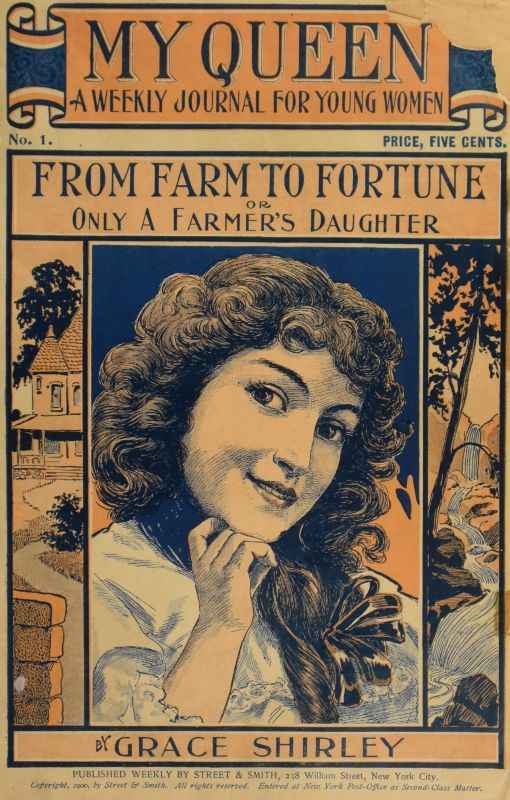
MY QUEEN
CONTAINING THE FAMOUS
Marion Marlowe Stories
Marion Marlowe is a beautiful and ambitious farmer’s daughter, who goes to the great metropolis in search of fame and fortune. One of the most interesting series of stories ever written; each one complete in itself, and detailing an interesting episode in her life.
Published Weekly. Edited by Grace Shirley.
CATALOGUE
| 1—From Farm to Fortune; or, Only a Farmer’s Daughter. | Issued Sept. 27th |
| 2—Marion Marlowe’s Courage; or, A Brave Girl’s Struggle for Life and Honor. | Issued Oct. 4th |
| 3—Marion Marlowe’s True Heart; or, How a Daughter Forgave. | Issued Oct. 11th |
| 4—Marion Marlowe’s Noble Work; or, The Tragedy at the Hospital. | Issued Oct. 18th |
| 5—Marion Marlowe Entrapped; or, The Victim of Professional Jealousy. | Issued Oct. 25th |
| 6—Marion Marlowe’s Peril; or, A Mystery Unveiled. | Issued Nov. 1st |
Thirty-two pages, and beautiful cover in colors. Price, five cents per copy. For sale by all newsdealers.
STREET & SMITH, Publishers,
238 William Street, New York City.
Transcriber’s Notes
Minor punctuation and printer errors repaired.