
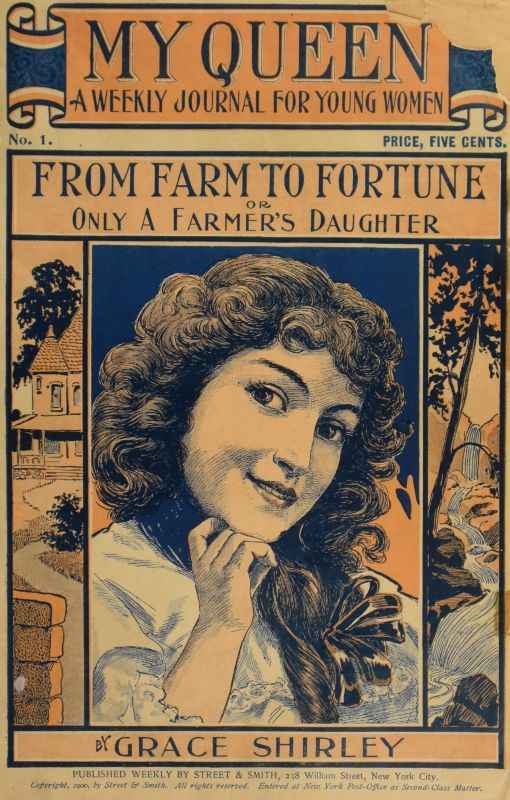
CHAPTER IV.
THE ABDUCTION OF DOLLIE.
Joshua Marlowe’s tanned and bearded face grew pale at his daughter’s words. They rang in his ears for hours after she uttered them. He was not an altogether bad man at heart, but he was narrow-minded and ignorant. First of all, he loved his farm; wife and children came after.
This deal with Silas had been his own secret.
If the marriage was not consummated it would become public property.
But what was a man to do with a daughter like Marion? It was a proposition which would have puzzled a wiser man than Solomon.
Martha Marlowe had always been an obedient wife. It did not occur to the old farmer that Marion might have inherited her obstinacy in some degree from her father.
The day following the tragic scene in the kitchen Marion spent in close companionship with Dollie, but still the girl’s manner baffled and pained her.
“Are you sick, Dollie, or worried?” she asked, over and over, but each time there came the same reply. Her sister declared that she was perfectly happy.
Marion watched her as she went about her daily work. She moved like one in a dream, always smiling, but appealing.
“Poor Dollie! Poor little sister!” Marion whispered, as she tucked her into bed and went out into the air to think a little.
It was a clear moonlight night, and Marion walked farther than she thought, finding herself again on the brow of the hill where she had registered her vow during the glow of sunset.
The distant roar of the express came slowly to her ears, gradually growing louder and louder until with a piercing shriek it prepared to slow down at the little station.
Marion strained her eyes, but not even the light was visible. For some reason or other the blast of the whistle had made her shudder. As the train puffed away she felt curiously depressed. The air seemed more sultry; it was almost choking her.
After the last rumble of the wheels had died away the silence was more intense than ever.
The very landscape itself seemed wrapped in slumber, but the view from the hill was growing more attractive to her eyes, for even the Poor Farm’s ugliness was mellowed by the moonlight.
Suddenly Marion’s sharp eyes detected a moving form. Some one was coming across the fields from the direction of the Pool Farm, but avoiding the open spots on the way in a suspicious manner.
“One of the boys has run away!” exclaimed Marion, in dismay. “Poor fellow! He’ll be caught and soundly whipped to-morrow!”
She watched with eager eyes as the poor boy hurried from lot to lot, keeping as close as possible in the shadow of the trees, but as the moments passed there was no sound from the Poor Farm.
“It’s Bert Jackson!” whispered Marion as the boy came nearer. “Poor Bert! His broken arm is well again, they say! I wonder if he has been flogged that he is running away from his prison!”
She ran down the hill as swiftly as she could.
“Bert! Bert!” she called softly. “It is only I, Marion! What’s the matter, Bert? Has anything serious happened?”
The boy came out of the shadow cautiously and joined her before he answered.
“A great deal has happened,” he said, bitterly; “but I can’t talk about it. I’m just boiling with rage! I’m running away, Marion.”
“Of course,” said Marion, simply, “I knew that when I saw you, but where can you go, Bert? ’Tisn’t safe to risk the station, and besides, there’s no train now ’til to-morrow morning.”
“I know it,” answered Bert quickly. “I’m going to walk to Haysville. It’s only five miles, and there’s a train from there to New York at four in the morning.”
“New York,” echoed Marion, in a frightened whisper. “That’s a big city, Bert! Are you sure you ought to go there?”
“The bigger the better,” said the boy, smiling bitterly. “I’ve got to lose myself for awhile, you know, so that brute cannot find me.”
He nodded toward the Poor Farm and Marion understood the gesture.
“I hate him!” she said, with a stamp of her foot. “I’ve hated him ever since he hit you that day, the monster!”
“Well, he’s hit me a good many times since,” said Bert, slowly. There was a hard ring in his voice that cut the air like a bit of metal.
“Have you any money, Bert?” asked Marion, after a minute.
“Not a cent,” said the boy, doggedly; “but I reckon I can earn some. I’ll have to steal my ride to the city, that’s the part that’s bothering me.”
“No you won’t!” said Marion, stoutly. “I’ve got five dollars, Bert! Quick, come back to the house with me! You’ve got to do it!”
“Oh, I can’t take your money,” began Bert, but Marion stopped him.
“You shall take it. Come!” she said, commandingly, as she caught his arm and almost dragged him toward the farm-house.
Leaving Bert hidden behind a clump of lilacs in the yard, Marion crept stealthily around to a side door and into the house to get her five dollars.
A lamp was burning in the sitting-room, and as Marion passed she glanced up at the clock. She had been out over two hours, while every one else was in bed and sleeping.
Marion found the money in her own chamber, and then tip-toed to Dollie’s. Her anxiety for her sister was making her almost nervous.
She peered into the room, which was clearly lighted by the moon.
Her sister was not there. The bed was rumpled but empty.
Marion flew down the stairs and through the side door to the yard.
“Bert! Bert!” she called softly, but nobody answered.
“Oh, dear, what has happened?” she whispered to herself. “There’s something wrong; it’s in the air! I know it! I feel it!”
A soft step on the walk made her turn expectantly.
Bert Jackson was just behind her. He had been in the kitchen. He explained it by whispering that he had been after a drink of water.
Marion did not give a thought to this fact while her mind was in such a whirl; she only hurried to him quickly and gave him the money.
“Oh, Bert,” she said, in agony. “I can’t find Dollie! She’s gone somewhere, I don’t know where! She was in bed when I left her!”
Bert looked at her in surprise, but there was no time to lose. He must be off at once if he expected to catch the train from Haysville.
“I’ll let you hear from me, Marion, in some way,” he whispered gratefully. “And if anything has happened to Dollie, you can count on me. I’ll never forget you, Marion, you are such a friend to a fellow!”
“Take care of yourself in New York, Bert,” said the girl, tremblingly, “and who knows what may happen in that lovely big city?”
“Good-by, Marion,” answered Bert, “I’m sure something good must happen.”
He darted away and Marion went back to the house. There was not a sign of her sister’s returning.
Suddenly Marion made a discovery that nearly turned her brain. Every article belonging to Dollie’s Sunday wardrobe was missing.
In other words, she had dressed herself in her best when she went, and this fact was significant even to a girl like Marion.
Darting downstairs, the frightened girl awoke her father and mother.
“Dollie has gone! She has run away!” she cried in agony. “Oh, father, come quick and perhaps we can find her!”
But not a trace of Dollie could be found, nor was Mr. Lawson, their boarder, to be found on the premises.
Marion set her teeth hard when she made this discovery.
“They’ve gone together! He’s took her!” whined Mrs. Marlowe. “He’s run off with my darter! the scallywag!” bawled Deacon Marlowe, but Marion only clenched her hands and bit her lips. It was horrible to think of Dollie in the clutches of her insulter.
“What shall you dew, father?” asked Mrs. Marlowe, at last.
“Dunno,” said her husband, a little absently. “I calkerlate, tho’, I’ll jest ler ’er go! ’Pears tew me that’s about what she desarves, the for’ard critter!”
Marion Marlowe’s eyes flashed as she heard this decision, but she did not deign to make any answer.
Going straight to the old chest behind the kitchen door, she opened the lid and began overhauling its contents.
“What dew you want in there?” asked her father, suspiciously.
“I want grandma’s topazes,” she said very firmly. “I am going to sell them to Widow Pearson; you know she always wanted them, and the money will enable me to hunt for Dollie!”
“Yew sha’n’t tech them!” cried both her mother and father at once.
“They are ours—Dollie’s and mine,” said Marion, calmly. “I shall use them as I think best——”
A scream finished the sentence.
“They are gone! The topazes are gone!” she cried, excitedly. “See, here is the chamois bag! It is completely empty!”
She held it up to the flickering light that fell from the tallow candle in her mother’s hand.
A double crime had been committed—abduction and theft. Marion sat down on the chest and burst out crying.
“It’s Dollie that’s done it!” bellowed Deacon Marlowe angrily. “It wasn’t enough fer her tew disgrace herself an’ us by runnin’ away with that air feller, but she must up an’ steal the topazes, the brazen hussy! She shall never darken my door ag’in! The wicked jade! the—the——”
“Hush, father! Don’t you dare to call Dollie names,” cried Marion. “If any one is to blame, it is that black-hearted scoundrel! Oh, I knew he was a villain! Why didn’t I watch him!”
Marion had sprung from the chest and was confronting the old farmer—her eyes scintillating with feeling, and her drawn lips were almost bloodless.
“My sister is innocent! Do you hear me, father! Shame on you for being the first to condemn your own daughter!”
Her voice was so sharp that it seemed to hiss through the air, and the old farmer shrank back as though she had struck him.
Mrs. Marlowe covered her face with her hands and began to sob, but Marion’s eyes were burning—she had done with weeping.
Now was the time to act—to save her sister.
CHAPTER V.
A DARK DEED.
It was almost dark when a long, dust-covered train drew slowly under cover of the Grand Central Depot.
The rush and roar of the big city was at its height and the pushing, jostling crowd of travelers inside the station was noisy, rude and bristling with impatience.
As the long stream of passengers swept through the yawning archway, a young girl stepped aside from the throng and leaned in some bewilderment against the wall of the building.
No one noticed her at first except by a casual glance, for she was poorly dressed and just a bit awkward.
It was plainly evident that she was waiting for some one.
After several minutes had passed she suddenly removed her veil—a hideous green one which had distorted and disguised her features.
After that when any one glanced at her they turned to look again, for such a face as Marion Marlowe’s was not often seen in the big city.
At last the crowd dwindled to only the employees of the station, and a messenger in a red cap stepped up and accosted her civilly:
“Excuse me, miss, but can I be of service to you?” he asked, politely. “You know it’s our business to look after passengers.”
“Thank you,” said Marion, sweetly. “I am waiting for my uncle. I wrote him that I was coming, and I fully expected him to meet me.”
“Ought to be here if he’s coming,” said the man, good-naturedly; “you’ve been waiting nearly an hour. You must be getting pretty weary.”
“I am, and hungry, too,” said Marion, smiling; “but you see I am a country girl, and I don’t know my way. I would certainly get lost if I were to attempt to find him.”
As she spoke she did not notice that a well-dressed man had suddenly drawn near and was listening intently to her remarks without appearing to do so.
“What’s his address?” asked the messenger, in a business-like way.
Marion took a slip of paper from her reticule, and handed it to him.
“Frederic Stanton, The Norwood,” the man read aloud. “That’s a good ways from here. You’d better take a cab.”
“How much will it cost?” asked Marion, anxiously.
The messenger consulted his table of rates for a moment before answering.
“Two dollars,” he said, finally; “but of course your uncle will pay it. Mighty queer of him not to meet you when he knew you were a stranger in the city.”
“But you see he doesn’t know me!” said Marion, quickly. “He married my mother’s sister Susan, but we girls have never seen him. I—I was obliged to come here on business, so I had to write to him. There was no one else, and he wrote back that he would meet me.”
“Perhaps he did and didn’t know you,” said the messenger more cheerfully; “but anyway. I’ll get you a carriage and send you to him.
“Here!” he called to a cabman standing a short distance away. “Take this lady’s trunk check and here’s the address she’s to go to.” He turned away with the air of one who had done his duty.
The man who had been watching Marion moved a little nearer. When the cabman came up he heard the conversation between them.
After the “cabby” had placed Marion in his vehicle, he started back into the depot to find her trunk, and as she leaned from the cab window and looked after him Marion saw that he was joined by the stranger.
She could not hear what they said, but she saw the cabman shake his head repeatedly while the man wrote something on a piece of paper without once stopping talking.
Finally she saw a bill change hands between them. The cabman had evidently relented, for he pocketed not only the money but the paper the stranger had written.
As the young girl was rapidly driven uptown she gazed out of the cab windows and the scenes of the great city made her face pale and flush alternately.
Every little while she felt in her bag for her money—the fifty dollars which her father had at last given her when she denounced him so vigorously for his treatment of Dollie.
“I’ll find her! I’ll find her!” she kept whispering to herself, and then the fearful proportions of the great city staggered her and she would be almost overwhelmed by the enormity of her undertaking.
She took a crumpled paper from her bag and read it over. It was a letter from Bert Jackson written in a cleverly disguised hand, telling her that he had reached New York safely, and giving her the address of a cheap lodging-house that he was making his home for the present.
Marion had answered the letter promptly, giving him the news of Dollie’s disappearance, and she knew full well that Bert would be constantly on the lookout for her sister.
“Poor Bert! I must hunt him up,” she whispered, with a sigh. “He’ll help me find Dollie. He’s really my only friend in all this big city!”
Then another thought entered her mind and would not go away. She was thinking of Bert’s visit to the kitchen that last night and the sudden disappearance of the family jewels.
“He wouldn’t have written if he had been guilty,” she whispered decidedly. “It was Mr. Lawson who stole them! The infamous villain who abducted my sister!”
Marion breathed a sigh of thankfulness that she had never mentioned her suspicions. There would have been people enough ready to accuse him if they had known of his visit to the farmer’s kitchen.
“When one is down, everybody gives him a kick,” she said to herself. “Even poor, dear Dollie was not spared! Oh, how our own neighbors slandered my innocent sister!”
Just as she finished her reflections the cab drew up before a handsome building. Marion saw the words “The Norwood” in gilt letters over the door, and in another instant the cabman was at the window.
“You sit here a minute, miss, till I see if he’s in,” he said, as he moved toward the entrance. He disappeared within the building, leaving Marion trembling with excitement.
“It’s no wonder Aunt Susan’s husband never recognized us,” she whispered bitterly. “He’s rich and lives in luxury, while we are only poor farmers. Oh, I do hope they won’t be ashamed of me just because of my plain clothes.”
She looked down at her homespun dress with a sorrowful sigh. Then her face brightened a little as she reflected that at least it was tidy and very neat fitting. She was not to blame for her personal appearance.
Five, ten minutes elapsed before the cabman reappeared, but when he finally came he had a colored man with him, who promptly lifted Marion’s little trunk to his shoulder.
“This way, miss,” said the negro, and Marion followed happily. Such proof of her uncle’s wealth made her heart beat more rapidly. It did not seem possible that he could refuse the slight request she had come to make of him.
Marion’s eyes grew even brighter as she stepped into the upholstered elevator and was carried to the top floor.
It was the luxury she had dreamed of during her whole life on the farm. She looked upon it as a friend. It neither embarrassed nor startled her.
At the door of a beautifully decorated apartment stood a middle-aged man. Marion had only time to notice that he was bald and dissipated looking when he stepped forward smilingly and introduced himself as her uncle.
“Your aunt is away at present,” he said glibly, “but our housekeeper, Miss Gray, will attend to you, my dear. I am sorry, very sorry, that I missed you at the station.”
“Then you were there!” exclaimed Marion gladly. “Oh! I was sure you would come—but I ought to have taken off my veil before. I had sent you my picture so you would be sure to know me.”
“Well, you are here now, safe and sound,” said the man rather awkwardly; “but, I say, niece, isn’t it right that you should kiss your uncle?”
Marion glanced at him sharply and colored with surprise. There was something in his tone that offended her deeply. Should she refuse? The question flashed through her brain like lightning. She must win his good will in order to help Dollie. With this determination she stepped forward and kissed him on the cheek.
“Oh! not so cold a kiss, my beauty,” said the man with a leer; “a real love kiss for your uncle—like this!” he cried, bending over her.
“Don’t!” cried Marion sharply, springing back as she spoke. “Don’t look at me that way; it is not nice at all, and it makes me feel that you are not really my uncle!”
She stood staring at him with dilated eyes, and a thrill of horror coursed through her veins that she could not account for.
There was a rustle of heavy draperies and a handsomely dressed woman entered.
“Come with me, my dear,” she said shortly. “Your uncle is not exactly himself to-night. You see, he has just dined and has drank a little too heavily.”
Marion drew a long breath as she went immediately toward the woman. She was glad that his action could be accounted for reasonably, but the horror was still there—she could not overcome it.
The man did not make the slightest attempt to detain her, but Marion caught a significant glance which passed between the two, and her heart began beating so fiercely that it almost suffocated her.
As soon as she was alone with the woman whom her uncle had called his housekeeper, she lost no time in telling the whole story of the cause of her journey.
“My poor sister has been abducted by a villain,” she cried in conclusion, “and there is no one but me to rescue her from him! Oh, if I should be too late, I am sure it would kill me!”
CHAPTER VI.
THE PLOT OF A VILLAIN.
Adele Gray listened intently to the country girl’s story, but not so much as by an expression did she show that she sympathized. She was a woman of twenty-five and would have been exceedingly pretty only that her face was marred by lines of sorrow about her mouth and a coldness in her eyes that was very repelling.
Her gown was of rich materials, and she wore a few expensive jewels; further, every movement which she made was indicative of natural refinement.
The coldness of her manner was something which she had acquired—even to an inexperienced girl like Marion it bespoke a morbid condition.
“I have ordered some dinner for you,” she said, quietly, as Marion finished. “Here it is; you must be hungry after your tiresome journey.” She rose to meet the waiter, who was placing a loaded tray upon the table.
Marion ate her dinner in some perplexity, for every few moments Miss Gray excused herself, and pouring a glass of liquor from a decanter on the table, took it in to her host, who still remained in the parlor.
“Does he always drink like that?” Marion ventured to ask timidly; “for if he does, I am sorry for my poor aunt. She must be wretched indeed to have a drunken husband.”
A grim smile stole over the woman’s face.
“He is drinking a little more than usual to-night,” she said softly, “but don’t worry—it won’t hurt him, and you will be that much safer.”
“Why, what do you mean?” asked Marion in alarm.
Miss Gray laughed bitterly.
“Wait until he is dead drunk,” she said, “and perhaps I’ll tell you.”
Marion was almost too astonished to even think, but as yet not a suspicion of the truth had dawned upon her.
That the man in the parlor was her uncle she did not doubt for an instant, but she was filled with disgust at the possession of such a relative.
“Of course he is no blood relation,” she whispered to herself. “And he may not be a bad man when he is in his sober senses. What a pity it is that he should drink!” She drew a long sigh at the conclusion of her reverie.
“There!” said Miss Gray, coming in and depositing an empty glass on the table. “At last he is safe for the night, at least! Now, I am ready, Miss Marlowe, to hear the rest of your story!”
It was the first sign of genuine interest that she had shown, and Marion smiled at her gratefully before continuing.
Miss Gray watched her with the sharp glance of an eagle as she talked. There was an intensity in her gaze that puzzled Marion.
“And you have come to New York alone to search for your sister,” she said finally. “Without funds or friends you have entered upon this mission?”
“I have fifty dollars,” said Marion reluctantly, “and, oh, Miss Gray, do you not think uncle will help me? He must be rich to live in such luxury!”
Before she answered the question the woman rose and looked around, moving every drapery and curtain and looking behind it cautiously. At the last she tiptoed to the front room and listened a minute, when she returned she moved her chair as closely as possible to Marion’s.
“See here, girl, you look brave,” she said, very softly. “Can you face a serious matter without flinching, do you think? I have something to tell you, but you must promise to be perfectly calm when you hear it.”
As she spoke Marion noticed that her hands were trembling; she clinched them tightly, as though she resented this trace of weakness.
“I promise,” said Marion, staring wide-eyed at the woman. “I am not a child, Miss Gray—you must see that you can trust me.”
“I see that I can,” was the quiet answer, then the woman leaned forward and whispered rapidly:
“You have made a terrible mistake, my child, but you are not to blame. You are in the wrong place—your host is not your uncle!”
Marion caught her breath sharply but did not utter a sound.
“Who is he, then?” she said softly, clasping her hands tightly together.
The woman shrugged her shoulders and glanced quickly around the room.
“Never mind who he is,” she said, almost roughly. “He is not your uncle, and he is not married. Now tell me, who is your uncle, and how did you come here?”
Marion replied with eager promptness:
“My uncle is Frederic Stanton, and he lives at ‘The Norwood.’ I wrote him at that address and he answered my letter. He married my mother’s sister, and he is very rich, so rich that he has never recognized any of his wife’s relatives in the country. When Dollie was abducted my father disowned her and I was obliged to write to uncle, then I came to him,” she finished simply.
“There are a dozen apartment houses in the city by that name,” said the woman thoughtfully. “He probably lives at the biggest one, uptown on Fifth avenue.”
“I don’t know,” said Marion anxiously. “I only knew ‘The Norwood.’ You see I did not even think that there might be two of them.”
“Well, he should have thought and told you,” said the woman, “or the cabman should have as soon as you told him.”
Marion gave a quick exclamation, which was as quickly smothered. She had thought of something that might explain it.
“There was a man watching me in the station while I was waiting,” she said slowly. “He heard uncle’s name and the address, I am sure, and afterward I saw him give the cabman some money and a scrap of paper. Do you suppose it is possible——”
Miss Gray interrupted her:
“Is that the piece of paper?” she asked, drawing a scrap from her pocket.
Marion took it and read these astonishing words:
“Dear Ted: Here’s a treasure, right fresh from the country. Name, Marion Marlowe, looking for her uncle, Frederic Stanton at ‘The Norwood.’ Married her mother’s sister, but she has never seen him. Expected him to meet her, but, luckily for you, he didn’t. I’ll be around to-night; meanwhile I wish you luck. Don’t ever say again that I’m not a judge of beauty.”
The note was not signed, and Marion looked at the woman inquiringly.
“That was written by the blackest villain in New York,” said Miss Gray, her voice vibrating strangely, “and it is not his first effort in that direction either.”
Marion rose from her chair and confronted the woman. She understood at last the full horror of her position.
“I am the victim of a plot,” she said at last. “Oh, my dear Miss Gray, how can I thank you for telling me?”
For once the woman smiled; her features had softened amazingly. Marion’s expressions of gratitude seemed thawing her coldness.
“But can I not protect myself against them?” asked Marion, after a minute. “Can’t I have them arrested by a policeman or something?”
Miss Gray smiled at the country girl’s ignorance of such matters.
“No use,” she said shortly. “What could you do? You haven’t an atom of proof that you did not come here freely.”
“But that bit of paper?” cried Marion, pointing to the note that Miss Gray was holding between her fingers.
In the coolest possible manner the woman tore it into atoms.
“Would mean nothing at all, I can assure you,” she said quickly; “for in the first place, I have destroyed it.”
She rose and tossed the fragments into the grate as she spoke. Marion stared at her helplessly; she was too bewildered to answer.
When Miss Gray came back her eyes were shining dangerously.
“They have gone a little too far in their dastardly deeds this time,” she said in a whisper. “But have I the courage to thwart their plottings?”
She began pacing the floor as she asked the question.
Marion watched her for a moment in sympathetic silence. The woman’s agony was so genuine that it could not be mistaken.
“Oh, I shall despise myself utterly if I do not save her!” she muttered, “for the others it did not matter, but this poor child is innocent!”
Marion sprang to her side as she comprehended her meaning.
“You surely do not mean that he would harm me!” she whispered sharply. “Never! Never! Miss Gray, the thing is outrageous! Come! Let us leave this place at once,” she urged. “Surely you can get a position elsewhere! You need not work for such a monster!”
The woman hesitated a moment and Marion doubled her entreaties.
“Come, Miss Gray, put your hat on and we will leave this place at once! We will go somewhere, anywhere, so that we escape from that creature!”
“If he finds me I am lost!” muttered the woman slowly, then she raised her head defiantly, as she added, “but I will risk it!”
“But surely he is not your jailer,” cried Marion in surprise.
“He is worse than that,” was the woman’s answer. “He has wrecked my life, and made me his tool, but it shall end to-night, yes, by your purity, I swear it!”
There was a sudden fierceness in her speech that startled Marion. She resembled nothing so much as a creature at bay, a poor, wounded creature who had turned upon her persecutors and was thirsting for vengeance.
A church clock struck ten as they left the building, the country girl, as innocent as an angel, and the woman who admitted that her life was clouded and blackened.
“Where shall we go?” asked Marion as they reached the curb. The lights of the big city were already bewildering her.
A cab rattled up to the entrance as she spoke and a man sprang out and started into the building.
Miss Gray caught Marion by the arm and pulled her into the shadow.
“That is Emile Vorse—your pseudo uncle’s boon companion,” she whispered savagely.
“It is the man who watched me at the depot,” answered Marion, as she gave him a sharp glance. “Oh, I never knew before that such creatures existed!”
“Come,” said her companion, as she hurried down the street. “I must get as far away as possible now that Emile has come. He will arouse his friend, and that means that my hours are numbered.”
“What injury could they do you?” whispered Marion as they hurried along.
“They could tell the truth about me and make me lose my soul!” was the woman’s strange answer. “One more goad from that villain and I shall commit murder!”
Marion shuddered violently, but there was nothing to be said. Her companion had hailed a cab and was helping her into it.
CHAPTER VII.
ON THE TRACK OF THE ABDUCTOR.
A half hour later Miss Gray and Marion alighted before a small, third rate hotel and Miss Gray paid the cabman with a bill which seemed to be all the money she had in her purse.
Almost as if in a dream Marion followed her into the office and up the stairs to a room on the top floor.
“We’ll stay here to-night,” said Miss Gray, as she locked the door carefully, “and to-morrow you shall go to your real uncle, Miss Marlowe. Just remember that ‘The Norwood’ is on Fifth avenue; any officer will direct you if I should not be able to go with you.”
“But, dear Miss Gray—you are in trouble yourself, I am sure of it,” said Marion eagerly. “Can’t I help you in any way? Just think how much I owe you!”
“You can help me, yes, but I will not tell you how, now,” was the woman’s answer; “neither will I tell you my story. It is not fit for your ears. Some other time, when I have vindicated myself perhaps—but come—let us retire, for you are weary and sleepy.”
Marion went to bed gratefully, for she was almost worn out with excitement and fatigue. In spite of her anxiety and bewilderment she soon fell asleep and slept soundly.
When she awoke next morning the sun was shining brightly. She raised herself from the pillow only to find that Miss Gray had deserted her.
“Gone! And I am all alone!”
Marion whispered the words as she sprang out of bed. After a hasty glance about the room she was more astonished than ever.
Not only had her companion left her alone in the hotel, but she had taken every article of Marion’s homely wardrobe, leaving her own expensive garments in exchange for the poor ones.
Marion sat down in amazement to think over the situation. Suddenly she remembered her money and sprang up to look for her reticule.
She was horror struck when she found that gone also. In its place was Miss Gray’s expensive pocket-book. She opened it quickly. It contained the contents of her bag minus forty dollars. Marion looked at the lone five-dollar bill in despair.
“Well, if this doesn’t beat all!” she said aloud. Then in spite of her dismay she burst out laughing, and the result was wonderful—her courage came back to her.
“I guess I have the best of the bargain after all,” she went on as she looked at the clothing, “but it will never do for me to go to see uncle in that dress! He would be suspicious of me right away! As like as not he would think I had stolen it.”
She mused a little longer and then began to dress. It was evident that she must wear Miss Gray’s gown for awhile, at least, and at last she became curious to see how she would look in it.
“It fits as if it was made for me,” she whispered as she tripped over to the mirror. “We must be nearly the same size, for even her shoes are just my number.”
She glanced down at her little foot with a feeling of pride—it was the first time she had ever worn any shoes but “cowhides.”
When the dainty, graceful girl was fully arrayed in the stylish garments she could not help flushing with pride at her pretty reflection. A beautifully made suit of rich, blue crepon, a dainty hat, gloves, veil and tan shoes made up a far prettier costume than she had ever hoped to wear, and surely she was justified in taking the good of it, for it was no fault of hers that Miss Gray preferred homespun.
As soon as Marion was dressed she went directly to the office, hoping to learn something of her companion from the clerk behind the desk, but on her guard not to say anything that might sound as if she mistrusted her.
The man behind the desk gave her a glance of admiration, but it was plain that he saw nothing unusual in her appearance.
“She went out about daylight,” he said, in answer to her question. “She paid for the room. Do you wish to keep it any longer?”
“I hardly know yet,” answered Marion, trying not to appear green, “I’ll just have some breakfast, I think, and then I have an errand to do.”
“Oh, well, it will be here when you want it,” said the clerk good-naturedly, “and, anyway, it is yours until eleven o’clock to-night, so you’ve got all day to make up your mind. The dining-room is right in here, if you are looking for breakfast.”
Marion thanked him sweetly, and walked to a table with as much grace as a queen, although the long skirts were clumsy and made her feel a little awkward.
There were a dozen or more people just taking breakfast, and they all stared at her in such open admiration that the young girl could feel herself blushing hotly.
When she paid her bill she was glad to find a young woman at the desk. She looked pale and worn, but her face was not unkindly.
“Do you know where I could find a real cheap boarding-house, miss?” she asked timidly.
The young woman looked her over critically before she answered.
“Sure! I know dozens of ’em,” was her rather curt reply. “But, Gee! you don’t want a very cheap one, I guess! You don’t look as if you had to count your pennies!”
“But I do,” said Marion, smiling, as she comprehended the look: “and I’d be very much obliged if you could give me some addresses.”
The cashier scribbled two or three on a piece of paper. “Here, I guess these are about the thing you want,” she said, handing it to Marion.
“I’ll bet she has run away from home,” she said to a waiter, as Marion thanked her and moved away. “She looks like a rich girl all right, but it’s ten to one she’s had a scrap with her folks! She’ll get sick of it, I’m thinking, especially if she goes to boarding.”
When Marion reached the sidewalk she opened Bert’s letter and read it again. It was a Bowery lodging-house that he was stopping at when he wrote, and she decided to hunt him up and consult with him before going to her uncle.
“He may be able to advise me,” she thought, “and I need a friend now if I ever did, for I am alone in this big city with only five dollars! Oh, shall I ever be able to find my poor sister?”
As she walked slowly along the street she studied the street signs carefully, and more than once she saw both women and men half stop to stare at her.
Finally she saw a big man in a blue uniform, and knowing that he must be a policeman she went up boldly and asked him to direct her to the lodging-house.
“Is there some one there you know?” asked the officer kindly, “’cause if there isn’t you’d better keep out of that neighborhood. I can see you’re a stranger, although you don’t look like a country girl by a jug-full!”
“Well, I am nothing else,” answered Marion, smiling a little. “But I am not afraid to go to the lodging-house if you will tell me the way. I can take care of myself, I am sure, and there is a boy there that I must see, sir.”
“All right, then,” said the officer as she finished speaking. “Just walk over two blocks and take a Third avenue car. Tell the conductor to put you off at the number you’ve got. I wouldn’t try to walk there—you’re apt to get tangled.”
Marion thanked him and hurried on, her cheeks tingling with excitement. It was lovely to be in a big city at last. To be actually experiencing one of her daisy chain wishes, but the next moment she thought of Dollie, and all the pleasure vanished.
There was no car in sight so Marion walked on. She was thinking deeply of Dollie now, and was almost crying.
Suddenly a man brushed past her and leered into her face. Marion turned her head instantly and stepped up as if to glance into a nearby window. The man walked on, leaving Marion staring absently at an array of jewelry, seemingly odds and ends, which were displayed in the window with price marks attached to them.
Slowly, and almost without realizing it Marion’s gaze concentrated itself upon a pair of curious shaped earrings. They were golden brown topazes in quaint, old fashioned settings. Then with a little scream she leaned forward until her head nearly touched the pane. They were her grandmother’s topazes—she recognized them instantly.