
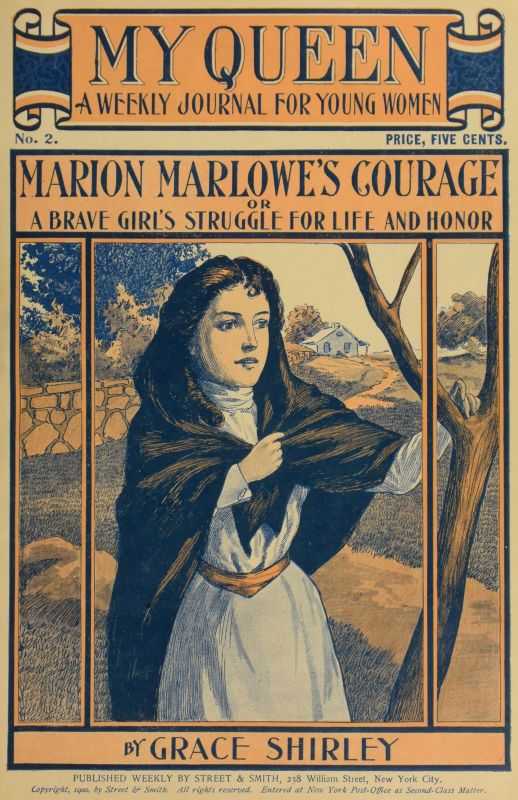
CHAPTER IV.
SILAS JOHNSON’S PROPOSAL.
Ten minutes later, when Dollie Marlowe emerged from the private door, her face was flushed and her eyes were blazing.
“The whole thing was a hoax!” she whispered over and over. “That man lured us all there for no purpose but to insult us.”
“I guess that is right,” said a voice at Dollie’s side.
The young girl looked around quickly and recognized the consumptive.
“I got tired of waiting,” went on the girl, “besides, I had a presentiment that the thing was all a hoax, but just for the joke of the thing, do tell me what he said to you.”
There was a tone in her voice that awakened Dollie’s sympathy. It was plain that the girl was both discouraged and disappointed.
“He told me he would make an actress of me, put me on the stage, make me famous, and all that, but he expected me to pay him for my tuition. The idiot! As if I had any money to spend that way,” cried Dollie, indignantly.
“Is that all he said?” asked the other girl, slyly. “I don’t believe you’d be so mad if that had been his only proposition.”
Dollie’s anger was so violent that she was glad to relieve it, and the young girl looked so sympathetic that she didn’t mind telling her.
“He told me I would have to wear tights,” she stammered, furiously, “and, oh, he said a lot more, but I cannot repeat it.”
The sick girl burst into a roar of bitter laughter.
“Same old gag,” she said, shortly. “Well, I’m glad I didn’t tarry. No danger of his interesting himself in my direction.”
“It was disgusting,” said Dollie, who could not understand her laughter.
“I’d have given a dollar to have heard you go for him,” said the girl, looking at her admiringly.
“I didn’t dare to say very much,” said Dollie, more quietly, “I remembered what you said about his having us arrested.”
“You learn quickly,” said the companion, “do you live in New York?”
“I am here with my sister, and we have no money,” said Dollie, frankly. “We are trying to get work, that is why I came here this morning.”
“Haven’t you any friends who can help you?” asked the girl, with interest.
“Not a soul,” said Dollie, her lips quivering a little. “I don’t know what we will do. We can’t live without money.”
They walked on together for a moment in silence, then the sick girl spoke in a cautious manner.
“Mr. Max, that man you just left, has money, I suppose, and he looks like a man who would spend it freely.”
“Well, what of it?” asked Dollie, turning to stare a little.
“I was wondering whether you were wise; you are without friends or money. Don’t you think his proposition was worth considering?”
“What! pay him for teaching me to act!” cried Dollie.
“No, I didn’t mean that,” said the sick girl, slowly, “but——”
“You needn’t go on. I understand you,” said Dollie, her lips curling a little. “Do you think because I am poor I would stoop to dishonor?”
The girl shrugged her shoulders and turned away.
“When you have worn yourself out, soul and body, as I have, you will understand better,” she said wearily. “I have lived an honest life, but what thanks have I for it?”
“You have your own self-respect,” cried Dollie, taking a step toward her.
“Poor food for a starved stomach,” said the girl, half smiling, “but, good-by and good luck, my little rustic.”
Dollie stood still for a moment and looked after the girl. The tears had sprung to her eyes, and were trembling on her lashes.
“Poor soul,” she whispered, with a heavy sigh. “Poor, weary girl. Oh, how I pity her. Then there is starvation and want in this great city of plenty.”
She walked on after this, thinking deeply as she went, but never quite forgetting that she must be alert and watchful.
For although Professor Dabroski was safely in jail, there were times when Dollie almost trembled with dread. It seemed as if his fatal spell was still haunting her senses.
As she turned into the block that led to their furnished room, she came suddenly in sight of a familiar figure, which made her stand for a moment as if rooted to the spot, while the blood coursed through her veins in a perfect torrent.
A young man, with a gaunt, angular figure, dressed in butternut colored garments, a bandana handkerchief around his neck, and a wide brimmed straw hat upon his head, was standing about half way down the block, staring up at the houses in a gawkified manner. Dollie knew him at once. It was Silas Johnson, their next door neighbor at home in the country.
This man, was the husband whom her father had chosen for her—the man whom she had solemnly vowed she would never marry.
What was he doing in New York?
Dollie asked herself the question. It was not possible that Silas should meet her now after her fearful experience with Professor Dabroski. Before she had fairly recovered from her surprise, Silas Johnson saw her and came striding along the pavement, mopping his forehead vigorously with another bandana.
“So here’s where ye be!” was his extraordinary greeting. “I told yer folkes I’d find ye an’ tell ’em how ye wuz livin’.”
“Are they so anxious about us?” asked Dollie, faintly. “I should have thought if they were anxious they might have answered our letters, for both Marion and I have written to mother.”
Silas Johnson eyed her curiously before he answered, much as if she were a stranger instead of the girl he had known from childhood.
“Waal, yew kain’t blame ’em fer not bein’ over pertik’lar about hearin,’” he said, bluntly. “When a gal’s run away an’ disgraced her fam’ly it’s ag’in natur not ter resent it a leetle.”
Dollie Marlowe blushed to the roots of her hair.
“Is that what you came to say to me, Sile?” she asked, hotly. “If it is, I’ll go on, for I’m tired and hungry.”
“No, tain’t all,” said Silas, with a peculiar leer. “I’ve got sumthin’ else tew say tew ye, but I calkulate the street is no place tew say it.”
“It will have to do, Silas,” said Dollie, decidedly, “for Marion is not at home, and I cannot ask you in. There is no one to hear; quick, what else have you to say to me?”
“Waal, ef I must, I must,” was the drawling answer, “tho’ tain’t exac’ly the place fer a man ter pop ther question.”
“What do you mean, Silas?” asked Dollie, sharply.
“Oh, I knew yew’d be surprised,” said the fellow, arrogantly. “’Tain’t every respecterble man thet ud want ye, Dollie, but I’m willin’ ter take ye an’ dew what’s right by ye. Yew see, I’ve got a five hundred dollar mor’gige on yer father’s farm that’ll fall due in Janooary, an’ if yew’ll marry me, Dollie, I’ll give him ther paper; but ef yew won’t——”
“What, then?” asked Dollie, trembling.
“Then I’ll foreclose on him an’ turn em out,” was the decided answer. “It’s yew or the money, an’ the deacon ain’t got no money.”
CHAPTER V.
A SAD PARTING OF FRIENDS.
When Dollie burst into the little room she was breathless with excitement and indignation. Much to her surprise, she found Marion there before her.
“Oh, sister!” she blurted out, “Silas Johnson is here! And what do you think! he still wants me to marry him!”
Marion stared at her in genuine astonishment. “What! Silas here in the city, and you have seen him, Dollie?”
“I met him in this very block just as I was coming home,” said Dollie, pulling off her gloves, “and, oh, of all the awkward-looking gawks! I never realized before that Silas was so homely!”
“That is because you had never seen stylish men before you came to New York,” said Marion, quickly; “I find myself comparing every one I ever met with Mr. Ray—city men are so handsome—and then they dress so much better.”
“Silas had on a flannel shirt and cowhide shoes,” went on Dollie, laughing, “and I never before believed that they could look so ugly! But listen, Marion, he says he has a mortgage for five hundred dollars on father’s farm, but that as he thinks I could save him that amount in time he is willing to let it go if I will marry him!”
“He expects you to earn it weeding gardens, milking cows and churning butter, I suppose,” said Marion scornfully.
“But, sister, just think! Where will father get the money? He can never, never pay Sile such an amount, and he’ll turn them out if he doesn’t get the money!”
“Turn them out of the old homestead!” exclaimed Marion, turning pale. “The thing is outrageous! He must never do it! Never!”
“Then I’ll have to marry him,” said Dollie, dolefully. “There’s no other way to settle the matter.”
“I’m not so sure,” said her sister, shutting her white teeth together. “There are nearly three months before the mortgage is due. I must think a little, Dollie; but hush! Here comes Miss Allyn!”
Miss Allyn came in, carrying the typewriter in her arms, and for the next hour the girls almost forgot their troubles.
“I’ll learn just as fast as I can,” said Dollie, clapping her hands.
“And I’ll do my best to get you a position,” said Miss Allyn, kindly, “but I warn you it will be with some old codger who has a red-headed wife to look after him! You shall not have any champagne luncheons and tete-a-tetes with your employer if I can prevent it!”
“What do you mean?” asked both girls together.
“Just this,” said Miss Allyn, with her characteristic brevity—“a pretty typewriter is often looked upon as lawful prey by some men who employ one in their private office. I know some typewriter girls who tell me that they go to business in a regular mask—don’t dare wink or smile for fear they’ll be tangled up in a divorce suit. Of course it is not so in all cases, but a working girl must keep her eyes open in a big city. There’s more temptation to the square inch than you get in ten miles in the country. Look out, girls! Take my advice, wear green veils over those pretty faces.”
“Thank you for your good advice,” said Marion, sadly; “we have already learned that there are many pitfalls in the city, but with a friend like you we are forewarned, Miss Allyn. Oh, how fortunate we are to have won your sympathy.”
“Nonsense!” said Miss Allyn, as she started for the door. “I’m only a poor reporter doing space work for my living. It’s not in my power to be a friend to any one except to give them a few points on the things I am most familiar with, and they are—the ways of the world and the wiles of the wicked.”
She went out laughing, and just then there came a peal at the bell. Marion ran out and looked over the banisters, and then ran down to greet Mr. Ray and his sister.
“Oh, I am so glad to see you!” she cried as she hugged and kissed Miss Ray—“I was so afraid you would go away without coming to see me.”
Mr. Ray shook hands with Dollie and then turned to Marion. He seemed older and sadder than she had ever seen him. Not much like the gay-hearted young man who had befriended her so bravely on that eventful day when she rescued poor Dollie.
“We are going abroad for a time,” he said, simply. “Now that father is dead I think it is best. A year or two abroad, and, perhaps, some of our griefs will be forgotten.”
As Marion glanced at their robes of mourning she could hardly keep back the tears. These were her only friends in the big city, and now she was going to lose them.
“I think you are wise,” she managed to say, at last, “poor Miss Ray will be benefited greatly by the change. It must be dreadful for her here, when every one knows of her wretched experience.”
“It is indeed,” was the answer, as Mr. Ray glanced lovingly at his sister. Miss Ray was talking with Dollie and had not heard their words, but she came over and joined them before Marion could answer.
“My poor sister Ada is heartbroken,” she said, sadly. “Just think! She has lost her lover, and all through me. I feel terribly about it, and yet I think she is lucky.”
“She is indeed!” said her brother, promptly, “I can’t imagine a fellow being such a cad as to throw over a sweet girl just because of something unpleasant in the life of her sister.”
He looked at Marion as he spoke, and as their eyes met she blushed charmingly. Such eloquent glances as Mr. Ray’s needed no interpreter of their meaning.
“Oh! I despised him as soon as I read of it!” broke in Dollie, impulsively. “She is well rid of him, poor girl. I hope she will get over it quickly.”
“If a brother’s love will help her to forget him, he will not be remembered long,” said Mr. Ray, nobly.
Marion gave him a glance that set his blood to tingling. He was radiantly happy to see how well she understood him.
The girls all wept as they said good-by, and even the young man’s eyes looked suspiciously moist as he took leave of the two sisters.
Miss Ray slipped something into Dollie’s hand at the last. Dollie tried to remonstrate, but was checked emphatically.
“A reminder of my gratitude to your sister,” Miss Ray whispered; “but for her I would still be living a life of disgrace and torture. She saved me. I can never forget it!”
“Good-by, Miss Marlowe; Marion!” whispered Mr. Ray very gently. “You shall hear from us after, and some day I shall be back, then——”
He pressed her hand in both his own, while Marion’s eyes fell beneath the glance that was so ardent and so tender.
“Good-by, Marion. God bless you,” whispered Miss Ray, taking Marion in her arms.
“Good-by, dear brave girl, and may the angels guard you. They ought to, my dear, for you are one of their number.”
CHAPTER VI.
MARION’S CLEVER TRICK.
“Just see what she gave me!” said Dollie, after their guests had gone and the girls had wiped their eyes and recovered a little from the parting. She opened her hand and showed a fifty dollar bill. For a moment Marion’s face flushed, and she was annoyed and indignant.
“You shouldn’t have taken it, Dollie,” she said, sharply.
Dollie hurriedly repeated Miss Ray’s words when she offered it, and Marion’s flush of resentment faded in an instant.
“The dear girl! It was lovely of her!” she said, very softly. “If that was the spirit of her offering, I accept it gratefully.”
The girls ate their supper with saddened hearts. They were sorrowing for Miss Ray and her noble brother, as well as worrying over the fate which must soon overtake their own father and mother.
“I can’t bear to think of their losing the farm,” Marion said over and over, with tears in her eyes. “Mother is such a weak, helpless woman and father is so old. Oh! it makes my blood boil to think of it, and yet I cannot help it!”
“Father can hardly expect us to help him,” said Dollie, sadly. “He has never written us once, nor will he allow mother to do so. If he were a little less hard-hearted I think I should feel worse about it, Marion.”
“We must not think of that,” said Marion, decidedly. “They are our parents, dear; we must try to help them.”
“But how?” asked Dollie, in great perplexity.
Marion’s eyes grew thoughtful as she answered slowly:
“I don’t know how exactly, but it must be done! I must help my father pay off that mortgage!”
“This money will only last about a month,” said Dollie, who was doing a little figuring, “but Oh, Marion, I am sure we shall have work before then! But tell me, what did you do to-day? I have had no time to ask you before.”
“I went to five places,” said Marion, promptly. “I offered my services as laundress, chambermaid and waitress; then I tried an employment bureau, which was a regular fraud, by the way, and two applications in dry goods stores completed my day’s work, Dollie.”
“Poor Marion! You must be tired and discouraged!” said Dollie, impulsively.
“Tired of fraud and humbug!” was Marion’s quick answer. “Sick and tired of sham, hypocrisy and deceit!” she said again. “Why, do you know, Dollie; two of those advertisements that I answered were merely catch traps to get your money! Instead of having positions to offer, they merely tell you they can get you one provided you pay them for their trouble!”
Dollie burst out laughing as Marion finished, but the laugh was unnatural; there was not an atom of mirth in it.
“I had a little experience of my own to-day,” she said, hysterically. “Oh, Marion, it was awful! I don’t know why I laugh! Sometimes I can’t help it though, for things in New York are so miserably funny!”
“Better laugh than cry! But tell me what you did,” said Marion, quickly. “Oh, Dollie, I hope you didn’t get into any serious trouble.”
“Well, if I did, I got out of it,” said Dollie, sobering a little. Then she told her sister the story of her visit to the private office. Just as she was finishing the door bell rang.
Marion lighted the gas in their room and then went to the stairs to listen.
“It’s Bert Jackson! Oh, Bert, come right up!” she cried, gayly. “I’m delighted to see you, but for goodness sake what is the matter?”
She had just caught sight of the boy’s white face, and without another word she drew him into the room and closed the door behind them.
“They’re after me—the Poor Farm people!” whispered Bert, more in anger than in fright. “Matt Jenkins has heard where I am and he’s seen my employer. I had to run away, and just when I had a nice position!”
“It’s just too mean for anything!” cried Dollie, angrily. “Matt Jenkins is a brute! You shall not go back to him!”
“I’ll never forget how he struck you once when your arm was broken,” said Marion, slowly. “He was not fit to be keeper of the Poor Farm—he ought to be in prison!”
“Well, I’ll have to go back to him if they catch me,” muttered Bert, “and he’ll flog me every day for two years, I suppose. You know I was to stay there until I was eighteen—so much for being an orphan! Any one would think I was a criminal!”
Marion’s mouth was curving in hard lines now, very much as it had curved when she was planning the search for her sister. She pondered intently a moment or two, then her sister knew by her voice that she had thought out a solution.
“Is Matt here looking for you, Bert?” she asked, very softly.
“I think so,” said the boy, “and I saw Silas Johnson here, too. One of the boys at the office said a man had been there looking for me. He described him accurately. I am sure it was Matt Jenkins.”
“What did your employer do?” asked Marion again.
Bert’s eyes snapped with pleasure as he drew a ten dollar bill from his pocket.
“He gave me this and told me I’d be safer somewhere else,” he answered, smiling. “Oh, it was lucky I was out when Matt Jenkins called on him!”
“He gave you good advice,” said Marion, “and I repeat it. Bert; you’d be safer somewhere else than in our room to-night, for Silas Johnson knows we live here, and he’s likely to come here. You must go away quick, but, where, is the question.”
“I won’t leave New York!” said Bert, determinedly.
“You won’t have to,” said Marion. “You can easily hide in this big city. You must change your name and go to some lodging house for the present, then you must look for another job while you have the ten dollars, and Dollie and I will find some way to come and see you.”
“I know a place where I can go,” said Bert. “It’s way over to the East Side, and I can get room and board for three dollars.”
“Then go quickly,” said Marion, “but leave the address, and remember your name is to be Bert Wilson.”
“I’ll remember,” said Bert, grinning, as he scribbled the address.
He started down the stairs saying good-by to the girls cheerily.
In two minutes he was back, his eyes flashing with anger.
“They are out there, Matt Jenkins and Sile,” he whispered, “and they are coming in here just as sure as shooting!”
“Quick! Get into these, Bert!” cried Marion, sharply.
She sprang to the door and turned the key, then began pulling some clothing out of a valise in the corner.
“It’s the suit Miss Ray gave me the first night I met her,” she whispered. “The skirt is so long that it will hide your feet and I’ve got a thick veil that will conceal your features.”
Bert pulled off his jacket as quick as a flash. In two minutes he was dressed in Miss Ray’s stylish garments.
“They are down at the door talking to the landlady,” whispered Dollie, who was listening at the key-hole. “Oh, I am sure they are coming up. Is he ready, Marion?”
Marion grabbed Bert’s jacket and cap and tucked them under the mattress, then she gave him some old gloves and drew his veil a little tighter.
“Take short steps and hold your dress up, just a little,” she whispered, “now, then, sum up all your courage and pass them without a look. I’ll detain them long enough to give you the start of them.”
Marion opened the door safely, and Bert slipped out into the hall. There were two men and the landlady on the flight before him.
“He’d come here, sure, if the gals air here,” said the well known voice of Matt Jenkins, the keeper of the Poor Farm.
“Waal, the gals air here all right,” was Silas Johnson’s answer, “an’ I allow they know where Bert is right enough. The question is, kin we make ’em tell us?”
“And what will you do with the boy if you catch him?” asked the landlady, anxiously.
“Take him back tew the Poor Farm, where he belongs,” said Matt Jenkins. “An’ yew bet I’ll lick him good fer puttin’ me tew all this trouble.”
“Oh, you will, will you?” thought Bert, as he started down the stairs.
Marion walked out to the banisters and leaned over calmly.
“Some one looking for me, Mrs. Dean?” she called out, pleasantly. “If it is, they can come right up; my sister and I will be glad to see them.”
The landlady turned back with a sigh of relief. She was stout and heavy and climbing stairs was not to her fancy.
“I hain’t so sure about yew’r bein’ glad tew see us, Marion Marlowe,” said Matt Jenkins, dryly.
As he spoke he looked up at the girl, and at that moment Bert passed him.
“You are mistaken, Mr. Jenkins, I shall be delighted,” said Marion, smiling. “And Silas, too, why, this is really a great pleasure.”
“Then yew’r sentiments haz changed sense I saw yew last,” said Matt Jenkins, roaring. “Yew must ter larn’t manners sense yew come tew ther city.”
“Oh, I’ve learned lots of things besides manners,” said Marion, gayly, “but walk right in to our humble room. I assure you I am really and truly very glad to see you.”
Dollie got up smilingly, and greeted the two.
“Our room is not very large,” said Marion, politely, “but you can have the chair, and I will sit on the bed.”
She winked at Dollie as she seated herself firmly.
If they found Bert’s cap and jacket it would be with some difficulty.
CHAPTER VII.
MARION PROVES HERSELF A HEROINE.
“An hour and a half! Well, that isn’t so bad. Bert must have had time to get a boarding place by this time.”
Marion Marlowe glanced up at the tiny nickel clock as she spoke, and both she and her sister laughed a little nervously.
“I never talked to Silas so much in all my life,” said Dollie, merrily. “But I kept thinking of Bert, and just went on talking and talking.”
“And how polite I was to that brute, Matt Jenkins,” laughed Marion. “Oh, well, we had to do it to save poor Bert. He’s well worth the sacrifice we made for him, Dollie.”
“I should say so,” said Dollie, “but it is awfully late, Marion, and I’m tired and sleepy.”
“It seems to me I smell smoke,” was Marion’s only answer.
She went to the door and opened it cautiously.
Slowly a great volume of smoke came rolling up the stairway.
“The house is on fire! I am sure of it!” cried Marion, sharply. “Oh, Dollie, I wonder if Miss Allyn is in. Quick! Get your hat on dear, while I run and warn her.”
Marion was up the stairs like a flash of lightning, and at the same moment there came cries and shrieks from every floor and landing.
“The house is on fire!” echoed from every side, and in an instant the halls were crowded with half-dressed men and women.
Great puffs of smoke came from all directions, and soon the frightened people could hear the woodwork snapping and crackling.
There were shrieks and orders, some hysterical and some calm, but in the excitement no one seemed to know just what to do or which way to go to secure their safety.
Marion pounded vigorously on Miss Allyn’s door, but could get no response, although she felt certain that her friend was within.
The smoke choked and stifled her, but she continued her frantic efforts to arouse her friend, although all the other roomers had disappeared in the darkness.
Suddenly new sounds fell distinctly upon her ear. The firemen had arrived; she could hear them racing up the stairs and shouting.
Just as her strength seemed giving out Miss Allyn opened her door. There was a gust of wind from the open window, then a sudden burst of flame in the hallway.
Marion staggered into the room and slammed the door behind her. In that awful moment she thought suddenly of Dollie.
The house was old and burned as rapidly as tinder. In spite of the furious streams of water that hissed and spurted upon it the flames ate their way ravenously to the very roof, flashing their long tongues of flame out of every window and thrilling with sensations of horror the thousands of spectators who had gathered in the streets.
One by one the roomers had been hurried out by the firemen, one of them carrying Dollie in his arms down the stairs and depositing her safely on the pavement.
“My sister! Oh, my sister!” shrieked Dollie, shrilly. “Oh, save my sister Marion and dear Miss Allyn!”
“Where are they?” asked a fireman who had heard her cry.
“Third floor, back,” answered Dollie in an agonized whisper.
The fireman shook his head.
“No use,” he muttered sadly. “The rear is gutted. If it was front we might save them.”
Suddenly a cry of terror went up from the crowd, then followed shouts of warning from a thousand throats, which were unintelligible to poor frightened Dollie.
The fireman looked up from the hose he was tending.
“My God, don’t jump!” he shouted, hoarsely. Dollie looked up and saw her sister standing on the sill of a third story window, her girlish form encircled by wreaths of smoke and long tongues of flame lapping the wall until they almost reached her.
Spell-bound with horror, Dollie stood and gazed as a long ladder was run up by an agile fireman.
The ladder was too short and another was handed up; Dollie meanwhile standing motionless as the crowd shouted about her.
“Quick, now! Jump!” ordered the fireman who had braced himself on the top of the ladder. “Jump right into my arms. Don’t be afraid. I’ll catch you!”
“Wait!” cried Marion, in clear, ringing tones.
The monster crowd stood silent—holding its breath in wonder.
Slowly and carefully Marion bent and reached into the room, keeping her balance by holding with one hand to the fast blistering casement.
“Her muscles must be like steel,” said a voice near Dollie. The young girl did not heed it. Her eyes were riveted upon her sister.
Then the crowd saw something that made them breathless. Marion was helping Miss Allyn to a place on the sill, and it looked for a moment as if the two girls were arguing with each other.
“Quick! There is no time to lose! Jump!” cried the fireman, sharply.
With a sudden violent motion, Marion pushed Miss Allyn from the sill. She landed squarely in the fireman’s arms and was promptly handed down the ladder.
At the next command Marion let go her hold. As she was caught by the fireman a great cheer went up—the crowd had recognized and were rewarding an unusual heroine.
A half hour later Marion opened her eyes. She had fainted and been carried by the crowd to the nearest drug store.
“Not a scratch,” said the physician who was bending over her. “She’ll be all right in an hour. All she needs is rest and a bath to make her less smoky.”
“I looked like a nigger when I first got here,” said Miss Allyn, laughing, “but as some one was kind enough to wash my face, I don’t feel quite so much like a herring.”
“I’m all right,” said Marion, with a feeble smile, “and if both of my friends are the same I am more than thankful.”
“We are safe and sound,” said Miss Allyn, calmly, “but I was as mad as a hornet when you pushed me, Marion. I thought of it myself, but I didn’t have the courage to do it.”
“If you had I would never have forgiven you,” said Marion, laughing. “You had befriended me once, it was my turn,” she added, then both girls turned solemnly and kissed each other.
“It was perfectly terrible,” said Dollie, who had not stopped crying. “I thought I would die when I first saw you, Marion.”
“Well, what will we do next?” asked Marion, as the crowd in the drug store dwindled gradually away. “You are so ready with advice, what do you suggest, Miss Allyn? Is there any place in New York for two girls to live who have no positions and not a cent of money?”
“Oh, Marion!” cried Dollie, “I didn’t once think of that. Our fifty dollars is burnt up and so is Bert’s cap and jacket and Miss Allyn’s typewriter.”
“Let me think,” said Miss Allyn, with a puzzled look. “If I was only dressed now I could go down to the office and get some money, but——” here she looked down at her wrapper and slippers disgustedly.
“You young ladies must let me provide for you,” said a gentleman, rushing in. “I have just heard of your bravery and am glad I have found you. Come, let me take you home to my wife for the night, young ladies. It is the least I can do to show my appreciation of such heroism.”
The girls all turned and looked at the speaker.
He was an elderly man, with such a kindly face that they were satisfied and glad to accept his kind offer.