
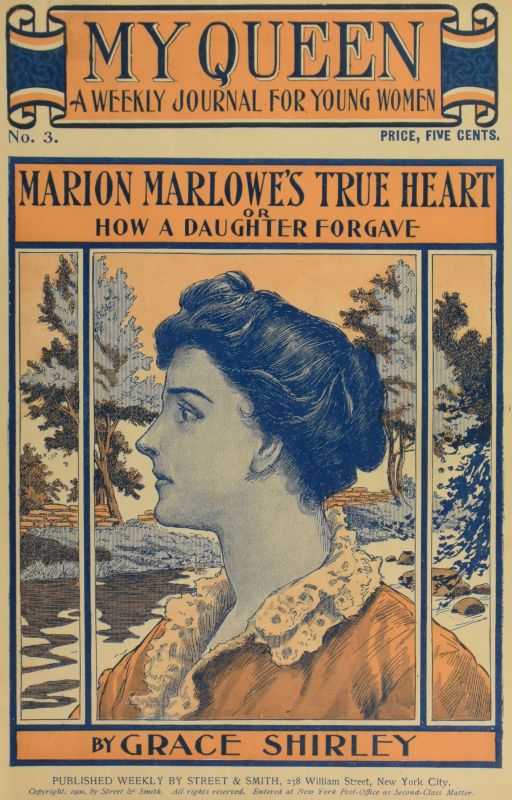
The Project Gutenberg eBook of My Queen: A Weekly Journal for Young Women. Issue 3, October 13, 1900
Title: My Queen: A Weekly Journal for Young Women. Issue 3, October 13, 1900
Author: Lurana Sheldon
Release date: July 26, 2018 [eBook #57582]
Language: English
Credits: Produced by MWS and the Online Distributed Proofreading
Team at http://www.pgdp.net (This file was produced from
images generously made available by The Internet
Archive/American Libraries.)
MY QUEEN
A WEEKLY JOURNAL FOR YOUNG WOMEN
No. 3. PRICE, FIVE CENTS.
MARION MARLOWE’S TRUE HEART
OR
HOW A DAUGHTER FORGAVE
BY GRACE SHIRLEY
PUBLISHED WEEKLY BY STREET & SMITH, 238 William Street, New York City.
Copyright, 1900, by Street & Smith. All rights reserved. Entered at New York Post-Office as Second-Class Matter.
Issued Weekly. By Subscription $2.50 per year. Entered as Second Class Matter at the N. Y. Post Office, by Street & Smith, 238 William St., N. Y.
Entered According to Act of Congress in the year 1900, in the Office of the Librarian of Congress, Washington, D. C.
No. 3. NEW YORK, October 13, 1900. Price Five Cents.
Marion Marlowe’s True Heart;
OR,
HOW A DAUGHTER FORGAVE.
By GRACE SHIRLEY.
CHAPTER I.
IN THE FARMHOUSE KITCHEN.
It was a cold, dreary day and the country was white with snow, causing the sparsely settled village of Hickorytown to look even more desolate than usual.
Old Deacon Joshua Marlowe and his wife were seated in the dingy kitchen of the old farmhouse, and it was plainly to be seen that they were both worried and angry.
The farmer’s elbows were on his knees and his head between his hands, and as he sat in silent meditation he spitefully chewed a long wisp of straw.
Martha Marlowe dried her eyes with her apron now and then, and finally a decided sniff evinced to her husband that she was crying.
Instead of becoming more calm at this sign of his wife’s grief, Deacon Marlowe raised his head and scowled at her angrily.
“’Tain’t no use tew snivel about it, Marthy,” he said, snappishly. “It’s got tew be did, an’ thet’s all thar is about it! Sile’s got the mor’gage on the farm, an’ he’s a-goin’ tew foreclose, an’ all the cryin’ yew kin dew won’t help matters any.”
“But where be we a-goin’?” asked his wife, desperately. “I’ve asked Samanthy tew take us, an’ she ’lows Tom won’t have us!”
“Tom’s a doggoned jackass!” was the farmer’s answer. “Ef I’d a-knowed how tarnal stingy he wuz, I’d never hev let Samanthy marry him!”
“Waal, you wuz pretty sot on the matter, Joshuy!” snapped his wife, with some spirit. “The Lord knows, Samanthy didn’t want tew marry him!”
There was no answer to this, so Mrs. Marlowe grew bolder.
“Marion told yew how it would turn out when yew done it, Joshuy, an’, in spite of that, yew done yewr best tew make Dollie marry Sile Johnson! Not but that yew meant well by the gal,” she added, a little more humbly, “but it shows on the face of it that it ain’t right fer a father tew interfere in sech matters. Ef our children hadn’t been driv so by their father, they might a-been here tew comfort us this minute!”
She put her apron up to her face and burst out crying now. Her mother heart had at last conquered her fear of her husband.
“I hain’t a-lookin’ fer comfort, Marthy,” said the old farmer, stubbornly. “The facts of the case is clear, an’ we’ve got tew face ’em!”
“Yew mean we’ve got tew leave the old home an’ go tew the Poor Farm, I s’pose,” was the answer. “Oh, Joshuy! It’s hard, an’ I ain’t done nothin’ tew deserve it!”
Joshua Marlowe arose and paced the floor excitedly. For the first time in his life he began to feel the twinges of a rebuking conscience.
Only two years before he had been a fairly prosperous farmer, with a good wife and three of the prettiest daughters to be found in that section.
When Tom Wilders, a lean, lanky, close-fisted farmer from his own town, asked to marry Samantha; he gave her to him without a word, and his eldest daughter, who inherited her mother’s meekness, accepted him for a husband, knowing that she loathed the fellow.
Only a little while after the marriage, Tom Wilders called on the deacon. His interview with his father-in-law was strictly private, but in some way it cost the deacon exactly five hundred dollars.
Where he got the money no one knew for a time, but very soon Silas Johnson, another neighbor, began suing boldly for the hand of Dollie Marlowe.
Dollie was only seventeen, but she had more spirit than Samantha, and, better yet, she had her sister Marion to protect her.
For what the rest of the women of the Marlowe family lacked in spirit, beautiful, gray-eyed Marion made up in full. As she grew older she developed the determination of her father, but it was backed by honor and good judgment, and her love for her twin sister made her as fearless as a lion.
Quite by accident Marion learned of her father’s reason for assenting to Silas Johnson’s suit. He had given Silas a mortgage on the farm for five hundred dollars in order to obtain the money to loan to Tom Wilders.
Now, when the mortgage was to be foreclosed and the old people turned out, Tom, the dutiful son-in-law, not only refused to pay up, but he also refused to even harbor his wife’s parents.
There was still a mystery about the loan of the money, but neither Mrs. Marlowe nor Samantha dared to question their husbands, and there was not a scrap of paper to prove the transaction.
“Ef Marion wuz here, she’d sift this thing tew the bottom,” thought poor, weak Mrs. Marlowe, as she sat and wept, and then for, perhaps, the first time in her life, she turned and bitterly berated her husband.
“Yew’ve done it all, Joshuy!” she said, lowering her apron. “Yew tied Samanthy hand and foot tew the stingiest critter this side er Jordan, an’, what’s more, yew’ve driv both Marion and Dollie from their own father’s door—yew’ve done it, an’ some day yew’ll answer fer it, Joshuy!”
Her husband paused in his nervous pacing, and stared at her wonderingly. There was a red flush of shame creeping over his wrinkled forehead.
“I’ve never said it before, being I ain’t dared, but I’ll say it now ef yew kill me, Joshuy Marlowe! I’m tew full tew keep still! I jest can’t, an’ that’s all there is about it! Yew’ve been tew hard on yewr own flesh an’ blood, an’ yew’ve been tew hard on me—an’ we air goin’ tew the Poor Farm as a jedgement upon us—yew fer bein’ so hard, an’ me fer keepin’ still an’ mindin’ ye!”
Before such a flood of honest condemnation, Joshua Marlowe stood silent; he had not dreamed that his wife harbored such bitterness toward him.
With hardly a pause for breath, she went on speaking, rolling the corners of her apron in both hands and rocking her body back and forth in the torrent of her misery.
“Ef it warn’t fer yewr hardness, they would be here now, Joshuy—Samanthy, Marion an’ Dollie! But yew turned ’em out! Yew did, Joshuy Marlowe! Yew giv Samanthy tew Tom an’ disowned poor Dollie, an’ yew’d a-turned Marion out ef yew’d a-dared, but yew dassent! That’s one of yewr children that wasn’t afeard of yew, Joshuy! Oh, Marion! Marion! I wish yew wuz here this minute!”
The poor woman clasped her hands over her face and began weeping again, while Joshua Marlowe stood like one transfixed, staring grimly at her.
There was a light step on the snow outside, but neither of them heard it. The next second the door flew open and a beautiful girl stood upon the threshold, her eyes flashing like diamonds as their glance fell upon the weeping woman.
“Mother! Mother! I have come back!” cried a sweet, young voice.
The poor woman dropped her apron and gave a scream of joy.
“Oh, Marion! Thank God! It is my darter Marion!”
CHAPTER II.
PAYING OFF THE MORTGAGE.
Without even noticing her father, Marion Marlowe crossed the room to her mother’s side, and for just a moment mother and daughter wept together.
Joshua Marlowe stared at her silently. He could hardly believe his eyes. Was this beautiful, stylishly dressed girl his daughter Marion?
After her burst of tears was over, Marion dried her eyes. It was not her nature to waste much time in weeping.
“Why didn’t you answer our letters, mother—Dollie’s and mine?” she asked, and then answered her own question without waiting for her mother.
“I suppose father would not let you,” she said, with some scorn, “and of course you were too scared to dream of disobeying him! It doesn’t seem possible that a woman could be so weak, but I forgive you, mother. I know he would only have made your life miserable for you.”
“Yew air tew hard on me, Marion,” said her father, faintly. He had always stood a little in fear of his daughter Marion.
The girl sprang to her feet and faced him, her cheeks flaming with indignation.
“No, I’m not, father!” she said, hotly. “I am not hard enough on you! You have broken up your own family and you ought to be ashamed of it!”
“Did I send Dollie away?” asked the farmer, flaring up a little. “Did I make her run away with that scapegrace, Lawson?”
“No, you didn’t do that, father,” said Marion, sadly, “but you condemned and disowned her as soon as she was gone, when you might have known that Dollie was innocent.”
“Waal, any father would hev done the same, I reck’n,” said the old man, lamely, “but ef I did wrong, I’m a-gittin’ paid fer it, there’s no use denyin’ that, Marion.”
His mood had softened and his lips were twitching suspiciously.
As Marion looked at him she seemed suddenly to realize how old and worn he was, and in an instant her heart was bleeding for him.
“Father! Father!” she cried, going over to him as he sank upon a chair and putting her hand almost tenderly upon his shoulder. “You have been hard with us all, father; but we will forgive you! Just say that you love us, and that in future you will be more kind.”
“It’s tew late, Marion,” cried the old man, huskily. “There’s no home fer yew tew come back tew now, so it don’t make no diff’rence about your old father! We air goin’ tew the Poor Farm, yewr mother an’ me, an’ I guess she’s right—she sez it’s jedgement upon us!”
Marion Marlowe’s lips trembled, but only with a smile. Her eyes shone through her tears as she gazed steadily at her father.
There was something she must know before she told them the truth about the errand that had brought her back to the mortgaged homestead.
“Father,” she began, sternly, “there is something I must know! If you refuse to tell me, I will never forgive you! What scrape was Samantha’s husband in when you loaned him that five hundred dollars? Tell me the actual truth, father, for I am determined to know it.”
Deacon Marlowe raised his head with the old, stubborn motion that his wife and daughter knew so well, but one look at Marion’s face made his glance waver considerably.
“I can’t tell yew—it’s Tom’s secret,” he began, but Marion interrupted him.
“You must tell me,” she said, firmly, “or I will employ a detective to find out for me.”
Deacon Marlowe’s jaw dropped and his cheeks became almost ashen in color. The word detective to his country ears was synonymous with everything that meant diabolical cleverness.
“Yew wouldn’t dew that!” he began, and stopped. There was something in Marion’s eyes that told him plainly that she would do it.
“Waal, I’ll tell ef I must,” he muttered at last, “an’, after all, I don’t much keer, fer Tom’s behaved mighty mean tew me. I let him hev the money when he went tew New York that time, an’ I reckon he lost it in some of them hocus-pocus games—I don’t know what they call ’em, it’s ‘bunco,’ or sumthin’! Anyhow, he lost the money, an’ come home with a satchel full of worthless green paper, an’ it’s nat’ral thet neither on us wanted tew say much about it, excep’ I had tew tell Sile, ’cause he took the mor’gage.”
Mrs. Marlowe stared at her husband in breathless interest while he was talking. In the height of her indignation she had never dreamed that he was such a sinner.
As for Marion, her first thought was one of disgust; then, the picture of her gawky brother-in-law being “buncoed” by sharpers rose before her mental vision, and, in spite of herself, she burst out laughing.
“So you were a ‘green goods’ victim, dad!” she cried, hysterically. “You thought, by mortgaging the farm, you’d get rich in a minute! Oh, it’s no wonder that city people think we country folks are green! That’s why they never lose a chance of imposing upon us!”
“Waal, it’s did, an’ thet’s all there is about it,” said her father, dolefully, “an’ it’s me an’ yewr mother thet’s got ter bear the brunt. Yew an’ Dollie air free, an’ yew look prosperous, Marion.”
The old man was weakening very rapidly now. He was fast becoming meek and submissive in his manner.
“We’ve had an awful struggle,” was Marion’s slow answer. “We’ve been without money and almost without friends, but Dollie has got a position as typewriter in view, and when I get back I’m to be a nurse. I’ve got a letter in my pocket this minute accepting my application.”
Her parents stared at her curiously, so Marion went on. She was glad to see that they took an interest in what she was telling them.
“Yes, I applied for a dozen or more positions during the first few weeks I was in New York, and this morning, just as I was coming away, I got my first acceptance. I’m to go to Charity Hospital, on Blackwell’s Island, as soon as I go back, and I’m just crazy to begin, for I know I will like nursing.”
“But I tho’t yew wanted to be a singer,” said her father, a little vaguely. “Yew’ve got a bootiful voice, Marion, it’s a pity yew can’t use it.”
Marion smiled at these words of praise from her father, but did not show by a look that she thought them surprising.
“I sang one night in a concert hall,” she said, laughing. “I had no idea what the place was like before I sang, or I would never have done it; but I guess it didn’t hurt me, and I made a hundred dollars.”
“What!” cried her father and mother, in one breath.
Marion nodded her head in a knowing manner.
“They offered me that every night if I would sing,” she said, proudly; “but it was a drinking place, and I wouldn’t do it.”
Deacon Marlowe was still staring at her as though he could not believe his senses. Such tales as this set his old brain to spinning.
“Everything that is wicked pays well in New York,” said Marion, sadly; “but it’s another thing when you are honest and want to live decently.”
Mrs. Marlowe began weeping again, this time very quietly.
“Tew think what we have come tew,” she moaned, behind her apron. “Our two daughters in a big, wicked city a-tryin’ tew earn their livin’, an’ yew an’ me, Joshuy, a-goin’ tew leave the old home an’ go tew the Poor Farm, an’ it’s all on account of yewr hardness an’ overbearin’—it’s all yewr fault, Joshuy!”
Marion stopped her before she could go any farther.
“See here, mother,” she said, brightly, “things ain’t quite so bad as you think! In fact, what do you suppose I’ve come back for, if it isn’t to help you?”
“What, yew help a father that’s been so hard on yew!” sobbed the woman.
“Yew come back to help me, Marion?” gasped her astonished father.
Marion slowly drew a roll of bills from the purse in her hand and laid it on her mother’s lap before she answered.
“You’ve been hard on us, father, but we forgive you,” she said, gently. “I saved a little girl’s life in New York a day or two ago, and her mother was so grateful that she rewarded me handsomely. There’s five hundred dollars to pay off the mortgage, father, and all I want you to say is that you forgive your little Dollie!”
There was a noble light shining from Marion’s eyes. As the old farmer looked up at her he burst out crying.
CHAPTER III.
A POOR WIFE’S DETERMINATION.
It was almost train time when Marion left her father and mother, now radiantly happy in the little farmhouse kitchen. As she walked briskly along the rough, frozen road to the station the young girl’s face was fairly glowing with pleasure. She had saved her sister Dollie, and now she had saved the old home. She could hardly believe it seemed possible that she was still Marion Marlowe.
“Just a simple little country girl,” she whispered to herself. “Why, only a few months ago I was driving the cows down this very road and wearing a calico dress and a gingham sunbonnet.” She looked down at her neat cloth dress and her soft fur collar and muff, and a smile of content crossed her beautiful features.
“It has been a hard struggle, but I am sure it is nearly over now!” she sighed. “Oh, I shall win fame and fortune yet, I feel sure that I shall! All it needs is the three Ps—‘patience, pluck and perseverance.’”
She was just passing the gate of an old red farmhouse now, and her eyes wandered a little curiously over the familiar premises.
“Silas Johnson’s farm,” she said, aloud. “Oh, I wonder if he is kind to the poor, unfortunate girl that he married!”
Almost as if in answer, a young girl came running down the path. Marion recognized her at once. It was Sallie Green, her old playmate.
“Oh, Marion! Marion! How do you do!” cried Sallie. “I knew you in a minute in spite of your lookin’ so stylish!”
Marion put her arms around the girl and kissed her tenderly.
Sallie was pale and thin, and even homelier than ever.
“Oh, Marion! This life is awful!” she said, as soon as she could speak. “It is killing me to live with Sile! You have no idea how cross he is, now that he’s got me where he can boss me!”
“But don’t let him ‘boss’ you!” said the young girl, quickly. “Have some will of your own, Sallie, and make him respect it!”
“Oh, I can’t! I can’t!” sobbed Sallie, dolefully. “He’d kill me, I believe, he’s so almighty spiteful! He wasn’t so bad at first, but it’s awful now. Why, sometimes, Marion, I believe he just hates me!”
“It’s dreadful!” said Marion; “but I don’t see how you can help it. You were weak and foolish enough to marry him, and now you’ll have to suffer forever unless you can summon up the courage to rise above it.”
“I’ll run away, that’s what I’ll do,” said Sallie, sullenly. “I’ll run away like Dollie did and go to the city.”
“Hush!” said Marion, sharply. “You must not say that, Sallie! Dollie did not run away of her own free will. She was hypnotized and abducted by the fellow Lawson! Oh, you have no idea what a terrible experience she had; but I rescued her, and now she has a position. She is to be typewriter in a lawyer’s office.”
Poor Sallie Johnson looked at her in perfect bewilderment.
“Couldn’t I do that?” she asked, rather stupidly.
“It requires a great deal of practice,” said Marion, kindly. “I am afraid you would not have time to learn, even if you had a machine; but I must hurry, Sallie, it is time I was at the station.”
Sallie’s eyes were full of tears as Marion kissed her.
“I’ll run away some day, you can be sure of it, Marion,” she repeated. “I jest hate Silas Johnson, and I won’t stand him much longer! I’ll either kill myself or run away to the city.”
“Don’t! Don’t!” was all that Marion had time to say. “Try to bear it, Sallie. Perhaps things will get better.”
There was a distant shriek of an engine whistle, and Marion fled down the street. It was the last train to the city, and she had to catch it or remain in Hickorytown until another day.
Just as she reached the little station a burly form confronted her, and the coarse voice of Matt Jenkins, the keeper of the Hickorytown Poor Farm, growled a word of greeting.
“Been up to visit the old folks, I s’pose,” he said, sneeringly. “Waal, it’s well you came now, fer they won’t be long at the homestead. They’ll be a boardin’ with me at the Poor Farm in a week or so.”
“Are you sure?” asked Marion, coldly, as she turned away from him.
“Waal, five hundred-dollar bills don’t grow on bushes,” he said, sneeringly, “an’ if Sile Johnson don’t get his money, he’ll turn ’em out the first day of Janooary.”
“Silas Johnson is a brute!” said Marion, sharply.
“’Tain’t sweetened his nature any tew marry Sal,” said Matt Jenkins, coarsely, “fer, with all her shortcomin’s, he’d ruther hev married Dollie.”
Marion turned her back on him without a word. The train was approaching, she could see the headlight in the distance.
“Bert Jackson got killed—s’pose yew heerd of it,” said Jenkins, in her ear. “I reckin he got tew smart with them cable cars—thet’s usually the end of country boys and gals thet think they’re smart enough tew git on in the city.”
“Bert was the smartest boy that the Poor Farm ever held,” said Marion, suddenly, turning square around. “I helped him to run away from the Poor Farm that night, and I only wish that I could help them all to get away from your cruel treatment, Matt Jenkins.”
“Bert wouldn’t hev been killed if he’d stayed at the farm,” was the answer; “fer I ain’t so good ter my boys—I only half kill ’em.”
Marion sprang aboard of the train almost before it stopped, and as she took her seat she was shaking with laughter.
“Wouldn’t he be mad if he knew the truth,” she was thinking. “Why, if Matt Jenkins knew that Bert was alive and in a good position, I believe he’d be so mad that he would chew nails for a fortnight.”
A ripple of laughter flowed from Marion’s lips. She was so amused at her thoughts that she entirely forgot her surroundings.
“By Jove! But that’s a pretty girl!” said a low voice just behind her. Marion sobered instantly, but did not turn around. She knew that the gentleman who had spoken did not intend that she should hear him.