
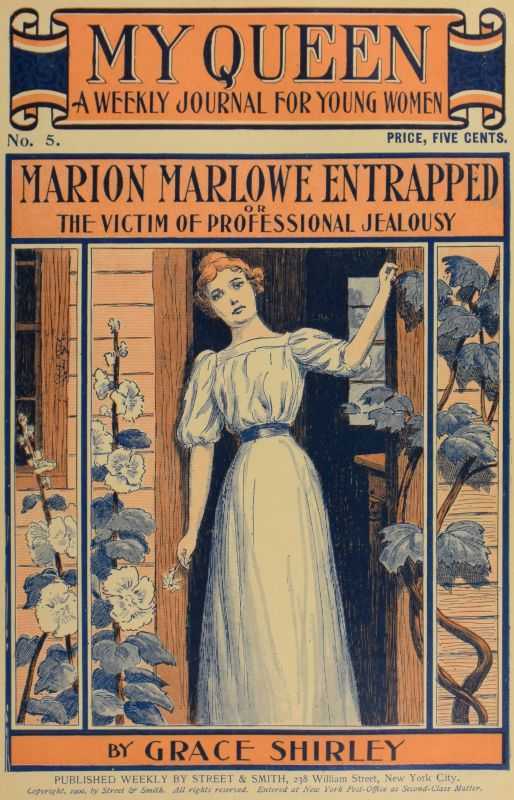
CHAPTER VIII.
THE CONQUEST OF A CRITIC.
As Marion made her way across the scene-room she was almost trembling with alarm, for her keen intuition had told her that she was right in her surmise and that there must be no delay if she wished to prevent a tragedy. She peered here and there, looking for Mr. Graham, and then it suddenly occurred to her that he would be in the front of the house rather than behind the scenes during a performance, and that she must look for Mr. Brown, the stage manager, instead.
She had just caught sight of him in the distance, talking to the “calcium man,” when the awful thing happened.
It seemed to Marion that she had been listening for it all the time, yet she stood perfectly still for a moment, her nerves tense with agony.
The chorus was going through a sword drill at the time, and everything was moving rhythmically, when there came a sharp scream.
Marion heard an order given, the curtain was rung down, and then Mr. Brown’s voice came to her as if from some great distance. He was talking calmly to the audience, telling them what had happened. There was a dim murmur of applause from the front of the house, then Marion heard no more, for she had suddenly come to her senses just as two of the “supers” came “behind,” carrying one of the chorus girls between them.
“Quick!” cried Marion, as she instantly knelt by the wounded girl’s side. “Give me a piece of ribbon or a big handkerchief, someone. She will bleed to death if we don’t prevent it. Now, a stick of some kind!” she added, as some one handed her a piece of ribbon. As deftly as possible Marion wound the ribbon around the girl’s bleeding arm, and then, thrusting a stick through it, she began twisting it gently.
The stage manager had already sent for a physician, but before he arrived Marion had stopped the flow of blood.
“Well done, my brave girl,” said the doctor, smiling at her. “You have saved this girl’s life. It is a pity there are not more women like you.”
“Oh, but I have had experience as a nurse,” said Marion, quickly. “I was in Charity Hospital for awhile this winter.”
“That accounts for it, then,” said the doctor, as he applied a ligature.
Marion helped him deftly, all the time listening for her cue. Fortunately there was a good deal for the other performers to do before she was needed.
For in less than five minutes the curtain had gone up again, showing the sword drill exactly where the momentary tragedy had left it.
“One of the chorus girls has pricked herself with her sword,” the audience was told. No one, except a few of her companions, dreamed that the injury was serious.
When Marion’s turn came at last, Miss Lindsay’s arm was all bandaged and she had just opened her eyes with a return of consciousness.
As Marion rose from her place beside her on the dusty floor of the scene-room she caught a glance from Jack Green’s eyes as he stood a little way from them.
The fair girl shuddered as she saw his look; it was so full of an ugly, brooding hatred.
“He hates her and she loves him,” was her whispered comment. The next moment she was out on the stage, and everything else was forgotten.
“Ila de Parloa’s” appearance was always the signal for great applause, but to-night the audience fairly outdid themselves. It seemed as though they were determined to give her an unusual welcome. Once, as she sang, Marion glanced suddenly into the wings. Carlotta stood there watching her, with a face that was almost ashen.
When the song was ended there was tremendous applause. Marion had never sung better, and her audience appreciated the effort.
She was encored until she was obliged to go back, and this time, just as she stepped on the stage, she caught sight of Mr. Graham in the rear of a box, talking to a gentleman.
A curtain call followed, which Marion took gracefully and modestly. It was the crowning whisp of fuel to Carlotta’s already flaming fire of jealousy.
“I tell you, she shall not sing in this company another week,” she said, with choking voice, as Clayton Graham passed her.
Graham had gone behind the scenes to congratulate Marion, as well as to present his friend, Howard Everett, who had for a week past been begging for an introduction.
“How are you going to prevent it?” asked Graham, carelessly, as both he and Everett, who was a newspaper critic, paused for a moment.
“I’ll find a way!” was Carlotta’s answer as, with a disdainful glance at Everett, she flounced out upon the stage.
“She hates you almost as badly as she does me,” said Graham, chuckling. “She’d knock our heads together this minute if she dared.”
“It isn’t always a critic’s lot to be loved,” said Everett, shrugging his shoulders, “but, then, I am not ambitious to be loved by a creature like Carlotta.”
“You prefer a dainty maid like Ila, I suppose,” said Graham, laughing.
“‘Signorita de Parloa’ is glorious!” was the critic’s answer, and strangely enough, his words were honest—he felt them as he spoke them.
Marion was greatly pleased to make the acquaintance of the critic, for he had been the kindest of them all in his daily reviews. As she stood chatting with him pleasantly, Miss Lindsay came up to her. She looked pale and scared, and her arm was carried painfully.
“I thank you for what you did,” she said, in a tremulous voice, “but it would have been better if you hadn’t done it, Ila. I cut myself on purpose—is it possible that you did not guess it?”
“Hush!” said Marion, sternly. “Don’t say that, Miss Lindsay. I am glad I was able to help you, dear, but you look sick and weak. Can I do anything more for you?”
“No, thank you,” said the girl, and then she blushed furiously and added:
“Jack is going home with me. He is sorry, he says. Please don’t tell any one what happened this evening, will you?”
“I certainly will not,” said Marion, kissing her.
She would have liked to warn the girl about Green, but another look at the wan, white face quickly silenced the desire.
“She loves him, and it would kill her if she knew,” she thought. “Oh, why is it that some men are so treacherous to those who love them!”
She turned back to Mr. Everett with a saddened heart. The sorrow in this young girl’s face had destroyed Marion’s happiness for the evening.
“You are very sympathetic, signorita,” said the critic, as he watched her.
“Too much so for my own good,” was the fair girl’s answer. “It was because of my intense sympathy that I was obliged to resign my position as a nurse. I do hope that it will not also ruin my career as a singer.”
“Nothing must ruin that,” was Howard Everett’s quick answer. “You will be great some day, both great and famous. There is a wide difference in those words, although many do not seem to know it. A woman with a face and voice like yours should have the world at her feet, and you can, signorita; you have only to think so.”
He spoke softly and tenderly, yet with a masterful tone, and Marion felt the thrill of his words through every fibre of her being.
As she glanced up suddenly, their eyes met for a moment; then Marion, with an unaccountable blush, held out her white hand and bade him “good-evening.”
CHAPTER IX.
THE HIDEOUS CHINAMAN APPEARS AGAIN.
When Marion reached her dressing-room after leaving Howard Everett she found a note awaiting her.
She was about to throw it aside, thinking that it was one of the nightly “mash notes” which she had been receiving all the week, when a sharper glance revealed that the handwriting was familiar.
She tore it open hastily and a smile of pleasure lighted her features as she read. It was from Alma Allyn, one of her dearest friends. Miss Allyn told her briefly that she was in the theatre and would be at the stage door to go home with her right after the performance.
Miss Allyn was a newspaper reporter and a very clever woman. She had known both the Marlowe girls ever since they came to the city, and it was in her flat that Dollie Marlowe was married.
Since Dollie’s marriage she had been living alone, but she visited the bride as often as possible.
Marion hurried on her street dress so as not to keep her waiting, and very soon after eleven o’clock the girls took a cab and were driven up town together.
“I have a lot of news for you, Marion,” was Miss Allyn’s greeting, “and now that we have a few minutes together we must make up for lost time and tell each other everything.”
“I haven’t much to tell,” was Marion’s quick answer; “only Carlotta hates me and is trying to make trouble for me, and I can’t help feeling that she is going to be successful.”
“She’s a bad woman, from all accounts,” said Miss Allyn, shortly; “for, besides being divorced from her husband, she is Clayton Graham’s mistress—and not a very faithful one, either, according to rumor.”
“How perfectly awful,” said Marion, gasping, “and to think that I went home with her one night in the hope of making a friend of her.”
Miss Allyn looked at her with an inquiring glance, and Marion made haste to tell her all about it.
“You were lucky to get out so easily,” she said, when the story was finished. “I wouldn’t trust that woman the length of my nose. Why I believe she’d knife a person if she got very angry.”
“Well, now tell me your news,” said Marion, quickly. “I want to get that unpleasant taste out of my mind as soon as possible.”
“My news will make your heart go pit-a-pat, Marion,” said Miss Allyn, laughing, “for I saw your devoted admirer, Dr. Reginald Brookes, to-day, and he fairly loaded me down with tender messages for you.”
“Why didn’t he bring them himself?” asked Marion, slyly.
“Couldn’t,” said Miss Allyn. “He’s up to his ears in business. You know he only came down from the Prison Hospital yesterday, and to-day he was around looking up an office.”
“I suppose he’ll be up to-morrow, then?” said Marion, dreamily. “I shall be glad to see him, for he will bring all the news from the Island.”
“It is like getting a message from Hades, isn’t it, Marion?” asked Miss Allyn, shivering. “Some way I always had a horror of Blackwell’s Island!”
“Well, vice is quite concentrated up there,” said her companion, smiling, “but there is an advantage in that which we don’t have here in the city.”
“No, that’s so,” said Miss Allyn, promptly; “it is badly scattered here. You dodge it on one corner only to bump into it on another. Oh, the crooks and the criminals are not all on the Island by any means! But don’t you wish to hear any of the doctor’s messages, Marion? There’s one that I’m sure will be very pleasant.”
“What is it?” asked Marion, striving hard not to show her eagerness.
“I have a great notion not to tell you, Miss Indifference,” said Miss Allyn. “But here it is: Dr. Brookes is taking music lessons. He thinks he will study for the operatic stage, and has an amazing taste all of a sudden for comic opera.”
Marion burst out laughing as Miss Allyn finished.
“You are surely joking, Alma,” she exclaimed, her cheeks glowing. “What do you mean by telling such stories?”
“It’s the Gospel truth,” said Miss Allyn, chuckling. “A few months ago he was desperately interested in the sick people on Blackwell’s Island: now he is possessed with an insane desire to go into comic opera. Why, Marion, I’ll bet a quarter that if you started a dressmaking establishment, Dr. Reginald Brookes would learn to do fine sewing.”
The flush on Marion’s cheek had deepened steadily and her eyes sparkled with mischief at Miss Allyn’s suggestion, but she could hardly believe that the doctor was quite so badly smitten as her friend’s remarks would indicate, and she was greatly surprised at his new ambition.
“Why, he never told me that he sang,” she said, after a minute; “although, of course, I knew he was a great admirer of music.”
“He is passionately fond of singing,” said Miss Allyn, smiling, “and unless I’m much mistaken, he is also passionately fond of a certain singer.”
She pinched Marion’s arm very gently as she spoke, but the beautiful girl had no answer ready.
“Here we are at Dollie’s,” said Miss Allyn, poking her head out of the carriage window; “now you must run in and let them know you are safe, and then you must come over and stay all night at my bachelor’s quarters.”
Her friend sprang out of the carriage and ran up the steps. In a few minutes she returned, bringing a small handbag with her.
“Oh, Marion, I’ve seen a sight!” was Miss Allyn’s greeting. “A creepy-looking ‘chink’ just passed the carriage. His face was all scars, and he was simply hideous.”
“Are you sure it was a Chinaman?” asked Marion, quickly; “a small, swarthy fellow, with long, yellow, clawlike fingers?”
“He was small and swarthy all right,” was the answer, “but his hands were out of sight. I couldn’t see his fingers.”
“That is very strange,” said Marion, half to herself, as she seated herself beside Miss Allyn. “That is the second time I’ve known of that fellow being around here, and I’d like to know what he is striving to accomplish.”
“He looked like a ghoul,” was Miss Allyn’s extraordinary answer. “I have seen pictures of such creatures; they are always haunting graveyards.”
“I wonder if he can be that wicked Chinaman who steals young girls,” said her companion, thoughtfully, and then she told of the article Dollie’s husband had seen in the paper.
Miss Allyn had been in the newspaper business too long not to know that even stranger things than this occurred in a big city, so she listened without a word and at the end she seemed to be thinking deeply.
“We must be on the lookout in the future,” she said, “and above all we must warn Dollie to be very particular. She must never step out after dark unless Ralph is with her.”
“I don’t think she does” was Marion’s answer; then a sudden idea seemed to come to both of them.
“Perhaps he is looking for you,” Miss Allyn said, slowly.
“Well, I hope not,” said Marion, with a shiver, “but I’d much rather it would be me than my darling sister.”
CHAPTER X.
CLAYTON GRAHAM’S MURDER
When Marion awoke the next morning she saw Alma Allyn standing by her bed-side, her eyes fairly bulging with horror.
“Quick, Marion, look!” she cried, holding out the morning paper. “Clayton Graham is dead. He has been murdered in his own apartments.”
The young girl sat bolt upright in bed and snatched the paper hastily. She could hardly speak for a moment after she finished reading.
“It was Carlotta, no doubt,” said Miss Allyn, slowly, “for they say she is missing and has been since midnight.”
“It is dreadful,” cried Marion, springing out of bed. “Oh, it doesn’t seem possible that she could have done it.”
“Well, they know it was a woman,” said her friend, as she glanced over the paper again, “and who so likely as Carlotta?”
“I knew they had been quarreling frequently of late—every one in the company knew it,” was the thoughtful answer, “but still I can’t think that she would actually murder him, for, in spite of her bad temper, I believe she loved him.”
“It was probably done in a second; she had, no doubt, lost her self-control completely when she shot him,” said Miss Allyn.
Marion dressed herself hastily and ate her breakfast; then, as soon as she could, she started for the theatre.
There was quite a group of girls at the stage door when she reached there and, of course, they had all come on the same errand.
“The notice on the call board says that the treasurer will take charge at once,” said one of the girls just as Marion came up. “He is Graham’s brother and I believe he has money in the enterprise.”
“Well, there’ll be no performance to-night, anyway,” said another girl turning away, “but the new manager has called a rehearsal for to-morrow.”
Marion waited to see for what time the rehearsal was called and then started back uptown to tell Dollie what had happened.
A block from the theatre a carriage was driven closely to the curb and a handsome young man, tall and aristocratic in appearance, leaned out of the window and greeted her eagerly.
“Oh, Mr. Ray!” cried Marion, as she recognized her old friend and champion. “I am so delighted to see you again!”
In an instant Mr. Ray was out on the pavement beside her.
“Do let me drive you wherever you are going,” he said, quickly.
“To Dollie’s, then,” laughed Marion, as she entered the carriage.
Her lovely face was radiant as Mr. Ray smiled down into her eyes, for in a second Marion’s beauty seemed enhanced a hundred fold.
Her cheeks flushed and paled at the unexpected pleasure and little dimples appeared that were not often seen and which made her face for the minute almost as childishly sweet as her twin sister’s.
“And I am delighted to see you also,” murmured Mr. Ray, softly. “Both my sister and I have been striving to meet you, but you have no idea how busy we are, Marion.”
He uttered her name as though it was sacred to him, and the fair girl’s eyelids drooped shyly as she heard him.
“You see we have sold our house and are storing the most of our things,” he continued, rather sadly, “for there are only two of us now, and we intend to travel. I am in wretched health, and I know it is better.”
He spoke a little doubtfully, as if arguing with himself, but Marion understood and hastened to turn the subject.
“I am sure that you must be busy with all that to do,” she added, quickly, “but have you heard that my manager is dead, Mr. Ray? I am to have a vacation perforce—I do not know for how long until I see our new manager to-morrow.”
“I read of the horrible occurrence,” was the answer. “I am glad all women are not like that dreadful Carlotta.”
Once more he gazed down into Marion’s eyes with his tender smile, and the fair girl’s heart throbbed with a sweet emotion.
She knew only too well what he was longing to say, and she knew also why it was that the words could not be uttered.
Archie Ray had loved her almost from the hour they met, and then, poor fellow, he supposed he had a right to love her—but later, before the sweet question had been asked, he discovered that the woman whom he had married when a boy at college, and who he thought had been dead for two years, was still alive, and, more, that she was now a thoroughly dissolute character.
The knowledge had shocked him beyond expression, but he had borne it like a man and Marion had helped him. Only a short time after the discovery the wretched creature died. She had drifted to Blackwell’s Island as a “drunk and disorderly,” her face disfigured by vitriol which had been thrown upon her by another low woman.
It was Marion Marlowe’s lot to round out the fearful tragedy, for at the very last moment, when poor Mary Ray’s body was en route for Potter’s Field, it was she who rescued her remains and gave them back to her husband and to a Christian burial.
Since that time Marion and Mr. Ray had met but once. That was at Dollie’s wedding at the little flat in Harlem.
And now he was thinking of going away, yet she knew that he loved her more deeply than ever—she could read it in his eyes and in his voice when he spoke to her.
But the beautiful girl was not so sure of her own sentiments as she was of his, for the question of love had always been put aside by her—there was too much else to be considered in the fearful struggle for existence. Until Dollie was safely settled she did not dare to think of herself, but now with these tender eyes looking almost into her soul, Marion was forced to, in a measure, analyze her feelings for him.
“You will come and see us, will you not?” she asked earnestly, as she raised her lovely eyes to his face. “Dear Dollie is so happy in her little home. Do promise me that you will come and see us.”
There was something in her voice that thrilled his very soul and in an instant every barrier seemed to melt from between them.
A sudden pallor appeared upon his handsome face at her request, then a flush rose swiftly to his very brow as he answered:
“I will come, Marion, on one condition,” he murmured, eagerly. “Oh, Marion, darling! Don’t you know that I love you? May I not come to you as your lover, dearest?”
He had taken her hands in his as he spoke and his dark eyes were looking into hers as though he would read her heart’s every secret.
But after the first flush of excitement the loyal girl’s lips became firm and she raised her eyes to his face with a tender, anxious expression.
“Oh, Mr. Ray! I am so sorry! But it cannot be! I am too young, too inexperienced! I do not know my own heart! Do, please, please forget that you have asked me that question!”
Archie Ray’s face paled to the lips, but he smiled at her bravely.
“As you will, Marion,” he said, almost sadly. “Forgive me if I have pained you, but, oh, my darling, do not decide too quickly! Give me a month, a year, and I will wait patiently.”
Marion bowed her head. She could not answer. This avowal of love had almost overwhelmed her.
CHAPTER XI.
MARION IS LURED INTO A TRAP.
When Marion reached home she was delighted to find Bert Jackson there. He had come from Canada the day before and expected to sail for Europe in two days, but his first thought seemed to be for the welfare of Dollie and Marion. He was a fine-looking lad in his stylish clothes, and when Marion first caught sight of him she hardly knew him.
“You don’t look much like the bare-footed boy in blue jeans that you were last summer, Bert,” she said, laughingly, as she finally pulled her hands away from the grasp he had given them.
“No, I’m a dude now,” said Bert, very gayly. “All I lack is an eye-glass, a walking-stick and a lisp. Oh, I know what they look like! There’s lots of ’em loafing around in my class in society.” The girls both screamed at Bert’s allusion to society, although the boy had only made the remark jestingly.
“Well, why shouldn’t you be in society?” asked Marion, after a pause. “You have plenty of money, and that seems to be nearly all that is needed.”
“Oh, you ought to have a pedigree like a trotter to be real, dead swell,” said Bert, quickly, “and I’m only an orphan brought up on a poor farm!”
“This society business just makes me sick! I’ve been in it a month, and I’m ready to graduate any minute.”
“They are not all bad, thank Heaven!” said Marion, soberly. “I suppose the percentage of goodness is about the same in all classes. But tell me, Bert, what are your plans for the future? You know, Dollie and I are your sisters, and we shall always be interested.”
“Look here, Marion!” said Bert, jumping up and facing her. “I don’t object to calling Dollie any old thing you like, but you can’t play the sister racket on me, for I’m fully determined to marry you some day!”
“Oh, Bert! How ridiculous you are!” said the fair girl, laughing.
“Promise me that you will not say ‘yes’ to anybody for a year. Do promise, Marion. It will make me perfectly happy.”
Marion looked at him sharply to see if he was in earnest. Just at that minute Dollie came to the rescue.
“Why, Bert, how foolish of you!” she exclaimed, with great wisdom. “If sister cares for you she does not need to promise, and if she doesn’t, why, of course, you don’t want her to promise.”
“I guess that’s right,” said the lad, growing thoughtful. “They say love is like lightning—it goes where ’tis sent—so, if that’s the case, there’s no use in my trying to control it.”
There was a ring at the bell, and Marion was glad of the interruption. For the first time in his life Bert was growing too serious.
“Oh, Dollie!” she cried, as she tore open a note that had come to her by a messenger boy, “Miss Lindsay is very ill, and wishes me to come to her at seven o’clock, if I possibly can. I must go, of course, but Mr. Ray is coming to call. Still, perhaps, I can return early; it’s not a very great distance.”
“Try to,” said Dollie, “for, of course, Adele will be with him. Oh, I am so glad they are coming! I have not seen them since my wedding.”
Bert went away soon, and the two girls busied themselves in tidying up the flat, and at about a quarter of seven Marion started to visit Miss Lindsay. Little did she dream when she said good-bye to Dollie that another trap had been laid for her unsuspecting feet and that she was going deliberately to her own destruction.
She smiled happily at her sister as she tripped down the steps, and her sweet face was so radiant with joy and health that nearly every one she passed turned at once and looked after her.
“What an awful neighborhood,” she thought, as she reached Miss Lindsay’s block at last. It was farther from Dollie’s than she had anticipated.
When she saw the number she was seeking on the door of a dilapidated tenement-house, she breathed a sigh of sympathy for little Miss Lindsay.
“I did not dream she was so poor,” she murmured, and then, lifting her skirts carefully, she picked her way through a swarm of dirty-faced children and boldly mounted the rickety steps of the dingy tenement.
Up, up she went, and still no signs of Miss Lindsay. She inquired on each landing, but not half of the women whom she asked understood her, for they were mostly ignorant foreigners who did not know a word of English.
At last, at the very top of the house, she saw a half-open door, and almost as she touched it she came face to face with Miss Lindsay.
“Oh, signorita!” cried the girl, in a half-whisper, as she saw her. Then, without another word, she burst into violent weeping.
“Don’t cry, dear,” said Marion, as she put her arms around the girl. “I understand: you are ill, and poor, and unhappy, but I will help you gladly. I am so glad you sent for me, dear.”
Instead of answering, the poor chorus girl began weeping more bitterly than ever. Her frail form was racked with sobs that were heart-rending. The more earnestly Marion endeavored to comfort her the more hysterical she became, until at last the brave girl was fairly bewildered.
“How can I help you, dear, if you do not tell me your trouble?” she asked, in desperation, at the same time laying her hand softly on Miss Lindsay’s shoulder.
In a second the girl dropped on her knees before her. As she lifted her streaming eyes to Marion’s face she seemed suddenly to have grown a dozen years older.
“Oh, signorita, forgive me!” she cried, in agony. “Forgive me for wronging you. I did not mean it! Oh, I am a guilty, vile woman to do as I have done, but I love him. Oh, I love him, and I could not help it!”
For just one second Marion Marlowe was dazed, then, like a flash, it came to her comprehension what the weeping girl meant. She had once more been led into some wicked trap. Either her life or her virtue was in immediate danger.
“What is it? Quick! You must tell me!” she cried, seizing the girl by both shoulders. “I forgive you freely for your part in the matter, only tell me what it is, that I may protect myself. A moment more and it may be too late. Hurry, I implore you!”
There was a heavy step on the stair and Marion had heard it. The girl heard it also, and it seemed to paralyze her senses.
“Too late! Too late!” she whispered, wildly. Then, with a bound, she sprang to her dilapidated bureau and opened it.
“Here, take this!” she whispered, thrusting a revolver into Marion’s hand. “And, oh, forgive me for letting them make a tool of me, Miss Marlowe! I would save you now if I could! Oh, what a guilty creature I am!”
She sank down, cowering at her visitor’s feet, just as Marion dropped the weapon carefully into her pocket.
There was another footstep heard in the hall and some one touched the door.
Marion turned and faced the emergency calmly, but with flashing eyes, and at that moment Miss Lindsay raised her head and whispered, hoarsely:
“Be careful! It is loaded! For God’s sake don’t shoot him!”
Marion did not move her eyes from the door, neither did she heed the last words.
“It would not be much use to me if it were not loaded,” she said, very coolly. Then, as a beautiful statue, she stood, silently, calmly, and—waited!