
Note.—This department will be made a special feature of this publication. It will be conducted by Miss Shirley, whose remarkable ability to answer all questions, no matter how delicate the import, will be much appreciated, we feel sure, by all our readers, who need not hesitate to write her on any subject. Miss Shirley will have their interests at heart and never refuse her assistance or sympathy.
Street & Smith.
“Will you please advise me in the following matter? I am engaged to a young man who is only making twenty dollars a week, and who is obliged to support his old father and mother. If I marry him I must live with the old folks, and do all the work. Do you think by doing this I could ever be happy?
“Mamie.”
We think the chances are that you would be very miserable indeed. You had better wait until the young man is able to employ some one to take care of his parents, and then you can have your own little nest together. It is not well, as a rule, for a young married couple to begin life in the same house with their relatives.
“I have been reading the ‘Marion Marlowe’ stories with great interest, but I am inclined to think that Marion is something of a coquette, and that she does not seem to know her own mind where her lovers are concerned. The stories are very interesting and exciting, and I enjoy them immensely, but I felt sorry for ‘Archie Ray’ and ‘Dr. Brookes.’ I feel like scolding Marion because she does not love them. I wish I had her chance to marry either one of them. If they are really true characters I wish you would send me their addresses.
“M. B.”
We are glad to hear that you are reading the “My Queen” series, but we are afraid you have not studied Marion’s character very thoroughly. She has been absolutely honest with the two young men you mention, and no one would resent the term of “coquette” more quickly than they would. Unfortunately, we do not know their addresses at present, so we cannot favor you, but no doubt, both gentlemen would feel honored at your candid appreciation.
“I have been married two years, and have a baby six months old. My husband says I give all my time to the baby and none to him. The baby is delicate, and no one can soothe him except his mother. If I must neglect either one, which should be neglected?
“Florence McK.”
This is the same old story that we have heard many times. Many married men use it as an excuse for spending their time elsewhere, and God pity the wives of such inhuman monsters! You have brought an innocent child into this world of sin and woe. It is your duty to devote yourself to it just so long as it needs or claims your devotion. The claims of wife are nothing when compared with the duty of motherhood. The man or woman who would neglect his or her own child for even one hour is guilty of the greatest sin that can be committed. You cannot expect your child to grow up loving or respecting you unless you have proven yourself worthy of these sentiments. Try and make your husband understand your position and his in this important matter.
“I have been brought up to think that it was a sin to drink liquor, and now I am deeply in love with a young man who often drinks a glass of wine; who, to the best of my knowledge, has never been tipsy. Would I be doing right to marry this man? I do not know how I can give him up, and yet I hate to go against my principle.
“Edna.”
Your anxiety is very natural, but we hardly think you would be doing wrong to marry a man who takes a glass of wine occasionally. History is filled with the names of great men who were not total abstainers. If liquor disagrees with a man, or he is prone to yield to its insidious fascination, that is another matter, but the mere fact of a man taking an occasional drink is not a sign that he is destined to fill a drunkard’s grave. Total abstinence is commendable, and in the case of men weak in will power it is almost a necessity, but many a man who is a moderate drinker will prove a better husband than the total abstainer, whose other virtues are not as fully developed as his abstinence.
Study the character of the man whom you think perhaps to marry. If he is honorable, brave and true, you can safely trust your life’s happiness in his hands, despite his occasional glass of wine.
“I am so sick at heart that I can hardly write this letter, but I must know your opinion, my dear Miss Shirley. I have been deeply in love for over a year, and now I am forced to believe that the object of my affections has forsaken me for another. Oh, what can I do to win him back! I shall certainly die if I have to live another week without him!
“Imogen S.”
There is anguish in every word of this letter, and we are very sorry indeed for you, Imogen. There is no grief so poignant as that which a young girl feels when she awakes to the fact which you seem to have discovered. But bear in mind, my dear, that there are scores of lovely and lovable men on earth, and perhaps your cloud will yet have a silver lining. Some day you will meet a man whose love will be all your own, and you will be able to see that this first disappointment was all for the best. We would not advise you to try and get him back. If he does not come back of himself his love is not worth having.
“Will you please tell me if you think fifteen is too young to love? I am just that age, and I have just met a young man who is very attractive, and I know he is in love with me and wants me to marry him. People tell me that at my age I don’t know my own mind. I should hate to marry him thinking that I love him and then find myself mistaken.
“Lotta.”
A letter like this is a positive treat! A girl of fifteen who can reason so wisely will not be apt to make many errors. A great deal of the misery in the world has been created through thoughtless and hasty marriages. Women marry men at eighteen whom they despise at twenty-five, or choose husbands at twenty-five whom they have ceased to love or respect at thirty. Human nature is ever changeable, and it is one of the most difficult tasks in the world to discover two intellects that will be perfect mates for life. One may go ahead or lag behind, and because of this the result of marriages is uncertain. We would certainly advise you to wait until you are older. No girl of fifteen is sufficiently well developed mentally or physically to marry, and, furthermore, your education cannot be completed at your age.
“I have been married a year, and, oh, how I regret it! Just think, Miss Shirley, I was an only daughter. I earned ten dollars a week as cloak model down town, and having no board to pay, could use it all in pin money. Now ten dollars a week has to do for a whole family, my husband, myself and a six weeks’ old baby. I would give the world if I had never been married, and I write this letter as a warning to others. I do hope you will print it in your correspondence columns.
“Mrs. G.”
We receive so many letters like this one that if we printed them all we are afraid we should discourage matrimony. You should have “looked before you leaped,” but that is a thing that young people in love rarely do. It seems strange that love, or whatever the sentiment is that draws some young people together, should so blind their eyes to the future. We are very sorry that you have made such a blunder, but now that you have done it you should make the best of it. For the sake of your child you must “put your shoulder to the wheel” and try to conquer every obstacle that threatens your domestic happiness. Above all, try not to take too many into your confidence in this wise; people will only laugh at you for marrying in haste. It is better to hide your grief and bear the penalty of your own error with silent dignity.
“I have read your Correspondence Department for several weeks with great interest, and wish to add one more to the list of questions. What I want to know is this: Is a woman of thirty too old to marry a man of twenty-one, and what will be the natural outcome of such a union?
“Gertrude B.”
As a rule, we should answer “yes” to the above question, but there are exceptional cases which demand a different answer. Some men of twenty-one are very mature both mentally and physically, and many women of thirty are as sprightly as kittens. Mentality should always decide this question. If a woman of thirty has every taste in common with a man much younger and feels confident that she possesses sufficient spirit and magnetism to charm him through the years that are before them, she is running very little risk in marrying him. It is true that most women age faster than most men, but the exception is not so rare as it used to be, however. Physical exercise and a more intelligent mode of living are keeping our women young nowadays, while the men are inclined to age a little prematurely.
“I am very much in love with a man of fifty who is a widower with four children, the oldest being only fifteen. Would you advise me to marry him? He has no money of his own—is working on a small salary.
“Abbie S.”
No, we do not advise you to marry him. The position of step-mother to four children is not an enviable one. No doubt, he wants you to be a mother to his children, a wife to him, cook, housekeeper, needle-woman and perhaps laundress. We advise you to look farther before you marry.
“I have read every number of ‘Marion Marlowe,’ and I can hardly wait for the weeks to come around. I know a young man who is exactly like ‘Bert Jackson,’ and I mean to catch him for a husband, if possible. Do you blame me?
“Nora.”
I do not indeed, and I wish you success! Young men like “Bert Jackson” are very rare. We advise you to do all that you can, modestly and properly, of course, to make Bert’s counterpart fall in love with you. We are sure it will be a happy marriage.
“I am about to be married, my dear Miss Shirley, and I am sure it will surprise you to learn that I am very unhappy. All my life I have heard and read of the ‘perfect bliss’ which a young girl feels on the eve of her marriage, yet I am to be married in a week, and I spend half of my time in crying. I think that I love my future husband very dearly, yet I can’t bear to give up my girlhood and be a married woman, and then I am beset by the responsibilities and uncertainties of the future. Am I different from other girls, or is this a natural feeling? I cannot talk to my mother on this subject. She is a very peculiar woman and only laughs at my anxieties.
“C. F. B.”
Your condition of mind seems to us to be very natural. The girl who can stand upon the threshold of matrimony and feel differently must be sadly lacking in the elements of common sense and caution. But there is no necessity for leaving your “girlhood behind.” Take it right along with you into your married life, only add to it day by day the grace and wisdom of a woman. I have seen many married women who played with dolls in their leisure hours, and I think their husbands really enjoyed witnessing their innocent pleasure. Women, or most of them, “settle down” too thoroughly as soon as they are married. They forget that it was their “girlishness” that first charmed their lovers, and that this same “girlishness” can be made to charm and hold a husband. Never grow old in your husband’s eyes if you can help it. As for the responsibilities and uncertainties, they will not all come in a minute. When they do come, you will be surprised to find how easily you can manage them.
“I have been told over and over that all marriages are failures, and as I look about me I am tempted to believe it, yet if this is true, what is the use of living? Must we go on slaving and toiling without a ray of happiness in this life. If marriage is a failure, then love is a failure. Is there anything left worth living or striving for?
“C. V. S.”
This letter is the result of some old busy-body’s croaking. There are plenty of happy marriages where love reigns supreme, and there will be plenty more if truth is to be relied upon. The people who say that marriage is a failure are usually the ones who have made it a failure by their own foolishness or wickedness. The ideal married life is heaven on earth, and it is possible to all who will strive to attain it. Choose wisely, carefully and with moderation, then remember that the germ of love must be constantly nourished, and that the greatest care is needed to make it bloom fragrantly. Those who expect much are apt to give little. The perfect harmony of the family depends upon mutual effort and a constant endeavor to please one another.
This world would be a sad place indeed were it not for love. The power of affinity holds the universe together.
“Will you please advise me in the following matter: I have received an invitation to dine with a man I have never met. He is a friend of one of my girl friends, and I think she is in love with him. She showed him my picture and now he has written me this letter of invitation. I believe he is rich, and I would like to meet him. Would it be honorable to my friend to accept his invitation?
“A. F.”
First of all, we do not think it would be “honorable” to yourself to dine with a man whom you have never seen or to whom you have never been introduced, and we cannot understand your considering his invitation for a minute. The proper thing for you to do is to pay no attention to the letter. It was decidedly rude and uncomplimentary to you to write it in the first place.
“The social season is just beginning in our town, and there is a party, or ball, or something of the sort almost every evening. I enjoy going out more than anything else, but my parents object to my doing so, and scold me continually. I am sixteen years old, and it does seem to me that I ought to be allowed to have some fun. Don’t you think they are awfully mean not to allow me pleasure of this sort?
“Annie S.”
Your parents are a great deal wiser than you are, Annie, and we advise you not to go contrary to their wishes. You are much too young to be thinking of social pastimes. Stay at home for a year or two more at least, and spend your time with your books improving your mind and fitting yourself to be a useful, helpful woman. When you do begin to go out again make your pleasures incidental to your life, and do not allow them to absorb your whole time and thought.
“I have read every number of ‘My Queen’ and have enjoyed them immensely. I think Marion the sweetest girl that ever lived, and I am sure that her creator, Miss Shirley, is awfully wise. Will she be kind enough to spare time to give me a little advice? I am nineteen years old and have been in society for two years, but, somehow, I don’t get along in company a bit. Other girls laugh and talk, but I can never find anything to say, and the men all vote me a bore, I am sure. Can you tell me of some magic method by which I can attain the social graces.
“Jean R. R.”
Thank you for your kind words in regard to “My Queen” and the author’s wisdom. Experience is the only teacher, Jean, and a hard one at that. Do not be disheartened if you do not attract the men who like the chattering, giggling girls—probably you will attract the quietest and most substantial, and make firmer friends of them than the other girls could possibly make of the other men. In a general way, you can probably overcome your diffidence and backwardness in conversation by endeavoring to discover in what subject a man is interested and then talking of that. If he finds that you are interested yourself in his fads he will take interest enough in you to interest himself in yours, and then the wheels of conversation will run smoothly enough.
“One of the best fellows in the world has asked me to become his wife. I esteem him highly—I might almost say that I love him if I had not decided long ago to leave the word ‘love’ out of my dictionary. I feel that I would be happy indeed if I were his wife, but there is a chapter in my life that I dread to tell him, and still I think too much of him to marry him without being perfectly candid. Won’t you tell me what to do? I am heart-broken over the situation.
“Marie W. S.”
It is much better to be frank before marriage than to make two people unhappy after. If this young man really loves you he will forgive much, endure much, condone much, and his affection will still survive in spite of all. If his regard stands the test you will have a husband and lover of whom you may be proud. If it does not you may feel assured that he would have probably made your married life miserable, and that you have saved both him and yourself considerable unhappiness. The man that will listen to your revelation and continue to love you, has in that one act proven his value. The man who does not, likewise proves that his affection is a matter of circumstance, and not the unfailing, all-enduring type that is really of worth. There is an old proverb, “Tell the truth and fear naught,” that exactly fits your case.
“I am in love with one of the most charming girls in the United States, but I am not quite sure that she loves me. I have read lots of your good advice to young women, so I hope you will be willing to give me some. I want this girl for my wife, but, frankly, I am afraid to ask her. I have more of her society than any one else as it is, and if she doesn’t accept me I am afraid I’ll lose it all. Now, won’t you please advise me what to do.
“Edward H.”
You seem to be a very diffident young man, Edward. If you really love this girl, why don’t you tell her so, and see what she says? “Faint heart never won fair lady.” If she doesn’t love you she will only say “no,” and then you can look for another who will perhaps appreciate your timid nature.
Those lines were written by one of our best students of human nature.
Grace Shirley would advise you to study them carefully, and if you cannot summon up enough courage to test your standing in this young woman’s affection we would advise you to retire to a monastery.
“I enjoy going about with the boys more than I do anything else, and as I am a great favorite with them I get lots of invitations. I live with an aunt who makes my life miserable scolding about my keeping late hours. I think she is really jealous because I get attention and she doesn’t, but I would like to know some way to avoid the continual quarrels I have with her on the subject. I am nearly eighteen years old, and I think I ought to be allowed to have my own way, don’t you?
“Mildred D.”
Your aunt may not take the wisest way to show you that you are acting foolishly, but her intentions are certainly good. A girl of your years should not spend her time “going about with the boys.” You would be doing much better if you would spend your leisure hours fitting yourself to become the wife of some good man who may some day desire your entire society. The attentions of “the boys” may seem very enjoyable now, but a few years later you will no doubt look upon the time spent in this way with regret. Do not be too anxious to have your own way, but remember that other people’s views may be much more sensible than your own.
Tobacco Cure
How a Mother Banished Cigarettes and
Tobacco With a Harmless Remedy.
Costs Nothing to Try.
The remedy is odorless and tasteless can be mixed with coffee or food and when taken into the system a man cannot use tobacco in any form. The remedy contains nothing that could possibly do injury. It is simply an antidote for the poisons of tobacco and takes nicotine out of the system. It will cure even the confirmed cigarette fiend and is a Godsend to mothers who have growing boys addicted to the smoking of cigarettes. Anyone can have a free trial package by addressing Rogers Drug & Chemical Co., 1138 Fifth and Race Sts., Cincinnati, O., and easily drive foul tobacco smoke and dirty spittoons from the home.
Was Devoid of Hair
WHAT A FREE TRIAL PACKAGE OF A REMEDY DID FOR HER.
Miss Emond lives in Salem, Mass., at 276 Washington St. and naturally feels very much elated to recover from total baldness. The remedy that caused Miss Emond’s hair to grow also cures itching and dandruff, sure signs of approaching baldness and keeps the scalp healthy and vigorous. It also restores gray hair to natural color and produces thick and lustrous eyebrows and eyelashes. By sending your name and address to the Altenheim Medical Dispensary, 1551 Butterfield Bldg., Cincinnati, Ohio, enclosing a 2c. stamp to cover postage and they will mail you prepaid a free trial of their remarkable remedy.
MY QUEEN
CONTAINING THE FAMOUS
Marion Marlowe Stories
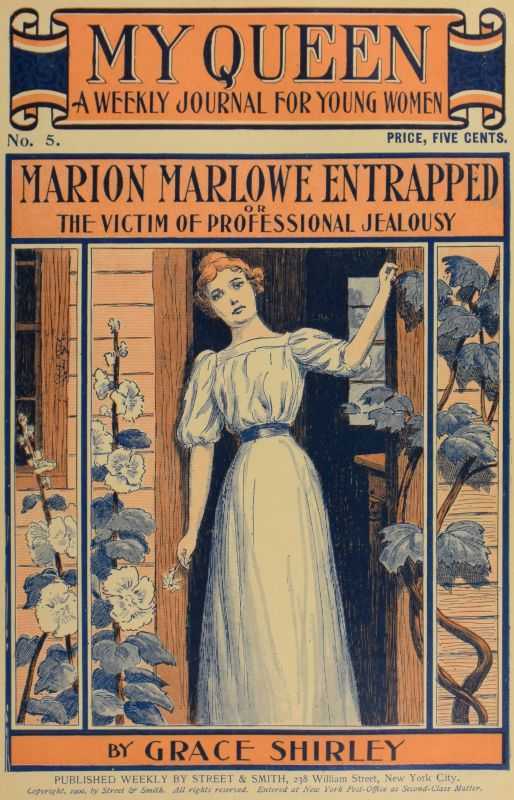
Marion Marlowe is a beautiful and ambitious farmer’s daughter, who goes to the great metropolis in search of fame and fortune. One of the most interesting series of stories ever written; each one complete in itself, and detailing an interesting episode in her life.
Published Weekly. Edited by Grace Shirley.
CATALOGUE
- 1—From Farm to Fortune; or, Only a Farmer’s Daughter.
- 2—Marion Marlowe’s Courage; or, A Brave Girl’s Struggle for Life and Honor.
- 3—Marion Marlowe’s True Heart; or, How a Daughter Forgave.
- 4—Marion Marlowe’s Noble Work; or, The Tragedy at the Hospital.
- 5—Marion Marlowe Entrapped; or, The Victim of Professional Jealousy.
- 6—Marion Marlowe’s Peril; or, A Mystery Unveiled.
- 7—Marion Marlowe’s Money; or, Brave Work in the Slums.
- 8—Marion Marlowe’s Cleverness; or, Exposing a Bold Fraud.
- 9—Marion Marlowe’s Skill; or, A Week as a Private Detective.
- 10—Marion Marlowe’s Triumph; or, In Spite of Her Enemies.
- 11—Marion Marlowe’s Disappearance; or, Almost a Crime.
- 12—Marion Marlowe in Society; or, A Race for a Title.
Thirty-two pages, and beautiful cover in colors. Price, five cents per copy. For sale by all newsdealers.
STREET & SMITH, Publishers,
238 William Street, New York City.
Transcriber’s Notes
Minor punctuation and printer errors repaired.