
The Project Gutenberg eBook of My Queen: A Weekly Journal for Young Women. Issue 5, October 27, 1900
Title: My Queen: A Weekly Journal for Young Women. Issue 5, October 27, 1900
Author: Lurana Sheldon
Release date: October 4, 2018 [eBook #58022]
Language: English
Credits: Produced by MWS and the Online Distributed Proofreading
Team at http://www.pgdp.net (This file was produced from
images generously made available by The Internet
Archive/American Libraries.)
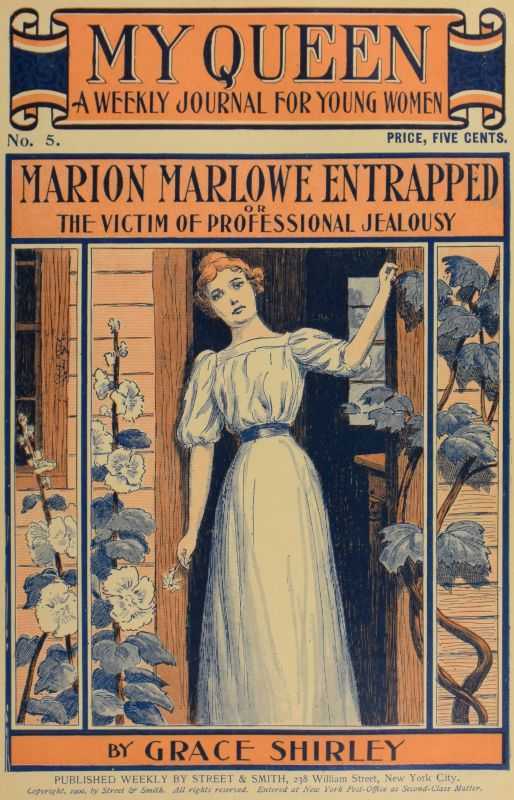
MY QUEEN
A WEEKLY JOURNAL FOR YOUNG WOMEN
No. 5. PRICE, FIVE CENTS.
MARION MARLOWE ENTRAPPED
OR
THE VICTIM OF PROFESSIONAL JEALOUSY
BY GRACE SHIRLEY
PUBLISHED WEEKLY BY STREET & SMITH, 238 William Street, New York City.
Copyright, 1900, by Street & Smith. All rights reserved. Entered at New York Post-Office as Second-Class Matter.
Issued Weekly. By Subscription $2.50 per year. Entered as Second Class Matter at the N. Y. Post Office, by STREET & SMITH, 238 William St., N. Y.
Entered According to Act of Congress in the year 1900, in the Office of the Librarian of Congress, Washington, D. C.
No. 5. NEW YORK, October 27, 1900. Price Five Cents.
Marion Marlowe Entrapped;
OR,
THE VICTIM OF PROFESSIONAL JEALOUSY.
By GRACE SHIRLEY.
CHAPTER I.
“ILA DE PARLOA.”
Howard Everett, musical critic for the New York Star, was just entering the office of his friend, Manager Graham, when he stopped and almost stared at the young lady who was emerging. She was by far the most beautiful girl that Everett had ever seen, and that was saying much, for the critic had traveled extensively. She was not over seventeen, a trifle above medium height, with a brilliant complexion, luxuriant chestnut hair and large gray eyes, that flashed like diamonds as she glanced at him carelessly.
Everett gave a long, low whistle to relieve his feelings, then threw open the door and rushed into the office.
“Who the mischief is she?” he blurted out, instantly.
Clayton Graham, manager of the Temple Opera Company, turned around from his desk and smiled good-naturedly.
“So she’s bewitched you, too, has she?” he asked, jovially. “Well, she’s the first woman I ever saw that could rattle the cold-blooded, cynical Howard Everett!”
“But, good Heavens, man, she’s a wonder! I never saw such a face. It is a combination of strength, poetry, beauty; and, most wonderful of all, goodness! Why, that girl is not only worldly, but she is heavenly, too! Quick, hurry, old man, and tell me what you know about her.”
“That won’t take me long,” said Graham, as he passed his friend a cigar. “Sit down, Everett, and have a smoke. Perhaps it will calm your nerves a little.”
“Pshaw! I’m not as much rattled as I look,” said the critic, laughing, “but for once in my life I am devoured by curiosity, as the novelists say—I want to know where you discovered that American Beauty.”
“Well, you want to know too much,” was Graham’s answer; “but, seeing it is you, I suppose I’ll have to forgive you. But here’s her story, as much as I know of it—and that, as I said, is mighty little. She came here from the country about six months ago. Was poor as poverty, and had not a friend in the city. Well, one night Vandergrift—you know him, the manager of the Fern Garden—heard her singing on the street in behalf of one of those preacher fellows. Her voice was wonderful, and, of course, he stopped to listen. It was just before his opening and he needed a singer, inasmuch as my present prima donna, ‘Carlotta,’ was engaged to sing at the opening of the Olio, the rival garden just across the street from his place. Well, to make a long story short, he made terms with this girl at once—offered her a big price for one night, thinking that the offer would dazzle her so that she would feel too grateful and all that sort of thing to listen to any future offers. Well, he billed her that night as ‘Ila de Parloa,’ and her song was great; she was the hit of the evening. The very next morning, what do you think she did? Took her money and bolted, and Vandergrift lost track of her entirely.”
“What, didn’t she go over to the Olio or to some other concert hall?”
“Nit! She just disappeared, leaving no address behind, after politely informing Vandergrift that his place wasn’t respectable.”
“But didn’t she know that before she sang there?” asked the critic, in amazement.
“It seems not,” was the answer. “She was as green as grass. She thought she was to sing in some Sunday-school concert or something of that sort, I fancy.”
Clayton Graham chuckled over what he thought was a good joke, but his face looked somewhat serious, in spite of his laughter.
“I made her sit in front and see my show before I talked to her,” he added, shrewdly, “and the little Puritan told me, gravely, that she quite approved of it, and was willing to sing for me a week on trial.”
“But where in the world has she been hiding since that night at the Fern Garden? If her voice is so wonderful, I should certainly know if she had been singing.”
“Oh, she tells me that at just that time she decided to be a nurse—went up to Charity Hospital, on Blackwell’s Island, for a time, but the sights up there upset her so she had to give it up and look for something different.”
“Good Heavens! The idea of that face being hidden in a hospital ward!” cried Everett in horror. “Why, if her voice is half as beautiful as her face, I’ll give her a column and make Carlotta green with envy.”
“She’s that already,” said Graham, laughing. “You just ought to see her! Why, that woman would kill her, I believe, if she dared.”
“Strange how jealous these professionals are,” said Everett, soberly, “and particularly after they get a bit old and their voices are not quite up to the standard.”
“Well, Carlotta is unusually jealous,” said Graham, with a little chuckle. “I suppose it is because she is suspicious of me. Thinks I may get stuck on the new face, you understand, old fellow.”
“Carlotta should know the world by this time, if any woman ever knew it,” said Everett, scowling. “Does she imagine you are going to dance attendance upon her forever?”
“If she does, she’ll be mistaken,” said Graham, decidedly, “and as for my new singer, Ila de Parloa, she had better not meddle with her. The girl is as pure and unsophisticated as she is beautiful, and, bad as I am, I admire virtue in a woman.”
“The most of us can,” said Everett, slowly; “but, by the way, what is the beautiful Ila’s right name? ’Pon honor, Clayte, I’ll never tell it.”
“Her name is Marion Marlowe,” was the manager’s answer, “but, of course, for business purposes, we shall stick to ‘Ila.’”
CHAPTER II.
A JEALOUS WOMAN.
The audience had dispersed and the auditorium of the great Broadway Theatre was enveloped in darkness, but Carlotta, the prima donna of the company, was still pacing back and forth in her disordered dressing-room.
She was a handsome woman, of the ripe, sensual type. Her eyes were wide and far apart, like a panther’s; her nose aquiline, and her lips red and voluptuous. As she walked excitedly back and forth she threw her gaudy garments aside, leaving only a trailing skirt of rich white silk and a bodice of lace falling low on her shoulders.
“What do you mean by it, anyway? Am I to be eclipsed entirely? Is Carlotta to be put in the background and sneered at by the people, while that little country girl is standing in the calcium?”
She turned as she spoke and faced a heavily-built man, who sat on a trunk in one corner, gazing calmly at her frenzy.
“Answer me, Clayte Graham!” she almost screamed. “What do you mean by showing so much preference to that country snip?”
The man shrugged his shoulders before he answered. He was growing weary of his prima donna’s anger.
“I believe I am the manager of this company, Miss Thompson,” he said, calmly, “and so long as I hold that position I shall try to fill it, and one part of my duty is to select my singers.”
“And why have you selected her, I should like to know?” cried the woman. “She is as green as grass and her voice has never had an hour of training.”
“City people like grass,” was his tantalizing answer, “and as for training—her voice don’t need it.”
“Oh, of course you’ll stick up for her! I expected it!” was the furious answer. “But I’ll not put up with it! Do you hear me, Clayte Graham?”
Again the man shrugged his shoulders and smiled at her calmly.
“What will you do about it, Miss Temper?” he asked, very coolly. “You certainly will not be so foolish as to break your contract?”
“Oh, I know what you mean,” cried the woman, more wildly. “I can’t sign another for two years without your permission. No manager would dare engage me. Oh, yes, I understand you.”
“Well, you’ll understand me better before I am done with you,” said the manager, emphatically, “for I’ll make Marion Marlowe a famous singer yet—so famous that people will forget that they ever listened to a croaker like Carlotta.”
“That’s it!” shrieked the woman, who had now grown livid. “That’s right, Clayte Graham. Heap your sneers and slurs upon me! I have made money for you for years in more ways than one—but now that my voice is failing you throw me over.”
“You have brought it on yourself, Carlotta, with your fiendish jealousy,” said the man, more gently.
In an instant the woman was on her knees before him, the tears streaming over her painted face and her voice quivering with emotion.
“Oh, Clayte, Clayte, don’t you know it is because I love you! Don’t you know that there is nobody else in this world for me but you, and yet you reproach and abuse me for being jealous!”
“Pshaw!” said the man, indifferently, as he moved away from her. “You are in love with yourself far more than with me, Carlotta. You’d scratch the eyes out of my head this minute if you dared to.”
The woman sprang to her feet and confronted him like a tigress.
“And you refuse to listen to my entreaties?” she asked, breathlessly. “Am I to understand that in future you will do nothing to please me?”
“I shall do nothing that interferes with my success in business,” said the man, very sternly. “I would be a fool indeed to let myself be influenced by a woman.”
The singer’s breath was coming in gasps now, and she clenched her hands together until they were bloodless and rigid.
“Why do you like this girl so much, Clayte?” she asked, tensely. “Is she so much handsomer than I, or does she sing so much better?”
“The public think she is handsomer,” said the man, evasively, “and you have read what the critics say about her voice.”
“But you, Clayte, what do you think?” was the woman’s eager answer; “what is there about her that makes you prefer her?”
Clayton Graham turned and looked the woman squarely in the eye.
“Her greatest charm is her modesty,” he said, slowly and clearly, “and she is attractive to me because she is a virtuous woman.”
If he had struck her with a lash the words could not have cut more deeply. The woman shrank away from him, her breath coming shorter and faster.
“That is like you, Clayte—to ruin a woman and then insult her!” she hissed between her teeth. “But beware, Clayton Graham. You had better not go too far! Carlotta has blood in her veins, real blood, that will avenge an insult. You may yet live to feel the power of a wronged and scorned woman.”
For answer the manager promptly turned his back upon her. The next moment she was alone amid the mocking emblems of mirth. The last vestige of self-control vanished as she fell upon the floor in a perfect frenzy of passion.
“Wait! Wait!” she muttered over and over, between her set teeth. “Just wait until Carlotta has gained her self-control, then look out, Clayte Graham and Marion Marlowe, for, innocent though you are, I shall not spare you! I shall have my revenge! Aye, and it shall be a grand one! Leave a scorned woman alone for plotting vengeance! I shall play my cards most cleverly, but each play shall tell. They shall find me no weakling in the game of love and jealousy!”
She staggered to her feet and began dressing rapidly. It was time that she was out of the dark, empty building. Suddenly a light tap sounded on the dressing-room door.
The woman opened it and confronted a beautiful young girl. It was “Signorita Ila de Parloa,” according to the programme, but in private life, no other than Marion Marlowe.
CHAPTER III.
CAUGHT IN A TRAP.
“Pardon me, mademoiselle, but are you ill?” asked the beautiful girl, kindly. “I thought I heard you weeping, and I could not resist speaking to you.”
She looked so sweet and innocent, standing there in the dismal place, that for a moment a flush of shame dyed the black-hearted woman’s features; then a thought of Clayton Graham and the wrong he had done her flashed over her brain, and instantly the flame of jealousy leaped again within her.
“I must fool her,” she thought in that one brief moment. “I must play my cards well, if I am to wreak my vengeance on this girl.”
Almost like magic, a charming smile took the place of her frown, for Carlotta was an actress as well as a singer.
“I am ill, but only from grief,” she murmured, brokenly. “A dear friend has died, and I have only just now heard of it.”
She turned her face a little and put her handkerchief before it. She wanted to be sure that she had perfectly controlled her features.
“Oh, I am so sorry,” said Marion, sympathetically, as she took a step forward and held out both of her white hands.
“It is dreadful to lose a friend. I am truly sorry for you, Carlotta.”
By this time the wicked woman had formed her plans, and, as she turned and accepted the young girl’s hand, she said to her, pleadingly:
“Dear Miss Marlowe, you are so good and sweet to me that I am almost tempted to ask you a favor.”
“What is it?” asked the girl, with impulsive eagerness. “Oh, I shall be so delighted if I can comfort you.”
“Come home with me to-night, dear,” begged the woman, brokenly. “I shall grieve myself to death if I have to stay alone to-night. Do come; there is nothing to hinder you, is there?”
Marion Marlowe looked astonished at this request from a stranger, but she was not accustomed to stand upon ceremony when the opportunity was offered her to do a kindness.
“Only my twin sister,” was her thoughtful answer. “Dollie will expect me, of course, and will be waiting up. You see she is married, and I am living with her at present. I would feel dreadfully to give her a night of anxiety.”
She spoke so honestly that once more the woman felt a twinge of shame, but she steeled herself promptly against all feelings of sympathy.
“You can send her a message,” she said. “I’ll write it and tell her how kind you are to me. So, now, that is settled, and you are coming. I’ll be ready in a minute and my carriage is waiting.”
Marion helped her to adjust her wraps and then followed her to the carriage, the old door-keeper at the stage door staring after them curiously.
“That is queer,” he muttered, with a shake of his head. “There is mischief in the wind; I’m as sure of it as I’m living.”
But poor, innocent Marion did not dream of mischief; she was only happy to think that she was befriending this woman. Almost the first night of her appearance with the company she had felt that Carlotta disliked her, and her gentle heart had been pained by the thought. She could see no reason why Carlotta should be jealous of her.
“She is far more experienced and clever than I,” she said to herself, for she was too thoroughly modest to ever overrate her own talents.
Now the woman was smiling at her and chatting pleasantly, and the noble girl’s heart was rejoicing in the belief that she had been mistaken in the prima donna’s sentiments and that Carlotta was really a friend to her.
“Is your sister as pretty as you are?” asked Carlotta, after they were seated in the carriage. She was gazing steadily at Marion with an expression of admiration.
“Of course you know you are pretty,” she added, quickly. “All pretty women do, so you need not look so horrified.”
“I think Dollie is much prettier than I,” was the low, soft answer. “She has golden hair and eyes like the violets; then her form is so plump, and so pretty and graceful.”
“Wasn’t there something about the two of you in the papers not long ago?” was the singer’s next question. “Wasn’t she abducted or something, and didn’t you rescue her?”
“A man who boarded with us in the country abducted her, yes,” said Marion, slowly, “and I followed and saved her; he was Professor Dabroski, the Hypnotist.”
“Heavens! What an experience!” said the woman, feigning great sympathy. “Did he—did he wrong her, Ila? But you need not answer; I see it pains you.”
“I do not know,” said the girl, very sadly, “and poor Dollie will never know, because she has no recollection of her experiences.”
“Well, a man would not meet with much success in your direction,” said the woman, laughing loudly. “I fancy you’d hold your own and make things lively for the one who tried it.”
“I should certainly resent such an attempt,” said the brave girl, sternly, “but I guess I am not so weak as a great many women.”
“Oh, no, you are a little paragon of virtue,” thought the woman, bitterly. “You are a wonderful creature, and men love you because you are virtuous.”
Aloud she responded, suavely: “Well, I’m glad you are strong, my dear. You will need all your strength to resist the men in our profession.”
The carriage stopped before a telegraph office as the woman spoke, and Carlotta leaned over and called to the coachman:
“Bring me a blank and a pencil!” Then she turned to Marion and said, smilingly: “You must let me send the message to your sister, dear.”
Marion told her Dollie’s address, without a moment’s suspicion, but she could not help wondering why it took Carlotta so long to write the message.
“I’ll just write a line of condolence to my friend whose sister is dead while I’m about it,” said the woman, as she scribbled another message and handed the two, with the pad and pencil, to the driver.
“I just told Dollie that you are staying with me to-night,” she said, calmly, “but to expect you about noon to-morrow; is that right? I can’t possibly think of letting you leave me before eleven.”
“All right,” said Marion, smiling. “I hope she won’t be worried. It’s the first time that I have been away from her since I came from the hospital.”
“Well, you’ll be separated more in future,” thought the woman again, and, as the outlines of a fiendish plan developed slowly before her vision, her mouth curved in a sneer, which was promptly changed into a smile for Marion’s benefit.
“Here we are at home!” she cried, as the carriage stopped again. “My flat is not beautiful, but it is very cozy, and you shall have a room to yourself, so you will be perfectly comfortable.”
“But I shall not feel that I am much company for you if I do not remain in the room with you,” said Marion, smiling.
“Oh, I’ll feel all right just to know that you are with me. If I can’t sleep I’ll wake you up and make you talk to me.”
“All right,” said Marion, “I’ll agree to that; but, dear me, what a pretty home!” she cried, as she stood gazing into the apartment.
“Here’s a negligé for you,” said Carlotta, gayly, as she took a flimsy wrapper from the wardrobe and tossed it to Marion.
“It’s a trifle too negligé,” said Marion, laughing, as she tried to pull the dainty lace up over her white throat and shoulders.
The woman was busy making herself comfortable also, and as she moved about she talked so gayly and laughed so often that Marion began to wonder if she had forgotten her friend’s death completely.
“She must be a queer woman,” she thought to herself. “She doesn’t need me at all. I wonder why she asked me to come.”
The more she thought it over the more it perplexed her.
“Now we’ll have a bite of supper and go to bed,” said Carlotta, with another laugh. “You’ll have a glass of wine, won’t you, dear, and a cigarette, to help digest your welsh rarebit?”
Her guest’s great eyes darkened as she stared at her for the space of a second.
“Oh, no, thanks,” she said, finally. “I neither drink nor smoke. You know, I am a country girl,” she added, laughing.
“Oh, well, if you won’t, you won’t,” was the woman’s answer, and just at that moment the outer door opened unceremoniously.
Marion looked up in astonishment. There were two well-dressed men, both glittering with diamonds, standing in the doorway, gazing at her admiringly.