
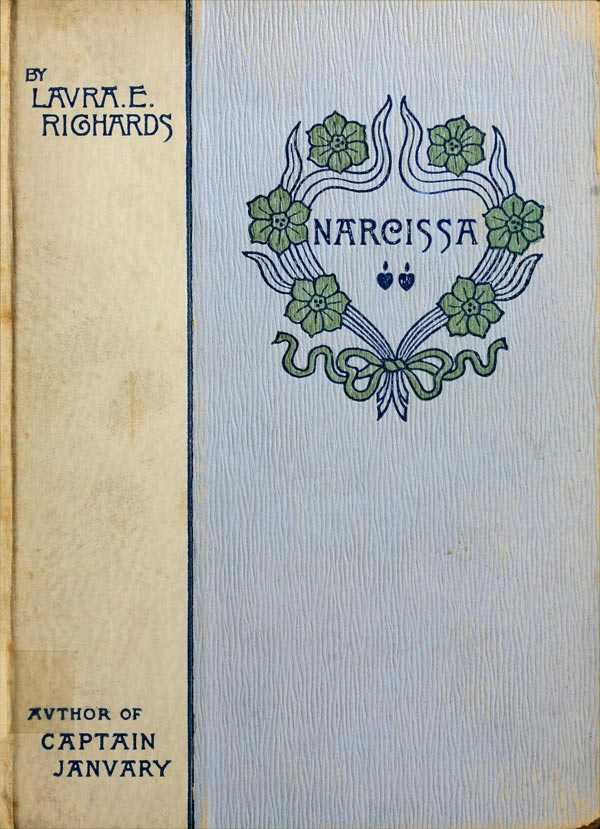
The Project Gutenberg eBook of Narcissa, or the Road to Rome; In Verona
Title: Narcissa, or the Road to Rome; In Verona
Author: Laura Elizabeth Howe Richards
Release date: October 26, 2012 [eBook #41188]
Most recently updated: October 23, 2024
Language: English
Credits: Produced by Mary Akers, Suzanne Shell and the Online
Distributed Proofreading Team at http://www.pgdp.net (This
file was produced from images generously made available
by The Internet Archive/American Libraries.)
NARCISSA
OR
THE ROAD TO ROME
IN VERONA
BY
LAURA E. RICHARDS
AUTHOR OF "CAPTAIN JANUARY," "MELODY,"
"QUEEN HILDEGARDE," ETC.
ELEVENTH THOUSAND
BOSTON
ESTES & LAURIAT
1894
Copyright, 1892,
By the Two Tales Publishing Co.
Copyright, 1894,
By Laura E. Richards.
Copyright, 1894,
By Estes and Lauriat.
All Rights Reserved.
University Press:
John Wilson and Son, Cambridge, U.S.A.
CONTENTS.
| Page | ||
| Narcissa | 3 | |
|---|---|---|
| I. | Dreaming | 3 |
| II. | Waking | 21 |
| In Verona | 43 |
NARCISSA.
NARCISSA.
THE ROAD TO ROME.
Part I.
DREAMING.
Narcissa was sitting in the doorway, feeding the young turkeys. It was the back door of the old gray house,—no one would have thought of sitting in the front doorway,—and there were crooked flagstones leading up to it, cracked and seamed, with grass growing in the cracks. Close by the door-post, against which the girl was leaning, stood a great bush of tansy, with waving feathery leaves and yellow blossoms, like small gold buttons. Narcissa was very fond of this tansy-bush, and liked to pluck a leaf and crush it in her hands, to bring out the keen, wholesome smell. She had one in her hand now, and was wondering if ever any one had a dress of green velvet, tansy-color, with gold buttons. The minister's wife once had a bow of green velvet on her black straw bonnet, and Narcissa had loved to look at it, and to wish it were somewhere else, with things that belonged to it. She often thought of splendid clothes, though she had never seen anything finer than the black silk of the minister's wife, and that always made her think of a newly-blacked stove. When she was younger, she had made a romance about every scrap of silk or satin in the crazy-quilt that Aunt Pinker's daughter, the milliner, had sent her one Christmas. The gown she had had out of that yellow satin—it did her good to think about it even now!—and there was a scrap of pale pink silk which came—was it really nothing but fancy?—from a long, trailing robe, trimmed with filmy lace (the lace in the story-papers was always filmy), in which she had passed many happy, dreamy hours.
It never occurred to Narcissa that she needed no fine clothes to set off her beauty; in truth, she never dreamed that she had any beauty. Color meant so much to her, that she had always accepted the general verdict that she was "pindlin'-lookin'," and joined sincerely in the chorus of praise which always greeted the rosy cheeks and solid-looking yellow hair of Delilah Parshley, who lived at the next house below the old gray one.
Yet it was true that Narcissa had no need of finery; and it was a pretty picture she made, sitting in the doorway, leaning against the door-post. Her hair was nearly black, with no gloss or sparkle, only a soft, dusky cloudiness. It curled in little rings about her broad, low forehead, and round her soft, pale cheeks. Her eyes were dusky, too, but more gray than brown, and the only vivid color was in the scarlet line of her lips. There was nothing unhealthy in her clear pallor, no hint of sallowness, but a soft, white glow. The nostrils of her little straight nose were cut high, which gave them a look of being always slightly dilated; this caused the neighbors to say that Narcissa White was proud, though dear knew what she had to be proud of. As for her dress, it was of blue jean, a good deal faded, but all the better for that; and her white apron, though coarse, was spotless and carefully starched.
The turkeys seemed to approve of her appearance, for they gathered eagerly round her, trying to get their beaks into the dish she held, gobbling and fluttering, and making a great commotion. Narcissa was fond of the turkeys, and had names for all her favorites. The finest young gobbler was called Black Diamond, and he was apt to take unfair advantage of his mistress's partiality, and to get more than his share. So noisy they all were, that Narcissa did not hear the sound of approaching footsteps, nor know that some one had spoken to her twice in vain, and was now standing in silent amusement, watching the struggle for food.
It was a young man who had come so lightly up the steps of the old house that no sound had been heard. He had gone first to the front door, but his knock had brought no answer, and catching the flutter of Narcissa's apron he had come round to the back porch and was standing within three feet of the girl and her clamorous brood.
A very young man, hardly more than a boy, yet with a steady, manly look in his blue eyes, which contradicted the boyish curves of cheek and chin. He was plainly but neatly dressed, and he carried in one hand a small satchel, such as travelling agents affect. His eyes were bright and quick, and glanced about with keen interest, taking in every outline of the house, but coming always back to the girl who sat in the doorway, and who was unlike any girl he had seen before. The house was dim and gaunt, with a look of great age. One did not often, in this part of the country, see such tall doors, such quaint chimneys, such irregular outlines of roof and gable. The green-painted front door, with its brass knocker, and its huge, old-world hinges, seemed to him a great curiosity; so did the high stone steps, whose forlorn dignity suffered perpetual insult from the malapert weeds and grasses that laughed and nodded through the cracks and seams.
And in the dim, sunken doorway sat this girl, herself all soft and shadowy, with a twilight look in her eyes and in her dusky hair. The turkeys were the only part of it all that seemed to belong to the sort of life about here, the hard, bustling life of New England farm-people, such as he had seen at the other houses along the way. If it were not for the turkeys, he felt that he should hardly find courage to speak, for fear it might all melt away into the gathering twilight,—house, maiden, and all,—and leave nothing but the tall elms that waved their spectral arms over the sunken roofs.
As it was, however,—as the turkeys were making such a racket that the girl would never become aware of his presence unless he asserted himself in some way,—he stepped boldly forward and lifted his hat, for he had been taught good manners, if he was a tree-agent.
"Excuse me, lady," he said. "Is this the road to Rome?"
Narcissa started violently, and came out of her dream. She had actually been dressed in the green velvet, and was fastening the last gold button, ready to step into the chariot that was waiting for her,—she loved the word chariot, though the pictures in the Bible made her feel uncertain about the manner of riding in one,—and to drive along the road, the road to Rome. How strange that at this very moment some one should ask about the road!
She raised her eyes, still shining with the dream-light, and looked attentively at the stranger.
"Yes, sir," she answered. "This is the road,—the road to Rome. But it's a long way from here," she added, rousing herself, and rising from her seat. "Shoo! go away, now;" and she waved a signal of dismissal with her apron which the turkeys understood, and at sight of which they withdrew, not without angry cluckings and gobblings directed at the disturber of their evening meal.
"Won't you set down and rest a spell? It's ben real hot to-day, though it's some cooler now."
"It has so!" assented the young man, taking off his hat again to wipe his brow, and dropping his satchel on the doorstep.
"I should be pleased to set a few minutes, if I'm not intruding. And do you suppose I could have a drink of water, if it wouldn't be too much trouble?"
Narcissa went away without a word, and brought back the water, ice-cold and clear as crystal, in a queer brown mug with a twisted handle, and an inscription in white letters.
"I'm sorry I haven't got a glass," she said. "But the water is good."
The young man drank deeply, and then looked curiously at the mug. "I'd rather have this than a glass," he said. "It's quite a curiosity, ain't it? 'Be Merry!' Well, that's a good sentiment, I'm sure. Thank you, lady. I'm ever so much obliged."
"You no need to," responded Narcissa, civilly.
"I—I don't suppose you want any trees or plants to set out, do you?" said the stranger. "I am travelling for a house near Portland, and I've got some first-rate things,—real chances, I call 'em."
"I—guess not," said Narcissa, with an apprehensive glance over her shoulder. "I only keep house for the man here,—he's my father's uncle,—and he don't buy such things. I wish"—she sighed, and looked longingly at the black satchel. "I suppose you've got roses, have you, and all kinds of flowers?"
"I should think so!" replied the youth, proudly. "Our house is the greatest one in the State for roses. Let me show you some pictures." He opened the satchel and took out a black order-book filled with brilliant pictures.
"Oh!" cried Narcissa, "I—I guess I'd better not look at 'em. I don't believe he'd like it. Not but what I'm just as much obliged to you," she added, hastily.
But the stranger had already opened the book.
"Just look here, lady," he said. "Why, it can't do no manner of hurt for you to look at them. Just see here! Here's the Jacqueminot rose, the finest in the world, some folks think. Why, we've got beds and beds of it. Splendid grower, and sweet—well there! I can't give you any idea of it. Cornelia Cook! that's a great rose nowadays. And here's a white blush, that looks for all the world like—"
Here he stopped suddenly; for it was Narcissa's cheek that the rose was like, he thought, and it came to him suddenly that he did not want to say such things to this girl.
The girl at the house below, when he had paid her compliments, had laughed in his face, well pleased, and seemed to ask for more; but she was an ordinary girl, like other folks. This soft, shadowy maiden might shrink away, and vanish in the dusky porch, if he should touch her rudely.
He need have had no fear, for Narcissa would hardly have heard or understood his compliment. She was gazing with hungry eyes at the bright pictures, drinking in every shade of crimson and scarlet and gold.
"Oh, stop!" she cried eagerly. "Oh, may I read about that one? Ain't it beautiful! May I?"
"Well, I should think you might!" replied the gallant agent, holding the book toward her. "Here, lean right over me; I'd like to read it too."
"'This grand rose,'" Narcissa read aloud,"'has created an epoch in rose-growing. Of free habit and luxurious growth, the plants form the most splendid ornament of garden or hot-house. The beautiful, perfectly-shaped flowers show a marvellous blending of colors, in which a rich apricot predominates, shading into light pink, bright canary, and pale yellow. The outer petals are grandly recurved, forming a fine contrast to the Camellia-like inner petals. With its rare and exquisite fragrance, its bold and beautiful foliage, and the unparalleled profusion with which its splendid blossoms are borne, we claim that this rose is absolutely without a rival.'"
Narcissa drew a long breath and looked up, her eyes full of awe and admiration. "Ain't that elegant?" she said simply. "They have great writers there, don't they?"
The youth smiled, as he thought of little Mr. Bimsey, who "got up" the catalogues and kept the accounts; then, reminded by this and by the fading light that he had still a good way to go before nightfall, he added, rising reluctantly from his seat,—
"I must be going, I guess. You haven't any notion how far it might be to Rome, have you, lady?"
Narcissa shook her head.
"It's a long way," she said. "When Uncle Pinker goes there with the turkeys in the fall, it takes him the whole day to go and come."
"You haven't got a map of the county?" persisted the youth. "I'd ought to have one myself, and I guess I shall have to get me one. I'm a stranger in these parts."
Narcissa shook her head again. "We haven't got any kind of a map, as I know of," she said; but next moment her face brightened. "We've got a picture of Rome," she said,—"a real handsome picture. Would you like to see it?"
"Well, if it ain't too much trouble."
Narcissa led the way into the house, cautioning the stranger to tread softly. "Uncle Pinker is asleep," she said. "He's real old, and he sleeps in the afternoon, most times. He's so deef, he wouldn't hear you most likely, but you never can count on deef folks. Not but what he'd be pleased to see you," she added, with a doubtful look at a closed door as she passed it.
"I'd ought to make you acquainted with my name, seem's though," said the agent, following her into a dim, dreary room. "My name's Patten,—Romulus Patten." He paused, and then went on: "Folks always ask how I got my name, so I get into the way of firing right ahead before they ask. My mother got it out of the history book. She was a great hand for history, my mother was. It seems queer, my going to Rome, don't it? They made consid'able fun about it, down to our place, but I'm used to that, and don't mind it."
There was no answering gleam in Narcissa's lovely eyes. "Romulus? was he in the Revolution?" she asked. "I had to leave school before we got through history. I'd only got as far as the Battle of Lexington, when Aunt Pinker died, and I had to come and keep house for Uncle Pinker. It was real interestin'," she added, with a little sigh of regret, "I wish't I could have finished history."
Romulus Patten flushed with shame and anger,—not at the girl, but at the sordid people who had kept her in ignorance. He had gone through General History himself, and having a good memory, considered himself very well up in such matters. When he came back, he thought, perhaps he might manage to stop a spell, and tell her a little about things. Romulus in the Revolution! it was a scandalous shame, and she so sweet and pretty!
But here was the picture of Rome, and Narcissa turning with gentle pride to introduce him to it.
"Ain't it handsome?" she cried with enthusiasm. "I do like to look at it the most of anything, seem's though. I think you're real fortunate to be going there, Mr.—Mr. Patten."
She was silent, gazing with delight that was fresh every time her eyes rested on the beloved picture; and Romulus Patten was silent too.
What was it he saw?
Asteel engraving, dim and gray, like the house, like the walls on which it hung; framed in dingy gold, spotted and streaked. Within, as in a dull mirror, appeared towers and temples, columned porticos and triumphal arches: the whole seemed to be steeped in pale sunshine; in the background rose a monstrous shape which Romulus' practised eye, familiar with the illustrations in the General History, recognized as the Coliseum. "That's Rome!" said Narcissa, softly. "Ain't it elegant?"
The young man glanced at her, with a light of sympathetic amusement in his eyes. This was her little joke; he had hardly thought she would make jokes, she was so quiet. But the smile faded into a look of bewilderment, which quickly strove to efface itself; for Narcissa was not in jest. She was gazing at the picture with a rapt look, with almost passionate enjoyment. She had forgotten him for the moment, and had entered the city of her dreams as she so often entered it, robed in velvet and satin (it was the tansy-colored velvet this time, and the buttons were very splendid indeed, and she had a bunch of roses in her hand), riding in a chariot. She was passing under those wonderful arches; that soft, mysterious sunshine wrapped her in a cloud of glory. Presently she would meet other beings, splendidly dressed like herself, who would greet her with smiles, and tell her of other strange and beautiful things that she was going to see. Ah, to be in Rome! to be really going there!
"Ain't it handsome?" she repeated, turning her soft eyes on her companion. "You're real fortunate to be going there."
Romulus Patten stammered. "You—you're sure that is Rome?" he said. "This same Rome, down east here? It don't hardly seem just like a down-east place, does it?"
The soft eyes grew wide, and the lips smiled a little. "Why, it says so!" said Narcissa. "See here, right under the picture, 'Rome.' So it couldn't be any place else, could it?"
"I—I suppose not," murmured Romulus, hanging his head, like one found in an unpardonable ignorance.
"I hope to go there some day," the girl went on. "It's never been so I could, yet; and folks don't go much from about here. Ain't it queer? They'll go the other way, to Tupham, and Cyrus, and other places that's just like—like to home here,—" and she gave a little disparaging glance along the bleak road, with its straggling willows and birches,—"and there's scarcely anybody goes to Rome. And it like that!" she added, with another look of loving reverence at the old picture.
"You said something about your uncle going," suggested Romulus. "Hasn't he ever told you about the place,—whether it's like the picture?"
Narcissa shook her head. "I asked him last time he come back," she said. "I've asked him two or three times; but all he does is nod his head and laugh, the way he has. He ain't one to talk, Uncle Pinker ain't. He goes to Rome once every fall, when he kills the turkeys. The biggest part of 'em goes the other way, to Tupham and on beyond, but he allers takes some portion to Rome. He says they're great on turkeys there. I should think they would be, shouldn't you?"
This was a long speech for Narcissa, and she relapsed into silence and the picture.
"And you live all alone here with a deef old man who don't talk?" said Romulus Patten. "Excuse me, Miss—well, you haven't told me your name, have you?" and he laughed a little.
"Narcissa," was the reply. "Narcissa White."
"Thank you!" said the well-mannered Romulus. "You live all alone with him, and don't see no company? It's lonesome for you, ain't it?"
"I—don't—know," Narcissa answered thoughtfully. "I never thought much about it's bein' lonesome. I have the turkeys, and they're a good deal of company: and I—I think about things." A faint color stole into her clear white cheek, as she remembered the velvet gown. She supposed a man would consider such thoughts "triflin'."
"Don't you see anything of the neighbors?" the young man persisted. "There's a young lady down at the next house, half a mile below here,—wide-awake looking girl, with yeller hair and red cheeks, looks some like a geranium; don't you know her?"
"That's Delilah Parshley!" said Narcissa. "She's real handsome, don't you think so? No, I don't see her, only to meetin' sometimes. I guess she don't care to go much with folks up this way. Her friends is mostly the other way, on the Tupham road. Their house sets on the corner, you know."
Narcissa did not know—how should she?—that Delilah Parshley and the other girls of her sort considered her "a little wanting," because she was silent, and never seemed interested in the doings of the neighbors, or of such stray travellers as came along the road to Rome. She felt kindly toward the Parshleys, as toward all the "meetin' folks;" but she rarely held speech with them, and was "gettin' as dumb as the old man was deef," the neighbors were beginning to say.
"But haven't you got any folks of your own?" this persistent young man went on. "I—I hope I'm not too forth-puttin', Miss White, but I'd like to know."
"I'm sure you're real kind to ask!" replied Narcissa, who was not used to having any one care to ask her questions.
"Yes, I've got some folks. Father's livin', but he's married again, and there's more children, and he was glad to have me find a chance; and it was so that I was glad, too," she added, with no resentment in her tone, but a touch of sadness, which made the ready color come into those tell-tale cheeks of Romulus Patten.
"It ain't right," he said hotly. "I'll be switched if it's right. Ain't there a better chance you could get, somewheres round here, if you don't feel to go fur away? If you did feel to make a change, there's lots of chances down our way. I'd be real pleased to be of assistance, if there was any ways I could; I would, now, Miss White."
Narcissa looked a little alarmed.
"You're real good," she said. "But I ain't thinkin' of any change. Uncle Pinker means well by me, and the work ain't too hard, 'cept come hayin' time, and along through the spring, sometimes, when I have to help in the gardin. I'm sure I'm obliged to you!" she added gratefully, with a shy, sweet look in her eyes that made Romulus feel as if the day had grown suddenly warm again.
"Well!" he said, with an effort, "I reely must be going, I suppose. I've had a good rest, and I must be getting on."
But Narcissa was not ready to have him go now. Her heart had been stirred by the unwonted kindness, the interest which this handsome stranger with the kind eyes had shown in her, Narcissa White, who was of no account to any one in the world. Her heart was stirred, and now she must show her gratitude in such simple wise as she could. She made him sit down at the table, and brought him doughnuts and milk, and the prettiest apples she could find in the cellar. In fear and trembling she took from the cupboard a tumbler of apple jelly, wondering as she did so what Uncle Pinker would say, and whether he would call it stealing. She had made the sweetmeat herself, and had earned the money to buy a half-dozen tumblers, by braiding rugs for Mrs. Parshley. She had picked the apples, too. Altogether, she thought she had a right to offer the jelly to the kind stranger.
He was delighted with his little feast, and pronounced the jelly the best he had ever tasted. She made it herself? he wanted to know! girls were smart on the road to Rome, he guessed. He drank her health from the brown mug, and again she apologized for not having a glass to give him. "There is good glasses," she said with a blush, "but Uncle Pinker keeps 'em locked up. I broke one when I first come here, two years ago, and he's never let me touch one sence."
Romulus Patten muttered something in confidence to the brown mug, but Narcissa did not hear it. She was too happy to think that other people might consider Uncle Pinker a mean old curmudgeon. She felt a warmth about the heart, wholly strange to her starved and barren life. It had been dear and precious to dream, oh, yes! but here was reality. Here was some one like the people she dreamed about, only real flesh and blood, instead of shadows. He cared, this wonderful person, really cared, to be kind to her, to say pleasant words, and smile, and look at her with his bright, gentle eyes. And he was going to Rome! that was almost the best part of all, for now she could fancy him there, and would have some one to speak to, when she made her shadowy journeys to the Dream City.
She was hardly sorry when, the simple feast over, her new friend rose to go. It could not last forever, and Uncle Pinker would be waking up soon, and was apt to be "a little set," as she charitably expressed it, when he first woke. She made apologies for not having roused the old man, and was sure he would have been "real pleased" to see Mr. Patten, if it had been any other time of the day. She was a little startled when Romulus held out his hand at parting. She had an idea that people only shook hands at funerals; but she laid her little brown palm in the warm, strong one held out to her, and felt a cordial pressure that brought the tears to her eyes,—the sweet, forlorn gray eyes that never guessed at their own sweetness or sadness! Romulus Patten looked long into them before he let the little hand go.
"I sha'n't forget you, Miss White," he cried. "You may be sure of that; and I hope you won't forget me, either, for a spell. I may stop on my way back, if I don't have to go round another way when I leave Rome. I'll try my best to fix it so as I can come back this way, and then—then perhaps you'll let me call you Narcissa. Good-by—Narcissa!"
"Good-by!" echoed Narcissa; and then she stood on the doorstep and watched him, her new friend, the first friend she had ever had, as looking back often, and waving his hand once and twice in sign of farewell, he passed along down the road to Rome.
Part II.
WAKING.
"Good mornin', sir; can I sell you anything this mornin'?"
It was a strong, clear voice that broke rudely in upon Uncle Pinker's morning meditations as he sat in the doorway (the same setting that had framed Narcissa yesterday, but how different a picture!), smoking his short black pipe.
"Can I sell you anything?" repeated the voice, with an imperious intonation. Uncle Pinker looked up. The sound was a mere murmur in his ears; but when he saw the figure before him, he recognized it for one he had sometimes seen on the road, and knew instinctively what was wanted. "Ga-a-ah!" said Uncle Pinker.
This remark was a favorite one of the old gentleman's, and though no one knew its precise derivation, there was no doubt of its being the quintessence of scornful refusal. He used it constantly, but it never had such bitter force as when he was asked to spend money. "Ga-a-ah!" said Uncle Pinker again.
"What might you mean by that?" asked the newcomer, with some asperity. "That ain't no form of salutation ever I heard yet. Haven't you a civil tongue to use, old gentleman? You're ancient enough to have learned manners, if you'll excuse me sayin' so."
The old man snarled again. "I'm stone deef!" he said. "I don't hear nothin' you say, nor yet I don't want to hear. You needn't waste no time, fur as I'm concerned."
"Stone deef, be you?" returned the pedlar. "Well, that has its compensations, too. You wouldn't buy anything if you had the hearin' of ten, and now I can have the pleasure of tellin' you what I think of you. You skinny, starved old weasel, you're about the wickedest-lookin' piece I ever set eyes on. Real old screw, you are, if ever I saw one. Pity your folks, if you've got any; more likely you've starved 'em all off, though, and are skeered of dyin' yourself, fear of havin' another funeral to pay for. The Lord leaves folks like you for a warnin' to others, understand?—set up, kind of, to show how ugly a critter can be when he tries. Oh, you needn't snarl at me. I'm enjoyin' myself real well, I tell you. There's other ways to have a good time besides sellin', if it is my trade. Guess I'll set down a spell, uncle, sence you are so pressin'."
Uncle Pinker was almost foaming with rage by this time. He could hear no distinct words, but the insulting nature of the stranger's speech was evident from look and gesture. He was just wondering whether his strength would suffice to throw himself on the intruder, when a new figure appeared on the scene,—Narcissa, who had been busy in the back kitchen, and catching some high note of the stranger's scornful speech, now came hurrying out to see what was the matter.
She found Uncle Pinker quivering in his chair, his lean, veined hands clutching the arms, his little red eyes starting from his head with impotent fury; and sitting on the doorstep, looking up into his face with a smile of calm amusement, was the strangest figure Narcissa had ever seen.
Aperson of middle age, with strongly marked features, and a countenance of keen intelligence, but dressed in a singular manner. A suit of brown cloth, rather worn, but well-brushed and neat; loose trousers, and an odd, long-skirted coat, reaching to the knees, both coat and trousers trimmed with rows of narrow black-velvet ribbon. The person's hair was cropped short; the person's head was surmounted by a curious structure, half cap, half helmet, like that worn by Miss Deborah in "Cranford," only of far humbler materials. Beside the person, on the doorstep, lay a bag, of the kind affected by pedlars, lank and shiny, and particularly unattractive in appearance.
Such was the individual at whom Narcissa White was now staring with eyes very wide open, her stare being returned by a quizzical gaze, half smiling, and wholly shrewd and observant.
"Mornin', young lady," said the strong, clear voice. "Wonderin' what I be, are ye? fish or flesh, or red herrin', or what, hey? Well, I'll put you out of your misery. I'm a woman, that's what I am; the folks calls me Bloomer Joe. Now, then, do you want to buy anything of me?"
Here her tone changed, and her voice rose and fell in a kind of chant, dwelling with dramatic emphasis on a telling phrase here and there.
"Buy any lace, threads, or needles, pins—or—essences? Here's a looking-glass to see your face in—prettiest face I've seen along the road! (I tell that to every girl I see, and most of 'em believe it; but you ain't that kind, so you shall have the joke instead.) Real celluloid ivory combs, fit for the President's wife, sure enough. Gold beads, stockin'-supporters, teeth-brushes,—and—stickin'-plaster."
Here she dropped back into a conversational tone, opening her bag as she did so, and drawing forth some of its treasures.
"Just look at this lace, young lady! strong enough to hang yourself with, if you was feelin' that way, or to hang the old gentleman here, if you was feelin' another. I know which way I'd feel, quick enough. Not your father, is he?" she added, seeing a look of distress in Narcissa's eyes.
"Oh, no," said Narcissa, speaking for the first time. "But—he's my uncle,—at least, my father's uncle; and I—guess you'd better not talk so, please."
"All right," said the stranger. "I won't, not if it is any trouble to you. It would be meat and potatoes and apple-pie for me, if he was my uncle, to hear him get his rights for once in a way; but I see you're one of the soft-hearted ones. Want any salve? Here's a kind that will cure corns, bunions, rheumatism, croup, sore-throat, backache, horse-ail, and colic; cure most anything except a broken heart, and won't do a mite of harm to that. But you don't need any salve, and the old gentleman, he's past it. Well, then, here's ribbons, all colors of the rainbow,—red, yeller, blue, see? handsome they are, and cheap as good counsel. Aha! you'd like to see them, hey?"
Narcissa had indeed changed color at sight of the bright ribbons, and she now gave an anxious glance at Uncle Pinker, who was still fuming and snorting in his chair.
"You, Narcissy White, send this critter away, can't ye?" he snarled; "or else go into the house yourself, and go to work, not stand foolin' here, with the work all on the floor. Go 'long, d' ye hear? This woman, or feller, or whatever she calls herself, can talk till she's hoarse; she won't hurt me, nor she won't get nothin' out of me."
"Could I get a drink of water, do you s'pose?" the pedlar asked quietly, paying no attention to the angry old man. "Needn't trouble to bring it out; I'll go right into the house with you, if you've no objections."
She followed Narcissa into the house before the latter could make any remonstrance, and shut the door after her.
"He don't reelly disturb me," she said, "not a mite; but we can trade better in here. Let me try some of the ribbons on your hair. I don't often see such hair as this on my tramps, and that's no compliment, but the plain truth."
"Oh!" cried Narcissa, in distress. "You're real kind, but please don't. I haven't got any money to buy things with, and I couldn't take your time for nothing. They are handsome, ain't they? Oh, that yellow is just elegant, isn't it? It's like the buttons; I mean like the tansy blossoms. I thank you for showin' them to me, I'm sure, but it ain't any use for you to."
"Don't he pay you for workin' here?" asked the pedlar, with a sharp glance.
"Yes, he does pay me," Narcissa answered,—"a dollar and a half a week. But—but I don't get it very reg'lar, sometimes, and I'm saving up to buy me a dress. I need one bad, to wear to meetin'."
The pedlar frowned. It was against her principles to leave any house where she knew there was money, without selling at least a box of salve; but this seemed a hard case.
"A dollar and a half a week!" she muttered scornfully. "The old caraway seed! he'd better go and live in Rome, and be done with it. He'll find plenty of company there."
Narcissa looked up with wide-open eyes.
"Why do you say that?" she asked.
"Because Rome is the skinniest place on this round earth," was the reply; "and I think 'twould suit your uncle down to the ground."
Still the girl gazed. "I guess you're mistaken," she said quietly. "I guess you never was there, was you?"
"Never till yesterday," replied the woman, "and never want to be there again. You see, this isn't my own country at all, as you may say. I belong in another part of the State, and most generally keep to my own beat, havin' my regular customers, understand? and goin' round amongst 'em. But oncet in a while the fancy takes me to roam a little, and see other parts; and so I come round through Damascus and Solon, and passed through Rome yesterday."
"Oh!" cried Narcissa, breathlessly. "You did? do tell me! and wasn't it elegant? I don't see how you could come away. Did you walk about, and see all them handsome buildings? and did you see the folks?"
The pedlar gazed at her in wonder. The girl's eyes were like stars, her whole face alight with enthusiasm. What did it mean?
"Handsome buildin's?" she repeated. "In Rome? I'll tell you what I saw, child, and then you'll know. I saw the forlornest place on this earth, I don't care where the next may be. I saw rocks and turkeys, and turkeys and rocks. The street (if you can call it a street; 'twould be called a hog-wallow, down where I come from) is solid rock where it ain't mud, and solid mud where it ain't rock. There's a house here and a house there, and they all look as if they was tryin' to get away from each other, but didn't darse to move for fear of fallin' down.
"The folks I saw were as lean as their own turkeys, and I can't say no further than that. I tried to sell 'em some of my salve; told 'em 'twould heal the skin where 'twas broke with the bones comin' through, but they was past jokin' with.
"I tell you, child, Rome is the—Why, what's the matter?" The good woman stopped suddenly, for Narcissa was trembling all over, and her face shone white in the dim, half-lighted room.
"I—I don't understand you!" she cried wildly. "There's some mistake; you went to the wrong place, and never saw Rome at all. Look here!" and she led the way swiftly across the hall, into the other room, the room into which she had taken Romulus Patten the day before. She almost ran up to the picture, and motioned the pedlar, with an imperious gesture, strange in so gentle a creature, to look at it. "That is Rome!" cried Narcissa. "You went to the wrong place, I tell you. This—this is Rome!"
The woman drew out a pair of spectacles, and fitted them on her nose with exasperating deliberation. She took a long look at the picture, and then turned to the trembling girl, with a kind light of pity in her eyes struggling with amusement.
"You poor—deluded—child!" she said at length. "Who ever told you that was Rome, I should like to know?"
"But it says so!" cried Narcissa. "Can't you read? 'Rome.' There it is, in plain letters; and I—don't—" she wanted to say "I don't believe you!" but the blue eyes that met hers steadily showed nothing but truth and kindness.
"So it is Rome, dear!" said the pedlar, speaking now very gently. "But it's ancient Rome, over in Europe; Italy, they call the country. Where the ancient Romans lived, don't you know? Julius Cæsar, and all those fellers who cut up such didoes, hundreds of years ago? Don't tell me you never went to school, nor learned any history."
"I—I went for a spell!" Narcissa faltered. "I had to leave when I was fourteen, because I was wanted to home, and we hadn't only got to the Battle of Lexington in history. I did hope to learn about the Revolution, to home, but father's wife didn't think much of readin', and she burned up the book."
There was a silence, and then the good-natured pedlar began fumbling in her bag.
"It's a livin' shame!" she cried indignantly. "Here—no, it ain't, neither. Well! I did think, much as could be, that I had two or three little books here, and I should have been pleased to give you one, dear, just for keeps, you know. But they don't seem to be here. Well, never mind! I was goin' to ask if you wouldn't like this piece of yeller ribbon you seemed to take to. It's a real good piece, and I should be pleased—I declare, child, I do feel bad to have spoiled your pretty notion of Rome. I s'pose you thought likely you'd go there some day, hey? well, well! sit down, and let me put this ribbon on your hair. You no need to be scairt of me. I act kind o' wild sometimes, like I did with your uncle, but it's four parts fun. I'm well known up our way, and anybody'll tell you I come of good stock, if I am crazy enough to wear sensible clothes, that don't hender me walkin' nor settin'. Mis' Transom, my name is. And he called you Narcissy, didn't he? Why, I had a cousin once, name of Narcissy; it's not a common name either, and I allers thought it was real pretty. Set down here, dear, and let's talk a spell."
Thus the kind woman rattled on, watching the girl keenly the while. She was making time for her, giving her a chance to recover from what was evidently a heavy blow.
But Narcissa scarcely heard her. She was dazed; her dream was shattered, her glorious city laid in ruins, the beauty and romance of her whole life dashed away, as a rude touch dashes the dew from the morning grass.
As she sat, trying to realize it, trying to think that it really was not so much, that there would be other pleasant things, perhaps, to fill the barren working days, and gild the grayness of the long lonely Sabbaths,—as she sat thus, a new thought flashed into her mind, piercing like the thrust of a sword.
Her friend, Romulus Patten! She had sent him off on a false scent, had lied to him about the place, the city—she could hardly bear even to think of its dishonored name now. He had gone there, thinking to find what she had told him about,—the stately houses, the arches, the soft sunshine gilding all. What would he think of her when he found it was all a cheat, a lie? He had been kind to her, had seemed to care about her as nobody had ever done in her forlorn young life; and this was how she had repaid him!
She started up, shrinking as if from some cruel sting. "I must go and tell him!" she cried. "I lied to him, though I didn't know it was a lie. I must go and find him, and tell him I didn't mean to."
"Tell who?" cried the pedlar, catching her by the arm. "What is it troubles you so, Narcissy? Who did you lie to, I should like to know? Don't believe she could tell a decent lie if 'twas to save her own soul," she added to herself.
But Narcissa did not heed her.
She had taken down her sunbonnet from a nail, and was tying it under her chin with trembling fingers, with a feverish haste that took no note of anything.
"Where are you going?" cried Mrs. Transom, now beginning to be frightened at the girl's distracted looks. "You're never going out of the house feeling like this? You'll have a fit of sickness, sure as you're alive, and then where'll you be? and 'tis all foolishness, too, I'll be bound. I can't understand a word you say. And there's a storm coming up, too. I see it as I was coming along, and was reckoning on finding shelter here when I fust stopped to speak to the old gentleman. There, hear the thunder this very minute! Narcissy! Why, good land of deliverance, she's gone!"
The storm came on very suddenly,—first, a low bank of cloud heaving in sight on the western horizon, long and misshapen, like the back of a kraken; then the whole monster revealed, rising across the sky, tossing monstrous arms about, showing ugly tints of yellow, ugly depths of purple and black.
There was no lightning at first, only low mutterings of thunder, and every now and then a pale lifting of the darkness, as if the monster were opening his cavernous jaws, showing glimpses of dim horror within. Then, of a sudden, with no note of warning, the whole sky sprang into flame, the whole air was a roar and a bellow, deafening the ears, stunning the senses,—and the storm broke over the road to Rome.
The rain struck aslant, driving a spray before it, as of a mountain stream. In five minutes no road was to be seen,—only a long stretch of brown water, hissing and writhing under the scourge of the rain and wind. A horse came plodding carefully along, crouching together as well as he could, picking his way through the water. The two men in the buggy behind him were crouching, too, and trying to hide behind the rubber boot. It was some comfort to think that they were trying to keep dry, though both knew that they were already drenched to the skin.
"It's lucky for me that I met you," said the younger of the two, shaking himself, and sending a shower of spray in all directions.
"P'r'aps 'tis just as well," replied the other man, with a chuckle. "You'd hardly have known yourself from a muskrat by this time, if you'd had to foot it from Rome here. Been stoppin' there?"
"Stopping as long as I cared to," said the youth, who was no other than our friend Romulus Patten. "I got there last night, and was good and ready to come away this morning. I'm travelling for Brown's Nurseries, and there don't seem to be any call for any of our goods in Rome. Stone-crop's the only plant they raise much of, I guess."
"Well, that's so," said the elder man. "That's so, every time. I never knew but one man that could make anything grow in Rome, and he carted all the dirt three miles, over from North Podley, before he could make a seed grow. Yes, sir, he did so. Mighty poor country up that way. Some say the Rome folks don't see any garden-truck from year's end to year's end, and that if you ask a Rome girl to cook you up a mess of string beans, she takes the store beans and runs 'em on a string, and boils 'em that way; but I dono. I'm from Vi-enny way myself."
"My gracious! what's that?"
The whole world had turned to livid white for a moment, dazzling and blinding them; but still they had seen something on the road, something like a human form, torn and buffeted by the wind and the furious rain, but staggering on towards them with uncertain steps.
"My God! it's a woman!" cried Romulus Patten. "Stop your horse, and let me get out. A woman, alone in this storm!"
He sprang to the ground, and holding his arm before his face to keep off the blinding rain, made his way towards the forlorn figure splashing through the water, now ankle deep in the road, stumbling, often on the point of falling.
"Hold up, lady!" he called out, in his cheery voice. "There's friends here! Hold up just a minute!"
At the sound of his voice the woman stopped and seemed to shudder and clasp her hands. "I never meant it!" she cried out wildly. "I can't see you, I'm most blind, but I know your voice. I never meant to lie to you about Rome. I—thought—'twas all true; and when I found out, I—came—to tell you. I never meant to send you there on a lie."
"Narcissa!" cried Romulus Patten. "Oh, Lord! Oh, you poor little thing! and you thought I didn't know? I'd ought to be shot, that's what I ought to be. Here, you poor little thing, let me take your hands! They're like wet ice, and you're shivering all over. Oh, dear me! come with me, and get right into this buggy out of the rain. Oh, Lord! and I let you go on thinking I didn't know!"
Half leading, half carrying her, he made his way to the buggy, and then fairly lifted her in his strong young arms to lay her on the seat; but here an obstacle was interposed in the shape of another arm as strong as his, and a good deal bigger. "Easy, there!" said the owner of the buggy. "Seems to me you're makin' yourself rather too free, young feller. Do you think I'm goin' to have that gal brought in here, runnin' all the rivers of Babylon? Who in Jerusalem is she, anyway? Some of your folks?"
Romulus Patten's face was streaming with cold rain, but he flushed as if a flame had swept over him.
"She's the young lady I'm going to marry," he said. "Will you take her in, or shall I carry her home this way?"
"Now you're talking!" the stranger said, removing his arm and making way. "Why didn't you speak up before, sonny? Here, give me a holt of her!" He lifted Narcissa gently into the buggy, and drew her close to his side, laying her head well up on his shoulder so that she could breathe easily. "Family man," he explained. "Gals of my own. Now you reach under the seat there, and bring out a shawl you'll find."
Romulus obeyed, and half angry, half pleased, watched the stranger as he deftly wrapped the shawl round the fainting girl, and put her dripping hair tenderly off her face.
"Allers take a shawl along," he explained further. "Wife enjoys poor health, and have to be ready for a change of wind. Comes in handy, don't it? Now get in, young feller, and tell me where to drive to. You needn't look down in the mouth, either, 'cause you don't know everything in creation yet. Time enough to learn, and you're likely to learn easy, I should say.
"And you rest comfortable, my dear," he added, speaking to Narcissa as if she were a small child. "Here's your friend alongside of you, and you're just as safe as you would be in the best stuffed chair in the settin'-room at home. Fetch your breath, like a good girl, and try to look about you."
But Narcissa heard never a word, for she had fainted.
An hour later, Romulus Patten and Mrs. Transom were sitting by Narcissa's bedside, watching her. She had fallen into a deep, childlike sleep, and their low voices did not disturb her.
"The old gentleman was so mad he was all cheesed up," the pedlar was saying. "There! I was fairly sorry for him, old weasel as he is; so I let him go on for a spell, till he was clean tuckered out, and then I e'en took him up and put him to bed, same as if he was a child. Glad enough he was to get there too, if he was mad. Then I took and made him some warm drink, and gave him to understand I'd stay by till Narcissy come back, and here I be. And now, young man," she added, fixing her keen blue eyes on Romulus's face, "I've got a word to say to you. You let fall something when you was bringin' this child in—I won't say that I wasn't mighty glad to see her, and you, too,—but you let on something about keepin' company with her. Now, I want to know right here, what you meant, and who you are, and all about it. Oh, you may look at my pants much as you're a mind to. I come of good folks, and I dress as seems fit to me, and I don't care in any way, shape, or manner what folks say or think. I've been snoopin' round some, since I put that old man to bed, and I found the family Bible; and this child is the lawful daughter of my cousin, Narcissy Merrill, that I haven't heard of this twenty years. Bein' so, I'm goin' to stand by her, as is right and proper; so, now I'll hear what you've got to say. I've as good a right to do for her as that old skimp-jack in there, if he is her father's uncle."
Romulus Patten spoke out frankly. He had "taken to" Narcissa from the first moment he saw her. When was that? Well, it wasn't long ago, it was true. It was only yesterday; but he wasn't one to change, and he had never seen a girl yet that he would look twice at. And when she came, in all that awful storm, just to tell him,—here the young man choked a little, and the woman liked him the better for it,—he made up his mind then, he went on, all in a minute, that she should be his wife; and she should, if so be she was willing. He would go back to the place and see if he could get a job in the garden; he might have had one now, but he was some tired and had thought it would rest him to travel a spell. He would quit travelling now, and had little doubt that he could have a good place.
He knew of a pleasant rent—in that part of the country a hired tenement is known as a "rent"—with four rooms, that belonged to a friend of his, and he could get that, he guessed. In short, the sooner Narcissa got away from Uncle Pinker the better, in his opinion, and he was ready to take her, the first day she would go. That was all he had to say for himself; but he presumed Mr. Brown would give him a character if he was asked. He had worked for Browns three years, and had no reason to think they weren't satisfied with him.
When Romulus had finished his little speech, which left him flushed and tremulous, yet with a brave light in his eyes, and a tender look as he glanced towards his love where she lay sleeping quietly, Mrs. Transom gazed at him for a while in silence; then she held out her hand and grasped his heartily.
"I guess you'll do," she said. "I guess you're the right sort. Now, I'll tell you what. You go along and get your place, and see about your rent. Don't engage it, but get the refusal of it, if it belongs to a friend, as you say. Then you come back here and find your girl all well and peart again, and you say your say, and let her say hers. You don't want to take advantage of her being sick and weakly now—now, you no need to flare up! I say you don't want to, and I mean it. You'll need a box of my salve, if you're so thin-skinned as all that comes to.
"You go along, I say, and when you come back, come over to my place, Tupham Corner, third house from the cross-road, white house with a yeller door. Everybody knows Mis' Transom's house. You'll find your gal there, and you'll marry her there, with her mother's cousin to stand up with her. There, don't be scairt! Pity some gals haven't got the trick of blushin' as you have, young man. I've got as good a black silk as any in Tupham or Cyrus, and nobody's goin' to say 'Bloomer Joe' round where my own folks live, you'd better believe. What say? Like my idee, or have you got a better one yourself?"
"You're real good!" Romulus cried. "Poor little Narcissa! It does seem as if she had found all her friends at once, and she never having any in her life before, as you may say. I tell you, Mis' Transom, I'll treat her as well as I know how. If she was a queen, she shouldn't have any more care than what I'll give her. I—I think a sight of her!" he added simply. "Seems as if she always belonged to me, somehow."
"That's right!" said Mrs. Transom, who was as romantic as any lady in silk and satin. "That's right, young man. We'll get her away from this old rathole, and then I guess it'll be a good while before either you or I travels this way again, hey?"
"I don't know as I have anything to say against the country," said Romulus Patten, with another loving look at the sleeper. "It isn't exactly the place to sell trees, but yet there's good things to be found on this road,—the road to Rome."
IN VERONA.
IN VERONA.
First of all, let me correct the mistaken impression that my title cannot fail to make upon the patient reader. On reading the words, "In Verona," his mind instantly conjures up a vision of white palaces; of narrow streets across which the tall houses nod at each other, hinting at the mysteries they dare not reveal; of ancient fountains, embowered in myrtle and laurel; finally, of Juliet's tomb, and a thousand memories of the immortal lovers.
All this is natural, but it will not do. Here in Verona are no fountains, but half a dozen old well-sweeps, and all the rest cucumber-wood pumps; no palaces, but neat white houses with green blinds, and flowers in their front-yards; no laurel, but good honest sunflowers instead; finally, no tomb of Juliet, for our Juliet did not die; briefly, and to have done with mystery, our Verona is in the State of Maine.
Ihave often wondered what manner of men they were, who named the towns in the good old State. Lyceum teachers for the most part, one would think,—men who had read books, and whose hearts yearned for the historic glories of the old world, glories which their narrow lives might never see. So, disagreeing with this same Juliet in the matter of names, they did what they could, and not being able to go to Europe, did their best to bring Europe over into their own new country. So we have here in Maine Rome and Paris, Palermo and Vi-enny (miscalled "Vienna" by pedants, and those thinking themselves better than other people), Berlin Falls and South China,—in fact, half the continent to choose from, all in our own door-yard, as it were.
You may not find Verona on the county-map; you certainly will not see it as you flash by on the Maine Central Railway, on your way to Bar Harbor. But if you travel for a certain length of time on a certain quiet road, grass-grown for the most part, and with only a few straggling cottages dotting it here and there,—if, as I say, you travel long enough, and do not get out of patience and turn back towards Vi-enny, you will come suddenly round a bend of the road, and there will be Verona before you, all white and smiling, tucked away under the great hill-shoulder that curls lovingly round it. The cleanest, freshest, sleepiest little New England village! No myrtle, no laurel, not the faintest suggestion of a fountain! Yet here lived and loved, not so very long ago, Romeo and Juliet.
They were simple young people; they did not even know their own names, for Juliet answered to the name of Betsy Garlick, while Romeo was known only as Bije Green; and they worked for the Bute girls.
It is well known that the Bute girls—who might better be spoken of, if the custom of the country allowed it, as the Misses Bute—did not speak to each other. They lived in two white cottages, side by side, on the Indiana road; and though they could not avoid seeing each other every day, no communication had taken place between them since the time of their mother's death, some ten years ago. Old Mrs. Bute had been partly responsible, all the neighbors thought, for this unfortunate state of things. She was a masterful woman, and never allowed her daughters to call their souls their own, even when they were middle-aged women. Though both gifted with strong wills, they lived in absolute subjection to the small withered autocrat who hardly ever stirred from her armchair in the chimney-corner.
She persisted in treating her daughters, either of whom could have picked her up with one hand and set her on the mantelpiece, as if they were little children; and they accepted the position with meekness.
It was even said that when Mrs. Bute felt called on to die, as we say in Verona, she insisted on having her daughters' mourning made and tried on in her presence, that she might be sure of its being respectable, and fitting properly. "Neither one of you has sense to know when a gown wrinkles in the back," she said. "I couldn't lay easy in my grave, and you going round all hitched up between the shoulders."
So the village dressmaker cut the clothes (black stuff dresses, and black cambric pelisses lined with flannel), and came in fear and trembling to try them on. It must have been a grim scene: the two gaunt, middle-aged women standing meekly before the bed, turning this way and that at command; the dying woman issuing, in halting whispers, her directions for "seam and gusset and band," while death had her by the throat, fitting her for the straight white garment which was making in the next room. Not till she had seen her daughters arrayed in the completed costumes, with bonnet and veil to match, would Eliza Bute turn her face to the wall and go, feeling that she had done her duty.
Perhaps it was hardly to be wondered at, if, so soon as the iron grasp was loosened which had held them all their days, the two women went to the other extreme, and could brook no suggestion of authority from any one, least of all from each other. Perhaps each was sure that Mother (awful shade, still hovering on the borders of their life!) would be of her way of thinking; however it was, the two sisters quarrelled the day after the funeral. The will was read, and it was found that the property was to be evenly divided between them. Evenly divided! It was a dangerous phrase. Miss Duty had her idea of what "even" meant, and Miss Resigned Elizabeth had hers; and neither was likely to give up to the other. They listened in grim silence as the lawyer read the will; and each decided that she knew what Mother meant, and 'twasn't likely the other did.
The strife that followed was grim, though not loud. No wrangling was heard; no neighbor was called in to keep the peace; but after three days, Miss Resigned Elizabeth sent for a man and a wheelbarrow, and removed with all her goods and chattels to the house next door, which was hers by right of inheritance from her grandmother.
Aneighbor calling on Miss Duty the day after the separation, found her in the spare chamber, seated before the bed, on which were spread out divers articles of the personal property which had been her mother's. There was one black lace mitt, six white stockings and six gray ones, half of an embroidered apron, ditto of a nankeen waistcoat in which Father Bute had been married; item, one infant's sock; item, three left-hand shoes. Here, on what was evidently the half of a green veil, lay a slender store of trinkets: one mosaic earring, one garnet one, half of a string of gold beads, and—piteous sight!—half of a hair bracelet, its strands, roughly cut, already half unbraided, and sticking out in silent protest against the inhuman treatment they had received.
The neighbor broke out into indignant inquiry, but was quickly silenced. Miss Duty was satisfied, and so was her sister; that being so, she didn't know that the neighbors had any call to be distressed. Good Mrs. Dill went home in high indignation, and before night all Verona knew how "ridiklous" the Bute girls had behaved, and joined with Mrs. Dill in thinking that Old Ma'am Bute had better have left them a "gardeen," if that was all they knew about how to treat good stuff, as had cost more money than ever they were likely to earn.
When Bije Green came to work for Miss Duty Bute, he knew nothing of the feud between the two houses. He was not a Veronese, but came from that mysterious region known as "out back," meaning the remote country. When, working in the garden, he saw on the other side of the fence an old woman (any person above thirty was old to Bije) who looked almost exactly like the old woman who had hired him, it seemed the proper thing to say "hullo!" to her, that being the one form of salutation known to Bije; but instead of an answering "hullo!" he met a stony stare, which sent him back in confusion to his potatoes. "She's deef!" said Bije to himself, charitably. "And my old woman's nigh about dumb,—quite an asylum between 'em." And he whistled "Old Dog Tray" till Miss Duty came and told him to stop that racket!
Poor Bije! he found life dull, at first, on the Indiana road. He was shy, and not one to make acquaintances easily, even if Miss Duty had approved of his running down to the village, which she did not. But he was used to cheerful conversation at home, and felt the need of it strongly here. His innocent attempts at entertaining Miss Duty were generally met with a "H'm!" which did not encourage further remarks. "Nice day!" he would say in a conciliating manner, when he brought in the wood in the early morning. "H'm!" Miss Duty would reply, with a frosty glance in his direction.
"Havin' nice weather right along!"
If he met with any reply to this suggestion, it would be a "H'm!" even more forbidding; while a third remark, if he ever ventured on one, would be answered by swift dismissal to the woodshed, with the admonition not to be "gormin' round here, with all the work to do."
These things being so, Bije was sad at heart, and pined for a certain corner of the fence at home, and his sister Delilah leaning over it, talking while he hoed. Delilah was only a girl, but she could be some company; and what was the use of having a tongue, if you never used it, 'cept just to jaw people? Jawing never did no good that he could make out, though he didn't know but he'd ruther be jawed than hear nothing at all from get up to go to bed.
Such thoughts as these were in Bije's mind one morning, as he wrestled with the witch-grass on the strip of green near the fence which divided Miss Duty's lot from her sister's. He did not like witch-grass; he never could see the use of the pesky stuff. Delilah was always saying that there was use for everything; Bije wished she were here, to tell him the use of witch-grass. He guessed—At this moment the tail of his eye caught a flutter, as of a petticoat, beyond the dividing fence. Now Miss Resigned Elizabeth's petticoats never fluttered; they were not full enough. Bije looked up, and saw—a girl.
She was standing in the porch, polishing the milk-pails. She had curly, fair hair, which she kept shaking back out of her eyes,—blue eyes, as bright as the little pond at home, when the sun shone on it in the morning. The red-and-white of her cheeks was so pure and clear, that Bije thought at once of a snow-apple; and his hand made an instinctive movement towards his pocket, though it was not near the time for "snows." There was not much wind, and yet this girl's things seemed "all of a flutter;" her pink calico gown, her blue-checked apron, her flying curls,—all were full of life and dancing motion. The milk-pails twinkled in the morning sun, catching fresh gleams as she turned them this way and that. They were not common milk-pails, it appeared, but pure silver, or they could not twinkle so. Also, the sun was brighter than usual. Bije stood gazing, with no knowledge that his mouth was open and his brown eyes staring in a very rude way. The witch-grass took breath, and rested from the fierce assaults of the hoe. Bije knew nothing of witch-grass. He had never heard of such a thing. There were only two things in the whole world, so far as he knew: a milk-pail and Betsy Garlick.
When Betsy looked up, as of course she did in a moment, she saw no fairy vision, but only a boy: a brown boy, in brown overalls, with his mouth open, staring as if he had never seen a girl in his life before. Betsy had seen plenty of boys, and she was not in the least afraid of them; so she returned Bije's stare with a calm survey which took him all in, from his conscious head to his awkward heels, and then, with a toss of her curls and a click of pails, disappeared into the house.
All that day, Bije went about in a dream. When Miss Duty asked him what he had been doing all the morning, he answered "Milk-pails;" and when she asked what they used to keep off potato-bugs out his way, he could only say "Pink calico." At this atrocious statement, Miss Duty turned sharply on him. "Bijah Green," she said, "if you are goin' loony, I'll thank you to take yourself off home. I don't want no naturals round here, so now you know."
Bije was terribly frightened at this. Yesterday it would have been rather a good joke to be discharged by the old lady, and go home to the farm with a month's wages in his pocket; to-day, it seemed the most dreadful calamity that could happen to him; and he hastened to give such an eloquent description of the potato-bug war, as carried on in West Athens (pronounced Aythens) that Miss Duty was mollified, and reckoned she must try paris green herself. When evening came, Bije went early for his cow, and milked that good beast with undue haste and trepidation. Then, having carried the brimming pails into the kitchen, he returned to the shed, and looked about him with gleaming eyes. Yes, there it was! the knot-hole that he had found the other day, when he was brushing down the cobwebs,—just opposite the back-porch of the house across the way. She would be coming out again in a minute; it wasn't likely that she had done milking yet. He drew up a broken stool, and seating himself on it, flattened his face against the rough boards of the shed, and waited. The door of the house across the way opened, and Miss Resigned Elizabeth came slowly out. She was younger than Miss Duty, but she looked older, being near-sighted, and walking with a stoop and a shuffle. She was rather good-looking, with soft brown hair, and a little autumnal red in her thin cheeks; but to Bije's distorted vision, she seemed the most horrible old hag that had ever darkened the earth. Her scant gray skirt (made out of her half of a dress of Mother Bute's, who wore her skirts full), her neck-handkerchief, her carpet slippers, all were an offence to him; and he could hardly resist the impulse to call out to her to take herself out of his field of vision, and leave it clear for the desired one. The dreadful old woman! how she stood round, as if folks wanted to see her, instead of wishing she was in Jericho. She was actually sitting down, taking out her old knitting! Such things ought not to be allowed. There ought to be a law against ugly women—Hark! what was that? Miss Resigned Elizabeth was calling to somebody,—to somebody in the house. "Betsy! Betsy Garlick! come out here, will you?"