
“I hope he is not near here now,” said Marion, involuntarily, as the tales of the grizzly bear’s ferocity she had heard flitted through her mind.
“Wal,” said Wild Nat, “I shouldn’t be s’prised ef he warn’t more’n a hundred miles off. A grizzly ain’t a very nice playthin’. I could tell some yarns about ’em thet would make ye open yer peepers. They are jist the all-firedest, meanest thing tew fight thet ever run. Take a big one an’ I’d ruther fight twenty Pawnees single-handed, unless I’d got the advantage of him. They’re jist the orneriest critters thet travels.”
“Thet’s a fact,” said Vic. “I hev an idee thet— Varmints, thar’s the ole fellow himself!”
Every man grasped his gun and turned on the defensive, as a huge grizzly bear suddenly appeared from behind the rocks and bushes on the right. Marion shrunk back with a white face, and stood watching his movements breathlessly.
He was a most majestic fellow, large and ferocious in appearance, and evidently had no intention of leaving immediately. Walking up toward them he stopped a few yards distant, and raising his huge body on his hind legs, deliberately surveyed the party before him.
“Oh, de Lord,” ejaculated Scip, “we’s all dead men.”
“Shet yer trap,” growled Wild Nat. “Down on yer knees, all of ye an’ git yer knives out.”
The men all dropped as directed, and as the bear slowly advanced, Wild Nat hastily removed the cap from his gun, replacing it with a fresh one. The bear advanced to within a few feet of them, licking his huge jaws, as if in anticipation of a coming feast. Kent raised his rifle to fire.
“Hold thar,” exclaimed Nat; “don’t fire, for yer life! Now, Vic!”
The bear was now close, and, raising himself, rushed forward with a ferocious growl. At that moment, Vic drew his attention by throwing his cap aside, and in the momentary pause Wild Nat raised his rifle and fired both barrels into the monster’s eye. With a fearful roar the grizzly pitched forward and lay stretched lifeless on the ground.
“Thet war a neat little transacktion,” said the trapper, coolly surveying the beast, “an’ we ’scaped bein’ strung tew mince-meat by it. It war a good shot.”
“Why did you tell me not to fire?” asked Kent.
“Why? Beavers an’ catamounts! Ef ye’d fired, ye’d ’a’ bin dead in tew minnits. You’d have aimed at his head, an’ ye mought as well try tew shoot through one of them ’ere rocks as tew try tew kill a grizzly by shootin’ his head. Ye can’t dew it nohow. It jist maddens ’em an’ then thar’s lively times. I had a grizzly chase me once.”
“Golly,” ejaculated Scip, “I bet I’d run!”
“Humph,” said Wild Nat, contemptuously, “ye mought run an’ be hanged. Much good it would do ye. I had a dorg in them days, an’ by virtew of his sooperior powers as an animile, I managed tew sarcumvent the critter. He war a powerful animile, thet dorg war. He’d run a leetle the fastest of any thin’ out. Lay to: this meat’s done.”
“What sort of a dog?” asked Scip, as he obeyed the trapper’s orders.
“Hound,” replied Nat; “he’d ketch a live deer in forty rods when the deer had ten rods the start. Howsomever,” added the trapper, “thar war one disadvantage about him. He’d git tired. After a run of ten miles he war clean tired out. But, he would go like lightnin’. Take it on open ground an’ he couldn’t well be beat. It’s dangerous runnin’ dorgs in the woods. Bill Stevens hed a splendid hound thet would jist measure sile tew beat all. When thet critter got a-goin’ it war hard tellin’ what he war, for all ye could see war a streak, an’ I’ve seen a streak ahind thet dorg twenty yards long, he went so fast; ’peared like he spread over thet distance like a komit’s tail, ye know. But his speed war the ’casion of a great catastrophe, to him. Howsomever, it war a gain in the long run.”
“What was it?” asked Kent, laughing, as the trapper paused to help himself to another piece of meat.
“It happened in this way. We war out huntin’ one day, an’ got arter a deer. It war in the woods, an’ the dorg got his eye on the game an’ war jist streakin’ it over the ground, an’ bein’ so engaged he didn’t notice whar he war goin’ an’ so happened tew run ag’in a tree an’ split him clean in two, length-ways. Bill jist run up an’ grabbed up the pieces, an’ clapped ’em together, an’ the dorg started on. As he started, Bill see’d the mistake he’d made, but it war too late then. In his hurry he’d clapped the dorg together so two legs war up an’ two down, an’ though he felt sorry at the time, he see in a short time thet it war a great advantage, for when two of his legs got tired the dorg jist whipped over on t’other two, an’ kep’ on same as ever.”
Shouts of laughter greeted the recital of this extraordinary occurrence, but the trapper never relaxed his grave aspect, standing with the utmost gravity amid the peals of laughter which convulsed the remainder of the company, apparently unconscious that he had said any thing particularly funny or incredible.
“See here, Nat,” said Wayne, as Vic proceeded to cut off some portions of the bear-meat, “why did you order us to drop on our knees before you fired?”
“For this,” said the trapper. “I warn’t sure how the beast would act. Thet’s the Injin way of doin’. All git on their knees, an’ when the grizzly comes up one of ’em tackles him, an’ thet draws his attention, an’ then the others pile on tew him, an’ he’s gener’ly dispatched ’thout any one gittin’ ser’usly hurt. It’s all the way ye kin do when ye don’t hev guns, or a chance to use ’em ef ye do hev ’em.”
“Exactly,” replied Kent. “I understand now, but it strikes me I shouldn’t like to have a battle with one every day.”
“No more should I. But it’s ’bout time we war on the move, I reckon. It’s gittin’ late,” said Vic, rising to his feet.
“Thet’s so,” exclaimed Wild Nat; “so let’s tew hoss. Come on, Kent.”
Ten minutes later they were on their way.
It was a beautiful day, with an unusually clear atmosphere, and the tops of the distant mountains shone blue through the haze. Their way lay through a pleasant country, and, as they were gradually leaving the regions of the mountains, the timber increased in plenty and variety. Toward morning they came in view of Laramie Peak, while far to the south-east rose the dark summits of the Black Hills.
“How far distant is Fort Laramie?” asked Marion, as she gazed through the blue distance toward the hills.
“’Bout twenty miles,” replied Vic. “We hain’t made a very big journey to-day. Got started too late. Howsomever, we’ll git thar in purty good season to-morrow.”
“Gallinippers!” ejaculated Wild Nat, suddenly, in a suppressed tone. “Thar’s Injuns!”
“Where?” was the simultaneous question from the startled party.
“Thar!” replied Wild Nat, pointing toward the north-west with his right hand.
Four pair of eyes examined the horizon in the direction indicated, but two only saw what they sought. Vic, sharper sighted than the others, at once detected the enemy.
“Where are they, Vic?” queried Marion, shading her eyes with her hand, and gazing earnestly away toward the point indicated. “I can see nothing.”
“Look here,” said Vic. “Ye see thet hill ’way yonder? Wal, jist tew the left of that ye can see—if yer eyes are sharp—a lot of leetle dark movin’ objects. Them’s ’em.”
“Oh, yes! But how far distant they are. Mere specks on the horizon,” said the fair girl, as she watched them.
“Humph! It won’t take ’em long to git nearer,” said Vic, “but as we’re purty clus to the fort I don’t feel very uneasy. They hain’t seen us; we are a small party, ye know. Move on!”
The march was resumed and they were soon out of sight of their dreaded enemy. Sunset found them about twelve miles from the fort, when they concluded to pass the night, as their animals gave evidence of considerable fatigue. They had not allowed them much time to feed or rest since morning, and a good camping-spot being found, they prepared for the night’s repose. The spot selected was in a small clump of timber, through which ran a clear, purling brook. A fire was kindled beside a fallen trunk, some meat for supper roasted, and then the little camp relapsed into slumber.
CHAPTER XI.
THE LAST OF EARTH.
It was near morning when Kent was awakened by a hand on his shoulder and a gentle shake.
Starting up, half asleep, he asked in a whisper:
“What is wanting?”
“Git up,” was the reply, in the well-known voice of Nathan Rogers. “Thar’s Injuns clus at hand, an’ we can only save ourselves by slidin’!”
Wide enough awake now, the young man rose to his feet, and saw that Vic stood near, with the horses ready saddled.
“How close are they?” he asked.
“Not forty rods off,” was the startling reply, “an’ we’ve got to be off at once.”
Stepping along a few feet to where Marion lay in innocent slumber, Kent stooped and touched her arm.
“Marion,” he whispered, gently, “Marion, awake.”
The girl moved uneasily, and the loved voice mingling with her dreams, she murmured:
“Wayne, dear Wayne. Oh, be careful! They will kill you if they discover you. Have a care!”
“Poor child,” murmured her lover, “even her dreams are haunted by the thought of our foes. Marion,” he added, louder, “awake.”
She started up in affright, and collecting her scattered senses, asked what was wanted.
“We are forced to continue our journey,” answered Kent; “the Indians are near enough to render our presence here dangerous.”
She sprung to her feet, frightened but calm.
“Wayne,” she said, steadily, “you do not tell me all. I am not afraid. How near are they?”
“Forty or fifty rods,” was the answer. “We must make haste. Are you ready?”
“Yes.”
He assisted her to mount, the other three men being already in the saddle, and then springing to his seat, they were off.
It was dark—so dark that they were in some danger of encountering foes, or making some noise that might betray them; but, the dexterity of the old trapper carried them safely to the edge of the plain, where they halted a moment to make sure of their bearings.
“All right, this way,” said Wild Nat, in a suppressed voice, as he led the way in the darkness. “Keep powerful still.”
Fortunately, the trapper’s expertness and knowledge of woodcraft enabled them to avoid the Indians, who were lurking on the opposite side of the timber, unaware, as yet, of the proximity of the whites.
Silently the little band, led by Wild Nat, kept on in the darkness, and were soon two miles distant from the grove, and under the shelter of some low hills and timber. The east was beginning to grow light, and morning would soon be there. They kept on at a sharp trot for a few miles, the darkness slowly lifting till the eastern horizon was bathed in rosy light, and the last shadows of the night vanished in the west.
A desultory conversation was maintained by the rest, in which Wild Nat did not join. He appeared unusually grave and preoccupied. Marion watched him furtively, and at length thinking his grave demeanor caused by apprehensions of danger from the Indians, she spoke to him.
“What is it, Nathan? Is there great danger?”
“No, guess not,” he replied, absently. Then rousing himself to consider her question, he continued: “Probably they’ll find our trail, but I guess we’ll be near enough the fort tew distance ’em. Shan’t worry, anyway.”
An animated discussion of the probabilities of their being pursued sprung up, while the trapper relapsed into his former gravity and silence.
Mile after mile detached itself from the distance, and stretched itself away behind them, until only a few remained between them and their destination, when, suddenly, a long shout reached them, and looking back they beheld a slight eminence about half a mile distant, covered with a war-party of Indians.
“We’re in for it,” muttered Wild Nat. “Forrard all!”
The fugitives quickened their pace at once, and whooping and yelling the Indians followed, and the race was fairly begun. Our friends felt but little anxiety, as their horses were comparatively fresh, and the distance to Fort Laramie so short, but a race with Indians, even under the most auspicious circumstances, can not fail to be exciting.
For a time the two parties maintained their relative positions, and then the Indians began to gain slowly. Already the fugitives felt comparatively safe, so near were they to their destination, and the knowledge of this fact served to stimulate their pursuers with renewed energy. On they flew, their horses straining every nerve, their battle-axes and war-spears glittering in the sun, and a deafening roar of whoops filling the air.
“Thet’s lovely music,” remarked Vic, with a grin, “an’ thar’s the akompanyment,” he added, as a shower of arrows flew around them. “’Tain’t no use tew dodge, after they’ve gone past,” as Scip made frantic efforts to elude the flying arrows. “We’ll be out of danger in a few minits. See, thar’s the fort!”
Amid a shower of death-winged missives the little band of fugitives flew on, up the little rise that led to the fort, closely followed by their pursuers, who were evidently determined to abandon their purpose only when forced to do so. Occasionally a bullet, from a rifle in the hands of the savages, whizzed through the air with its peculiar whistling music, losing itself in the space beyond.
Suddenly Kent, who was near Wild Nat, observed a deadly pallor overspread the trapper’s face, and saw him reel in his seat. With a presentiment of danger, the young man caught the falling man and supported him, until in an instant they were all safe within the walls of the fort.
Vic caught sight of him and hurried to him.
They laid him down carefully, Marion holding his head, and bathing his brow with water.
He opened his eyes with a faint smile.
“It’s all over,” he said, looking up. “Vic, my boy, we’ll go trapping together no more. I’ve hunted my last buffalo. Good-by.”
Vic grasped his hand and wrung it without a word, turning away to hide his emotion.
The old trapper looked from one to the other.
“Good-by boys, I’m going! Good-by, little ’un; don’t forgit me. Don’t cry, it’s best so. We’ll meet ag’in, I hope.”
He closed his eyes with a smile, holding one of Marion’s hands in his. The pallor deepened on his rough face, the labored breathing grew fainter.
“He is asleep,” said Marion, reverently, with fast-dropping tears. “Asleep forever in this life.”
Kent was kneeling beside him, holding one hand.
“Yes, he’s gone,” he said, in a low tone, rising to his feet. “The bullet passed near his heart.”
Marion disengaged her hand from the tight clasp of the trapper, and with earnest sorrow for the life gone so suddenly, withdrew from the room.
Vic came up, brushing his rough hand across his eyes, as if ashamed of his emotion.
“He is gone,” he said, with a glance at his peaceful face, “an’ a braver man never lived.”
The baffled Indians had withdrawn, fearing pursuit by the garrison.
Much to the surprise and pleasure of the party, they found at the fort a party from the Willamette River Mission, on their way to the States, with whom they might travel in company.
They remained at Fort Laramie over one day. Wild Nat was buried near the fort, and a rude slab to mark the place was erected by Kent and Vic. It was with sincere grief that they mourned the rough but kindly friend who had been with them through so many perils, and gave his life for their safety.
CHAPTER XII.
CONCLUSION.
Pass over two years, and come with me to a beautiful country-place, a short distance from Cincinnati, Ohio.
In the midst of a lovely garden stands a fine white house, whose shady piazza is overrun with climbing roses and scarlet creepers. Large trees throw their cool shadows over the roof and furnish homes for numberless birds.
The front door is open, and a dark-eyed woman, young and fair, is sewing by the window. At a little distance from her is a white-robed baby playing on the floor, to which her eyes wander with a tender glance.
There is a step on the piazza; a manly form darkens the door; a cheery voice chirps to the laughing baby, and the mother looks up with a smile. It is our old friends, Marion Verne, now Marion Kent, and Wayne. This beautiful country-place is their home, and a happier family it would be hard to find.
“Marion,” said Wayne, as he tossed the crowing child, “do you know what day this is?”
“No—yes—it is Wednesday, the seventeenth of September, I believe.”
“Yes; but do you remember that this is the second anniversary of Wild Nat’s death?”
Marion looked up with a graver face.
“Two years have brought their changes, Wayne. I wonder where Vic is?”
“Trapping beavers and fighting Indians I daresay. I wonder— Ah, there is company.”
Marion turned to look from the window.
A man mounted on a large gray horse had ridden up to the gate and dismounted. As he stepped from behind a clump of lilac bushes, Mrs. Kent started up with an exclamation:
“Why, Wayne—it is—yes, it is Vic Potter!”
Wayne started toward the door, meeting the trapper at the threshold.
“Welcome, old friend!” he said, heartily. “Welcome!”
There was a hearty greeting and hand-shaking all round, as he entered.
“I’m powerful glad tew see ye,” he exclaimed, as he took a seat. “I got a notion thet mebbe ye’d like tew see Vic’s ugly pictur’ ag’in, so I jist extended my travels a little, an’ here I be! Is this here youngster yours, Marion?”
“Yes,” was the smiling reply, as the trapper took the little fellow from his father’s arms. “And what do you think it’s name is, Vic?”
“Hain’t no idee,” said the trapper, reflectively. “Wayne, mebbe, arter its father.”
“No,” said Marion, “we have named him Victor.”
The old hunter looked up with a delighted grin.
“Did ye now? Wal, thet’s suthin’ I didn’t expect. He’s a fine little fellow, an’ I ’spect tew have the pleasure of l’arnin’ him how tew trap beavers one of these days.”
At this moment the dining room door opened, and a shining black face looked in. We have no difficulty in recognizing it as belonging to Scip.
“Gorry mi’ty! Is dat ar’ you, Vic?” he ejaculated, as his eyes fell on the trapper. “He! he! I wasn’t ’spectin’ to see you.”
“Nor I you,” answered Vic, as he shook hands. “What ye doin’ here?”
“Oh, Miss Marion, she keeps me about de kitchen. ’Spect I’m good to scour knives,” answered Scip, with a broad grin.
“Indeed, he is invaluable,” said Marion, as she led the way out to dinner. “I couldn’t do without him.”
“You are not going back very soon, are you?” asked Wayne, when they were seated at the table.
“Next week,” replied Vic. “I can’t stand it ’mong civilization very long. I’m only to hum on the plains. It’s lonesome tho’,” he added, in a changed tone, “’thout Nat.”
“Poor fellow,” said Wayne. “He at least had the privilege of dying with friends around him, though an Indian bullet laid him low.”
“He war a good fellow,” said Vic; “thar war none better nor braver.”
“Nor one more kindly,” said Marion. “He was a rough diamond but a true one. I mourned him as a friend.”
Thus was the trapper, whose lonely grave in the wilds of the Far West might move the wonder of some chance passerby, remembered.
THE END.
BEADLE & ADAMS’
New Twenty Cent Novels!
ALBERT W. AIKEN’S
Celebrated Dick Talbot Romances!
The immense popularity of the four romances of which Dick Talbot (“Injun Dick”) is the center of interest, impels the publishers to put them into volumes of convenient size and attractive style, each volume to be a complete story, and to be sold at the remarkably reasonable price of Twenty Cents.
Unable to keep these most noted of all Mr. Aiken’s productions in print, as serials, in the New York Saturday Journal, their appearance in book shape will be welcomed by those who, having read all or a portion of the romances, as serials, wish to reperuse them, and to have them in permanent form; while, to those who have heard of the stories, but who have not been able to obtain them, this announcement will be received with satisfaction.
To readers in general it may be said with truth that in this series they have several of the most brilliant novels which American literature has offered—a combination of Bret Harte, Gustave Aimard and Charles Reade, that gives us the New School of Romance of which every American may well be proud.
The following is the order of issue:
Rocky Mountain Rob. Now ready.
Kentuck, the Sport. Ready.
Injun Dick. Ready.
Overland Kit. Ready.
Sold by all newsdealers; or sent, post-paid, to any address, on receipt of price—Twenty Cents each—by
BEADLE AND ADAMS, Publishers,
98 William Street, N. Y.
DIME DIALOGUES, No. 11.
- Appearances are very Deceitful. For six boys.
- The Conundrum Family. For three males and three females.
- Curing Betsey. For three males and four females.
- Jack and the Beanstalk. A dress piece and fairy tale drama. For five characters.
- The Way to Do it and Not to Do it. For three females.
- How to become Healthy, Wealthy and Wise. For one male and one female.
- The Only True Life. For two girls.
- Classic Colloquies. For two boys.
- I. Gustavus Vasa and Cristiern.
- II. Tamerlane and Bajazet.
- Fashionable Dissipation. For two little girls.
- A School Charade. For two boys and two girls.
- Jean Ingelow’s “Songs of Seven.” Arranged as a dress piece and recitative, for seven girls.
- A Debate. For four boys.
- Ragged Dick’s Lesson. For three boys.
- School Charade with Tableau. From School Festival.
- A Very Questionable Story. For two boys.
- A Sell. For three males.
- The Real Gentleman. For two boys.
DIME DIALOGUES, No. 12.
- Yankee Assurance. For two males and one female, and several subsidiary characters.
- Boarders Wanted. For two females and one male and several subsidiary characters.
- When I was Young. For two girls.
- The Most Precious Heritage. For two boys.
- The Double Cure. For two males and four females.
- The Flower-garden Fairies. For five little girls.
- Jemima’s Novel. For three males and two females.
- Beware of the Widows. For three girls.
- A Family not to Pattern After. For ten characters.
- How to Man-age. An acting charade.
- The Vacation Escapade. For four boys and teacher.
- That Naughty Boy. For three females and one male.
- Mad-cap. An Acting Charade.
- All is not Gold that Glitters. An Acting Proverb.
- Sic Transit Gloria Mundi. A Latin Acting Charade.
DIME DIALOGUES, No. 13.
- Two O’clock in the Morning. For three males.
- An Indignation Meeting. For several females.
- Before and Behind the Scenes. For several boys and girls.
- The Noblest Boy. For a number of boys and teacher.
- Blue Beard. A Dress Piece. For several girls and boys.
- Not so Bad as it Seems. For two girls and several subsidiaries.
- A Curbstone Moral. For two males and one female.
- Sense vs. Sentiment. A Parlor and Exhibition Petite Drama.
- Worth, not Wealth. For four boys and a teacher.
- No such Word as Fail. A Dramatic Proverb. For several male characters.
- The Sleeping Beauty. A Fairy Tale Drama. For a school.
- An Innocent Intrigue. For two males and one female.
- Old Nably, the Fortune-teller. For three girls.
- Boy-talk. For several little boys.
- Mother is Dead. For several little girls.
- A Practical Illustration. For two boys and one girl.
DIME DIALOGUES, No. 14.
- Mrs. Jonas Jones. For three gents and two ladies.
- The born genius. For four gents.
- More than one listener. For four gents and one lady.
- Who on airth is he? For three girls.
- The right not to be a pauper. For two boys.
- Woman nature will out. For a girls’ school.
- Benedict and bachelor. For two boys.
- The cost of a dress. For five persons.
- The surprise party. For six little girls.
- A practical demonstration. For three boys.
- Refinement. Acting charade. For several characters.
- Conscience the arbiter. For one lady and one gent.
- How to make mothers happy. (Temperance.) For two girls.
- A conclusive argument. (Temperance.) For two boy speakers.
- A woman’s blindness. (Temperance.) For three girls.
- Rum’s work. For four gents.
- The fatal mistake. For two young ladies.
- Eyes and nose. For one gent and one lady.
- Retribution. For a number of boys.
DIME DIALOGUES, No. 15.
- The Fairies’ Escapade. A dress piece. For numerous characters.
- A Poet’s Perplexities. For six gentlemen.
- A Home Cure. For two ladies and one gentleman.
- The Good there is in Each. For a number of boys.
- Gentleman or Monkey. For two boys.
- The Little Philosopher. For two little girls.
- Aunt Polly’s Lesson. For four ladies.
- A Wind-fall: Acting Charade. For a number of participants.
- Will it pay? For two boys.
- The Heir-at-Law. For numerous male characters.
- Don’t Believe What You Hear. For three ladies.
- A Safety Rule. For three ladies.
- The Chief’s Resolve. Extract. For two males.
- Testing her Friends; or, The Widow Brown’s Will. For several characters of both sexes.
- The Foreigner’s Troubles. For two ladies.
- The Cat Without an Owner. For several characters.
- Natural Selection. For three gentlemen.
☞ Beadle’s Dime Dialogues are for sale by all newsdealers; or will be sent, post paid, to any address, on receipt of price, TEN CENTS EACH, by
BEADLE AND ADAMS, Publishers,
98 William Street, New York
THE ILLUMINATED DIME
POCKET NOVELS!
Comprising the best works only of the most popular living writers in the field of American Romance. Each issue a complete novel, with illuminated cover, rivaling in effect the popular chromo,
And yet Sold at the Standard Price—Ten Cents!
Incomparably the most beautiful and attractive series of books, and the most delightful reading, ever presented to the popular reading public.
Distancing all rivalry, equally in the beauty of the books and their intrinsic excellence as romances, this new series will quickly take the lead in public favor, and be regarded as the Paragon Novels!
NOW READY, AND IN PRESS.
No. 1—Hawkeye Harry, the Young Trapper Ranger. By Oll Coomes.
No. 2—Dead Shot; or, The White Vulture. By Albert W. Aiken.
No. 3—The Boy Miners; or, The Enchanted Island. By Edward S. Ellis.
No. 4—Blue Dick; or, The Yellow Chief’s Vengeance. By Capt. Mayne Reid.
No. 5—Nat Wolfe; or, The Gold-Hunters. By Mrs. M. V. Victor.
No. 6—The White Tracker; or, The Panther of the Plains. By Edward S. Ellis.
No. 7—The Outlaw’s Wife; or, The Valley Ranche. By Mrs. Ann S. Stephens.
No. 8—The Tall Trapper; or, The Flower of the Blackfeet. By Albert W. Aiken.
No. 9—Lightning Jo, the Terror of the Santa Fe Trail. By Capt. J. F. C. Adams.
No. 10—The Island Pirate. A Tale of the Mississippi. By Captain Mayne Reid.
No. 11—The Boy Ranger; or, The Heiress of the Golden Horn. By Oll Coomes.
No. 12—Bess, the Trapper. A Tale of the Far South-west. By Edward S. Ellis.
No. 13—The French Spy; or, The Fall of Montreal. By W. J. Hamilton.
No. 14—Long Shot; or, The Dwarf Guide. By Capt. Comstock.
No. 15—The Gunmaker of the Border; or, The Hunted Maiden. By James L. Bowen.
No. 16—Red Hand; or, The Channel Scourge. By A. G. Piper.
No. 17—Ben, the Trapper; or, The Mountain Demon. By Maj. Lewis W. Carson.
No. 18—Wild Raven, the Ranger; or, The Missing Guide. By Oll Coomes.
No. 19—The Specter Chief; or, The Indian’s Revenge. By Seelin Robins.
No. 20—The B’ar-Killer; or, The Long Trail. By Capt. Comstock.
No. 21—Wild Nat; or, The Cedar Swamp Brigade. By Wm. R. Eyster.
No. 22—Indian Jo, the Guide. By Lewis W. Carson.
No. 23—Old Kent, the Ranger. By Edward S. Ellis.
No. 24—The One-Eyed Trapper. By Capt. Comstock.
No. 25—Godbold, the Spy. A Tale of Arnold’s Treason. By N. C. Iron.
No. 26—The Black Ship. By John S. Warner.
No. 27—Single Eye, the Scourge. By Warren St. John.
No. 28—Indian Jim. A Tale of the Minnesota Massacre. By Edward S. Ellis.
No. 29—The Scout. By Warren St. John.
No. 30.—Eagle Eye. By W. J. Hamilton.
No. 31—The Mystic Canoe. A Romance of a Hundred Years Ago. By Edward S. Ellis.
No. 32—The Golden Harpoon; or, Lost Among the Floes. By Roger Starbuck.
No. 33—The Scalp King; or, The Squaw Wife of the White Avenger. By Lieut. Ned Hunter.
No. 34—Old Lute, the Indian-fighter; or, The Den in the Hills. By Edward W. Archer.
No. 35—Rainbolt, the Ranger; or, The Ærial Demon of the Mountain. By Oll Coomes.
No. 36—The Boy Pioneer. By Edward S. Ellis.
No. 37—Carson, the Guide; or, the Perils of the Frontier. By Lieut. J. H. Randolph.
No. 38—The Heart Eater; or, The Prophet of the Hollow Hill. By Harry Hazard.
No. 39—Wetzel, the Scout; or, The Captive of the Wilderness. By Boynton Belknap, M. D.
No. 40—The Huge Hunter; or, The Steam Man of the Prairies. By Edward S. Ellis. Ready
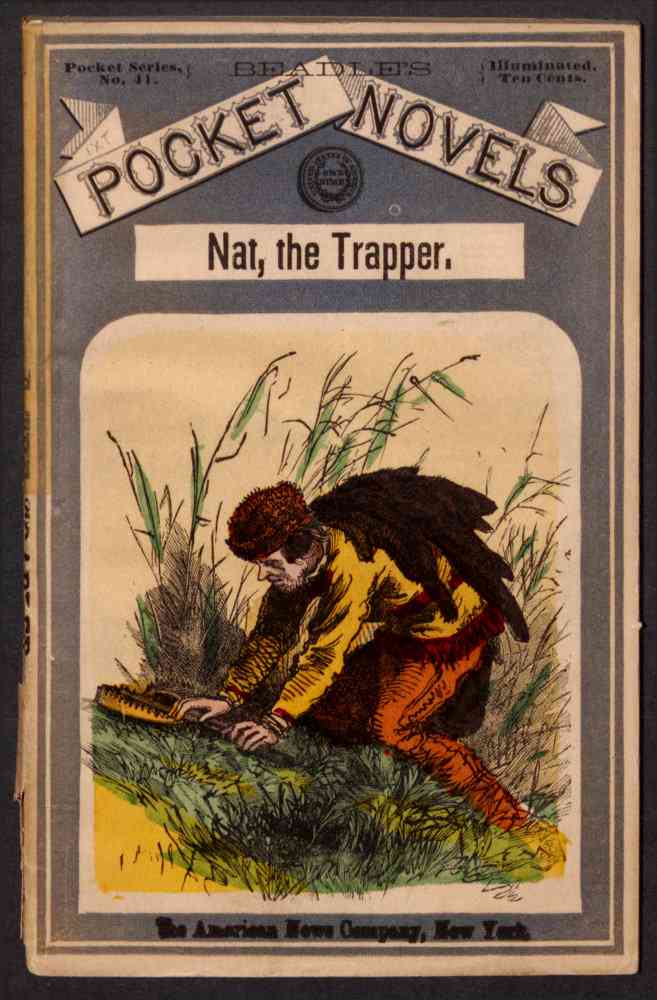
No. 41—Wild Nat, the Trapper. By Paul Prescott. Ready
No. 42—Lynx-cap; or, The Sioux Track. By Paul Bibbs. Ready Feb. 1st.
No. 43—The White Outlaw; or, The Bandit Brigand. By Harry Hazard. Feb. 15th.
☞ Beadle’s Dime Pocket Novels are for sale by all newsdealers; or will be sent, post-paid, to any address, on receipt of price, TEN CENTS EACH, by
BEADLE AND ADAMS, Publishers,
98 William Street, New York
Transcriber’s Notes
- Silently corrected a few typos.
- Retained publication information from the printed edition: this eBook is public-domain in the country of publication.
- In the text versions only, text in italics is delimited by _underscores_.
- Created a Table of Contents based on the chapter headings.